


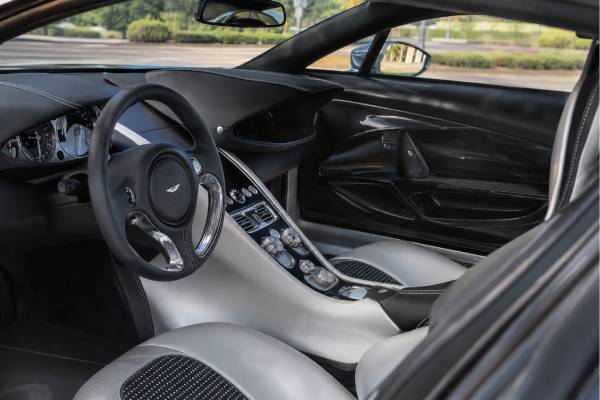
The Aston Martin One-77 is a 77-car flagship built around ideas that did not appear together in any earlier road-going Aston Martin: a carbon-fibre monocoque, hand-formed aluminium body, inboard pushrod suspension, and a 7.3-litre naturally aspirated V12 producing 750 bhp. It was previewed before production, developed through 2010, and delivered mainly during 2011 and 2012. The result sits between a traditional British grand tourer and a purpose-built hypercar, with two seats, a rear automated manual transaxle, hydraulic steering, and a claimed top speed above 220 mph.
Its rarity makes accurate ownership guidance more important than folklore. Low mileage does not guarantee mechanical health, an attractive repaint does not preserve originality, and a production-number plaque is only one part of authentication. Anyone considering a One-77 should understand the engineering layout, the technique required by its transmission, the risks created by long storage, and the cost of specialist carbon, aluminium, brake, and suspension work. This guide brings those issues together with confirmed specifications and a practical inspection and buying framework.
Table of Contents
- From Concept to 77 Cars
- One-77 Specifications and Data
- The AM77 V12 and Rear Transaxle
- Carbon Monocoque and Hand-Formed Body
- Driving the One-77 Well
- Inspection and Maintenance Priorities
- One-77 Buying Framework
From Concept to 77 Cars
The One-77 was Aston Martin’s statement that traditional craftsmanship and advanced composite engineering could create one uncompromised flagship. Its name described the production ceiling from the outset: one design, limited to 77 customer cars.
Aston Martin first teased the project beneath a partially concealed body at the 2008 Paris motor show. A full-scale presentation followed, and the completed car won the design award for concepts and prototypes at the 2009 Concorso d’Eleganza Villa d’Este. Engineering development continued into 2010, while customer production gathered pace in 2011 and concluded in 2012. That timeline explains why the model is often discussed as a 2010–2012 car even though many registered examples are dated 2011 or 2012.
The programme was not a shortened DB9 production line. Aston Martin created a dedicated manufacturing environment at Gaydon and combined specialist suppliers with intensive handwork. The carbon monocoque was developed with Multimatic, the enlarged V12 was engineered with Cosworth, and exterior aluminium panels were formed and finished by craftspeople. Contemporary material described roughly 1,500 hours of labour for each car.
The advertised price exceeded £1 million, with a substantial reservation deposit. Price alone, however, did not define the car. Aston Martin allowed each owner to choose colours, leathers, woven materials, anodised finishes, wheel treatments, and chassis preferences. Two One-77s can therefore look markedly different while both remain correct.
Production numbering is helpful but should not be treated as a simple chronological registration sequence. Build, delivery, export, and first road registration could occur in different years. Some cars remained unregistered for extended periods, and some were moved between countries before receiving local papers. The correct description of an individual example should come from its VIN, build record, production number, certificate of conformity, and dated ownership documents.
The One-77 also established an engineering direction that later Aston Martins revisited. Carbon structures, extreme bespoke work, pushrod suspension, high-output Cosworth-developed engines, and a visible relationship between mechanical function and cabin theatre all became recurring themes in later limited projects. Yet the One-77 remains distinctive because it combines those ideas with a front-mounted naturally aspirated V12 and the proportions of a grand touring coupé.
One-77 Specifications and Data
The One-77 is a petrol-only ICE coupé with a front-mid-mounted V12 and rear-wheel drive. Its engine, carbon propeller shaft, rear transaxle, and centrally concentrated masses were arranged to improve balance, while the carbon monocoque supplied a rigid foundation for inboard suspension and hand-formed aluminium panels.
| Item | Value | Detail |
|---|---|---|
| Engine family | AM77 V12 | Cosworth-developed Aston Martin engine |
| Displacement | 7,312 cc | All-alloy construction |
| Induction | Naturally aspirated | Dry-sump lubrication |
| Maximum power | 750 bhp / 559 kW / 760 PS | Final production rating |
| Maximum torque | 750 Nm (553 lb-ft) | Factory rating |
| Compression ratio | 10.9:1 | Production specification |
| Transmission | Six-speed automated manual | ASM/SSM electro-hydraulic control |
| Drivetrain | Rear-wheel drive | Rear transaxle and limited-slip differential |
| Measure | Factory figure |
|---|---|
| 0–100 km/h | Under 3.7 seconds |
| Maximum speed | Over 354 km/h (220 mph) |
| Rear aerodynamic device | Automatically deploying spoiler |
| Stability assistance | Dynamic Stability Control and traction control |
| Brake assistance | ABS, EBD, and emergency brake assist |
| Area | Construction |
|---|---|
| Primary structure | Carbon-fibre monocoque |
| Body panels | Hand-crafted aluminium |
| Front suspension | Pushrod-actuated double wishbones |
| Rear suspension | Pushrod-actuated double wishbones |
| Damper arrangement | Horizontal inboard spring and damper units |
| Steering | Hydraulically assisted rack and pinion |
| Axle | Wheel | Tyre | Brake disc |
|---|---|---|---|
| Front | 20 × 9.5 inches | 255/35 ZR20 | 398 mm carbon ceramic |
| Rear | 20 × 12.0 inches | 335/30 ZR20 | 360 mm carbon ceramic |
| Measure | Published value |
|---|---|
| Length | 4,601 mm |
| Height | 1,222 mm |
| Wheelbase | 2,791 mm |
| Front track | 1,706 mm |
| Rear track | 1,627 mm |
| Kerb weight | 1,630 kg |
| Fuel tank | 98 litres |
| Seats | Two |
A width figure is often reproduced incorrectly because one factory brochure appears to reverse its “including mirrors” and “excluding mirrors” labels. Omitting that disputed row is more accurate than silently correcting or repeating it. For an individual car, use its homologation papers when transport or storage width is critical.
The AM77 V12 and Rear Transaxle
The 7.3-litre V12 is the One-77’s defining mechanical feature, but its installation matters as much as its output. Dry-sump lubrication helped lower the engine and move it behind the front axle, while the transaxle moved gearbox mass to the rear.
Cosworth did not simply enlarge a regular production engine and stop there. The AM77 programme reduced internal mass, revised breathing, and supported sustained high-performance use while retaining the smoothness expected of an Aston Martin V12. The final 750 bhp rating made the car one of the most powerful naturally aspirated road cars of its era. Just as importantly, peak response arrives without turbochargers or electric torque fill.
That power reaches the rear through a carbon-fibre propeller shaft inside a torque tube. The six-speed gearbox is an automated manual: a conventional clutch and gearset are operated by electro-hydraulic actuators. This gives the direct mechanical connection and packaging benefits Aston Martin wanted, but it also creates a different low-speed experience from a torque-converter automatic or modern dual-clutch unit.
Owners should adapt their technique. At parking speed, allow the car to complete an engagement rather than repeatedly feathering the accelerator. Avoid holding it on an incline with throttle. During assertive upshifts, a slight lift can reduce the sensation of interruption and ease the torque transfer. Reverse manoeuvres should be planned to avoid prolonged clutch slip.
A pre-purchase test should assess engagement from cold, shift quality through multiple modes, clutch take-up, hydraulic response, warning messages, and behaviour after the drivetrain is fully warm. The specialist should read diagnostic values where the system supports them and compare adaptation or wear data with the service history. A rough shift is not enough to condemn the transaxle, but it should never be dismissed as “they all do that” without diagnosis.
The engine needs the same evidence-based approach. Check cold-start behaviour, oil pressure, dry-sump oil-level procedure, cooling-fan operation, fuel trims, misfire history, stored faults, exhaust condition, and evidence of leaks. The car’s rarity means a generic inspection sheet is inadequate. Every observation should be tied to AM77-specific service information.
Exhaust sound and throttle response can make a short test drive persuasive, yet the expensive risks often appear during heat soak, restart, low-speed manoeuvring, or diagnostic review. A complete inspection must include those conditions rather than focusing only on full-throttle performance.
Carbon Monocoque and Hand-Formed Body
The One-77’s structure combines a moulded carbon passenger cell with aluminium exterior craftsmanship. Inspection therefore requires both composite expertise and traditional coachwork knowledge; one paint gauge cannot evaluate the whole car.
The monocoque provides the main load path and supports the suspension, powertrain, doors, glazing, and cabin. Damage assessment should look for impact transfer, crushed mounting areas, disturbed bonding, repair resin, altered weave, drilled holes, and non-standard fasteners. Undertrays can conceal evidence, so their removal should be agreed in advance and performed only by a qualified facility.
Carbon does not deform like steel. A surface that looks acceptable can contain delamination, and a visible mark may be only cosmetic. Ultrasound, thermography, tap testing, dimensional measurement, or other non-destructive methods may be appropriate depending on the suspected damage. The objective is not to subject every car to unnecessary testing, but to escalate intelligently when history, alignment, or visual evidence raises concern.
The aluminium body presents different issues. The bonnet and other panels were shaped and finished by hand, so minor asymmetry or variation is not automatically a repair. An experienced inspector should study panel gaps, edge profiles, paint texture, metallic orientation, overspray, sealants, fasteners, and tool marks. Conventional high-temperature or heavy-filler repair methods can damage originality and create future corrosion or cracking.
Door operation is a practical indicator. The swan-wing doors should move cleanly without contact, abnormal effort, or inconsistent latching. Check seals, glazing alignment, hinge areas, gas assistance, and clearance to the roof and sill. The long bonnet, active rear spoiler, underbody panels, and low front surfaces also deserve close inspection for transport or ramp damage.
The cabin deliberately exposes construction and engineering. Carbon braces, suspension viewing panels, woven leather, anodised metal, instrument surfaces, and sculpted seats should be checked against the build record. Wear patterns must make sense for the stated mileage. A low odometer accompanied by heavily polished bolsters, marked switchgear, replaced trim, or chipped sill edges needs explanation.
Originality should not be pursued blindly at the expense of safety. A correctly documented factory or specialist repair can be preferable to concealed damage. The key is to know what happened, who performed the work, what methods were used, and whether dimensional and structural integrity were verified afterward.
Driving the One-77 Well
The One-77 rewards smooth, intentional inputs and properly warmed mechanical systems. Its speed is extraordinary, but the more unusual experience is the combination of naturally aspirated response, hydraulic steering, wide-track stability, and a chassis that communicates through relatively little isolation.
Before moving, allow the car to complete its start-up checks and confirm that no hydraulic, stability, tyre-pressure, spoiler, or drivetrain warnings remain. Build oil, coolant, gearbox, brake, and tyre temperature progressively. High engine speed on cold oil and heavy brake use on cold carbon-ceramic discs add risk without demonstrating anything useful.
The engine is tractable enough for normal roads, but its character changes markedly with revs. The absence of turbo lag makes accelerator position directly meaningful. On a dry, open road, that precision helps the driver meter power; on cold tyres or a damp surface, it means the rear axle can be loaded very quickly. Leave stability control engaged until conditions, tyre age, and driver familiarity justify anything else.
Steering effort and feedback should build consistently. Pulling, a nervous straight-ahead position, tramlining beyond what the tyres reasonably produce, or steering-wheel offset can indicate pressure, tyre, alignment, ride-height, or damage issues. Because suspension settings could be tailored, document the car’s current configuration before attempting to “correct” it to another example.
The brakes may make noises that would seem unusual on a mass-production car. What matters is repeatable pedal feel, straight stopping, correct ABS operation, no vibration under load, and discs that pass specialist condition criteria. Surface appearance alone does not establish remaining life.
Visibility, width, turning space, and the long front body demand planning in towns. Front or rear camera options can help, but period electronics should not be treated as infallible. Use a spotter for ramps, enclosed transport, and unfamiliar garages. Scraping a carbon or hand-finished aluminium component is an expensive way to learn the car’s dimensions.
A One-77 should be exercised enough to keep systems functional, but use must be purposeful. Repeated short journeys create condensation and battery load without bringing fluids to stable temperature. A complete drive followed by cooling, leak inspection, and a stored diagnostic review is more valuable than frequent idling.
Inspection and Maintenance Priorities
Condition depends more on time, storage, and service quality than odometer reading alone. A One-77 with several hundred kilometres can still need tyres, fluids, batteries, hydraulic work, seals, and a complete recommissioning.
Start with provenance and chronology. Obtain the factory build specification, certificate of conformity, registration history, export papers, service book, invoices, mileage records, transport documents, and photographs. Match dates and odometer readings. Long gaps do not prove neglect, but they require direct questions about storage and maintenance.
The inspection should include:
- complete diagnostic scans before and after road testing;
- cold start and hot restart;
- dry-sump oil condition and correct level-check procedure;
- cooling-system pressure, fans, hoses, radiators, and heat exchangers;
- clutch engagement, adaptation, and transaxle hydraulics;
- suspension leaks, joints, alignment, and ride-height settings;
- carbon-ceramic disc condition and brake-fluid age;
- tyre dates, sidewalls, flat spotting, and approved specification;
- battery health, charging behaviour, and low-voltage history;
- spoiler, cameras, navigation, audio, climate control, windows, locks, and keys;
- carbon structure, aluminium panels, underbody, glazing, and seals.
A long-stored car should not be started casually. First determine fuel age, oil history, coolant condition, battery state, and whether the engine has been rotated or pre-lubricated. A specialist may recommend draining old fuel, servicing fluids and filters, inspecting cylinders, priming lubrication, and turning the engine before ignition.
Tyres age chemically even in perfect-looking storage. Replace them based on condition and date, not tread depth alone, and retain removed original tyres only as documented display items when appropriate. New tyres must have correct dimensions, load and speed capability, and compatibility with the chassis and pressure-monitoring system.
Carbon-ceramic brakes need measurement and manufacturer-specific assessment. Do not machine the discs like conventional iron rotors or apply unsuitable wheel cleaners. Brake-fluid condition remains important even when pads and discs show little use.
Low voltage can create misleading faults. Use the approved maintainer, verify battery type and capacity, and investigate repeated discharge rather than merely clearing codes. After battery replacement or disconnection, follow model-specific initialization and calibration procedures.
Annual planning should include a documented inspection even when no mileage interval has been reached. Record fluid changes, diagnostic results, tyre dates, battery tests, paint and carbon observations, accessory inventory, and storage conditions. This history demonstrates stewardship and makes future troubleshooting easier.
One-77 Buying Framework
A sound One-77 purchase balances identity, originality, mechanical readiness, legal usability, and total ownership cost. The lowest-mileage car is not automatically the safest choice, and the most dramatic specification is not automatically the most valuable.
First confirm exactly what is being sold. Record the VIN, production number, engine number, model year, build date, original market, steering position, paint and trim specification, factory options, keys, books, tools, covers, charger, luggage, and certificates. Compare the physical car with factory data rather than relying on a dealer’s abbreviated description.
Next establish legal status. Determine title quality, liens, taxes, duties, temporary-import conditions, registration eligibility, emissions or safety exemptions, and whether the car can be driven on public roads in the intended country. A globally valuable collector car can still be locally difficult to register.
Use a team when necessary. A One-77-trained mechanical specialist, composite engineer, aluminium body and paint expert, and provenance researcher bring different skills. Their reports should include photographs, measurements, diagnostic printouts, severity assessments, and realistic cost ranges.
Assess modifications carefully. Factory-approved changes with documentation may be historically valid. Unrecorded software, exhaust, wheel, suspension, interior, or audio changes can reduce confidence even if they are reversible. Ask for every removed original part and proof of who completed the work.
Establish a baseline geometry record before purchase. The One-77’s inboard suspension, adjustable setup, carbon structure, and hand-finished aluminium skin make visual symmetry an unreliable substitute for measurement. Ask for ride heights, corner weights where the approved procedure permits them, alignment values, damper condition, wheel runout, and tyre circumference. Compare left and right suspension pickup areas and underbody surfaces for impact evidence. A car can look perfectly centred in photographs while carrying an old kerb strike or an unsuitable setup inherited from a previous owner.
The active rear spoiler and its surrounding bodywork deserve a complete operating check rather than a single demonstration. Confirm deployment and retraction through the specified conditions, inspect hinges and actuators, scan for stored faults, and look for contact marks or paint disturbance at the panel edges. The mechanism, rear camera equipment, boot sealing, and hand-formed panels occupy the same valuable area; a minor alignment error can create several different symptoms.
Finally, inspect the completeness of the One-77-specific delivery set. Bespoke keys, books, charger, covers, tools, luggage, certificates, and presentation materials may have travelled separately from the vehicle. Their absence should be priced explicitly, because reproducing an object is not the same as restoring its original provenance.
Budget for immediate needs rather than assuming the sale condition is permanent. Allow for enclosed transport, insurance, secure climate-managed storage, timed servicing, tyres, battery, fluids, clutch or hydraulic diagnosis, paint protection, and specialist recommissioning. Bespoke parts may involve long lead times and high fabrication or approval costs.
Market comparisons must account for major differences among cars: production number, colour, left- or right-hand drive, mileage, ownership history, country, damage, servicing, accessories, factory provenance, and sale venue. An auction result is not a universal valuation formula. Compare the net condition and evidence, not merely the hammer price.
The best ownership approach avoids two extremes. Treating the car as disposable transport ignores its materials, rarity, and replacement cost. Treating it as a sealed sculpture can let fuel, seals, hydraulic components, batteries, and tyres deteriorate unnoticed. Controlled use, correct maintenance, and meticulous documentation preserve both the engineering and the history.
A One-77 remains compelling because it is not just a collection of large numbers. The V12, carbon cell, hand-shaped skin, rear transaxle, and exposed suspension form one coherent design. A buyer who verifies that coherence—on paper, in the workshop, and on the road—is far better positioned than one who buys only the production limit or headline power figure.
References
- Aston Martin One-77 | Aston Martin 2026 (Model Archive)
- ONE-77 – 2018 (Manufacturer Media Archive)
- one-77 2010 (Factory Brochure)
- 2012 Aston Martin One-77 | St. Moritz 2021 | RM Sotheby’s 2021 (Auction Catalogue)
- Bonhams Cars : 2011 Aston Martin One-77 Chassis no. SCFGFXXXOBGS17701 2024 (Auction Catalogue)
- Assured Provenance | Aston Martin Works 2026 (Authentication)
Disclaimer
This material is educational and does not replace an Aston Martin inspection, structural assessment, legal review, or model-specific workshop instruction. Verify the VIN, market specification, equipment, fluid standards, service intervals, and repair procedures for the individual One-77. Please share the article on Facebook, X/Twitter, or another platform when it may help another collector make a better-supported decision.