
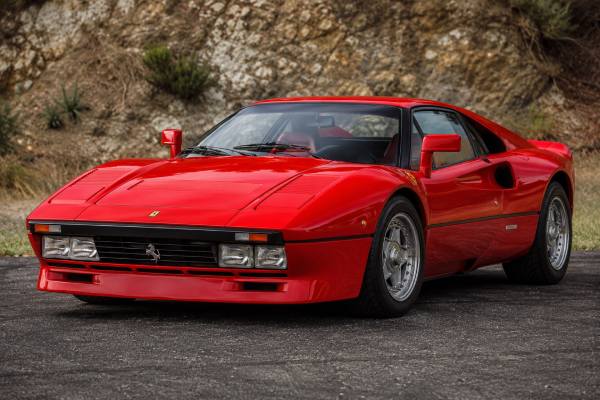
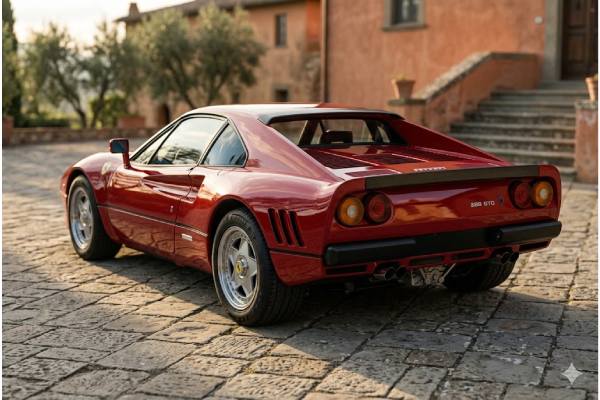
The Ferrari 288 GTO, officially named simply Ferrari GTO, is the 1984–1987 homologation special that turned Ferrari’s familiar mid-engined V8 formula into a far more serious limited-production supercar. Its F114 B 000 2.9-liter twin-turbo V8, longitudinal engine layout, lightweight composite bodywork, and 400 hp output placed it well beyond the regular 308 and 328 family in both engineering and performance.
Its importance is larger than its production number. The 288 GTO revived the GTO name, introduced Ferrari’s modern turbocharged halo-car line, and became the direct technical and emotional bridge to the F40. Built in only 272 production examples, it now sits at the center of Ferrari collector culture, where originality, Ferrari Classiche certification, mileage, history, and correct mechanical condition can matter as much as the car’s speed.
Quick Take
The Ferrari 288 GTO is most compelling because it feels like a road-legal competition project rather than a luxury flagship: light, compact, turbocharged, analog, and rare. Its strongest identity is the F114 twin-turbo V8 and Group B-inspired engineering hidden under a Pininfarina shape that still echoes the 308. The main caution is that age, originality, undocumented repairs, turbo-system condition, and incorrect restoration work can turn an exciting purchase into a very expensive problem. For buyers, the key factor is not simply finding a 288 GTO, but finding one with clear provenance, verified numbers, specialist maintenance, and evidence that its structure, engine, gearbox, and bodywork remain correct.
Table of Contents
- History, Group B Roots and Significance
- F114 Engine, Chassis and Specifications
- Production, Variants and Factory Details
- Design, Engineering and Special Features
- Driving Experience and Performance Character
- Reliability, Maintenance and Restoration
- Market Value, Buying Guide and Rivals
History, Group B Roots and Significance
The 288 GTO matters because it was Ferrari’s first modern limited-production supercar and the first road Ferrari to combine mid-engine packaging with twin-turbo power at this level. It was launched at the 1984 Geneva Motor Show after being announced in 1983, and it immediately gave Ferrari a new kind of flagship: smaller and sharper than the flat-12 Berlinetta Boxer, but far more extreme than the regular V8 models.
The name GTO stands for Gran Turismo Omologata, or homologated grand touring car. Ferrari had used those letters before on the 250 GTO, one of the most famous competition Ferraris ever built. Bringing the name back in the 1980s was a serious statement. The 288 GTO was not a cosmetic special edition. It was a re-engineered machine built around a competition idea, even though the changing Group B landscape meant it never developed into the factory racing career originally imagined.
At first glance, the 288 GTO looks related to the 308 GTB and 328 GTB. That resemblance is useful, but also misleading. The GTO had a longer wheelbase, wider track, different bodywork, different cooling needs, different engine placement, and a completely different powertrain concept. Where the 308 used a transverse naturally aspirated V8, the GTO used a longitudinal twin-turbo V8 with a rear-mounted five-speed transaxle. This change was central to the car’s identity.
The 288 GTO also arrived at a key point in Ferrari road-car history. In the early 1980s, Ferrari was experimenting with turbocharging in both racing and road cars. Turbo power was difficult to manage, but it offered huge performance from a compact engine. The GTO used that idea in a dramatic way: a 2,855 cc V8 with IHI turbochargers, intercoolers, Weber-Marelli electronic injection, and 400 hp. In period, this made the car one of the fastest production road cars in the world.
Its reputation has only grown because it sits at the start of Ferrari’s modern halo-car bloodline. The F40 followed with a more aggressive version of the same basic philosophy: twin turbos, low weight, limited comfort, and intense performance. Later came the F50, Enzo, LaFerrari, and F80. Collectors often group these cars together, but the 288 GTO remains the rarest production member of that modern Ferrari supercar family.
The car’s significance today comes from a mix of rarity, engineering purity, and historical timing. It was built before electronic driver aids became central to supercar performance. It has no paddle-shift gearbox, no hybrid boost, no active suspension, and no stability-control safety net. That makes it more demanding than a modern Ferrari, but also more transparent. For many enthusiasts, that is the point.
F114 Engine, Chassis and Specifications
The 288 GTO’s specification is defined by its F114 B 000 engine: a compact, dry-sump, twin-turbocharged V8 mounted longitudinally behind the cabin. The key technical story is not just the power figure, but how Ferrari reworked the entire 308-derived layout to handle the extra output, cooling, packaging, and homologation goals.
| Item | Specification |
|---|---|
| Production years | 1984–1987 |
| Engine code | F114 B 000 |
| Engine type | 90-degree V8, twin turbocharged |
| Displacement | 2,855.08 cc |
| Bore x stroke | 80 mm x 71 mm |
| Induction | Twin IHI turbochargers with Behr intercoolers |
| Fuel and ignition | Weber-Marelli electronic injection and ignition |
| Output | 294 kW / 400 cv at 7,000 rpm |
| Torque | 496 Nm at 3,800 rpm |
| Transmission | Five-speed manual transaxle |
| Drive layout | Rear mid-engine, rear-wheel drive |
| Top speed | 305 km/h |
The displacement was not random. Under the turbocharged equivalency rules of the period, forced-induction engines were multiplied by a factor for classification. Ferrari’s 2.855-liter engine sat just under the effective four-liter threshold when calculated that way. This is why the car is commonly called the 288 GTO: roughly 2.8 liters and eight cylinders.
The engine used four valves per cylinder, twin overhead camshafts per bank, and dry-sump lubrication. Dry-sump lubrication stores oil outside the normal deep sump, helping oil control during hard cornering and allowing a lower engine installation. This mattered in a car designed around high speed, lateral grip, and competition logic.
The chassis was based around a tubular steel frame, but the 288 GTO was not just a 308 with more boost. Ferrari lengthened the wheelbase, widened the body, and used lighter body materials. The bonnet, doors, and engine cover were aluminum, while much of the body used composite materials. The combination helped keep weight low while giving the car the stance, cooling openings, and tire clearance it needed.
| Item | Specification |
|---|---|
| Frame | Tubular steel |
| Suspension | Independent wishbones, coil springs, anti-roll bars |
| Brakes | Ventilated discs |
| Wheelbase | 2,450 mm |
| Length | 4,290 mm |
| Width | 1,910 mm |
| Height | 1,120 mm |
| Dry weight | About 1,160 kg |
| Fuel capacity | About 120 liters |
The gearing, tire size, turbo behavior, and low mass gave the car its performance. Period acceleration figures vary depending on test conditions and source, but a 0–100 km/h time of about five seconds and a 305 km/h top speed are central to the car’s factory performance identity. For 1984, that was extraordinary.
Production, Variants and Factory Details
The 288 GTO was built in very small numbers, with 272 production cars commonly accepted as the total. That limited supply is one reason the model is so sensitive to documentation, originality, and correct identification.
Unlike later Ferrari halo cars, the 288 GTO was not offered as a family of coupe, spider, Assetto Fiorano, track package, and tailor-made variants. The standard production car was already the special model. Most cars were finished in Rosso Corsa with a purposeful black interior, and the main differences between examples tend to involve market delivery, optional comfort equipment, mileage, history, certification, and condition rather than major factory version changes.
Important identification and desirability factors include:
- Chassis number, engine number, gearbox number, and body number consistency.
- Ferrari Classiche certification, especially when it confirms the original engine and transaxle.
- Original books, tools, warranty documents, import papers, service invoices, and ownership history.
- Correct body materials, correct trim, original glass, original wheels, and accurate interior details.
- Evidence of accident repair, repainting, or structural work.
- Market history, including whether the car was delivered new in Europe, Japan, or another region.
- U.S. import and federalization history for cars that later entered America.
The most famous related version is the 288 GTO Evoluzione. It was far more extreme, with race-focused bodywork, much higher power, and a lighter structure. The Evoluzione was not the regular road car covered here, but it matters because it previewed several ideas that influenced the F40. It also shows how far Ferrari intended the GTO concept to go before the relevant competition path disappeared.
For buyers, the lack of many factory variants simplifies the model range but raises the importance of originality. A 288 GTO with strong documentation, known long-term ownership, Ferrari Classiche certification, low or sensible mileage, and no questionable repairs is a very different proposition from a car with missing history or unclear work.
The car’s body and trim details are also important because hand-built low-volume Ferraris can show small differences. That does not mean every difference is a problem. It means a buyer needs a marque specialist who knows what is normal for the model and what suggests later repair, replacement, or modification.
Design, Engineering and Special Features
The 288 GTO’s design is powerful because it looks familiar at first and then reveals how much has changed. Pininfarina kept the basic wedge-shaped Ferrari V8 language, but the wider track, swollen wheel arches, deeper cooling openings, and more aggressive stance make the GTO much more purposeful than a 308.
The front end is low and clean, with pop-up headlights and a wide, flat nose. The sides are more dramatic. Large rear-quarter intakes feed the turbocharged engine’s cooling needs, while the flared arches cover wider wheels and tires. The tail is broad and functional, with vents and outlets shaped by heat management as much as styling.
The engineering changes are more important than the surface resemblance. Mounting the V8 longitudinally changed the car’s character. It allowed a more competition-like engine and gearbox arrangement and gave Ferrari the space needed for the turbochargers and intercoolers. It also helped make the GTO feel like a racing project adapted for the road, not a normal road car converted for performance marketing.
The body construction was advanced for its time. Ferrari used a mix of aluminum and composite materials to reduce weight. The result was not a stripped racing shell, but it was far lighter and more specialized than ordinary production cars of the period. The 288 GTO’s lightness is central to how it accelerates, brakes, and changes direction.
Turbocharging and cooling
The twin-turbo system defines the car mechanically and emotionally. Turbocharging in the 1980s was not as seamless as it is today. There is more delay, more buildup, and more sense of machinery coming alive. The Behr intercoolers, side intakes, rear vents, and engine-bay layout all exist because the car has to manage heat and intake temperature under serious load.
This is also why neglected examples are risky. Heat affects hoses, wiring, seals, fuel lines, intercooler connections, and turbo hardware. A 288 GTO that looks excellent on the outside still needs careful inspection underneath and behind the body panels.
Cockpit and driver focus
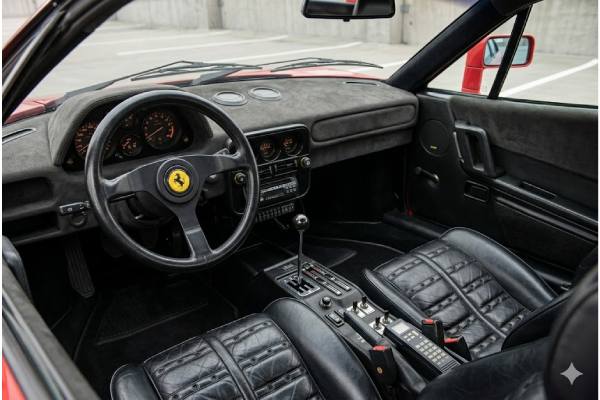
Inside, the GTO is simple by modern standards. The driving position, gated manual shifter, analog instruments, low dashboard, and slim pillars make it feel direct and compact. It is not a luxury GT. Some cars have air conditioning, electric windows, or a stereo, but the cabin’s main purpose is to support fast driving.
The seats, steering wheel, pedals, and shifter are part of the experience. In a modern supercar, speed often comes through software, drive modes, and electronic systems. In the GTO, the driver manages clutch engagement, boost, revs, gear selection, steering load, and braking feel directly.
Driving Experience and Performance Character
The 288 GTO feels fast because it is light, compact, turbocharged, and mechanical. Its 400 hp figure may no longer sound shocking beside modern supercars, but the delivery, weight, gearing, and lack of electronic filtering make the performance vivid.
At low speeds, the car needs respect and patience. The gearbox rewards a measured hand, especially when cold. The clutch, steering, and brakes feel more physical than those in a modern Ferrari. This is part of the attraction, but it also means a tired or poorly adjusted car can feel disappointing. A properly set-up GTO feels tight and alert; a neglected one can feel hot, heavy, vague, or fragile.
The engine character is a major part of the car’s legend. Below boost, it behaves like a compact, high-quality Ferrari V8 with a purposeful but not overwhelming response. As the turbochargers build pressure, the car becomes much more urgent. The torque peak arrives at 3,800 rpm, giving the car a strong mid-range surge. The best driving comes from learning how to place the engine in the right part of its boost curve rather than simply flooring the throttle and waiting.
The steering is unassisted in feel and rich in feedback by modern standards. The front end is more communicative than many later, heavier supercars. The car’s compact size also helps. It does not feel like a wide modern hypercar that dominates a road. It feels small enough to place accurately, but serious enough that mistakes carry consequences.
Braking performance was strong for the period, with ventilated discs and relatively low weight. Still, buyers should not expect modern carbon-ceramic brake endurance or ABS intervention. Brake condition, fluid quality, tire age, and suspension setup make a large difference. A car on old tires or with aged dampers will not show the balance that made the GTO special.
The ride is firm but not crude when the car is healthy. The chassis was designed for serious speed, but the relatively modest wheel size by modern standards gives the tires some sidewall. Cabin noise, heat, mechanical sound, and turbo whoosh are part of the experience. It is usable on the road, but it is not casual transportation.
On a mountain road, the GTO rewards smooth inputs. Sudden throttle use in a corner, especially as boost arrives, can quickly unsettle the rear tires. On a track, the car demands mechanical sympathy. It is valuable, rare, and old enough that full-speed use should follow careful inspection, fresh fluids, correct tires, and a realistic understanding of heat management.
Reliability, Maintenance and Restoration
The 288 GTO is not unreliable in the simple sense, but it is a highly specialized 1980s Ferrari with turbochargers, aging materials, limited parts supply, and collector-grade originality concerns. Maintenance quality matters more than mileage alone.
A low-mileage car can still need serious work if it has sat unused for long periods. Rubber parts age, fuel systems varnish, seals harden, brake components corrode internally, and electrical connections suffer. Conversely, a car with moderate mileage and excellent specialist maintenance can be more trustworthy than a static museum piece.
The main inspection areas include:
- Timing belt history, tensioners, cam seals, and related service records.
- Turbocharger condition, boost control, oil lines, intercooler plumbing, and exhaust heat management.
- Fuel tanks, pumps, lines, filters, injectors, and evidence of stale-fuel damage.
- Cooling system condition, radiator efficiency, hoses, fans, and temperature stability in traffic.
- Gearbox synchros, clutch wear, linkage adjustment, differential noise, and leaks.
- Brake calipers, discs, flexible hoses, master cylinder, and fluid age.
- Suspension bushings, dampers, ball joints, wheel bearings, and alignment.
- Electrical connectors, fuse panels, relays, alternator output, and period alarm or audio modifications.
- Body-panel fit, composite repairs, aluminum corrosion, chassis straightness, and hidden accident damage.
Restoration is difficult because the GTO is both rare and technically specific. A normal body shop may not understand the correct materials, panel shapes, heat shielding, fasteners, or factory finishes. Mechanical work also needs model-specific knowledge. The engine bay is crowded, heat-loaded, and unlike a normal 308 layout.
Originality is a major value issue. Some upgrades may improve usability, but they can reduce collector appeal if they are visible, irreversible, or poorly documented. Sensible hidden improvements, such as modern fuel hose compatible with current fuels, may be accepted if installed correctly and recorded. Non-original wheels, incorrect trim, aftermarket electronics, modified exhausts, or changed bodywork can be more serious.
A strong maintenance file should show regular attention from recognized Ferrari specialists, not just occasional oil changes. Buyers should look for invoices that explain what was done, by whom, and when. A one-line “major service completed” entry is less useful than detailed records covering belts, fluids, valves, fuel system, cooling system, clutch, brakes, suspension, and road testing.
Ferrari Classiche certification is highly relevant, but it is not a substitute for a mechanical inspection. Certification can support authenticity and value, especially if it confirms matching major components. It does not guarantee that every hose, seal, bearing, or electrical connector is ready for hard use today.
Market Value, Buying Guide and Rivals
The 288 GTO is now a blue-chip Ferrari collector car, and recent top auction results have pushed the best examples into a much higher market tier. The most desirable cars combine originality, low or carefully documented mileage, strong provenance, Ferrari Classiche certification, original books and tools, correct colors, and no questionable repair history.
The market is thin because only 272 production cars exist and many are locked in long-term collections. That means public auction results can move perception quickly, especially when a special car appears with single ownership, very low mileage, factory certification, or exceptional preservation. Private-sale prices can be harder to read, but the same value drivers apply.
| Value factor | Why it matters |
|---|---|
| Originality | Correct engine, gearbox, bodywork, trim, and finishes are central to collector confidence. |
| Ferrari Classiche certification | Supports authenticity and can confirm major matching components. |
| Provenance | Long-term ownership, famous owners, or clear early history can add desirability. |
| Mileage | Very low mileage can bring a premium, but only when condition and storage history support it. |
| Condition | Mechanical health, structure, paint, interior, and underside condition all matter. |
| Documentation | Books, tools, warranty papers, invoices, import records, and inspection reports reduce uncertainty. |
| Restoration quality | Correct specialist work protects value; poor restoration can be extremely costly to undo. |
A serious pre-purchase inspection should be done by a specialist who knows the 288 GTO specifically. The inspection should not stop at paint depth and a short test drive. It should include number verification, chassis inspection, lift inspection, leak checks, compression or leak-down testing where appropriate, fuel and cooling system review, gearbox assessment, documentation review, and confirmation that any certification matches the car as presented.
Cars to seek are those with coherent stories. A GTO that has been owned carefully, serviced regularly, stored properly, and documented thoroughly is the ideal. Cars to avoid are those with missing histories, unclear import conversions, poor repainting, accident rumors, inconsistent numbers, long inactivity without recommissioning, or shiny cosmetic work hiding tired mechanical systems.
The closest rivals depend on the buyer’s goal. The Porsche 959 is the most obvious period rival: more technologically complex, all-wheel drive, and more advanced electronically, but less raw in feel. The Ferrari F40 is the direct successor and offers a harder, more famous, more aggressive version of the twin-turbo Ferrari idea. The Ferrari F50 is rarer than the F40 and more naturally aspirated and Formula 1-inspired in character. The Lamborghini Countach delivers similar poster-car drama, but a very different driving and engineering experience.
For Ferrari collectors, the 288 GTO’s strongest alternatives are usually other halo Ferraris rather than general supercars. Against the F40, the GTO is subtler, rarer, and historically earlier. Against the F50, it is more compact and turbocharged. Against an Enzo or LaFerrari, it is far more analog. That combination is why demand remains strong among buyers who want the beginning of the modern Ferrari supercar line rather than simply the fastest car available.
References
- Ferrari GTO (1984) – Ferrari.com 1984 (Manufacturer Specifications)
- Ferrari Classiche: Certification – Ferrari.com 2026 (Certification)
- 1985 Ferrari 288 GTO | Paris 2026 | RM Sotheby’s 2026 (Auction Result)
- Record-Breaking Ferrari 288 GTO and FXX K Evo Surpass Expectations at Gooding Christie’s Landmark Paris Sale 2026 (Auction Result)
- Interpretation ID: nht90-2.36 1990 (Official Import Interpretation)
Disclaimer
This article is for informational purposes only and is not a substitute for professional diagnosis, repair, inspection, valuation, or restoration advice. Specifications, torque values, service intervals, procedures, parts, and compliance details can vary by VIN, market, production detail, equipment, and later work, so owners and buyers should verify all information against official Ferrari service documentation and a qualified marque specialist.
If this guide helped you, please consider sharing it on Facebook, X/Twitter, or your favorite enthusiast community to support our work.