
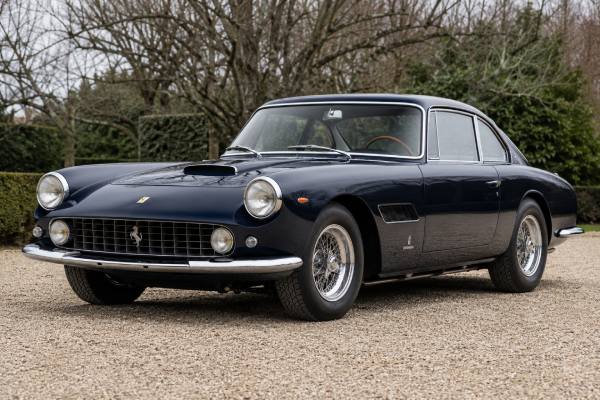
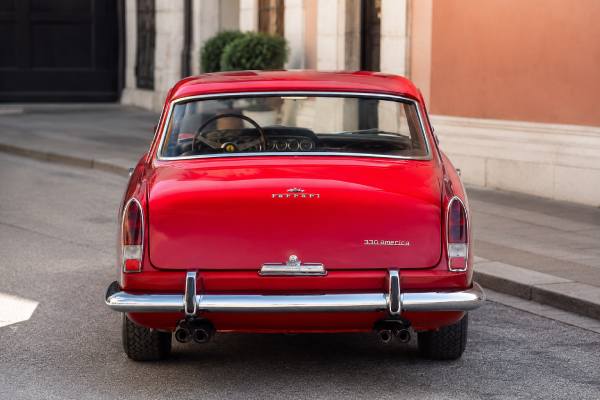
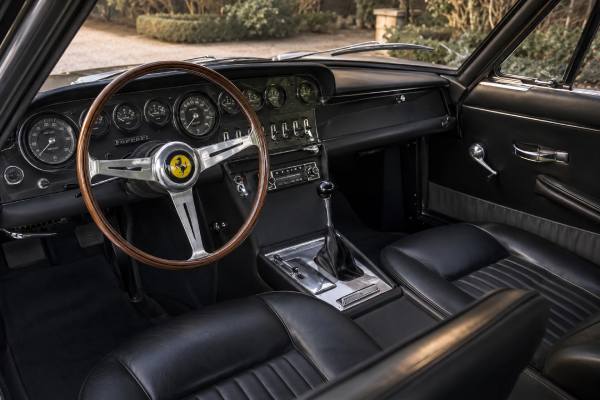
The Ferrari 330 America was a short-lived 2+2 grand tourer built for 1963 and early 1964, combining the familiar Tipo 508E chassis and Pininfarina body of the late 250 GT/E with Ferrari’s newer 4.0-litre Tipo 209 Colombo V12. Rated at about 300 hp, it gave Ferrari’s four-seat GT buyer a clear step up in torque and high-speed ease while the more comprehensively redesigned 330 GT 2+2 was being prepared.
Its importance is easy to miss because it looks so much like a Series III 250 GT/E. That is also the heart of its appeal. The 330 America is not a radical model, a racing homologation special, or a coachbuilt one-off. It is a transitional Ferrari with rare production, elegant packaging, a larger V12, and strong usability for a 1960s Maranello road car. For collectors, it sits between the better-known 250 GT/E and the 330 GT 2+2, which makes originality, documentation, and correct identification especially important.
Quick Take
The Ferrari 330 America’s strongest appeal is its blend of 250 GT/E elegance with the stronger 4.0-litre V12 that defined the early 330 road-car family. It is rare, with only about 50 built, but it is also subtle, so value depends heavily on matching numbers, Ferrari Classiche documentation, restoration quality, and proof that the car is a true 330 America rather than a modified 250 GT/E. The main caution is ownership cost: the car may look restrained, but it is still a hand-built V12 Ferrari with expensive body, engine, brake, wiring, and trim needs.
Table of Contents
- History and Place in Ferrari Lineage
- Tipo 209 V12, Chassis and Specs
- Production Details, Variants and Options
- Pininfarina Design and Engineering Character
- Road Feel, Performance and GT Pace
- Maintenance, Restoration and Ownership Risks
- Values, Buying Strategy and Rivals
History and Place in Ferrari Lineage
The 330 America matters because it marks Ferrari’s move from the 3.0-litre 250 four-seat GT to the larger-displacement 330 road-car generation. It was an interim model, but not an insignificant one: it brought the 4.0-litre V12 into Ferrari’s practical grand-touring range before the 330 GT 2+2 arrived.
By the early 1960s, Ferrari had proved that a four-seat road car could be commercially important without destroying the marque’s performance image. The 250 GT/E 2+2 had been introduced as a more usable Ferrari for owners who wanted a proper grand tourer, not just a weekend sports car. Its layout pushed the engine forward in the chassis to create better cabin space, giving buyers rear seats that were more than decorative.
The 330 America followed that logic but added a new engine identity. Instead of the 250 GT/E’s 3.0-litre V12, it used a 3,967 cc version from the expanding 330 family. Ferrari’s naming tradition rounded the displacement of one cylinder to “330,” so the model name was both technical and marketing shorthand: this was the familiar four-seat GT, but with a larger V12.
The car also sits in an interesting period of Ferrari history. The early 1960s lineup included glamorous two-seat GTs, front-engined competition cars, and luxurious road models for wealthy private clients. The 330 America was aimed especially at buyers who valued refinement, speed, and discretion. It was fast enough to feel like a serious Ferrari, yet it had a more conservative shape than later quad-headlight 330 GT 2+2 models.
Its Pininfarina body links it closely to the final Series III 250 GT/E. That is why casual observers can struggle to identify one. The America badge on the rear is the easiest visual clue, but the real difference is under the bonnet. This subtlety gives the car a special appeal among collectors who enjoy transitional Ferraris, but it also creates buying risk. A correct 330 America should be verified by chassis records, engine number, body details, and specialist documentation.
Today, the 330 America is collectible for four main reasons:
- Very low production compared with the 250 GT/E and 330 GT 2+2.
- A desirable 4.0-litre Colombo-derived V12 in a restrained Pininfarina 2+2 body.
- Historical importance as the bridge between two better-known Ferrari GT generations.
- Strong usability by classic Ferrari standards, with proper luggage space, comfortable cabin trim, disc brakes, and relaxed high-speed manners.
It is not usually valued like a 250 GT Lusso, 275 GTB, or open Ferrari of the period. That is not its role. Its appeal is more understated. It is a rare, elegant, V12 Ferrari grand tourer for buyers who want a historically interesting road car rather than a headline concours centerpiece.
Tipo 209 V12, Chassis and Specs
The 330 America’s key specification is the pairing of the Tipo 508E 2+2 chassis with a 3,967 cc Tipo 209-family V12 rated at about 300 hp. In simple terms, it is a late 250 GT/E-style body and platform with the stronger engine package that would define the early 330 GT line.
Some references identify the America’s interim engine as Tipo 209/B, while the broader family is commonly described as Tipo 209. The important point for buyers is that it should not have a 250 GT/E 3.0-litre engine, nor should its engine identity be accepted without number verification.
| Item | Specification |
|---|---|
| Model years | 1963–1964 |
| Body style | 2-door 2+2 coupé by Pininfarina |
| Chassis type | Tipo 508E tubular steel chassis |
| Engine | 4.0-litre Colombo-derived 60-degree V12, Tipo 209-family |
| Displacement | 3,967.44 cc |
| Bore x stroke | 77 mm x 71 mm |
| Induction | Three twin-choke Weber carburetors |
| Output | About 300 hp at 6,600 rpm |
| Drivetrain | Front engine, rear-wheel drive |
| Transmission | 4-speed manual with electric overdrive |
| Wheelbase | 2,600 mm |
| Brakes | Four-wheel hydraulic disc brakes |
The engine is an all-alloy V12 with a single overhead camshaft per bank and two valves per cylinder. It used wet-sump lubrication in road-car form and carburetion rather than fuel injection. Its value lies not only in peak power, but in the way the larger displacement changes the character of the car. Compared with the smaller 250 unit, the 4.0-litre engine gives more flexible road performance and better long-distance pace.
The chassis layout is traditional Ferrari GT engineering of the era. The front suspension uses unequal-length wishbones with coil springs and telescopic dampers. The rear uses a live axle with semi-elliptic leaf springs, radius arms, and telescopic dampers. That rear axle arrangement sounds old-fashioned today, but it was normal for many powerful road cars of the period and works well when properly rebuilt and aligned.
The 2,600 mm wheelbase was central to the 2+2 packaging. Ferrari moved the engine farther forward than in its two-seat GTs, which created more room inside the cabin. This is why the 330 America feels different from a compact two-seat Ferrari of the same era. It is not as delicate or sharp, but it is more usable over distance.
Performance figures vary by source and by the condition of the individual car. A healthy 330 America is generally described as capable of about 149–152 mph, with 0–60 mph or 0–100 km/h performance around seven seconds. Those figures were strong for a refined four-seat GT in the early 1960s, especially one with luxury trim, wire wheels, and a full-size touring body.
| Category | Typical figure |
|---|---|
| Top speed | About 149–152 mph |
| 0–60 mph / 0–100 km/h | About 7 seconds, depending on test and condition |
| Length | About 4,700 mm |
| Width | About 1,710 mm |
| Height | About 1,340 mm |
| Fuel capacity | About 90 litres |
| Wheels | 15-inch Borrani wire wheels on many cars |
The data should be treated with classic-car caution. Dry weight, curb weight, tire fitment, carburetor specification, and transmission details can vary in records and auction descriptions. For purchase or restoration, the relevant source is not an online specification table. It is the car itself, factory records, build documentation, and expert inspection.
Production Details, Variants and Options
The 330 America was not built in multiple official series; it was a small interim run of roughly 50 cars. That simplicity helps identification in one way, but the car’s close relationship to the 250 GT/E means documentation is more important than usual.
Most references place production from late 1963 into early 1964. Chassis numbers are commonly described as running in the odd-number Ferrari road-car sequence with a GT suffix, broadly within the 4953 GT to 5125 GT range. All known production cars are left-hand drive, which fits the model’s strong North American orientation.
There were no major factory variants like a Spider, lightweight version, or competition model. The 330 America was a 2+2 coupé. Its differences from the 250 GT/E are primarily mechanical and identification-related rather than body-style-related.
How it differs from a 250 GT/E
The 330 America’s body is effectively the late 250 GT/E Series III style. That means the car generally shares the same elegant roofline, slim pillars, oval grille form, front fender vents, and refined 2+2 proportions. The Series III-style details include front auxiliary lights mounted outside the grille and revised rear lamp treatment.
The main identifiers are:
- 4.0-litre Tipo 209-family V12 rather than a 3.0-litre 250 engine.
- “330 America” rear badging on cars retaining correct trim.
- 330-related engine and build records.
- Correct chassis and engine number relationship.
- Documentation from Ferrari, marque historians, restoration files, or Classiche certification.
The strongest cars are usually those with a clear chain of identity: known chassis number, known engine number, original color and trim information, ownership history, restoration invoices, and no unexplained gaps.
Factory trim and special-order character
Ferrari road cars of this period were not built like modern mass-production cars with a neat option sheet. Paint, leather, instruments, radios, tires, wheels, and detail equipment could vary by buyer, importer, or market. Luigi Chinetti Motors was especially important for U.S. deliveries, and many Americas were configured for buyers who wanted a refined, fast European GT.
Common or period-correct equipment can include:
- Leather upholstery.
- Wool carpeting.
- Wood-rim steering wheel.
- Veglia instruments.
- Borrani wire wheels.
- Blaupunkt or similar period radio.
- Lap belts on some cars, often added or changed later.
- Pirelli or later Michelin-type period-style tires, depending on restoration choices.
Original color and trim matter greatly. A repaint from the original shade is not automatically a problem, but it affects collector judgment. A color change should be disclosed and documented. Returning a car to its original color can improve authenticity, but only if the work is done to a high standard.
Matching numbers and paperwork
For a 330 America, matching numbers can influence value more than cosmetic perfection. The reason is simple: the model’s value depends heavily on being a true 330 America, not merely a 250 GT/E-style car with a larger engine installed later.
Strong documentation may include:
- Ferrari Classiche certification.
- Factory build information.
- Marcel Massini or other respected historian reports.
- Old registration records.
- Importer or dealer paperwork.
- Restoration invoices with photographs.
- Engine, gearbox, axle, and body-number records.
- Concours judging sheets where relevant.
A car can be enjoyable without every document, but it should be priced accordingly. Missing papers, replacement engine, unclear gearbox history, or heavy undocumented restoration should all trigger deeper inspection.
Pininfarina Design and Engineering Character
The 330 America’s design character is defined by understatement: it uses Pininfarina’s clean 250 GT/E shape while hiding a larger V12 beneath the bonnet. This makes it one of the quieter-looking ways to own a rare 1960s Ferrari.
The body is a restrained grand-touring coupé rather than an aggressive sports car. The long bonnet, thin pillars, balanced glass area, and gently falling roofline give it an elegant, formal shape. It looks more like a gentleman’s express than a racing-derived berlinetta, which is exactly what it was meant to be.
The steel body construction, with aluminium used for panels such as the bonnet and boot lid on many cars, reflects Ferrari’s road-car practice of the time. The bodies were hand-finished, so small differences from car to car are normal. That does not mean poor panel fit should be excused. It means the inspection standard must understand hand-built 1960s Italian coachwork.
The engineering choices are practical rather than exotic. The engine-forward 2+2 layout creates cabin space. The live rear axle keeps the chassis robust and predictable. Disc brakes at all four corners give the car braking credibility for its period. The overdrive gearbox supports long-distance cruising, allowing the V12 to settle at speed instead of feeling busy.
The cabin and grand-touring layout
Inside, the 330 America is more comfortable than a two-seat Ferrari of the period. The rear seats are not limousine-like, but they are useful for children, smaller adults, coats, or soft luggage. The boot is meaningful for touring, helped by the car’s practical shape and fuel-tank packaging.
The dashboard layout is typical of Ferrari GTs of the era: large primary instruments, smaller auxiliary gauges, brightwork, leather, and a driving position that feels upright compared with later low-slung sports cars. The driver looks over a long bonnet and hears the V12 from ahead rather than behind, giving the car a very different feel from modern mid-engined Ferraris.
Sound and mechanical personality
The 4.0-litre V12 is the center of the car’s emotional appeal. It does not need to be driven at racing speeds to feel special. The triple-carburetor intake sound, mechanical valvetrain texture, and exhaust note give the car a layered soundtrack. At low speed, it should feel smooth and cultured when properly tuned. At higher revs, it becomes sharper and more urgent.
That sound is also a diagnostic tool. A healthy car should not feel flat, smoky, uneven, or reluctant once warm. Poor carburetor balance, weak ignition, air leaks, old fuel lines, incorrect plugs, or low compression can all make a 330 America feel far less special than it should. A test drive should include warm running, idle quality, throttle response, temperature behavior, and restart behavior.
Road Feel, Performance and GT Pace
A good 330 America should feel like a fast, refined 1960s grand tourer, not a lightweight sports racer. Its strengths are torque, stability, sound, and long-distance pace rather than razor-edge cornering.
The larger V12 gives the car relaxed acceleration. It should pull cleanly from moderate revs and build speed with less effort than a 250 GT/E. The difference is especially noticeable on open roads, where the car can overtake confidently without needing constant downshifts. The engine is flexible, but it still rewards revs and proper carburetor setup.
The gearbox is part of the period experience. The four-speed manual with overdrive is not as modern in feel as a later five-speed. It should shift cleanly when warm, but it will not feel like a contemporary performance transmission. A reluctant second gear, noisy bearings, weak synchromesh, or poor overdrive engagement can indicate expensive work ahead.
The steering is weighty at low speeds and more satisfying once the car is moving. The long wheelbase gives stability, but the driver must remember that this is a front-engined 2+2 with period tires and a live rear axle. It prefers smooth inputs. Push hard on uneven roads and it will feel older than its engine output suggests.
Braking is good for the era when the system is fresh. Servo-assisted four-wheel discs are a major advantage over earlier drum-braked classics, but they still require realistic expectations. Old hoses, tired calipers, contaminated pads, weak boosters, or warped discs can transform a safe-feeling car into a nervous one. Any serious buyer should treat brake condition as a core inspection area, not a minor service item.
What separates a great driver from a tired car
Two 330 Americas can feel completely different. A sorted example should start cleanly, idle evenly, run at stable temperatures, steer without wandering, stop straight, and ride with controlled compliance. A tired one may feel heavy, hot, noisy, vague, and reluctant.
Pay attention to:
- Warm oil pressure at idle and under load.
- Coolant temperature in traffic.
- Carburetor balance and smooth progression.
- Exhaust smoke on start-up and overrun.
- Clutch take-up and gearbox noise.
- Overdrive engagement.
- Straight-line braking.
- Steering free play.
- Rear axle noise and vibration.
- Cabin heat, fumes, and electrical function.
A restored car is not automatically better than a preserved car. A preserved car with careful mechanical upkeep can drive beautifully. A shiny restoration with poor mechanical detail can be disappointing and costly.
Maintenance, Restoration and Ownership Risks
The 330 America is a rare V12 Ferrari, so ownership risk is driven less by ordinary reliability and more by age, workmanship, parts availability, and authenticity. The car can be dependable when maintained correctly, but neglect is expensive.
The engine is robust in concept, but a rebuild is a major specialist job. The V12 has many precision components, and parts quality matters. A proper rebuild involves far more than rings and bearings. It can include machine work, valve gear, timing chains, carburetors, ignition, cooling passages, oiling checks, and careful setup. Any invoice described only as “engine refreshed” should be examined closely.
Cooling system condition is critical. Old radiators, blocked passages, tired water pumps, weak fans, incorrect hoses, and poor tuning can make a classic Ferrari run hot. Because the 330 America is often used sparingly, deterioration can be hidden until the car is driven in traffic or warm weather.
Fuel and ignition systems also demand attention. Modern fuel can be hard on old hoses, seals, and carburetor parts. Ethanol-resistant lines, proper filters, clean tanks, rebuilt carburetors, and correct ignition components are practical reliability upgrades when done without spoiling originality.
Common restoration and inspection areas
The most important areas to inspect are not just mechanical. Body and chassis condition can determine whether a purchase is sensible.
| Area | Why it matters |
|---|---|
| Chassis tubes and outriggers | Rust, accident repairs, and poor welding can undermine safety and value. |
| Body seams and lower panels | Corrosion can hide beneath older paint and filler. |
| Bonnet, boot lid, doors | Panel fit reveals restoration quality and possible accident history. |
| Engine number and type | Correct identity is central to value. |
| Gearbox and overdrive | Repairs are specialized and can be costly. |
| Brakes | Calipers, booster, master cylinder, and lines are safety-critical. |
| Suspension bushings and dampers | Wear can make the car feel vague and unstable. |
| Interior trim | Correct leather, carpets, instruments, and hardware affect authenticity. |
| Electrical system | Aged wiring, switches, and charging faults are common in old restorations. |
Rust deserves special attention. These cars were built before modern corrosion protection, and many have lived through multiple climates, storage periods, and restorations. Look at the sills, lower wings, floors, boot floor, spare-wheel area, suspension mounting points, and inner structures. A magnet test is not enough. A specialist should inspect from underneath and behind trim where possible.
Interior restoration can also become expensive. Correct-style leather, wool carpet, chrome details, Veglia instruments, switches, and period radios are not cheap. A tired interior may look charming at first, but bringing it back to high standard can cost far more than expected.
Originality versus sensible upgrades
Collectors usually prefer originality, but some hidden reliability improvements are accepted if they are reversible and well documented. Examples include improved fuel hoses, discreet cooling improvements, modern brake lining materials, battery isolation, and careful electrical protection.
More visible changes need caution. Non-original wheels, modern seats, incorrect instruments, modified bodywork, wrong badging, replacement engine type, or non-period colors can reduce the pool of serious buyers. The safest approach is to preserve original components and document every change.
Values, Buying Strategy and Rivals
The 330 America occupies a narrow collector-market niche: rarer than a 250 GT/E or 330 GT 2+2, but generally less expensive than the most coveted two-seat Ferraris of the same period. Its value is highly sensitive to authenticity, history, and condition because so few trade publicly.
Recent public sales show that strong cars can sit in the low-to-mid six-figure range in U.S. dollars, with some results around the $400,000 mark. UK and European value aggregators show broadly similar upper-six-figure local-currency context when converted loosely, but the market is too thin for a simple price guide to be definitive. One sale can shift the apparent average.
The most desirable examples usually have:
- Matching-numbers engine.
- Clear 330 America identity and chassis documentation.
- Ferrari Classiche certification or strong historian documentation.
- Known ownership history.
- High-quality older restoration or careful preservation.
- Original or documented factory color and trim.
- Correct instruments, wheels, badging, and body details.
- Strong recent mechanical invoices.
- No major unresolved corrosion, accident, or identity questions.
Cars to approach carefully include those with unclear chassis stamping, missing engine-number support, heavy color changes without records, visible body filler, poor panel fit, non-original drivetrain components, dormant mechanical condition, or incomplete restoration work. A cheap 330 America can become expensive very quickly.
Buyer checklist
Before committing, a serious buyer should complete these steps in order:
- Confirm the chassis number, engine number, gearbox details, and body identity with a marque specialist.
- Review all factory, Classiche, historian, ownership, and restoration documents.
- Inspect the car on a lift with someone familiar with 1960s Ferrari chassis construction.
- Perform compression and leak-down checks if recent credible results are not available.
- Test drive the car from cold to fully warm, including traffic and open-road conditions.
- Check overdrive, brakes, steering, charging, cooling, and fuel behavior under real use.
- Price the car based on total ownership risk, not just cosmetic presentation.
A pre-purchase inspection should come from a Ferrari classic specialist, not a general exotic-car shop. The difference matters. The inspector must understand what is correct for a 330 America, what is shared with the 250 GT/E, what is unique to the 330 engine installation, and what later repairs are acceptable.
Rivals and alternatives
The closest same-brand alternative is the Ferrari 250 GT/E. It is more numerous and usually less expensive, but it lacks the 330 America’s larger V12. The 330 GT 2+2 is the natural successor and offers a more developed package, especially in later five-speed Series II form, but it has a different body style and a less subtle visual personality.
The 330 GTC is a more sporting and generally more valuable two-seat alternative. It offers a different chassis character and a more prestigious market position, but it does not provide the same 2+2 usability. Buyers often cross-shop only if their budget and intended use are flexible.
Non-Ferrari rivals include the Maserati 3500 GT, Aston Martin DB4 and DB5, Iso Rivolta IR 300, and high-end Jaguar E-Type fixed-head coupés. Each has a different ownership profile. The Maserati offers Italian GT charm at a different price point. The Aston carries strong design and cultural appeal. The Iso combines Italian styling with American V8 usability. The E-Type is more sporting and more widely supported. None gives quite the same mix of rarity, Ferrari V12 identity, and Pininfarina four-seat elegance.
The best reason to buy a 330 America is not speculation. It is the desire for a rare, usable, historically interesting Ferrari GT with a discreet body and serious engine. Buy the best-documented, best-sorted car you can afford, because restoration shortcuts and identity questions are far more expensive than paying properly for a correct example at the start.
References
- Ferrari 330 GT 2+2 (1964) 1964 (Manufacturer Model Page)
- Ferrari 250 GT 2+2 (1960) 1960 (Manufacturer Model Page)
- Ferrari Classiche: Certification – Ferrari.com 2026 (Certification)
- 1963 Ferrari 330 America by Pininfarina | Amelia Island 2017 | RM Sotheby’s 2017 (Auction Listing)
- 1963 Ferrari 330 America for sale on BaT Auctions – sold for $428,000 on June 29, 2024 (Lot #152,023) | Bring a Trailer 2024 (Auction Listing)
Disclaimer
This article is for informational purposes only and is not a substitute for professional diagnosis, repair, inspection, valuation, or restoration advice. Specifications, torque values, service intervals, procedures, component numbers, and equipment can vary by chassis, market, production detail, and later restoration history. Always verify against official service documentation, factory records, Ferrari Classiche information, and a qualified classic Ferrari specialist before buying, repairing, or restoring a Ferrari 330 America.
If you found this guide useful, please consider sharing it on Facebook, X/Twitter, or your favorite enthusiast community to support our work.