
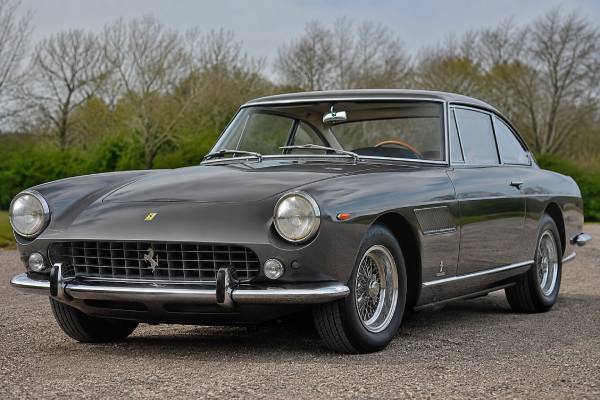
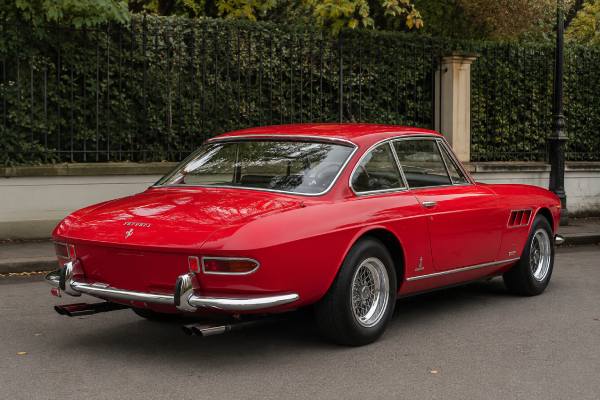
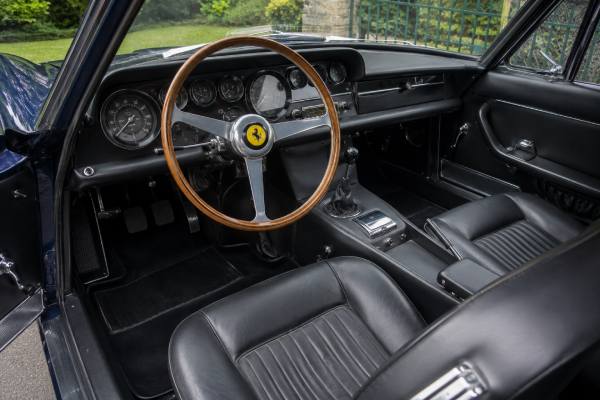
The Ferrari 330 GT 2+2 Series II, built from 1965 to 1967 on the Tipo 571/65 chassis and powered by the 4.0-liter Tipo 209 V12, is one of the most usable classic front-engined Ferraris. It kept the 300 hp grand-touring performance of the earlier 330 GT 2+2 but added cleaner two-headlamp styling, a standard five-speed gearbox, revised detail design, and a more mature character.
This was not a small sports car with occasional rear seats. It was Ferrari’s proper four-seat grand tourer: fast, long-legged, leather-trimmed, and made for covering distance with adults and luggage aboard. That makes it important today because it sits at a rare intersection. It has a Colombo-derived V12, Pininfarina coachwork, hand-built 1960s Ferrari character, and real road usability, yet it remains less expensive than the two-seat 275-series cars that shared the same era.
For buyers and owners, the Series II is attractive because it is the most resolved version of the 330 GT 2+2. The appeal is strong, but condition, originality, corrosion, mechanical history, and documentation matter enormously. A cheap example can become expensive very quickly if the engine, body, trim, gearbox, brakes, or suspension need deep restoration.
Quick Take
The Ferrari 330 GT 2+2 Series II is a sophisticated 1960s V12 grand tourer with real four-seat practicality, elegant Pininfarina styling, a 300 hp 4.0-liter engine, and the desirable five-speed manual gearbox. Its strongest appeal is usability: it feels like a proper classic Ferrari without the cramped nature or far higher prices of many two-seat models. The main caution is ownership cost. Corrosion, tired mechanicals, missing trim, non-original components, and weak documentation can erase any apparent bargain, so the best cars are those with matching numbers, known history, careful restoration, and specialist maintenance records.
Table of Contents
- History and Collector Significance
- Engine, Chassis, and Key Specifications
- Production, Variants, and Factory Options
- Design, Engineering, and Special Details
- Driving Character and Road Performance
- Maintenance, Reliability, and Restoration Risk
- Market Values, Buying Guide, and Rivals
History and Collector Significance
The 330 GT 2+2 Series II matters because it was Ferrari’s refined, usable V12 road car for customers who wanted speed, comfort, and four seats in one package. It was not the most exotic Ferrari of its day, but it was one of the cars that proved Ferrari could build a serious luxury grand tourer as well as racing-derived berlinettas.
The 330 GT 2+2 line replaced the short-lived 330 America and moved Ferrari’s 2+2 formula forward from the earlier 250 GTE. The 250 GTE had already shown that wealthy customers wanted a Ferrari they could use more often. The 330 GT 2+2 went further with a longer wheelbase, more interior room, stronger 4.0-liter power, and a more substantial touring character.
The first 330 GT 2+2 appeared in 1964 with a distinctive four-headlamp front end. That Series I design has become better appreciated with time, but it was controversial when compared with the cleaner two-seat Ferraris of the same period. The Series II, introduced in 1965, replaced the four-headlamp nose with a simpler two-headlamp front treatment that brought it closer to the visual language of the 275 GTS. This change is a major reason many collectors prefer the Series II.
The Series II also benefited from mechanical and equipment updates. The five-speed manual gearbox became standard, replacing the earlier four-speed-plus-overdrive arrangement used on many earlier cars. Cast alloy wheels became standard, while Borrani wire wheels remained available. Electric windows were standard, and power steering and air conditioning became important optional equipment for buyers who wanted easier touring use.
In Ferrari’s 1965 model range, the 330 GT 2+2 had a clear role. The 275 GTB was the more sporting two-seat berlinetta. The 275 GTS was the open two-seat grand tourer. The 500 Superfast was the low-volume flagship. The 330 GT 2+2 was the practical V12 Ferrari for long trips, business use, family travel, and fast continental driving.
Today, the car’s reputation is shaped by two truths. It is one of the more accessible classic V12 Ferraris, but it is still a hand-built 1960s Ferrari with expensive restoration needs. Enthusiasts value it for its sound, engine, steering, cabin, and long-distance ability. Collectors value it when the car has matching numbers, factory documentation, Ferrari Classiche certification, attractive colors, and a restoration that respects original details.
Its concours relevance is more subtle than that of a short-wheelbase racing Ferrari. A 330 GT 2+2 is unlikely to be judged by motorsport history. It is judged by authenticity, panel fit, interior correctness, factory features, and whether the car still presents as a proper period grand tourer rather than a modified or casually restored old Ferrari.
Engine, Chassis, and Key Specifications
The heart of the 330 GT 2+2 Series II is its 3967 cc Tipo 209 V12, a front-mounted 60-degree engine rated at 300 hp. The chassis is a tubular steel structure with a 2650 mm wheelbase, independent front suspension, a live rear axle, four-wheel disc brakes, and rear-wheel drive through a five-speed manual gearbox.
| Item | Specification |
|---|---|
| Model years | 1965–1967 |
| Chassis type | Tipo 571/65 tubular steel frame |
| Body style | 2+2 coupé by Pininfarina |
| Engine | Tipo 209 60-degree V12 |
| Displacement | 3967.44 cc |
| Bore x stroke | 77 mm x 71 mm |
| Valve gear | Single overhead camshaft per bank, two valves per cylinder |
| Fuel system | Three twin-choke Weber carburetors |
| Compression ratio | 8.8:1 |
| Power | 300 hp at about 6600 rpm |
| Torque | About 244 lb-ft at about 5000 rpm |
| Transmission | Five-speed manual |
| Drive | Rear-wheel drive with limited-slip differential |
| Brakes | Four-wheel Dunlop disc brakes with servo assistance |
| Fuel capacity | 90 liters |
The Tipo 209 engine is closely tied to the Colombo V12 family, but it was enlarged for the 330 series with wider bore centers to support the 77 mm bore. This detail matters because the engine is not simply a bored-out 250 unit. It is still compact and charismatic, but it was engineered for the greater displacement and cooling demands of a 4.0-liter Ferrari road car.
Carburetion is by three twin-choke Weber units. Some sources and cars are described with 40 DCZ/6 carburetors, while Series II references often note Weber 40 DFI carburetors. For buyers, the exact carburetor type should be checked against the car’s build records, market, and restoration history, because originality can affect both value and tuning behavior.
The five-speed manual gearbox is one of the most important Series II features. It gives the car a more modern driving rhythm than the earlier four-speed-plus-overdrive setup. Ratios are better spaced, highway cruising is easier, and the car feels more natural on a fast road.
| Area | Detail |
|---|---|
| Front suspension | Unequal-length wishbones, coil springs, telescopic dampers, anti-roll bar |
| Rear suspension | Live axle, twin radius arms, semi-elliptic springs, coil-over telescopic dampers |
| Steering | Worm-and-sector type; power steering optional on many Series II cars |
| Wheelbase | 2650 mm |
| Length | About 4840 mm |
| Width | About 1715 mm |
| Height | About 1360 mm |
| Dry weight | About 1380 kg |
| Period top speed | About 149–152 mph, depending on source and conditions |
| 0–62 mph | Often quoted at a little under seven seconds |
The performance figures should be treated as period benchmarks, not modern test-lab numbers. Tire type, gearing, engine condition, carburetor tune, road surface, and test method all affect results. What matters more is that the car had genuine high-speed ability in period and still feels quick enough for modern grand-touring use when properly sorted.
Production, Variants, and Factory Options
The Series II was the cleaner and more developed final version of the 330 GT 2+2. Most reliable counts place Series II production at roughly 455 to 460 cars, with a small number of right-hand-drive examples and one prototype commonly noted in specialist records.
Production-number discussion requires care because different sources count Series I, interim cars, prototypes, and later Series II examples differently. A practical buyer should focus less on a single quoted total and more on identifying the actual car correctly. Chassis number, engine number, gearbox number, Pininfarina body number, factory records, and known ownership history are more important than a broad production statistic.
Series I, interim, and Series II differences
The 330 GT 2+2 family can be understood in three broad groups:
- Series I: four-headlamp nose, many cars with four-speed-plus-overdrive transmission, earlier exterior and interior details.
- Interim cars: Series I-style four-headlamp body with several later mechanical features, including the five-speed gearbox.
- Series II: two-headlamp nose, five-speed gearbox, cast alloy wheels as standard, revised side vents, electric windows, and later trim details.
The Series II’s visual identifiers are straightforward. It has one round headlamp per side, a cleaner front clip, revised front wings, triple-louver front fender vents, and usually the 10-hole Campagnolo-style cast alloy wheels with knock-off hubs. Borrani wire wheels could still be ordered, so wire wheels alone do not make a car earlier or incorrect. They do, however, need to be supported by documentation if originality is important.
Engine and chassis identification
The car’s identity should be checked in several places. On a proper inspection, the specialist should verify:
- chassis stamping on the frame
- engine number and type
- gearbox number
- differential number where recorded
- Pininfarina body number
- chassis plate
- factory build records or copies
- ownership history and restoration invoices
- Ferrari Classiche certification if present
Matching-numbers status is especially important. A replacement engine does not automatically make a car undesirable, especially if it was replaced early and documented, but a correct original engine is a major value factor. The same applies to the gearbox and body. On a coachbuilt Ferrari, the body number and panel details can be just as important as the drivetrain.
Factory equipment and special-order details
The Series II could be specified with features that made it easier to use as a luxury road car. Air conditioning and power steering are the most important comfort options for many buyers today. A radio, headrests, Borrani wire wheels, power windows, and specific leather or paint combinations also matter.
Color has a strong effect on market appeal. Red is familiar, but many 330 GT 2+2 Series II cars look especially elegant in silver, gray, dark blue, black, green, or subtle period metallics. Interior originality is often more valuable than a fresh but incorrect retrim. Correct leather grain, seat pattern, dashboard finish, switches, instruments, carpets, and hardware all matter when the car is judged or sold.
Ferrari Classiche certification can help confirm major components and factory configuration, but it should not replace a physical inspection. A certification binder is valuable; a freshly restored car with poor panel fit, incorrect trim, weak mechanicals, or hidden corrosion is still a risky purchase.
Design, Engineering, and Special Details
The Series II’s design is defined by restraint. Pininfarina turned the 330 GT 2+2 into a more balanced and less controversial car by replacing the earlier four-headlamp face with a cleaner two-headlamp nose and tidier side detailing.
The body is long, formal, and elegant rather than aggressive. It has thin pillars, a broad glass area, a useful trunk, and a cabin proportion that makes the rear seats believable. This was a Ferrari meant to be seen at hotels, mountain passes, business districts, and long-distance rallies, not only outside a race paddock.
Most bodies used steel as the main material with aluminum for opening panels such as the doors, bonnet, and boot lid. As with many coachbuilt cars of the period, small variations exist from car to car. Panel gaps, trim fit, and body lines should be judged with an understanding that these cars were hand-finished, but poor symmetry or heavy filler is still a warning sign.
Engineering character
The 330 GT 2+2 Series II combines modern-for-the-period road speed with traditional Ferrari construction. The tubular steel frame is strong but vulnerable to corrosion and poor repairs. The front suspension gives good precision, while the live rear axle is robust but less sophisticated than the independent rear suspension that would become more common in later high-end GT cars.
The braking system uses discs all round, which was advanced for the era and essential for a car with this speed potential. Brake performance depends heavily on condition. Old hoses, tired servos, worn discs, seized calipers, or contaminated fluid can make the car feel much older and more nervous than it should.
The engine installation is also part of the car’s identity. The long V12 sits ahead of the cabin, but the car does not feel like a crude nose-heavy luxury coupe when properly set up. The weight is real, yet the steering, throttle response, and gearbox give the car enough Ferrari sharpness to separate it from softer grand tourers.
Cabin and sensory details
Inside, the Series II feels more luxurious than many small Ferraris of the same era. The dashboard has a formal wood finish, large primary instruments, secondary gauges, rocker switches, leather trim, and a broad view over the hood. The driving position is upright by modern sports-car standards, but it suits the car’s touring role.
The V12 sound is central to the experience. It is smoother and more layered than a big American V8 and less raw than a racing Ferrari engine. At low rpm it has a cultured mechanical hum. As revs rise, the induction noise, exhaust note, and valve-train texture become more complex. A properly tuned car should feel clean, crisp, and eager, not smoky, hesitant, or rough.
Cooling, airflow, and cabin heat are also part of the design story. Like many classic front-engined GTs, the car can generate heat in traffic, especially in warm climates. A clean radiator, correct fan operation, good hoses, proper ignition timing, and well-tuned carburetors make a major difference.
Driving Character and Road Performance
A well-sorted 330 GT 2+2 Series II drives like a fast, refined 1960s road car, not like a modern sports coupe. Its best qualities are smooth V12 torque, long-legged gearing, clear steering feedback, strong high-speed composure, and the sense that the car was designed for real distance.
The engine does not need to be thrashed to feel special. The 4.0-liter V12 has enough torque to move the car easily from low and medium speeds, but it becomes much more alive as the revs climb. Throttle response depends heavily on carburetor tuning. A correctly adjusted car pulls cleanly, warms through predictably, and does not stumble every time the driver asks for power.
The five-speed gearbox is a major benefit. It gives the car a more flexible character than earlier overdrive arrangements. First gear is for getting moving, the middle gears suit flowing roads, and top gear makes motorway or autostrada cruising relaxed. As with many classic gearboxes, the shift should be treated with respect until the oil is warm. A worn synchro or poorly adjusted linkage can make the car feel heavier and less precise than it should.
Steering effort varies depending on whether the car has power steering. Non-assisted cars have weight at parking speeds but should become accurate once moving. Power-assisted cars are easier in town and on tours, though some drivers prefer the clearer feel of manual steering. Either way, vague steering is not normal. It can point to worn suspension joints, steering box issues, old tires, or poor alignment.
Ride quality is one of the car’s strengths. The 330 GT 2+2 was not designed to punish occupants. It should feel supple, planted, and composed on uneven roads. The live rear axle can be felt over sharp bumps, but it is not crude when the dampers, springs, bushings, and tires are right.
Brakes require period expectations. A healthy disc-brake system is capable, but it will not feel like a modern ABS-equipped setup. Pedal feel, straight-line stability under braking, and servo behavior should all be checked carefully. Pulling, long pedal travel, or a hard inconsistent pedal are warning signs.
The car’s size is noticeable in cities and tight roads. Visibility is good because of the glass area and thin pillars, but the long nose and valuable bodywork encourage caution. On open roads, the size becomes part of the appeal. The car settles into a fast rhythm, the V12 works effortlessly, and the cabin feels built for grown-up travel rather than short bursts of excitement.
Tires make a large difference. Period-correct tire sizes and quality modern classic tires can transform the way the car tracks, steers, and brakes. Old tires with plenty of tread but aged rubber are unsafe and can make the car feel nervous.
Maintenance, Reliability, and Restoration Risk
The 330 GT 2+2 Series II can be reliable when maintained by specialists, but it is never a low-cost classic. The major risks are corrosion, deferred engine work, poor previous restoration, worn suspension and brakes, tired wiring, fuel-system problems, and missing model-specific trim.
The engine is strong in principle, but rebuilding a Ferrari V12 is expensive. A pre-purchase inspection should include compression and leak-down testing, oil-pressure checks, cooling-system inspection, carburetor assessment, ignition review, and a careful look for smoke, leaks, noise, and overheating. Timing-chain condition, valve clearances, cam timing, water passages, and oil leaks all need expert attention.
The carburetors must be clean, correctly jetted, and synchronized. A car that is hard to start, smells heavily of fuel, fouls plugs, or spits through the intake may simply need tuning, but it may also have deeper ignition, compression, or fuel-delivery issues. Old fuel lines are a safety risk and should be treated seriously.
Cooling-system condition is critical. Radiator blockage, weak fans, old hoses, incorrect caps, poor coolant mixture, and sediment in the engine can all cause heat problems. A car that behaves well on a cool test drive may still struggle in summer traffic.
The five-speed gearbox is desirable, but it should not be assumed healthy. Listen for bearing noise, feel for synchro weakness, and check for leaks. The clutch should engage smoothly without slip or judder. Differential whine, worn mounts, or vibration under load can add major repair cost.
Corrosion and body restoration
Body and chassis condition may matter more than paint shine. Corrosion can appear in sills, lower doors, wheel arches, floors, trunk areas, suspension pickup zones, lower front wings, rear quarters, and around repaired accident damage. Because these cars were hand-built, proper metalwork requires experience, not generic body-shop methods.
Warning signs include:
- uneven panel gaps
- bubbling around lower panels
- thick paint or filler readings
- poor door fit
- cracked paint near structural joints
- distorted jacking points
- fresh underseal hiding old repairs
- mismatched trim holes or hardware
- evidence of major front-end repair
A high-quality restoration must preserve the car’s identity. Replacing large sections of metal is sometimes necessary, but the work should be photographed and documented. Poor metalwork can reduce value even if the car looks attractive at first glance.
Interior, trim, and electrical issues
Interior restoration is expensive because correct materials, instruments, switches, woodwork, seat patterns, and small trim parts are not always easy to source. Missing pieces can cost more than expected. The same is true for exterior brightwork, lights, wheel hardware, badges, and model-specific details.
Electrical systems are simple by modern standards but can be troublesome after decades of repairs. Old wiring, weak grounds, non-original accessories, poor fuse-box connections, and tired switches can cause intermittent faults. Electric windows, lighting, gauges, heater controls, and charging performance should all be tested.
Originality versus upgrades is a real decision. Sensible hidden improvements, such as better cooling efficiency, improved wiring safety, or modern internal components during a rebuild, can make the car easier to use. Visible modifications, incorrect wheels, non-factory colors without documentation, modern seats, or altered dashboards usually hurt collector appeal.
Market Values, Buying Guide, and Rivals
The 330 GT 2+2 Series II sits below the most valuable 1960s two-seat Ferraris but above ordinary classic GTs because it is still a coachbuilt V12 Ferrari. Recent public sales and asking prices commonly place good usable cars in the mid-six-figure range, while exceptional, highly documented examples with excellent colors and restoration quality can command more.
Market value moves with condition. A tired car may look tempting because the entry price is lower, but the restoration bill can exceed the price gap to a better example. This is especially true for cars needing engine work, metal repair, interior retrim, chrome, missing parts, or correction of earlier poor restoration.
The strongest value factors are:
- matching-numbers engine and gearbox
- Ferrari Classiche certification or strong factory documentation
- attractive original color combination
- known ownership history
- high-quality specialist restoration
- original or carefully preserved interior
- correct wheels, tools, books, jack, and small accessories
- no major undisclosed accident history
- strong mechanical condition
- clear title and import documentation
Cars to approach carefully include those with vague histories, non-original engines, missing body numbers, cheap cosmetic restorations, old repaint over corrosion, incorrect interiors, overheating behavior, gearbox issues, or long-term storage without proper recommissioning.
Pre-purchase inspection priorities
A proper inspection should be performed by a Ferrari specialist who knows 1960s V12 cars. General classic-car knowledge is not enough.
| Area | What to verify |
|---|---|
| Identity | Chassis, engine, gearbox, body number, build records, and title consistency |
| Engine | Oil pressure, compression, leak-down, smoke, leaks, noise, cooling behavior |
| Fuel and ignition | Carburetor tune, fuel lines, pumps, distributors, coils, plug condition |
| Transmission | Synchros, clutch operation, bearing noise, linkage feel, leaks |
| Chassis and body | Corrosion, accident damage, panel fit, metalwork quality, filler depth |
| Suspension and brakes | Bushings, dampers, steering box, discs, calipers, servo, hoses |
| Interior and trim | Correct leather, gauges, switches, wood, carpets, brightwork, missing parts |
| Documentation | Invoices, restoration photos, ownership chain, tools, manuals, certification |
Rivals and alternatives
The closest period rival in spirit is the Aston Martin DB5 or DB6. The Aston offers British elegance, a straight-six engine, and strong grand-touring appeal, but it does not deliver the same Ferrari V12 character. A Maserati Sebring, Mexico, or later Indy can offer Italian GT charm for less money, though market depth and parts support differ. The Lamborghini 400 GT 2+2 is another fascinating alternative, with V12 power and rarity, but it has its own specialist demands.
Within Ferrari, the 250 GTE is the earlier and often more delicate-feeling 2+2. The 365 GT 2+2 is larger, softer, and more comfort-focused. The 330 GTC is much more valuable and sportier, but it lacks the Series II 2+2’s rear-seat practicality. The 275 GTB belongs to a different price world and buyer profile.
For long-term collectability, the Series II has several strengths: elegant styling, low production, a five-speed gearbox, a 4.0-liter V12, and genuine usability. It is unlikely to become as valuable as the famous two-seat Ferraris of the period, but the best examples should remain desirable because they offer a complete classic Ferrari experience without being purely ornamental.
The smartest purchase is not the cheapest car. It is the car with the clearest identity, the best body, the strongest mechanical history, and the fewest expensive unknowns. A well-bought 330 GT 2+2 Series II can be a deeply rewarding classic Ferrari. A poorly bought one can become a long and costly restoration project before it ever becomes the elegant grand tourer it was meant to be.
References
- Ferrari 330 GT 2+2 (1964) 1964 (Manufacturer Model Page) ([Ferrari][1])
- Ferrari 330 GT 2+2 Specifications 2025 (Technical Specifications) ([SBR Engineering][2])
- Guide: Ferrari 330 GT Series 2 – a Historical & Technical Appraisal 2019 (Historical Technical Guide) ([Supercar Nostalgia][3])
- Ferrari 330 GT 2+2 Series II Market – CLASSIC.COM 2026 (Market Data) ([Classic.com][4])
- 1966 Ferrari 330 GT 2+2 Series II – Sports Car Market 2024 (Market Analysis) ([Sports Car Market][5])
Disclaimer
This article is for informational purposes only and is not a substitute for professional diagnosis, repair, valuation, or inspection. Specifications, torque values, service intervals, procedures, and original equipment can vary by VIN, market, production date, and individual factory configuration. Always verify details against official service documentation, factory records, and a qualified Ferrari specialist before buying, repairing, restoring, or judging a vehicle.
If you found this guide useful, please consider sharing it on Facebook, X/Twitter, or your favorite classic-car community to support our work.