


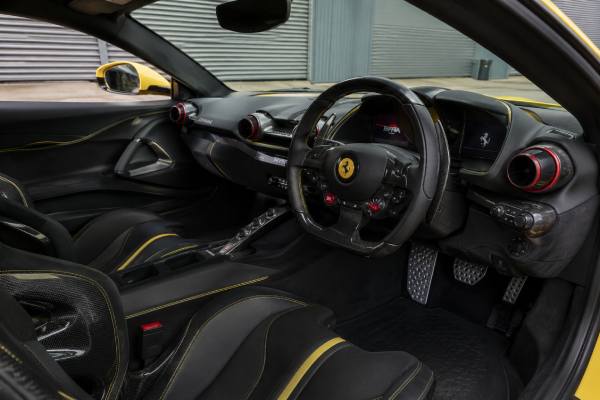
The Ferrari 812 Competizione is the sharper, rarer, more focused version of the 812 Superfast, built around Ferrari’s front-mid-mounted 6.5-liter naturally aspirated V12. It sits in a special bloodline that includes the 599 GTO and F12tdf: limited-production, front-engined V12 Ferraris made for collectors who want more response, more sound, more aero work, and a more serious driving character than the regular production model.
For many buyers, the 812 Competizione is important because it is not hybridized, turbocharged, or softened into a daily grand tourer. It is a high-revving, rear-drive, two-seat Ferrari berlinetta with 819 hp, a 9,500 rpm redline, a seven-speed dual-clutch gearbox, active vehicle systems, and a body reshaped for cooling and downforce. It is also a very condition-sensitive collector car, where mileage, specification, originality, service history, and factory documentation can affect value as much as raw performance.
Quick Take
The 812 Competizione’s strongest appeal is its combination of a naturally aspirated 6.5-liter V12, 9,500 rpm redline, limited production, and genuinely aggressive Ferrari special-series engineering. It is a modern collector Ferrari with old-school emotional appeal: front engine, rear drive, huge revs, and a sound that feels central to the car’s identity. The tradeoff is that ownership is not casual. Carbon-ceramic brakes, Cup 2 R tires, carbon body parts, low ride height, complex electronics, and market sensitivity mean the best cars are the ones with clear factory specification, complete documentation, correct maintenance, recall work completed, and no hidden track or impact damage.
Table of Contents
- History and Significance
- Engine, Chassis and Specs
- Production, Variants and Options
- Design, Aero and Engineering
- Driving Experience and Performance
- Maintenance, Reliability and Restoration
- Market Value and Buying Guide
History and Significance
The 812 Competizione matters because it is one of Ferrari’s last great non-hybrid, naturally aspirated V12 special-series road cars. It takes the already extreme 812 Superfast and turns it into a more limited, more technical, more collectible machine aimed at serious Ferrari clients and drivers.
Ferrari presented the 812 Competizione and the open 812 Competizione A in 2021, with deliveries following during the 2022–2024 period. The coupe continued the tradition of Ferrari’s most focused front-engined V12 berlinettas. That line does not include every V12 Ferrari. It specifically means the more intense special cars: the 599 GTO, F12tdf, and then the 812 Competizione.
The base car, the 812 Superfast, was already a major step in Ferrari V12 history. It replaced the F12berlinetta and brought an 800 cv version of the F140 family V12, rear-wheel steering, electric power steering, and a more aggressive performance character than earlier front-engined Ferrari GTs. The Competizione pushed the same basic formula much further. Ferrari revised the engine internals, intake system, exhaust, cooling, aerodynamics, controls, weight-saving strategy, and rear-wheel steering behavior.
It is useful to think of the 812 Competizione as a road-legal track-biased V12 rather than a stripped-out race car. It still has a finished Ferrari interior, dual-clutch transmission, road registration, climate control, electronic stability systems, and the polish expected from a modern Maranello product. But it is not a relaxed long-distance grand tourer in the way an 812 GTS or standard 812 Superfast can be. It is louder, firmer, more intense, and more tied to tire temperature and road surface.
Its place in Ferrari history is also shaped by timing. The later 12Cilindri kept the naturally aspirated V12 alive, but the 812 Competizione arrived at a moment when large naturally aspirated engines were becoming rarer across the industry. It therefore carries special weight among collectors who value mechanical response, high engine speed, and traditional Ferrari V12 character.
Collectibility comes from four main factors:
- limited production
- special-series position in Ferrari’s model hierarchy
- a heavily revised high-revving V12
- a distinct body and aero package that cannot be mistaken for a normal 812
The car’s reputation today is strong because it is not just a cosmetic edition. The 812 Competizione has real engineering separation from the 812 Superfast. Its titanium connecting rods, lighter crankshaft, higher redline, independent rear-wheel steering, redesigned cooling and brake airflow, fixed aluminum rear screen with vortex generators, and unique rear diffuser all give it a clear technical identity.
Engine, Chassis and Specs
The heart of the 812 Competizione is the F140 HB 6.5-liter naturally aspirated V12, rated at 610 kW, 830 cv, or about 819 hp. Its key numbers are impressive, but the larger point is the way Ferrari raised engine speed and response without using turbocharging or hybrid assistance.
| Category | Specification |
|---|---|
| Model | Ferrari 812 Competizione coupe |
| Internal model context | F152MVS special-series 812 derivative |
| Engine code | F140 HB |
| Engine type | 65-degree naturally aspirated V12 |
| Displacement | 6,496 cc |
| Bore x stroke | 94 mm x 78 mm |
| Maximum power | 610 kW / 830 cv / 819 hp at 9,250 rpm |
| Maximum torque | 692 Nm / 510 lb-ft at 7,000 rpm |
| Maximum engine speed | 9,500 rpm |
| Compression ratio | 13.5:1 |
| Transmission | 7-speed F1 dual-clutch automatic |
| Drivetrain | Front-mid engine, rear-wheel drive |
The engine’s headline change is not only the extra power over the 812 Superfast. It is the way Ferrari reduced rotating mass and friction so the V12 could rev harder and faster. Titanium connecting rods reduce reciprocating weight, a rebalanced crankshaft saves weight, and diamond-like carbon coating is used on selected moving parts to cut friction. The valve gear uses sliding finger followers derived from Ferrari’s racing experience, helping the engine breathe at very high rpm.
The intake system was also shortened and redesigned. In simple terms, shorter intake paths help the engine make more power near the top of the rev range, while variable intake geometry helps preserve useful torque across a wider spread of engine speeds. That is why the Competizione does not feel like a peaky engine that only works at the limit. It pulls hard, then keeps building intensity as the tachometer climbs.
Ferrari also revised the oiling and cooling systems. A high-revving V12 that can be used on track needs stable oil control, thermal stability, and brake cooling. The Competizione received a variable-displacement oil pump, a redesigned oil tank, improved coolant flow, and a body nose reorganized around a single front air intake.
| Item | Ferrari 812 Competizione |
|---|---|
| Length | 4,696 mm |
| Width | 1,971 mm |
| Height | 1,276 mm |
| Wheelbase | 2,720 mm |
| Dry weight | 1,487 kg with optional lightweight equipment |
| Weight distribution | 49% front / 51% rear |
| Fuel tank capacity | 92 liters |
| Front tires | 275/35 ZR20 |
| Rear tires | 315/35 ZR20 |
| Front brakes | 398 mm carbon-ceramic discs |
| Rear brakes | 360 mm carbon-ceramic discs |
| Top speed | Over 340 km/h |
| 0–100 km/h | 2.85 seconds |
| 0–200 km/h | 7.5 seconds |
| Fiorano lap time | 1 minute 20 seconds |
The chassis electronics are central to the car. The 812 Competizione uses Ferrari’s Side Slip Control 7.0, E-Diff3 electronic differential, F1-Trac traction control, magnetorheological dampers, high-performance ABS/EBD, and independent four-wheel steering. These systems are not there to make the car artificial. They are there to let a very powerful front-engined, rear-drive car rotate quickly while still giving the driver a usable margin.
Production, Variants and Options
The 812 Competizione coupe was limited to 999 examples, while the 812 Competizione A was limited to 599 examples. Those production numbers are central to value, because both versions were allocated to selected Ferrari clients rather than offered as ordinary showroom inventory.
| Version | Production | Body style | Main identity |
|---|---|---|---|
| 812 Competizione | 999 units | Fixed-roof berlinetta | Closed-roof special-series V12 with aluminum rear screen and vortex generators |
| 812 Competizione A | 599 units | Targa-style open car | Open-top limited version with removable carbon-fiber roof panel and revised rear aero bridge |
The coupe is the purer aerodynamic statement. Its most obvious identifier is the replacement of the conventional rear glass with an aluminum rear screen carrying vortex generators. This is not just a styling trick. It is part of the rear downforce strategy and gives the car a very different profile from the 812 Superfast.
The 812 Competizione A has a different appeal. It keeps the same engine character but adds open-air drama and even lower production. Instead of the coupe’s fixed rear screen treatment, the A uses a targa layout with flying buttresses, a removable carbon-fiber roof panel, and a bridge element that helps manage airflow toward the rear spoiler.
For buyers, variant choice is partly emotional and partly market-driven. The coupe is generally the car for drivers who want the most cohesive closed-body special-series experience. The A is rarer and often more expensive, but its value depends heavily on specification, mileage, and whether the buyer wants open-air use or a trophy-grade collector piece.
Factory specification and personalization
Like most modern limited Ferraris, the 812 Competizione’s desirability is shaped by its factory build. Two cars with similar mileage can differ meaningfully in value because of paint, livery, interior material, seat type, carbon-fiber equipment, wheel choice, and Tailor Made details.
Important factory and special-order areas include:
- exterior paint, including historical colors and extra-range shades
- painted or exposed carbon-fiber exterior details
- racing stripe or full-length livery treatment
- forged wheels or optional carbon-fiber wheels
- brake caliper color
- carbon-fiber racing seats and seat size
- Alcantara, leather, technical fabric, and contrast stitching choices
- passenger display and interior technology options
- front suspension lift, cameras, parking aids, and market-specific convenience equipment
- Ferrari Atelier or Tailor Made personalization
The optional carbon-fiber wheels deserve special mention. They reduce weight and are highly desirable on many cars, but they also create inspection responsibility. A buyer should check for impact damage, previous repair, curb rash, heat exposure, and correct finish. Replacement cost can be very high, and not every cosmetic mark is harmless.
Originality is especially important. A wrap, paint protection film, or removable number graphic may be acceptable if it has protected the original finish and was installed properly. Paintwork, repaired carbon, aftermarket exhaust changes, non-factory software, changed wheels, or missing factory parts can reduce buyer confidence. On a limited Ferrari, “easily reversible” is not the same as “irrelevant.”
Design, Aero and Engineering
The 812 Competizione looks different because the engineering demanded it. Its vents, blade-like bonnet treatment, closed rear screen, exhaust outlets, diffuser, and brake cooling are all tied to heat management, downforce, sound, or weight reduction.
The design was created by the Ferrari Styling Centre, working from the 812 Superfast’s basic proportions but giving the car a more compact and race-inspired visual identity. The bonnet’s transverse carbon-fiber blade is one of the car’s signature features. It disguises and organizes the cooling outlets while also recalling the idea of a racing stripe across historic Ferrari competition cars.
At the front, the Competizione uses a large central intake and aggressive side openings. These are not only for visual drama. The car needs more cooling for the higher-output V12 and stronger braking performance. The airflow path was reorganized to feed the radiators, front brakes, underbody, and wheel-arch pressure relief points more efficiently.
The rear of the car is even more distinctive. The coupe’s aluminum rear screen with vortex generators is one of the boldest modern Ferrari design choices. It removes the traditional view into the rear of the cabin and engine area, replacing it with a sculptural surface that helps manage the pressure field over the rear axle. It also creates a visual spine from roof to spoiler.
The rear diffuser and exhaust layout are closely linked. Instead of the 812 Superfast’s round tailpipes, the Competizione uses vertical rectangular exhaust outlets. This frees space for the diffuser and lets exhaust flow interact with the rear aero package. The result is not simply more drama from behind. It is a functional change that helps the rear of the car generate downforce.
Independent four-wheel steering
The Competizione’s rear-wheel steering is more advanced than the system used on earlier 812 models. Each rear actuator can be controlled independently, allowing Ferrari to tune yaw response more precisely. In plain language, the system helps the car turn in quickly without making the rear feel loose or nervous.
This matters because the 812 Competizione has a long hood, a large V12, huge power, and rear-wheel drive. Without careful electronic and mechanical tuning, that could produce a car that feels heavy at the front and wild at the rear. Instead, the Competizione feels alert and compact for its size.
Weight-saving measures
Ferrari reduced weight through the engine, body, wheels, cabin materials, and battery. The car uses carbon fiber on exterior components such as bumpers, air intakes, and rear aero pieces. Inside, it uses lighter door panels, technical fabrics, carbon-fiber trim, and reduced sound insulation.
This weight saving does not turn the car into a bare track special. It remains a finished Ferrari road car. But it changes the car’s responses. Less rotating mass in the engine helps it rev more freely. Lighter wheels reduce unsprung mass. Reduced insulation brings more sound and mechanical texture into the cabin.
Sound and emotional character
The 812 Competizione’s sound is part of its engineering story. Ferrari had to meet modern emissions rules, including the use of gasoline particulate filter equipment in relevant markets, while preserving V12 character. The exhaust and intake were therefore tuned not only for flow, but also for frequency and quality of sound.
The result is a car that feels mechanical and operatic rather than simply loud. The lower and middle rev ranges are strong, but the final climb toward 9,500 rpm is the point of the car. That last stretch is where the Competizione separates itself from many turbocharged supercars that may be faster in some conditions but cannot offer the same naturally aspirated crescendo.
Driving Experience and Performance
The 812 Competizione is brutally fast, but its defining trait is response rather than only acceleration. It feels special because the engine, steering, gearbox, brakes, tires, and rear-wheel steering all react quickly and ask the driver to stay involved.
The engine dominates the experience. At low speed, it is more tractable than its extreme numbers suggest. You do not need to drive at 9,000 rpm for the car to feel alive. The torque curve is strong enough for normal road driving, and the dual-clutch gearbox keeps the car clean and easy in traffic when the driver wants it to.
But the car’s real character appears when the road opens. The throttle response is immediate, the engine rushes through the middle of the rev range, and the final 2,000 rpm feel almost unreal for a 6.5-liter road engine. The power delivery keeps building instead of flattening. That is a major reason the 812 Competizione feels different from high-output turbocharged cars.
The seven-speed F1 dual-clutch gearbox is fast and direct. Ferrari kept the same basic gear ratios as the 812 Superfast but recalibrated the shift strategy and used the higher engine speed to create a more intense shift feel. In automatic mode, the car can be civilized. In manual mode, using the paddles, the experience is much more dramatic.
Steering feel is a more debated area. Ferrari’s modern front-engined cars use very quick steering, and the Competizione adds rear-wheel steering that makes the car feel shorter than it is. Some drivers love the speed and agility. Others may need time to trust how quickly the nose reacts. A proper test drive should include smooth roads, tight bends, and braking zones, not just straight-line acceleration.
Ride quality is firm but not crude by exotic-car standards. The magnetorheological dampers help, and Ferrari’s bumpy-road setting can make the car more usable on imperfect roads. Even so, tire choice matters. Michelin Cup 2 R tires are designed for high grip and track performance, not quiet all-weather comfort. They need temperature, dislike standing water, and can feel less friendly in cold weather.
Braking performance is huge, but carbon-ceramic brakes need proper inspection and correct expectations. They can feel different from iron brakes at low speed and may make noise. On track, they offer strong resistance to fade when healthy and properly cooled. On a used car, disc condition, pad life, heat history, and surface damage matter more than mileage alone.
The Competizione’s cornering balance is more serious than the 812 Superfast’s. The front end is sharp, the rear follows quickly, and the electronic differential and traction systems allow controlled rotation if the driver has the skill and space. It is not a beginner’s track toy. It is a fast, expensive, powerful Ferrari that rewards smooth inputs and punishes overconfidence.
In normal use, visibility is good forward and acceptable to the sides, but the coupe’s rear treatment limits the usual rearward view. Parking cameras and sensors are valuable. The low nose, expensive splitter, and wide body also make urban use stressful. The car can be driven on the road, but it always feels like a special machine, not a daily supercar.
Maintenance, Reliability and Restoration
The 812 Competizione is not known as a fragile car when maintained correctly, but it is a high-value Ferrari special series with expensive consumables and complex systems. The main ownership risk is not ordinary reliability; it is hidden damage, deferred service, expired consumables, expensive wear items, and poor documentation.
Ferrari’s seven-year maintenance program is important because it covers scheduled maintenance for the early life of the car, with regular service intervals based on time or mileage. Buyers should still read the service record carefully. A car can be low mileage and still need annual attention, battery care, brake-fluid service, tires, software updates, and inspection for age-related issues.
Known service and ownership watch points
| Area | What to check | Why it matters |
|---|---|---|
| Engine | Annual service, oil quality, leaks, warm-up behavior, fault codes | The V12 is highly stressed and expensive to repair if abused or neglected |
| DCT gearbox | Shift quality, clutch data, software status, leaks | Low mileage does not eliminate software, seal, or use-related concerns |
| Carbon-ceramic brakes | Disc condition, pad thickness, heat marks, service records | Replacement costs are high and track use can accelerate wear |
| Tires | Age, compound, tread, heat cycles, matching specification | Old or incorrect tires change the car’s behavior and value |
| Carbon wheels | Impact marks, curb damage, finish condition, previous repair | They are desirable but costly and must be inspected carefully |
| Front lift and suspension | Lift operation, damper behavior, leaks, warning lights | Hydraulic and electronic faults can be expensive |
| Body and underbody | Splitter, diffuser, side skirts, floor panels, paint meter readings | Low cars often suffer hidden underside damage |
| Electronics | Battery health, module scans, dashboard warnings, infotainment | Modern Ferraris depend on stable voltage and current software |
| Recall work | Brake-fluid reservoir cap recall completion where applicable | Some 2022 Ferrari 812 vehicles, including the Competizione, were included in a brake-system recall |
The brake-fluid reservoir cap recall is especially important for U.S.-market or imported cars. The issue involved venting of the brake-fluid reservoir cap, with the possibility of brake-fluid leakage and reduced braking capability. The remedy involved replacing the cap and updating software for warning behavior. A buyer should verify completion by VIN through an authorized Ferrari dealer or official recall database.
Battery care is another real-world concern. Many low-mile collector Ferraris spend long periods on tenders. That is normal, but the tender, battery age, charging history, and low-voltage faults should be checked. Weak voltage can trigger confusing electronic warnings that do not always point to a failed major component.
Tires are more important than many buyers expect. A Competizione on old Cup 2 R tires may look perfect in a showroom but drive poorly and dangerously in cold or wet conditions. Tire date codes, storage, heat cycling, and correct specification should be checked before spirited driving.
Restoration is not the right word for most 812 Competizione examples yet, because these are modern cars. The better term is preservation. Paintwork, carbon-fiber replacement, wheel repair, interior wear, and missing original parts can all matter to value. A car that has been repainted after a minor front-end scrape may drive perfectly, but collectors will price it differently from a fully original, documented example.
Do not assume low mileage means low risk. A car with 80 miles may have old tires, storage marks, battery issues, or incomplete campaigns. A car with 3,000 careful miles, full annual service, fresh tires, and a clean inspection may be the better driver’s car. For collector value, however, mileage still matters strongly, especially at the top of the market.
Market Value and Buying Guide
The 812 Competizione sits deep in modern collectible Ferrari territory, well above original list price in many public sales. The best examples are valued less like ordinary used supercars and more like allocation-grade collector assets, where specification and story can move the price sharply.
Recent public market activity has placed many coupe transactions and serious bids broadly in the mid-$1 million to low-$2 million range, with exceptional low-mile cars and special specifications bringing stronger money. Market trackers have shown coupe benchmarks around the high-$1 million area, while public auction results have included sales above $2 million for very low-mile examples. The 812 Competizione A normally carries an additional rarity premium because only 599 were built and open special-series Ferraris have strong collector appeal.
Exact pricing changes quickly, so buyers should not treat any single auction result as the market. A car sold at Monterey, a car offered privately by an official Ferrari dealer, and a car crossing an online auction platform can produce different outcomes. Currency, location, taxes, import status, warranty, specification, and seller reputation all matter.
| Value factor | Effect on desirability |
|---|---|
| Variant | Competizione A usually commands a rarity premium over the coupe |
| Mileage | Ultra-low mileage supports collector value, but regular maintenance still matters |
| Color and livery | Historic colors, tasteful stripes, and strong Tailor Made builds can add appeal |
| Originality | Original paint, factory parts, and no accident history are highly important |
| Documentation | Window sticker, manuals, service invoices, build record, books, tools, cover, and tender help value |
| Carbon-fiber wheels | Often desirable, but condition must be verified carefully |
| Maintenance status | Annual Ferrari service, campaigns, tires, and brake condition can affect real cost |
| Market location | U.S., Europe, Middle East, and Asia can differ in demand, taxes, and import rules |
What to seek
A strong 812 Competizione purchase candidate should have a clean, complete story. The best cars usually share these traits:
- original paint or fully disclosed minor cosmetic work
- complete Ferrari dealer service history
- all recall and campaign work completed
- no unexplained electronic faults
- matching factory specification to window sticker or build documentation
- fresh or correctly aged tires
- healthy carbon-ceramic brakes
- clean underbody, splitter, diffuser, and rocker panels
- all books, tools, car cover, battery tender, and accessories present
- clear ownership history and no import or title complications
A buyer who wants to drive the car should not automatically chase the lowest-mile example. Paying a huge premium for delivery mileage can make the car psychologically difficult to use. A carefully driven, well-maintained car with moderate mileage can be more enjoyable and still collectible if its history is clean.
What to avoid
Avoid cars with vague explanations. On a limited Ferrari, uncertainty is expensive. Be cautious with:
- missing service history
- aftermarket exhausts or software
- paintwork not disclosed before inspection
- replaced carbon panels without clear reason
- repeated battery or electronic faults
- heavy track use without brake and tire documentation
- damaged carbon wheels
- overdue annual service
- imported cars with incomplete market-compliance paperwork
- sellers unwilling to allow a Ferrari specialist inspection
A specialist pre-purchase inspection is not optional at this level. The inspection should include a diagnostic scan, paint and body review, lift inspection, brake measurement, tire date check, verification of recall completion, and review of the car’s factory build. For carbon wheels, request specific inspection rather than a casual visual look.
Long-term collectability
The 812 Competizione has strong long-term ingredients: limited production, front-engined Ferrari V12 layout, natural aspiration, special-series status, a distinct design, and a clear place in the 599 GTO/F12tdf lineage. It is also tied to a period when Ferrari was balancing tradition with emissions pressure, hybrid expansion, and new model strategies.
The main risk is not that the car lacks importance. The risk is overpaying for the wrong example or buying a car with hidden condition issues. Modern limited Ferraris can trade like financial assets during strong markets, but the cars that remain most desirable over time are usually the ones with the best specification, best originality, best documentation, and least complicated history.
For an owner who wants the experience, the 812 Competizione is one of the most exciting modern Ferraris because it offers something increasingly rare: a large, high-revving, naturally aspirated V12 in a focused rear-drive chassis. For a collector, it is a car to buy carefully, maintain properly, and document obsessively.
References
- 812 COMPETIZIONE AND 812 COMPETIZIONE A: TWO INTERPRETATIONS OF FERRARI’S RACING SOUL 2021 (Press Release)
- Ferrari 812 Competizione: V12 830 cv – Ferrari.com 2021 (Official Model Page)
- Part 573 Safety Recall Report 22V-536 2022 (Recall Database)
- 2024 Ferrari 812 Competizione | Monterey 2025 2025 (Auction Result)
- Ferrari 812 Competizione Market 2026 (Market Tracker)
Disclaimer
This article is for informational purposes only and is not a substitute for professional diagnosis, repair, valuation, or inspection. Specifications, torque values, service intervals, recall status, procedures, equipment, and market requirements can vary by VIN, country, model year, and factory configuration. Always verify details against official Ferrari service documentation, dealer records, and a qualified Ferrari specialist.
If this guide helped you, please consider sharing it on Facebook, X/Twitter, or your preferred car community to support our work.