
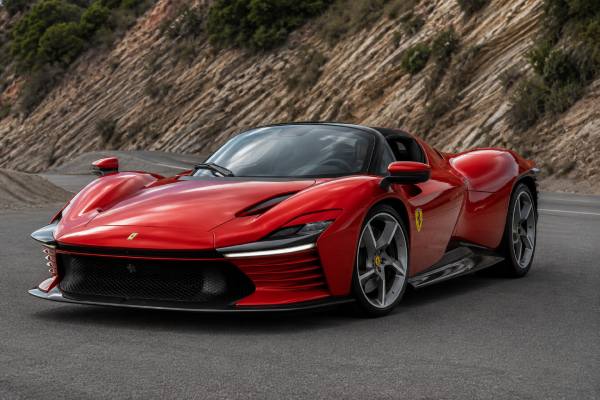
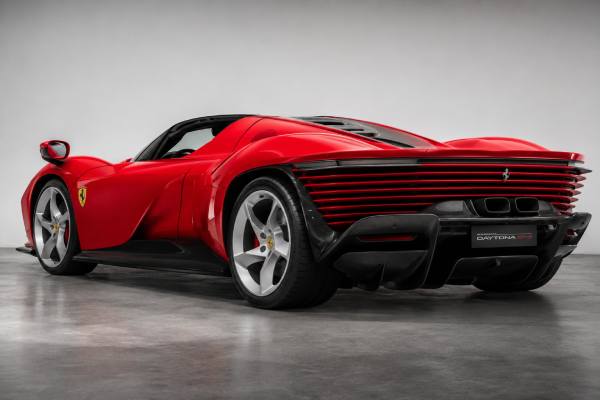
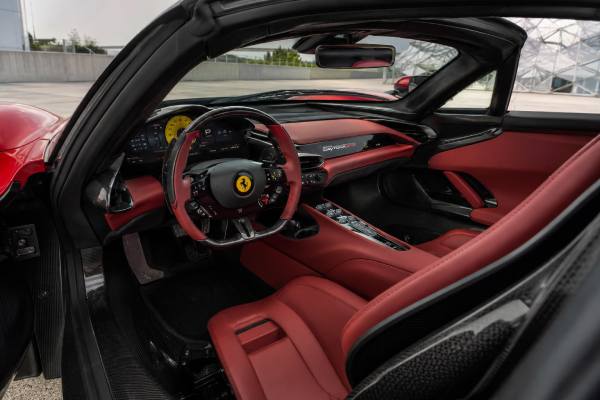
The Ferrari Daytona SP3 is one of the most important modern Ferrari collector cars because it combines an old-school idea with very modern execution: a naturally aspirated V12 mounted behind the cabin, no hybrid assistance, a carbon structure, and a limited-production Icona identity. It is not a normal series-production Ferrari, and it is not a track-only special. It sits in the rare space between usable road car, design statement, engineering showcase, and allocation-only collector asset.
Quick Take
The Daytona SP3’s strongest appeal is its pure mid-mounted V12 character: 829 hp from the F140HC engine, a 9,500 rpm redline, rear-wheel drive, and a body shaped around Ferrari’s 1960s sports-prototype heritage. Its ownership identity is just as important as its performance, because only 599 standard examples were planned, with a later one-off “599+1” Tailor Made charity car showing how much collector attention surrounds the model. The main caution is that the car’s value depends heavily on originality, factory documentation, specification, mileage, and damage-free carbon-fiber condition; a casual “used exotic” inspection is not enough.
Table of Contents
- Why the Daytona SP3 Matters
- Engine, Chassis, and Key Specs
- Production, Variants, and Factory Options
- Design, Engineering, and Signature Details
- Performance Feel and Road Character
- Maintenance, Reliability, and Ownership Risks
- Market Value and Buying Advice
Why the Daytona SP3 Matters
The Daytona SP3 matters because it is Ferrari deliberately stepping away from the hybrid arms race and celebrating the emotional core of its V12 road cars. Instead of using electric boost, all-wheel drive, or active aerodynamics as the headline, Ferrari built the car around a naturally aspirated 6.5-liter V12, a carbon-fiber structure, rear-wheel drive, and a design language inspired by endurance racing.
The car belongs to Ferrari’s Icona line, the collector-focused series that began with the Monza SP1 and SP2. Those cars looked back to open sports racers of the 1950s. The Daytona SP3 moved the idea forward into the 1960s, especially Ferrari’s mid-engined sports prototypes from the era of the 330 P3/4, 330 P4, 350 Can-Am, and 512 S.
The name is not a casual styling label. It refers to Ferrari’s 1-2-3 finish at the 1967 24 Hours of Daytona, one of the most famous endurance-racing moments in the company’s history. The SP3 is not a replica of any one racing car, but it borrows the mood of that period: low nose, high front fenders, wraparound screen, powerful rear haunches, and dramatic horizontal rear blades.
In Ferrari history, the Daytona SP3 also stands out because mid-engined V12 road Ferraris are rare. The line includes cars such as the 365 GT4 BB, 512 BB, Testarossa family, F50, Enzo, and LaFerrari. But the LaFerrari used hybrid assistance, while the Daytona SP3 returned to a non-hybrid naturally aspirated V12 layout. That makes it feel like a deliberate mechanical farewell to one of Ferrari’s most loved formulas.
The production period is usually described as 2022–2025, with market registration years varying by country. It was not sold like an ordinary showroom car. Allocation went to selected Ferrari clients, and the whole production run was effectively spoken for before normal buyers had any real chance to order one.
For collectors, the Daytona SP3’s importance comes from four things:
- It is part of a numbered, limited Ferrari family.
- It uses a naturally aspirated V12 at a time when Ferrari is expanding hybrid and electrified technology.
- It has a carbon-fiber structure and bodywork, making damage history especially important.
- It connects strongly to Ferrari’s racing mythology without being a retro copy.
For enthusiasts, the appeal is simpler: it is a modern Ferrari that still puts engine sound, throttle response, and visual drama ahead of pure lap-time technology. That does not make it old-fashioned. It makes it unusually focused.
Engine, Chassis, and Key Specs
The Daytona SP3’s core specification is built around the F140HC V12, a 6,496 cc naturally aspirated engine producing 840 cv, commonly listed as 829 hp. It is paired with a 7-speed dual-clutch transmission and drives the rear wheels only.
| Category | Detail |
|---|---|
| Model code | F251 |
| Engine code | F140HC |
| Engine type | 65-degree naturally aspirated V12 |
| Displacement | 6,496 cc / 6.5 liters |
| Bore x stroke | 94 mm x 78 mm |
| Maximum output | 840 cv / 829 hp at 9,250 rpm |
| Maximum torque | 697 Nm / 514 lb-ft at 7,250 rpm |
| Maximum engine speed | 9,500 rpm |
| Compression ratio | 13.6:1 |
| Transmission | 7-speed F1 dual-clutch automatic |
| Drivetrain | Rear-wheel drive |
The engine is related to Ferrari’s modern front-engined V12 family, but the Daytona SP3 installation is much more dramatic because the power unit sits behind the cockpit. It is not helped by electric motors. That matters because the car’s response, traction behavior, sound, and value story all come from the combustion engine itself.
Ferrari’s work on the engine focused on airflow, friction reduction, rotating-mass control, and high-rpm stability. The result is a V12 that delivers its peak power very high in the rev range. This is not a low-revving torque engine that happens to be large. It is a big-capacity, short-stroke, high-revving Ferrari V12 that rewards the driver for using the top half of the tachometer.
| Item | Figure |
|---|---|
| Length | 4,686 mm |
| Width | 2,050 mm |
| Height | 1,142 mm |
| Wheelbase | about 2,650–2,651 mm, depending on published specification |
| Dry weight | 1,485 kg |
| Weight distribution | 44% front / 56% rear |
| 0–100 km/h | 2.85 seconds |
| 0–200 km/h | 7.4 seconds |
| Top speed | over 340 km/h / over 211 mph |
| EPA fuel economy | 12 mpg city / 16 mpg highway / 13 mpg combined |
| WLTP combined fuel consumption | about 16.2 l/100 km |
| WLTP CO₂ emissions | about 368 g/km |
The chassis uses carbon-fiber construction, which is central to the car’s stiffness, packaging, and collector value. The suspension layout follows modern Ferrari supercar practice, with double-wishbone geometry and electronically controlled damping. Ferrari’s stability and traction systems, including Side Slip Control, help manage the huge power output without turning the car into an all-wheel-drive machine.
Braking is handled by carbon-ceramic discs, with large front and rear rotors suitable for repeated high-speed use. The tire package is staggered, with 20-inch wheels at the front and 21-inch wheels at the rear. The common fitment is 265/30 ZR20 front and 345/30 ZR21 rear, using high-performance Pirelli rubber developed for this level of car.
The specification sheet is impressive, but the important point is balance. Ferrari did not chase the highest possible horsepower number. It built a high-rpm V12 car that keeps the driver, engine, chassis, tires, and rear axle closely linked.
Production, Variants, and Factory Options
The Daytona SP3 was produced as a very limited Icona model, with 599 standard customer cars planned. The later Tailor Made “599+1” charity car is important, but it should not be treated as a normal production example when judging the market.
Unlike mainstream Ferrari models, the Daytona SP3 was not offered in a wide range of body styles. There is no normal coupe, Spider, lightweight track pack, or later performance edition. The car’s removable roof panel gives it a targa-like character, but it remains a single core model.
Standard production identity
The standard Daytona SP3 is already the special version. Its value does not come from needing a separate handling package or limited trim level. The main collector differences are found in specification, condition, delivery market, mileage, and documentation.
The most important identification and value points are:
- correct Daytona SP3 chassis identity and factory records
- original engine and transmission documentation
- original paint, trim, and Tailor Made specification records
- matching factory books, tools, battery conditioner, cover, and accessories
- official service history in Ferrari’s system
- no accident history, carbon-tub repair, or structural body repair
- clear import, tax, and registration history for the country where it is being sold
Because many cars were personalized, two Daytona SP3s can feel very different in the market. A restrained historic color may appeal to traditional collectors. A vivid Atelier or Tailor Made specification may appeal to buyers who want uniqueness. But uniqueness only helps when it is documented and tasteful enough for the next buyer.
The Tailor Made 599+1 car
The 2025 Tailor Made “599+1” car is a one-off additional example built for charity auction. It sold for $26 million at RM Sotheby’s Monterey 2025, with proceeds benefiting The Ferrari Foundation. That result is historically important, but it is not a normal valuation benchmark for every Daytona SP3.
Its significance comes from several special factors happening at once:
- it was an additional car beyond the original 599-unit run
- it was factory-built and factory-backed
- it had a unique Tailor Made specification
- it was sold for charity
- it carried major publicity and record-setting attention
A buyer should not use that $26 million figure as the value of an ordinary low-mileage Daytona SP3. It does, however, show how powerful the model’s collector story has become.
Factory options and personalization
For a Daytona SP3, factory options are less about performance and more about materials, finishes, and identity. Typical areas of personalization include exterior paint, exposed carbon-fiber elements, wheels, brake caliper color, interior leather or Alcantara, contrast stitching, seatbelts, special fabrics, and plaques.
The best specifications usually share three qualities. They suit the car’s design, they are fully factory documented, and they do not make later maintenance or restoration difficult. Highly unusual interiors, special fabrics, or exposed carbon finishes can be desirable, but only if their condition is excellent and the factory record is complete.
Design, Engineering, and Signature Details
The Daytona SP3’s design is not just retro decoration; the body shape is tied to cooling, airflow, engine placement, and Ferrari’s sports-prototype references. It looks dramatic because the engineering package allows it to be low, wide, and heavily sculpted.
The front end has a strong horizontal character, partly because the car avoids the tall, open grille look of many modern performance cars. The wheel arches are pronounced, giving the driver a view over the front fenders that recalls older racing prototypes. The windshield wraps low around the cockpit, while the mirrors are positioned high and outward to strengthen the race-car effect.
The rear is the car’s most recognizable angle. The horizontal blades across the tail are not subtle, but they are the feature that makes the SP3 instantly identifiable. They visually lower and widen the car while hiding modern lighting and airflow management within a design that feels closer to a concept car than a normal road car.
Passive aerodynamics
One of the most interesting engineering choices is Ferrari’s reliance on passive aerodynamics. Many modern hypercars use active flaps, moving wings, or variable aero surfaces. The Daytona SP3 instead uses body shaping, underbody airflow, ducts, extractors, and carefully placed openings.
This gives the car a cleaner design and a more timeless feel. It also means the aerodynamics are baked into the physical form rather than performed by visible moving devices. For collectors, that may age better visually. For owners, it means the condition of underbody panels, ducts, splitters, and rear aero surfaces matters a great deal.
Carbon structure and body materials
The carbon-fiber construction is vital to the car’s stiffness and weight control. It also raises the standard for inspection. A minor scrape on a steel-bodied grand tourer is one kind of problem. Damage to a carbon-fiber panel, mounting point, undertray, or structural component is a much more serious issue.
Paint condition is also more complicated on a car like this. Large sculpted surfaces, tight panel gaps, exposed carbon options, and unusual factory finishes require specialist assessment. The question is not just whether the car looks shiny. The question is whether the finish, carbon weave, panel alignment, and repair history are consistent with an untouched or properly documented factory car.
Cockpit layout
The interior puts the driver low and close to the center of the car. The seats are fixed, while the pedal box and steering wheel adjust to the driver. This is a race-inspired solution: it helps packaging and lowers the seating position, but it also means fit should be checked before purchase.
The dashboard uses a 16-inch curved digital display rather than a traditional cluster. Most major controls sit on or around the steering wheel, continuing Ferrari’s modern cockpit philosophy. There is no large central touchscreen dominating the cabin. The result feels more focused than luxurious, although materials and personalization can make individual cars feel very rich.
The sensory character is the real special feature. The intake sound, exhaust note, short shift times, tight cockpit, removable roof panel, and V12 sitting behind the driver all define the car more than any single screen or trim choice.
Performance Feel and Road Character
The Daytona SP3 is extremely fast, but its real distinction is the way it delivers speed. It builds performance through revs, sound, throttle precision, and rear-drive traction rather than silent electric torque or all-wheel-drive launch drama.
A 0–100 km/h time of 2.85 seconds is already hypercar territory, especially for a rear-wheel-drive car. The 0–200 km/h time of 7.4 seconds shows how hard the V12 pulls once the tires are hooked up. But the figures do not fully explain the experience. A naturally aspirated Ferrari V12 with peak power at 9,250 rpm makes the driver chase the top end of the engine. That gives the car a rising sense of occasion as speed increases.
The throttle response is likely to be one of the car’s defining traits. Without turbochargers or electric torque fill, the engine responds directly to the driver’s right foot. That does not mean it is soft at lower rpm; a 6.5-liter V12 has real displacement. But the character is still about building urgency rather than receiving one instant shove.
The 7-speed dual-clutch gearbox suits the engine because it keeps the V12 in its power band and shifts quickly enough to maintain momentum. Some purists will always dream of a manual gearbox in a car like this, but the Daytona SP3’s performance and engine speed make the DCT the more coherent technical choice.
Steering and chassis balance are shaped by the rear-mid-engine layout. The car carries more mass over the rear axle, and the wide rear tires give it huge traction once warm. Ferrari’s electronic systems allow controlled slip rather than simply cutting power at the first sign of movement. This matters because a car with this much power should feel alive, not locked down.
Ride quality depends heavily on tire condition, road surface, and suspension mode. The Daytona SP3 is not a luxury GT like an 812 GTS. It is wider, lower, more exposed, and more intense. At the same time, it is still a road Ferrari, not a Challenge car with number plates. The removable roof panel adds open-air drama, but it also makes wind noise, heat, and storage practicality part of the ownership experience.
On track, the car has the power, braking, and aero efficiency to be very quick, but owners should be realistic. Track use accelerates tire wear, brake wear, paint damage, and heat exposure. In collector terms, a heavily tracked Daytona SP3 will need better documentation than a delivery-mile car, not less. Video of track use, repeated heat cycles, and worn carbon-ceramic brakes can affect resale confidence.
On the road, its best environment is not traffic. It is a clear, open route where the driver can use revs, brakes, steering, and sound without constantly fighting width or attention. The car is usable by hypercar standards, but it is still a low, wide, rare, carbon-bodied Ferrari. That alone changes how, where, and how often most owners will drive it.
Maintenance, Reliability, and Ownership Risks
The Daytona SP3 is too rare and too new for broad high-mileage reliability patterns to be meaningful, so ownership risk is better judged by systems, usage, documentation, and repair complexity. The biggest risks are not ordinary “will it start tomorrow?” concerns; they are carbon damage, deferred specialist maintenance, electronic faults, tire and brake costs, and value loss from poor documentation.
Ferrari’s 7-Year Genuine Maintenance program is relevant because it supports scheduled routine servicing during the early life of the car, but buyers still need to verify coverage by VIN, market, in-service date, and official dealer records. A rare Ferrari without clean service history will always raise questions, even if the mileage is very low.
Mechanical areas to inspect
The F140HC V12 is a highly developed modern Ferrari engine, but it should be treated with respect. A pre-purchase inspection should check oil leaks, coolant leaks, engine mounts, exhaust condition, sensors, software updates, and any signs of overheating or abnormal operation. A car that has mostly sat unused still needs attention, because seals, fluids, tires, and batteries age even when mileage stays low.
The dual-clutch gearbox should shift cleanly at low speed and under load. Any harsh engagement, warning lights, hesitation, fluid seepage, or drivetrain fault history needs specialist diagnosis. The electronic differential, traction systems, and stability systems should also be scanned with Ferrari-approved diagnostic equipment.
Cooling is especially important on a mid-engined V12 car. Inspect radiators, ducts, fans, hoses, clamps, coolant condition, and evidence of debris impact. Low, wide cars collect road debris, and blocked or damaged cooling paths can become expensive.
Carbon-ceramic brakes and tires
Carbon-ceramic brakes can last a long time in gentle road use, but they are expensive when damaged or worn beyond limits. Buyers should check disc condition, pad life, edge chipping, heat marks, and service measurements rather than relying on a visual glance.
Tires matter more than many collectors admit. Old tires with deep tread are still old tires. On a high-power rear-drive car, date codes, correct specification, heat cycles, and storage conditions are important. A Daytona SP3 on aged or incorrect tires will not drive as intended and may create unnecessary risk.
Carbon body, lift system, and electronics
The front splitter, underbody panels, side skirts, diffuser, and lower carbon areas need careful inspection. Nose-lift use, driveway scrapes, transport damage, and road impacts can leave marks that are easy to miss in photos. A lift system, where fitted, should operate evenly and without warning messages.
The electronic side of the car matters as much as the mechanical side. Digital displays, steering-wheel controls, driver settings, battery health, immobilizer behavior, charger use, and software status should all be checked. Low-mileage collector cars often suffer from weak batteries, storage-related faults, or outdated software.
The best ownership approach is simple: keep the car on a proper battery conditioner, service it on schedule, drive it enough to keep systems healthy, and document everything. For a Daytona SP3, a complete record is not paperwork clutter. It is part of the car’s value.
Market Value and Buying Advice
The Daytona SP3 sits in the top tier of modern Ferrari collectability, and values are driven more by allocation rarity, specification, originality, and provenance than by mileage alone. The original price was around the low-$2-million range before options and market taxes, but real-world asking prices and auction results have often moved well above that.
The 2025 “599+1” Tailor Made car’s $26 million sale is a landmark, but buyers should treat it as a charity-driven one-off result. Standard Daytona SP3 values are better judged by private-sale activity, dealer asking prices, mileage, specification, delivery market, and whether the car has already been registered or is still effectively delivery mileage.
What drives value
The most valuable standard cars usually have a combination of rarity, beauty, and clarity. A perfect-looking car with weak paperwork is not the same as a fully documented car with known history.
Key value factors include:
- factory-original paint and trim
- desirable color and tasteful Tailor Made specification
- low but believable mileage
- no accident or carbon repair history
- complete accessories, books, cover, charger, and tools
- official Ferrari service record
- clean ownership chain
- correct taxes, import documents, and registration status
- remaining warranty or maintenance coverage where applicable
- strong dealer or specialist inspection report
Color is a personal matter, but the market is not completely neutral. Historic Ferrari colors, exposed carbon details, elegant interiors, and documented Tailor Made features tend to travel better across markets. Extremely unusual specifications can bring a premium from the right buyer but may narrow the audience later.
Buyer inspection checklist
A serious Daytona SP3 inspection should be performed by an official Ferrari dealer or a recognized modern Ferrari specialist with carbon-structure experience. The inspection should include more than a road test and paint-meter walkaround.
| Area | What to confirm |
|---|---|
| Identity | VIN, build records, specification sheet, market delivery, and ownership chain |
| Body | Carbon-fiber condition, panel gaps, underbody, splitter, diffuser, and repair history |
| Paint and trim | Original finish, exposed carbon quality, interior wear, seat fabric, stitching, and plaques |
| Powertrain | Diagnostic scan, fluid leaks, cooling system, gearbox behavior, and engine operating data |
| Brakes and tires | Carbon-ceramic disc condition, pad life, tire date codes, correct tire specification |
| Electronics | Display, steering controls, lift system, battery condition, software updates, warning history |
| Documents | Service history, warranty status, manuals, tools, charger, cover, and factory accessories |
Cars to seek and avoid
Seek cars with transparent history, original condition, strong factory documentation, and a specification that looks intentional rather than random. A slightly higher-mileage car with perfect maintenance and clean use may be more reassuring than a delivery-mile car that has been badly stored or moved between dealers without clear records.
Avoid cars with vague import status, missing accessories, unclear service history, unexplained paintwork, damaged carbon, mismatched tires, warning lights, or seller resistance to a proper Ferrari inspection. Also be cautious with cars advertised mainly around “investment” language but lacking the documents that support investment-grade status.
Long term, the Daytona SP3 has many of the ingredients collectors usually want: limited production, V12 power, a non-hybrid identity, a strong design story, a famous name, and a place in Ferrari’s Icona series. The risk is not desirability. The risk is buying the wrong car at the wrong price without understanding the cost of protecting its originality.
References
- Ferrari Daytona SP3 – Ferrari.com 2026
- Gas Mileage of 2025 Ferrari Daytona SP3 2025
- 2025 Ferrari Daytona SP3 ‘Tailor Made’ | Monterey 2025 | RM Sotheby’s 2025
- Warranties And Official Ferrari Maintenance 2026
- Search Safety Issues | NHTSA 2026
Disclaimer
This article is for informational purposes only and is not a substitute for professional diagnosis, repair advice, valuation advice, or a factory inspection. Specifications, torque values, service intervals, repair procedures, software requirements, warranty terms, and equipment can vary by VIN, market, production date, and individual specification. Always verify details against official Ferrari service documentation and a qualified Ferrari specialist before buying, servicing, or repairing a Daytona SP3.
If this guide helped you, please consider sharing it on Facebook, X/Twitter, or your favorite car community to support our work.