
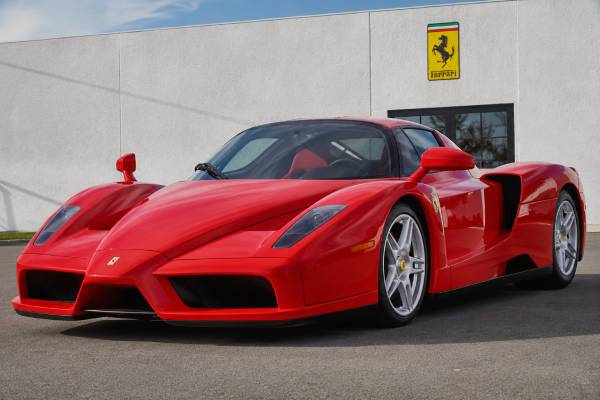
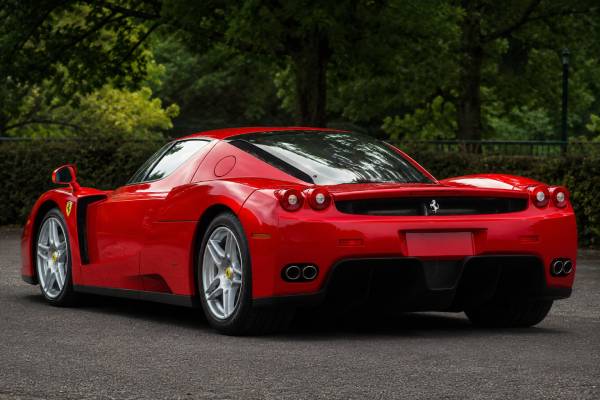
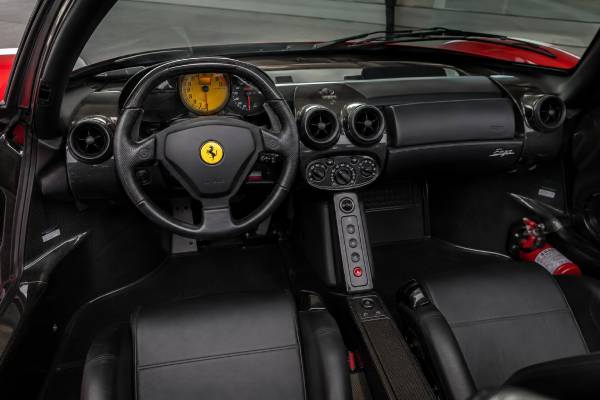
The Ferrari Enzo Ferrari is one of Maranello’s defining modern halo cars: a limited-production, carbon-bodied, naturally aspirated V12 supercar built during Ferrari’s dominant Formula 1 era. Produced from 2002 to 2004, it sits between the more analog F50 and the hybrid LaFerrari, making it a key bridge between old-school Ferrari drama and the electronically managed hypercar age. Its 6.0-liter F140B V12, 660 hp output, F1-style paddle-shift gearbox, carbon-ceramic brakes, and active aerodynamics made it one of the most advanced road cars of its time. Today, the Enzo matters not only because it is rare and fast, but because originality, service history, provenance, and condition now play a major role in its value as a serious collector Ferrari.
Table of Contents
- Why the Enzo Still Defines Ferrari Hypercars
- F140B V12, Chassis, and Core Specifications
- Production Numbers, Options, and Authenticity Details
- Pininfarina Design, Aero, and F1-Era Technology
- What the Enzo Feels Like to Drive
- Maintenance Risks, Service, and Restoration Reality
- Market Values, Inspection, and Buying Advice
Why the Enzo Still Defines Ferrari Hypercars
The Enzo matters because it brought Ferrari’s early-2000s Formula 1 mindset into a road car with almost no compromise. It was the successor to the F50, the predecessor to LaFerrari, and the model that turned Ferrari’s flagship line from raw supercars into technology-led hypercars.
Launched for the 2002 model year and built through 2004, the Enzo was officially named after Enzo Ferrari himself. That was a bold move. Ferrari had already used legendary names such as GTO, F40, and F50, but putting the founder’s name on a road car set a very high bar. The car had to feel like more than a limited edition. It had to represent the best Ferrari could do at the time.
It arrived during a golden period for the Scuderia. Michael Schumacher, Ross Brawn, Jean Todt, and Ferrari’s technical team were at the center of one of the most dominant eras in modern Formula 1. The Enzo reflected that atmosphere. It used a carbon-fiber and Nomex honeycomb monocoque, carbon-ceramic brakes, a paddle-shift F1 automated manual gearbox, adaptive damping, active aerodynamics, and a naturally aspirated V12 that formed the basis for a whole family of later Ferrari engines.
The Enzo was also a turning point in Ferrari styling. The F40 looked like a racing prototype made legal for the road. The F50 looked more like an open cockpit F1 fantasy with a body wrapped around it. The Enzo, designed under Ken Okuyama at Pininfarina, was sharper and more technical. Its pointed nose, cab-forward cockpit, visible aero channels, and dramatic doors made it look less like a traditional Italian GT and more like a Formula 1 car translated into road-car language.
For collectors, the Enzo’s appeal comes from several forces working together:
- It is the final Ferrari flagship before hybrid assistance changed the category.
- It uses a naturally aspirated V12 with no turbochargers and no electric boost.
- It was built in very limited numbers.
- It belongs to the “big Ferrari” lineage that includes the 288 GTO, F40, F50, LaFerrari, and F80.
- It was technologically significant when new and still feels special today.
- It has become a blue-chip modern collectible, not just an expensive used exotic.
The Enzo also has a reputation for being both extreme and usable in the right setting. It is not relaxed in the way a modern Roma or 812 Superfast can be, but it is not a fragile showpiece either when properly maintained. It was engineered to run hard, stop hard, and handle repeated high-speed use. The problem is that every major system is expensive, and many cars are now too valuable to be used casually.
That tension is part of the Enzo’s character. It is a machine built for speed, but many examples now live as investment-grade collector cars. The best cars are judged not only by mileage and condition, but by originality, Classiche certification, tools, luggage, books, warranty documents, service history, ownership chain, and whether the engine and gearbox remain original to the chassis.
F140B V12, Chassis, and Core Specifications
The Enzo’s core specification is simple to understand but difficult to replicate: a 6.0-liter naturally aspirated V12, rear-wheel drive, a carbon monocoque, F1-style paddle shifting, and carbon-ceramic braking. The car’s numbers still read like a serious modern supercar, even though the engineering is now more than two decades old.
| Category | Specification |
|---|---|
| Model | Ferrari Enzo Ferrari, Type F140 |
| Production years | 2002–2004 |
| Body style | Two-seat berlinetta coupe |
| Layout | Rear mid-engine, rear-wheel drive |
| Engine code | F140B |
| Engine type | 65-degree naturally aspirated V12 |
| Displacement | 5,998.8 cc |
| Bore x stroke | 92.0 mm x 75.2 mm |
| Compression ratio | 11.2:1 |
| Maximum output | 660 hp at 7,800 rpm |
| Maximum torque | 657 Nm at 5,500 rpm |
| Fuel and ignition management | Bosch Motronic ME7 |
| Lubrication | Dry sump |
| Transmission | Six-speed electrohydraulic F1 automated manual |
| Clutch | Twin-plate clutch |
| Chassis | Carbon-fiber and Nomex honeycomb monocoque |
| Front suspension | Independent pushrod suspension with adaptive dampers |
| Rear suspension | Independent pushrod suspension with adaptive dampers |
| Brakes | Brembo carbon-ceramic discs |
| Steering | Rack and pinion |
| Fuel capacity | 110 liters |
The F140B engine is central to the car’s identity. It was not a warmed-over version of an older Ferrari V12. It was a new architecture, built around high revs, low internal friction, strong midrange torque, and the dramatic top-end character expected from a Ferrari flagship. The engine used four camshafts, four valves per cylinder, dry-sump lubrication, electronic engine management, and a short-stroke layout that helped it breathe freely at high rpm.
The gearbox is often described as an F1 transmission, but it is important to understand what that means. It is not a dual-clutch gearbox. It is an automated single-clutch manual transaxle with electrohydraulic actuation. The driver pulls paddles behind the steering wheel, while the system operates the clutch and gear selection. At full attack it feels fierce and mechanical. At parking speeds it can feel abrupt compared with modern dual-clutch cars.
| Measurement | Figure |
|---|---|
| Length | 4,702 mm |
| Width | 2,035 mm |
| Height | 1,147 mm |
| Wheelbase | 2,650 mm |
| Approximate kerb weight | About 1,365 kg, depending on source and measurement method |
| 0–100 km/h | About 3.65 seconds |
| Top speed | About 350 km/h / 217 mph |
| EPA fuel economy, 2003 U.S. rating | 7 mpg city, 12 mpg highway, 8 mpg combined |
The carbon-ceramic braking system was especially important. Today, carbon-ceramic brakes are common on high-end performance cars. When the Enzo arrived, they were still exotic road-car technology. Their value was not just stopping distance. They gave the car better fade resistance, lower unsprung weight than comparable iron systems, and a direct link to Ferrari’s racing technology.
The suspension also shows how serious the car was. Pushrod suspension is not used because it sounds exciting in a brochure. It allows better packaging, more precise geometry, and a more race-car-like layout. Combined with electronic adaptive damping, the Enzo could maintain control at very high speeds while still being usable on normal roads, at least by hypercar standards.
Production Numbers, Options, and Authenticity Details
Most buyers should think of the Enzo as a 400-car story: 399 original customer cars plus one final charitable example associated with Pope John Paul II. Because values are now so high, originality and documentation matter almost as much as mechanical condition.
Ferrari initially planned an extremely limited run, and the cars were offered only to selected clients. This was not a normal showroom model. The Enzo was allocated to people Ferrari considered important customers, often those with a history of owning major Ferrari models. That controlled distribution helped create the car’s aura from day one.
The extra 400th car is one of the best-known Enzo stories. Ferrari built it after the main run and donated it for charity. Its later sale helped support relief efforts after the 2004 Indian Ocean tsunami. That car is historically important because it is not simply another production Enzo with a special story. It is tied to Ferrari, the Vatican, and a major charitable event.
For normal production examples, collectors focus on these details:
- Chassis number and Ferrari build records.
- Original engine and gearbox/transaxle numbers.
- Ferrari Classiche certification.
- Original books, manuals, warranty pouch, and service records.
- Factory tool kit and tire inflator.
- Factory luggage, when supplied.
- Original exterior color and interior trim.
- Paint meter readings and evidence of accident repair.
- Mileage backed by service entries, inspection records, and ownership history.
- Market specification, especially U.S., European, Middle Eastern, or Japanese delivery.
The Enzo was not offered in a large range of mechanical variants. There was no factory Enzo Spider, no manual gearbox version, and no regular lightweight package. That makes the car easier to identify than many limited Ferraris, but it also puts more pressure on details. Two red Enzos can differ greatly in value if one is a low-mileage, single-owner, Classiche-certified car with complete accessories and the other has repaint history, missing items, and thin service documentation.
Colors, trims, and desirability
Rosso Corsa is the color most people imagine when they picture an Enzo, and red cars remain highly liquid in the market. Yellow, black, silver, and special-order colors can also be extremely desirable, especially when original and well documented. Rare colors can bring premiums, but only when the story is clean. A rare repaint is not the same as a rare factory color.
Interior condition is also important. The Enzo cabin is functional rather than plush. Carbon fiber, leather, racing-style seats, exposed structure, and simple controls create a cockpit that feels closer to a competition car than a grand tourer. Wear on bolsters, steering wheel trim, switches, carbon surfaces, and sticky interior parts should be judged carefully. Low mileage does not automatically mean perfect condition, especially if the car has sat in poor storage.
FXX, MC12, and related cars
The Enzo also led to important relatives. The track-only Ferrari FXX was developed around the Enzo platform and pushed the formula much further, with more power, sharper aerodynamics, and a private-client development program. The Maserati MC12 also shared Enzo-related architecture but had a very different purpose, being tied to GT racing homologation.
These related cars add to the Enzo’s historical importance. They show that the platform was not a styling exercise or a one-off collector toy. It was a serious technical base that could support both Ferrari’s experimental client racing program and Maserati’s return to top-level GT competition.
Pininfarina Design, Aero, and F1-Era Technology
The Enzo looks the way it does because its shape was driven by airflow, cooling, and the idea of a Formula 1 car wearing road-car bodywork. It is not conventionally pretty in the soft, classic Ferrari sense, but it is one of the most recognizable Ferrari designs ever made.
Ken Okuyama’s Pininfarina design used a narrow, pointed nose that recalls a single-seater racing car. The front fenders sit like bodywork wrapped around imaginary open wheels. The cockpit is pushed forward, the rear deck is broad, and the body sides are deeply carved to manage airflow and feed the engine bay.
The doors are one of the Enzo’s most theatrical details. They open upward and forward, adding drama but also improving access over the wide sills of the carbon tub. This is a practical feature as much as a visual signature. Getting into a carbon-monocoque supercar can be awkward, and the door design helps make the cabin easier to enter than the low roofline suggests.
The Enzo’s aero package avoided a huge fixed rear wing. Instead, Ferrari used underbody airflow, diffusers, and active aerodynamic surfaces to balance downforce and drag. The result is a car that looks cleaner from the rear than many track-focused supercars, while still being shaped around high-speed stability.
Cooling is just as important as downforce. The 6.0-liter V12 sits behind the cabin and produces serious heat, especially in traffic or hot climates. The body’s intakes and outlets are not decoration. They manage radiator airflow, engine-bay temperatures, brake cooling, and underbody pressure.
Inside, the Enzo is focused and narrow in purpose. The steering wheel carries controls and shift lights, reinforcing the Formula 1 connection. The seats are fixed around a performance driving position, and the cabin does not try to hide the car’s structure. You sit low, surrounded by carbon fiber, with the V12 close behind you.
The sensory character is one of the reasons the car remains so loved. The intake noise is hard-edged. The exhaust note rises from metallic snarl to racing shriek. The engine is immediate but not peaky in the fragile sense; it has enough torque to pull hard before it reaches the upper rev range. Modern turbocharged supercars may be faster, but very few deliver the same unfiltered naturally aspirated drama.
The Enzo also changed what buyers expected from a Ferrari flagship. The F40 was brutally simple. The F50 was rare, loud, and mechanically fascinating. The Enzo added systems: electronic damping, paddle shifting, carbon ceramics, active aero, and a more deliberate man-machine interface. That approach shaped later Ferraris, especially the 458 Speciale, F12tdf, LaFerrari, SF90, and F80.
What the Enzo Feels Like to Drive
The Enzo feels fast, physical, noisy, and unusually direct for a car with electronic systems. It is not as smooth as a modern dual-clutch Ferrari, but that rough edge is part of why it feels alive.
At low speed, the car reminds you that it was not designed as a luxury GT. The clutch can be sharp. The gearbox can hesitate or thump if driven lazily. Rear visibility is limited. The nose and sills require care. The turning circle is not city-friendly. Heat, noise, and attention from everyone around you are constant.
Once the car is moving properly, the engineering begins to make sense. The V12 responds cleanly and builds speed with real force. There is no turbo lag, no electric torque fill, and no artificial soundtrack. The engine’s power delivery is linear, but the car is so light and so highly geared toward performance that it never feels soft.
The gearbox is best when driven with intent. Lift slightly and it can feel mechanical and dramatic. Keep the throttle open in the right mode and the shifts hit hard. Compared with a modern Ferrari DCT, it is slower and less polished. Compared with a conventional manual, it removes the clutch pedal but not the sense of mechanical action. It feels like an important transitional technology.
The steering is one of the Enzo’s strongest traits. It is quick, alert, and full of front-end confidence. The wide front track and serious tires give the car immediate turn-in. The rear follows with stability rather than nervousness, though this is still a 660 hp mid-engine car. Old tires, cold tires, wet roads, or poor alignment can change the car’s behavior dramatically.
Braking performance is immense, but carbon-ceramic brakes need proper inspection and proper use. The pedal can feel different from a conventional iron-brake car, especially when cold. On the road, the system can feel almost too capable. On track, it shows why Ferrari invested in the technology.
The ride is firm but not primitive. The adaptive damping gives the Enzo more control and range than a pure race car for the road would have. It is not a soft car, and road quality matters. Sharp urban impacts, steep driveways, and rough roads can make the car feel tense. On smooth fast roads, it feels planted and purposeful.
Road use versus track use
The Enzo can be driven on the road, but the best road is open, smooth, and flowing. It is too wide, too valuable, and too intense to enjoy in tight traffic. Mountain roads can be wonderful if they are clean and well sighted, but the car’s speed builds so quickly that restraint is essential.
On track, the Enzo becomes clearer. The brakes, aero, engine response, and chassis balance all make more sense when the car has space. But track use also raises the cost of ownership. Tires, brakes, clutch wear, fluids, heat cycles, and inspection needs all become more serious. A buyer should not assume that an Enzo with track history is bad, but the records need to show proper specialist care.
Maintenance Risks, Service, and Restoration Reality
The Enzo is not unreliable in the ordinary sense, but it is an aging, low-production Ferrari hypercar with complex systems and very high parts costs. A cheap Enzo usually becomes expensive quickly, and a neglected one can become financially painful even for wealthy owners.
The engine itself is strong when serviced correctly, but it must be treated like the specialized unit it is. Correct oil, correct fluids, regular inspection, and attention to leaks, sensors, hoses, ignition components, and cooling health are essential. These cars often cover very few miles, and low use can create its own problems. Seals dry out, fuel systems age, batteries weaken, connectors corrode, and tires time out before they wear out.
The F1 transmission and clutch deserve close inspection. Clutch wear depends heavily on driving style. Repeated low-speed maneuvering, hill starts, reversing, and stop-start city driving are hard on the system. A diagnostic readout from a qualified Ferrari specialist is essential. Guessing clutch life from mileage alone is not enough.
The carbon-ceramic brakes are another major cost area. Buyers should check disc condition, pad life, surface damage, thickness, heat history, and whether the car has seen track use. Replacement costs can be very high, so “brakes look fine” is not an acceptable inspection standard.
Suspension and damping systems need careful review. The Enzo’s adaptive dampers, suspension joints, pushrod hardware, lift-related components where fitted, and alignment condition all affect how the car drives. A car that feels nervous, uneven, or harsh may need more than tires.
Common ownership concerns include:
- Sticky interior switchgear and trim deterioration.
- Aging rubber seals, hoses, and mounts.
- Weak batteries causing electronic faults.
- F1 pump, actuator, sensor, or clutch wear issues.
- Carbon-ceramic brake wear or damage.
- Tire age, flat spotting, and incorrect tire fitment.
- Cooling system leaks or heat-related deterioration.
- Paint protection film aging, yellowing, or lifting.
- Carbon tub or body damage from accidents or poor jacking.
- Missing tools, books, luggage, or warranty records.
- Incomplete service history or long gaps between services.
Accident damage is especially serious. The Enzo’s carbon monocoque is not like a steel unibody that any quality body shop can repair. Carbon structure repair requires specialist knowledge and documentation. Even a beautifully refinished car can lose major value if structural repairs are not properly recorded and accepted by the market.
Restoration is also different from restoration on a classic 1960s Ferrari. The Enzo has electronics, control modules, carbon materials, specialized brake systems, and model-specific parts. A cosmetic refresh may be straightforward for the right specialist. A full correction of neglected mechanical and electronic systems can be far more complicated.
Originality is a balancing act. Some owners upgrade exhausts, add modern paint protection, install better battery tenders, or change tires for safety. Sensible reversible changes may be acceptable, but permanent alterations usually hurt value. For serious collectors, the safest path is factory-correct condition, documented maintenance, and reversible preservation work.
Market Values, Inspection, and Buying Advice
The Enzo is now a top-tier modern Ferrari collectible, with strong examples commonly valued in the multi-million-dollar range and exceptional cars reaching far higher. The best purchase is rarely the cheapest car; it is the car with the cleanest history, strongest documentation, best condition, and lowest unresolved risk.
As of the current collector market, ordinary language like “used-car value” does not fit the Enzo. These cars trade more like fine art, historic racing cars, or rare watches. Mileage matters, but it is not the only factor. A very low-mileage car with weak documentation may be less attractive than a slightly used car with perfect records, Classiche certification, original accessories, and known ownership.
Key value drivers include:
- Factory-original color and trim.
- Low, documented mileage.
- Ferrari Classiche certification.
- Matching engine and gearbox/transaxle.
- Complete books, tools, luggage, and warranty pouch.
- Clean accident history.
- Known ownership chain.
- Regular specialist service despite low mileage.
- Market specification and registration status.
- Desirable provenance, such as single ownership or notable collections.
- Condition of carbon trim, paint, brakes, tires, clutch, and interior.
| Area | What to Check | Why It Matters |
|---|---|---|
| Identity | VIN, chassis records, engine number, gearbox number | Confirms authenticity and matching-numbers status |
| Documentation | Service books, invoices, Classiche file, ownership history | Supports value and reduces hidden-risk concerns |
| Carbon structure | Tub condition, repair evidence, jacking damage, accident history | Structural issues can seriously affect safety and value |
| Powertrain | Engine health, leaks, diagnostic codes, clutch reading | Major repairs are highly specialized and expensive |
| Brakes | Disc condition, pad life, heat damage, service records | Carbon-ceramic replacement costs can be substantial |
| Suspension | Dampers, joints, alignment, tire wear, ride height | Directly affects drivability and safety |
| Interior | Carbon trim, leather, switchgear, sticky controls | Original interior condition is a major collector factor |
| Accessories | Tools, manuals, luggage, inflator, covers | Missing items can be costly and affect completeness |
Avoid cars with vague stories. “Serviced by a friend,” “records lost,” “minor paintwork,” or “no time to inspect” are not acceptable at this level. A proper pre-purchase inspection should be done by an Enzo-experienced Ferrari specialist, ideally with diagnostic access, paint readings, lift inspection, service-record review, and confirmation of factory data.
Buyers should also understand the difference between preserved and dormant. A preserved Enzo has been stored correctly, serviced on time, exercised carefully, and kept complete. A dormant Enzo has simply sat. The second car may look better in photographs but need more recommissioning.
For owners, the smartest strategy is preventive care. Keep the car on the correct battery support, drive it enough to keep systems healthy, service it by time as well as mileage, keep every invoice, and avoid irreversible modifications. For investors, the safest cars are original, documented, complete, and easy for the next buyer to understand.
Long term, the Enzo’s collectability looks secure. It has the right ingredients: a naturally aspirated V12, a famous name, low production, landmark technology, dramatic design, Ferrari flagship status, and a direct place in the brand’s hypercar bloodline. Market values will still move with the economy and collector sentiment, but the car’s historical importance is not likely to fade.
References
- Ferrari Enzo: Specs, Price & Formula 1 Technology 2026
- 2003 Ferrari Enzo Ferrari 2026 (Fuel Economy Data)
- 2004 Ferrari Enzo | Paris 2026 | RM Sotheby’s 2026 (Auction Result)
- Ferrari Enzo Ferrari Specifications – SBR Engineering 2025
- Ferrari Enzo Recalls | Cars.com 2026 (Recall Database)
Disclaimer
This article is for informational purposes only and is not a substitute for professional diagnosis, inspection, maintenance, or repair. Specifications, torque values, service intervals, fluids, procedures, and correct parts can vary by VIN, market, equipment, and service history. Always verify details against official Ferrari service documentation and consult a qualified Ferrari specialist before buying, repairing, or modifying an Enzo.
If this guide helped you, please consider sharing it on Facebook, X/Twitter, or your favorite car community to support our work.