
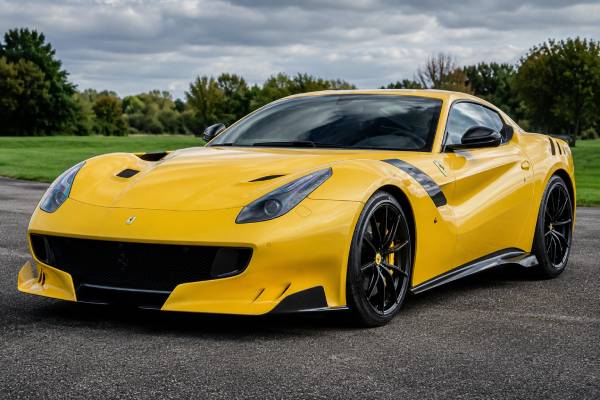
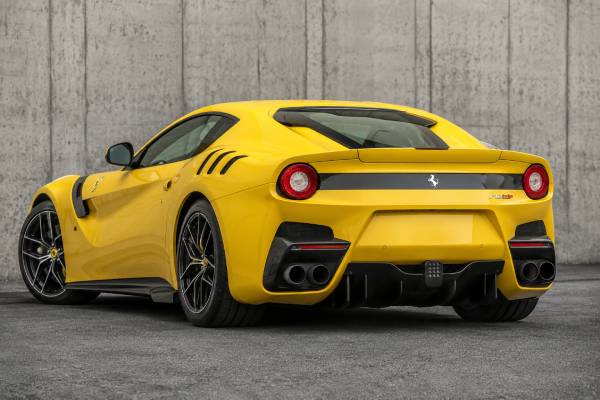
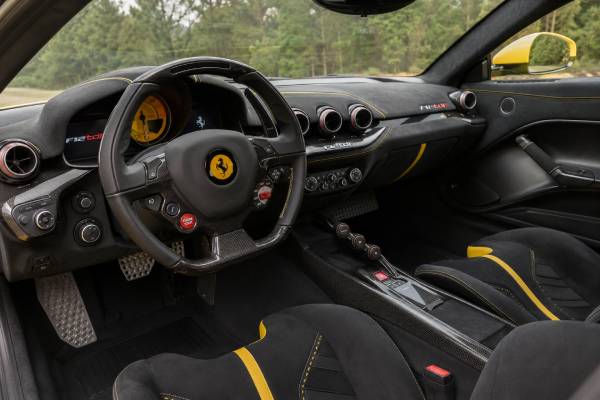
The Ferrari F12tdf is the limited-production, harder-edged version of the F12berlinetta, built from 2015 to 2017 as a front-engine V12 super-GT with a clear track bias. It uses the 6,262 cc F140 FG naturally aspirated V12, tuned to 780 metric horsepower, or about 769 hp, and sends power to the rear wheels through a seven-speed dual-clutch gearbox. Ferrari named it after the Tour de France automobile race, not the bicycle event, linking it to the brand’s 1950s and 1960s endurance-road-racing success.
For collectors, the F12tdf matters because only 799 were built and because it sits in a prized modern Ferrari line: 599 GTO, F12tdf, and 812 Competizione. For enthusiasts, it matters because it is one of the most aggressive front-engine V12 Ferraris ever made, with rear-wheel steering, serious aero work, lighter construction, and a wilder character than the standard F12.
Table of Contents
- Why the F12tdf Still Matters
- F140 FG V12, Chassis, and Specs
- Production Run, Options, and Identification
- Aero Design and Virtual Short Wheelbase
- Road and Track Driving Character
- Maintenance, Reliability, and Service Risks
- Market Values and Buying Checks
Why the F12tdf Still Matters
The F12tdf is important because it took Ferrari’s already extreme F12berlinetta and turned it into a sharper, rarer, more technical special series. It is not simply an F12 with more power; it is a lighter, more focused car with different aerodynamics, wider front tires, rear-wheel steering, revised controls, and a more demanding personality.
The base F12berlinetta arrived as Ferrari’s front-engine V12 flagship, replacing the 599 GTB Fiorano. It was a grand tourer by layout but a supercar by output, with more than 700 hp from a naturally aspirated V12. The F12tdf pushed that formula toward track use while keeping road legality, luggage space, and the classic long-hood Ferrari silhouette.
The name is central to the car’s identity. “tdf” refers to the Tour de France automobile race, a road-and-circuit endurance event where Ferrari built a strong reputation with cars such as the 250 GT Berlinetta. Ferrari used the name to signal stamina, speed, and race-bred road ability rather than comfort or luxury.
In the modern Ferrari hierarchy, the F12tdf belongs to the brand’s limited V12 special series. It followed the 599 GTO and came before the 812 Competizione. That position gives it three kinds of appeal:
- It is a collector car because production was capped at 799 examples.
- It is an engineering car because it introduced rear-wheel steering to a Ferrari road car.
- It is an enthusiast car because it preserves the front-engine, rear-drive, naturally aspirated V12 formula.
The F12tdf also arrived before Ferrari’s wider move toward hybridization and turbocharged powertrains. That does not make newer Ferraris less impressive, but it does make the F12tdf feel like a high point of a particular era. It is large, loud, front-engined, rear-drive, and naturally aspirated, yet it has enough electronic control and aero development to feel modern rather than nostalgic.
Its reputation today is based on contrast. The standard F12berlinetta is fast and dramatic, but it can still behave like a luxury GT. The F12tdf is more nervous, more immediate, more physical, and less forgiving. That edge is exactly why collectors want good examples and why drivers remember it.
F140 FG V12, Chassis, and Specs
The F12tdf’s core specification is simple but spectacular: a 6.3-liter naturally aspirated V12, rear-wheel drive, a dual-clutch gearbox, and a lighter aluminum chassis. Its official performance figures place it among the fastest front-engine road cars of its period.
| Item | Specification |
|---|---|
| Model code | F152-based Ferrari F12tdf |
| Production years | 2015–2017 |
| Engine code | F140 FG |
| Engine type | 65-degree naturally aspirated V12 |
| Displacement | 6,262 cc |
| Bore x stroke | 94.0 mm x 75.2 mm |
| Compression ratio | 13.5:1 |
| Maximum output | 780 cv / 769 hp at 8,500 rpm |
| Maximum torque | 705 Nm / 520 lb-ft at 6,250 rpm |
| Maximum engine speed | 8,900 rpm |
| Transmission | Seven-speed F1 dual-clutch gearbox |
| Drivetrain | Front-engine, rear-wheel drive |
The engine is the heart of the car. The F140 family is one of Ferrari’s great modern V12 lines, and in F12tdf form it gained a more intense calibration than the F12berlinetta. The tdf uses direct injection, a high compression ratio, revised intake behavior, and a very high rev limit. It makes peak power near the top of the tachometer, but it is not empty at low revs. A major part of the car’s usability is the wide spread of torque for a naturally aspirated engine.
The gearbox is a seven-speed dual-clutch transaxle. Compared with an older automated single-clutch Ferrari, it shifts with far more speed and smoothness. Compared with a traditional manual, it allows the V12 to stay in its strongest range with almost no interruption. Gear ratios and shift strategy are part of the tdf’s urgency: the car feels eager to stay awake.
| Item | Figure |
|---|---|
| Length | 4,656 mm |
| Width | 1,961 mm |
| Height | 1,273 mm |
| Wheelbase | 2,720 mm |
| Dry weight | 1,415 kg |
| Kerb weight | 1,520 kg |
| Weight distribution | 46% front / 54% rear |
| Fuel capacity | 92 liters |
| 0–100 km/h | 2.9 seconds |
| 0–200 km/h | 7.9 seconds |
| Top speed | Over 340 km/h / 211 mph |
| Fiorano lap time | 1 minute 21 seconds |
The chassis is based on Ferrari’s aluminum spaceframe approach rather than a carbon-fiber tub. That matters because the F12tdf is still a front-engine GT at its foundation, not a mid-engine prototype-style hypercar. Ferrari reduced weight through carbon fiber body panels and interior parts, lighter trim, and careful deletion of unnecessary comfort items.
The tires are a major part of the car’s behavior. Ferrari fitted wider front rubber than the standard F12 to improve turn-in and front-end bite. The front tires are 275/35 ZR20, while the rears are 315/35 ZR20. That front tire size, combined with faster steering and rear-wheel steering, helps explain why the car reacts so sharply for something with a big V12 ahead of the cabin.
The brakes are carbon-ceramic, with hardware influenced by Ferrari’s highest-performance models of the period. Official braking figures are very strong: 100–0 km/h in about 30.5 meters and 200–0 km/h in about 121 meters. For buyers, the key point is not only stopping power. Carbon-ceramic condition is a major cost and inspection item.
Production Run, Options, and Identification
Ferrari built the F12tdf as a single coupe-only limited series of 799 cars. There was no factory Spider, no manual version, and no separate powertrain choice, so condition, color, options, mileage, documentation, and provenance drive most of the differences between examples.
The car was unveiled in 2015 and built through 2017. All examples use the naturally aspirated V12, dual-clutch gearbox, rear-wheel drive, and tdf-specific aero and chassis package. That makes identification easier than with some older Ferraris, but buyers still need to confirm that the car’s configuration, options, and history match the factory records.
What makes an F12tdf identifiable
The F12tdf has several clear visual and technical identifiers:
- More aggressive front bodywork with larger aero surfaces.
- Distinctive louvres and vents around the rear quarter area.
- A steeper, more purposeful rear treatment than the standard F12.
- A larger rear spoiler profile and active rear diffuser.
- Wider front tires and tdf-specific chassis calibration.
- A stripped-back cabin with Alcantara, carbon fiber, and reduced trim.
- F12tdf badging and documentation matching the limited-series model.
Because values are high, documentation matters. A buyer should not rely only on badges, paint, or seller descriptions. The car should be checked through Ferrari records, factory build data, service invoices, and, where available, Ferrari Classiche or official dealer documentation.
Options and personalization
The F12tdf was often specified through Ferrari’s Atelier or Tailor Made programs. Many cars have expensive and highly personal combinations, and those choices can affect desirability strongly.
Common value-relevant options and specification areas include:
- Exterior carbon fiber, including splitter, diffuser, sill, engine-bay, and lighting-area trim.
- Racing stripes, historic livery themes, painted shields, or contrast roofs.
- Special paints, including triple-layer, Extra Range, historic colors, matte finishes, and one-off shades.
- Carbon-fiber racing seats, usually in different size choices.
- Alcantara-heavy interiors with contrast stitching, colored seat inserts, and special embroidery.
- Passenger display.
- Telemetry or track-related equipment where specified.
- Front axle lift, parking sensors, rear camera, or other usability options.
- JBL Professional audio on cars ordered with more comfort equipment.
- Brake caliper colors and forged wheel finishes.
Collectors often pay more for cars with tasteful, original, factory-documented specifications. A rare color can help, but only when the whole configuration works. A heavily personalized car may be more valuable to one buyer and less valuable to another. This is common in modern Ferrari collecting: rarity alone is not enough if the specification is awkward.
Originality and documents
A strong F12tdf file should include:
- Original order or window sticker where available.
- Factory option list.
- Books, tools, battery tender, covers, and accessories.
- Annual service records from Ferrari or a recognized specialist.
- Recall and campaign completion records.
- Paint protection film documentation if installed.
- Tire replacement records with date codes.
- Any warranty or extended-warranty paperwork.
- Clean title, import, tax, and registration history.
Matching numbers are discussed differently on a modern Ferrari than on a 1960s Ferrari, but the principle is similar: originality matters. Engine, gearbox, body, paint, interior, and factory options should align with official records. Any replacement engine, repaired carbon panel, repaint, accident entry, or missing factory accessory should be reflected in the price.
Aero Design and Virtual Short Wheelbase
The F12tdf’s special character comes from the way Ferrari combined power, aero, lighter weight, front-end grip, and rear-wheel steering. The car was engineered to feel much more agile than its size and layout suggest.
The design was created by the Ferrari Styling Centre, and it keeps the long-nose, cab-rearward shape of the F12berlinetta. The difference is that the tdf looks more carved and functional. Airflow management is visible everywhere: the front bumper, side channels, underbody, rear quarter vents, spoiler, and diffuser all serve a purpose.
Ferrari claimed a major improvement in aerodynamic efficiency compared with the F12berlinetta. Downforce rises sharply, with about 230 kg at 200 km/h. That is a serious figure for a road-legal front-engine car. The result is more high-speed stability and more confidence on fast circuits, without turning the car into a fixed-wing track special.
The active rear diffuser is one of the most important aero pieces. It changes how air exits from under the car, helping balance drag and downforce. The rear spoiler, rear screen treatment, and side vents are also more than decoration. They manage pressure, cooling, and rear stability.
Virtual Short Wheelbase
The F12tdf introduced Ferrari’s Virtual Short Wheelbase system, a rear-wheel-steering system designed to make the car feel more responsive without making it unstable. At certain speeds and conditions, the rear wheels steer slightly to help the car rotate or settle.
The name describes the sensation. At lower and medium speeds, the car can feel as if it has a shorter wheelbase because it turns in so quickly. At higher speeds, the system can help stability. The rear axle does not make huge visible movements; the effect is subtle in hardware but obvious in the way the car changes direction.
This system matters because the F12tdf has a big engine up front, a long wheelbase, and enormous speed. Without careful control, wider front tires and fast steering could make the rear feel too lively. Rear-wheel steering helps Ferrari create response without sacrificing control.
Interior design and sensory details
The cabin is not bare like a race car, but it is stripped back compared with a luxury GT. Ferrari used carbon fiber, Alcantara, and simplified trim to reduce weight and focus the driver’s attention. In many examples, the door panels, dashboard details, center tunnel, and seats make the car feel closer to a track special than a cross-continent grand tourer.
The sound is one of the car’s defining features. The V12 is naturally aspirated, high-revving, and mounted ahead of the driver, so the experience combines induction noise, mechanical sound, and exhaust note. It does not deliver the muted torque swell of a turbocharged engine. It builds, hardens, and becomes more intense as it nears the top of the rev range.
That is why the F12tdf remains emotionally powerful even against newer, quicker cars. Its numbers are impressive, but the sound, response, and sense of mechanical drama are what make it memorable.
Road and Track Driving Character
The F12tdf feels fast in a way that demands respect. It has huge power, instant throttle response, sharp steering, and a rear axle that can feel very alive, especially on cold tires or rough roads.
On paper, the car is easy to summarize: 0–100 km/h in 2.9 seconds, more than 340 km/h, and a Fiorano lap time of 1:21. On the road, the numbers are only part of the story. The larger point is how quickly the car reacts. The standard F12 is already extremely fast, but the tdf feels more alert and less relaxed.
The engine dominates the experience. At low revs, it is flexible enough for normal traffic. In the middle of the rev range, it starts to feel urgent. Near the top, it becomes ferocious. The throttle response is crisp because there are no turbochargers to wait for and no electric torque fill smoothing over the delivery. The driver gets a very direct connection between pedal movement and acceleration.
The dual-clutch gearbox suits the engine well. In automatic mode, it can behave cleanly enough for light use, but the car makes more sense in manual paddle operation. Upshifts are rapid, downshifts are dramatic, and the gearing encourages the driver to use the V12’s upper range.
Steering is one of the tdf’s most discussed traits. It is quick, and the front axle bites hard. Drivers coming from a softer GT may need time to trust it. Small inputs can create big responses. That makes the car exciting on the right road but nervous if the driver is clumsy.
The rear-wheel steering adds another layer. In fast, flowing bends, it can make the car feel more settled than expected. In tighter corners, it helps the car rotate. The effect is clever, but it does not remove the need for judgment. This is still a rear-drive Ferrari with 769 hp and a short temper when provoked.
Road usability
The F12tdf can be used on the road, but it is not as easygoing as the F12berlinetta. Ride quality is firmer, tire noise is more present, and the cabin is less insulated. The front overhang needs care on driveways, so a car with front lift is easier to live with.
Visibility is reasonable for a low exotic GT, but the long hood and wide body still require attention. Parking sensors and camera equipment are useful if fitted. In city traffic, the gearbox is much smoother than older single-clutch Ferrari systems, but the car never feels small or casual.
On a highway, it can still cover distance quickly and comfortably enough, especially compared with mid-engine track specials. The fuel tank is large, the seating position is good, and the V12 is not strained at cruising speed. But the tdf always feels like it would rather be on a clear mountain road or circuit.
Track behavior
On track, the F12tdf is more serious than the standard car. The aero helps at speed, the brakes are strong, and the front axle is much more positive. Tire temperature matters, and so does driver smoothness. Cold tires, old tires, or mismatched tires can make the car feel edgy.
The brakes can withstand hard use, but buyers should not confuse carbon-ceramic durability with zero running cost. Track use can be expensive. Pads, tires, fluid, alignments, and carbon-ceramic disc condition all matter. A car that has done track days is not automatically bad, but it needs a deeper inspection than a static collection car.
The best way to understand the F12tdf is as a very fast analog-feeling car with modern electronic support. It is not actually analog in the old sense; the systems are complex. But the engine, sound, steering response, and rear-drive balance make the driver feel heavily involved.
Maintenance, Reliability, and Service Risks
The F12tdf is not known as a fragile car when maintained correctly, but it is still a limited Ferrari V12 with expensive consumables, complex electronics, and very costly body and brake components. The right question is not whether it is “reliable” in a normal used-car sense, but whether a specific example has been serviced, stored, driven, and inspected properly.
Most F12tdf examples have low mileage. That can be good for cosmetics and collectability, but low mileage does not eliminate risk. Cars that sit for long periods can develop battery problems, tire aging, sticky controls, fluid deterioration, seal weeping, and electronic faults. A regularly exercised car with proper annual service can be healthier than a delivery-mile car that has mostly sat on display.
Major areas to inspect
A proper pre-purchase inspection should focus on the whole car, not just the engine.
| Area | What to check | Why it matters |
|---|---|---|
| Engine | Leaks, misfires, warning lights, service history, abnormal noise | The V12 is strong but expensive to diagnose and repair |
| DCT gearbox | Shift quality, fault codes, adaptation data, fluid service history | Gearbox issues are costly and require specialist tools |
| Brakes | Disc wear, cracks, chips, pad life, fluid age, recall completion | Carbon-ceramic parts can be extremely expensive |
| Suspension | Dampers, bushings, front lift, alignment, tire wear | Sharp handling depends on correct setup |
| Body and carbon | Paint depth, panel gaps, splitter damage, diffuser repairs | Carbon and aero parts are costly and affect value |
| Electronics | Battery health, modules, displays, sensors, warning history | Modern Ferraris dislike weak batteries and poor storage |
| Documentation | Factory options, books, tools, service invoices, campaign records | Paperwork is a major value factor |
The battery should be treated as a maintenance item. These cars should live on the correct maintainer when stored. A weak battery can trigger confusing warning lights and module communication faults. Replacing a battery is not the issue; chasing voltage-related faults can waste time and money.
Tires are another common blind spot. A car with 1,000 miles may still need tires if the date codes are old. On an F12tdf, tire condition affects safety, ride, steering, and value. The car’s chassis was tuned around serious performance tires, so bargain replacements or mixed tire types should be avoided.
Carbon-ceramic brakes deserve careful measurement and visual inspection. A seller may describe them as “like new” based on mileage, but disc condition depends on use, heat cycles, cleaning methods, stone damage, and track driving. Replacement cost is high enough to change the economics of a purchase.
Recalls and campaigns
Recall exposure depends on market, model year, and VIN. U.S. records have included F12-family cars in campaigns involving brake-fluid reservoir cap ventilation and software warnings, and some F12tdf examples have appeared in airbag ECU-related recall information. The only safe approach is to check the VIN with Ferrari or the relevant national recall database.
Campaign completion should be documented. A car with an open recall is not necessarily a bad car, but it should be resolved through an authorized Ferrari dealer. Buyers should also check for software updates and service bulletins that may not appear as public safety recalls.
Ownership costs and restoration reality
The F12tdf is too new to be a restoration car in the traditional sense, but it is already old enough for age-related work. Rubber, fluids, adhesives, electronics, protective film, and interior materials all age. A car stored in a climate-controlled collection may still need recommissioning if it has barely been driven.
Important ownership cost drivers include:
- Annual servicing by Ferrari or a recognized specialist.
- Brake fluid, coolant, gearbox fluid, and other time-based maintenance.
- Tires, alignment, and suspension setup.
- Carbon-ceramic brake inspection and possible replacement.
- Front splitter, underbody, and diffuser damage.
- Front lift faults where fitted.
- Sticky or worn interior switchgear and trim.
- Paint correction or paint protection film replacement.
- Transport, storage, insurance, and warranty coverage.
Originality versus upgrades is also important. Some owners may want aftermarket exhausts, lowering springs, wheel spacers, or tuning. Those changes can make the car more exciting to one driver but less attractive to a collector. For a high-value F12tdf, reversible changes should be documented, and original parts should stay with the car.
Market Values and Buying Checks
The F12tdf has become a blue-chip modern Ferrari, with values far above the standard F12berlinetta and increasingly sensitive to specification, mileage, and provenance. The best cars are no longer just used supercars; they are collector-grade assets.
Recent public auction activity shows a wide spread. Many normal excellent cars have traded around the low-to-mid seven-figure range in U.S. dollar terms, while exceptional, ultra-low-mileage, single-owner, or highly specified examples can bring much more. A very low-mileage 2017 example sold at Amelia in 2026 for a record-level result, showing how far buyers may go for the right car in the right setting.
That does not mean every F12tdf is worth a record price. The market separates cars sharply. A common-color car with higher mileage, missing accessories, accident history, non-original modifications, or patchy service records may sit well below the most publicized sales. A rare Tailor Made or Atelier car with superb records, low mileage, original paint, and full accessories can command a major premium.
What drives value
The strongest value factors are:
- Original factory specification.
- Desirable color and interior combination.
- Low but believable mileage.
- Clean paintwork and no accident history.
- Complete books, tools, tender, covers, and accessories.
- Ferrari dealer or top specialist service history.
- Completed recalls and campaigns.
- Factory carbon options and tasteful personalization.
- Strong provenance, such as single ownership or notable collection history.
- Market-specific paperwork, taxes, import documents, and title clarity.
Color is more nuanced than many buyers expect. Rosso Corsa is always recognizable, but rare reds, yellows, blues, silvers, whites, and historic shades can be more desirable when paired well with the interior and stripe package. Matte finishes and highly personal liveries require extra care because repainting or repairing them can be difficult.
Cars to seek
The best F12tdf to buy is not always the lowest-mileage car. It is the car with the cleanest story.
Seek examples with:
- Full Ferrari service history.
- Clear factory build sheet or window sticker.
- No accident or paintwork concerns.
- Sensible recent use rather than years of total inactivity.
- Fresh tires or allowance for replacement.
- Verified brake condition.
- All original equipment present.
- A specification that will still look good in ten years.
A car with a few thousand miles and excellent maintenance can be a better ownership prospect than a delivery-mile car needing recommissioning. For investment-focused buyers, mileage still matters, but condition and documentation matter just as much.
Cars to avoid or price carefully
Be cautious with:
- Missing service history.
- Unexplained warning lights.
- Old tires on a “perfect” low-mileage car.
- Non-factory carbon parts or modified exhausts without originals.
- Paintwork that cannot be explained.
- Front splitter and underbody damage.
- Track use without brake, tire, and fluid records.
- Imported cars with incomplete tax or registration history.
- Cars missing books, tools, battery tender, covers, or option records.
- Sellers unwilling to allow a specialist inspection.
Because values are high, small details become expensive. A missing accessory set, poor paint protection film removal, incorrect tires, or undocumented body repair can reduce buyer confidence. The car may still be mechanically excellent, but the market rewards certainty.
Buying process checklist
Before purchase, use a structured process:
- Confirm the VIN and factory specification through Ferrari or a trusted specialist.
- Review the full service file and check for annual maintenance gaps.
- Verify recall and campaign completion.
- Inspect paint depth, carbon panels, underbody, splitter, and diffuser.
- Scan all modules for stored and current faults.
- Check tire brand, specification, tread, and date codes.
- Measure or professionally assess carbon-ceramic brake condition.
- Confirm all books, keys, tender, covers, tools, and accessories.
- Review title, import, tax, and lien status.
- Drive the car only when conditions allow proper tire temperature and safe testing.
The F12tdf is likely to remain collectible because it combines scarcity, a famous name, a naturally aspirated V12, dramatic styling, and genuine engineering significance. It is also usable enough to enjoy, which separates it from cars that are valuable but awkward. The best ownership strategy is to buy the right car, maintain it without shortcuts, keep every record, and resist changes that cannot be reversed.
References
- Ferrari F12tdf (2015) – Ferrari.com 2015 (Manufacturer Specifications) ([Ferrari][1])
- Ferrari F12tdf: Ferrari History 2015 (Manufacturer History) ([Ferrari][2])
- Part 573 Safety Recall Report 22V-536 2022 (Recall Database)
- 2016 Ferrari F12tdf | Abu Dhabi 2025 (Auction Result) ([RM Sotheby’s][3])
- 2017 Ferrari F12tdf | The Amelia Auction 2026 2026 (Auction Result) ([Broad Arrow Auctions][4])
Disclaimer
This article is for informational purposes only and is not a substitute for professional diagnosis, repair, valuation, or inspection. Specifications, torque values, service intervals, procedures, recall status, and parts can vary by VIN, market, equipment, software version, and service history. Always verify details against the official Ferrari service documentation and have any car inspected by a qualified Ferrari technician or specialist before purchase or repair.
If this guide helped you, please consider sharing it on Facebook, X/Twitter, or your preferred enthusiast community to support our work.