
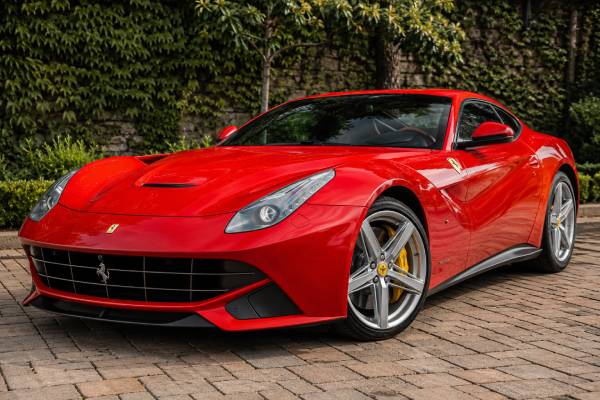

The Ferrari F12berlinetta is the front-mid-engine V12 Ferrari that replaced the 599 GTB Fiorano and carried Maranello’s grand touring line into a sharper, more modern era. Known internally as the F152, it uses the F140 FC 6.3-liter naturally aspirated V12, quoted by Ferrari at 740 CV and commonly rounded in U.S. output figures to about 730 hp. Built from 2012 to 2017, the F12 sits between the older analog-feeling 599 and the later, even more powerful 812 Superfast. It matters because it combines a traditional Ferrari layout—long hood, two seats, rear-wheel drive, and a front-mounted V12—with very modern aerodynamics, dual-clutch shifting, magnetic dampers, carbon-ceramic brakes, and advanced traction systems. For buyers, owners, collectors, and enthusiasts, it remains one of the most usable ways to own a naturally aspirated Ferrari V12 with serious long-term appeal.
Table of Contents
- Why the F12berlinetta Still Matters
- F140 FC V12 Specs and Chassis Data
- Model Years, Options, and Factory Identification
- Aero Bridge Design and Ferrari Engineering
- How the F12berlinetta Drives
- Maintenance Risks and Specialist Ownership
- Market Values and Buyer Checklist
Why the F12berlinetta Still Matters
The F12berlinetta matters because it reset Ferrari’s front-engine V12 formula after the 599 GTB. It was faster, lighter, more compact, more technically advanced, and much more aggressive in character while still being a real road car rather than a track special.
The 599 GTB Fiorano had already moved Ferrari’s big V12 coupe into the modern era with an aluminum chassis, F1-style gearbox, and serious electronic control. The F12berlinetta went much further. Ferrari shortened the car, lowered the center of gravity, moved mass rearward, sharpened the transaxle layout, and gave the car a naturally aspirated V12 that was extraordinary even by Ferrari standards.
Its place in the model line is important. The F12 was the direct successor to the 599 and the predecessor to the 812 Superfast. It was not a limited-production halo car like the Enzo or LaFerrari, but at launch it was one of the fastest and most powerful production road Ferraris ever offered to normal customers. That makes it attractive to buyers who want a flagship-style Ferrari without stepping into the much higher pricing and complexity of limited-series machinery.
The car also arrived at a turning point. Turbocharging, hybrid assistance, emissions rules, and noise regulations were changing the supercar world quickly. The F12’s appeal today is tied to the fact that it still feels like a pure naturally aspirated V12 Ferrari: high revs, instant throttle response, a hard metallic intake note, and a rear-drive chassis that demands respect.
Historically, it also marked a design change. The body was shaped by Ferrari Styling Centre under Flavio Manzoni in collaboration with Pininfarina, but it did not look like a soft continuation of earlier Pininfarina grand tourers. It was more technical, more sculpted, and more aerodynamic. The “Aero Bridge” front-fender treatment became one of the car’s signature features and helped turn the F12 into a design reference point for later Ferrari berlinettas.
For collectors, the F12berlinetta is not rare in the numbered-edition sense, but it is becoming more important because of what it represents. It is a naturally aspirated V12 Ferrari from the final stretch before electrification became central to high-performance development. The best cars—low mileage, original paint, strong colors, carbon options, complete books, invoices, tools, and Ferrari service records—are already treated differently from ordinary used exotic cars.
For drivers, it remains unusually broad in ability. It can cruise, tour, and carry luggage, yet its performance is still extreme. It is not a small sports car and it is not as delicate as a classic front-engine Ferrari, but it has enough drama to feel special at any speed.
F140 FC V12 Specs and Chassis Data
The core of the F12berlinetta is its 6,262 cc F140 FC naturally aspirated V12. Ferrari quoted 740 CV at 8,250 rpm and 690 Nm of torque at 6,000 rpm, with a maximum engine speed of 8,700 rpm.
| Item | Specification |
|---|---|
| Model code | F152 |
| Engine code | F140 FC |
| Engine type | 65-degree naturally aspirated V12 |
| Displacement | 6,262 cc |
| Bore x stroke | 94.0 mm x 75.2 mm |
| Compression ratio | 13.5:1 |
| Fuel system | Direct injection |
| Maximum power | 545 kW / 740 CV at 8,250 rpm |
| U.S.-style output reference | About 730 hp |
| Maximum torque | 690 Nm / 509 lb-ft at 6,000 rpm |
| Maximum engine speed | 8,700 rpm |
| Transmission | 7-speed F1 dual-clutch transaxle |
| Drivetrain | Rear-wheel drive |
The F140 engine family is a major part of modern Ferrari history. Versions of it appeared in several important Ferrari models, but the F12’s F140 FC tune is especially valued because of its response and sound. It uses high compression, direct injection, a dry-sump lubrication system, and very careful intake and exhaust tuning. The result is not only peak power, but a very wide, urgent power band for a naturally aspirated engine.
The dual-clutch transaxle is also central to the car’s feel. Earlier V12 Ferraris with single-clutch automated manuals can feel dramatic but clunky in traffic. The F12’s 7-speed dual-clutch gearbox is much smoother at low speed and much quicker during hard driving. It makes the car easier to use daily, but it also removes some of the old-school mechanical harshness that collectors either love or dislike depending on taste.
| Area | Ferrari F12berlinetta data |
|---|---|
| Body structure | Aluminum spaceframe and aluminum body construction |
| Suspension | Front double wishbone, rear multi-link |
| Dampers | SCM-E magnetorheological adaptive dampers |
| Brakes | CCM3 carbon-ceramic discs |
| Front tires | 255/35 ZR20 |
| Rear tires | 315/35 ZR20 |
| Wheelbase | 2,720 mm |
| Length | 4,618 mm |
| Width | 1,942 mm |
| Height | 1,273 mm |
| Dry weight | 1,525 kg, depending on specification |
| Kerb weight | About 1,630 kg, depending on market and equipment |
| Weight distribution | 46% front / 54% rear |
| Fuel capacity | 92 liters / 24.3 U.S. gallons |
| 0–100 km/h | 3.1 seconds |
| 0–200 km/h | 8.5 seconds |
| Top speed | Over 340 km/h / about 211 mph |
The numbers only partly explain the car. A 46/54 weight split, rear transaxle, quick steering, electronic differential, F1-Trac traction control, and magnetorheological dampers help the F12 manage a huge amount of front-mounted V12 power. It is still a large, powerful car, but it does not feel like an old-fashioned nose-heavy GT when driven properly.
Model Years, Options, and Factory Identification
The standard F12berlinetta was not a numbered limited edition, so specification matters more than a plaque. The most desirable examples are usually the most original, best documented, lowest-mileage cars with strong colors, tasteful carbon options, and continuous Ferrari service history.
Production began in 2012, with most market listings and registrations falling across the 2013 to 2017 model years. It was built as a two-seat berlinetta coupe. There was no regular-production spider version of the standard F12berlinetta, which helps keep the coupe identity clean and focused.
The F12tdf is related but should not be confused with the standard F12berlinetta. The tdf is a limited, more track-focused model with more power, weight reduction, rear-wheel steering, different aero, and much higher collector pricing. One-off and Special Projects cars also used the F12 platform, but they belong in a different buying category entirely.
For the standard car, buyers should focus on the build sheet. Ferrari options can change the feel and value of an F12 significantly. Carbon-fiber exterior and interior pieces, front-axle lift, forged wheels, special stitching, Daytona or racing seats, passenger display, premium audio, parking cameras, and special-order paint can all influence desirability.
| Option area | Why it matters |
|---|---|
| Exterior color | Rosso shades are classic, but special colors, historic colors, and elegant greys or blues can bring strong interest when paired with the right interior. |
| Interior trim | Daytona seats, racing seats, contrast stitching, leather color, Alcantara, and carbon trim affect both appearance and resale appeal. |
| Carbon-fiber packages | Carbon driver zone, bridge, sill plates, exterior details, and engine-bay trim can add value if factory documented. |
| Front-axle lift | Highly useful for real-world roads, steep driveways, transport loading, and protecting the front underside. |
| Wheels and brake calipers | Factory forged wheels and tasteful caliper colors can improve appearance without hurting originality. |
| Passenger display | A popular modern Ferrari option that gives the passenger speed, rpm, and performance information. |
| Documentation | Window sticker, build sheet, books, tools, battery tender, tire inflator, service invoices, and Ferrari Approved paperwork matter to buyers. |
Authentication is usually straightforward if the car is complete and unmodified. The VIN, engine number, body tags, option plate or build documentation, service invoices, and Ferrari dealer records should all support the car’s identity. A specialist can also confirm whether paint depth, panel gaps, undertray condition, glass markings, and hardware look consistent with the mileage and accident history.
Factory originality is especially important because many F12s were personalized after purchase. Aftermarket exhausts, ECU tunes, lowered suspension, non-factory wheels, painted trim changes, and carbon add-ons can make a car more exciting to some owners but less attractive to conservative collectors. Reversible upgrades are less damaging than permanent modifications, but the original parts should come with the car.
Aero Bridge Design and Ferrari Engineering
The F12’s shape is functional first, which is why it still looks modern. Its most memorable design features are not decoration; they manage airflow, cooling, stability, and high-speed confidence.
The front of the car is defined by the long hood, deep grille, and sculpted channels that lead into the Aero Bridge. This feature routes air from the hood area through openings near the front fenders and along the sides of the car. The goal is to increase downforce and clean up airflow without relying on a large fixed wing. It gives the F12 a carved, muscular look, but its purpose is engineering.
The rear is a short, powerful Kamm-style tail with circular lamps, a diffuser, and vertical aerodynamic elements. Compared with the 599, the F12 looks more compact and more tense. The cabin sits far back, the hood is long, and the flanks are deeply cut. That layout visually tells the truth about the car: the V12 is mounted behind the front axle line, the gearbox is at the rear, and the mass is pulled toward the center of the chassis.
Ferrari also used active brake cooling. The front brake-cooling ducts can stay closed when extra cooling is not needed, reducing drag, then open when brake temperature requires more airflow. For a road car with more than 700 hp and carbon-ceramic brakes, this is not a small detail. It helps the F12 combine top-speed efficiency with repeated hard braking.
The chassis is made from multiple aluminum alloys rather than carbon fiber. That choice kept the car in Ferrari’s front-engine GT tradition while allowing stiffness, weight control, and repairability that made sense for a production grand tourer. It is still an exotic structure, but it is not a carbon-tub hypercar. For owners, that can make long-term care somewhat more approachable, although structural repairs still require Ferrari-level expertise.
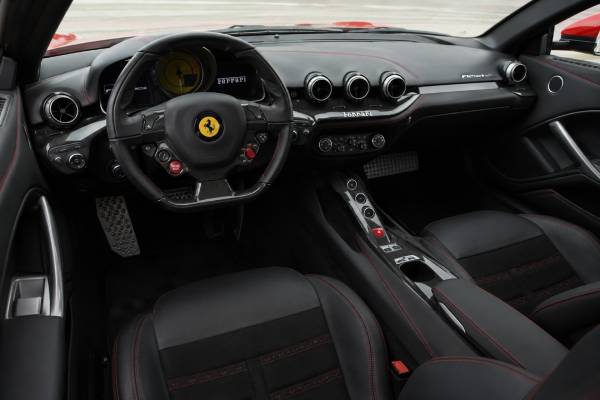
Inside, the F12 follows the modern Ferrari driver-focused layout. Major controls are on the steering wheel, including the manettino drive-mode switch, indicators, lights, wipers, and engine start button. The center bridge carries transmission controls. The cabin is more compact and purposeful than a luxury coupe’s interior, yet there is usable luggage space behind the seats and beneath the rear hatch.
The sensory engineering is just as important as the visible design. The intake and exhaust tuning give the F12 its personality. At low rpm it can be surprisingly calm. As revs rise, the tone hardens into a sharp, layered V12 sound that is very different from turbocharged performance cars. That sound is a major part of the car’s market appeal today.
How the F12berlinetta Drives
The F12 feels like a grand tourer until the V12 is opened up, and then it feels much closer to a supercar. Its defining trait is the combination of huge naturally aspirated power with a chassis that is more agile than the layout suggests.
Throttle response is immediate. There is no turbo lag and no electric fill; the car responds directly to pedal movement. The engine pulls hard from low rpm, but it becomes truly special in the upper half of the tachometer. The final rush toward 8,700 rpm is one of the reasons the F12 has held enthusiast attention so well.
The gearbox is quick and polished. In automatic or relaxed manual use, it is smooth enough for traffic and touring. In more aggressive settings, shifts become sharper and better timed. It does not dominate the experience the way an older single-clutch Ferrari gearbox can. Instead, it lets the engine take center stage.
Steering is fast, and this is one area where first-time drivers need adjustment. The F12 does not require large steering inputs. On a mountain road, nervous hands can make the car feel busier than it really is. A calm driver who lets the chassis settle will find much better balance.
Ride quality is firm but not punishing when the dampers and tires are healthy. The magnetorheological suspension gives the car enough compliance for real roads, especially compared with more track-focused exotics. Tire condition matters enormously. Old, heat-cycled, mismatched, or budget replacement tires can make the F12 feel harsh, vague, or traction-limited.
Braking performance is extremely strong, but carbon-ceramic brakes need inspection. They work very well on the road and can tolerate serious heat, but rotor condition, pad life, sensor readings, and surface damage should be checked before purchase. Replacement costs are high enough to affect the value of an individual car.
The F12’s handling balance is rear-biased, powerful, and controlled by sophisticated electronics. With all systems active, it gives the driver a lot of support. In more permissive settings, the car still demands respect. A naturally aspirated V12 sending this much torque to the rear tires can overwhelm cold tires or poor pavement very quickly.
As a road car, the F12 is more usable than its numbers suggest. Visibility is better than many mid-engine supercars, the front lift option helps in daily situations, luggage space is practical for a two-seat Ferrari, and the cabin can handle long-distance driving. The tradeoff is width, low ride height, tire noise, and the constant awareness that small mistakes can become expensive.
On track, the F12 is fast but not as naturally suited to repeated abuse as a lighter mid-engine track model. It has serious brakes, cooling, and electronics, but it is still a front-engine V12 GT with expensive consumables. Track use should show up in a pre-purchase inspection through tire wear, brake condition, underbody marks, heat exposure, and service history.
Maintenance Risks and Specialist Ownership
A good F12 can be dependable by exotic-car standards, but it is never a casual used car. The expensive problems usually come from deferred maintenance, accident history, worn carbon-ceramic brakes, neglected tires, electrical issues, and cars bought without a proper Ferrari specialist inspection.
Ferrari’s seven-year maintenance program helped many early owners keep service records clean. By now, all standard F12berlinettas are old enough that buyers must look beyond the original program and judge the actual maintenance pattern. Annual servicing, brake-fluid care, gearbox checks, battery health, software updates, and inspection reports matter more than low mileage alone.
The V12 itself is generally respected when maintained correctly, but heat, age, fluids, sensors, gaskets, and ancillary systems need attention. Low-mileage cars are not automatically trouble-free. Cars that sit for long periods can develop battery, tire, seal, brake, and fuel-system problems.
Key ownership areas to check include:
- Service history: Look for annual or mileage-based service, not long gaps explained away by low use.
- Battery and charging: Weak batteries create strange electronic faults in modern Ferraris.
- Gearbox behavior: Shifts should be clean, with no hesitation, warning lights, or fluid-leak evidence.
- Suspension: Check dampers, bushings, ball joints, lift system operation, and uneven tire wear.
- Carbon-ceramic brakes: Confirm rotor condition, pad life, sensor data, and any track-use history.
- Tires: Replace aged tires even if tread depth looks acceptable.
- Cooling system: Inspect radiators, hoses, fans, debris buildup, and signs of overheating.
- Exhaust and manifolds: Listen for leaks, rattles, failed valves, or non-factory modifications.
- Interior electronics: Test displays, switches, manettino functions, cameras, sensors, HVAC, seat controls, and passenger display if fitted.
- Body and undertray: Look for curb strikes, front splitter damage, repaired panels, repainting, and missing fasteners.
Recalls and campaigns should be verified by VIN. U.S. recall records include a brake-fluid reservoir cap campaign affecting 2013–2017 F12 vehicles, with the remedy involving cap replacement and software updates for warning behavior. Some cars may also have airbag-related recall history depending on market and build. A Ferrari dealer can confirm open campaigns.
| Inspection area | What to verify | Why it matters |
|---|---|---|
| VIN and records | Build sheet, service invoices, ownership history, recall completion | Protects value and confirms the car is what the seller claims |
| Paint and body | Paint meter readings, panel gaps, glass, trim, front underside | Accident repair and repainting can materially affect collectability |
| Powertrain | Cold start, leaks, fault codes, gearbox operation, exhaust valves | V12 and transaxle repairs are specialist, high-cost work |
| Brakes | Carbon-ceramic rotor condition, pad wear, warning lights | Brake replacement can change the economics of a purchase |
| Suspension and lift | Damper condition, lift operation, bushings, alignment | Worn suspension makes the car feel nervous and expensive to correct |
| Electronics | Battery test, modules, displays, sensors, HVAC, cameras | Modern Ferrari faults often start with voltage or module issues |
| Original parts | Factory wheels, exhaust, books, tools, charger, removed parts | Originality supports resale and collector confidence |
Independent Ferrari specialists can be excellent, but documentation should be detailed. A short invoice that says “service completed” is less useful than a record showing fluids, filters, brake measurements, diagnostic scans, battery condition, tire dates, and technician notes. For a high-value F12, a pre-purchase inspection should include a road test, lift inspection, diagnostic scan, paint readings, and review of all paperwork.
Market Values and Buyer Checklist
The F12berlinetta is no longer just a depreciated super-GT; it has entered modern collector territory. Values depend heavily on mileage, originality, color, options, service history, market, and whether the car has been modified or tracked.
Recent public-market data places average F12berlinetta transaction values around the mid-$200,000 range, while special low-mileage or highly desirable dealer-listed cars can be advertised far higher. Higher-mileage, modified, or less ideally specified cars usually trade below the best examples. The gap between an average car and an excellent car is large enough that buyers should not shop by price alone.
The main value drivers are:
- Mileage: Very low mileage helps, but only when service history is strong.
- Originality: Factory paint, factory exhaust, factory wheels, and unmodified electronics matter.
- Specification: Carbon options, lift, seats, wheels, special colors, and tasteful interiors can add demand.
- Condition: Sticky interior parts, worn bolsters, front-end chips, underbody damage, and aged tires reduce appeal.
- Documentation: A complete file with window sticker, build sheet, invoices, books, tools, and recall records is valuable.
- Ownership history: Known ownership, clean title, no accident history, and Ferrari dealer involvement help.
- Market location: U.S., European, U.K., Middle Eastern, and Asian-market cars can differ in equipment, history, and import complexity.
The best F12 to buy is usually not the cheapest one. A slightly more expensive car with clear records, original condition, recent tires, completed recalls, healthy brakes, and no stories can be cheaper over five years than a discounted car needing correction.
Avoid cars with vague history, missing records, unexplained warning lights, old tires, aftermarket tunes without original parts, heavy track use, poor repainting, inconsistent panel gaps, incomplete recall status, or sellers unwilling to allow a specialist inspection.
A serious buyer should follow a simple sequence:
- Confirm the VIN, build specification, market, and title status.
- Review service invoices line by line.
- Check open recalls and Ferrari campaign completion.
- Inspect tires, brakes, suspension, lift system, and underbody before negotiating.
- Run a diagnostic scan and road test from cold.
- Verify paintwork and accident history.
- Price the car based on required work, not just mileage or color.
- Keep money aside for immediate baseline maintenance after purchase.
Long-term collectability looks strong for the right examples. The F12 is powerful, beautiful, usable, and emotionally distinctive. It is also one of the last front-engine Ferrari V12s that feels mostly defined by engine, chassis, and aero rather than hybrid systems or turbocharging. That does not mean every F12 will become a blue-chip investment. It means the best cars are likely to remain sought after because they deliver an experience that is becoming harder to replace.
References
- Ferrari F12berlinetta (2012) – Ferrari.com 2012 (Manufacturer Specifications)
- Warranties And Official Ferrari Maintenance 2026 (Manufacturer Maintenance)
- Part 573 Safety Recall Report 22V-536 2022 (Recall Database)
- F12 Berlinetta Car 2014 (Design Award)
- Ferrari F12berlinetta Market – CLASSIC.COM 2026 (Market Data)
Disclaimer
This article is for informational purposes only and is not a substitute for professional diagnosis, inspection, repair, valuation, or legal advice. Specifications, torque values, service intervals, recall status, parts, fluids, software procedures, and repair methods can vary by VIN, model year, market, and equipment. Always verify details against official Ferrari service documentation and have any Ferrari F12berlinetta inspected by a qualified Ferrari dealer or specialist before purchase or repair.
If you found this guide useful, please consider sharing it on Facebook, X/Twitter, or your favorite car community to support our work.