
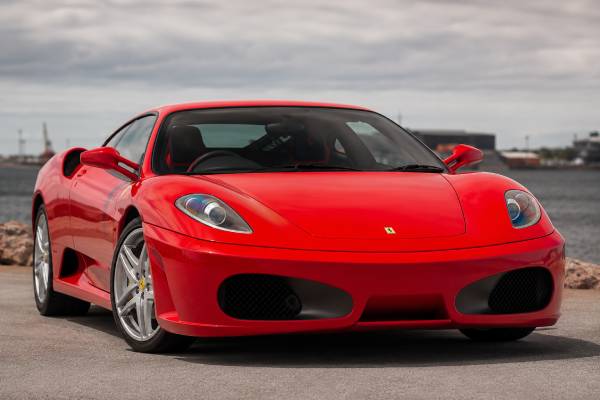
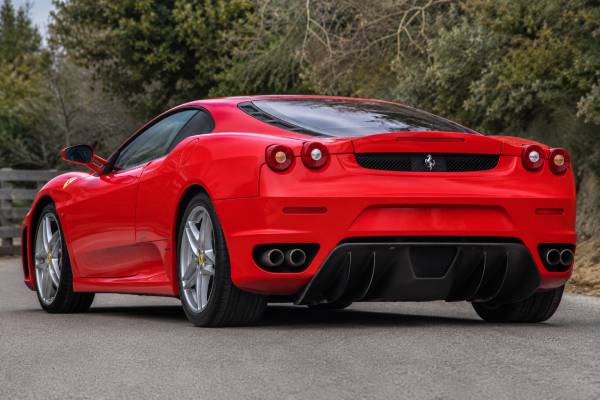
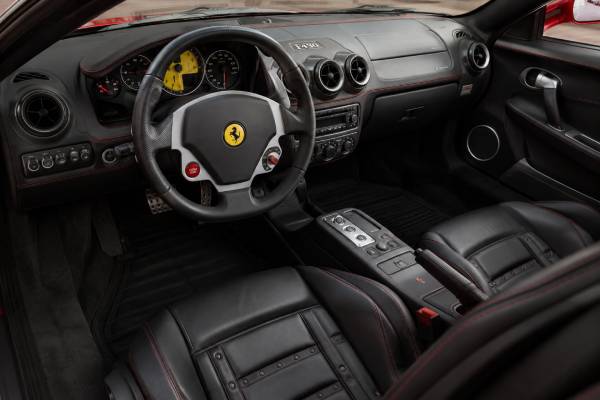
The Ferrari F430 is the mid-engine V8 berlinetta and Spider that replaced the 360 Modena and helped define Ferrari’s modern analog-to-digital turning point. Built on the F131 platform and powered by the F136 E 4.3-liter flat-plane-crank V8, it brought 490 CV, an 8,500 rpm redline, the E-Diff electronic differential, steering-wheel manettino control, and available carbon-ceramic brakes to Ferrari’s regular-production V8 line. It is also one of the last mid-engine Ferraris available with a traditional open-gate manual gearbox, which now gives the model serious collector weight. For buyers, owners, and enthusiasts, the F430 matters because it combines real usability with a raw naturally aspirated soundtrack, sharp hydraulic steering, important Formula 1-era technology, and a market split between accessible F1 paddle-shift cars and highly prized factory manuals.
Table of Contents
- Why the F430 Still Matters
- F136 E V8, Chassis, and Core Specs
- Coupe, Spider, Scuderia, and Options
- Pininfarina Shape and Race-Bred Details
- Road and Track Driving Character
- Maintenance Risks and Ownership Reality
- Market Values and Buyer Checks
Why the F430 Still Matters
The F430 is important because it took Ferrari’s aluminum mid-engine V8 formula and added a level of powertrain, differential, brake, and chassis control that felt genuinely new in 2004. It was not a mild facelift of the 360 Modena; it was a much deeper evolution with a new engine family, new electronic systems, more dramatic aero detailing, and a sharper performance brief.
Ferrari introduced the F430 at the 2004 Paris Motor Show, with customer cars reaching many markets for the 2005 model year. It replaced the 360 Modena, a car that had already modernized Ferrari’s V8 line with an aluminum spaceframe, visible-engine styling, and improved usability. The F430 kept the same broad mid-engine, rear-drive layout, but it gave the platform a more forceful personality.
The biggest change was the F136 E V8. The older 360 used a 3.6-liter V8; the F430 moved to 4,308 cc and raised output to 490 CV at 8,500 rpm. That was a major jump for Ferrari’s “entry” mid-engine model and put the car close to supercar territory while still being relatively compact, communicative, and usable.
The F430 also arrived during a rich period for Ferrari Formula 1 technology. The steering-wheel manettino, E-Diff, F1-style paddle gearbox logic, and aggressive brake development all helped Ferrari connect its road cars to the image and engineering culture of its Grand Prix program. Some of the systems now seem normal because later cars made them familiar, but the F430 was one of the cars that made them central to Ferrari road-car identity.
For collectors, the model has three main claims:
- It is one of the last naturally aspirated Ferrari V8s before the later move to turbocharging.
- It is the final regular-production mid-engine Ferrari V8 offered with a factory gated manual gearbox.
- It marks the moment when electronic chassis control began to shape the driving character without fully taking over the experience.
The F430 also sits in an appealing ownership window. It is modern enough to have strong brakes, effective air conditioning, usable ergonomics, and diagnostic systems, yet old enough to feel mechanical compared with dual-clutch 458, 488, and F8 models. A good F430 still feels like a car that asks the driver to participate.
Its reputation today depends heavily on specification. An F1 paddle-shift coupe can be one of the more attainable modern-classic Ferraris. A clean factory manual Spider or berlinetta is a far more serious collector item. A 430 Scuderia or Scuderia Spider 16M belongs in a different, more focused market. That spread is part of the F430’s appeal: the same model family can suit a driver, a collector, or a long-term Ferrari investor, but only if the buyer understands the differences.
F136 E V8, Chassis, and Core Specs
The core F430 specification is built around a 4.3-liter naturally aspirated V8, rear-wheel drive, an aluminum chassis, and either a six-speed gated manual or six-speed F1 automated manual. Ferrari quoted 490 CV, commonly described as 490 metric horsepower, while SAE output is often listed at about 483 hp.
| Item | Specification |
|---|---|
| Platform code | F131 |
| Engine code | F136 E |
| Engine layout | 90-degree naturally aspirated V8, rear mid-mounted |
| Displacement | 4,308 cc / 4.3 liters |
| Bore x stroke | 92 mm x 81 mm |
| Compression ratio | 11.3:1 |
| Maximum power | 490 CV at 8,500 rpm |
| Maximum torque | 465 Nm / 343 lb-ft at 5,250 rpm |
| Transmission | 6-speed manual or 6-speed F1 automated manual |
| Drivetrain | Rear-wheel drive with E-Diff electronic differential |
| 0–100 km/h | About 4.0 seconds |
| Top speed | Over 315 km/h / about 196 mph |
The F136 E is a flat-plane-crank V8, which means the crankshaft design supports quick revving, sharp exhaust pulses, and the high-pitched sound many people associate with Ferrari’s naturally aspirated V8 era. Unlike a turbocharged engine, it does not deliver a huge low-rpm shove. It builds character as revs rise, and the last few thousand rpm are central to the experience.
The chassis uses aluminum construction, continuing the direction Ferrari had taken with the 360. Suspension is by double wishbones with coil springs, anti-roll bars, and adaptive dampers. The F430 also introduced the E-Diff to this model line. In simple terms, the E-Diff is an electronically controlled rear differential that manages how torque is sent across the rear axle. It helps the car put power down on corner exit and gives the driver more confidence when accelerating hard.
The steering is hydraulic, not electric. That matters because much of the F430’s feel comes through the steering wheel. It is quick, alert, and more talkative than many later supercars. The car’s electronics are important, but the driver still gets clear feedback through the chassis.
| Area | Detail |
|---|---|
| Length | 4,512 mm / 177.6 in |
| Width | 1,923 mm / 75.7 in |
| Wheelbase | 2,600 mm / 102.4 in |
| Front tires | 225/35 ZR19 |
| Rear tires | 285/35 ZR19 |
| Fuel capacity | About 95 liters / 25.1 US gallons |
| Brakes | Steel discs standard on many early cars; carbon-ceramic brakes optional and later more common |
| EPA fuel economy example | 2008 F1: 13 mpg combined, 11 city, 16 highway |
The F1 gearbox is not a modern dual-clutch unit. It is a single-clutch automated manual with electrohydraulic shift actuation. At full throttle, in the right mode, it can shift with real aggression. At low speeds, it needs a sympathetic driver. Creep, reverse, parking maneuvers, and hill starts can wear the clutch if handled carelessly.
The manual gearbox is mechanically simpler from the driver’s point of view and now much more valuable, but it is not immune from wear. Synchros, clutch condition, linkage feel, and originality all matter.
Coupe, Spider, Scuderia, and Options
The standard F430 family is divided mainly into coupe, Spider, F1, and manual cars, while the 430 Scuderia and Scuderia Spider 16M form the lightweight, more collectible performance branch. For identification and value, gearbox, body style, factory documentation, and originality matter more than small cosmetic differences.
The coupe, often called the berlinetta, is the cleanest expression of the F430 concept. It has the strongest structure, the lowest weight, and the clearest view of the engine under glass. The Spider adds open-air drama and is highly desirable in many markets, but it brings extra weight and roof-system complexity.
The Spider’s folding roof is one of the major inspection points. It is a powered fabric top that folds into a compartment above the engine. The packaging is clever, but the mechanism, hydraulics, sensors, elastic straps, and seals all age. A Spider with a slow roof, warning light, fluid seepage, or poor alignment can turn a tempting purchase into a specialist repair.
The transmission split is where the market becomes especially interesting. Most F430s were ordered with the F1 paddle-shift gearbox. Factory gated manual cars are much rarer, especially in later production. This rarity has made the manual cars far more expensive, but it has also created a market for F1-to-manual conversions. A well-done conversion can be enjoyable, but it is not valued like a factory manual. Buyers should make sure sale listings clearly separate original manual cars from converted examples.
Main road-car versions
| Version | Character | Buyer note |
|---|---|---|
| F430 Coupe | Closed-body berlinetta with the purest structure and lowest standard-car weight | Often the best driver’s choice among standard F430s |
| F430 Spider | Open-top version with the same V8 character and added theatre | Inspect roof hydraulics, seals, and recall history carefully |
| F430 F1 | Single-clutch paddle-shift transmission | Clutch wear percentage and shift quality are major purchase checks |
| F430 Manual | Six-speed gated manual with traditional Ferrari shift action | Much rarer and far more valuable when factory-original |
| 430 Scuderia | Lighter, sharper, 510 CV track-focused coupe | Separate collector market with higher running-cost sensitivity |
| Scuderia Spider 16M | Limited open-top Scuderia variant | Low-volume collectible; provenance and originality are critical |
The 430 Scuderia is not just an F430 with a body kit. It has more power, less weight, faster shift logic, more aggressive chassis tuning, carbon-fiber details, and a harder-edged character. It was designed as the successor to the 360 Challenge Stradale and sits closer to Ferrari’s track-focused road-car tradition.
Factory options can have a major effect on desirability. Carbon-ceramic brakes, Daytona-style seats, carbon racing seats, carbon-fiber interior trim, Scuderia shields, special paint, leather-to-sample interior work, challenge-style wheels, upgraded audio, and carbon exterior pieces all matter. However, options should be judged in context. A heavily optioned F1 Spider may not be worth more than a lower-option factory manual coupe because gearbox and condition dominate the value picture.
Documentation is part of the car. The strongest examples usually have:
- Original books, pouch, tools, inflator, keys, and radio/security codes where applicable.
- Ferrari dealer or recognized specialist service invoices.
- Clear annual mileage history.
- Recall and campaign records.
- Paint-meter results and accident-repair disclosures.
- Factory build specification or dealer-supplied option printout.
- Matching identity across VIN, chassis records, service history, and title documents.
Color also affects value. Rosso Corsa remains the classic Ferrari choice and is easy to sell, but strong cars in black, silver, blue, yellow, or special-order colors can attract serious buyers when the specification is right. Interior condition is just as important. Sticky switches, shrinking leather, worn bolsters, loose trim, and scratched carbon trim can make a low-mileage car feel neglected.
Pininfarina Shape and Race-Bred Details
The F430’s design works because it turns technical needs into visible features: big cooling inlets, Enzo-inspired rear lights, deep side intakes, and a clear engine display. Frank Stephenson’s design, developed with Pininfarina, is more assertive than the 360 but still compact and readable.
The front end is defined by two large oval intakes. They are often compared with Ferrari’s 1960s racing sports cars, but they are not just decoration. They feed cooling and help give the nose a wider, more planted look. The headlights are stretched and swept back, while the front bumper has a more aggressive shape than the smoother 360.
At the side, the F430 keeps the classic mid-engine Ferrari proportion: short nose, cabin pushed forward, strong rear haunches, and large intakes behind the doors. Those side intakes are a major part of the car’s identity. They feed the engine bay and visually separate the F430 from less focused sports cars.
The rear is one of the most recognizable parts of the car. The round taillights sit high and exposed, echoing the Enzo. The rear diffuser is also more serious than the 360’s treatment. It is not there only for style; it supports underbody airflow management and helps visually widen the car.
The engine bay is part of the design. On the coupe, the glass cover turns the V8 into a display piece. Red intake plenums, visible hardware, and the compact packaging all remind the owner that this is not a front-engine grand tourer. The car feels special before it moves.
Inside, the F430 cabin is simple by today’s screen-heavy standards. The driving position is low, the main instruments are clear, and the steering wheel carries important controls. The manettino switch lets the driver choose settings for stability control, damping, shift response, and differential behavior. It can feel normal now, but at the time it made the steering wheel feel like a bridge between road car and racing car.
The interior quality depends heavily on condition. Ferrari leather from this era can shrink, pull around vents, become shiny with wear, or loosen around the dashboard and airbag cover. Switchgear can become sticky as soft-touch coatings age. Carbon trim and racing seats lift the cabin, but only if they have been cared for.
The F430’s sound is one of its defining features. The flat-plane V8, high rev limit, intake noise, and exhaust tuning create a crisp, metallic voice. Many cars have aftermarket exhausts, headers, or valve controllers. Some sound excellent, but buyers should check emissions compliance, warning lights, heat management, and whether original parts are included. A car that sounds dramatic but has poorly installed exhaust parts can create expensive problems.
Road and Track Driving Character
A good F430 feels fast, light on its feet, and intensely responsive, with the engine becoming more exciting the harder it is revved. It is not as seamless as a 458 or as brutally quick as a turbocharged modern Ferrari, but it often feels more alive at road speeds.
The engine is the center of the experience. Below 3,500 rpm, it is flexible enough for traffic, but it does not feel lazy or overboosted. From the midrange upward, it sharpens quickly. Near the top of the tachometer, the F136 E gives the car its full personality: urgent, loud, and very Ferrari.
Manual and F1 cars feel different. The gated manual turns each shift into an event. The metal gate, clutch pedal, and lever movement slow the process down in a good way. It makes the car feel more classic and more involving, especially on a flowing road.
The F1 gearbox gives a more period-correct early-2000s Ferrari feel. In relaxed driving it can be clunky, especially if the driver expects a normal automatic. In sportier modes and at higher throttle openings, it makes sense. The shift hits harder, the engine note snaps between gears, and the car feels connected to Ferrari’s Formula 1 image of the period. The key is to drive it as an automated manual, not as a torque-converter automatic.
Steering is one of the F430’s great strengths. It is quick and detailed, with enough weight to feel serious but not heavy. Compared with many newer supercars, the front end talks clearly. Good tires and correct alignment are essential. A car on old or mismatched tires can feel nervous, vague, or harsh, and that can wrongly make the chassis seem flawed.
The ride is firm but usable. The adaptive dampers give the car enough range for real roads, though it is still a low, wide Ferrari. Broken pavement, steep driveways, and speed bumps need care. Cars with front lift, where fitted or retrofitted, may be easier to live with, but lift systems add their own maintenance concerns.
Braking performance is strong. Steel-brake cars can be excellent for road use and may be cheaper to maintain. Carbon-ceramic brakes offer heat resistance and lower unsprung weight, but condition matters. Replacement costs are high, so disc thickness, surface condition, pad life, and warning signs of misuse should be checked before purchase.
On track, the F430 is capable but age-sensitive. Cooling system health, brake condition, tire age, suspension bushings, ball joints, clutch wear, and fluid condition become much more important. A car that is perfect for weekend road use may need significant preparation for repeated track days.
Visibility is better than in many modern supercars. The car is wide, but the cabin is not buried under huge pillars and screens. The front nose is low, the mirrors are useful, and the driver can place the car with confidence once familiar with its width. That everyday usability is one reason the F430 still attracts people who want a Ferrari they can actually drive.
Maintenance Risks and Ownership Reality
The F430 can be a robust Ferrari when maintained properly, but neglected examples become expensive quickly. The biggest ownership risks are clutch wear on F1 cars, exhaust manifold problems, sticky interior parts, aging suspension components, carbon-ceramic brake costs, Spider roof issues, and incomplete service or recall history.
The engine uses timing chains rather than the timing belts associated with some older Ferraris. That helps reduce one famous Ferrari maintenance anxiety, but it does not make the car cheap to own. Fluids, filters, plugs, coils, gaskets, mounts, sensors, exhaust parts, and cooling components still require specialist attention.
Common F430 issues and inspection areas include:
- Exhaust manifolds: Cracking or failure can cause noise, leaks, poor running, and potential catalyst damage. Many cars have had replacements or aftermarket headers.
- F1 clutch wear: A diagnostic readout can estimate clutch wear, but it should be interpreted by someone who understands Ferrari systems.
- F1 hydraulic system: Pumps, actuators, accumulators, sensors, and setup quality affect shift behavior and repair cost.
- Motor mounts and gearbox mounts: Worn mounts can create vibration, poor shift feel, and driveline movement.
- Suspension ball joints and bushings: Wear can create knocks, loose steering feel, uneven tire wear, and poor alignment stability.
- Sticky buttons and switches: Common on this era of Ferrari and costly to restore neatly.
- Leather shrinkage: Dash and airbag-area leather can pull or distort with heat and age.
- Cooling system leaks: Radiators, hoses, clamps, and expansion tanks should be checked carefully.
- Carbon-ceramic brakes: Disc wear, chips, heat damage, and pad condition must be inspected before purchase.
- Spider roof hydraulics: Leaks, slow movement, warning lights, or poor panel alignment need specialist diagnosis.
Recall history is especially important. Some 2005–2007 F430 Spider cars were affected by a convertible-top hydraulic-line heat-shield campaign. A wider 2005–2009 Ferrari brake fluid reservoir cap recall also included F430 coupe and Spider models in the United States. A buyer should not assume these were done just because the car has been serviced. The VIN should be checked with an authorized Ferrari dealer or official recall database.
Service intervals and procedures should be verified by VIN and market. As a practical ownership rule, many specialists recommend annual servicing even for low-mileage cars, because time matters as much as mileage. Brake fluid, coolant, gearbox fluid, tires, and rubber parts age even when the car is stored.
Low mileage is not automatically good. A 2,000-mile car that has old tires, dried seals, sticky interior parts, weak battery history, and little exercise may need more immediate spending than a 20,000-mile car with careful annual maintenance. Ferraris do not like being ignored.
A proper pre-purchase inspection should include:
- Full diagnostic scan with Ferrari-capable equipment.
- Clutch wear and F1 system evaluation if fitted.
- Compression or leak-down testing when history or symptoms justify it.
- Paint-meter inspection and underside check for accident repair.
- Brake disc and pad measurement.
- Tire date-code and alignment review.
- Suspension joint and damper inspection.
- Exhaust manifold and catalyst check.
- Roof operation test on Spider models.
- Verification of recalls, campaigns, books, keys, tools, and service invoices.
Specialist labor matters. A general repair shop may be capable with normal cars but not with Ferrari diagnostic routines, F1 gearbox setup, carbon brake inspection, or trim restoration. The cheapest service history is rarely the best one. On an F430, the quality of past maintenance is part of the asset.
Market Values and Buyer Checks
The F430 market is split into clear tiers: F1 coupes and Spiders are the entry point, factory manuals command a large premium, and Scuderia models sit above the standard cars. Condition, originality, mileage, color, documentation, and factory specification can move values dramatically.
In current enthusiast-market terms, usable F1 coupes often sit in the lower part of the F430 range, while clean Spiders can bring more depending on mileage and color. Very low-mileage cars, rare colors, carbon racing seats, strong dealer history, and excellent condition push prices higher. Factory manual cars are a separate category and can cost far more than comparable F1 cars. Converted manuals should be valued as conversions, not as factory-built three-pedal cars.
Broad market ranges can look like this, though exact numbers change with region, currency, mileage, and auction timing:
| Type | Typical market position | What drives value |
|---|---|---|
| F430 F1 coupe | Most accessible standard F430 | Service history, clutch life, color, mileage, brake condition |
| F430 F1 Spider | Often slightly above comparable coupe | Roof condition, hydraulic history, desirable color, low miles |
| Factory manual coupe | High-premium collector car | Original gearbox, proof of factory build, mileage, provenance |
| Factory manual Spider | Very desirable and often very expensive | Open-gate rarity, color, options, complete documentation |
| 430 Scuderia | Track-focused collector branch | Originality, carbon brakes, track history, low miles, specification |
| Scuderia Spider 16M | Limited-production top-tier open model | Provenance, originality, low mileage, complete accessories |
The best buyer strategy is to buy the best-documented car you can afford, not the cheapest car with the right badge. A deferred-maintenance F430 can look like good value until it needs clutch work, brakes, tires, suspension refresh, exhaust manifolds, sticky-button restoration, and roof repairs in the same year.
Seek cars with consistent mileage records, clear title history, repeated specialist care, and no vague stories. Avoid cars with missing service gaps, unexplained clutch readings, warning lights, poor roof function, heavy aftermarket changes without original parts, accident damage, or sellers who cannot answer basic maintenance questions.
For collector buyers, originality is central. A factory manual should have documentation proving it was born that way. A rare color should match the build record. A Scuderia should retain its correct trim, wheels, carbon parts, and mechanical specification. Modifications are not always bad for a driver’s car, but they usually narrow the collector audience.
For drivers, the sweet spot may be a well-maintained F1 coupe or Spider with sensible mileage, recent tires, healthy brakes, documented clutch life, and all major known issues already addressed. That kind of car can deliver the F430 experience without the manual-car premium.
Long-term, the F430 has strong collectability because it represents the end of several Ferrari traditions at once: naturally aspirated drama, compact mid-engine proportions, hydraulic steering feel, and optional gated shifting. The standard F1 cars may remain the most usable value play, while factory manuals and Scuderia variants are likely to remain the most sensitive to originality, mileage, and provenance.
References
- Ferrari F430 (2004) – Ferrari.com 2004 (Manufacturer Specifications)
- Ferrari F430 Spider (2005) 2005 (Manufacturer Specifications)
- Fuel Economy of the 2008 Ferrari F430 2008 (EPA Fuel Economy)
- Ferrari North America. Inc. 2009 (Recall Database)
- Ferrari F430 Market 2026 (Market Data)
Disclaimer
This article is for informational purposes only and is not a substitute for professional diagnosis, repair, appraisal, or pre-purchase inspection. Specifications, torque values, service intervals, recall applicability, and repair procedures can vary by VIN, market, model year, equipment, and prior updates. Always verify details against official Ferrari service documentation and consult a qualified Ferrari specialist before buying, servicing, or repairing an F430.
If you found this guide useful, please consider sharing it on Facebook, X/Twitter, or your favorite car community to support our work.