
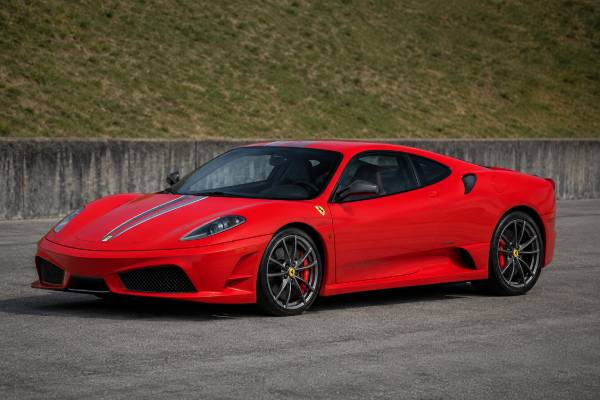
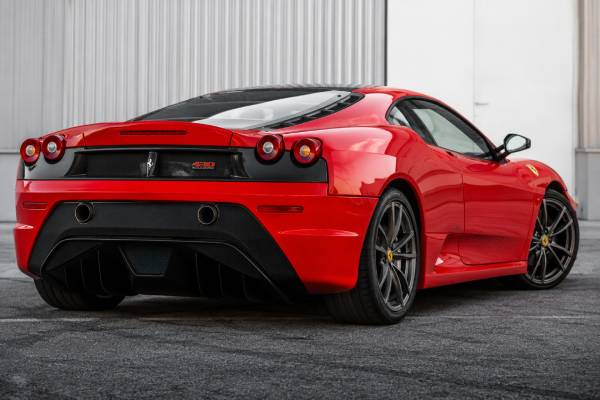
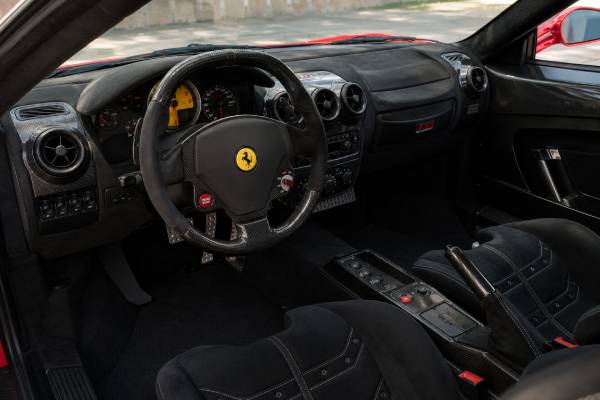
The Ferrari 430 Scuderia is the hard-edged, track-focused version of the F430, built around the F131 mid-engine platform and a 4.3-liter naturally aspirated V8 commonly identified with the F136 ED specification. Introduced for the late-2000s peak of Ferrari’s naturally aspirated V8 era, it took the standard F430’s already serious hardware and sharpened it with more power, less weight, faster shift logic, standard carbon-ceramic brakes, revised aerodynamics, and more aggressive electronic chassis control. It sits between the earlier 360 Challenge Stradale and the later 458 Speciale in Ferrari’s line of lightweight V8 specials. Buyers and collectors still care because the 430 Scuderia combines old-school feel with modern speed: hydraulic steering, a screaming flat-plane-crank V8, a single-clutch F1 gearbox, and enough electronics to be fast without feeling filtered.
Table of Contents
- Why the 430 Scuderia Matters
- F136 ED Specs and Chassis Data
- Production, Variants, and Factory Identifiers
- Scuderia Design, Aero, and Sensory Details
- How the 430 Scuderia Drives
- Maintenance Risks and Specialist Care
- Market Values and Buying Checks
Why the 430 Scuderia Matters
The 430 Scuderia matters because it was Ferrari’s most focused road-going V8 coupe of its generation. It was not just an F430 with stripes; it was a lighter, louder, faster, more technical car built to bring Ferrari’s track knowledge into a road-legal package.
The standard F430 arrived as the successor to the 360 Modena and moved Ferrari’s entry mid-engine V8 line forward in a major way. It kept the aluminum-intensive structure and mid-engine layout, but added a larger 4.3-liter V8, the E-Diff electronic differential, sharper aerodynamics, and a more muscular design. The 430 Scuderia then took that base and pushed it toward the spirit of the 360 Challenge Stradale.
Ferrari revealed the model in 2007, with production generally associated with the 2008 and 2009 model years in many markets. The car was developed at a time when Ferrari still used naturally aspirated V8 engines, hydraulic steering, and single-clutch paddle-shift gearboxes. That combination now makes it feel very different from later dual-clutch and turbocharged models.
Its role in Ferrari history is especially important because it belongs to the “special-series” V8 line. That line includes cars such as the 360 Challenge Stradale, 430 Scuderia, 458 Speciale, 488 Pista, and later track-focused V8 or hybrid successors. Each one takes the standard mid-engine Ferrari and removes some comfort, adds more response, and gives the driver a more direct link to the car.
The 430 Scuderia was also a bridge between eras. It was more electronic than a Challenge Stradale, thanks to F1-Trac traction control and the integrated E-Diff system, yet it still felt mechanical and raw. The gearbox could shift extremely quickly for a single-clutch transmission, but it still delivered a physical kick on full-throttle upshifts. The engine revved to 8,500 rpm and delivered its best work near the top, which is a major part of the car’s appeal today.
Collectors value it because it represents a narrow moment in Ferrari history:
- It has a naturally aspirated V8 rather than turbocharging or hybrid assistance.
- It has hydraulic steering rather than electric steering.
- It uses a single-clutch F1 gearbox, which gives a more dramatic feel than later dual-clutch systems.
- It was lighter and more focused than the normal F430.
- It is part of Ferrari’s respected lightweight V8 lineage.
The 430 Scuderia is not the easiest Ferrari to use every day, and that is part of the point. It was built for drivers who wanted noise, response, heat, vibration, and urgency. In today’s market, that character has become more valuable, not less, because many newer supercars are faster but smoother and more isolated.
F136 ED Specs and Chassis Data
The 430 Scuderia’s key specification is simple: a 4,308 cc naturally aspirated V8, 510 metric horsepower, rear-wheel drive, and a much lighter body than the standard F430. Its performance still feels serious because the car combines low weight, sharp gearing, fast shifts, and strong braking rather than relying only on peak power.
The engine is a 90-degree, flat-plane-crank Ferrari V8 derived from the F430 unit but revised for the Scuderia. In public Ferrari material, the headline figures are more important than the internal engine-code discussion: 4.3 liters, 510 CV at 8,500 rpm, and 470 Nm of torque at 5,250 rpm. In SAE terms, that output is commonly listed around 503 hp and 347 lb-ft.
| Category | Specification |
|---|---|
| Model code | F131 platform |
| Engine family | F136-series 90-degree V8, Scuderia tune commonly referenced as F136 ED |
| Displacement | 4,308 cc / 4.3 liters |
| Induction | Naturally aspirated |
| Power | 510 CV at 8,500 rpm |
| Torque | 470 Nm at 5,250 rpm |
| Transmission | 6-speed F1-SuperFast2 automated manual |
| Drive layout | Mid-engine, rear-wheel drive |
| Dry weight | About 1,250 kg / 2,756 lb |
| Kerb weight | About 1,350 kg / 2,976 lb |
| 0–100 km/h | About 3.6 seconds |
| Top speed | About 320 km/h / 199 mph |
The engine changes were not only about a higher number on paper. Ferrari revised breathing, exhaust tuning, engine management, and response. The result is a power unit that feels sharper than the standard F430’s 4.3-liter V8. The Scuderia does not have huge low-rpm torque by modern turbocharged standards, but it builds speed quickly because it is light, closely geared, and eager to rev.
The six-speed F1-SuperFast2 gearbox is a major part of the car’s identity. It is not a conventional manual and not a modern dual-clutch automatic. It is an electrohydraulic automated manual with paddles, a clutch, and single-clutch shift behavior. At low speeds it can feel abrupt or clumsy compared with a modern gearbox, but when driven hard it gives fast, dramatic upshifts and a very direct sense of mechanical action.
| Area | Detail |
|---|---|
| Body and structure | Aluminum-intensive F430-based structure with lightweight Scuderia components |
| Suspension | Independent double wishbones front and rear |
| Steering | Hydraulic power assistance |
| Front tires | 235/35 ZR19 |
| Rear tires | 285/35 ZR19 |
| Brakes | Carbon-ceramic discs as standard |
| Front brake discs | 398 x 36 mm carbon-ceramic |
| Rear brake discs | 350 x 34 mm carbon-ceramic |
| Chassis electronics | E-Diff, F1-Trac, stability control, manettino drive-mode control |
The wheel and tire setup is modest by modern supercar standards, but that helps the car’s steering feel. Modern cars often use far wider tires and heavier wheels, which increase grip but can mute response. The Scuderia’s grip is high, yet the car still communicates clearly through the front axle.
The brakes are another major upgrade over a normal F430. Carbon-ceramic brakes were not just a luxury feature here; they were part of the car’s track-use package. When healthy, properly bedded, and fitted with the correct pads, they offer strong stopping power and better resistance to repeated hard use. They are also one of the most expensive parts of the car to inspect before purchase.
Production, Variants, and Factory Identifiers
The 430 Scuderia coupe was the main lightweight version, while the Scuderia Spider 16M was the open-top limited-series companion. The coupe was not officially numbered in the same simple way as the 16M, so buyers should focus on documentation, VIN records, factory specification, and condition rather than relying only on claimed rarity.
Ferrari did not market the 430 Scuderia as a mass-production trim in the ordinary sense. It was a special, focused model built for clients who wanted a harder car than the F430 coupe. Public estimates for coupe production vary, and buyers should be cautious with exact numbers unless backed by Ferrari documentation. The 16M Spider, by contrast, was officially presented as a limited series of 499 cars.
The main related versions are:
- F430 coupe: the regular fixed-roof model with the 4.3-liter V8, offered with F1 gearbox or rare gated manual depending on market and configuration.
- F430 Spider: the open-top version of the standard F430.
- 430 Scuderia: the lightweight, track-focused coupe with 510 CV, F1-SuperFast2 gearbox, carbon-ceramic brakes, revised aero, and stripped-back cabin.
- Scuderia Spider 16M: the limited open-top version celebrating Ferrari’s 16th Formula 1 Constructors’ title, with Scuderia hardware and unique identity details.
There was no factory gated-manual 430 Scuderia. This matters because conversions exist in the wider Ferrari market. A converted car may be enjoyable to drive, but it is not the same thing as a factory-original Scuderia. Collectors usually place a premium on cars that retain original drivetrain configuration, factory trim, books, tools, service records, and clear ownership history.
Factory options and personalization can have a large effect on value. Commonly discussed Scuderia features include racing seats, Alcantara cabin trim, carbon-fiber interior parts, exterior carbon details, stripe configurations, wheel choices, audio delete or lightweight equipment, and market-specific equipment. Some cars are highly stripped, while others were ordered with more comfort features.
The factory stripe is one of the best-known visual identifiers. Many buyers want the Scuderia racing stripe because it gives the car its familiar look, but originality matters. A factory stripe, a dealer-applied stripe, and a later owner-applied stripe are not the same in collector terms. The build record should confirm what the car had when new.
For authentication, a serious buyer should verify:
- VIN and market specification.
- Factory build sheet or Ferrari documentation where available.
- Original color and interior trim.
- Seat type and size.
- Stripe specification.
- Carbon package details.
- Wheel type and finish.
- Books, tools, tire inflator, keys, covers, and manuals.
- Service history from Ferrari dealers or respected independent specialists.
Because the 430 Scuderia was often used as intended, track exposure is not automatically a problem. The question is whether the car was maintained to match that use. A carefully serviced track-day car can be a better buy than a low-mile car that has sat unused, missed fluid changes, and developed sticky rubber, weak batteries, or old tires.
Scuderia Design, Aero, and Sensory Details
The 430 Scuderia looks close to an F430 at first glance, but its details are more functional and aggressive. The exterior changes improve cooling, airflow, weight, and identity rather than turning the car into a showpiece with large wings.
The base F430 design came from the Pininfarina era and carried a clear visual link to Ferrari’s racing and road-car heritage. The Scuderia version sharpened that shape with a deeper front treatment, revised rear details, exposed or optional carbon pieces, lighter wheels, and a cabin that looked closer to a Challenge car than a luxury GT.
Aerodynamics were central to the package. Ferrari did not add a huge fixed rear wing. Instead, it relied on underbody airflow, diffusers, front-end management, and careful cooling paths. This gave the car a planted feel at high speed while keeping the shape clean. The Scuderia has more visual drama than a normal F430, but it still looks compact and purposeful compared with many newer supercars.
The engine placement defines the shape. The V8 sits behind the cabin and ahead of the rear axle, giving the car its short nose, cab-forward stance, and wide rear haunches. The rear glass and engine-bay view are part of the ownership experience. The engine is not hidden away; it is presented as the centerpiece.
The cabin is intentionally less plush than a regular F430. Alcantara, exposed carbon fiber, racing seats, simple door pulls, and reduced sound insulation give the car a stripped feel. It is not crude in the way an old racing car is crude, but it is clearly built around driving rather than comfort. Cabin noise, road roar, drivetrain sound, and engine heat are part of the Scuderia personality.
The exhaust and intake sound are among the car’s biggest emotional strengths. The F136-series V8 has a hard, metallic tone that becomes sharper as revs rise. At low speed it can sound busy and mechanical. At high rpm it becomes one of the defining Ferrari V8 noises of the modern era. This is a major reason the car has become more desirable as newer performance cars have moved toward turbocharging, hybridization, and stricter sound limits.
The Scuderia’s engineering choices are unusual by modern standards. A current supercar might use electric steering, a dual-clutch gearbox, adaptive aero, and heavy sound insulation. The 430 Scuderia instead uses hydraulic steering, a single-clutch automated manual, naturally aspirated response, and a cabin that lets the driver feel more of the car’s activity. That makes it less smooth but more memorable.
Small details also matter to collectors. Correct carbon weave, original seat shells, proper Scuderia badging, unmodified exhaust components, original wheels, factory fasteners, and clean underbody panels all help separate a properly preserved car from one that has been heavily altered or poorly repaired.
How the 430 Scuderia Drives
The 430 Scuderia drives like a sharp, high-revving Ferrari with just enough electronic help to let a skilled driver use its performance confidently. It is fast in a modern sense, but its real appeal is response, sound, steering feel, and drama.
At low speeds, the car can feel more demanding than its numbers suggest. The F1 gearbox needs smooth throttle inputs in traffic, and clutch wear depends heavily on driving style. Creeping in stop-start traffic is not its natural environment. The ride is firm, the cabin is loud, and the car feels impatient until the road opens up.
Once moving, the Scuderia makes more sense. The engine is crisp rather than lazy. It rewards revs and feels strongest when worked hard. Throttle response is immediate, so small pedal movements matter. Compared with turbocharged cars, there is no big wave of boost; instead, the power grows cleanly and urgently.
The gearbox is one of the most debated parts of the car. Driven gently, it can feel old-fashioned. Driven hard, it becomes a core part of the experience. Full-throttle upshifts arrive with a forceful, mechanical snap. Downshifts are theatrical, especially with the engine hot and the exhaust valves open. Buyers used to dual-clutch smoothness should drive one before buying, because the Scuderia’s shift character is a feature, not a flaw.
The steering is a major strength. Hydraulic assistance gives the front axle a clear, textured feel. The car does not need modern hyper-aggressive steering ratios to feel alive. It tells the driver what the front tires are doing, and that helps on mountain roads, fast sweepers, and track corners.
Balance is also part of the appeal. The rear-mid-engine layout gives strong rotation, but the electronic differential and traction control help manage power delivery. In Race mode, the car feels alert without becoming reckless. With systems reduced or disabled, it demands respect, especially on cold tires, damp roads, or uneven surfaces.
The brakes are strong, but carbon-ceramic systems need proper condition and temperature. On the road, a healthy system should feel firm and confident. On track, brake performance depends on pad choice, disc life, fluid condition, cooling, and driver technique. A car with worn carbon-ceramic discs can turn a good purchase into a painful one.
As a road car, the 430 Scuderia is best for committed drives rather than casual errands. Visibility is reasonable for a mid-engine Ferrari, the car is compact enough for back roads, and the engine is tractable. But the cabin noise, low front end, firm ride, and gearbox behavior remind you that this is a special-series car with a clear purpose.
Maintenance Risks and Specialist Care
The 430 Scuderia is generally robust for an exotic Ferrari when maintained correctly, but neglected examples can become very expensive quickly. The biggest risks are clutch wear, F1 hydraulic issues, carbon-ceramic brake condition, sticky interior parts, suspension wear, exhaust problems, electrical faults, and deferred age-related service.
The engine is not known for the same belt-service burden as older Ferrari V8s because the F430 family uses timing chains. That does not make it maintenance-free. Fluids, ignition components, engine mounts, exhaust manifolds, sensors, cooling components, and gaskets still age. Cars that sit for long periods can develop their own problems, especially weak batteries, flat-spotted tires, sticky switches, and seals that do not like inactivity.
The F1 gearbox system needs careful inspection. The transmission itself is related to a manual gearbox, but the clutch and shift actuation are electronically and hydraulically controlled. A specialist should check clutch wear percentage, shift quality, hydraulic pump behavior, actuator condition, fluid leaks, and any stored fault codes. A car that has spent much of its life being reversed uphill, parked by valets, or crawled through traffic can have more clutch wear than its mileage suggests.
Carbon-ceramic brakes are a major cost area. A visual look is not enough. The inspection should include disc wear, surface condition, edge condition, pad life, cracking, previous track use, and measurement where possible. Replacement costs are high, so “brakes are fine” should not be accepted without evidence.
Common ownership and inspection areas include:
- Clutch wear and F1 pump operation.
- Gearbox calibration and shift behavior.
- Carbon-ceramic disc condition.
- Brake fluid age and recall completion.
- Tire age, brand, size, and heat-cycle history.
- Suspension bushings, ball joints, and dampers.
- Engine mounts and gearbox mounts.
- Exhaust manifolds, brackets, valves, and heat shielding.
- Cooling system leaks, radiator condition, and hoses.
- Battery health and charging-system behavior.
- Sticky interior buttons and trim coatings.
- Air-conditioning performance.
- Underbody damage from speed bumps or track curbs.
- Accident repair quality and paint thickness.
The 2022 brake-fluid reservoir cap recall is especially important for U.S.-market and affected vehicles. A buyer should confirm the campaign was completed and documented. The issue involved brake-fluid reservoir venting, possible brake-fluid leakage, and reduced braking capability. This is not a cosmetic update; it is a safety item.
Parts availability is usually manageable through Ferrari channels, specialists, and the exotic-parts market, but pricing is not ordinary. Carbon parts, original trim pieces, Scuderia-specific components, carbon-ceramic brake parts, and F1 system components can be expensive. Labor should be handled by technicians who know the platform, because diagnosis by guessing is costly.
Originality creates another maintenance tradeoff. Some owners install aftermarket exhausts, steel brake conversions, suspension changes, audio upgrades, or manual gearbox conversions. These can make sense for personal use, but they may reduce collector value unless the original parts are retained and the modifications are reversible.
A good service record should show consistent annual or mileage-based care, not just occasional oil changes. Look for brake-fluid changes, gearbox and F1 system checks, coolant service, spark plugs when due, tires replaced by age as well as tread, alignment records, campaign completion, and specialist notes. A thick folder from respected shops is worth real money on this car.
Market Values and Buying Checks
The 430 Scuderia has moved from used exotic into modern collectible territory. Values vary widely because mileage, originality, color, documentation, options, brake condition, market location, and recent sales history can change the right number by a large margin.
Current market data can look confusing. Auction averages, market benchmarks, dealer asking prices, and rare outlier sales do not always agree. Broad benchmarks have often sat in the low-to-mid-$300,000 range, while exceptional low-mileage cars, rare specifications, and aggressive dealer asks can be far higher. The right approach is to compare like with like: coupe to coupe, mileage to mileage, factory spec to factory spec, and actual sold results to actual sold results.
Value is strongest when a car has:
- Low but believable mileage.
- Full service history.
- Ferrari or specialist documentation.
- Original paint or clearly documented minor paintwork.
- Desirable factory colors.
- Factory stripe where expected by the market.
- Racing seats and desirable carbon options.
- Original wheels, books, tools, and accessories.
- No accident history.
- Healthy carbon-ceramic brakes.
- Completed recall and campaign records.
Cars to approach carefully include high-mileage examples with thin records, cars with missing original parts, cars with unclear track history, cars with manual conversions, cars with sticky interior damage left unresolved, and cars advertised mainly on hype rather than documentation.
| Priority | What to check | Why it matters |
|---|---|---|
| Identity | VIN, build records, original color, options, market spec | Confirms the car is represented correctly |
| Drivetrain | Clutch wear, F1 system, shift quality, engine fault codes | Repairs can be expensive and affect drivability |
| Brakes | Carbon-ceramic disc and pad condition | Replacement cost can materially change value |
| Structure | Accident repair, underbody damage, paint measurements | Collector value depends heavily on clean history |
| Maintenance | Annual services, fluids, tires, campaigns, specialist invoices | Deferred work can erase any purchase discount |
| Originality | Exhaust, wheels, seats, stripe, interior trim, software | Non-original changes can limit resale appeal |
The best examples are not always the lowest-mile cars. A barely used car can have old tires, aging fluids, sticky controls, and a weak maintenance pattern. A slightly higher-mile car with continuous specialist care, fresh tires, clean brakes, and full documentation can be the better driver’s buy.
Color matters, but condition matters more. Rosso Corsa and Rosso Scuderia cars are classic and easy to understand in the market. Yellow, black, silver, grey, white, and special-order colors can be desirable depending on specification and buyer taste. Interior condition is also important because Alcantara, seat bolsters, carbon trim, and sticky switches reveal how a car was stored and used.
A proper pre-purchase inspection should be done by a Ferrari dealer or independent specialist familiar with F430 and Scuderia systems. The inspection should include a lift inspection, diagnostic scan, clutch reading, brake assessment, paint readings, road test, leak check, tire-date check, and review of all service documents.
Long-term collectability looks strong because the 430 Scuderia has the right ingredients: limited supply, motorsport flavor, special-series status, naturally aspirated engine, hydraulic steering, and a raw driving experience that later cars do not fully duplicate. It is not a cheap car to buy or run, but it is one of the clearest examples of Ferrari’s late naturally aspirated V8 identity.
References
- Ferrari 430 Scuderia (2007) – Ferrari.com 2007
- Scuderia Spider 16M (2008) 2008
- Part 573 Safety Recall Report 22V-536 2022 (Recall Database)
- USA RECALL CAMPAIGN 2023 (Recall Campaign)
- Ferrari 430 Scuderia Market – CLASSIC.COM 2026 (Market Data)
Disclaimer
This article is for informational purposes only and is not a substitute for professional diagnosis, inspection, repair, or valuation. Ferrari specifications, torque values, service intervals, recall applicability, parts, and procedures can vary by VIN, market, equipment, software version, and service history. Always verify details against the official Ferrari service documentation for the specific car and consult a qualified Ferrari specialist before buying, repairing, tracking, or modifying a 430 Scuderia.
If you found this guide useful, please share it on Facebook, X/Twitter, or your favorite car community to support our work.