
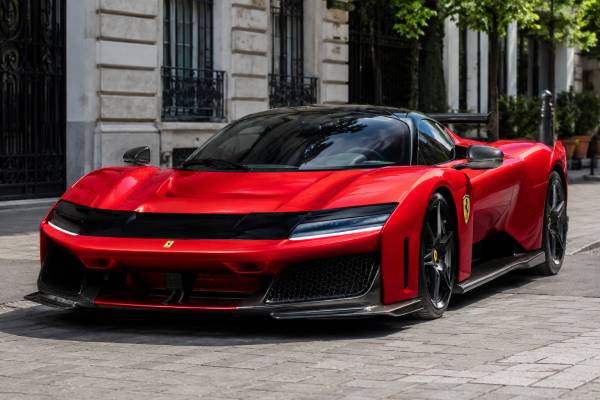

The Ferrari F80 is Maranello’s 2025–2027 limited-run flagship hypercar, commonly linked with the F250 project code and powered by the F163CF 3.0-liter 120-degree twin-turbo V6 hybrid system. It follows the bloodline of the 288 GTO, F40, F50, Enzo, and LaFerrari, but it moves Ferrari’s halo-car formula into a sharper era: racing-derived V6 power, 800-volt hybrid hardware, electric front-wheel drive, active aerodynamics, and a compact “1+” cockpit. With 1,200 hp quoted by Ferrari, 799 planned examples, and production aimed around Ferrari’s 80th anniversary period, the F80 matters because it is both a collector object and a technical statement. Buyers care about allocation, originality, service history, battery condition, and provenance. Enthusiasts care because it shows how Ferrari turns Formula 1 and Le Mans hybrid thinking into a road-legal supercar.
Table of Contents
- Why the F80 Matters in Ferrari History
- F163CF Hybrid Powertrain and Core Specs
- Production Numbers, Allocation, and Options
- Aero, Carbon Structure, and Design Details
- Road, Track, and Hybrid Performance Character
- Maintenance Risks for an F80 Owner
- Buying, Valuation, and Inspection Priorities
Why the F80 Matters in Ferrari History
The F80 is Ferrari’s next-generation halo car, not a normal series-production supercar. Its role is to show the most advanced road-car technology Ferrari is willing to place in customers’ hands during the mid-2020s.
Ferrari’s special flagship line has never been only about outright speed. The 288 GTO brought turbocharged Group B thinking to the road. The F40 turned raw boost, weight reduction, and visual aggression into a legend. The F50 leaned into Formula 1 character with a naturally aspirated V12. The Enzo focused on carbon structure, paddle-shift control, and aerodynamic efficiency. LaFerrari added hybrid assistance to the V12 formula. The F80 goes further into hybrid race technology, but with a controversial and important change: the internal-combustion engine is a V6, not a V12.
That engine choice is central to the car’s identity. The F80’s 3.0-liter F163CF V6 is closely tied in concept to Ferrari’s modern competition direction, especially turbo V6 hybrid racing. Rather than using electric power only as a headline feature, the F80 uses it to shape traction, response, boost delivery, front-axle drive, energy recovery, and track performance. In that sense, the F80 is less about nostalgia and more about what Ferrari believes the fastest road cars can be in a heavily software-controlled era.
The F80 also sits at a turning point for collectors. It arrives after LaFerrari became an established blue-chip modern collectible, and before the full long-term collector verdict on Ferrari’s hybrid V6 era is settled. Some buyers will value the F80 because it is the newest member of the halo-car family. Others will judge it against the emotional pull of Ferrari’s older V12 flagships. That tension may actually make the car more interesting over time.
Its planned production of 799 examples makes it rare, but not impossibly obscure. It is more numerous than some earlier Ferrari halo models, yet still limited enough that original specification, allocation history, and delivery-mile condition will matter. The F80 is also tied to Ferrari’s 80th anniversary period, which gives it a clear historical marker.
For owners and collectors, the headline is simple: the F80 is likely to be judged as one of Ferrari’s defining road cars of the hybrid age. For enthusiasts, it is a chance to study how Maranello blends carbon structure, active suspension, e-turbos, all-wheel-drive hybrid control, and extreme aerodynamics into a road-legal machine.
F163CF Hybrid Powertrain and Core Specs
The F80’s main technical story is its 1,200 hp hybrid system built around the F163CF 3.0-liter twin-turbo V6. The combustion engine produces 900 cv on its own, while the electric system adds front-axle drive, boost, regeneration, and torque shaping.
| Item | Specification |
|---|---|
| Engine code | F163CF |
| Engine layout | Rear-mid-mounted 120-degree V6, twin-turbo, dry sump |
| Displacement | 2,992 cc |
| Bore x stroke | 88 mm x 82 mm |
| Engine output | 900 cv at 8,750 rpm |
| Engine torque | 850 Nm at 5,550 rpm |
| Maximum engine speed | 9,000 rpm, with dynamic limiter at 9,200 rpm |
| System output | 1,200 hp / cv quoted by Ferrari |
| Transmission | 8-speed dual-clutch F1 DCT |
| Drivetrain | Hybrid all-wheel drive with electric front axle |
The V6 uses electric turbo technology, with an electric motor between turbine and compressor. The point is not just more boost. It lets Ferrari size and tune the turbochargers for high power while using electric assistance to reduce lag and sharpen response at lower engine speeds. This is one reason the F80’s engine can reach a quoted 300 cv per liter, an exceptional specific output for a road car.
The hybrid layout uses two electric motors at the front axle and an MGU-K at the rear. The front motors provide torque vectoring and make the F80 effectively all-wheel drive under power. The rear electric motor can recover energy and assist the combustion engine. The system is not a plug-in hybrid in the everyday sense, and there is no full-electric driving mode. Ferrari designed the hybrid system for performance, energy management, and response rather than silent urban driving.
| Component | Key details |
|---|---|
| Front electric motors | Two motors, 105 kW each, 121 Nm each, up to 30,000 rpm |
| Rear MGU-K | Up to 60 kW assist, 70 kW regeneration, 45 Nm, up to 30,000 rpm |
| Operating voltage | 650–860 V |
| High-voltage battery | 2.28 kWh lithium-ion battery |
| Battery maximum voltage | 860 V |
| Battery weight | 39.3 kg |
The chassis is as important as the powertrain. The F80 uses a carbon-fiber and composite central structure with aluminum subframes and titanium fasteners. The active suspension uses 48-volt electric actuation, double wishbones, active inboard dampers, and 3D-printed upper wishbones. It is designed to control ride height, downforce platform, and road compliance without relying on conventional anti-roll bars.
| Area | Specification |
|---|---|
| Length | 4,840 mm |
| Width | 2,060 mm |
| Height | 1,138 mm |
| Wheelbase | 2,665 mm |
| Dry weight | 1,525 kg with optional lightweight content |
| Weight distribution | 42.2% front / 57.8% rear |
| Tires | 285/30 R20 front, 345/30 R21 rear |
| Brakes | CCM-R Plus carbon-ceramic system, 6-piston front and 4-piston rear calipers |
| Top speed | 350 km/h |
| 0–100 km/h | 2.15 seconds |
| 0–200 km/h | 5.75 seconds |
| 100–0 km/h braking | 28 meters |
| 200–0 km/h braking | 98 meters |
These numbers put the F80 beyond ordinary supercar territory. The more important point is how integrated the systems are. Engine calibration, electric turbo response, front motor torque, active suspension, active aero, braking, and tire behavior are all managed as one performance package.
Production Numbers, Allocation, and Options
The F80 is planned as a 799-unit limited-production coupe, with production tied to the 2025–2027 period. That number is central to value, because allocation and original build specification will likely matter as much as mileage.
At launch, Ferrari positioned the F80 as a special-series flagship rather than an open-order model. These cars are typically offered first to established Ferrari clients with strong purchase histories, participation in brand programs, or previous ownership of important limited models. That means many F80s will have clear first-owner provenance from day one, and that paperwork should be preserved carefully.
No official F80 Spider, Aperta, XX, Evoluzione, or track-only version should be assumed unless Ferrari announces one. Ferrari’s history encourages speculation, especially because LaFerrari gained the Aperta and some halo models later developed track-focused relatives, but a serious buyer should separate factory confirmation from market rumor. For now, the F80 coupe is the core model.
Identification details that matter
The F80 has several quick identifiers that separate it from Ferrari’s other hybrid supercars:
- Butterfly doors with a dual-axis opening system.
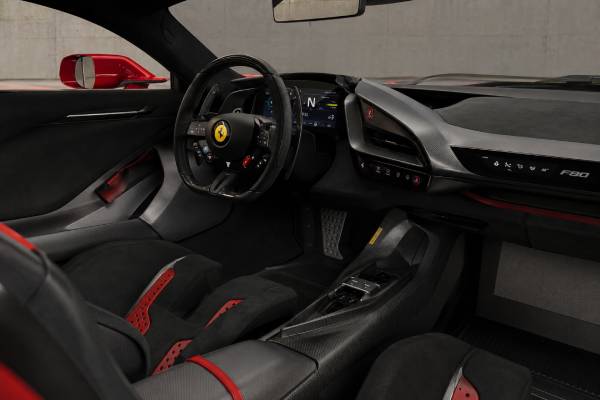
- A compact “1+” cabin layout, with the passenger positioned slightly behind the driver.
- A black front visor area that visually hides the lighting elements.
- A louvred engine-compartment spine with six slots referencing the V6.
- Large functional side intake forms inspired by NACA duct thinking.
- An active rear wing paired with underbody aero and front active devices.
- A rear-mid-engine V6 hybrid layout, unlike the V8-based SF90 or V6 plug-in 296 family.
For documentation, a buyer should want the original order specification, factory invoice or equivalent delivery paperwork, warranty documents, service records, software update history, battery inspection records when available, and confirmation that all factory campaigns have been completed. On a car like this, missing paperwork is not a small annoyance. It can affect trust, resale confidence, and collector value.
Factory options and personalization
Ferrari has not treated the F80 like a normal options-sheet purchase. Most examples will likely be heavily personalized through Ferrari’s Atelier or Tailor Made programs, and the exact spec can have a major effect on desirability. The safest collector specifications tend to be coherent rather than simply expensive.
High-value areas include:
- Exterior color, especially launch colors, historically important Ferrari colors, or tasteful Tailor Made finishes.
- Exposed carbon-fiber areas and whether they were factory-ordered.
- Wheel design and finish.
- Interior materials, contrast stitching, racing harness provisions where market-legal, and trim color balance.
- Paint protection film, if applied carefully and documented.
- Market-specific equipment, lighting, emissions, and safety compliance.
- ADAS and infotainment configuration where regional rules differ.
Because the F80 is new, originality means “as delivered” rather than “restored correctly.” Any aftermarket tuning, wrap, paint alteration, non-factory carbon replacement, wheel change, or electronics modification should be documented and reversible. Even if an owner prefers personalization, the factory build file should remain the reference point.
Aero, Carbon Structure, and Design Details
The F80’s design is shaped by airflow, cooling, and packaging rather than decoration. Its visual drama comes from engineering decisions: active wings, ducting, a small cockpit, wide shoulders, and a carbon structure built around performance.
Ferrari quotes up to 1,050 kg of downforce at 250 km/h. That figure comes from a complete aero system, not one large wing alone. The front triplane, S-Duct, flat underbody, active front device, rear diffuser, and active rear wing work together. The active wing changes angle and height depending on speed, braking, steering, and acceleration demands. In high-downforce use, it contributes more rear grip and stability. In low-drag settings, it reduces resistance so the car can reach its maximum speed more efficiently.
The underbody is one of the most important parts of the car. Ferrari enlarged the diffuser’s working volume and shaped the chassis around airflow. The active suspension helps keep the aerodynamic platform under control, which matters because a car producing huge downforce is sensitive to ride height, pitch, and roll. In simple terms, the suspension is not only there to make the ride comfortable or the handling sharp. It also helps the aero work.
Cooling is another major design driver. A 900 cv V6, three electric motors, high-voltage battery, inverters, e-turbos, carbon-ceramic brakes, and active suspension systems all create heat. The F80 uses multiple radiators, condensers, channels, and brake-cooling passages. Air is guided through the body rather than merely around it. Some ducts feed the engine intake, some cool intercoolers, some cool brakes, and others manage hot air extraction so it does not damage aero efficiency.
The “1+” cockpit
The cabin is one of the F80’s most unusual features. Ferrari describes it as a driver-focused “1+” layout rather than a normal two-seat cockpit. The driver sits as the central focus, while the passenger is still accommodated but visually and physically secondary. The passenger seat is positioned slightly rearward, allowing the cabin to be narrower. A narrower cabin reduces frontal area, helps weight, and gives the car its single-seater-like feel.
The steering wheel is also significant. Ferrari moved back toward physical controls on the wheel spokes after criticism of some fully touch-sensitive layouts in recent models. For a car this fast, controls that can be found by feel are not a luxury; they are a real usability advantage.
Design references without retro styling
The F80 does nod to earlier Ferraris, especially the F40 in some vertical and structural visual cues, but it is not a retro car. The black visor, floating cabin volume, exposed carbon lower sections, aerospace-like surfaces, and short-tail rear treatment make it look more like a prototype racer translated into a road car.
The important design achievement is that the car does not hide its functional pieces. The ducts, wing, louvres, diffuser, and cooling exits are part of the styling. That honesty may help the F80 age better than a car designed mainly around fashion.
Road, Track, and Hybrid Performance Character
The F80 is designed to feel brutally fast but also manageable, with hybrid torque filling, electric front-axle grip, and active systems helping the driver use extreme performance. It should not be judged only by 0–100 km/h numbers, because its real character comes from response, braking, aero confidence, and energy deployment.
The V6 is smaller than the V12 in LaFerrari, but the F80’s combustion engine is far more intensely boosted. The electric turbo system should give the driver a sharper connection between throttle input and boost response than a conventional large-turbo setup. The rear MGU-K and front electric motors add another layer, helping the car deliver torque while the turbochargers build pressure and while the control systems manage traction.
Drive modes are important. Hybrid mode is the normal starting point and manages energy recovery and battery charge. Performance mode is aimed at repeated fast running, especially where the car needs to preserve battery state for consistent pace. Qualify mode is the most aggressive setting, using the available electrical and combustion performance for maximum attack.
The F80 also introduces Boost Optimization. The idea is simple from the driver’s point of view: the car can learn a circuit during a reconnaissance lap, then deploy extra boost where it will be most useful. That does not make the driver irrelevant. It means the car’s energy deployment becomes more strategic, like a race car using hybrid power where it gains the most lap time.
Steering, braking, and tires
The steering experience will depend on how naturally Ferrari has blended electric front-axle torque with the driver’s hands. In a hybrid all-wheel-drive hypercar, the challenge is not simply grip. It is making the car feel predictable as the front motors add or reduce torque while the rear axle carries the main combustion load.
The brakes are among the F80’s most serious pieces of hardware. The CCM-R Plus carbon-ceramic system is designed for high thermal capacity and repeatability. For road use, the main question will be feel at low temperature and low speed. For track use, the key factors will be pad condition, disc surface condition, cooling, tire temperature, and whether the car has been allowed proper warm-up and cool-down cycles.
The Michelin Pilot Sport Cup 2 and Cup 2 R tire choices also shape the car’s personality. Cup 2 tires should offer a more usable road and fast-road balance. Cup 2 R tires are more track-biased and can unlock higher grip, but they are more temperature-sensitive and less forgiving in cold or wet conditions. On a car this powerful, old tires or mismatched tire types are not minor issues. They change the whole behavior of the vehicle.
Everyday usability
Ferrari intended the F80 to be usable on the road, but usability should be understood in hypercar terms. Visibility, ride compliance, cabin heat management, front lift behavior, parking clearance, tire noise, and the stress of driving a very wide car all matter. The active suspension should help ride quality compared with a fixed, track-stiff setup, but the F80 will still demand attention on rough roads, steep ramps, and crowded streets.
The most rewarding driving environment will likely be a fast circuit or open road where the powertrain, aero, brakes, and suspension can work as intended. At low speeds, much of the car’s genius will be waiting in the background.
Maintenance Risks for an F80 Owner
The F80 is too new for a mature reliability record, so ownership risk should be judged by system complexity rather than repeated public failure patterns. The car combines a highly stressed V6, e-turbos, high-voltage hardware, active suspension, active aero, carbon structure, and advanced electronics.
Ferrari includes a seven-year scheduled maintenance program, and that is especially important here. The regular maintenance interval is described as every 20,000 km or once a year, with no mileage restriction within that annual schedule. For a collector car, annual service still matters even if the odometer barely moves. Fluids age, batteries need health checks, tires date out, seals harden, and software campaigns may apply.
Systems that deserve close attention
The most important ownership areas are:
- High-voltage battery and electronics: Ask for battery health data, cooling-system checks, diagnostic scans, and records of any hybrid-system warning history.
- E-turbo and oil-feed systems: The F163CF is highly stressed. Oil quality, correct warm-up, and dealer-level inspection are essential.
- Cooling system: The F80 has complex thermal management for the engine, hybrid system, brakes, cabin, and active suspension. Any overheating history should be treated seriously.
- Active suspension: The 48-volt actuators, inboard dampers, sensors, and control software are core to both ride and aero platform control.
- Active aero: Wing movement, front aero devices, sensors, actuators, and calibration must be checked after any body repair or track incident.
- Carbon-ceramic brakes: Inspect disc condition, pad thickness, surface damage, heat marks, and replacement costs before purchase.
- Tires: Age, heat cycles, puncture repairs, storage conditions, and correct tire specification matter more than tread depth alone.
- Carbon tub and body panels: Any impact, curb strike, lift-point damage, or poorly repaired carbon should be investigated by a Ferrari-approved specialist.
Because the F80 is a hybrid hypercar, an ordinary exotic-car inspection is not enough. A proper pre-purchase inspection should include factory diagnostic equipment, high-voltage system checks, underbody inspection, suspension calibration review, brake measurements, tire-date verification, paint-depth readings where appropriate, and confirmation of campaign status.
Storage and low-mileage concerns
Many F80s will be stored more than driven. That protects mileage, but it can create different problems. Hybrid batteries dislike neglect. Tires can flat-spot. Brake surfaces can suffer from moisture if the car is stored poorly. Fuel can age. Seals and cooling hoses can deteriorate. Software updates can be missed.
A delivery-mile car is not automatically better than a carefully used car. For serious collectors, the best example is often one with low mileage, proper annual servicing, controlled storage, original finish, and complete documentation. A static display car with skipped service is less attractive than its odometer suggests.
Restoration is not yet a normal topic for the F80, but future repair difficulty should be considered now. Carbon structures, bespoke body panels, active aero components, hybrid parts, and model-specific electronics may be expensive and allocation-controlled. Any accident history can have a long-term effect on value, even if the car is repaired well.
Buying, Valuation, and Inspection Priorities
The F80 is not a normal used-car purchase; it is an allocation-based collectible with extreme technical risk if condition or documentation is weak. Price will be driven by provenance, specification, originality, mileage, service status, and whether public resale transactions prove strong demand.
At launch, the base price was reported around 3.6 million euros, or about $3.9 million, and the model was described as already assigned to specific clients. Early secondary-market values may carry a premium, but public, repeatable transaction data is limited during the first production years. Asking prices should not be treated as market value unless supported by completed sales, clear specification, and comparable mileage.
The F80 has several likely value strengths: it is part of Ferrari’s halo-car lineage, it is limited to 799 examples, it is tied to Ferrari’s 80th anniversary era, and it is the most extreme expression of Ferrari’s V6 hybrid road-car technology. Its possible debate point is emotional character. Some collectors may still prefer a V12 flagship. Others may see the F80’s race-derived V6 hybrid system as exactly what makes it historically important.
| Area | What to verify |
|---|---|
| Identity | VIN, market specification, original order documents, delivery paperwork, and ownership chain |
| Factory specification | Exterior color, interior trim, carbon options, wheels, tires, and Tailor Made records |
| Service history | Annual Ferrari dealer service, diagnostics, software updates, and campaign completion |
| Hybrid system | Battery health, inverter status, fault codes, cooling performance, and charging/regeneration data |
| Powertrain | Oil history, leak checks, e-turbo condition, warm-up behavior, and abnormal noises |
| Brakes and tires | Disc condition, pad life, heat damage, tire age, correct Michelin specification, and track wear |
| Carbon structure | Underside, lift points, tub, doors, aero surfaces, crash repairs, and paint-depth consistency |
| Electronics | ADAS function, displays, steering-wheel controls, active aero, suspension calibration, and stored faults |
Examples to seek
The strongest F80s will usually have one-owner history, original paint, full Ferrari service records, no accident history, no aftermarket tuning, and a tasteful factory specification. Cars with significant Tailor Made content can be valuable if the spec is coherent and well documented. Launch-color or historically meaningful configurations may also command attention.
A car that has been driven lightly but serviced properly may be more trustworthy than a zero-mile car with uncertain storage. If the car has seen track use, that is not automatically disqualifying. The F80 was built for track performance. What matters is whether the owner documented tire changes, brake condition, service after hard use, and any repairs.
Examples to avoid
Be careful with any F80 that has vague ownership history, missing order paperwork, unexplained warning lights, non-factory software, aftermarket exhaust or tuning, mismatched tires, undocumented PPF removal, wheel damage, underbody scrapes, or repaired carbon aero parts. Exported cars also need careful tax, title, emissions, and warranty review because market specification can affect registration and support.
The safest approach is to buy through Ferrari’s official network or a recognized specialist with transparent documentation. A private sale can be fine, but only if the seller provides full records and allows a proper Ferrari-authorized inspection.
Long-term collectability looks strong, but it is not risk-free. The F80’s place in history is secure because of its role in Ferrari’s halo-car sequence. Its exact market behavior will depend on how owners use the cars, how many remain delivery-mile collectibles, whether future Ferrari flagships move further away from combustion engines, and how collectors come to value the V6 hybrid era. For buyers, the best decision is not simply the lowest-mile car. It is the most complete, original, well-documented, properly serviced example with the cleanest story.
References
- Ferrari F80 – Ferrari.com 2024 (Manufacturer Model Page)
- F80: Ferrari’s new supercar 2024 (Manufacturer Press Release)
- How the Ferrari F80’s technology tames its incredible 1200 horsepower 2024 (Manufacturer Technology Article)
- Ferrari unveils new $3.9 million F80 supercar | Reuters 2024 (Market Context)
Disclaimer
This article is for informational purposes only and is not a substitute for professional diagnosis, repair, valuation, or pre-purchase inspection. Specifications, torque values, maintenance intervals, software procedures, campaign status, and equipment can vary by VIN, market, production date, and individual factory specification. Always verify details against the official Ferrari service documentation for the exact vehicle.
If this guide was useful, please consider sharing it on Facebook, X/Twitter, or with other Ferrari enthusiasts to support our work.