
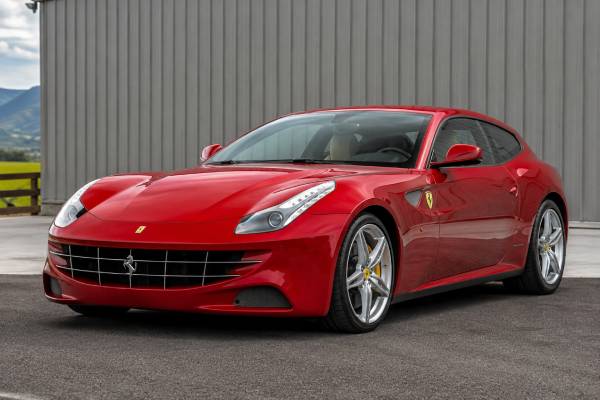
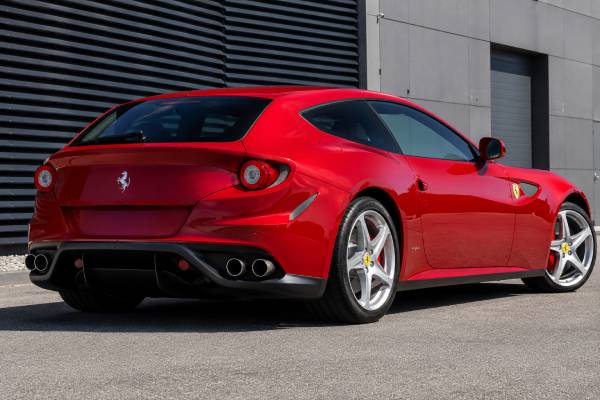
The Ferrari FF is the F151-generation grand tourer that replaced the 612 Scaglietti and introduced something Ferrari had never offered in a regular production road car: four-wheel drive. Built from 2011 to 2016, it combined a front-mid-mounted F140 EB 6.3-liter naturally aspirated V12 with a rear transaxle dual-clutch gearbox, Ferrari’s unusual 4RM all-wheel-drive system, four real seats, and a shooting brake body. It was not a soft luxury wagon with a badge; it was a 651 hp V12 Ferrari that could cross countries quickly, carry luggage, and cope with rain or snow better than any earlier front-engine Ferrari GT. Today, buyers care because the FF sits at an interesting point in Ferrari history: naturally aspirated V12 drama, practical usability, controversial design, and rising modern-classic appeal in one car.
Table of Contents
- Why the FF Mattered in Ferrari History
- F140 EB V12, Chassis, and Key Specs
- Production Years, Options, and Identity Checks
- Shooting Brake Design and 4RM Engineering
- How the Ferrari FF Drives
- Maintenance Risks and Specialist Service
- Market Values and Buying Strategy
Why the FF Mattered in Ferrari History
The Ferrari FF mattered because it changed what a front-engine Ferrari GT could be. It was Ferrari’s first regular production four-wheel-drive car, yet it kept the core ingredients buyers expected from Maranello: a naturally aspirated V12, rear-biased handling, sharp steering, and a dramatic sense of occasion.
The FF arrived publicly at the 2011 Geneva Motor Show as the successor to the 612 Scaglietti. The 612 was a more traditional two-door 2+2 grand tourer, while the FF took a far bigger risk. Instead of a long coupe roofline, it used a shooting brake profile with a large rear hatch and folding rear seats. The name stood for “Ferrari Four,” referring to both four seats and four-wheel drive.
This was not Ferrari trying to build a normal estate car. It was a response to wealthy GT buyers who wanted one Ferrari that could handle more of real life: ski trips, poor weather, airport runs, long motorway journeys, and mountain roads. Before the FF, a Ferrari V12 GT was a magnificent long-distance car but not something most owners wanted to use on snow-covered roads. The FF made that idea plausible.
In the Ferrari model line, the FF sat above the California and alongside the company’s serious mid-engine sports cars, but with a different mission. It was the most versatile Ferrari of its day and one of the quickest four-seat cars in the world. Its top speed of 208 mph and 0–100 km/h time of 3.7 seconds placed it firmly in supercar territory, even though it had rear seats and a usable luggage area.
Its reputation has changed with time. When new, the styling divided opinion. Some loved the confidence of the shooting brake shape; others thought it looked too bulky or too unconventional for a Ferrari. As naturally aspirated V12 Ferraris have become more prized, the FF has aged better. It now appeals to buyers who want something rarer and more usable than an F12berlinetta, more characterful than many luxury GTs, and more historically important than its understated market prices once suggested.
For collectors, the FF’s importance comes from four main points:
- It was the first production Ferrari with four-wheel drive.
- It used the naturally aspirated F140 EB V12 before turbocharging and hybrid systems became more common across the performance market.
- It introduced the modern Ferrari shooting brake format continued by the GTC4Lusso.
- It combined real usability with limited production compared with ordinary luxury GTs.
The FF is not a concours-era classic yet, and it is still bought by people who drive their cars. That is part of the appeal. It feels special without being too fragile to use, but it is old enough now that condition, service records, options, and drivetrain health make a huge difference.
F140 EB V12, Chassis, and Key Specs
The FF’s headline specification is the F140 EB 6,262 cc naturally aspirated V12. It produces 660 PS, commonly listed as 651 hp, and sends power through a seven-speed dual-clutch rear transaxle with Ferrari’s 4RM front-drive system assisting when needed.
| Item | Ferrari FF F151 |
|---|---|
| Production period | 2011–2016 |
| Engine code | F140 EB |
| Engine layout | Front-mid-mounted naturally aspirated V12 |
| Displacement | 6,262 cc |
| Bore x stroke | 94.0 mm x 75.2 mm |
| Compression ratio | 12.3:1 |
| Maximum power | 660 PS / 651 hp / 485 kW at 8,000 rpm |
| Maximum torque | 683 Nm / 504 lb-ft at 6,000 rpm |
| Fuel system | Direct injection |
| Transmission | 7-speed dual-clutch F1 gearbox, rear transaxle |
| Drive system | Ferrari 4RM four-wheel drive with rear-biased layout |
| 0–100 km/h | 3.7 seconds |
| Top speed | 335 km/h / 208 mph |
The engine is a major reason the FF is gaining attention. It is not turbocharged, not hybrid-assisted, and not muted by the character of modern emissions-era powertrains. It revs hard, sounds expensive, and delivers the kind of linear response that defines Ferrari’s best front-engine V12 cars.
The FF’s layout is also important. The main gearbox sits at the rear as a transaxle, which helps weight distribution. The 4RM system is not a conventional all-wheel-drive layout with a heavy center differential and front driveshaft from the rear gearbox. Instead, Ferrari used a separate power take-off arrangement at the front of the engine to send torque to the front wheels through electronically controlled clutches. The result is lighter and more compact than a normal AWD system, while preserving a rear-drive feel when extra front traction is not needed.
| Item | Specification |
|---|---|
| Body style | 3-door shooting brake, four seats |
| Construction | Aluminium-intensive chassis and body structure |
| Suspension | Double-wishbone layout with magnetorheological adaptive dampers |
| Steering | Power-assisted rack-and-pinion |
| Front brakes | Carbon-ceramic discs, approximately 398 mm |
| Rear brakes | Carbon-ceramic discs, approximately 360 mm |
| Front tires | 245/35 ZR20 |
| Rear tires | 295/35 ZR20 |
| Length | 4,907 mm |
| Width | 1,953 mm |
| Height | 1,379 mm |
| Wheelbase | 2,990 mm |
| Kerb weight | About 1,880 kg, depending on market and equipment |
| Luggage capacity | About 450 liters, expandable to about 800 liters |
| Fuel tank | About 91 liters |
The FF’s EPA fuel economy is modest, as expected for a large V12 Ferrari. U.S. data lists 11 mpg city, 17 mpg highway, and 13 mpg combined for later-model FFs. In real ownership, fuel use depends heavily on short trips, temperature, tire type, traffic, and how often the V12 is allowed to reach the upper half of the rev counter.
The key technical takeaway is that the FF is not just a 612 replacement with a hatch. It is a highly engineered V12 transaxle Ferrari with a complex traction system, adaptive chassis control, carbon-ceramic brakes, and genuine long-distance packaging.
Production Years, Options, and Identity Checks
The FF was built as one main body and powertrain configuration, so originality is less about choosing the “right variant” and more about verifying specification, options, service history, market version, and condition. There was no regular-production FF Spider, lightweight edition, manual version, or track-focused factory special.
Production ran from 2011 to 2016, with the GTC4Lusso replacing it for the 2017 model year in many markets. Total FF production is commonly cited at around 2,291 cars, making it rare compared with normal luxury GTs, though not rare in the sense of a numbered Ferrari limited edition.
All FFs used the 6.3-liter F140 EB V12, seven-speed dual-clutch gearbox, four seats, hatchback shooting brake body, and 4RM all-wheel-drive system. Differences between cars usually come down to:
- model year and market equipment
- exterior and interior color combination
- wheel design
- carbon-fiber trim
- suspension lifter presence
- panoramic roof
- audio and infotainment options
- passenger display
- seat style and upholstery
- rear entertainment equipment
- Ferrari Tailor Made or special-order details
- HELE stop-start equipment on some cars
- service plan and warranty documentation
Ferrari’s personalization program matters because two FFs can feel very different inside. Some cars are conservative grand tourers in dark paint with tan or black leather. Others are bold Tailor Made builds with unusual leather colors, contrast stitching, carbon driving zones, painted shields, colored calipers, forged wheels, and panoramic glass roofs.
Factory options that affect desirability
Most FF buyers should care less about having every option and more about having the right options in good condition. A heavily optioned but poorly maintained car is not a smart buy. Still, certain items can help desirability:
- Suspension lifter, useful because the front overhang is long and repair costs are high.
- Carbon-fiber steering wheel with shift LEDs, popular with Ferrari buyers.
- Passenger display, a desirable modern Ferrari novelty.
- Panoramic roof, attractive to many GT buyers but worth checking for seals, trim condition, and interior heat effects.
- Forged or diamond-finish wheels, provided they are straight and not repeatedly refinished.
- Scuderia Ferrari shields, a common but market-friendly option.
- Premium audio, especially for owners who use the car on long trips.
- Rear-seat entertainment, less essential today but part of the FF’s luxury-GT identity.
Identity and documentation checks
Because the FF is modern, the inspection process is less about matching carburetors and more about confirming electronic records, VIN-specific work, and factory build data. A serious buyer should ask for:
- VIN and market specification.
- Original books, manuals, tools, tire inflator, charger, and keys.
- Ferrari dealer or recognized specialist service invoices.
- Recall completion records by VIN.
- Factory option list or build sheet.
- Evidence of regular fluid services, not just mileage-based servicing.
- Battery replacement history and battery conditioner use.
- Tire date codes and correct tire specification.
- Brake disc and pad wear measurements.
- Diagnostic scan results from a Ferrari-capable system.
- Paint-meter readings and accident repair inspection.
Mileage alone should not decide the purchase. A low-mileage FF that sat unused with old tires, weak battery history, overdue fluids, and unresolved recalls can be worse than a higher-mileage car with annual service and documented use.
Shooting Brake Design and 4RM Engineering
The FF’s design works because the shape serves the mission. Its long hood, rear-biased cabin, and large hatch give it the stance of a Ferrari GT, while the shooting brake roofline creates space that earlier Ferrari 2+2 models could not offer.
The exterior was developed with Pininfarina and Ferrari’s design team at a time when Ferrari was moving away from purely traditional proportions. The front has a wide intake, swept-back headlamps, and a clear link to the era of the 458 Italia and 599 GTB. The rear is the controversial part: a high hatch, muscular haunches, and twin round taillights set into a shape that is more practical than elegant from every angle.
The design is easier to understand when viewed as packaging. Ferrari wanted four usable seats, luggage space, a V12 ahead of the cabin, a rear transaxle, and all-wheel-drive assistance without turning the car into a tall SUV. The answer was a low shooting brake.
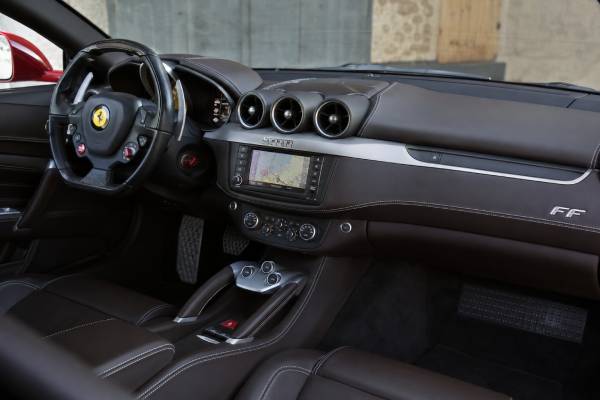
The interior follows Ferrari’s early-2010s control philosophy. Many major driving controls sit on or near the steering wheel. The manettino switch changes vehicle behavior, while large shift paddles sit behind the wheel. The cabin is more luxurious than a 458 and more special than most luxury coupes, but it is not as screen-driven as later Ferraris. That can be a strength for buyers who prefer physical controls and a more mechanical-feeling cockpit.
How the 4RM system is different
The 4RM system is one of the FF’s defining engineering features. Instead of using a typical transfer case and center differential, Ferrari fitted a front power transfer unit driven from the front of the engine. This unit can send torque to the front wheels through two wet clutches, one for each side.
In normal dry, fast driving, the FF behaves mostly like a rear-drive Ferrari. When the system detects that the front tires can help, it sends torque forward. This is especially useful in low-grip situations such as rain, snow, cold roads, or steep launches. It can also help stabilize the car under hard acceleration out of corners.
The benefit is that the FF does not feel like a heavy conventional AWD grand tourer. The drawback is complexity. The 4RM unit, often discussed by owners as the PTU, is a specialist component. Leaks, internal wear, or poor maintenance history can create large bills.
Aerodynamics, cooling, and sound
The FF’s body is cleaner than its unusual silhouette first suggests. The large front openings feed cooling systems needed by the V12, brakes, and drivetrain. The side and rear shapes help manage air around the wheel arches and tail. The rear diffuser and underbody work matter because a car capable of 208 mph needs stability, not just power.
The sound is central to the FF’s appeal. The V12 is smooth at low revs, muscular in the midrange, and sharp near the top end. It does not have the raw edge of some mid-engine Ferraris, but it has the expensive, layered voice of a big naturally aspirated Ferrari twelve-cylinder. An exhaust-modified car may sound more dramatic, but originality usually matters more for long-term value and buyer confidence.
How the Ferrari FF Drives
The FF drives like a large Ferrari GT, not like a luxury SUV and not like a small sports car. Its best quality is the way it blends V12 speed, all-weather confidence, and long-distance comfort without losing the sense that the rear axle is doing most of the work.
At low speeds, the FF feels wide and valuable. Visibility is better than in many mid-engine supercars, but the long nose and low front splitter demand care. The steering is quick, the brake pedal is firm, and the gearbox is smooth enough in automatic mode for city traffic, though still more performance-focused than a normal torque-converter automatic.
Once moving, the engine defines the car. The V12 does not need high revs to feel strong, but it rewards them. The throttle response is immediate compared with turbocharged GTs. The power delivery builds cleanly, and the final third of the rev range gives the FF its real Ferrari identity. It is fast enough that full-throttle use needs space and judgment.
The seven-speed dual-clutch gearbox suits the car well. In automatic mode, it can cover relaxed driving. In manual mode, the large paddles make the FF feel more focused. Shifts are quick, and the transaxle layout helps keep the car balanced despite the engine’s size.
The ride is one of the FF’s strongest points. With magnetorheological dampers, it can handle long trips and imperfect roads better than many supercars. It is not soft, and the tires are large, but it has enough compliance to make cross-country driving realistic. This matters because many FFs have accumulated more real mileage than garage-kept two-seat Ferraris.
In corners, the FF is impressive rather than delicate. You feel its mass, especially on tight roads, but the chassis is more agile than its size suggests. The front end is responsive, and the rear-biased drivetrain keeps the car from feeling numb. On cold or wet roads, the 4RM system gives confidence that an older rear-drive V12 Ferrari cannot match.
The carbon-ceramic brakes are powerful and durable when healthy. For road use, they can last a long time, but replacement cost is high if discs are worn, chipped, heat-damaged, or previously abused. A buyer should never judge carbon-ceramic brakes only by appearance; proper measurement matters.
The FF is not the best Ferrari for track days. It is heavy, expensive to consume tires and brakes in, and more rewarding as a fast road car. Its natural home is a long journey with open roads, changing weather, and enough luggage to make the shooting brake shape feel justified.
Maintenance Risks and Specialist Service
The FF is not unreliable in the ordinary used-car sense, but it is complex, expensive, and unforgiving of neglected maintenance. The safest cars to buy are those with consistent specialist care, correct fluids, healthy electronics, verified recalls, and no signs of deferred drivetrain work.
The F140 EB V12 itself is generally respected when maintained properly. It is a sophisticated dry-sump Ferrari engine with tight tolerances, high oil capacity, and expensive surrounding systems. The biggest ownership risks often sit around the drivetrain, electronics, suspension, brakes, and age-related items rather than the basic engine block.
Major inspection priorities
A pre-purchase inspection should focus on the systems that can turn a tempting FF into a financial trap:
- 4RM/PTU condition, including leaks, noises, warning messages, and service history.
- DCT gearbox behavior, including smooth engagement, reverse selection, shift quality, and any fault codes.
- E-Diff and transaxle leaks.
- Engine oil leaks around covers, seals, and auxiliary areas.
- Cooling system condition, including radiators, hoses, fans, and coolant history.
- Suspension dampers, lifter system if fitted, bushings, ball joints, and alignment.
- Carbon-ceramic brake disc wear, pad life, edge damage, and service measurements.
- Battery health, charging behavior, and evidence that a conditioner was used.
- Sticky interior switches and soft-touch trim deterioration.
- Infotainment, instrument displays, passenger display, parking sensors, cameras, and seat electronics.
- Tire brand, size, tread, wear pattern, and date codes.
The owner’s manual oil-check procedure is more involved than on a normal car. Oil level must be checked warm, at idle, on level ground, and within a defined timing process. Overfilling or using the wrong oil is not harmless. The same general principle applies across the car: Ferrari procedures matter.
Battery condition deserves special attention. Modern Ferraris dislike low voltage. Weak batteries can create warning lights, confused modules, and false fault symptoms. A car that has been parked for long periods without a conditioner may need more than a simple battery swap if modules have been stressed repeatedly.
Recall and campaign awareness
U.S. FFs were included in major recall activity, including Takata passenger airbag campaigns on affected model years and the later brake fluid reservoir cap recall affecting many Ferrari models. The brake recall relates to a reservoir cap ventilation issue that could contribute to brake fluid loss and reduced braking capability. Recall completion should be verified by VIN, not assumed from model year.
For buyers outside the United States, local recall systems and Ferrari dealer records should still be checked. Imported cars need extra care because recall status may not transfer cleanly between countries.
Maintenance cost reality
The FF can look like strong value compared with its original price, but the car still carries Ferrari V12 running costs. Annual service, tires, brake work, suspension parts, diagnostic labor, interior trim repairs, and drivetrain issues can easily exceed what buyers expect if they compare it with a normal luxury coupe.
A sensible ownership plan includes:
- annual inspection even with low mileage
- regular fluid services by time as well as mileage
- battery conditioner use whenever parked
- tire replacement by age, not just tread depth
- brake measurements kept with the service file
- specialist diagnosis before buying parts
- immediate attention to warning lights or fluid leaks
Originality versus upgrades is a real choice. Some owners fit exhaust controllers, aftermarket exhausts, updated infotainment, paint protection film, or different wheels. Tasteful reversible upgrades usually hurt less than permanent changes. For long-term value, keep factory parts and avoid modifications that interfere with emissions systems, drivetrain electronics, or Ferrari diagnostic access.
Market Values and Buying Strategy
The FF sits in a buyer-friendly but tightening market position. As of 2026, many usable cars trade or list in the low-to-mid $100,000 range, while low-mileage, rare-color, highly optioned, or exceptional cars can command much more.
The market has begun to understand what the FF represents: the first AWD Ferrari, a naturally aspirated V12, and a practical four-seat layout that Ferrari no longer builds in exactly the same way. Even so, buyers remain selective. A cheap FF is not automatically a bargain, because deferred maintenance can erase the discount quickly.
Value is driven by several factors:
| Factor | Why it matters |
|---|---|
| Service history | Consistent Ferrari dealer or specialist invoices reduce drivetrain and ownership risk. |
| PTU and DCT health | These are among the most important high-cost inspection areas. |
| Mileage | Low mileage helps value, but inactivity can create problems if maintenance was neglected. |
| Specification | Carbon trim, shields, lifter, passenger display, panoramic roof, and attractive colors help desirability. |
| Color combination | Traditional Ferrari and elegant GT colors are easier to resell than highly personal combinations. |
| Brake condition | Carbon-ceramic replacement costs make documented measurements important. |
| Recall completion | Open recalls can delay registration, resale, or safe use. |
| Originality | Reversible upgrades are less concerning than permanent or poorly integrated modifications. |
The best FF to buy is usually not the cheapest one. Look for a car that has been used enough to prove it works, maintained enough to show careful ownership, and inspected by someone who understands the 4RM system. A car with 20,000 to 40,000 miles and excellent records can be more attractive than a garage queen with gaps in service.
Avoid cars with vague service claims, warning lights, mismatched tires, old batteries, unverified brake wear, missing keys, sticky interior neglect, accident history without proper documentation, or sellers who resist a Ferrari specialist inspection. Also be cautious with imported cars where market specification, emissions equipment, and recall records are unclear.
For collectors, the FF is interesting because it is still usable rather than purely decorative. Long-term collectability will likely favor:
- original paint or high-quality documented paintwork
- rare but tasteful factory colors
- low-to-moderate mileage with annual service
- strong option lists
- unmodified exhaust and electronics
- complete accessories and documentation
- no unresolved PTU, DCT, or suspension concerns
For enthusiasts, the buying case is simpler. Few cars combine a naturally aspirated Ferrari V12, four seats, four-wheel-drive traction, hatchback practicality, and genuine 200 mph performance. The FF may never be as universally loved as an F12berlinetta, but that is exactly why it remains compelling. It is the Ferrari for someone who wants to drive, travel, and explain their choice with a smile.
References
- Ferrari FF (2011) – Ferrari.com 2011 (Manufacturer Specifications)
- Part 573 Safety Recall Report 22V-536 2022 (Recall Database)
- Part 573 Safety Recall Report 18V-381 2018 (Recall Database)
- 2016 Ferrari FF | DriveClean 2016 (Official Fuel Economy Data)
- Ferrari FF Market – CLASSIC.COM 2026 (Market Data)
Disclaimer
This article is for informational purposes only and is not a substitute for professional diagnosis, inspection, maintenance, or repair. Specifications, torque values, service intervals, recall status, fluids, and procedures can vary by VIN, market, model year, and equipment. Always verify details against official Ferrari service documentation and have any purchase or repair assessed by a qualified Ferrari specialist.
If you found this guide useful, please consider sharing it on Facebook, X/Twitter, or your favorite car community to support our work.