
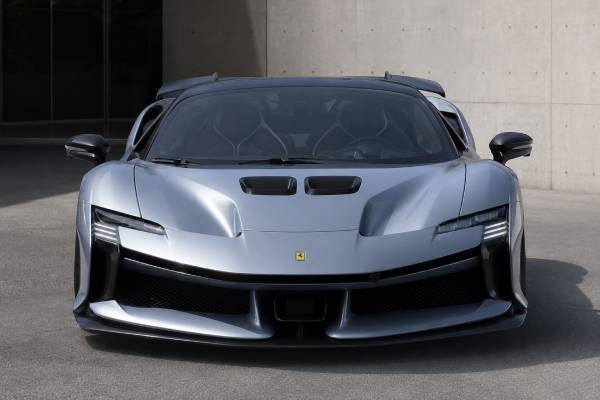
The Ferrari SF90 XX Stradale is the most extreme road-legal version of Ferrari’s first series-production plug-in hybrid supercar. Based on the SF90 Stradale, it brings the XX Programme’s track-focused thinking into a car that can still be registered for road use. Its F154 FB 4.0-liter twin-turbo V8 works with three electric motors to produce 1,030 cv, commonly listed as 1,016 hp, with all-wheel drive, torque-vectoring front electric motors, and an eight-speed dual-clutch gearbox.
Unveiled in 2023, the SF90 XX Stradale matters because it sits at a turning point in Ferrari history: part hybrid flagship, part limited-edition special, and part road-going track weapon. For collectors, its limited production and XX connection are central. For drivers, the appeal is the mix of brutal acceleration, active software, fixed-wing aero, and Ferrari’s evolving hybrid performance strategy.
Table of Contents
- Why the SF90 XX Stradale Matters
- F154 FB Hybrid Specs and Chassis
- Production, Variants, and Factory Options
- Aero Design and XX Engineering
- Road and Track Driving Character
- Maintenance, Reliability, and Ownership Risk
- Market Values and Buyer Checks
Why the SF90 XX Stradale Matters
The SF90 XX Stradale is important because it is the first road-legal Ferrari to carry the spirit of the XX Programme into a customer road car. Previous XX cars, such as the FXX, 599XX, and FXX-K, were track-only machines created for selected clients and factory-supported track use.
Ferrari positioned the SF90 XX Stradale as a bridge between two traditions. One is the Special Series lineage that includes cars such as the 360 Challenge Stradale, 430 Scuderia, 458 Speciale, 488 Pista, and 812 Competizione. The other is the XX Programme, where Ferrari develops extreme experimental cars for very skilled owners. The SF90 XX Stradale borrows from both, but it is not simply an SF90 with more power. It has specific aero, cooling, software, braking, sound, and chassis changes.
The base SF90 Stradale was already a milestone. It was Ferrari’s first series-production plug-in hybrid, with a mid-rear V8, three electric motors, and electric front-axle drive. The XX version takes that layout and makes it more serious. Power rises by 30 cv over the standard SF90, the body produces far more downforce, and the driving systems are tuned for more aggressive track work.
The car was unveiled at Fiorano in 2023 alongside the SF90 XX Spider. Ferrari announced 799 units for the Stradale coupe and 599 for the Spider, making the coupe rare but not a one-off museum piece. That matters for the market. It is limited enough to be collectible, but there are enough cars for public sales, auction results, and real-world ownership patterns to develop.
The SF90 XX Stradale also marks a clear shift in Ferrari’s modern identity. It shows how Maranello uses electrification not just for efficiency, but for response, traction, torque fill, and lap-time control. The electric motors are not decorative. Two front motors give the car electric all-wheel drive and allow precise torque delivery at the front axle. A third motor sits between the V8 and gearbox.
For collectors, the car’s significance comes from four main points:
- It is the first road-going XX-inspired Ferrari.
- It is a limited-production special based on Ferrari’s first production PHEV supercar.
- It brings back a fixed rear wing on a road-going Ferrari after a long absence.
- It set a 1 minute 17.309 second Fiorano road-car lap record in official Ferrari testing.
Its reputation today is still forming because deliveries and secondary-market sales are recent. Even so, the SF90 XX Stradale already sits in a special part of the Ferrari hierarchy: newer and more complex than a 488 Pista, more track-focused than a normal SF90, and far more usable than a track-only XX car.
F154 FB Hybrid Specs and Chassis
The SF90 XX Stradale’s headline is its 1,030 cv plug-in hybrid system, but the bigger story is how Ferrari combines the F154 FB V8, three electric motors, AWD, carbon-intensive body engineering, and high-downforce chassis control. Its specification is closer to a road-legal track car than a conventional grand touring supercar.
| Category | Specification |
|---|---|
| Model code | F173VS |
| Engine code | F154 FB, also written F154FB |
| Engine type | 90-degree twin-turbocharged V8 |
| Displacement | 3,990 cc |
| Bore x stroke | 88 mm x 82 mm |
| Combustion-engine output | 797 cv at 7,900 rpm |
| Combustion-engine torque | 804 Nm at 6,250 rpm |
| Electric motor output | 233 cv combined |
| Total system output | 1,030 cv / about 1,016 hp |
| Battery capacity | 7.9 kWh lithium-ion |
| Electric range | Up to 25 km under electric power |
| Transmission | 8-speed F1 dual-clutch automatic |
| Drivetrain | Plug-in hybrid all-wheel drive |
The V8 is not simply carried over untouched from the standard SF90. Ferrari reworked the intake and exhaust flow, changed internal details, raised the performance level, and removed the secondary air system to save weight. The result is a sharper version of the same basic twin-turbo V8 family that has powered many modern Ferrari V8 models.
The hybrid layout is central to the car’s behavior. The front axle is driven by two independent electric motors, while the rear motor works with the V8 and gearbox. In low-speed electric driving, the car can move using the front motors alone. Under hard use, the full system blends combustion power, electric boost, torque vectoring, and traction control.
| Item | Figure |
|---|---|
| Length | 4,850 mm |
| Width | 2,014 mm |
| Height | 1,225 mm |
| Wheelbase | 2,650 mm |
| Dry weight | 1,560 kg with optional lightweight content |
| Weight distribution | 44% front / 56% rear |
| Fuel tank capacity | 68 liters |
| Front tires | 255/35 ZR20 |
| Rear tires | 315/30 ZR20 |
| Front brakes | Carbon-ceramic, 398 x 223 x 38 mm |
| Rear brakes | Carbon-ceramic, 390 x 263 x 32 mm |
| Top speed | 320 km/h |
| 0–100 km/h | 2.3 seconds |
| 0–200 km/h | 6.5 seconds |
| Fiorano lap time | 1 minute 17.309 seconds |
The top speed is lower than the standard SF90 Stradale’s quoted maximum, but that does not make the XX slower in its intended environment. The fixed wing, extra downforce, cooling changes, and track-focused setup trade some ultimate straight-line speed for grip, braking confidence, and lap-time consistency.
Electronic control systems include eSSC, E4WD, FDE 2.0, EPS, ABS Evo, and Ferrari’s drive-mode logic. In plain terms, these systems help the car decide how much torque goes to each axle, how the car behaves near the limit, how the brakes blend regenerative and friction braking, and how much freedom the driver has before the software steps in.
Production, Variants, and Factory Options
The SF90 XX Stradale is limited to 799 coupes, while the related SF90 XX Spider is limited to 599 cars. Both were allocated to selected Ferrari clients, so buying one new was mostly about relationship, timing, and eligibility rather than walking into a showroom.
| Model | Body style | Production | Core appeal |
|---|---|---|---|
| SF90 XX Stradale | Fixed-roof coupe | 799 units | Lightest and most focused road-going SF90 XX version |
| SF90 XX Spider | Retractable hard-top spider | 599 units | Open-air version with similar performance character and greater rarity |
The Stradale is the purer choice for buyers who care most about track use, body rigidity, weight, and coupe collectability. The Spider is rarer and adds open-top drama, but the fixed-roof car is the one most closely aligned with the road-racer idea.
Factory specification matters a lot on a car like this. Because all examples are rare, value is less about simply finding one and more about finding the right one. Paint, livery, interior trim, wheel choice, carbon options, and Tailor Made details can create large differences between two similar-mileage cars.
Important factory and personalization areas include:
- Exterior paint, including historic colors, launch-style combinations, and Tailor Made finishes.
- Racing livery or contrast accents, especially when tied to the XX identity.
- Carbon-fiber wheels, which reduce unsprung weight and are highly desirable.
- Michelin Cup 2 R or equivalent track-focused tire fitment for maximum performance.
- Carbon racing seats, seat sizing, harness preparation, and Alcantara-heavy trim.
- Carbon exterior details, aero trim, mirrors, sill elements, and engine-bay pieces.
- Front-axle lift, parking aids, cameras, and convenience features.
- Premium audio and infotainment options, which may matter to road users but less to track-focused collectors.
Documentation is especially important because these cars are new enough that originality should be clear. A proper file should include the factory order, window sticker or market equivalent, option list, warranty information, maintenance record, battery and hybrid-system records, recall or service-campaign status, and any Ferrari Approved documentation if sold through the official network.
Identification is usually straightforward, but buyers should still verify that the car is a genuine SF90 XX Stradale and not a modified SF90 Stradale. The fixed rear wing, XX aero package, model-specific bodywork, interior treatment, and factory paperwork should all match. Any car with aftermarket aero, non-factory wheels, repaint work, or missing documentation should be approached carefully.
Aero Design and XX Engineering
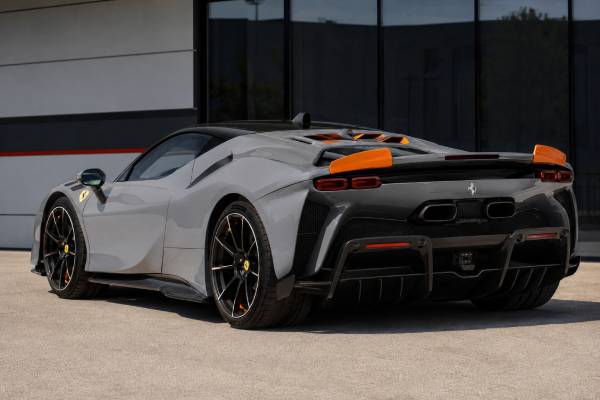
The SF90 XX Stradale looks dramatic because its shape is governed by aero, cooling, and track use rather than styling alone. The fixed rear wing is the most obvious clue, but the car’s real identity comes from the way the whole body manages airflow.
Ferrari’s Styling Centre, led by Flavio Manzoni, reshaped the SF90 around a more aggressive XX brief. The car keeps the mid-engine wedge and compact cabin of the SF90 Stradale, but it adds a harder visual edge. Vents, louvres, splitters, intakes, and exposed functional details are part of the design language instead of being hidden.
The fixed rear wing is historically significant. Ferrari had avoided fixed wings on many modern road cars, preferring cleaner forms and active aero solutions. On the SF90 XX Stradale, the wing returns because the car’s mission demands downforce and stability. Ferrari quotes up to 530 kg of downforce at 250 km/h, which gives the car a very different high-speed character from a normal road supercar.
Cooling and airflow
The XX bodywork is not only about cornering grip. A plug-in hybrid V8 supercar creates major heat-management demands. The V8, turbochargers, transmission, high-voltage battery, electric motors, power electronics, brakes, and cabin systems all need careful thermal control.
The extra openings and ducts serve several jobs:
- Feeding air to heat exchangers.
- Reducing pressure build-up inside the wheel arches.
- Improving brake cooling under repeated heavy stops.
- Managing airflow around the rear body and wing.
- Keeping hybrid components within safe operating ranges.
The three-louvre treatment on the body gives the car a clear Ferrari motorsport feel. It also recalls previous special Ferraris where functional vents became visual signatures.
Cockpit and controls
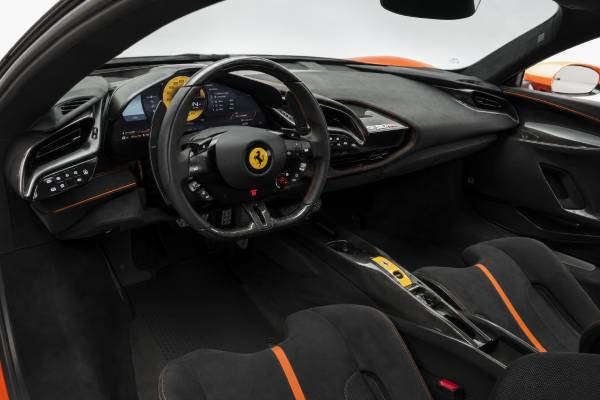
Inside, the SF90 XX Stradale is still recognizably modern Ferrari. The steering wheel carries key controls, the digital display puts performance information in front of the driver, and the cockpit wraps tightly around both occupants. Compared with the standard SF90, the XX interior feels more focused, with greater use of technical fabrics, Alcantara, carbon fiber, and lightweight trim.
The eManettino modes are central to the car’s dual character. In electric and hybrid modes, the car can operate with surprising calm. In Performance and Qualifying modes, the systems prioritize power delivery, battery support, response, and lap performance. The driver does not need to think about every torque split or energy flow. The car manages those layers in the background.
Sound and sensory character
Turbocharged hybrid cars risk feeling filtered, but Ferrari worked to make the SF90 XX Stradale more vocal and more direct than the standard car. The hot-tube sound system helps transmit intake and combustion character into the cabin. Gearshift logic is also tuned to feel more dramatic during hard use.
The result is not the same experience as a naturally aspirated V12 or older mid-engine V8. It is sharper, more complex, and more synthetic in how power is delivered. But it is still deeply Ferrari in the way it combines response, noise, grip, and urgency.
Road and Track Driving Character
The SF90 XX Stradale feels defined by immediacy: instant electric response, huge turbocharged thrust, rapid gearshifts, and aero grip that becomes more useful as speed rises. It is not a relaxed grand tourer with extra power; it is a track-first Ferrari that can be driven on the road.
In normal driving, the plug-in hybrid system gives the car a strange split personality. It can move quietly in electric mode for short distances, creep through traffic cleanly, and feel more civilized than its shape suggests. Then the V8 wakes, the gearbox sharpens, and the car becomes extremely intense.
Acceleration is the easy part to describe and the hard part to process. The 0–100 km/h time of 2.3 seconds puts the SF90 XX Stradale in the top tier of road-car performance. More impressive is the way it continues to pull beyond highway speeds. Electric torque fills the low and middle range, while the V8 takes over with huge force as revs rise.
The eight-speed dual-clutch gearbox is quick and tightly integrated with the hybrid system. In softer modes, it can shift smoothly enough for road use. In aggressive settings, it gives the car a more mechanical and eventful feel, especially with Ferrari’s revised shift logic.
Steering, braking, and balance
Modern Ferraris are known for quick steering, and the SF90 XX Stradale is no exception. The front axle can feel unusually alive because those front electric motors are doing more than simply pulling the car out of corners. They help shape the car’s attitude, add stability, and improve traction when the rear tires are dealing with major power.
The brakes are carbon-ceramic and supported by advanced electronic control. Pedal feel in modern hybrid supercars can vary because regenerative braking and friction braking must work together. In the SF90 XX Stradale, the goal is not old-school simplicity. It is repeatable deceleration, stability, and lap-time confidence.
The car’s balance depends heavily on mode, tire temperature, surface, and driver commitment. On cold tires or rough roads, the limits are too high and too serious to treat casually. On a circuit with heat in the tires, the car becomes more coherent. The aero starts to work, the electronics support corner exit, and the chassis feels more natural at speeds that would be irresponsible on public roads.
Road usability
The SF90 XX Stradale is road legal, but that does not mean it is effortless. It is wide, low, expensive to repair, and built around performance hardware. Visibility is acceptable for the type of car, but urban use requires attention. Front lift, cameras, and parking sensors are valuable, not decorative.
On ordinary roads, the car’s biggest challenge is restraint. The performance window is so high that meaningful use of full power or high-speed aero is rarely possible. Owners who never track the car may still enjoy the drama, rarity, and engineering, but the XX setup makes the most sense when the car is exercised properly.
Maintenance, Reliability, and Ownership Risk
The SF90 XX Stradale should be treated as a highly complex hybrid Ferrari, not as a normal used performance car. The major ownership risks are hybrid-system health, turbocharged V8 heat management, brake and tire condition, software status, accident history, and whether the car has remained inside the official service ecosystem.
Ferrari’s seven-year genuine maintenance program helps, but it does not remove the need for careful ownership. It generally covers scheduled maintenance, not every wear item, damage issue, battery concern, tire set, brake wear event, or track-use consequence.
Major inspection areas
A proper pre-purchase inspection should be carried out by a Ferrari dealer or a specialist with SF90 hybrid experience. The inspection should include:
- Full diagnostic scan of powertrain, hybrid, battery, brake, and chassis modules.
- Verification of software updates and service campaigns.
- High-voltage battery health report where available.
- Confirmation that charging equipment and cables are present and correct.
- Inspection of coolant circuits, radiators, fans, pumps, and heat exchangers.
- Turbocharger oil and coolant line inspection.
- Check for leaks around the V8, gearbox, e-motor area, and cooling system.
- Carbon-ceramic brake disc condition, pad life, and signs of track overheating.
- Tire age, tire type, tread depth, heat cycling, and uneven wear.
- Underbody, splitter, diffuser, and carbon aero inspection for scrape damage.
- Suspension, lift system, dampers, bushings, and wheel condition.
- Accident repair check, including paint depth and carbon-panel repair quality.
The hybrid system is the part that many traditional Ferrari buyers understand least. A low-mileage car is not automatically healthier than a regularly used car. Batteries, seals, cooling parts, and electronic systems dislike neglect. Storage quality matters. Cars kept on the correct maintainer, charged properly, serviced on time, and driven periodically are often safer buys than delivery-mileage examples with unclear storage.
Known SF90-family concerns
The wider SF90 family has had recall attention, including a U.S. campaign affecting certain SF90 Stradale and SF90 Spider vehicles for turbocharger oil delivery pipes that could leak and increase fire risk. Buyers should not assume every XX car is affected, but they should verify every VIN with Ferrari and the relevant national recall database.
Common exotic-car risk areas also apply:
- Carbon-ceramic brakes can be very expensive if damaged or heavily worn.
- Track tires may look usable but be heat-cycled out of peak performance.
- Carbon wheels, if fitted, require careful inspection after curb or pothole impacts.
- Front splitters and underbody aero are vulnerable on steep driveways.
- Hybrid faults can require dealer-level diagnosis.
- Cooling systems work hard and should be kept clean and unobstructed.
- Minor accident damage can become major value damage on a limited Ferrari.
Because the SF90 XX Stradale is still new, long-term reliability data is limited. That makes warranty status, factory maintenance, and specialist inspection more important, not less.
Market Values and Buyer Checks
The SF90 XX Stradale sits in a premium market above the standard SF90 because it is limited, allocated, more extreme, and tied to the XX identity. Early secondary-market examples have commonly appeared at major premiums over original list price, especially for low-mileage, well-specified cars.
Current values vary by market, tax status, delivery timing, mileage, configuration, and whether the car can be exported. Public results and listings have shown cars around the high six-figure to seven-figure range in major currencies, with some asking prices moving well beyond that for delivery-mileage or highly specified examples. The key point is that the market is still young. A few sales do not create a fully mature value curve.
Value is usually driven by:
- Mileage, with delivery-mileage cars often bringing a premium.
- Factory specification, especially color, livery, carbon wheels, and Tailor Made details.
- Ownership history and whether the car remains with its first owner.
- Ferrari dealer provenance and Ferrari Approved status.
- Complete books, charger, tools, accessories, and option documentation.
- No paintwork, no accident history, and no track damage.
- Service, recall, and software records.
- Market-specific desirability, including left-hand drive versus right-hand drive.
| Area | What to verify | Why it matters |
|---|---|---|
| Identity | VIN, build sheet, option list, and Ferrari records | Confirms the car is a genuine SF90 XX Stradale with correct specification |
| Hybrid system | Battery health, charging function, diagnostic codes | Hybrid faults can be complex and expensive |
| Aero and carbon | Splitter, diffuser, wing, underbody, carbon wheels | Damage can be costly and can affect value |
| Brakes and tires | Disc condition, pad life, tire age, tire compound | Track use and heat cycles can create large costs |
| Paint and body | Paint depth, panel alignment, repair invoices | Original paint and clean history are major collector-value factors |
| Service history | Dealer invoices, campaigns, annual checks, software updates | Shows whether the car has been properly supported |
The best cars to seek are complete, unmodified, low-mileage but properly maintained examples with desirable factory specifications and clear Ferrari dealer records. Cars with carbon wheels, strong color combinations, and tasteful factory livery details are likely to remain especially attractive.
Cars to avoid include those with unclear import status, missing documentation, aftermarket modifications, heavy track wear, unexplained battery warnings, paintwork without records, or suspiciously low prices. A discount can disappear quickly if the car needs carbon, brake, tire, software, or hybrid-system work.
Long-term collectability looks strong, but not risk-free. The SF90 XX Stradale has real historical importance, and Ferrari limited-series cars often age well when properly specified and preserved. The unknown is how future collectors will value complex hybrid systems compared with lighter, simpler combustion-only special Ferraris. The safest bet is a car with exceptional provenance, original condition, complete records, and a specification that still feels special years from now.
References
- Ferrari SF90 XX Stradale – Ferrari.com 2023 (Manufacturer Page)
- SF90 XX Stradale and SF90 XX Spider: the first road-going cars in the XX Programme 2023 (Manufacturer Press Release)
- THE FERRARI SF90 XX STRADALE SETS A 1’ 17.309” LAP RECORD AT FIORANO FOR A ROAD-GOING CAR 2023 (Manufacturer Technical Specification)
- Turbocharger Oil Delivery Pipe May Leak 2023 (Recall Database)
- Ferrari SF90 XX (2024 to 2026) 2026 (Market Data)
Disclaimer
This article is for informational purposes only and is not a substitute for professional diagnosis, repair advice, valuation advice, or a Ferrari dealer inspection. Specifications, torque values, service intervals, recall status, software updates, and procedures can vary by VIN, market, production date, and equipment. Always verify details against official Ferrari service documentation and a qualified Ferrari specialist.
If you found this guide useful, please consider sharing it on Facebook, X/Twitter, or your favorite enthusiast community to support our work.