
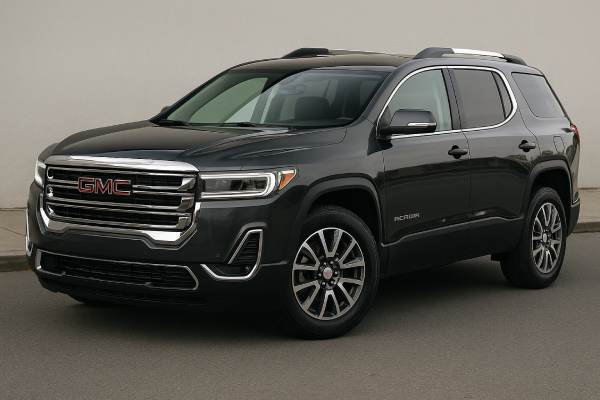
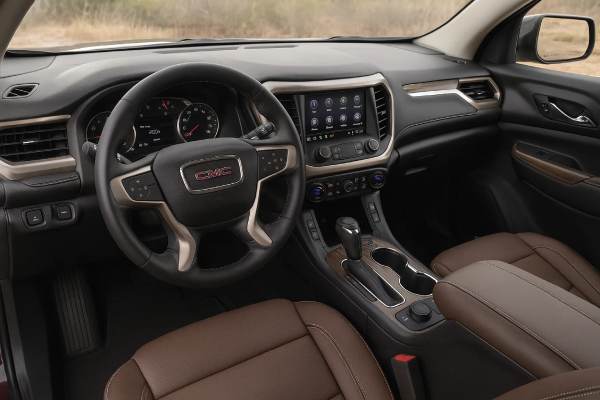
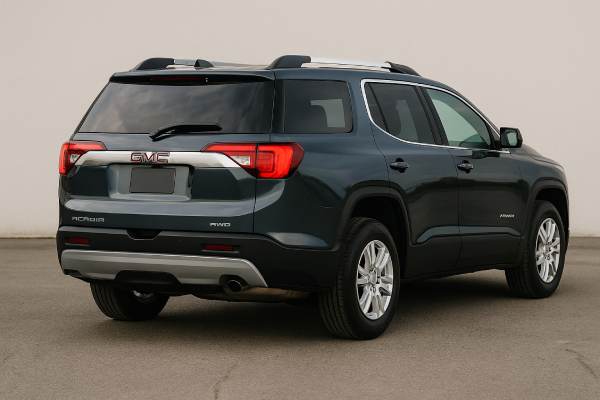
The 2020–2023 GMC Acadia AWD with the LSY 2.0-litre turbo engine targets drivers who need year-round traction without sacrificing fuel economy and comfort. The facelift brought sharper styling, a new 9-speed automatic, and an updated traction-select system that can fully disconnect the rear axle in good conditions, then re-engage it when grip is low. Paired with the 228 hp 2.0T and a broad torque band, the AWD system gives the Acadia confident launches on wet or snowy roads and better stability when towing.
From an ownership point of view, the 2.0T AWD configuration sits between high-consumption V6 SUVs and lighter FWD crossovers. It offers a manageable footprint, good highway refinement, and competitive safety scores, along with a known list of recalls and technical bulletins that buyers can verify before purchase. Understanding how the engine, 9-speed transmission, and active AWD system work together will help you maintain the vehicle properly and select the right trim and options for your use.
Top Highlights
- LSY 2.0L turbo (about 228 hp, 258 lb-ft) plus 9-speed automatic and selectable AWD modes for snow, off-road, and towing.
- AWD models add traction and stability in poor weather, with only a modest fuel-economy penalty versus FWD (around 21/27/23 mpg US city/highway/combined).
- Standard three-row layout with flexible second-row slide and up to roughly 2,237 L of cargo space with seats folded.
- Key caveat: several recalls and TSBs (rear-view camera, fuel pump, airbag, start/stop accumulator) should be checked by VIN before buying.
- Typical oil change interval is 7,500 miles / 12,000 km or 1 year with Dexos1 0W-20; more frequent changes are wise for short-trip or towing use.
Guide contents
- GMC Acadia AWD fundamentals
- Engine, AWD system and specs
- Trims, options and safety tech
- Reliability patterns and fixes
- Maintenance schedule and buying advice
- Driving experience and real-world economy
- How the Acadia AWD stacks up
GMC Acadia AWD fundamentals
The facelifted 2020–2023 GMC Acadia (C1UG) marks the second generation of the model, with a focus on trimming weight and improving efficiency compared with the first-generation Lambda-platform Acadia. The LSY 2.0-litre turbocharged inline-four arrives as a key powertrain, paired exclusively with a 9-speed automatic and, on many trims, an advanced all-wheel-drive system.
In AWD form, the Acadia uses an electronically controlled clutch pack at the rear axle and a traction-select drive-mode controller on the centre console. In “2×4” (AWD disconnect) the system powers only the front wheels to save fuel; twist to “4×4” and the rear axle comes online, sending torque to the rear wheels as needed. Additional modes, such as Sport, Off-Road and Trailer/Tow (where fitted), adjust transmission mapping, stability-control thresholds, and AWD behaviour for different conditions.
For buyers in snow-belt regions, this system is a key advantage over FWD. It allows:
- Confident starts on snow or gravel without spinning a single front tyre.
- More stable behaviour when accelerating out of wet junctions.
- Better composure when towing in poor weather, especially with a weight-distributing hitch and properly set trailer brakes.
The Acadia’s dimensions are unchanged versus FWD models, but AWD 2.0T versions typically weigh in around 4,240 lb (about 1,920 kg). That is still lighter than many full-size three-row SUVs, which helps fuel economy and manoeuvrability.
Inside, the AWD hardware is largely invisible to passengers. You still get the same three-row layout, available captain’s chairs in the second row, and sliding seats that let you trade second-row legroom for third-row space. Fold the rear rows and the Acadia behaves like a mid-size cargo van, with a flat load floor and a low lift-over height.
In short, the LSY 2.0T AWD Acadia is aimed at family owners who want:
- A reasonably efficient three-row SUV.
- Extra security in rain and snow.
- Occasional off-pavement capability on dirt or gravel roads, without moving to a heavy body-on-frame truck.
Engine, AWD system and specs
This section focuses on the 2.0L LSY turbo AWD configuration from the 2020–2023 facelift.
Engine and performance (LSY 2.0-litre turbo)
| Item | Specification* |
|---|---|
| Engine code | LSY 2.0L turbo inline-4 Ecotec Gen III |
| Layout | Transverse I-4, aluminium block and head, DOHC, 4 valves/cyl |
| Displacement | 1,998 cc (2.0 L) |
| Bore × stroke | ≈83.0 × 92.3 mm (≈3.27 × 3.63 in) |
| Induction | Twin-scroll turbocharger, intercooler |
| Fuel system | Spark-ignited direct injection (SIDI) |
| Compression ratio | About 10.0:1 |
| Max power | ≈228 hp (≈170 kW) @ ~5,000 rpm |
| Max torque | 349–350 Nm (258 lb-ft) @ ~1,500–4,000 rpm |
| Timing drive | Chain (no routine replacement interval) |
| Emissions standard | U.S. Tier 3 / LEV III or Euro 6, market-dependent |
| Rated economy (AWD 2.0T) | Around 21 / 27 / 23 mpg US city / hwy / combined (≈11.2 / 8.7 / 10.2 L/100 km) |
| Real-world highway (120 km/h) | Commonly 9.5–10.5 L/100 km (22–25 mpg US) with moderate load |
| Aerodynamics | Cd around mid-0.3 range; frontal area ≈2.8 m² (manufacturer data not always published) |
*Values are approximate and may vary by market, trim, and test cycle. Always confirm against your VIN.
Transmission and AWD driveline
| Item | Specification |
|---|---|
| Transmission | 9-speed automatic (Hydra-Matic 9T65/9T60 family), electronic control |
| Drive type | On-demand AWD with front-biased torque split |
| Final drive ratio | ≈3.47:1 with LSY 2.0T |
| AWD hardware | Power-take-off unit (PTU) up front, electronically controlled multi-plate clutch at rear axle |
| Modes (Traction Select) | 2×4 (AWD disconnect), 4×4 (AWD), Sport, Off-Road, Trailer/Tow (if equipped) |
| Differential | Open front and rear, with brake-based torque vectoring |
In normal dry conditions the system runs mainly in 2×4 to reduce frictional losses; as soon as the control module detects slip or you select 4×4 or Off-Road, it pre-emptively engages the rear axle.
Chassis and dimensions (typical 2.0T AWD)
| Item | Specification |
|---|---|
| Platform | GM C1 (C1UG) unibody crossover |
| Front suspension | MacPherson strut, coil springs, anti-roll bar |
| Rear suspension | Independent multi-link with coil springs and anti-roll bar |
| Steering | Electric power rack-and-pinion, approx. 2.75 turns lock-to-lock |
| Brakes | 4-wheel disc; ventilated front and rear, ABS and stability control |
| Wheels / tyres | Commonly 18 in alloys with 235/65 R18 all-season; 20 in 235/55 R20 available |
| Ground clearance | About 183 mm (7.2 in) |
| Length | ≈4,917 mm (193.6 in) |
| Width (without mirrors) | ≈1,915 mm (75.4 in) |
| Height | ≈1,744 mm (68.7 in), depending on roof rails |
| Wheelbase | ≈2,857 mm (112.5 in) |
| Turning circle | Around 11.8 m (38.7 ft) kerb-to-kerb |
| Curb weight (2.0T AWD) | ≈1,920–1,925 kg (≈4,230–4,250 lb), trim-dependent |
| GVWR | About 2,722 kg (6,001 lb) |
| Fuel tank | ≈83 L (22.0 US gal ≈18.3 UK gal) |
| Cargo volume | ≈362–2,237 L (12.8–79.0 ft³), depending on seat configuration and measurement method |
Performance and capability
| Item | Typical value |
|---|---|
| 0–100 km/h (0–62 mph) | Roughly mid-7-second range with 2.0T AWD |
| Top speed | ≈210 km/h (≈130 mph), electronically limited |
| Braking 100–0 km/h | Around 38–40 m (125–131 ft) with good tyres |
| Towing capacity | 1,000 lb (454 kg) base; up to around 3,500–4,000 lb (1,588–1,814 kg) when properly equipped with trailering package and correct engine/axle combination; confirm for your VIN |
| Payload | Typically 650–770 kg (≈1,400–1,700 lb) depending on trim/sticker |
| Roof load | Usually 75–100 kg (165–220 lb) with OEM crossbars; verify in the manual |
Fluids and service capacities (approximate)
| System | Spec (typical) | Approx. capacity |
|---|---|---|
| Engine oil | Dexos1 Gen 2 or later full-synthetic 0W-20 | ≈5.0 L (5.3 US qt) including filter |
| Engine coolant | Dex-Cool long-life OAT, 50/50 mix | ≈7–8 L (7.4–8.5 US qt) |
| Transmission (9-speed) | GM-approved low-viscosity ATF | ≈8–9 L (total); drain/refill less |
| Rear drive module | Synthetic gear oil to GM spec | Capacity varies; check manual/label |
| A/C refrigerant | R-1234yf | Around 600–700 g (21–25 oz) |
| Brake fluid | DOT 3 or DOT 4 to GM spec | ≈0.7–1.0 L for full flush |
Typical torque values (verify for your VIN and market):
- Wheel nuts: ~190–200 Nm (140–150 lb-ft).
- Engine oil drain plug: around 25–30 Nm (18–22 lb-ft).
Electrical and safety data
| Item | Specification |
|---|---|
| Alternator | Around 220 A with LSY engine |
| 12V battery | ~70–80 Ah AGM or flooded, Group 48/94R (varies by trim/climate) |
| Spark plugs | Long-life iridium, gap ≈0.7–0.8 mm (0.028–0.032 in) |
| Airbag coverage | Front, side-thorax and side curtain for all three rows, plus seat-mounted units (trim-dependent) |
| IIHS | Good in most crash tests; available front-crash prevention rated Advanced/Superior when equipped |
| NHTSA | AWD Acadia earns 5-star overall rating in many configurations, often one star higher than equivalent FWD models |
Trims, options and safety tech
The LSY 2.0T AWD powertrain is tied to specific trims and equipment packages in the 2020–2023 period.
Where the 2.0T AWD shows up
- 2020 model year
- The 2.0T is introduced as a late-availability engine, typically on SLE and SLT AWD models, and on some Denali configurations, with the 3.6 V6 and AT4 off-road trims retaining the V6.
- 2021–2022
- The 2.5L base engine fades out, leaving 2.0T and 3.6 V6 as the main options.
- The 2.0T becomes common on SLE and SLT AWD, and available on Denali in some markets.
- 2023
- Line-up rationalises around SLE, SLT, AT4 and Denali; 2.0T AWD remains a popular choice for SLE/SLT and some Denali buyers who prioritise economy over maximum towing.
You can confirm the engine by looking for RPO code LSY on the Service Parts Identification label and by decoding the VIN (8th character is engine-specific).
Key trim and option differences
SLE AWD (2.0T)
- Generally cloth interior, 18-inch wheels, three-zone climate, 8-inch infotainment with smartphone integration.
- Often has basic GMC Pro Safety features as standard in later years.
- Trailering package and more advanced driver-assistance features are typically optional.
SLT AWD (2.0T)
- Leather-appointed seats, power driver seat, more sound insulation.
- Additional convenience options such as heated front seats, power tailgate, and upgraded audio.
- Wider availability of advanced safety options and the trailering package.
Denali AWD (2.0T or V6)
- Chrome-heavy styling, 20-inch wheels, more premium interior trim and larger equipment bundles.
- Many ADAS features available as standard or in widely chosen packages (e.g., surround-view camera, rear pedestrian alert).
AT4 models are usually V6-only with off-road tyres and a more aggressive AWD calibration, so they are outside the strict scope of this 2.0T AWD article.
Safety systems and ADAS
Across 2020–2023, Acadia AWD models offer a growing list of driver-assistance features:
- Forward collision alert with automatic emergency braking.
- Front pedestrian braking.
- Lane-keep assist with lane-departure warning.
- Lane-change alert with side blind-zone alert.
- Rear cross-traffic alert and rear park assist.
- Front and rear park assist on higher trims.
- Surround Vision (360-degree camera) and HD rear vision camera.
The exact mix depends on year and trim:
- Early 2020 SLE/SLT models may require GMC Pro Safety or Pro Safety Plus packages to gain full AEB and lane-keeping support.
- By 2021–2022, forward AEB and lane-keeping features become more widely standard, with blind-spot and rear cross-traffic still mostly optional.
ADAS calibration and repair notes
For the AWD Acadia, pay attention to:
- Camera and radar calibration after windshield replacement, front-end collision repair, bumper cover replacement, or suspension geometry changes.
- Rear camera and coax harness: a recall covers intermittent or failed rear-view camera images; the official remedy involves inspection and replacement of coax cables or connectors.
- Parking sensors and surround-view: sensor replacement or bumper repainting can require calibration or relearning routines with a scan tool.
Parents will appreciate that Acadia offers LATCH/ISOFIX anchor points for child seats in the second row and a reasonably accessible third row for booster-aged children. The side curtain airbags cover the outboard third-row positions, but always confirm airbag and seat configurations in the manual for your specific VIN.
Reliability patterns and fixes
The LSY-powered Acadia AWD is not trouble-free, but it also does not have a single catastrophic flaw dominating the data. Instead, reliability patterns revolve around a combination of engine sensors, transmission and start/stop hardware, AWD components, and a cluster of recalls.
Engine and cooling
Coolant sensor and related faults (occasional, low-to-medium cost)
- Symptoms: Check-engine light, cooling fans running at high speed, remote start disabled, inaccurate temperature gauge.
- Likely cause: Faulty engine coolant temperature sensor or wiring harness issues, sometimes combined with software calibration.
- Remedy: Replace the sensor with updated part, inspect harness routing and connectors, then clear codes and confirm operation.
Active grille shutters and airflow faults (occasional, minor-to-medium)
- Symptoms: Stored fault codes, sometimes reduced fuel economy or overheating under heavy load.
- Cause: Shutter assemblies sticking because of debris, ice, or mechanical wear.
- Remedy: Clean and free the shutters; replace the assembly if binding persists. Some vehicles receive updated parts or routing per bulletins.
Oil consumption and deposits (currently rare but watch as mileage grows)
- Prolonged oil change intervals or non-Dexos1 oils can accelerate timing-chain and lubrication wear.
- Direct injection can lead to intake-valve deposits over high mileages; using quality fuel and sticking to oil-change intervals helps.
Transmission and AWD
Start/stop accumulator endcap bolts (significant when present, recall fix)
- Symptoms: Transmission fluid leak, visible oil spots, potential loss of drive if ignored.
- Issue: Some 9-speed units left the factory with missing or insufficient endcap bolts on the start/stop hydraulic accumulator.
- Remedy: Recall inspection; if bolts are missing or the accumulator has leaked, the assembly is replaced under the campaign.
Shift feel complaints (occasional, low-to-medium cost)
- Symptoms: Harsh 2–3 shifts, flare between gears, delayed engagement when selecting Drive or Reverse.
- Root causes: Early calibration maps, adaptive data, contaminated ATF, or in rare cases internal clutch wear.
- Remedy: Software updates to the transmission control module, adaptive-learning reset and road test; ATF drain/refill with correct fluid; further diagnosis if symptoms persist.
AWD clutch or rear drive-module issues (currently rare but important)
- Symptoms: Warning messages related to AWD system, binding in tight turns, or rear-axle noise.
- Causes: Low or degraded fluid, electronic control faults, or wear in the clutch pack.
- Remedy: Check for stored codes, inspect fluid, and follow GM diagnostic trees; some cases require module or clutch assembly replacement.
Body, electronics and NVH
- Rear-view camera failures (recall level issue): intermittent or black screen backing up, sometimes sensitive to tailgate movement.
- Roof-rail airbag concerns: certain vehicles are recalled for potential issues with inflator diffusers.
- Tyre or sidewall quality issues: a limited tyre batch on some 2020 vehicles was recalled for potential defects.
Noise and vibration issues, such as front strut top mounts knocking over low-speed bumps or interior trim squeaks, are generally resolved with updated parts or lubrication. Rust is not a systemic problem, but any SUV in road-salt regions should be inspected for subframe and brake-line corrosion.
Recalls, TSBs and extended coverage
Key areas to check via official VIN lookup and dealer records:
- Rear-view camera coax or harness recall.
- Fuel pump jet nozzle burrs that can lead to engine stall or loss of power.
- Roof-rail side-curtain airbag recall.
- Transmission start/stop accumulator endcap bolts.
- Tyre-related recalls where applicable.
A thorough pre-purchase inspection or annual ownership check should include a printout of open and completed campaigns. In some cases, GM also issues special coverage or extended warranties for specific components; these are VIN-dependent.
Pre-purchase reliability checklist for 2.0T AWD
When assessing a used Acadia AWD:
- Confirm recalls and campaigns are completed with proof from an official VIN check.
- Review oil-change history, preferably 7,500 miles / 12,000 km or less between services with Dexos1-approved oil.
- Test the AWD system: cycle traction-select modes, drive in a safe low-grip area, and verify no warning lights or binding.
- Check for transmission behaviour: look for smooth shifts, no flare, and no long delays engaging gear when cold.
- Inspect underbody and drivetrain: watch for leaks at the PTU, transmission case and rear drive module.
- Verify cameras and parking sensors work consistently in all modes.
Maintenance schedule and buying advice
The 2.0T AWD Acadia uses GM’s oil-life monitor to determine change intervals, but it is sensible to treat that as a maximum rather than a target, especially if you tow or run lots of short trips.
Practical maintenance schedule (typical for 2.0T AWD)
Always verify for your year and market, but as a working baseline:
- Every 7,500 miles / 12,000 km or 12 months (whichever comes first)
- Engine oil and filter (Dexos1 0W-20).
- General inspection of belts, hoses and visible leaks.
- Tyre rotation and pressure check.
- Every 15,000 miles / 24,000 km
- Cabin air filter.
- More detailed brake inspection (pads, discs, slides).
- Suspension and steering components inspected for play and wear.
- Every 30,000 miles / 48,000 km
- Engine air filter.
- Throttle body and intake inspection for deposits.
- Check AWD system operation, inspect rear drive-module fluid level and condition.
- Every 45,000–60,000 miles / 72,000–96,000 km
- Brake fluid flush.
- ATF service (drain and refill with correct low-viscosity ATF).
- Rear drive-module and PTU fluid change if specified or if the vehicle tows regularly.
- Every 5 years or up to 150,000 miles / 240,000 km (whichever comes first)
- Engine coolant service with Dex-Cool 50/50 mix.
- Comprehensive inspection of rubber hoses, bushings and mounts.
- Around 100,000 miles / 160,000 km
- Spark plug replacement (iridium plugs).
- Careful check for timing-chain noise or correlation codes; replace chain and related components if wear is detected.
- Every 3–5 years
- 12V battery testing annually after year 3; replacement is common around years 5–7.
- A/C performance check and refrigerant service as needed.
AWD does not add a huge amount of extra maintenance, but it does introduce rear drive-module and PTU fluids that should not be ignored, especially for vehicles used in towing or rough conditions.
Fluid specs and decision points
- Engine oil: Use only Dexos1-licensed 0W-20 from reputable brands; staying on spec is important for chain and turbo longevity.
- Coolant: Dex-Cool or fully compatible OAT coolant; avoid mixing with non-OAT green coolant.
- ATF: Only GM-approved low-viscosity ATF for the 9-speed; generic fluids that merely claim “LV” without explicit approval are risky.
- AWD fluids: Rear drive-module and PTU gear oils must meet GM specifications for friction and temperature characteristics; mixing can cause chatter or premature wear.
Buyer’s guide: which 2.0T AWD Acadia to choose
Recommended sweet-spot configurations
- 2021–2023 SLT or well-equipped SLE 2.0T AWD
- Benefit from early issues addressed and more safety kit standard or common.
- Offer a good balance of price, equipment and fuel economy.
Trims to scrutinise carefully
- Early-build 2020 models
- Perfectly fine if recalls and TSBs are properly completed, but require more paperwork checks.
- Denali AWD with 20-inch wheels
- Attractive and well-equipped, but ride quality can be firmer and tyre replacement is more expensive.
Inspection checklist for prospective buyers
When inspecting a candidate Acadia AWD:
- Read the door-jamb tyre and loading label for payload and towing information.
- Check for even tyre wear and matching tyre brands and sizes.
- Inspect underbody for rust (subframes, brake lines, exhaust hangers) in salt regions.
- Verify that the AWD system engages without warning messages and that mode changes feel smooth.
- Confirm that the rear hatch and glass operate cleanly and that weather seals are intact.
- Ask for printed service records, especially oil changes, ATF service and coolant changes.
Long-term, a well-maintained 2.0T AWD Acadia can realistically reach 200,000 miles (320,000 km) without major powertrain overhaul. The main determinants are oil quality, fluid maintenance, and avoiding overheating or neglect.
Driving experience and real-world economy
The AWD 2.0T Acadia drives much like the FWD version in normal conditions, with the rear axle quietly standing by when not needed. When the road turns slippery or you choose Off-Road or 4×4 modes, the character changes from front-biased crossover to more planted all-weather hauler.
Powertrain feel
The LSY engine’s broad torque band means that everyday driving rarely requires high revs. From about 1,500 rpm onwards, the Acadia pulls willingly, and the 9-speed gearbox quickly shuffles to higher gears to save fuel.
- Throttle response: Smooth and predictable; a short pause is normal while the transmission selects the best gear, then the turbo picks up.
- Turbo lag: Minimal in most situations; you feel more of a transmission decision than turbo spooling in day-to-day driving.
- Drive modes:
- 2×4 (AWD disconnect): Maximum efficiency on dry pavement.
- 4×4 (AWD): Better traction off the line and in changing weather.
- Sport: Holds lower gears longer, sharpens throttle and steering; useful for quick passes.
- Off-Road: Adjusts throttle and AWD mapping for loose surfaces.
- Trailer/Tow (if equipped): Alters shift points and stability control to better manage trailer loads.
Ride, handling and noise
- Ride quality: Comfortable and controlled, tuned towards family use. 18-inch wheels give the best blend of comfort and feedback; 20-inch setups look good but transmit more bumps.
- Handling: Body motions are well-managed, but this is not a sporty SUV. Steering is light, with moderate feedback. AWD helps the vehicle feel stable when powering out of damp corners or merging on short ramps.
- Noise levels: On smooth highways, wind and road noise are well suppressed. Coarser surfaces or aggressive all-season tyres can raise cabin noise; make sure you test on your typical road types.
Real-world fuel economy
Owner reports and road tests suggest that the AWD penalty versus FWD is relatively small, especially when the AWD disconnect mode is used:
- Urban / stop-start: 18–21 mpg US (13.1–11.2 L/100 km) depending on traffic, weather and load.
- Highway (110–120 km/h / 70–75 mph): 23–27 mpg US (10.2–8.7 L/100 km) when cruising steadily.
- Mixed use: 21–24 mpg US (11.2–9.8 L/100 km) is a sensible expectation.
Cold weather, roof racks, heavy loads and off-road use can significantly increase consumption. Remote start and idling time also matter in winter.
Load, towing and stability
When properly equipped with the trailering package, the Acadia AWD’s towing capacity typically ranges up to roughly 3,500–4,000 lb, depending on engine and axle combination and local rating tables. In practice:
- The 2.0T has enough torque for light-to-moderate campers and small boats.
- Staying within 70–75% of maximum rated capacity improves stability and component life.
- Expect fuel economy to drop by 25–40% when towing at highway speeds.
On long grades, the 9-speed’s lower gears and the turbo engine keep speeds steady, but using Tow/Haul mode and manual downshifts helps control temperatures and reduces brake load. The AWD system contributes to better traction when pulling away on slippery campsites or boat ramps.
How the Acadia AWD stacks up
In the crowded mid-size three-row SUV market, the GMC Acadia AWD 2.0T competes with vehicles such as the Toyota Highlander, Honda Pilot, Kia Sorento, Hyundai Santa Fe (three-row versions), Volkswagen Atlas/Atlas Cross Sport, Ford Explorer and Chevrolet Traverse.
Space, comfort and packaging
- Versus larger three-row SUVs (Pilot, Highlander, Atlas, Explorer):
- Acadia is slightly smaller outside, which makes parking and city driving easier.
- Third-row and cargo space with all seats up are a bit tighter than the largest rivals, but still usable for children and occasional adult trips.
- With rows folded, total cargo volume is generous but not class-leading.
- Versus “in-between” crossovers (Sorento, Santa Fe, Atlas Cross Sport):
- Acadia offers comparable or better third-row accommodation than some smaller three-row options.
- Cabin comfort, seat support and ride quality stack up well in everyday use.
Powertrain and efficiency comparison
- Against V6-only rivals:
- The 2.0T AWD Acadia often matches their real-world performance while delivering slightly better fuel economy, especially in city driving.
- V6 competitors can feel more relaxed when heavily loaded or towing at the top of their rating.
- Against hybrid or plug-in options:
- Some rivals offer full hybrids or plug-in hybrids, which can significantly lower fuel costs for urban drivers.
- The Acadia does not offer hybridisation in this generation, so operating costs depend more on driving style and maintenance.
Safety and technology
- The Acadia’s crash-test performance is strong, with excellent core structure and good airbag coverage.
- Availability of AEB, lane-keeping and blind-spot monitoring is broadly in line with competitors, but some brands moved faster to standardise these features across all trims.
- Infotainment performance (screen clarity, responsiveness, smartphone integration) is competitive, and the system is generally considered easy to use.
Ownership costs and reliability versus rivals
- Running costs:
- Service intervals and parts pricing are typical for mid-size SUVs; common consumables and fluids are widely available.
- Insurance groups and tax brackets will vary by region but are comparable to similar-size vehicles.
- Reliability:
- The Acadia 2.0T AWD tends to score average-to-slightly-above on owner-reported reliability, with most issues concentrated in electronics, transmission behaviour and recalls.
- Japanese rivals such as the Highlander and Pilot often edge ahead in long-term reliability surveys, while some Korean and European competitors can be more complex or expensive to repair out of warranty.
If you prioritise a slightly smaller footprint, comfortable ride, strong mid-range torque and genuine all-weather capability, the GMC Acadia LSY 2.0T AWD is a balanced choice. Shoppers willing to trade some interior volume and accept the lack of a hybrid option will find it a capable family SUV with manageable running costs, especially if they pay close attention to recall compliance and regular maintenance.
References
- 2020 GMC Acadia Catalog 2020 (Brochure)
- 2020 GMC Acadia Owner’s Manual 2020 (Owner’s Manual)
- 2020 GMC Acadia Fuel Economy 2020 (Fuel Economy Data)
- 2020 GMC Acadia 4-door SUV 2020 (Safety Rating)
- GM 2.0L Turbo I-4 LSY Engine Info, Power, Specs, Wiki 2024 (Engine Technical Summary)
Disclaimer
This article is provided for informational purposes only and is not a substitute for professional diagnosis, repair, or official service literature. Specifications, torque values, fluid capacities, and maintenance intervals can vary by model year, VIN, market, trim level and installed equipment. Always confirm critical data and procedures using the official owner’s manual, factory service information and technical bulletins for your specific vehicle, and consult a qualified technician for safety-critical work.
If you found this guide useful, you are welcome to share it with other owners or shoppers via Facebook, X/Twitter or your favourite forum to help support high-quality, accurate automotive information.