
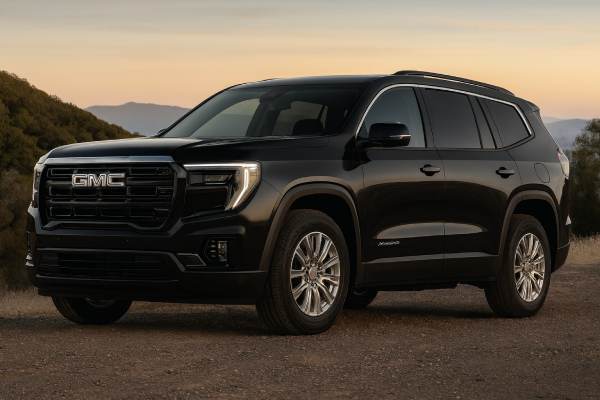
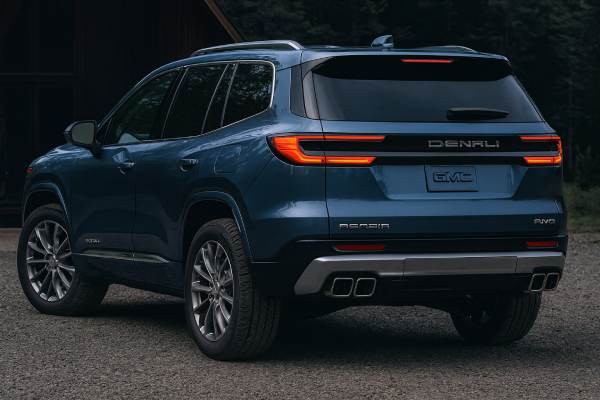
The third-generation GMC Acadia with the LK0 2.5-litre turbo engine moves this nameplate into a more serious three-row family and towing role. In AWD form, it combines a modern, high-output four-cylinder with a longer wheelbase, much larger cabin, and a full suite of driver-assistance systems. While the earlier Acadia was closer to a “large compact,” this version feels like a true mid-size SUV, with space and towing figures that rival body-on-frame models but with the refinement of a crossover.
For an owner or shopper, the key questions are straightforward: how strong and efficient is the new 2.5 turbo, what does the twin-clutch AWD system add in real use, and how do reliability and maintenance expectations compare with the outgoing 3.6 V6? This guide walks through the specifications, real-world behaviour, known issues so far, and where the Acadia AWD stands versus rivals like the Traverse, Pilot, Telluride, and Explorer.
Fast Facts
- Strong turbo 2.5 LK0 engine (328 hp, 326 lb-ft) gives confident passing and up to 5,000 lb (2,268 kg) tow capacity when properly equipped.
- Third-generation body brings a major jump in cabin and cargo space, with around 2,760 L (97.5 ft³) behind the front seats when fully folded.
- AWD system with available twin-clutch rear axle (AT4, selected Denali builds) improves traction in snow and light off-road use but adds weight and complexity.
- Expect engine oil and filter changes about every 12,000 km or 12 months under normal service; shorten the interval if you tow or drive mostly short trips.
- Early data shows no major systemic issues yet, but this is a new engine family, so strict warm-up habits, good-quality fuel, and regular software updates are important.
Explore the sections
- GMC Acadia 2.5 AWD overview
- LK0 AWD specs and data
- Acadia AWD trims and safety
- AWD reliability and service actions
- Care schedule and buying advice
- Driving feel and AWD performance
- Acadia AWD versus key rivals
GMC Acadia 2.5 AWD overview
For the C1UG-2 generation, GMC essentially re-positions the Acadia as a larger, more capable family SUV. Compared with the previous model, the new Acadia grows by roughly 10 inches in length and over 3 inches in height, and rides on a wheelbase of about 3,070 mm (120.9 in). That translates into a more open third row, a genuinely adult-friendly second row, and cargo space that now competes directly with top class rivals.
The core of this AWD variant is the LK0 2.5-litre turbocharged inline-four. It produces about 328 hp at 5,500 rpm and 326 lb-ft at 3,500 rpm, routed through an eight-speed automatic. That is more power and torque than the outgoing 3.6-litre LGX V6, even though it has two fewer cylinders and smaller displacement. In daily use, you get stronger mid-range shove and shorter gearing in the lower ratios, which helps with urban drivability and quick overtakes.
The AWD system is electronically controlled, with a clutch pack to engage the rear axle on demand. In higher trims like AT4, a twin-clutch rear module can actively send torque side-to-side for better traction on loose surfaces and on corner exits. The system links into the drive-mode selector, so “Normal,” “Snow,” “Off-Road,” and “Tow/Haul” adjust throttle, shift mapping, and how aggressively the rear axle participates. This is not a low-range rock crawler, but it is designed for wet climates, ski trips, gravel roads, and light trails.
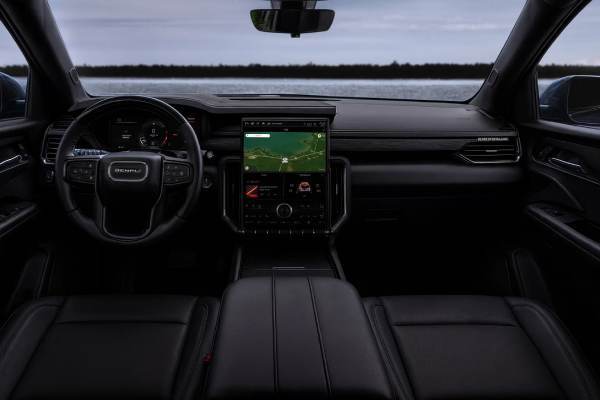
Interior technology moves the Acadia into modern territory. A tall portrait-style 15-inch central touchscreen and an 11-inch digital cluster are standard or widely available, bringing the interface closer to what you see in new EVs. Over-the-air update capability allows GM to refine shift logic, driver-assistance tuning, and infotainment stability over time without a workshop visit.
From an ownership perspective, the AWD Acadia targets families that need three rows and regular cargo but also value a comfortable ride and garage-friendly footprint. The trade-offs are typical for a turbocharged AWD crossover: more complexity than a simple FWD V6, greater dependence on high-quality fluids, and more sensitivity to maintenance neglect. If you understand those needs and stay ahead on scheduled service, the platform is engineered to deliver strong performance and robust safety for the long term.
LK0 AWD specs and data
Engine and performance
| Item | Specification (GMC Acadia AWD LK0) |
|---|---|
| Engine code | LK0 |
| Type | 2.5 L inline-4, turbocharged |
| Induction | Single twin-scroll turbocharger |
| Valvetrain | DOHC, 4 valves per cylinder |
| Displacement | 2.5 L (approx. 2,500 cc) |
| Fuel system | Direct injection |
| Compression ratio | Around 10.5:1 (market dependent) |
| Max power | 328 hp @ 5,500 rpm |
| Max torque | 326 lb-ft (442 Nm) @ 3,500 rpm |
| Emissions standard | Modern EPA/Euro-equivalent levels |
These numbers place the Acadia AWD among the stronger gasoline three-row crossovers in its price band, especially in mid-range torque. The turbo is tuned for usable power rather than high-rpm thrills; expect a broad plateau from around 2,000–4,500 rpm, with the transmission keeping the engine in that band most of the time for effortless progress.
Transmission and driveline
| Item | Specification |
|---|---|
| Transmission | 8-speed automatic (hydraulic torque-converter) |
| Drive type | On-demand AWD (electronically controlled) |
| Final drive ratio | Around 3.49 (varies slightly by trim) |
| Rear axle | Single clutch AWD; twin-clutch torque-vectoring on AT4 and some Denali packages |
| Tow/Haul mode | Adjusts shift points and AWD engagement |
The eight-speed is shared with other GM crossovers and is tuned for smoother downshifts and less gear hunting than the previous six-speed. Tow/Haul mode holds lower gears longer on grades and increases engine braking, which matters when pulling close to the 5,000 lb rating.
Chassis and dimensions
Approximate figures for a typical Acadia AWD in this generation:
| Item | Value |
|---|---|
| Length | ~5,180 mm (204.0 in) |
| Width (without mirrors) | ~2,020 mm (79.6 in) |
| Height | ~1,820 mm (around 71–72 in) |
| Wheelbase | ~3,070 mm (120.9 in) |
| Ground clearance | ~180–200 mm (7.1–7.9 in), trim-dependent |
| Seating | 7 or 8 (bench or captain’s chairs) |
| Cargo, all rows up | ~650 L (23.0 ft³) |
| Cargo, 3rd row folded | ~1,620 L (57.3 ft³) |
| Cargo, 2nd and 3rd rows folded | ~2,760 L (97.5 ft³) |
| Fuel tank capacity (AWD) | ~82 L (21.7 U.S. gal) |
Exact numbers vary slightly by trim, wheel and tyre package, and local homologation, but the main point is that this Acadia finally has the footprint and cargo flexibility of a full mid-size SUV.
Performance and capability
| Metric | AWD LK0 estimate |
|---|---|
| 0–100 km/h (0–62 mph) | ~6.4–6.8 s (trim and load dependent) |
| 0–60 mph | Just under 6.4 s in many tests |
| Top speed (governed) | ~210 km/h (130 mph) |
| Towing capacity (braked) | 2,268 kg (5,000 lb) when properly equipped |
| Unbraked trailer guideline | Typically 750 kg (1,650 lb) |
| Typical braking distance | Roughly high-30 m from 100–0 km/h on all-season tyres |
Expect performance on par with or better than most naturally aspirated V6 rivals in this size class, while maintaining respectable real-world efficiency.
Efficiency
Typical EPA-style fuel-economy figures:
| Configuration | City (mpg US) | Highway (mpg US) | Combined (mpg US) | Combined (L/100 km, approx.) |
|---|---|---|---|---|
| FWD | 20 | 27 | 23 | ~10.2 |
| AWD | 19 | 24 | 21 | ~11.2 |
On a steady 120 km/h (75 mph) highway trip in an AWD model, real-world owners often see about 22 mpg US (roughly 10.7 L/100 km), depending on wind, load, terrain, and tyre type.
Fluids and key capacities (typical values)
These are indicative values; always confirm against the service information for your VIN:
| System | Specification and approx. capacity |
|---|---|
| Engine oil | Dexos1-Gen3 0W-20 or 5W-30; ~5.0–5.5 L |
| Engine coolant | Long-life OAT coolant; ~8–9 L total |
| Automatic gearbox | Dexron-VI / HP-grade ATF; ~7–8 L total fill |
| Rear differential | Synthetic gear oil, 75W-90-class; ~1–1.5 L |
| AWD clutch module | Specific GM fluid; serviced per manual/TSB |
| A/C refrigerant | R-1234yf; charge mass typically 600–700 g |
Key torque values you will see frequently:
- Wheel lug nuts: typically around 140 Nm (about 103 lb-ft).
- Engine oil drain plug: commonly around 30 Nm (about 22 lb-ft).
These values are general GM crossover figures and may vary slightly by year or market.
Electrical and ADAS
| Item | Typical spec / notes |
|---|---|
| Alternator | High-output unit to support heated seats, defrost, twin displays, and ADAS load |
| 12 V battery | Around 70–80 Ah, often AGM construction |
| Driver-assist systems | Automatic emergency braking, pedestrian detection, lane-keep assist, blind-spot warning, rear cross-traffic alert, adaptive cruise, with hands-free highway driving available on some trims |
The Acadia’s electrical architecture is designed for continuous software updates and powers the extensive sensor suite needed for its safety and driver-assistance systems.
Acadia AWD trims and safety
For this generation, AWD is available or standard across three main trims: Elevation, AT4, and Denali. Each trim has a distinct mechanical flavour as well as cosmetic differences that make them easy to spot.
- Elevation AWD is the entry point for most markets. It typically offers 18- or 20-inch wheels, cloth or leatherette upholstery, and the full 2.5 turbo / 8-speed combo. AWD is often optional on Elevation but becomes standard in colder or mountainous regions. Mechanically, it shares suspension hardware with the FWD version but gains the rear drive module and associated control software.
- AT4 is the adventure-oriented trim, always paired with AWD. It adds off-road-tuned suspension, all-terrain tyres, increased ground clearance, and the twin-clutch rear axle that can route torque to a single rear wheel. This improves traction on loose surfaces and helps pull the vehicle around turns when grip is uneven. Skid-plate styling, dark exterior accents, and specific interior trims complete the look.
- Denali AWD focuses on comfort and technology: larger wheels, more chrome, the richest interior materials, the most comprehensive audio options, and broad availability of advanced driver-assistance features including hands-free driving where offered.
Visually, AT4 is easiest to identify by its more aggressive front bumper, underbody accenting, darker trim, and all-terrain tyres. Denali stands out with brightwork, a unique grille pattern, and more intricate interior stitching. Elevation has a simpler, sportier look with blacked-out or body-colour details and a more understated interior.
From a safety-equipment perspective, GMC has moved most critical items to standard status: automatic emergency braking with pedestrian detection, lane-keep assist, lane-departure warning, blind-spot monitoring, rear cross-traffic alert, rear parking sensors, and decent LED headlights. Options add 360-degree cameras, enhanced automatic parking, and, on many trims, a hands-free highway driving system with detailed driver monitoring.
Crash-test performance is a highlight. The latest Acadia earns strong ratings in independent testing, including “Good” scores in the main crashworthiness categories and recognition at the top of its safety class when equipped with the right headlight and crash-avoidance combinations. Pedestrian and vehicle-to-vehicle crash-avoidance systems also perform well, although headlight ratings can vary slightly by trim and lighting package.
For families, the cabin offers multiple ISOFIX/LATCH points, good belt geometry, and a relatively flat load floor when rear seats are folded. Third-row access is eased by sliding second-row seats and wide rear door openings, though very bulky rear-facing child seats may still be easiest to manage in the second row. When evaluating a specific car, confirm that your preferred child seats fit, that anchor points are easy to access, and that all belts retract and lock correctly in every seating position.
AWD reliability and service actions
Because the LK0 2.5-litre turbo engine and this third-generation Acadia are relatively new, long-term reliability data is still developing. However, by combining what is known about the engine family, GM’s recent turbo-four experience, and early owner reports, we can map likely risk areas and sensible precautions.
So far, there are no major, widely reported engine or transmission defects unique to the Acadia with LK0. The engine design is shared with the latest Chevrolet Traverse and Buick Enclave, which spreads development learnings across multiple models. Core components like the block, head casting, and fuel system come from GM’s modern turbo-four architecture, which has already seen duty in smaller SUVs and cars.
The most likely long-term issues for this setup mirror those seen on many direct-injection turbo engines:
- Carbon build-up on intake valves. Because fuel no longer washes across the valves, deposits can form over time. Symptoms include rough idle, misfires on cold start, and reduced performance. Remedies include intake cleaning (often walnut-shell blasting) around 120,000–160,000 km if symptoms appear, plus using high-quality fuel and allowing the engine to fully warm up.
- Turbocharger and wastegate wear. Hard use and repeated hot shutdowns after towing or long climbs can stress bearings and moving parts. Symptoms include boost lag, fault codes, or rattling noises on cold start. Prevention is simple: observe oil-change intervals, use the correct Dexos-approved oil, and drive gently for the last kilometre before shutting down after heavy loading.
- Timing chain and tensioner fatigue. Over very high mileage, especially with stretched oil intervals, timing hardware can wear. Warning signs include rattle on cold start, cam correlation faults recorded by the ECU, or metal in oil analysis. With proper maintenance, chain and guides are designed for engine life, but abuse shortens that window.
On the AWD side, the twin-clutch rear module and the on-demand clutch at the front of the prop shaft are sensitive to fluid condition and contamination. If fluid changes are ignored, especially on vehicles that tow frequently or see off-road duty, you may experience binding in tight turns, moaning noises from the rear axle, or AWD warning messages. Proactive fluid changes well before any symptoms appear are one of the best investments you can make in long-term reliability.
Regarding recalls and service campaigns, there have been relatively few affecting this new-generation Acadia powertrain. Many GM safety recalls centre on trucks and older SUVs rather than the latest crossovers. That said, manufacturers routinely release Technical Service Bulletins (TSBs) for:
- Infotainment bugs and screen freezes.
- Trim noises or rattles in early production builds.
- Calibration updates for engine or transmission control modules to improve cold starts, shift feel, or emissions behaviour in specific conditions.
Whenever you service the vehicle, ask the dealer to:
- Run a VIN-based recall and TSB check to ensure all outstanding campaigns and updates are applied.
- Confirm that any early-build fixes (weatherstripping improvements, clip updates, revised calibration files) are complete.
- Provide a service printout showing oil changes, coolant checks, and any AWD or gearbox fluid services.
In summary, the Acadia AWD with the LK0 engine is too new to call definitively “trouble-free” or “problematic,” but there is no evidence of a fundamental design flaw. Owners who follow the maintenance schedule, use the correct fluids, and avoid abuse (cold revving, long oil intervals, or persistent overloading) should see reliability comparable to other modern turbocharged crossovers, with the added benefit of strong crash performance and up-to-date safety technology.
Care schedule and buying advice
A practical maintenance plan for the Acadia AWD LK0 aims to protect three main systems: the turbocharged engine, the eight-speed transmission, and the AWD hardware. Always confirm intervals against your owner’s manual, but the following framework works well for mixed city and highway driving.
Suggested maintenance intervals (typical use):
- Engine oil and filter: every 12,000 km or 12 months under light use; shorten to 8,000–10,000 km for heavy towing, frequent idling, short trips, or very dusty conditions.
- Engine air filter: inspect at 24,000 km; replace every 40,000–50,000 km, or sooner if the filter looks dirty.
- Cabin air filter: replace every 24,000–30,000 km or 2 years to maintain HVAC performance and odour control.
- Spark plugs: generally every 96,000–120,000 km on iridium plugs, unless the service schedule for your market specifies a different figure.
- Coolant: first change around 160,000 km or 10 years, then every 5 years or 80,000 km.
- Automatic transmission fluid: consider a drain-and-fill around 80,000–100,000 km; earlier if you tow regularly, live in hilly regions, or keep the vehicle long-term.
- Rear differential and AWD module fluids: change around 80,000 km or 5–6 years; if you tow or off-road frequently, cutting that interval in half is cheap insurance.
- Brake fluid: flush every 3 years regardless of mileage.
- Tyre rotation and alignment: rotate every 10,000–12,000 km; check alignment annually or after major pothole impacts or kerb strikes.
- Auxiliary belts and hoses: inspect at each scheduled service; plan replacement around 150,000 km or at the first sign of cracking or glazing.
- 12 V battery: have it load-tested after 4–5 years; plan for replacement around the 5–7 year mark depending on climate and usage.
For DIY-friendly owners, basic tasks like oil and filter changes, air-filter replacement, and cabin filter replacement are straightforward with basic tools. More involved work—timing components, turbo or fuel-system service, AWD module work—should be left to a qualified workshop with the correct equipment and procedures.
Buyer’s guide tips
When buying new, focus on matching trim and options to your actual use:
- Choose Elevation AWD if you want value, the core mechanical package, and do not need every luxury feature.
- Choose AT4 if winter driving, gravel roads, and occasional trails are common; the hardware changes are real, not just cosmetic.
- Choose Denali AWD if you prioritise comfort, quietness, and technology for long highway runs and family road trips.
When buying used, especially in the first few model years, concentrate on five areas:
- Service history – look for proof of timely oil changes and any fluid services for the transmission and AWD system. Avoid cars with long gaps or only sporadic maintenance.
- Software updates – ask for documentation that the infotainment and powertrain control modules have the latest calibrations; updated vehicles tend to shift better and show fewer warning lights.
- AWD operation – test on a wet or loose surface: accelerate gently from a stop and in tight turns, listening for clunks or binding. The vehicle should engage smoothly without grinding or hopping.
- Evidence of heavy towing – a fitted hitch, aftermarket brake controller, or wiring harness is not negative by itself, but it increases the value of fresh gearbox and AWD fluids and careful brake inspection.
- Corrosion and underbody condition – check rear subframes, exhaust hangers, wheel arches, and brake lines, especially in regions that use road salt.
Long-term durability should be good if the vehicle is maintained correctly. The combination of a modern turbo engine, up-to-date safety features, and a roomy interior makes the Acadia AWD a strong candidate for families planning to keep a vehicle well past the finance term. Plan for periodic fluid refreshes beyond the absolute minimum, and treat every cold start and tow as events that deserve a little mechanical sympathy.
Driving feel and AWD performance
On the road, the LK0-powered Acadia AWD feels more muscular than most four-cylinder SUVs and more relaxed than its on-paper power figure might suggest. There is a brief hint of turbo lag if you stab the throttle from a dead stop, but once moving, the 2.5 pulls strongly and consistently. The eight-speed automatic is tuned for smoothness first, with relatively unobtrusive shifts and quick kickdowns when you ask for more power. In normal and comfort modes, it keeps revs low for quiet cruising; sportier modes hold gears longer and are better for overtakes and on-ramps.
Ride quality depends noticeably on trim and wheels:
- Elevation AWD with smaller wheels and conventional all-season tyres offers the most compliant ride over broken pavement and potholes.
- AT4 rides a little firmer but benefits from the taller sidewalls of its all-terrain tyres, which soften sharp impacts but add some tyre roar on coarse surfaces.
- Denali AWD with large wheels looks premium but can transmit more small-bump texture and expansion joints into the cabin, especially at lower speeds.
Noise, vibration, and harshness are well controlled for a large three-row crossover. Wind noise is modest due to the rounded body and careful sealing; roof rails and cross-bars add some whistle at highway speeds, as they do on most SUVs. Under heavy throttle, the four-cylinder is more audible than the older V6 and sounds more workmanlike than musical, but at a steady cruise it fades into the background.
The steering is light at parking speeds and weights up naturally as speed increases, giving confidence on the motorway without feeling nervous. The longer wheelbase aids straight-line stability, and body roll in corners is predictable and well managed. This is not a sporting SUV, yet the chassis feels secure and competent, even when fully loaded.
Braking performance is solid, with strong initial bite and good pedal feel. Repeated high-speed stops with a full load or when towing will heat the system as they would on any SUV of this class, so keeping fresh brake fluid and quality pads is important if you live in mountainous regions or tow frequently.
The AWD system is calibrated with safety and stability as priorities. In dry conditions, it mostly runs in front-drive mode and shifts torque rearward when slip is predicted or detected. In Snow or Off-Road modes, the system pre-emptively engages the rear axle and, in twin-clutch versions, can shuffle torque side-to-side to help keep the vehicle tracking straight on split-grip surfaces. With good winter tyres, you will notice cleaner launches, less traction-control intervention, and more confidence when pulling into traffic on slick roads.
Under load—whether with seven or eight passengers on board or towing a mid-size camper—the Acadia’s long wheelbase and wide track contribute to a stable, controlled feel. You will see a noticeable fuel-consumption penalty when towing (often 30–50 percent above solo consumption), so planning fuel stops becomes more important. Transmission temperatures are well managed when Tow/Haul mode is used, but easing off slightly on long grades in hot weather remains good practice.
Overall, the Acadia AWD’s driving character is that of a capable, secure family hauler with enough power to feel relaxed at motorway speeds and enough intelligence in the AWD system to handle real-world weather without drama.
Acadia AWD versus key rivals
In today’s mid-size three-row SUV market, the Acadia AWD competes most directly with the Chevrolet Traverse, Buick Enclave, Honda Pilot, Toyota Grand Highlander, Kia Telluride, Hyundai Palisade, and Ford Explorer. Each of these vehicles offers a slightly different balance of performance, economy, equipment, and long-term reputation.
Compared with its platform cousin, the Traverse, the Acadia leans a little more toward premium design and tech-heavy interiors. If you prefer GMC styling and branding, the Acadia’s exterior and dashboard may appeal more, while the Traverse often emphasises family practicality and slightly different equipment bundles at similar prices.
Against the Honda Pilot and Toyota Grand Highlander, the Acadia brings higher peak power from its turbo four but lacks the naturally aspirated V6 smoothness of the Pilot and the hybrid efficiency of some Grand Highlander variants. If low fuel bills and long-distance economy are top priorities, a hybrid rival may be more attractive. If you value quick passing performance and a strong tow rating, the Acadia compares very well.
When cross-shopping Kia Telluride and Hyundai Palisade, you will find those models offer proven V6 engines, very comfortable cabins, and generous equipment for the money, backed by long warranties. They may edge the Acadia slightly in perceived interior richness at some trim levels, and they have an established reliability record. The Acadia counters with newer infotainment hardware, modern driver-assistance integration, and the option of advanced hands-free driving systems in certain trims.
The Ford Explorer is perhaps the Acadia’s closest rival in terms of performance breadth, as it offers four-cylinder, V6, and hybrid options, plus high-performance trims. Explorer can be a better match if you want specific combinations such as RWD-biased handling or a performance-tuned variant. The Acadia, by contrast, simplifies choice by using a single powerful engine across the line and focusing options on trim, comfort, and capability features.
Where the Acadia AWD particularly stands out is the combination of:
- High output from a single standard engine, avoiding “underpowered base engine” trims.
- A genuinely roomy interior that now matches or beats many rivals in cargo flexibility.
- Advanced driver-assistance features with a clear upgrade path to hands-free highway driving in some markets.
- A towing package that reaches 5,000 lb without stepping into truck-based SUVs.
On the downside, fuel economy, while respectable, cannot match hybrid three-rows, and the reliance on a single turbocharged four-cylinder means long-term maintenance discipline is more critical than on some simpler V6 competitors. For many buyers, though, the blend of strong performance, generous space, modern tech, and robust safety credentials makes the Acadia AWD with the LK0 engine a very compelling mid-size SUV choice.
References
<a href="https://www.gmc.com/suvs/previous-year/acadia">2025 GMC Acadia | Mid-Size SUV</a> 2024 (Model information and specifications)<a href="https://www.iihs.org/ratings/vehicle/gmc/acadia-4-door-suv/2025">2025 GMC Acadia</a> 2025 (Safety Rating)<a href="https://www.iihs.org/ratings/top-safety-picks/2025/all/gmc">2025 TOP SAFETY PICKs</a> 2025 (Safety Rating Summary)<a href="https://www.caranddriver.com/gmc/acadia">2025 GMC Acadia Review, Pricing, and Specs</a> 2024 (Road Test and Specifications)<a href="https://gmauthority.com/blog/gm/gm-engines/lk0/">GM 2.5L LK0 I-4 Turbo Engine Info, Uses, Specs, Wiki</a> 2024 (Engine Technical Overview)
Disclaimer
This article is intended for informational purposes only and does not replace professional diagnosis, repair advice, or official service documentation. Specifications, torque values, service intervals, and procedures can vary by VIN, market, model year, trim level, and optional equipment. Always verify data against the official owner’s manual, workshop manual, and technical bulletins for your specific vehicle, and follow all safety precautions when working on any vehicle.
If you found this guide useful, please consider sharing it on your preferred social platforms (such as Facebook or X/Twitter). It helps other owners discover accurate information and supports the effort required to produce detailed, independent content like this.