
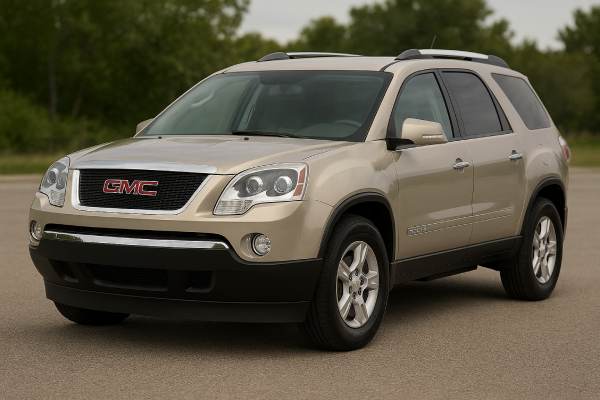
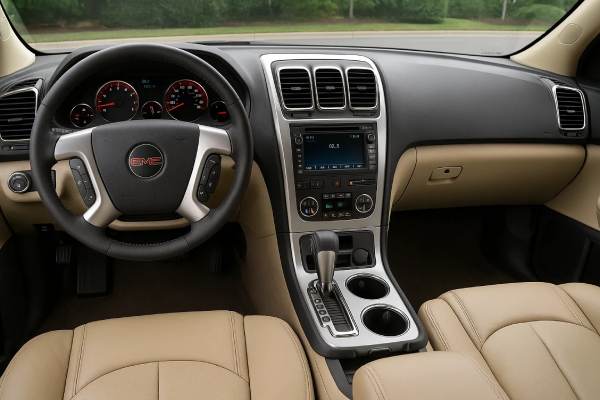
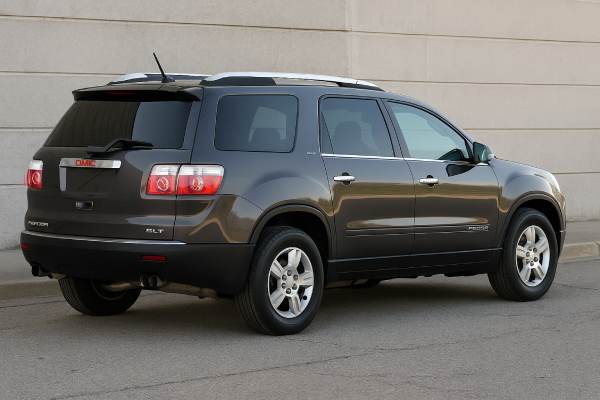
The 2009–2012 GMC Acadia AWD with the LLT 3.6-litre V6 sits right in the middle of the first-generation Acadia range. By this point in the model cycle, GMC had refined the powertrain, improved cabin quality, and positioned the Acadia as a family workhorse that could still tow, handle winter roads, and carry seven or eight people in comfort.
This variant uses the 288 hp direct-injection V6 paired with a six-speed automatic and an on-demand AWD system. It shares its core platform with the Buick Enclave and Chevrolet Traverse, so parts and knowledge are widely available. Owners value the spacious interior, strong safety scores, and relaxed highway manners, but you do need to pay attention to maintenance and a few well-known wear items.
This guide walks through the specs, known issues, service strategy, and how the AWD LLT Acadia compares if you are buying, owning, or reconditioning one today.
At a Glance
- Strong 3.6-litre V6 (288 hp) and AWD traction give confident acceleration and winter capability.
- Very generous cabin space and cargo capacity (over 3,300 L / 116 ft³ seats folded) for families and road trips.
- High crash-test ratings and standard stability control make it a solid safety choice among older three-row SUVs.
- Timing chain wear and 6-speed automatic issues can appear if oil and fluid changes are skipped.
- Plan on engine oil and filter every 8,000–10,000 km (5,000–6,000 miles) or 12 months, whichever comes first.
Contents and shortcuts
- AWD Acadia LLT profile
- Powertrain specs and figures
- Equipment levels and safety
- Reliability issues and fixes
- Maintenance schedule and buying
- On-road performance and feel
- AWD Acadia against rivals
AWD Acadia LLT profile
The 2009–2012 GMC Acadia AWD with the LLT 3.6-litre engine represents the “mature” phase of the first-generation Acadia. Earlier models used the LY7 V6; the LLT brought direct injection, a bump to 288 hp and more torque, which helped with towing and highway passing while maintaining similar fuel economy.
This Acadia rides on the GMT968 Lambda platform, shared with the Buick Enclave and Chevrolet Traverse. Its unibody construction, fully independent suspension, and car-like steering separate it from older truck-based SUVs. The AWD system is a primarily front-drive setup that can send torque to the rear when the front wheels slip, improving stability on wet or snowy roads without the complexity of a traditional transfer case.
Inside, the Acadia focuses on space and flexibility. Depending on trim and seating configuration, you get seating for seven (with second-row captain’s chairs) or eight (with a second-row bench). Both the second and third rows fold nearly flat, creating a very large load floor that makes the Acadia attractive for DIY projects or long trips. Denali trims add upscale touches like unique exterior styling, leather, and more sound insulation.
From a safety perspective, these years benefit from a full complement of airbags, electronic stability control, and a structure that performs well in crash testing. That, combined with good long-distance comfort and reasonable ownership costs if maintained, is why many families still seek out clean examples.
However, this is also a heavy three-row SUV with a relatively complex V6 and automatic gearbox. Neglected maintenance can lead to expensive timing chain and transmission repairs. A buyer or owner who understands the known weak spots and follows a conservative service schedule can enjoy a capable, comfortable SUV that still feels modern enough for daily use.
Powertrain specs and figures
This section focuses on the LLT 3.6-litre V6, the six-speed automatic, AWD hardware, and key chassis and performance details specific to the 2009–2012 Acadia AWD.
Engine and performance
| Item | Value |
|---|---|
| Engine code | LLT |
| Layout and cylinders | 60° V6, 6 cylinders |
| Valvetrain | DOHC, 4 valves per cylinder (24 valves total) |
| Displacement | 3.6 l (3,564 cc) |
| Bore × stroke | 94.0 × 85.6 mm |
| Induction | Naturally aspirated |
| Fuel system | Direct injection (SIDI) petrol |
| Compression ratio | ~11.3 : 1 |
| Max power | 288 hp (≈215 kW) @ 6,300 rpm |
| Max torque | ~366 Nm (270 lb-ft) @ 3,400 rpm |
| Recommended fuel | Regular unleaded (confirm octane in your market) |
| Timing drive | Chain-driven cams |
| Emissions standard (NA markets) | Tier 2 / LEV II era |
| Rated consumption (AWD, US EPA) | ~16 mpg city / 23 mpg highway / 19 mpg combined |
| Approx. rated consumption | ~14.7 l/100 km city / 10.2 l/100 km highway / 12.4 l/100 km combined |
| Real-world highway | Often ~11–12 l/100 km (20–22 mpg US) at 110–120 km/h with light load |
The LLT’s direct injection improves mid-range torque and cold-start behaviour versus the earlier port-injection engine. It prefers clean, high-quality oil and responds well to shorter oil-change intervals.
Transmission and driveline
| Item | Value |
|---|---|
| Transmission | 6-speed automatic (6T75 family) |
| Gearbox type | Hydraulically controlled automatic with lock-up torque converter |
| Drive type | On-demand AWD, front-biased |
| 1st / 2nd / 3rd | 4.48 / 2.87 / 1.84 : 1 (typical 6T75 ratios) |
| 4th / 5th / 6th | 1.41 / 1.00 / 0.74 : 1 |
| Reverse | 2.88 : 1 |
| Final drive ratio (typical) | ~3.16–3.39 depending on trim |
| AWD behaviour | Mostly FWD, sends torque rearward when front slip detected; no low range |
| Differential type | Open front and rear, controlled by ABS/ESC |
The AWD system is transparent in day-to-day use. It is tuned for bad weather and light off-road work like gravel or snow, not rock crawling.
Chassis and dimensions
| Item | Value |
|---|---|
| Platform | GM Lambda unibody crossover |
| Suspension front | MacPherson strut, coil springs, anti-roll bar |
| Suspension rear | Independent multi-link, coil springs, anti-roll bar |
| Steering | Power-assisted rack-and-pinion |
| Brakes | 4-wheel disc, ABS; ventilated front |
| Typical wheel/tyre sizes | 18–20 in rims, e.g. 255/65 R18 or 255/55 R20 |
| Ground clearance | ~190 mm (7.5 in) |
| Length | ~5,098 mm (200.7 in) |
| Width | ~1,986 mm (78.2 in) |
| Height | ~1,775 mm (69.9 in) |
| Wheelbase | 3,020 mm (118.9 in) |
| Turning circle (kerb-to-kerb) | ≈12.4 m (≈40.7 ft) |
| Curb weight (AWD) | Around 2,200 kg (≈4,850 lb) |
| GVWR | Around 2,930 kg (≈6,460 lb) |
| Fuel tank | ~83 l (21.9 US gal, 18.3 UK gal) |
| Cargo volume seats up | ~560 l (≈19.8 ft³) behind third row |
| Cargo volume seats folded | Up to ~3,310 l (≈116.9 ft³) with rear rows down |
Performance and capability
| Metric | Value (typical) |
|---|---|
| 0–100 km/h (0–62 mph) | About 8.5 s (AWD) |
| 0–60 mph | Roughly 8.3–8.6 s depending on trim/load |
| Top speed | Around 185 km/h (≈115 mph), electronically limited |
| Towing capacity (braked) | Up to ~2,040 kg (4,500 lb) with proper equipment |
| Towing capacity (unbraked) | Typically ~450 kg (1,000 lb) |
| Roof load rating | Commonly around 90 kg (200 lb) including rack (check manual) |
Fluids, capacities, and key torque values
(Always verify exact specs by VIN and in the official service information.)
| System | Specification (typical) | Approx. capacity |
|---|---|---|
| Engine oil | 5W-30 meeting GM dexos1; synthetic strongly recommended | ≈5.5–6.0 l (5.8–6.3 qt) with filter |
| Coolant | Long-life OAT coolant (Dex-Cool type) 50:50 mix | ≈11–13 l (≈11.5–13.7 qt) |
| Automatic transmission | Dexron-VI ATF | ≈5–6 l (partial service), 9+ l dry |
| Rear differential | GM-spec gear oil (75W-90) | ≈1–1.3 l |
| AWD module / PTU | GM-approved gear oil | ≈0.5–0.8 l |
| Brake fluid | DOT 3 or DOT 4 compatible | Flush amount varies |
| A/C refrigerant | R-134a, charge quantity varies by options | ~0.8–1.0 kg typical |
| A/C compressor oil | PAG type per compressor spec | ~120–180 ml |
Key torque values (approximate planning figures; confirm before use):
- Wheel lug nuts: about 140 Nm (103 lb-ft)
- Spark plugs: around 25 Nm (18 lb-ft)
- Engine oil drain plug: around 25–30 Nm (18–22 lb-ft)
Electrical
| Item | Value |
|---|---|
| Alternator output | Typically 170–180 A depending on equipment |
| 12 V battery | Group size 48/78 or similar, often 600–750 CCA |
| Spark plugs | Long-life iridium; gap around 1.0 mm (0.040 in) |
Equipment levels and safety
Across 2009–2012, the Acadia AWD was offered in several trims: SL, SLE, SLT-1, SLT-2, and Denali. Availability varies by year and market, but the structure is broadly consistent.
Trim overview
- SL / SLE
- Cloth interior, manual seats, basic audio.
- 18-inch wheels standard.
- Seven- or eight-seat configurations depending on second-row bench or captain’s chairs.
- AWD was optional on most SLE models.
- SLT-1 / SLT-2
- Leather upholstery, heated front seats, and power adjustments.
- Tri-zone automatic climate control.
- Upgraded audio (often with optional Bose speakers).
- Available dual-panel sunroof, power tailgate, navigation, and rear entertainment.
- Denali
- Unique grille, body-coloured lower cladding, chrome accents.
- Higher grade interior trim and additional sound insulation.
- High equipment level as standard: navigation, power tailgate, often larger wheels, and additional convenience features.
Mechanical differences between trims are modest. Suspension tuning and brakes are similar, though larger wheels on SLT and Denali slightly change ride and tyre costs. The most significant mechanical option is the trailering package, which adds:
- Factory tow hitch and wiring.
- Heavy-duty engine and transmission cooling.
- Higher rated towing capacity when combined with the correct axle ratio.
When shopping, confirm whether an AWD Acadia actually has this package rather than assuming all AWD trucks can tow the same weight.
Safety systems
Standard safety equipment typically includes:
- Dual front airbags, side airbags, and full-length curtain airbags covering all three rows.
- Electronic stability control (ESC) and traction control.
- Four-wheel disc brakes with ABS and brake assist.
- Tyre-pressure monitoring system.
- LATCH/ISOFIX anchor points for child seats in the second row.
Depending on trim and year, additional safety or driver-assistance features can include:
- Rear parking sensors.
- Rear-view camera displayed in the mirror or infotainment screen.
- Head-up display and blind-spot mirrors on some higher trims and Denali variants.
Crash performance
In crash testing, the 2009–2012 Acadia generally scores well:
- Strong frontal and side-impact ratings.
- Rollover resistance similar to other large crossovers, aided by ESC.
- Good overall occupant protection for its era.
For used vehicles, the bigger safety questions are:
- Whether any crash repairs were done properly.
- Whether all safety recalls (particularly those involving seat-belt anchor cables and side airbag wiring) have been completed.
Checking the VIN against official recall databases and having a trusted body shop look at any previous repair work is worthwhile.
Reliability issues and fixes
The LLT-equipped AWD Acadia can serve well beyond 200,000 km if cared for, but several recurring issues are important to understand. Mapping them by prevalence and cost helps set realistic expectations.
Engine timing chains (common, high cost if neglected)
The LLT V6 uses a set of timing chains rather than a belt. In theory they are lifetime components, but in practice they are sensitive to:
- Extended oil change intervals.
- Low oil level.
- Poor-quality or incorrect-spec oil.
Symptoms:
- Check-engine light with timing or cam/crank correlation codes.
- Rattle from the timing cover on cold start.
- Rough idle and reduced performance if timing has drifted.
Fix:
- Full timing chain service (chains, guides, tensioners, possibly cam phasers). This is a labour-intensive job and can be expensive at a dealer or specialist.
Prevention:
- Conservative oil changes (5,000–6,000 miles / 8,000–10,000 km).
- Regular oil level checks between changes.
- Avoid ignoring engine warning lights.
6-speed automatic transmission problems (occasional to common, medium to high cost)
The 6T75 automatic is robust when serviced, but some units suffer from:
- Wave plate failures causing loss of certain gears.
- Worn clutch packs or solenoid issues in high-mileage or poorly serviced boxes.
Symptoms:
- Harsh or delayed shifts.
- Slip or flare on upshifts.
- Loss of reverse, 3rd, or 5th gear.
- Metallic material in the transmission pan.
Fix:
- In mild cases, a fluid service and software update can improve shift quality.
- In more serious cases, a complete rebuild or replacement with an updated unit is required.
Prevention:
- Fluid changes every 60,000 miles (100,000 km) or sooner if towing or driving in hot climates.
- Using tow/haul mode when towing to reduce heat buildup.
AWD system wear (occasional, medium cost)
The on-demand AWD hardware is relatively simple but not maintenance-free.
Issues:
- Rear drive module (RDM) and clutch pack wear.
- Fluid breakdown causing binding or noise.
Symptoms:
- Shudder or binding on tight low-speed turns.
- Humming or whining from the rear.
- AWD or traction-control warning lights.
Fix:
- Fluid change in the RDM and any separate AWD or PTU units.
- Replacement or rebuild of the rear module if noise and binding persist.
Steering, suspension, and brakes (expected aging, low to medium cost)
Common wear items include:
- Power steering pump and rack leaks or noise.
- Front strut mounts, shocks, and sway-bar links.
- Wheel bearings, especially front hubs on high-mileage or rust-belt trucks.
- Brake rotors that warp or rust if the vehicle sits.
These are typical for a heavy SUV of this age; budgeting for a suspension and brake refresh on a newly purchased example is wise.
Electrical and body-related issues (occasional, variable cost)
- Water leaks: Blocked sunroof drains or poor sealing can lead to water in the cabin, damaging carpets and wiring.
- Liftgate problems: Weak struts, malfunctioning liftgate module or latch issues.
- Sensor and wiring faults: ABS, airbag, and seat-occupancy sensors can generate warning lights as vehicles age.
Recalls and extended coverage
Key recall themes in these years include:
- Seat-belt anchor cable fatigue at the front seating positions.
- Side-impact airbag wiring connections under the seats.
- Liftgate and rear door issues in some markets.
These are generally handled free of charge at GMC dealers when an active campaign exists. Always:
- Check the VIN on official recall sites.
- Ask for dealer service printouts to confirm completed campaigns.
A used Acadia with well-documented recall work and powertrain maintenance offers a much lower risk profile than one with gaps in its history.
Maintenance schedule and buying
A cautious maintenance schedule is the best insurance policy for the AWD LLT Acadia. The factory intervals tilted toward marketing-friendly long service periods; with age, shorter intervals are safer.
Practical maintenance schedule (approximate)
Every 8,000–10,000 km (5,000–6,000 miles) or 12 months
- Engine oil and filter (5W-30, dexos1-approved).
- Visual inspection for leaks, worn belts, and damaged hoses.
- Tyre rotation and quick brake inspection.
Every 20,000–25,000 km (12,000–15,000 miles)
- Cabin filter replacement.
- More detailed inspection of brakes, suspension, and steering joints.
Every 30,000–40,000 km (20,000–25,000 miles)
- Engine air filter replacement.
- Throttle body and MAF check/cleaning if idle is unstable.
Every 80,000–100,000 km (50,000–60,000 miles)
- Automatic transmission fluid service (Dexron-VI).
- Rear differential and AWD unit fluid changes.
- Brake fluid flush.
Every 120,000–160,000 km (75,000–100,000 miles)
- Spark plug replacement (iridium).
- More thorough cooling system inspection and, if due, coolant replacement.
- Consider proactive replacement of coolant hoses and serpentine belt.
Every 5 years (regardless of mileage)
- Full coolant change.
- Brake fluid flush if not already done.
- Comprehensive rubber and seal inspection (bushings, mounts, door seals).
The LLT’s timing chains are not serviced on a fixed schedule. Instead, you monitor for noise or timing-related codes and keep oil changes frequent to help them last.
Buyer’s guide: inspection checklist
When inspecting a used 2009–2012 GMC Acadia AWD:
- Cold start
- Listen for rattling from the front of the engine (timing chains).
- Watch for smoke from the tailpipe and check for a smooth idle.
- Test drive
- Confirm smooth, positive shifts at light and heavy throttle.
- Check for shudder on gentle acceleration or at steady speeds (could indicate torque-converter or driveline issues).
- Perform a tight-turn test at low speed in a car park to feel for AWD binding or clicking noises.
- Brakes and steering
- Check for pulsation under braking or pull to one side.
- Listen for clunks over bumps, indicating worn suspension components.
- Feel for heavy or noisy steering at low speeds.
- Body and interior
- Inspect for rust underneath, especially on subframes and suspension pickup points.
- Lift floor mats and check carpets for dampness or staining.
- Test all electrical features (windows, locks, seats, HVAC, infotainment, sunroof, liftgate).
- Engine bay and fluids
- Look for coolant or oil residue around the water pump, thermostat housing, and timing cover.
- Check engine oil and transmission fluid condition (colour and smell) if practical.
- Documentation
- Ask for service records, focusing on oil change frequency and any documented transmission or cooling system work.
- Confirm recall completion by checking the VIN against official databases.
Which examples to favour
- Later years (2011–2012) are generally preferable due to minor improvements and less age.
- Trucks with complete service records and regular oil and fluid changes are far more desirable than low-mileage vehicles with poor maintenance.
- A mid-level trim with simpler options can be easier and cheaper to own than a fully loaded Denali that has had little care.
If you plan to keep the vehicle for a long time, consider budgeting for an initial “baseline” service: all fluids, plugs (if due), filters, and a full brake and suspension check. This resets the clock and lets you track future wear from a known starting point.
On-road performance and feel
Behind the wheel, the AWD LLT Acadia behaves more like a big car than a rugged truck. The unibody structure and long wheelbase give it a settled, predictable character on the highway, which is exactly what many families want.
Ride and handling
The suspension tune leans toward comfort. On 18-inch wheels with higher-sidewall tyres, the ride is generally smooth, absorbing potholes and expansion joints without harshness. Larger 19- or 20-inch wheels sharpen steering response but can make sharp impacts more noticeable.
Body roll is present but progressive. The Acadia is tall and heavy, so it will never feel like a sport sedan, yet it keeps its composure in typical cornering. Electronic stability control steps in gently if you overstep its grip, trimming power and applying brakes to keep the vehicle in line.
Noise levels are competitive for its class and year. Wind noise is moderate, tyre roar varies with tyre choice, and the engine is quiet at cruising speeds. Denali trims, with extra insulation, feel noticeably more refined on long trips.
Powertrain character
The LLT V6 is smooth and willing to rev. Around town it feels adequate rather than aggressive, but at higher revs it pulls strongly. The six-speed automatic usually prioritises fuel economy and smoothness, shifting up early unless you press the throttle harder.
Kickdown response for overtakes is reasonable, and the combination of 288 hp and a broad torque curve means the Acadia climbs grades and merges onto motorways without drama. When fully loaded or towing, you will hear the engine work harder, but it remains composed.
Shift quality is a good litmus test of overall health. Harsh, delayed, or erratic shifts suggest that the gearbox or its fluid needs attention. A well-maintained unit should shift smoothly and predictably, with only occasional hunting on rolling terrain.
Real-world efficiency
In day-to-day use, most owners see:
- City: roughly 14–16 l/100 km (15–17 mpg US).
- Highway: roughly 10–12 l/100 km (20–23 mpg US) at 100–120 km/h (60–75 mph).
- Mixed: roughly 12–13 l/100 km (18–20 mpg US).
Frequent short trips, extensive idling, roof racks, and aggressive driving can raise consumption noticeably. Towing, especially at motorway speeds, may increase fuel use by 25–40 percent.
Traction, snow, and towing
In poor weather, the AWD Acadia inspires more confidence than the FWD version, especially when paired with good winter or all-weather tyres. The system reacts quickly enough to reduce wheelspin on slippery starts and stabilises the vehicle when accelerating on snow or wet surfaces.
When towing within its rated limits and set up correctly, the Acadia remains composed. The long wheelbase and wide track help stability, and the brakes are adequate when the trailer brakes are adjusted properly. Tow/haul mode, where fitted, adjusts shift behaviour to reduce gear hunting and improve engine braking on descents.
Overall, for everyday use the AWD LLT Acadia offers relaxed, predictable performance. It is not designed to be thrilling; it is built to be comfortable and confidence-inspiring with a full load of passengers and gear.
AWD Acadia against rivals
When new, the 2009–2012 GMC Acadia AWD competed with three-row crossovers such as the Honda Pilot, Toyota Highlander, Mazda CX-9, Ford Flex and Explorer, and its GM siblings (Buick Enclave, Chevrolet Traverse). On today’s used market, the same rivals still define the landscape.
Space and practicality
- The Acadia’s main advantage is sheer space. Third-row capacity is better than many rivals, making it viable for adults or teenagers on shorter trips.
- Cargo space with all seats up is generous, and with seats folded it can approach or exceed that of some minivans.
- Compared with the Highlander and Pilot of the same era, the Acadia generally offers more luggage capacity and a flatter load floor, though the Japanese models often provide slightly easier third-row access and simpler interior layouts.
Performance and fuel economy
- The 3.6-litre V6 offers power comparable to or better than most non-turbo rivals, especially earlier generations of the Pilot and Highlander.
- However, the Acadia’s weight and AWD hardware make its fuel economy mid-pack at best. If fuel costs are a high priority, a smaller or newer SUV, or a more efficient powertrain, may be more attractive.
Safety and technology
- Crash-test performance is strong, and with standard ESC and curtain airbags, the Acadia stands up well in passive safety comparison.
- In active safety, these years predate widespread advanced driver-assistance systems. Most rivals of the same era are similar, though some later Japanese models began to offer more advanced options sooner.
Reliability and ownership costs
- Japanese rivals like the Pilot and Highlander are often perceived as more reliable and can indeed show fewer major powertrain failures in high-mileage fleets.
- The Acadia’s timing-chain and transmission sensitivities mean that maintenance history is critical; a neglected example can become costly.
- On the other hand, the Acadia benefits from widely available parts, shared components with other GM models, and a large network of independent shops familiar with the platform.
Who the AWD LLT Acadia suits best
The 2009–2012 GMC Acadia AWD LLT is a strong candidate if you:
- Need genuine three-row capacity and serious cargo space.
- Drive in winter conditions where AWD traction is valuable.
- Want strong safety performance and a comfortable highway ride.
- Are willing to prioritise preventive maintenance and checks, especially on the engine and transmission.
If you place a higher priority on the lowest possible long-term repair risk, and can accept less space or a higher purchase price, a rival like the Highlander or Pilot may be more appealing. But for many families, a carefully chosen, well-maintained AWD Acadia offers a lot of vehicle for the money.
References
- 2012 GMC Acadia/Acadia Denali Owner Manual 2011 (Owner’s Manual)
- 2012 GMC Acadia Fuel Economy 2012 (Official Fuel Economy Data)
- 2012 GMC Acadia 4-door SUV Crashworthiness Ratings 2012 (Safety Rating)
- 2012 GMC Acadia SUV AWD Vehicle Details and Recalls 2012 (Recall Database)
- GMC Acadia I 3.6 V6 (288 Hp) AWD Automatic Technical Data 2020 (Technical Specifications)
Disclaimer
This article is intended for general informational purposes and does not replace professional diagnosis, repair, or official service documentation. Specifications, torque values, fluid types, and maintenance intervals can vary by VIN, production date, market, and installed equipment. Always confirm procedures and values using the official GMC service information and the owner’s manual for your specific vehicle, and consult a qualified technician before performing critical repairs.
If you found this guide useful, please consider sharing it with other owners or shoppers on social media platforms such as Facebook or X/Twitter. Your support helps others make informed decisions and supports the creation of detailed technical content.