


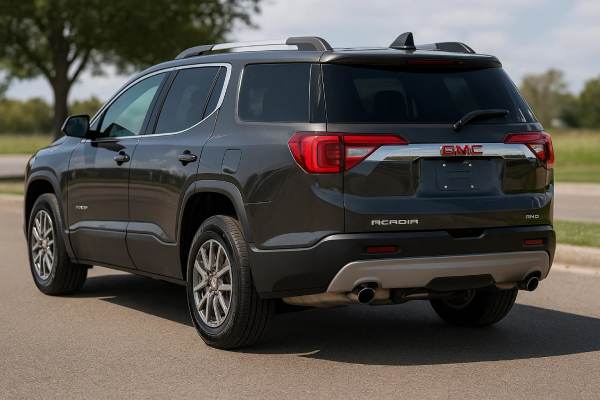
The 2020–2021 GMC Acadia AWD with the 2.5 litre LCV four-cylinder engine sits at the practical end of the mid-size SUV market. It keeps the same core structure and powertrain layout as the earlier second-generation Acadia, but adds sharper front styling, updated lighting, and a more modern cabin with improved connectivity. The naturally aspirated 2.5 engine produces around 193 hp and 188 lb-ft of torque and is paired with a 9-speed automatic and an on-demand AWD system shared with higher-output versions.
From an ownership point of view, this configuration aims for predictable behaviour and manageable running costs rather than outright speed. The facelift update improves day-to-day usability without making the vehicle more complex to maintain. Safety scores remain competitive for the class, and the Acadia continues to offer a flexible three-row interior and a practical cargo area. If you are considering an AWD Acadia 2.5 as a used purchase or already own one, this guide explains the key specs, maintenance needs, reliability patterns, and how it stacks up against rivals.
Fast Facts
- AWD Acadia 2.5 combines a simple naturally aspirated four-cylinder with an on-demand AWD system for all-weather confidence and predictable running costs.
- Facelift models add revised styling, an updated infotainment system, and reorganised cabin controls while retaining familiar mechanicals.
- Official crash testing shows strong overall safety performance for this generation, suitable for family duty.
- Owners should watch for timing-chain wear on high-mileage engines with poor oil-change history and for harsh or hesitant shifting from the 9-speed automatic.
- A sensible service rhythm is engine oil and filter every 8,000–12,000 km or 6–12 months, with transmission and AWD fluids refreshed on a longer interval.
Section overview
- AWD Acadia 2.5 facelift overview
- Facelift 2.5 AWD specs and data
- Trims, options and safety tech
- Reliability and service actions
- Maintenance plan and buyer’s guide
- Driving performance and economy
- How the AWD Acadia compares
AWD Acadia 2.5 facelift overview
For the 2020 model year, GMC refreshed the second-generation Acadia with more assertive front-end styling, a new grille and lighting design, and updated rear bumpers and wheel options. Inside, the centre console was reorganised around an updated infotainment system, additional connectivity features, and a push-button gear selector in place of the earlier mechanical shifter on many trims. Despite these visible changes, the underlying C1UG platform, basic suspension layout, and 2.5 litre LCV engine remained familiar.
The 2.5 AWD configuration is less common than the V6 or 2.0 turbo AWD pairings, and in some markets the 2.5 was officially sold mainly with front-wheel drive. Where a 2.5 AWD was offered, it uses the same electronically controlled clutch-pack rear drive module as stronger Acadia variants. In everyday driving, the system is front-biased for efficiency, sending torque to the rear wheels when slip is detected or when the driver selects an AWD or off-road mode. This gives better traction in poor weather while keeping highway fuel consumption reasonably close to that of a 2.5 FWD Acadia.
The LCV 2.5 is a direct-injected, naturally aspirated inline-four with variable valve timing. Its tuning favours smoothness and linear response rather than dramatic mid-range surge. Drivers coming from older GM V6s should expect to use more revs when merging or overtaking, but the engine is generally refined and predictable. The 9-speed automatic helps keep it in a useful band, though its behaviour depends heavily on software calibration and driving style.
From an ownership perspective, the facelift years benefit from incremental improvements introduced since the Acadia’s 2017 redesign. Many early electronic and transmission-tuning quirks had been addressed by 2020, so a well-serviced 2020–2021 Acadia AWD 2.5 can be a relatively low-drama family SUV, provided that maintenance is kept up and expectations around towing and performance are realistic.
Facelift 2.5 AWD specs and data
This section concentrates on the AWD Acadia with the 2.5 LCV engine in the 2020–2021 facelift years. Exact figures can vary slightly by market and trim, so treat the numbers below as a guide and confirm against official documentation for your VIN.
Engine and performance (LCV 2.5)
| Item | Value (approximate where noted) |
|---|---|
| Engine code | LCV |
| Layout and cylinders | Inline-4, aluminium block and head, DOHC, 4 valves per cyl |
| Displacement | 2.5 L (about 2,457 cc) |
| Induction | Naturally aspirated |
| Fuel system | Direct injection |
| Compression ratio | Around 11.3:1 |
| Max power | 193 hp (about 144 kW) near 6,300 rpm |
| Max torque | 188 lb-ft (about 255 Nm) near 4,400 rpm |
| Timing drive | Chain (no fixed replacement interval; condition-based) |
| Emissions / efficiency standard | Designed to meet U.S. Tier 3 / LEV III and euro-equivalent norms |
Official fuel-economy values for 2.5 FWD models sit in the low 20s mpg (US) combined. Adding AWD typically increases consumption by roughly 5–10 percent. For a 2.5 AWD Acadia, realistic expectations with sensible driving are:
- City: about 11.5–12.0 L/100 km (20–21 mpg US)
- Highway: about 9.0–9.4 L/100 km (25–26 mpg US)
- Mixed: about 10.2–10.5 L/100 km (22–23 mpg US)
Driving style, climate, and load can easily shift these numbers in either direction.
Transmission and driveline
| Item | Value / description |
|---|---|
| Transmission | 9-speed automatic (9T50 family) |
| Drive type | On-demand AWD, primarily front-drive in normal conditions |
| Rear differential | Electronically controlled clutch-pack module |
| Final drive (front) | Ratio around the high 3s (varies slightly by calibration) |
| Drive modes | 2WD, AWD, Off-Road, and Tow/Haul on suitable trims |
In 2WD mode, the system disconnects the rear axle to reduce drag. Selecting AWD locks in the ability to send torque rearwards as needed, which is helpful on wet, snowy, or unpaved surfaces.
Chassis and dimensions (typical 2020 AWD Acadia)
| Item | Value (approximate, model-year dependent) |
|---|---|
| Platform | C1UG (second-generation Acadia) |
| Suspension (front) | MacPherson strut, coil springs, stabiliser bar |
| Suspension (rear) | Independent multi-link with stabiliser bar |
| Steering | Electric power steering |
| Brakes | Four-wheel disc, front ventilated |
| Wheelbase | About 2,858 mm (112.5 in) |
| Length | About 4,915 mm (193.4 in) |
| Width (without mirrors) | About 1,915 mm (75.4 in) |
| Height | Around 1,690–1,700 mm (about 66–67 in) |
| Ground clearance | About 183 mm (7.2 in) |
| Turning circle (kerb-to-kerb) | Around 11.8–11.9 m (about 39 ft) |
| Curb weight (AWD 2.5) | Roughly 1,870–1,930 kg (4,120–4,255 lb) |
| Fuel tank | Around 72 L (19.0 US gal) |
| Seating | 6 or 7 passengers (captain’s chairs or bench in row two) |
| Cargo volume behind 3rd / 2nd / 1st rows | About 362 / 1,180 / 2,240 L (12.8 / 41.7 / 79 ft³) |
Performance and capability
With the extra mass and driveline drag of AWD, the 2.5 Acadia focuses on secure traction rather than quick acceleration:
- 0–100 km/h (0–62 mph): roughly 9.8–10.5 seconds, depending on load and conditions
- Top speed: electronically limited, broadly around 190–200 km/h (118–124 mph)
- Braked towing: commonly 1,000 kg (2,000 lb) with the 2.5 engine; higher ratings mainly apply to V6/turbo versions with tow packages
Fluids, capacities and key torques (approximate)
Always confirm exact values in the official manual or service information for your VIN, but as a planning guide:
| System | Specification and notes |
|---|---|
| Engine oil | Dexos1-approved 0W-20; about 5.0–5.5 L with filter |
| Engine coolant | Dex-Cool OAT; 50/50 mix; roughly 9–11 L system volume |
| Automatic transmission | GM-approved ATF for 9T50; drain-and-fill is less than full dry capacity |
| Rear drive module (AWD) | Synthetic gear oil; change interval based on use and condition |
| Brake fluid | DOT 3 or DOT 4, replaced on a time basis |
| Wheel lug nuts (torque) | Around 140 Nm (about 103 lb-ft) |
Trims, options and safety tech
During the facelift period, the Acadia range typically spanned SLE, SLT, AT4, and Denali trims, with equipment and drivetrain choices varying by market. The 2.5 engine was generally aligned with value-focused trims such as SLE and some SLT configurations, while AT4 and Denali more often paired AWD with the V6 or 2.0 turbo. Where a 2.5 AWD exists, it is usually a lower-to-mid-grade model, sometimes aimed at fleets or specific regional requirements.
Key trim and option differences that matter to a 2.5 AWD buyer include:
- Seating configuration
- 7-seat layout with a second-row bench, ideal for maximum passenger capacity.
- 6-seat layout with second-row captain’s chairs, improving comfort and third-row access.
- Infotainment and connectivity
- Base systems use a smaller touchscreen with fewer speakers and basic audio.
- Higher trims gain larger screens, more USB ports, improved audio systems, built-in navigation, and upgraded smartphone integration.
- Exterior hardware
- Wheel sizes vary from 17-inch on lower trims to 18- and 20-inch options on higher ones. Larger wheels sharpen steering response but can slightly degrade ride comfort and winter-tyre options.
- Headlamp technology transitions from halogen on some lower trims to HID or LED units on higher grades, which directly affects night-time visibility and headlight test scores.
- Interior and comfort features
- Cloth or leather upholstery, seat heating/ventilation, tri-zone climate, powered tailgate, and panoramic roof availability all climb with trim level.
- Denali adds distinctive cabin materials, extra sound insulation, and more comprehensive technology, though it is rarely paired with the 2.5 engine.
Safety ratings and structure
The second-generation Acadia has strong crash-test performance in key frontal and side-impact tests, with solid scores from both U.S. and international safety bodies. Rollover risk ratings are typical for a mid-size three-row SUV, with a modestly raised centre of gravity but a wide track and stable chassis.
Headlight ratings vary more widely, making it worth checking the specific headlamp type fitted to any particular vehicle. LED or HID packages tend to perform better in formal tests and real-world driving than basic halogen units, particularly on unlit rural roads.
Safety systems and ADAS
Equipment levels depend on trim and options, but a 2020–2021 Acadia AWD 2.5 may include:
- Multiple airbags (front, side, curtain) and a strong passenger cell
- Electronic stability control, traction control, ABS and brake assist
- Rear-view camera and rear park assist, sometimes with parking sensors at both ends
- Available advanced systems such as:
- Forward Collision Alert and Automatic Emergency Braking
- Lane Keep Assist with Lane Departure Warning
- Lane Change Alert with Blind-Zone Alert
- Rear Cross-Traffic Alert
- Adaptive Cruise Control on higher trims
- Surround-view camera systems on top-spec versions
After windshield replacement, front-end repairs, or suspension changes, radar and camera sensors may require calibration to maintain correct ADAS performance. It is worth verifying that calibration has been completed after major work.
AWD 2.5 reliability and service actions
The 2.5 LCV engine and 9-speed automatic have generally acceptable reliability when maintained correctly, but certain patterns are worth noting, especially on higher-mileage vehicles or those with incomplete service histories.
Engine-related issues
Typical concerns for this engine family include:
- Timing-chain wear and noise
Prolonged oil-change intervals or low-quality oil can accelerate chain and guide wear. Signs include rattling at cold start, timing-related fault codes, or inconsistent performance. The remedy is usually a timing set replacement (chain, guides, tensioner) along with careful inspection of oil passages and adherence to proper oil intervals thereafter. - Carbon build-up on intake valves
Direct injection can lead to deposits on intake valves over time, especially on vehicles used mostly for short journeys. Symptoms can include rough idle, misfires under load, and reduced economy. Cleaning typically involves walnut-shell blasting of the intake ports with the manifold removed. - Cooling system leaks
Plastic coolant fittings, thermostat housings, and ageing hoses may develop seeps or leaks as the vehicle ages. Watch for low coolant level, faint sweet smells from the engine bay, or dried residue around joints. Early attention often prevents overheating-related damage.
Transmission and AWD system
The 9-speed automatic is a complex unit, and its behaviour depends strongly on software and fluid condition:
- Harsh or hesitant shifts
Some owners report firm 1–2 or 2–3 shifts or hesitation when cold. Software updates and fresh ATF often improve this significantly. In severe cases, internal wear or torque-converter issues may need attention. - Torque-converter shudder
A light shudder under gentle acceleration in higher gears may point to fluid degradation. Fluid exchange using the correct specification, sometimes combined with updated software, is a common remedy.
The AWD system itself is usually robust if serviced:
- Rear drive module issues
Lack of fluid changes, contamination, or seal failures can lead to noise, binding in tight turns, or loss of AWD function. Regular fluid replacement is recommended if the vehicle tows, drives in hilly areas, or spends much time in AWD or Off-Road modes.
Chassis, electronics and corrosion
Common wear points include:
- Front suspension bushings and ball joints, especially on vehicles driven on rough roads
- Rear suspension links and bushings, leading to clunks or unstable feel over bumps
- Wheel bearings, particularly in harsh winter climates with road salt
Electronics and infotainment can show occasional glitches such as frozen screens, Bluetooth instability, or parking-camera faults. Many of these are addressed by software updates, module resets, or in some cases module replacement.
Corrosion protection is reasonable for the class, but used buyers should inspect:
- Rear subframe, suspension mounting points, and brake-line routing
- Tailgate edges, door bottoms, and under-door weather strips
- Roof-rail mounting points and windshield edges for paint bubbling or rust from trapped moisture
Recalls, TSBs and extended coverage
Acadia models from this era have been subject to various recalls for issues such as seatbelt or airbag wiring, electronic module concerns, and other safety-related items. Technical Service Bulletins cover topics like transmission software, infotainment behaviour, and driveline noises. Because coverage differs by region and VIN, the only reliable approach is to run a VIN lookup through official recall databases and ask a dealer for a record of completed campaigns and outstanding actions.
For any candidate vehicle, documentation showing completed recalls, TSB-related software updates, and regular servicing is a strong positive sign.
Maintenance plan and buyer’s guide
A structured maintenance plan is the best way to keep an AWD Acadia 2.5 running reliably into higher mileages. The official schedule may vary slightly by region and driving profile, but the framework below works well for most owners.
Suggested maintenance intervals (time or distance, whichever comes first)
- Engine oil and filter
- Normal use: every 12,000 km or 12 months
- Severe service (short trips, heavy traffic, towing, dusty conditions): every 8,000 km or 6 months
- Engine air filter
- Inspect at 24,000 km, replace every 45,000–60,000 km, sooner in dusty environments.
- Cabin air filter
- Replace every 24,000–30,000 km or every 2 years.
- Coolant (Dex-Cool OAT)
- First replacement around 5 years or up to roughly 240,000 km, then every 5 years or as specified for your region.
- Spark plugs (iridium)
- Commonly scheduled around 150,000 km or about 8–9 years.
- Automatic transmission fluid
- Change or perform a partial fluid exchange around 80,000–100,000 km in mixed use; sooner (60,000–80,000 km) if you tow regularly or drive in hot climates.
- AWD rear drive module / differential fluid
- Refresh between 60,000–80,000 km for towing and heavy AWD use, or around 100,000–120,000 km in lighter service.
- Brake fluid
- Replace every 2–3 years, regardless of mileage.
- Brakes (pads and rotors)
- Inspect at each service; typical life is 40,000–70,000 km depending on driving conditions.
- Serpentine/auxiliary belts and hoses
- Inspect closely from 100,000 km onward; replace if any cracks, fraying, glazing or noise appear.
- 12 V battery
- Test annually from year 4; most units last 5–7 years in moderate climates.
- Tyre rotation and alignment
- Rotate tyres every 10,000–12,000 km to promote even wear.
- Check alignment whenever you notice steering pull, uneven wear patterns, or after significant pothole impacts.
Because the LCV engine uses a timing chain instead of a belt, there is no set replacement interval. However, any chain-related rattle, timing-correlation codes, or metallic debris in the oil should be investigated promptly.
Buyer’s guide: what to check on a used AWD Acadia 2.5
When evaluating a candidate 2020–2021 AWD 2.5:
- History and paperwork
- Look for a consistent service record with oil changes at appropriate intervals using the correct specification.
- Confirm that recall work and important software updates have been completed.
- Check for documentation of transmission and AWD fluid changes by 100,000 km.
- Exterior and underside
- Inspect panel gaps, paint finish and headlamp alignment for signs of accident repair.
- Examine the underside for corrosion, especially on the rear subframe, suspension arms, and brake lines.
- Engine and cooling system
- Listen for rattles on cold start and during warm idle.
- Check coolant level and colour, and look for stains or crust around plastic coolant fittings and joints.
- Driveline behaviour
- During a road test, note any harsh shifts, hesitation or shudder from the 9-speed automatic.
- In a parking lot, drive slow tight circles and feel for binding or knocking that might indicate AWD module issues.
- Listen for humming wheel bearings at constant speeds.
- Electronics and interior
- Test all windows, locks, mirrors, seat adjustments and steering-wheel controls.
- Check the infotainment system, Bluetooth, smartphone integration and all camera views.
- Confirm that warning lights turn off after start-up and that no stored codes appear when scanned.
Budget for a baseline service after purchase unless the seller provides recent, detailed invoices. That baseline should include engine oil and filter, air and cabin filters, brake fluid, and, on higher-mileage vehicles, transmission and AWD fluids.
Driving performance and economy
Behind the wheel, the facelifted AWD Acadia 2.5 feels tuned for comfort and stability rather than aggressive performance. With about 193 hp and a curb weight approaching two tonnes in everyday trim, acceleration is adequate but not brisk, and you will often use higher revs when joining fast traffic or overtaking on the highway.
Ride and handling
The suspension calibration emphasises compliance. On 17- or 18-inch wheels, the Acadia absorbs small bumps and patched surfaces well, making it a relaxed long-distance cruiser. Body roll is noticeable in fast corners but remains well managed, and grip is predictable. Larger 20-inch wheels sharpen steering response slightly but introduce more impact harshness over potholes and expansion joints.
The electric power steering is light at low speed, making parking easy, and weights up moderately on the highway. Feedback is modest but adequate for the class. Straight-line stability at motorway speeds is generally solid provided tyres are in good condition and correctly inflated.
Noise, vibration and harshness
At low to medium engine speeds, the 2.5 engine is reasonably quiet. It becomes more vocal under heavy throttle, especially as it approaches the upper rev range. Wind and road noise are well controlled for a mid-size three-row SUV; highway noise mainly depends on tyre type and wheel size. Higher trims with extra sound insulation feel more refined on coarse asphalt.
Transmission and AWD behaviour
The 9-speed automatic aims to keep the engine in its efficient band, often shifting early and cruising in high gears at moderate speeds. Occasional hesitation or small lurches in low-speed urban driving can occur, especially if fluid is old or software is out of date, but many examples feel smooth once up to temperature. Selecting Tow/Haul mode when towing or heavily loaded can improve shift logic.
The AWD system is unobtrusive in normal driving. In dry conditions, it behaves much like a front-drive crossover, with AWD mode primarily providing a safety margin. On wet, snowy or gravel roads, the ability to send torque rearwards improves traction and reduces the need for stability-control intervention. The Acadia is not intended as a hardcore off-roader, but it handles mild trails and winter conditions reliably when fitted with appropriate tyres.
Real-world fuel economy
In mixed use, owners can expect:
- City-heavy driving: often 13–14 L/100 km (17–18 mpg US), especially in cold climates or with short trips.
- Mixed commuting: commonly around 11–12 L/100 km (19–21 mpg US).
- Highway focus (100–110 km/h): around 8.5–9.5 L/100 km (25–28 mpg US) with gentle driving and light loads.
Roof racks, cargo boxes, wider tyres, strong headwinds and high cruising speeds can push consumption higher. Compared with V6 AWD models, the 2.5 uses less fuel in light-load conditions but can approach V6-like consumption when heavily loaded or frequently driven hard, simply because the engine has to work harder.
Towing and load behaviour
With the 2.5 engine, the preferred use case is modest trailers and occasional light towing rather than frequent operation near the maximum rating. Staying well under the rated tow weight, using trailer brakes where possible, and allowing more time for acceleration and braking will make the experience more relaxed. When towing on long grades, manually selecting a lower gear and watching engine and transmission temperatures (if displayed) helps keep mechanical stress in check.
How the AWD Acadia compares
In the 2020–2021 market, the AWD Acadia 2.5 competes with three-row SUVs such as the Chevrolet Traverse, Buick Enclave, Honda Pilot, Toyota Highlander, Ford Explorer and similar models. Many of those rivals bundle AWD exclusively with V6 or turbocharged engines, which shifts the Acadia 2.5’s positioning slightly.
Where the AWD Acadia 2.5 stands out
- Manageable running costs
A naturally aspirated four-cylinder is simple by modern standards, and parts and fluids are widely available. For drivers who spend most of their time at urban and suburban speeds, it can be less thirsty than larger engines when driven gently. - Compact size with good space
The Acadia is slightly shorter and narrower than some big three-row SUVs but offers competitive cargo volume behind the first and second rows. This makes it easier to park in tight spaces without sacrificing everyday practicality. - Solid safety foundation
Good crash-test results, a strong passenger cell, and the availability of modern driver-assistance features give it a reassuring safety profile, especially when equipped with higher-spec lighting and ADAS packages.
Areas where rivals may be stronger
- Performance under heavy load
V6-powered Highlander, Pilot and Explorer models, as well as V6 or turbocharged Acadia variants, deliver more confident acceleration when fully loaded or towing. If you regularly travel with seven passengers and luggage or tow near the limit, those drivetrains can feel less strained. - Powertrain variety
Some competitors offer hybrid options that provide significantly better fuel economy in city driving. The Acadia 2.5 AWD does not have a hybrid counterpart, so heavy urban users who value economy above all might prefer a hybrid SUV. - Perceived refinement at the top end
Premium-trim rivals can offer more upscale interiors, more comprehensive ADAS packages, or smoother high-output engines. While Denali trims narrow that gap, they are less often paired with the 2.5 engine.
Best fit for the AWD Acadia 2.5
The facelifted AWD Acadia 2.5 suits:
- Families who prioritise safety, flexible space and all-weather traction over rapid acceleration.
- Drivers who value a conventional, naturally aspirated engine and plan to keep up with maintenance.
- Buyers seeking good value on the used market and willing to trade some performance for lower acquisition cost and straightforward ownership.
For drivers who tow heavy trailers frequently, live at high altitude, or simply prefer a more effortless powertrain, a V6 or turbocharged rival (or a different Acadia variant) is a better match. For many households, however, the 2.5 AWD combination delivers a sensible balance of cost, comfort and capability.
References
- Manuals and Guides | Vehicle Support 2020 (Owner’s Manual portal)
- 2020 GMC Acadia Catalog 2019 (Brochure)
- Vehicle Detail Search – 2020 GMC ACADIA SUV AWD 2020 (Safety Rating and Recalls)
- 2019 GMC Acadia 4-door SUV 2019 (Safety Rating)
- 2020 GMC Trailering Guide 2019 (Trailering Guide)
Disclaimer
This article is for informational purposes only and is not a substitute for professional diagnosis, repair, or official service documentation. Specifications, torque values, fluid capacities, available equipment, and maintenance intervals can vary by VIN, model year, market, and individual vehicle configuration. Always verify any procedure or figure against the official owner’s manual and service information for your specific vehicle, and consult a qualified technician before carrying out repairs or adjustments.
If you found this guide helpful, please consider sharing it on platforms such as Facebook or X/Twitter to support our work and assist other GMC Acadia owners.