
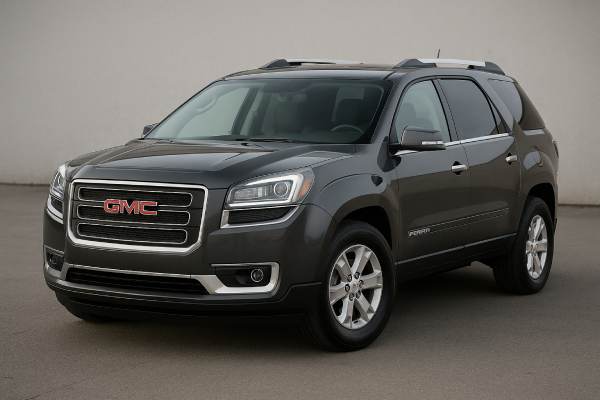

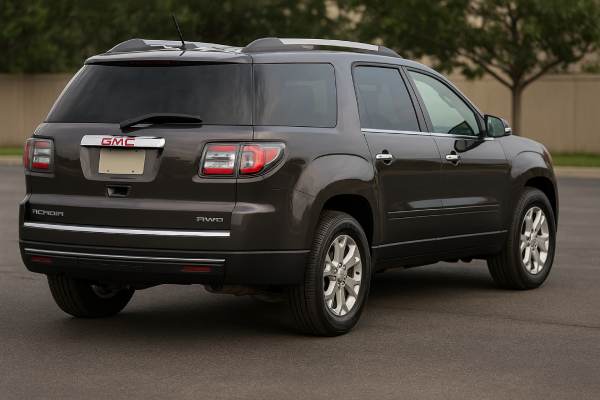
The 2013–2016 facelifted GMC Acadia AWD sits at an interesting point in the SUV market. It is a full-size three-row crossover with minivan-like space, a car-like unibody chassis, and a traditional naturally aspirated V6. For families, it offers seven or eight seats, generous cargo room, and confident all-weather traction. For owners, it brings a mix of solid crash test results, straightforward mechanicals, and a few well-known wear points that are manageable if you plan ahead.
This article focuses on the AWD Acadia with the 3.6-litre LLT V6 after the 2013 refresh. You will find detailed technical data, real-world reliability notes, maintenance guidelines, and buying tips aimed at long-term ownership. The goal is not only to list numbers, but to explain what they mean for running costs, comfort, and long-range durability. If you are considering a used Acadia or already own one and want to keep it healthy, this guide is designed to serve as your reference.
Top Highlights
- Strong 3.6-litre V6 with 288 hp gives confident highway passing and stable towing for a family crossover.
- Spacious cabin and flat load floor make the Acadia AWD a practical substitute for a minivan.
- Good crash performance and available advanced safety tech improve peace of mind for family use.
- Watch for timing chain stretch, transmission wear, and cooling system leaks as the miles add up.
- Plan on engine oil and filter every 10,000–12,000 km (6,000–7,500 miles) or 12 months, whichever comes first.
Navigate this guide
- GMC Acadia AWD in detail
- AWD Acadia specs and data
- Trims, options and AWD safety
- Reliability issues and fixes
- Maintenance planning and used buying
- On-road performance and traction
- AWD Acadia against competitors
GMC Acadia AWD in detail
The facelifted GMC Acadia AWD you see from 2013 to 2016 is the last and most refined version of the first-generation Acadia on GM’s Lambda platform. Styling changes brought a more upright grille, revised lighting, and a tidier rear, but the core layout stayed the same: a large unibody crossover with independent suspension and an available electronically controlled all-wheel-drive system.
Under the hood, all facelift AWD models use the LLT 3.6-litre V6. This is an aluminium, 60-degree V6 with dual overhead cams, variable valve timing, and direct injection. Output is 288 hp and roughly 270 lb-ft of torque, routed through a 6-speed automatic transmission to all four wheels. It is not a turbo or diesel; power delivery is linear and builds with revs, which suits highway driving and overtaking more than low-rpm lugging.
Inside, the Acadia aims at families and light-duty commercial use. The second row is usually captain’s chairs (with an eight-seat bench available on some trims), and the third row can fit adults on shorter trips. The facelift years gained an updated dashboard, improved infotainment with touchscreen and smartphone integration on higher trims, and better perceived material quality compared to the earliest 2007–2008 examples.
The AWD system is designed for on-road security rather than serious off-roading. It uses an electronically controlled clutch pack to send torque to the rear axle when slip is detected, staying primarily front-biased in normal driving. There is no low-range transfer case, but ground clearance and approach/departure angles are enough for rough gravel roads, snow, and light trail duty when paired with appropriate tyres.
In ownership terms, the facelift Acadia AWD benefits from the incremental improvements GM made across the first generation. Software calibrations for shift quality and stability control improved, cabin noise insulation got better, and some early component issues were reduced in frequency. At the same time, the core engine and gearbox design remained the same, so known LLT timing chain and 6-speed automatic wear patterns still apply and should be part of any buying or maintenance plan.
AWD Acadia specs and data
This section focuses on the common 2013–2016 GMC Acadia AWD with the 3.6-litre LLT V6 and 6-speed automatic. Figures can vary slightly by trim and equipment; always verify against your specific VIN.
Engine and performance
| Item | Specification |
|---|---|
| Engine code | LLT |
| Layout and cylinders | 60° V6, aluminium block and heads |
| Valvetrain | DOHC, 4 valves per cylinder, variable valve timing |
| Displacement | 3.6 L (3,564 cc) |
| Induction | Naturally aspirated |
| Fuel system | Direct injection (SIDI) |
| Compression ratio | About 11.3:1 |
| Max power | 288 hp (approx. 215 kW) @ ~6,300 rpm |
| Max torque | ~270 lb-ft (≈ 366 Nm) @ ~3,400–3,600 rpm |
| Timing drive | Chain |
| Recommended fuel | Regular unleaded (87 AKI) |
| Typical combined economy AWD | Around 15–17 mpg US (≈ 13–16 L/100 km) |
Real-world consumption depends heavily on load and speed. At 120 km/h (75 mph), many owners see mid-teens mpg (US), with city use often dropping into the low teens. Careful driving and good maintenance are essential to keep fuel usage in check.
Transmission and driveline
| Item | Specification |
|---|---|
| Transmission | 6-speed automatic (6T75 family) |
| Drive type | On-demand AWD (front-biased, electronically controlled rear drive) |
| Final drive ratio | Typically around 3.16–3.39, depending on trim |
| Differential | Open differentials with active clutch pack to rear axle |
| Towing capacity (AWD) | Commonly rated up to 2,000–5,200 lb depending on tow package |
Chassis and dimensions
| Item | Specification |
|---|---|
| Platform | GM Lambda |
| Front suspension | MacPherson strut with coil springs |
| Rear suspension | Independent multi-link |
| Steering | Hydraulic power rack-and-pinion |
| Brakes | 4-wheel disc, ABS |
| Overall length | About 5,100 mm (≈ 200.8 in) |
| Width (without mirrors) | About 1,989 mm (≈ 78.3 in) |
| Height | Around 1,787 mm (≈ 70.4 in) |
| Wheelbase | 3,021 mm (≈ 118.9 in) |
| Curb weight (AWD) | Roughly 2,200–2,350 kg (4,850–5,180 lb) |
| Fuel tank | About 83 L (≈ 22 US gal) |
| Cargo volume (approx.) | ≈ 691 L behind 3rd row, 1,980+ L seats folded |
Fluids and service points (typical values)
Use these as planning figures only; always confirm exact specifications and capacities in the official service manual or owner’s manual for your model year.
- Engine oil: Dexos-approved 5W-30 synthetic; roughly 5.7–6.0 L including filter.
- Coolant: Long-life Dex-Cool-type; around 10–12 L for a full system fill.
- Automatic transmission fluid: Dexron-VI; capacity varies with service method but expect roughly 7–9 L for a full change.
- Rear differential and power take-off unit: GM-specified gear oil; small capacities, often under 1.5 L each.
- A/C refrigerant: R-134a; charge quantity depends on model year and options.
These numbers give a ballpark idea of running costs and how much fluid you will need when budgeting for larger services.
Trims, options and AWD safety
During the 2013–2016 facelift period, the AWD Acadia was offered across several trims, often mirroring the front-wheel-drive lineup but adding traction and, in some cases, extra towing or wheel packages.
Trims and key features
Exact names vary by market, but a typical North American lineup includes:
- SLE-1 AWD – Entry-level equipment with cloth seating, manual liftgate, basic audio and air conditioning. AWD adds extra weight and security but usually without cosmetic upgrades.
- SLE-2 AWD – Often gains power tailgate, remote start, upgraded infotainment, and more convenience features.
- SLT-1 and SLT-2 AWD – Leather seating, heated front seats, tri-zone climate, premium audio, and more extensive driver information systems. SLT-2 typically brings larger wheels and more options.
- Denali AWD – Top trim with distinctive grille and exterior trim, premium leather, often a dual-panel sunroof, head-up display in some markets, and the richest equipment list.
Mechanical differences between trims are modest. The engine and basic AWD hardware remain the same, but Denali and higher trims may have different wheel and tyre sizes, which can slightly affect ride, noise, and braking performance. Tow packages add a heavier-duty cooling system, wiring, and hitch hardware, which are valuable if you plan regular towing.
Safety ratings
Lambda-platform Acadias, including the facelift AWD models, typically perform well in major crash test programs. Moderate overlap front, side impact, roof strength, and head restraint ratings are generally strong for 2007–2016 models. That solid structure is one of the model’s core advantages from a family safety perspective.
Keep in mind that ratings sometimes reference an early test vehicle (for example, a 2008 model), but apply to later model years through 2016 because the structure stayed fundamentally the same. Always confirm the exact rating for your year and configuration on official databases if safety performance is a deciding factor.
Safety systems and driver assistance
Standard passive and active safety features on most facelift AWD Acadias include:
- Front, side, and side-curtain airbags with rollover sensing.
- Electronic stability control and traction control.
- Four-wheel ABS with electronic brakeforce distribution.
- Tyre pressure monitoring system.
Available or trim-dependent systems on 2013–2016 AWD models can include:
- Rearview camera (standard on later years, optional earlier in the generation).
- Rear park assist sensors.
- Blind spot monitoring and rear cross-traffic alert on higher trims.
- Lane departure warning and forward collision alert on certain packages.
Advanced driver-assistance systems (AEB with automatic braking and adaptive cruise) were not widely available on this generation; what you get is mostly warning-based rather than active intervention. When repairs to bumper covers, cameras, or sensors are carried out, correct calibration is important to avoid nuisance warnings and to maintain system capability.
Child seat installation is supported by LATCH/ISOFIX anchors on the outboard second-row positions. The third row can take boosters but is less ideal for frequent seat installation due to access and anchor placement. If you use multiple child seats, test-fitting them in the vehicle before purchase is highly recommended.
Reliability issues and fixes
The facelift Acadia AWD is not fragile, but it does have several well-documented weak points. Understanding them by mileage and symptom helps you avoid surprises and plan repairs rather than reacting to failures.
Engine-related issues (LLT V6)
Timing chain stretch (common, medium–high cost)
- Typical mileage/age: Often 100,000–160,000 km (60,000–100,000 miles) and above, especially with extended oil change intervals.
- Symptoms: Check-engine light with cam/crank correlation codes, rough cold starts, rattling on startup, poor performance.
- Cause: Chain and tensioner wear aggravated by infrequent oil changes and degraded oil.
- Remedy: Replace timing chains, guides, and tensioners as a kit, using updated parts; maintain strict oil change intervals with the correct Dexos-approved oil to avoid recurrence.
Carbon build-up on intake valves (occasional)
Direct injection can allow deposits to form on the intake valves over time, especially in city driving. Symptoms include rough idle, hesitation, and reduced fuel economy. Solutions range from careful chemical cleaning to walnut-shell blasting of the intake ports on higher-mileage engines.
Cooling system leaks (common, low–medium cost)
Radiators, water pumps, and plastic quick-connect fittings can develop leaks with age and heat cycles. Early detection (sweet smell, coolant traces, slowly dropping reservoir level) allows planned replacement. Overheating has a direct negative impact on head gaskets and timing components, so treating cooling issues as urgent is wise.
Transmission and driveline
The 6-speed automatic can be durable with regular fluid service, but:
- Shift flare, harsh shifts, or slipping may appear as fluid ages. A fluid and filter change, along with updated software where available, often improves behaviour if caught early.
- Internal clutch failure is less common but expensive, usually requiring rebuild or replacement. This risk increases on vehicles that tow regularly without sufficient cooling or maintenance.
- AWD components (power take-off unit and rear differential) can suffer from worn fluid and leaks. Noise or binding when turning on full lock should be investigated promptly.
Steering, suspension, and brakes
As mileage rises, expect:
- Worn front struts and rear shocks, especially on heavier trims with large wheels.
- Front control arm bushings and ball joints developing play, leading to clunks and uneven tyre wear.
- Steering rack or power steering line leaks, often showing as assist loss or fluid drops.
Rust is generally better controlled than on some body-on-frame SUVs, but pay attention to subframe mounts, brake lines, and the rear underbody in road-salt regions.
Recalls and service campaigns
Across 2013–2016 model years, there have been recalls and service bulletins affecting items such as seat mounts, liftgate struts, and airbag or seatbelt components. Each vehicle has its own history; the correct approach is to:
- Check the VIN on the official recall database for open recalls.
- Ask a dealer to print the recall and service campaign history.
- Confirm that campaigns have been completed with documentation.
Vehicles with documented timing chain repairs, transmission servicing, and recall completion are more attractive and likely to deliver lower surprise costs.
Maintenance planning and used buying
A structured maintenance plan is the best defence against the known issues on an Acadia AWD. Below is a practical framework; always adapt to your driving pattern and confirm specific intervals from official service information.
Core maintenance intervals (typical)
- Engine oil and filter: Every 10,000–12,000 km (6,000–7,500 miles) or 12 months; shorten to 8,000 km (5,000 miles) for heavy city use, towing, or very hot/cold climates.
- Engine air filter: Inspect every 20,000 km (12,000 miles); replace roughly every 40,000–50,000 km (25,000–30,000 miles) or sooner in dusty conditions.
- Cabin air filter: Replace every 24,000–30,000 km (15,000–20,000 miles) to keep HVAC performance and odours under control.
- Spark plugs: Iridium plugs typically at 160,000 km (100,000 miles), but earlier replacement can improve cold starts and economy on higher-mileage vehicles.
- Coolant: Long-life coolant often specified for up to 5 years/240,000 km (150,000 miles); after the first full interval, a 4–5-year replacement cadence is sensible.
- Automatic transmission fluid: Aim for 60,000–80,000 km (35,000–50,000 miles) changes on AWD models, particularly if towing or driving in hilly regions.
- AWD system fluids (PTO and rear differential): Replace every 60,000–80,000 km as preventive maintenance.
- Brake fluid: Flush every 3 years to protect ABS components.
- Serpentine/aux belts and hoses: Inspect at each service; plan replacement around 100,000–120,000 km (60,000–75,000 miles) or at the first sign of cracking/noise.
- 12 V battery: Test annually after about 4–5 years; replace proactively at the first signs of slow cranking or unstable voltage.
- Wheel alignment and tyre rotation: Rotate tyres every 10,000–12,000 km and align whenever you see uneven wear or after suspension work.
Timing chains on the LLT are not listed as routine replacement items, but given the known wear patterns, treating chain-related noise or diagnostic codes early is essential. Do not ignore engine rattles or cam correlation codes; they are early warning signs.
Fluid specifications and torque examples
- Use Dexos-approved oil in the correct viscosity (typically 5W-30) to keep chain and lifter lubrication stable.
- When tightening wheel nuts, a typical torque spec is in the 135–150 Nm range; always confirm for your wheel and stud size.
- Critical suspension and steering fasteners should be torqued per the workshop manual; guessing here is not acceptable from a safety perspective.
Buyer’s checklist for a used Acadia AWD
When viewing a 2013–2016 facelift AWD:
- Service history: Look for regular oil changes, transmission fluid changes, and any timing chain or cooling system work.
- Cold start behaviour: Listen for rattles on first start and watch for warning lights.
- Transmission: On a road test, check for smooth shifts, no flare between gears, and no delay when shifting from Park to Drive/Reverse.
- AWD operation: On a wet or loose surface, confirm that all four wheels can drive without binding or harsh noises.
- Suspension and steering: Drive over rough roads and listen for clunks; check for steering wander or vibration at highway speed.
- Interior and electronics: Test every seat mechanism, HVAC zone, power tailgate, camera, and infotainment feature; electrical repairs can be time-consuming.
- Underbody and leaks: Inspect for fluid leaks, rust on subframes and brake lines, and evidence of accident repairs.
Well-maintained examples can cover high mileages with predictable running costs. Neglected vehicles, on the other hand, can require significant investment in chains, transmission, and suspension within a short period.
On-road performance and traction
The facelifted Acadia AWD is not a performance SUV, but its 288-hp V6 and 6-speed automatic give it respectable real-world pace. Acceleration to 100 km/h (62 mph) is typically in the high-8 to low-9-second range depending on load and trim, which is adequate for merging and overtaking even with passengers aboard.
Powertrain character
The LLT V6 is smooth and likes to rev. Around town, you spend most of your time in the midrange, where torque is sufficient but not overwhelming. The transmission is programmed to upshift early for fuel economy, so a firm throttle input is often needed to prompt a downshift for brisk acceleration. On the highway, once in top gear, the V6 settles to a relaxed cruise, though passing often involves a kickdown or two.
Many owners describe the gearbox as acceptable but not especially quick. Updated software and fresh fluid can improve shift quality, but you should not expect modern dual-clutch sharpness. Manual mode offers some control on hills or when towing, but the system still prioritizes protecting the powertrain.
Ride, handling, and NVH
The Acadia AWD is tuned primarily for comfort and stability:
- Ride: Soft and compliant, absorbing most road imperfections well, particularly on smaller wheel sizes. Larger wheels and low-profile tyres can introduce extra sharpness over potholes.
- Handling: Predictable, with safe understeer at the limit. The long wheelbase and wide track contribute to good straight-line stability, especially at motorway speeds.
- Steering: Light to moderate weight, with modest feedback. It is easy to place in traffic and parking lots but not especially engaging.
- Noise: Wind and road noise are generally well controlled, though coarse surfaces and worn tyres can raise cabin noise on high-mileage vehicles.
Braking performance is adequate for everyday driving. When towing or descending long grades, using lower gears to assist engine braking and avoiding excessive speed helps maintain brake consistency.
Efficiency and towing
Real-world consumption figures for AWD facelift Acadias often land in these ranges:
- City: 16–18 L/100 km (13–15 mpg US) depending on traffic and load.
- Highway (100–120 km/h / 60–75 mph): 10–12 L/100 km (19–24 mpg US) in steady conditions.
- Mixed driving: Around 13–15 L/100 km (16–18 mpg US) for many owners.
Towing a moderate-size trailer can increase fuel consumption by 30–50% and will highlight any weak points in cooling or transmission maintenance. The AWD system aids stability when launching on slippery surfaces, but correct loading, trailer brakes, and appropriate speed management remain essential.
In snow and rain, the Acadia AWD offers a clear advantage over FWD models, especially when paired with quality winter or all-weather tyres. The system reacts quickly enough for everyday use, and stability control stepping in early makes it forgiving for less experienced drivers.
AWD Acadia against competitors
When you compare the 2013–2016 GMC Acadia AWD with other three-row family crossovers of the same era, its strengths and weaknesses become clearer.
Space and practicality
Against rivals such as the Chevrolet Traverse, Buick Enclave, Ford Explorer, Honda Pilot, and Toyota Highlander, the Acadia scores well for:
- Generous third-row space; adults can fit more comfortably than in some mid-size competitors.
- A large, flat cargo area with all seats folded, nearing minivan levels of volume.
- Flexible seating configurations, especially on trims with second-row captain’s chairs.
Some competitors, particularly the Japanese options, may have slightly better small-item storage design and a lower load floor, but the overall packaging of the Acadia remains a strong selling point.
Performance and efficiency
The 3.6-litre V6 provides performance on par with other naturally aspirated V6 SUVs of the time. Turbocharged four-cylinder rivals from later generations may beat it on paper economy, but real-world differences depend heavily on driving style and load.
If fuel consumption is a primary concern, a smaller, lighter two-row SUV or a more recent turbocharged or hybrid three-row competitor will do better. If you prioritise smooth power delivery and a proven, non-turbocharged engine layout, the Acadia is still appealing.
Reliability and running costs
In reliability surveys and owner reports, the first-generation Acadia often sits mid-pack:
- Strong points include the basic robustness of the chassis and structure.
- Weaker points are the LLT timing chain and the 6-speed automatic on poorly maintained vehicles.
Some rivals, particularly from Toyota and Honda, may show fewer high-cost powertrain failures over very long mileages, but they can command higher used prices. Domestic competitors on similar platforms (Chevrolet Traverse, Buick Enclave) share many mechanical traits and issues, so condition and maintenance history matter more than the badge.
Safety and technology
In terms of crashworthiness, the Acadia is fully competitive for its age, with good structural performance and available side-curtain airbags covering all three rows. Where it lags newer rivals is in advanced driver-assistance technology. Modern SUVs often include standard automatic emergency braking, adaptive cruise, and lane-centering systems, while the Acadia offers warning-type features only, and typically as options on higher trims.
Infotainment and connectivity also feel dated compared to current vehicles, though the facelift brought an acceptable touchscreen interface, available navigation, and smartphone integration via Bluetooth.
Overall verdict
If you want a spacious, comfortable, all-weather family hauler with a traditional V6 and you are willing to invest in proper maintenance, a facelift 2013–2016 GMC Acadia AWD can be a good value. For buyers who prioritise the absolute lowest risk of major powertrain repairs and cutting-edge safety tech, a newer platform or a high-reputation Japanese rival may be more suitable. The key differentiator for the Acadia is space and comfort for the money, especially if you find a well-documented example with critical services already done.
References
<a href="https://www.gmc.com/support/vehicle/manuals-guides">Manuals and Guides | Vehicle Support | GMC</a> 2024 (Owner’s Manual Portal)<a href="https://www.gmccanada.ca/en/support/vehicle/manuals-guides">Owner's Manuals & Guides | GMC Canada</a> 2024 (Owner’s Manual Portal)<a href="https://www.nhtsa.gov/vehicle/2015/GMC/ACADIA/SUV/AWD">Vehicle Detail Search - 2015 GMC ACADIA SUV AWD | NHTSA</a> 2024 (Recall Database and Safety Info)<a href="https://www.iihs.org/ratings/vehicle/gmc/acadia-4-door-suv/2015">2015 GMC Acadia</a> 2015 (Safety Rating)<a href="https://www.fueleconomy.gov/feg/bymodel/2016_GMC_Acadia.shtml">Gas Mileage of 2016 GMC Acadia</a> 2016 (Official Fuel Economy Data)
Disclaimer
This article is for informational purposes only and is not a substitute for professional diagnosis, repair advice, or official service procedures. Specifications, torque values, fluid capacities, and maintenance intervals can vary by VIN, market, model year, and installed equipment.
Always verify critical information against your vehicle’s official owner’s manual, workshop manual, and current service bulletins. When in doubt, consult a qualified technician or authorised dealer before carrying out repairs or modifications.
If you found this guide useful, consider sharing it with other owners or shoppers on social media platforms such as Facebook or X/Twitter. Your support helps more drivers make informed, safe decisions about their vehicles.