
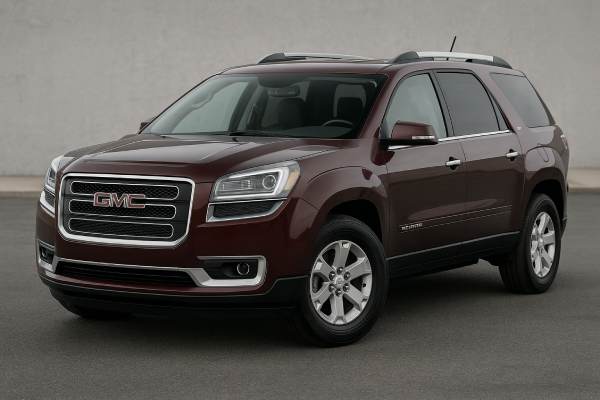
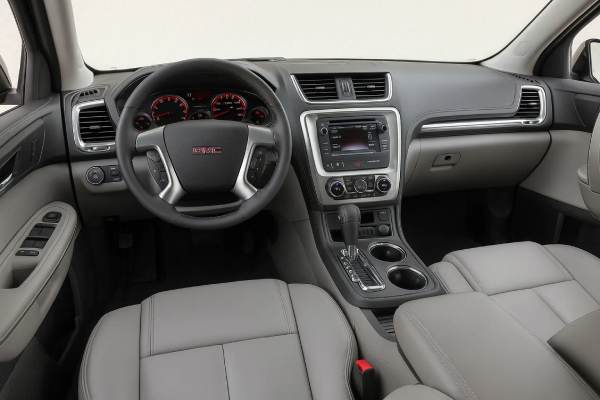
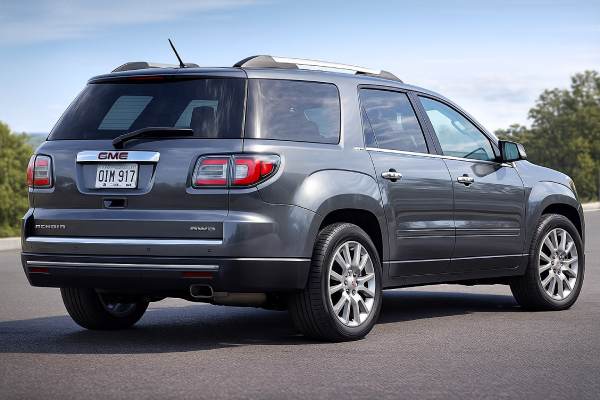
The 2013–2016 facelifted GMC Acadia FWD is the final and most refined stage of the first-generation Acadia. It keeps the proven LLT 3.6-litre V6 and six-speed automatic but adds updated styling, revised interior materials, and improvements to safety and equipment. For many buyers, this is the “sweet spot” in the range: all the space and towing ability of the early trucks, with cleaner looks and better long-distance comfort.
In front-wheel-drive form, the Acadia is lighter and slightly more fuel-efficient than its all-wheel-drive sibling, making it attractive for drivers in warmer climates or those who rarely see snow. At the same time, it remains a genuine three-row family hauler with seating for seven or eight and one of the most useful cargo areas in its class.
This guide walks through the detailed specs, reliability patterns, ownership costs, and how the facelift FWD Acadia compares to its main rivals if you are buying or maintaining one today.
Fast Facts
- 3.6-litre LLT V6 produces about 288 hp, giving confident performance for a fully loaded three-row SUV.
- Facelift brought stronger crash protection, improved cabin materials, and updated infotainment while keeping the proven platform.
- FWD layout cuts weight and usually reduces fuel use and maintenance compared with AWD versions.
- Timing chain wear, transmission issues, and cooling system leaks can be expensive if oil and fluid changes are delayed.
- Aim for engine oil and filter changes every 8,000–10,000 km (5,000–6,000 miles) or 12 months, whichever comes first.
Start here
- Facelift Acadia FWD summary
- Acadia FWD technical data
- Trims equipment and safety
- Long-term reliability and faults
- Ownership maintenance and buying guide
- Driving dynamics and efficiency
- Acadia facelift versus rivals
Facelift Acadia FWD summary
The facelifted 2013–2016 GMC Acadia FWD represents a careful evolution of the original 2007–2012 model rather than a complete redesign. Under the skin, it still rides on the Lambda-platform unibody chassis and uses the LLT 3.6-litre direct-injection V6 paired with a six-speed automatic transmission. The changes focus on styling, safety, and cabin usability.
Externally, the facelift brings a more upright grille, new front and rear fascias, updated lighting, and revised wheel designs. The overall effect is a slightly tougher, more squared-off look that matches GMC’s design language of the time. From the side, the long wheelbase and short overhangs remain, which are key to the Acadia’s excellent interior packaging.
Inside, GMC improved materials and detail design. The dashboard gained a cleaner centre stack, updated switchgear, and the availability of newer infotainment interfaces. Higher trims feel noticeably more upscale than the early trucks, with better textures, soft-touch surfaces in key areas, and extra sound deadening for quieter cruising. Seating flexibility is still a major selling point: seven-seat layouts with second-row captain’s chairs or eight-seat configurations with a second-row bench, all with folding second and third rows to maximise cargo space.
The front-wheel-drive layout suits drivers who mostly operate on paved roads in moderate climates. It removes the extra weight and complexity of the AWD system, improving fuel economy slightly and reducing the number of driveline components that need service. For many owners, especially those who do not tow at the upper limit of the vehicle’s rating or venture off paved roads often, FWD strikes a sensible balance between cost and capability.
From a safety and ownership perspective, these facelift years benefit from several rounds of running changes and service campaigns. Many of the early-production issues were worked through, although the core engine and transmission design remains the same, so good maintenance habits are still vital. For a buyer today, a clean, low-rust, well-documented 2013–2016 FWD Acadia can be one of the most appealing ways to get a large three-row family SUV without paying modern-SUV prices.
Acadia FWD technical data
This section focuses on the mechanical and dimensional details of the facelifted LLT 3.6-litre front-wheel-drive Acadia, including engine specifications, transmission, chassis, and service capacities. Figures may vary slightly by year and market, so always confirm with VIN-specific data.
Engine and performance
| Item | Value |
|---|---|
| Engine code | LLT |
| Configuration | 60° V6, 6 cylinders |
| Valvetrain | DOHC, 4 valves per cylinder (24 valves total) |
| Displacement | 3.6 l (approximately 3,564 cc) |
| Bore × stroke | About 94.0 × 85.6 mm |
| Induction | Naturally aspirated |
| Fuel system | Direct injection petrol |
| Compression ratio | Roughly 11.3 : 1 |
| Max power | About 288 hp (≈215 kW) @ ~6,300 rpm |
| Max torque | Around 366 Nm (270 lb-ft) @ ~3,400 rpm |
| Recommended fuel | Regular unleaded (check local octane guidance) |
| Timing drive | Chain-driven camshafts |
| Emissions standard | North American LEV II / Tier 2 era |
| Official consumption (FWD, EPA-type) | Approx. 17 mpg city / 24 mpg highway / 19–20 mpg combined |
| Approx. metric consumption | Around 13.8–14.0 l/100 km city, 9.8–10.0 l/100 km highway, 11.8–12.0 l/100 km combined |
The LLT engine delivers its best work in the mid-range, and the direct injection allows relatively high compression for better efficiency. Timing chains remove the need for a scheduled belt change but do demand clean oil.
Transmission and driveline
| Item | Value |
|---|---|
| Transmission | 6-speed automatic (6T75 family) |
| Type | Hydraulically controlled with lock-up torque converter |
| Drive layout | Front-wheel drive (FWD) |
| 1st / 2nd / 3rd | Approximately 4.48 / 2.87 / 1.84 : 1 |
| 4th / 5th / 6th | Approximately 1.41 / 1.00 / 0.74 : 1 |
| Reverse | Approximately 2.88 : 1 |
| Final drive ratio | Typically in the low-3:1 range, exact figure by axle code |
Compared with AWD versions, the FWD drivetrain has fewer components, slightly lower parasitic losses, and fewer fluids to maintain.
Chassis and dimensions
| Item | Value |
|---|---|
| Platform | GM Lambda unibody |
| Suspension (front) | MacPherson strut, coil springs, anti-roll bar |
| Suspension (rear) | Independent multi-link, coil springs, anti-roll bar |
| Steering | Power-assisted rack-and-pinion |
| Brakes | Four-wheel disc, ventilated front, ABS and stability control |
| Typical wheels | 18–20 in alloys, with 255-section tyres common |
| Ground clearance | Around 190 mm (≈7.5 in) |
| Length | Approx. 5,100 mm (≈200.8 in) |
| Width (excluding mirrors) | Around 1,986 mm (≈78.2 in) |
| Height | Around 1,775 mm (≈69.9 in) |
| Wheelbase | 3,020 mm (≈118.9 in) |
| Turning circle (kerb-to-kerb) | Roughly 12.4 m (≈40.7 ft) |
| Curb weight (FWD) | Around 2,050–2,150 kg (≈4,520–4,740 lb) depending on trim |
| GVWR | Around 2,900–3,000 kg (≈6,380–6,610 lb) |
| Fuel tank | Roughly 83 l (≈21.9 US gal, 18.3 UK gal) |
| Cargo volume (behind 3rd row) | Around 560 l (≈19.8 ft³) |
| Cargo volume (all rear seats folded) | Up to roughly 3,300 l (≈116.5 ft³) |
Performance and capability
| Metric | Value (typical FWD) |
|---|---|
| 0–100 km/h (0–62 mph) | Around 8.0–8.3 seconds |
| 0–60 mph | Roughly 7.8–8.1 seconds |
| Top speed | In the region of 185 km/h (≈115 mph), limited |
| Towing capacity (braked, with tow package) | Up to about 2,040 kg (4,500 lb) |
| Towing capacity (unbraked) | Typically around 450 kg (1,000 lb) |
| Roof load | Often around 90 kg (200 lb) including crossbars; confirm in manual |
Fluids and service capacities
Values are approximate and should be confirmed by VIN and service documentation before ordering parts or beginning work.
| System | Specification (typical) | Approx. capacity |
|---|---|---|
| Engine oil | 5W-30, GM dexos1-approved synthetic | ≈5.5–6.0 l (5.8–6.3 qt) with filter |
| Engine coolant | Long-life OAT (Dex-Cool type), 50:50 mix | ≈11–13 l (≈11.5–13.7 qt) |
| Automatic transmission | Dexron-VI ATF | ≈5–6 l for drain-and-fill, over 9 l dry |
| Power steering | Appropriate GM power steering fluid (if hydraulic) | Capacity varies by system |
| Brake fluid | DOT 3 or DOT 4-compatible | Flush quantity varies |
| A/C refrigerant | R-134a; charge quantity by label | Around 0.8–1.0 kg typical |
| A/C compressor oil | PAG oil, grade per compressor | ~120–180 ml typical |
Key torque values to confirm in official service information:
- Wheel nuts: often around 140 Nm (103 lb-ft).
- Spark plugs: usually around 25 Nm (18 lb-ft).
- Oil drain plug: often around 25–30 Nm (18–22 lb-ft).
Electrical
| Item | Value |
|---|---|
| Alternator output | Often 170–180 A depending on equipment |
| 12 V battery | Group size similar to 48/78, typically 600–750 CCA |
| Spark plugs | Long-life iridium, gap around 1.0 mm (0.040 in) |
Trims equipment and safety
The 2013–2016 facelifted Acadia FWD was offered in a trim structure that typically included SLE-1, SLE-2, SLT-1, SLT-2, and Denali. Availability can vary by market and model year, but the pattern is similar.
Trims and equipment
SLE-1
- Cloth upholstery, manual front seats, and basic audio.
- Rear-view camera and rear park assist became increasingly common or standard after the facelift.
- 18-inch alloy wheels, tri-row seating, and manual tailgate.
SLE-2
- Adds power driver seat, upgraded audio, roof rails, and sometimes remote start.
- More convenience features such as automatic climate control and additional USB/aux inputs.
SLT-1
- Leather upholstery on at least first and second rows.
- Heated front seats, power liftgate, and more advanced infotainment.
- Available second-row captain’s chairs for a seven-seat layout.
SLT-2
- Further equipment upgrades, including possible ventilated seats, larger wheels, and premium audio.
- Additional driver-convenience features, such as memory seating and enhanced lighting packages.
Denali
- Distinctive Denali grille, body-coloured lower cladding, extra chrome, and unique wheels.
- Richer interior trim with additional sound deadening, often standard navigation and sunroof.
- Typically the quietest and most comfortable version for long-distance touring.
Mechanically, FWD versions share the same basic engine and transmission across trims. The main differences are in weight (added equipment), wheel and tyre packages, and optional towing equipment.
Safety ratings
The facelift years generally maintain or improve the strong crash performance of the earlier Acadia:
- Frontal impact protection is rated highly, with effective crumple zones and controlled cabin intrusion.
- Side-impact performance is strong thanks to side and curtain airbags and a robust body structure.
- Rollover resistance is in line with other tall three-row crossovers, and electronic stability control is standard to help avoid loss-of-control events.
Exact star ratings or letter grades vary slightly by test body and model year, but the facelift Acadia remains competitive among large crossovers of its time.
Safety systems and child-seat provisions
Standard safety equipment normally includes:
- Front, side, and full-length curtain airbags, often covering all three rows.
- Electronic stability control, traction control, and ABS with brake assist.
- Tyre pressure monitoring and LATCH/ISOFIX points in the second row.
Depending on trim and year, you may also find:
- Rear-view camera integrated into the infotainment screen or mirror.
- Rear park assist sensors.
- Available forward collision and lane-departure warning on later models in some markets.
The Acadia’s wide-opening doors and relatively low hip point make installing child seats easier than in some rivals. The second-row captain’s chairs, if fitted, are particularly child-seat friendly. Always verify anchor locations in the owner’s manual, and avoid using seats or belts with any history of accident deployment unless they have been professionally inspected and cleared.
For used examples, it is important to confirm that all safety recalls have been completed, especially those involving seat-belt anchor cables, side airbag wiring under the seats, and any liftgate-related issues that could affect occupant safety.
Long-term reliability and faults
The facelifted FWD Acadia shares most of its mechanical DNA with earlier years, so its reliability profile is similar, though some issues were mitigated with running changes. Understanding the typical failure points helps you plan inspections and budget.
Engine and timing chains (common if neglected, high cost)
The LLT 3.6-litre V6 uses multiple timing chains. These can stretch and wear prematurely if:
- Oil changes are infrequent or oil quality is poor.
- The engine has been run low on oil.
- Driving pattern is mostly short trips with many cold starts.
Symptoms:
- Check-engine light with timing or cam/crank correlation codes.
- Rattling noise from the front of the engine, especially on cold starts.
- Rough idle, reduced performance, or poor fuel economy.
Remedy:
- Complete timing-chain service using an updated chain, guide, and tensioner set. This is labour-intensive and should be done by a shop familiar with the platform.
Prevention:
- Conservative oil-change intervals and regular oil-level checks are the most effective protection.
6-speed automatic transmission (occasional, medium–high cost)
The 6T75 automatic fitted to these vehicles benefits from regular fluid changes. Common issues include:
- Shift flare or harsh shifts.
- Hesitation on engagement or when changing direction.
- In more severe cases, loss of specific gears due to internal failures such as wave-plate breakage.
Symptoms:
- Noticeable slip or flare during upshifts.
- Delayed or clunky gear engagement.
- Warning lights or transmission failsafe behaviour in severe cases.
Remedy:
- For mild symptoms, a fluid service and any applicable software updates can improve operation.
- Persistent slipping or missing gears usually requires a rebuild or replacement transmission.
Prevention:
- Fluid changes every 100,000 km (60,000 miles) or sooner, especially for vehicles used to tow or carry heavy loads.
Cooling system and ancillary components (occasional, medium cost)
Cooling system issues seen on earlier Acadias can still appear on facelift models:
- Water pump leaks, sometimes accompanied by coolant loss or overheating.
- Thermostat housing or radiator leaks.
- Age-related degradation of hoses and plastic connectors.
Prompt attention to any coolant smell, visible residue, or temperature fluctuations is important to prevent head gasket or engine damage.
Steering, suspension, and brakes (expected wear, low–medium cost)
On a heavy three-row SUV, the following wear items are normal:
- Front struts, rear shocks, and their mounts, which can lead to a floaty ride or knocking noises as they age.
- Sway-bar links and bushings, often causing clunks over speed bumps.
- Wheel bearings, especially if the vehicle has seen rough roads or large wheels.
- Brake rotors and pads, which may need more frequent replacement if towing or driving in hilly areas.
A thorough suspension inspection is recommended on any high-mileage example.
Body, electronics, and leaks (occasional, variable cost)
- Sunroof drains: If equipped, blocked drains can lead to water entering the cabin, soaking carpets and potentially damaging wiring.
- Tailgate: Power liftgate issues, such as incomplete opening or closing, often stem from worn struts or a weak motor.
- Electrical: Age-related faults in sensors and connectors can trigger ABS or airbag warning lights. These should be diagnosed properly rather than ignored.
Recalls, TSBs, and extended coverage
For 2013–2016 vehicles, common campaign topics include:
- Seat-belt anchor cable fatigue.
- Airbag and pretensioner wiring under the front seats.
- Certain liftgate and lighting issues.
Before purchase, check the vehicle’s VIN on the official recall website for your region and ask for dealer printouts showing completed campaign work. A truck with all recalls and recommended software updates completed is more attractive than one with unknown history.
Ownership maintenance and buying guide
A disciplined maintenance plan is the best way to avoid large repair bills on a facelift Acadia FWD. The manufacturer’s schedule assumes ideal conditions; older vehicles benefit from shorter intervals and proactive fluid changes.
Practical maintenance schedule (approximate)
Every 8,000–10,000 km (5,000–6,000 miles) or 12 months
- Engine oil and filter (5W-30, dexos1-approved).
- Visual inspection for leaks, belt and hose condition.
- Tyre rotation and check of tread and pressures.
Every 20,000–25,000 km (12,000–15,000 miles)
- Cabin air filter replacement.
- More detailed brake inspection, including slide pins and hoses.
Every 30,000–40,000 km (20,000–25,000 miles)
- Engine air filter replacement.
- Throttle body and mass airflow sensor check/clean if idle or response degrade.
Every 80,000–100,000 km (50,000–60,000 miles)
- Automatic transmission fluid drain-and-fill (Dexron-VI).
- Brake fluid flush.
- Comprehensive inspection of suspension joints, steering components, and engine mounts.
Every 120,000–160,000 km (75,000–100,000 miles)
- Spark plug replacement (iridium).
- Coolant replacement if not already done.
- Consider proactive replacement of serpentine belt and coolant hoses.
Regardless of mileage, coolant should be changed about every five years, and brake fluid every three years. The LLT timing chains do not have a fixed service interval; instead, they should be inspected when symptoms appear, and protected by good oil practices.
Fluid specifications and torque values
When comparing workshops or doing work yourself, confirm that:
- Engine oil meets current GM dexos1 standards.
- Transmission fluid is Dexron-VI or a licensed equivalent.
- Coolant is compatible with GM long-life OAT formulations.
Critical fastener torques (wheel nuts, drain plugs, suspension bolts) should always be set using data from official service documentation for the exact year and configuration.
Buyer’s guide: what to look for
When shopping for a 2013–2016 Acadia FWD:
- Paperwork and history
- Look for consistent oil changes at intervals of no more than 10,000 km (6,000 miles).
- Check for documentation of transmission fluid changes, brake fluid flushes, and cooling system work.
- Confirm recall completion with a VIN check and any dealer records.
- Cold start and engine behaviour
- Listen for rattles from the timing chain area at cold start.
- Watch for misfires, warning lights, or rough idle after starting.
- Test drive
- Ensure smooth, predictable shifts in all gears and at different throttle levels.
- Check for vibrations, drivetrain shudder, or steering pull.
- Try a variety of speeds and road surfaces to reveal suspension or tyre issues.
- Underbody and bodywork
- Inspect the underside for rust on subframes, exhaust, and brake lines, especially in salt-using regions.
- Look for signs of accident repair: mismatched paint, uneven panel gaps, or overspray.
- Interior and electronics
- Check for damp carpets, especially under floor mats and in the rear cargo area.
- Test all seats, windows, locks, climate controls, audio, navigation, and the power tailgate if fitted.
A vehicle that passes these checks and has thorough service history is a much safer bet than a lower-mileage example with gaps in documentation. For higher-mileage trucks, budgeting for suspension refresh and a comprehensive fluid service shortly after purchase is wise.
Driving dynamics and efficiency
The facelift Acadia FWD drives very much like a large, comfortable car. For many families, its road manners are one of its strongest points, especially on long journeys.
Ride and handling
The suspension tune favours comfort. On 18-inch wheels, the Acadia absorbs potholes and expansion joints with a muted, controlled feel. Larger wheels with lower-profile tyres add some sharpness to impacts but can improve steering precision slightly.
In corners, body roll is noticeable but well managed. The long wheelbase and wide track give a stable, predictable feel, and the vehicle never feels nervous if you drive within reasonable limits. Electronic stability control steps in smoothly if you enter a corner too quickly or if grip is compromised.
Noise levels are competitive for a large crossover of this age. Wind noise is generally modest, engine noise is subdued at cruise, and road noise depends heavily on tyre choice. Denali and higher trims often feel quieter thanks to additional sound insulation.
Powertrain behaviour
With roughly 288 hp, the LLT V6 has enough reserve to handle full passenger loads and cargo without strain. Around town, it feels relaxed and smooth, with the six-speed automatic keeping revs modest. When you press the accelerator harder, the engine revs willingly and the transmission drops a gear or two to provide brisk acceleration for merging or overtaking.
Shift quality in a healthy transmission is generally smooth and unobtrusive. Any harshness, hesitation, or odd hunting between gears is a sign to investigate fluid condition and potential underlying wear.
Real-world fuel economy
Drivers commonly see:
- City: around 13–15 l/100 km (16–18 mpg US) depending on traffic and driving style.
- Highway: around 9.5–11 l/100 km (21–25 mpg US) at 100–120 km/h (60–75 mph).
- Mixed: around 11–12.5 l/100 km (18–21 mpg US).
FWD models tend to do slightly better than AWD versions, especially in steady highway use. Short trips, extreme cold, roof boxes, and heavy loads all increase consumption.
Traction and load behaviour
Without AWD, traction in snow and on loose surfaces depends heavily on tyre choice and driver inputs. Good-quality all-season or winter tyres make a major difference. In typical rain and light snow, a FWD Acadia on proper tyres behaves predictably and safely for most drivers.
With the correct towing package and within its rated limits, a FWD Acadia can tow a medium-size trailer. Stability remains good if the trailer is properly balanced, though steep hills and frequent stops will push the powertrain harder than in solo driving. Adjusting driving style and allowing extra braking distance is important.
Overall, the facelift FWD Acadia offers smooth, refined progress rather than sharp sporting responses. It is designed to carry families and cargo with minimal fuss, and it does this well when tyres and suspension are in good condition.
Acadia facelift versus rivals
On the used market, the 2013–2016 GMC Acadia FWD competes with vehicles like the Honda Pilot, Toyota Highlander, Ford Explorer and Flex, Mazda CX-9, and its GM siblings, the Buick Enclave and Chevrolet Traverse. Understanding how it stacks up helps refine your shortlist.
Space and practicality
- The Acadia is one of the roomiest options in its segment. The third row is genuinely usable for adults on short journeys, and the cargo area behind the third row is larger than in many rivals.
- With all rear seats folded, the Acadia can carry bulky items that might challenge smaller crossovers. Minivans still win outright cargo contests, but the Acadia comes close.
Relative to a Highlander or Pilot of the same era, the Acadia usually offers more cargo space and a wider load floor but may have slightly less clever small-item storage in the cabin.
Comfort and refinement
- Ride comfort and long-distance stability are strengths, especially after the facelift improvements in interior materials and noise suppression.
- Denali trims in particular can feel more premium than some mainstream competitors, though not at the level of true luxury brands.
Performance and efficiency
- The 3.6-litre V6 provides more power than some rivals’ smaller engines, making the Acadia feel relaxed even when loaded.
- Fuel economy is mid-pack: better than some heavier V8-based SUVs, but often a little worse than smaller, lighter crossovers or the most efficient Japanese competitors.
Reliability and ownership costs
- The Acadia’s main weaknesses are its potential for timing chain and transmission issues if servicing is neglected.
- Japanese rivals such as the Highlander and Pilot often have a reputation for fewer major powertrain failures over very high mileages, though they have their own problem areas.
- The Acadia counterbalances this with widely available parts and many independent shops experienced with GM crossovers, which can moderate repair costs.
Who the facelift FWD Acadia suits best
The 2013–2016 GMC Acadia FWD fits buyers who:
- Need a genuinely spacious three-row vehicle for family or light commercial use.
- Drive primarily on paved roads in climates where AWD is nice to have but not essential.
- Value comfort, safety, and towing ability over cutting-edge technology or the very lowest fuel consumption.
- Are willing to invest in preventive maintenance and careful pre-purchase inspection.
For drivers who demand the best possible long-term reliability above all else and can live with slightly less space, a well-kept Japanese rival may be preferable. But for many families, a facelift FWD Acadia with strong service history offers a lot of capability and comfort for the money.
References
- 2015 GMC Acadia/Acadia Denali Owner Manual 2014 (Owner’s Manual)
- 2015 GMC Acadia Fuel Economy 2015 (Official Fuel Economy Data)
- 2015 GMC Acadia 4-door SUV Crashworthiness Ratings 2015 (Safety Rating)
- 2015 GMC Acadia FWD Vehicle Details and Recalls 2015 (Recall Database)
- GMC Acadia 2016 Previous Model Overview 2016 (Model Overview)
Disclaimer
This article is for informational purposes only and is not a substitute for professional diagnosis, repair, or official service documentation. Specifications, torque values, fluid types, and maintenance intervals can vary by VIN, production date, market, and equipment level. Always confirm details using the official GMC service information and the owner’s manual for your specific vehicle, and consult a qualified technician before carrying out safety-critical work.
If you found this guide helpful, please consider sharing it with other owners or prospective buyers on platforms such as Facebook, X/Twitter, or relevant forums. Your support helps more drivers make informed decisions and encourages the creation of detailed, technically focused content.