
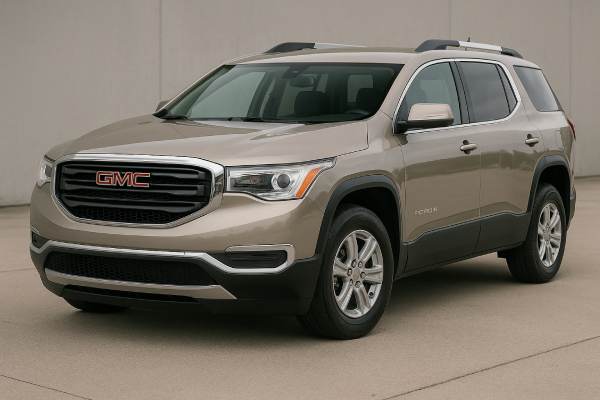
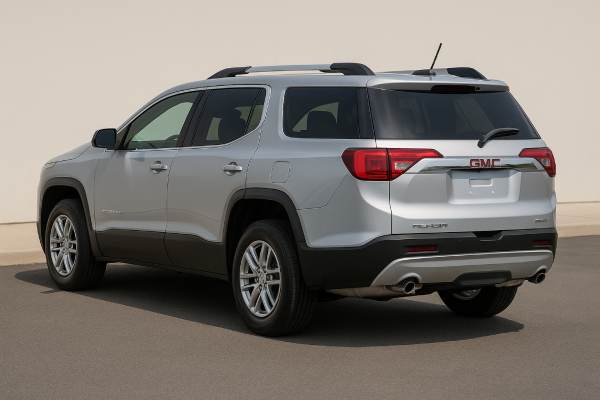
The GMC Acadia FWD with the 2.5 litre LCV four-cylinder is the “right-sized” version of GMC’s three-row crossover, aimed at buyers who want family space and comfort without V6 fuel bills. Introduced with the second-generation Acadia in the 2017 model year, this front-wheel-drive layout prioritises efficiency and an easier driving experience over outright muscle.
With 193 hp, a six-speed automatic, and a curb weight trimmed significantly versus the first-generation Acadia, the 2.5 FWD works best as a commuter and light-duty family hauler rather than a heavy tow rig. Strong crash-test scores, a flexible interior, and widely available active safety tech make it attractive on the used market, especially if you understand its common issues—most notably the well-documented “Shift to Park” warning some owners have experienced.
This guide walks through the key specs, real-world performance, known trouble spots, maintenance planning, and how the Acadia 2.5 FWD stacks up against rivals so you can buy and own with eyes open.
Fast Facts
- Efficient choice in the Acadia line, with official ratings around 21 mpg city / 26 mpg highway / 23 mpg combined for the 2.5 FWD.
- Comfortable, quiet ride and strong crash-test performance make it a solid family SUV.
- Performance is adequate but not brisk: roughly 9 seconds 0–60 mph, and it can feel strained when fully loaded or towing.
- Owners frequently report an intermittent “Shift to Park” message; the fix usually involves shifter wiring or replacing the shifter assembly.
- Plan engine-oil service roughly every 10,000 km or 12 months (or when the Oil Life Monitor calls for it), using Dexos-approved 5W-20 in the LCV 2.5.
Navigate this guide
- GMC Acadia 2.5 FWD Basics
- Specifications for Acadia 2.5 FWD
- GMC Acadia Trims and Safety
- Reliability and Known Issues Overview
- Maintenance Planning and Buying Advice
- On-Road Driving and Performance
- How the Acadia FWD Compares
- Back to top
GMC Acadia 2.5 FWD Basics
The 2016–2019 GMC Acadia FWD with the 2.5 litre LCV engine corresponds to the second-generation Acadia (C1UG platform), sold in most markets from the 2017 model year onward. The redesign moved the Acadia from a large, full-size-like crossover to a true midsize SUV, trimming overall length to about 193.6 in (4,917 mm) and width to 75.4 in (1,915 mm), and cutting roughly 700 lb of mass compared with the earlier “Acadia Limited.”
The 2.5 FWD variant is the efficiency-focused end of the range. Instead of the 3.6 V6, it uses GM’s LCV 2.5-litre direct-injected inline-four, a naturally aspirated engine shared with other GM products. It delivers around 193–194 hp at 6,300 rpm and 190 lb-ft (258 Nm) at 4,400 rpm, routed through a six-speed automatic (6T50) to the front wheels. That pairing is tuned more for smoothness and fuel economy than for hard acceleration.
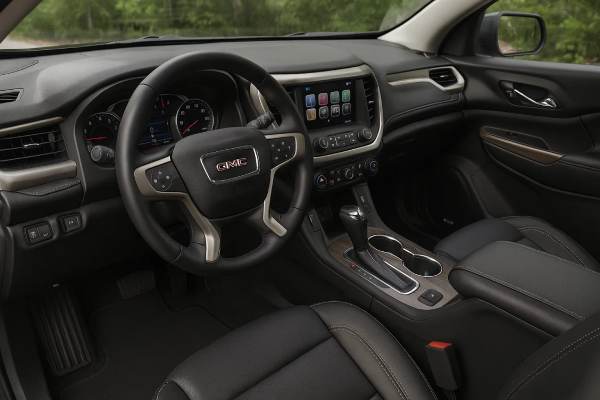
Inside, the Acadia offers two or three rows depending on configuration. Most 2.5 FWD models are seven-seat layouts, but some trims offer a six-seat arrangement with second-row captain’s chairs. The cabin is more car-like than truck-like, with a relatively low step-in height, clear controls, and good outward visibility.
Cargo space for this generation is competitive but not class-leading: around 12.8 ft³ (363 L) behind the third row, 41.7 ft³ (1,181 L) behind the second, and about 79 ft³ (2,237 L) with all rear seats folded (SAE/VDA measurement methods vary slightly by source). For families who rarely use all three rows, that’s plenty of flexibility for strollers, luggage, or DIY trips.
On the road, the 2.5 FWD Acadia feels lighter and more manoeuvrable than the first-generation model. Steering is light, parking is straightforward, and the ride is tuned for comfort rather than sharp dynamics. Owners who mostly drive in town or on motorways with occasional full-load trips will generally find the four-cylinder adequate. If you frequently tow or live in hilly regions, the 3.6 V6 is the better match, but it comes with higher fuel consumption and a slightly different ownership profile.
Overall, the FWD 2.5 is the “sensible spec” Acadia: it doesn’t feel premium in the way a Denali V6 does, but it delivers a solid mix of safety, space, and operating cost for families who value predictability over power.
Specifications for Acadia 2.5 FWD
Engine and Performance (LCV 2.5)
The Acadia 2.5 FWD uses GM’s LCV Ecotec inline-four, an all-aluminium, direct-injected unit with dual overhead cams and variable valve timing. Key technical data are:
| Item | Value |
|---|---|
| Engine code | LCV (Ecotec 2.5) |
| Layout & cylinders | Inline-4, aluminium block and head |
| Valvetrain | DOHC, 4 valves per cylinder, dual VVT |
| Displacement | 2.5 L (2,457 cc) |
| Bore × stroke | 88.0 mm × ~100.8 mm (3.46″ × 3.98″) |
| Compression ratio | 11.3:1 |
| Induction | Naturally aspirated, no turbo/supercharger |
| Fuel system | Direct injection (DI), petrol |
| Max power | ~193–194 hp (145 kW) @ 6,300 rpm (SAE) |
| Max torque | ~190 lb-ft (258 Nm) @ 4,400 rpm (SAE) |
| Timing drive | Chain, with variable cam phasing |
| Emissions standard | US Tier 3 / LEV III, Euro 6 equivalent depending on market |
Official ratings for the 2.5 FWD are around 21 mpg city / 26 mpg highway / 23 mpg combined, which corresponds to roughly 11.2 / 9.0 / 10.2 L/100 km. In real-world mixed use at 100–120 km/h, owners typically see around 9–11 L/100 km (21–26 mpg US), depending on load, climate, and tyre choice.
Transmission and Driveline
All 2.5 FWD Acadias of this period use a conventional six-speed automatic:
| Item | Value |
|---|---|
| Transmission | Hydra-Matic 6T50, 6-speed automatic |
| Drive type | Front-wheel drive (FWD) |
| Gear ratios | 1st: ~4.58, 2nd: 2.96, 3rd: 1.91, 4th: 1.45, 5th: 1.00, 6th: 0.75, Reverse: ~2.94 |
| Final drive | ~3.87:1 (varies slightly by model year and axle) |
| Differential | Open front differential |
| Tow rating (typical 2.5 FWD) | Around 1,000–1,500 kg (2,200–3,500 lb) with tow package; confirm on door sticker/VIN |
The FWD models do not include the twin-clutch rear drive unit used on the All Terrain AWD versions, so complexity and servicing costs are lower.
Chassis and Dimensions
Key dimensions for the second-generation Acadia:
| Item | Value |
|---|---|
| Platform | GM C1UG (midsize crossover) |
| Front suspension | MacPherson strut with coil springs, stabiliser bar |
| Rear suspension | Multi-link independent with coil springs |
| Steering | Electric power steering |
| Brakes | 4-wheel disc, front ventilated |
| Ground clearance | ~7.2 in (183 mm) |
| Length | 193.6 in (4,917 mm) |
| Width (without mirrors) | ~75.4 in (1,915 mm) |
| Height | ~66.0–68.7 in (1,676–1,744 mm), depending on roof rails and wheels |
| Wheelbase | 112.5 in (2,857 mm) |
| Turning circle | ~38.7 ft (11.8 m) kerb-to-kerb |
| Curb weight (2.5 FWD) | Around 3,950–4,050 lb (1,790–1,835 kg) depending on trim |
Factory wheel and tyre packages for 2.5 FWD models typically include 17″ or 18″ alloys with all-season tyres, for example 235/65R18.
Performance and Capability
The 2.5-litre Acadia is clearly tuned for efficiency rather than speed:
| Metric | Approximate value |
|---|---|
| 0–60 mph (0–97 km/h) | ~9.0–9.5 s for 2.5 FWD |
| Top speed (governed) | ~190 km/h (≈118 mph), varies by market |
| 100–0 km/h braking | Competitive stopping distances for the class |
| Max towing (2.5 FWD) | Typically limited versus V6; many markets quote 1,000–1,500 kg braked, depending on package |
With a relatively light front-drive layout, the Acadia 2.5 FWD is more about predictable, secure handling than outright capability on steep grades or with heavy trailers.
Fluids and Service Capacities (2.5 L FWD – typical)
Exact capacities can vary slightly by market and VIN. Always confirm against your owner’s manual or service information, but typical figures are:
| System | Specification | Approx. capacity |
|---|---|---|
| Engine oil | Dexos-approved 5W-20 (0W-20 allowed in some climates) | 4.7 L (5.0 US qt) with filter |
| Engine coolant | Long-life Dex-Cool OAT coolant (50/50 mix) | ~7–9 L total system |
| Automatic transmission (6T50) | Dexron VI ATF | ~9.0 US qt (8.5 L) total fill; ~4.2 qt drain-and-fill |
| Fuel tank | Petrol | ~72 L (19 US gal) |
| A/C refrigerant | R-134a or R-1234yf depending on market/year | Charge amount on under-bonnet label |
| Power steering | Electric (no fluid) | – |
For torque values (wheel nuts, drain plugs, suspension fasteners), rely on official service data; they vary with wheel size and regional specs.
Electrical and Safety Hardware
| Item | Value |
|---|---|
| Alternator | Typically 150+ A, depending on trim and equipment |
| 12 V battery | Group/size varies; capacity usually in the 60–80 Ah range |
| Airbags | Front, side, curtain, and often a front-centre airbag on higher trims |
| ADAS sensors | Forward camera, front radar (where equipped), rear radar modules, ultrasonic parking sensors |
GMC Acadia Trims and Safety
Trims, Options, and How to Identify Them
For 2017–2019 in most markets, the 2.5-litre FWD Acadia was offered mainly in lower and mid-range trims, with the V6 dominating upper trims. Typical trims for 2017 include Acadia SL FWD, SLE-1 FWD, SLE-2, SLT-1, SLT-2, and Denali. The 2.5 engine is most common in SL and SLE-1 FWD, with some availability in other front-drive trims.
Broadly:
- SL / SLE-1 FWD (2.5 most common):
- 17″ wheels, cloth seats, manual liftgate.
- Simple climate control and basic audio.
- Limited driver-assist systems as standard (rear camera, basic parking aids).
- SLE-2 & SLT-1 (mix of 2.5 and 3.6, FWD/AWD):
- 18″ wheels, upgraded infotainment with smartphone integration, power driver’s seat.
- Optional trailering package, roof rails, and more advanced safety tech packages.
- SLT-2 and Denali (normally V6, often AWD):
- 19–20″ wheels, leather, Bose audio, navigation, more chrome outside.
- Almost all available driver-assist and luxury features.
Quick visual identifiers:
- SL/SLE-1 often lack fog lamps and chrome; interior has simple cloth seats.
- SLT trims typically have leather, larger wheels, and additional chrome accents.
- Denali adds a distinctive chrome grille, body-colour lower cladding, and more wood-look interior trim.
VIN decoding and RPO (Regular Production Option) codes on the service parts label (usually in the spare-tyre area or door jamb) give the most reliable confirmation of engine (LCV vs LGX), driveline, and option packages.
Safety Ratings
Independent crash testing places the second-generation Acadia among the stronger performers in its class:
- Excellent ratings in small-overlap, moderate-overlap, side-impact, and roof-strength tests from major safety bodies.
- With the optional front crash-prevention system, certain configurations have earned “Top Safety Pick”–level recognition in testing years where headlights and ADAS configuration met the criteria.
- Government crash tests generally show high star ratings for frontal and side-impact protection.
Because ratings can vary by year, drivetrain, and options, it is worth checking the exact configuration you are considering on your national safety authority’s website.
Safety and Driver Assistance Systems
Depending on year and trim, the Acadia 2.5 FWD offers:
- Passive safety:
- Front, side-impact, and side-curtain airbags.
- A front-centre airbag on certain trims and years.
- Strong occupant compartment performance in independent crash tests.
- Standard active safety:
- Electronic stability control, traction control, ABS, hill-start assist.
- Rear-view camera across the line.
- Available ADAS (varies by trim and year):
- Forward Collision Alert and Automatic Emergency Braking.
- Lane Keep Assist with Lane Departure Warning.
- Blind-spot monitoring and Rear Cross-Traffic Alert.
- Front and rear parking sensors, and 360° surround-view camera on higher trims.
After collision repairs or windscreen replacement, camera-based ADAS features may require calibration. When buying used, ask for documentation of any ADAS calibrations or major repairs that could affect safety systems.
Reliability and Known Issues Overview
Overall, the LCV 2.5-litre Acadia has a decent reliability record when serviced on time, but there are several patterns you should know before buying.
High-Profile Issue: “Shift to Park” Message
The most widely discussed issue for 2017–2019 Acadias (2.5 and 3.6) is an intermittent “Shift to Park” warning even when the gear lever is already in P. Symptoms include:
- Message on the dash requesting “Shift to Park.”
- Inability to turn the vehicle fully off or remove the key, or the push-button system not powering down properly.
- Battery drain if the car does not recognise Park and leaves systems awake.
GM’s service bulletins attribute this to a fault in the park-switch circuitry in the shifter assembly. The official remedy typically involves cleaning the switch contacts and installing an in-line jumper harness; in persistent cases, the shifter assembly itself is replaced.
This is not always covered by a safety recall, so repairs outside warranty may be chargeable unless included in a local campaign or extended coverage. When shopping used:
- Ask specifically if the “Shift to Park” issue has ever occurred.
- Request invoices showing shifter or harness replacement.
- Test repeatedly by cycling in and out of Park and shutting down the vehicle.
Engine and Powertrain
The LCV 2.5 direct-injected engine is generally robust if oil changes are timely and the correct Dexos-approved 5W-20 or 0W-20 oil is used at the specified capacity (about 4.7 L with filter). Common patterns on higher-mileage examples include:
- Carbon build-up on intake valves (direct-injection trait):
- Symptoms: rough idle, hesitation, misfires, especially when cold.
- Contributing factors: short trips, extended oil intervals, low-quality fuel.
- Remedy: intake cleaning (such as walnut blasting) and updated engine-control software where applicable.
- Timing chain wear (uncommon but serious):
- Look out for rattle on cold start, cam/crank correlation codes, or persistent check-engine lights.
- If suspected, a professional inspection is essential; repair is labour-intensive.
The 6T50 automatic is broadly reliable when fluid is kept clean and not overheated. Chronic harsh shifts, flare between gears, or shudder under light throttle can indicate worn clutches or torque-converter issues. A fluid change using the correct Dexron VI ATF can sometimes improve behaviour; persistent problems require professional diagnosis.
Chassis, Electronics, and Corrosion
Issues seen across this generation (not on every car, but worth checking) include:
- Suspension wear:
- Front strut mounts, lower control-arm bushings, and rear suspension links can develop play, especially on rough roads.
- Symptoms: clunks over bumps, wandering on the highway, uneven tyre wear.
- Electrical niggles:
- Occasional infotainment glitches, Bluetooth dropouts, or random instrument warnings. Many are fixed with software updates or module resets.
- Battery condition is important: weak 12 V batteries can trigger spurious warnings and strange body-control-module behaviour.
- Corrosion hotspots (in salted climates):
- Rear subframe, brake lines, exhaust hangers, and lower tailgate lip should be inspected for surface rust, particularly on vehicles that have seen many winters.
Recalls, Service Bulletins, and Extended Coverage
Multiple recalls and service bulletins exist for the 2017–2019 Acadia, covering items such as seat belts, airbags, fuel-system concerns, and the “Shift to Park” condition. For any specific vehicle:
- Use your national safety authority’s VIN lookup (for example, NHTSA in the United States) to identify open recalls.
- Ask a GMC dealer to print the warranty and campaign history.
- Confirm completion of bulletins that materially affect reliability, especially those relating to shifter issues, engine-control updates, and transmission behaviour.
Pre-purchase reliability checklist:
- Confirm full service history with correct oil and coolant types.
- Check for evidence of shifter harness or shifter assembly replacement.
- Listen for abnormal engine noise and test both cold and hot starts.
- Test all electronics, including HVAC, infotainment, and ADAS features.
- Inspect underbody and suspension for rust and play.
Maintenance Planning and Buying Advice
Practical Maintenance Schedule (Typical 2.5 FWD)
Exact intervals vary by market and driving conditions, so always defer to your owner’s manual. A sensible schedule for the 2.5 FWD Acadia looks like this, using both mileage and time limits:
| System / Item | Typical interval (distance / time) | Notes |
|---|---|---|
| Engine oil & filter | Every 10,000 km or 12 months, or per Oil Life Monitor | Dexos-approved 5W-20 (or 0W-20 where specified); ~4.7 L. |
| Engine air filter | 30,000–45,000 km or 3 years | Sooner in dusty conditions. |
| Cabin air filter | 20,000–30,000 km or 2 years | Helps HVAC performance and odour control. |
| Spark plugs | 150,000 km or 8–10 years (iridium) | Replace sooner if misfires or poor economy. |
| Coolant (Dex-Cool) | Around 5 years / 150,000 km for first change, then 5-year intervals | Always refill with compatible OAT coolant. |
| Automatic transmission fluid | 80,000–100,000 km or 5–6 years | Shorten interval for frequent towing or heavy city use. |
| Brake fluid | Every 2–3 years | Moisture absorption affects ABS and corrosion. |
| Brake pads/rotors | Inspect every 20,000 km | City driving and towing accelerate wear. |
| Tyre rotation & alignment check | Rotate every 10,000–12,000 km; alignment annually | Helps steering feel and tyre life. |
| Serpentine/aux belt & hoses | Inspect from 80,000 km; replace by 150,000 km or on condition | Look for cracking, glazing, leaks. |
| 12 V battery | Test annually from 4 years; replace around 5–7 years | Weak batteries cause numerous electrical problems. |
| Timing chain | No fixed interval; inspect by symptom | Rattle or timing codes require attention. |
| A/C service | As needed; check every 3–5 years | Inspect refrigerant charge, cabin temps, and compressor noise. |
For high-mileage or harsh-use vehicles, shorter oil and ATF intervals are cheap insurance, especially on a direct-injected engine and a compact six-speed automatic.
Buyer’s Guide: What to Look For
When evaluating a used Acadia 2.5 FWD (2016–2019):
- History and paperwork
- Seek full service records with at least annual oil changes and documented brake, coolant, and ATF services.
- Verify recall completion using the VIN on the relevant safety authority website.
- Powertrain check
- Cold-start the engine and listen for rattles, ticking, or knocking. A brief direct-injection “clatter” is normal; persistent mechanical noise is not.
- On the road, confirm smooth, decisive shifts. Hesitation, slipping, or harsh engagement in Drive or Reverse warrants further diagnosis.
- Shifter operation
- Repeatedly shift from Drive to Park, then attempt to shut the vehicle off. Any “Shift to Park” message or refusal to shut down is a red flag; budget for repair if not already done.
- Suspension and steering
- Drive over bumps and at motorway speeds. Clunks, vibration, or wandering may indicate worn suspension components or bent wheels.
- Interior and electronics
- Test all seating mechanisms, climate-control functions, infotainment features, and ADAS systems.
- Check for water leaks around the sunroof (if fitted) and tailgate, as they can cause musty smells and electrical issues.
Which Years and Trims to Prefer
- Model years:
- 2017–2019 share the same basic hardware; later years benefit from incremental refinements and newer software calibrations.
- Focus on service history and documented fixes (especially shifter-related work) rather than chasing a specific year.
- Trims for the 2.5 FWD:
- SLE-1 and SLT-1 FWD often hit the “sweet spot”: better equipment than the base SL but still relatively light and efficient.
- Denali is usually paired with the V6, so it matters mainly if you decide the extra power is worth the running costs.
A well-maintained 2.5 FWD Acadia with documented shifter repairs, clean underbody, and up-to-date fluids can be a dependable long-term family car.
On-Road Driving and Performance
Everyday Driving Character
In daily use, the Acadia 2.5 FWD is tuned to be easygoing rather than exciting:
- Ride and comfort: The suspension focuses on comfort and control. It smooths most road imperfections without becoming floaty, and the cabin remains quiet at motorway speeds. Long journeys are generally relaxed as long as you are not pushing against strong headwinds with a full load.
- Steering and handling: Light electric power steering makes parking and low-speed manoeuvres simple. At speed, the Acadia tracks straight but offers modest steering feedback. The chassis tends to understeer progressively when pushed, which is predictable and appropriate for a family crossover.
- Braking: Brakes are strong and easy to modulate, with consistent performance in typical use. Pedal feel is firm enough for confidence but not overly aggressive.
Acceleration and Passing
With about 193 hp moving close to two tonnes, the 2.5 FWD is not a sprinter:
- Expect around 9–9.5 seconds for 0–60 mph (0–97 km/h), depending on load and tyres.
- Throttle response is acceptable at low speeds, but the engine has to rev to deliver its power, so passing on two-lane roads requires planning, especially when the vehicle is fully loaded or climbing.
The six-speed automatic generally shifts smoothly. In normal Drive mode, it prefers higher gears for economy, which can make the engine feel a little lazy until you give a firmer throttle input. Using manual mode or a lower gear on long grades can help keep the 2.5 in its power band and reduce hunting between gears.
Real-World Fuel Economy
Official fuel-economy ratings for the 2.5 FWD Acadia are around 21 mpg city / 26 mpg highway / 23 mpg combined. In practice:
- Urban driving with short trips often lands in the 11–12 L/100 km (19–21 mpg US) range.
- Steady motorway cruising at 110–120 km/h can return 8.5–9.5 L/100 km (25–28 mpg US) if the vehicle is lightly loaded and tyres are properly inflated.
- Mixed use typically centres around 10–11 L/100 km (21–24 mpg US), aligning reasonably well with the official combined rating.
Aggressive driving, heavy loads, roof boxes, or oversized winter tyres will increase consumption noticeably. Conversely, a gentle driving style, careful use of cruise control, and regular tyre-pressure checks can deliver results close to or even slightly better than the official figures.
Load, Towing, and Stability
With the 2.5 engine, the Acadia FWD is best treated as a light-duty tower:
- Light trailer loads, such as a small utility trailer, lightweight camper, or small boat, are fine if you stay within the manufacturer’s rated tow limit for your configuration and use a proper hitch, wiring, and cooling package.
- Expect a noticeable drop in performance and an increase in fuel use—up to 30–40% higher consumption under sustained towing or with a full load of passengers and cargo.
The long wheelbase and stability-control tuning provide good straight-line stability at speed, and the FWD layout simplifies maintenance compared with an AWD system. For frequent heavy towing, however, the 3.6 V6 or a larger SUV may be the better match.
How the Acadia FWD Compares
When cross-shopping the Acadia 2.5 FWD against other midsize three-row crossovers of the same era—such as the Toyota Highlander, Honda Pilot, Ford Explorer, and Chevrolet Traverse—you’ll notice a distinct trade-off profile.
Space and Practicality
- The downsized second-generation Acadia gives you more manoeuvrability but slightly less cargo room than some big-body rivals. With all rows up, 12.8 ft³ behind the third row is on the tight side compared with larger competitors, though the fold-flat seats make long loads easy to accommodate.
- Third-row space is adequate for children and shorter adults on medium trips, but rivals like the Honda Pilot and larger Traverse offer more generous third-row accommodation.
For families who mostly use two rows and only occasionally the third, the Acadia’s packaging is a good compromise between usable space and garage-friendliness.
Performance and Economy vs Rivals
- Power:
- The 2.5 FWD Acadia is less powerful than most V6-equipped competitors and can feel slower when fully loaded or climbing steep grades.
- Rivals with larger displacement or turbo engines offer more effortless acceleration, but with higher fuel consumption and often higher purchase cost.
- Fuel economy:
- With a combined rating around 23 mpg for the 2.5 FWD, the Acadia is competitive against similarly sized crossovers of its era.
- In stop-start urban use, differences between four-cylinder and V6 rivals narrow somewhat, but the 2.5 still tends to consume less fuel over time, especially for drivers with a gentle style.
If you rarely need brisk acceleration or heavy towing, the 2.5 FWD’s lower running costs can be more valuable than the performance of a larger engine.
Safety and Technology
The Acadia’s safety performance is a strong point:
- Crash-test scores are robust, and with the right options, some configurations qualify for top-tier safety awards.
- Available ADAS features—AEB, lane-keeping, blind-spot monitoring, rear cross-traffic alert—are broadly in line with peers, though standard fitment varies by year and trim.
Infotainment and connectivity (Apple CarPlay/Android Auto in later models, multiple USB ports, and available navigation) keep the Acadia competitive as a used buy, even if its cabin materials do not always feel quite as plush as some premium-leaning rivals.
Reliability and Ownership Costs
- The “Shift-to-Park” issue is the Acadia’s most notable black mark and is more widely discussed than many isolated rival problems. However, the documented wiring and shifter fixes make it manageable for informed owners.
- Routine service costs for the 2.5 FWD are reasonable thanks to straightforward FWD hardware, an established engine family, and wide parts availability.
If you find a well-maintained example with documented shifter repairs, clean inspection results, and good service history, long-term ownership costs can be competitive or better than many rivals, especially if you value fuel economy and safety over maximum power.
References
- 2017 GMC Acadia 2017 (Safety Rating)
- Gas Mileage of 2017 GMC Acadia 2017 (Fuel Economy Data)
- Manuals and Guides | Vehicle Support | GMC 2025 (Owner’s Manual)
- Vehicle Detail Search – 2017 GMC ACADIA SUV FWD | NHTSA 2017 (Recall Database)
- 19-NA-206 1..4 2019 (TSB – Shift to Park)
Disclaimer
This article is for informational purposes only and is not a substitute for professional mechanical diagnosis, repair, or safety advice. Specifications, fluid capacities, torque values, and maintenance intervals can vary by VIN, model year, market, and equipment level. Always verify critical data and procedures against your vehicle’s official owner’s manual, workshop information, and any technical service bulletins applicable to your specific GMC Acadia.
If you found this guide helpful, you are welcome to share it on your preferred platforms (Facebook, X/Twitter, forums, or groups) to help other GMC Acadia owners and buyers make better-informed decisions.