
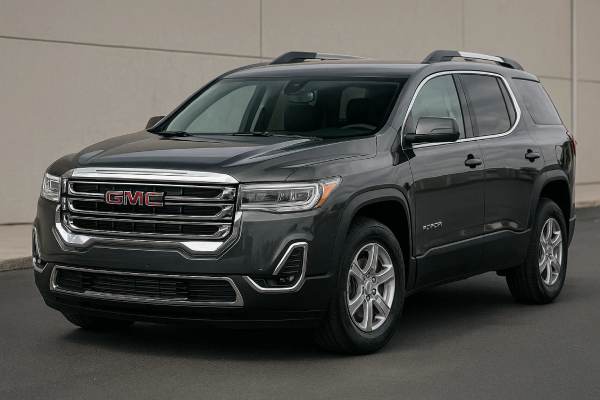
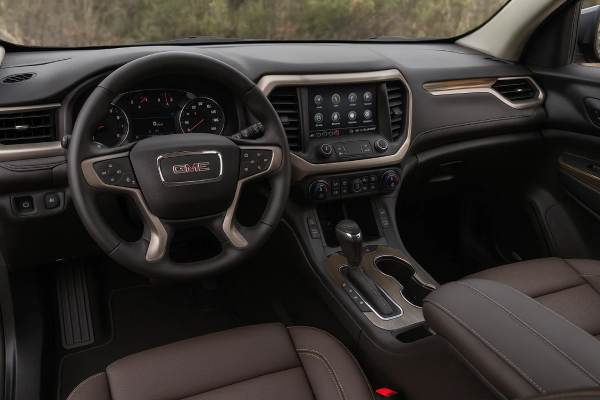
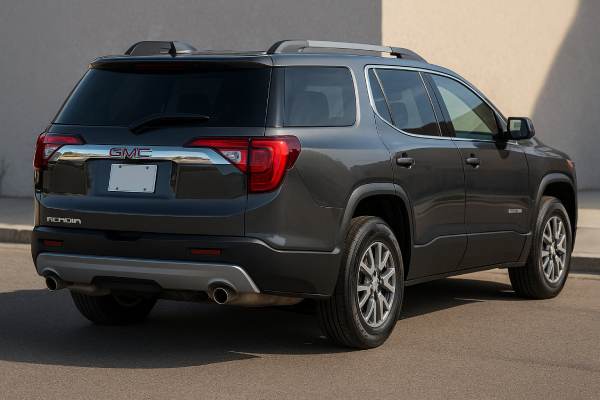
The 2020–2023 GMC Acadia FWD with the LSY 2.0-litre turbo engine sits in a sweet spot between compact crossovers and full-size three-row SUVs. The 2020 facelift brought a new front end, an upgraded infotainment system, and a 9-speed automatic that works with the 228 hp 2.0T to deliver smoother, more efficient cruising than the older 6-speed models.
For owners, this configuration balances everyday usability and fuel economy with enough torque for loaded family trips. It remains lighter and more manoeuvrable than many rivals, yet still offers three rows, a usable cargo area, and a long list of available driver-assistance features. Safety scores are strong, though some advanced systems were optional on earlier years.
If you are considering a used Acadia 2.0T or already own one, understanding the engineering details, real-world running costs, and known trouble spots will help you maintain it correctly and choose the right trim and model year.
Fast Facts
- 2.0L LSY turbo four (228 hp, 350 Nm) with 9-speed automatic and FWD; typical EPA rating 22/29/25 mpg US (city/highway/combined).
- Comfortable, quiet ride and flexible 3-row interior; curb weight around 1,830 kg (≈4,030 lb) keeps it more agile than many large rivals.
- Strong crash-test results, but advanced driver-assist (AEB, lane keep, blind-spot) is trim- and year-dependent rather than universal.
- Key ownership caveat: several important recalls (rear-view camera, roof-rail airbags, transmission accumulator, fuel pump) should be checked by VIN.
- Typical oil change interval is 7,500 miles / 12,000 km or 1 year with Dexos1 0W-20; engine oil capacity is about 5.0 L with filter.
Navigate this guide
- GMC Acadia 2.0T in detail
- GMC Acadia engine and specs
- GMC Acadia trims and safety
- Reliability issues and fixes
- Service schedule and buying tips
- On-road performance and comfort
- GMC Acadia versus competitors
GMC Acadia 2.0T in detail
The facelifted 2020–2023 GMC Acadia (C1UG) refines the second-generation Acadia with fresh styling, updated electronics, and new powertrain options. The LSY 2.0-litre turbocharged inline-four became the core engine for higher trims, pairing with a 9-speed automatic and standard front-wheel drive in North America.
In the Acadia, the LSY delivers about 228 hp (≈170 kW) and 350 Nm (258 lb-ft) of torque, tuned for strong mid-range response rather than headline peak numbers. It uses direct fuel injection, a twin-scroll turbocharger and variable valve timing, and it’s part of GM’s modern Ecotec family with an aluminium block and head, 4 valves per cylinder and chain-driven cams.
The front-drive layout suits buyers who spend most of their time on paved roads. It keeps weight and drivetrain losses down compared with AWD versions, so the 2.0T FWD tends to feel a little more responsive in everyday driving and returns slightly better fuel economy. EPA figures of around 22/29/25 mpg US (10.7/8.1/9.4 L/100 km) for city/highway/combined are competitive among three-row crossovers with turbo four-cylinder engines.
Inside, the Acadia offers a flexible cabin with standard three-row seating in most trims and sliding second-row seats to juggle legroom and cargo space. Cargo volume ranges from roughly 362 L (behind the third row) to about 2,237 L with rows folded, depending on seat configuration and measurement standard. The 2020 facelift also added an improved infotainment system with better graphics, a more powerful processor and enhanced connectivity, plus standard LED headlights.
On the road, this Acadia aims more for comfort than sport. The suspension tuning is soft but controlled, and the 2.0T’s torque helps mask the vehicle’s size in city traffic. Buyers who regularly tow heavy trailers or drive off-pavement might still prefer the 3.6 V6 with AWD, but for many families the 2.0T FWD gives a practical blend of performance, running costs and refinement.
GMC Acadia engine and specs
Engine and performance (LSY 2.0-litre turbo)
| Item | Specification* |
|---|---|
| Engine code | LSY 2.0L turbo inline-4 Ecotec |
| Layout | Transverse I-4, aluminium block and head, DOHC, 4 valves/cyl |
| Displacement | 1,998 cc (2.0 L) |
| Bore × stroke | 83.0 × 92.3 mm (3.27 × 3.63 in) |
| Induction | Twin-scroll turbocharger, intercooler |
| Fuel system | Direct injection (SIDI) |
| Compression ratio | About 10.0:1 |
| Max power | ≈228 hp (≈170 kW) @ ~5,000 rpm |
| Max torque | 350 Nm (258 lb-ft) @ ~1,500–4,000 rpm |
| Timing drive | Chain (no scheduled replacement) |
| Emissions standard | Euro 6 / U.S. Tier 3–Bin 70 equivalent (market-dependent) |
| Rated economy (FWD 2.0T) | ≈22 / 29 / 25 mpg US city / hwy / comb (10.7 / 8.1 / 9.4 L/100 km); ≈26.4 / 34.8 / 30.0 mpg UK |
| Real-world highway (120 km/h) | Typically 9.5–10.5 L/100 km (22–25 mpg US) when lightly loaded |
| Aerodynamics (est.) | Cd ≈0.35; frontal area ≈2.8 m² (manufacturer does not publish precise figures) |
*Values vary slightly by market, certification cycle and source. Always verify against your specific VIN.
Transmission and driveline
Most 2.0T FWD Acadias use GM’s 9T60 9-speed automatic transaxle, calibrated for smooth shifts and close ratio spacing.
| Item | Specification |
|---|---|
| Transmission | Hydra-Matic 9T60 9-speed automatic, electronically controlled |
| Drive type | Front-wheel drive (FWD) |
| Final drive ratio | Around 3.47:1 for 2.0L applications |
| 1st to 9th | Approx. 4.69 / 3.31 / 3.01 / 2.44 / 1.92 / 1.44 / 1.00 / 0.75 / 0.62 |
| Reverse | ≈2.96:1 |
| Differential | Open front differential with brake-based traction control |
Chassis and dimensions (FWD 2.0T, typical)
| Item | Specification |
|---|---|
| Platform | GM C1 (C1UG) unibody crossover |
| Front suspension | MacPherson strut, coil springs, anti-roll bar (independent) |
| Rear suspension | Multi-link independent, coil springs, anti-roll bar |
| Steering | Electric power rack-and-pinion; typical lock-to-lock ≈2.75 turns |
| Brakes | 4-wheel disc, ventilated front and rear; typical rotor diameters ≈320 mm front / ≈315 mm rear |
| Wheels / tyres (common FWD 2.0T) | 18 in alloys with 235/65 R18 all-season; 20 in with 235/55 R20 available |
| Ground clearance | ≈183 mm (7.2 in) |
| Length | ≈4,917 mm (193.6 in) |
| Width (excl. mirrors) | ≈1,915 mm (75.4 in) |
| Height | ≈1,744 mm (68.7 in) depending on roof rails |
| Wheelbase | ≈2,857 mm (112.5 in) |
| Turning circle | ≈11.8 m (38.7 ft) kerb-to-kerb |
| Curb (kerb) weight | ≈1,828 kg (≈4,030 lb) for 2.0T FWD |
| Fuel tank | ≈83 L (22.0 US gal ≈18.3 UK gal) |
| Cargo volume | ≈362–2,237 L (12.8–79.0 ft³) depending on seat position and measurement standard |
Performance and capability
| Item | Specification / typical value |
|---|---|
| 0–100 km/h (0–62 mph) | Low- to mid-7-second range in independent tests with FWD 2.0T (varies by trim/tyres) |
| Top speed | ≈210 km/h (≈130 mph), electronically limited |
| Braking 100–0 km/h | Typically ≈38–40 m (125–131 ft) with quality tyres and good pads |
| Towing capacity | Up to 1,588 kg (3,500 lb) with factory trailering package; 454 kg (1,000 lb) without |
| Payload | Typically ≈650–770 kg (≈1,400–1,700 lb) depending on trim and options (check door-jamb sticker) |
| Roof load | ≈75–100 kg (165–220 lb) with OEM crossbars; verify in manual for your exact rack |
Fluids and service capacities (approximate, check by VIN)
| System | Spec (typical) | Capacity (approx.) |
|---|---|---|
| Engine oil | Dexos1-approved full-synthetic 0W-20 | ≈5.0 L (5.3 US qt) with filter |
| Engine coolant | Dex-Cool long-life OAT, 50/50 mix | ≈7–8 L (7.4–8.5 US qt) including heater circuit |
| Transmission (9T60) | Dexron-spec LV ATF (GM-approved) | ≈8–9 L (8.5–9.5 US qt) total fill; drain/refill less |
| Power steering | Electric (no fluid service) | — |
| A/C refrigerant | R-1234yf (see under-hood label) | ≈600–700 g (21–25 oz), variant-dependent |
| A/C compressor oil | PAG-type; spec varies by compressor | Typically 120–150 mL (4–5 fl oz) |
| Brake fluid | DOT 3 or DOT 4 (GM spec) | ≈0.7–1.0 L (0.7–1.1 US qt) for full system flush |
Key torque values are application-specific; typical factory values are around 190–200 Nm (140–150 lb-ft) for wheel nuts and 25–30 Nm (18–22 lb-ft) for engine oil drain plug, but these must be confirmed in official service information for your VIN.
Electrical and safety data
| Item | Specification |
|---|---|
| Alternator | Around 220 A with LSY 2.0T |
| 12V battery | Typically 70–80 Ah AGM or flooded, Group 48/94R (varies by trim and climate) |
| Spark plugs | Long-life iridium, gap ≈0.7–0.8 mm (0.028–0.032 in) |
| Airbags | Front, side-thorax and side curtain for all three rows (exact count varies by trim) |
| Safety ratings | Summary |
|---|---|
| IIHS | 2020 Acadia earns “Good” in most crash categories, with “Superior” front-crash prevention when equipped; headlight ratings vary by trim and lamp type. |
| NHTSA | FWD models typically test at four stars overall out of five; AWD variants can reach five stars overall. |
GMC Acadia trims and safety
From 2020 to 2023, the LSY 2.0T engine appeared mainly in mid- and upper-level trims, with front-wheel drive standard and AWD optional in many markets.
Trim and engine map (North America, simplified):
- 2020 (facelift year)
- SLE/SLT: 2.5L base four or optional 3.6 V6; the new 2.0T is standard on SLT and Denali for certain configurations.
- AT4: Off-road styling, always 3.6 V6 with AWD.
- Denali: More likely to have 2.0T FWD or 3.6 AWD depending on equipment.
- 2021–2022
- The 2.5L four gradually phases out, leaving 2.0T and 3.6 V6 as primary engines.
- 2.0T becomes common on SLE/SLT and Denali, with FWD the default and AWD a paid option.
- 2023
- Line-up rationalised; many fleet-oriented lower trims disappear, with SLE, SLT, AT4 and Denali remaining. 2.0T FWD is the volume pick for SLE/SLT and some Denali examples.
How to identify a 2.0T FWD Acadia
- Under the hood, the emissions label shows engine code LSY.
- The Service Parts Identification (SPID) label (door or glove box) lists RPO LSY, plus an axle ratio code for the 3.47 final drive.
- The VIN’s 8th character is typically linked to the 2.0T LSY in many model years (confirm in official VIN decoding references).
Safety equipment and ADAS by trim/year
All 2020–2023 Acadias include a strong baseline:
- 7+ airbags including side-curtain coverage for all three rows.
- 4-wheel ABS, stability and traction control.
- Rear-view camera, tyre-pressure monitoring, and LED daytime running lights.
Advanced driver-assistance systems (ADAS) are bundled into GMC Pro Safety and GMC Pro Safety Plus packages, with availability changing over the years:
- 2020
- Many SLE/SLT trims require option packages for AEB, lane-keep assist, lane-change alert with blind-spot monitoring, and rear cross-traffic alert.
- Denali often includes more of these as standard or in a common package.
- 2021–2022
- GMC Pro Safety becomes standard or at least much more widely fitted, adding:
- Forward collision alert with automatic emergency braking.
- Lane-keep assist with lane-departure warning.
- Front pedestrian braking.
- Blind-spot monitoring, rear cross-traffic alert, surround-view camera and rear pedestrian alert remain optional or part of higher trims.
- 2023
- The feature mix is largely similar to late-2022, with a higher take-rate of safety packages because of trim simplification.
Safety ratings in context
- IIHS: 2020 Acadias tested with “Good” overall crashworthiness, but some headlight variants fall short of top marks. When equipped with optional safety packages, the SUV earns strong front-crash prevention ratings against both vehicles and pedestrians.
- NHTSA: Front-drive models score four stars overall, with strong side-impact performance and a rollover rating typical for mid-size crossovers. AWD variants can reach five stars overall.
ADAS calibration considerations
If your Acadia 2.0T FWD has forward collision alert, lane-keep assist, or surround-view cameras, be aware:
- Windshield replacement, front bumper repairs, and suspension/alignment work can require camera and radar recalibration.
- The surround-view rear camera system is subject to a GM recall for coax cable issues that can cause intermittent or failed camera images; the fix involves replacing coaxial cables and must be done by a dealer.
After any major body or glass work, insist that the shop documents ADAS calibration with printed reports from the scan tool.
Reliability issues and fixes
Overall, the 2020–2023 Acadia 2.0T FWD has average-to-above-average reliability when maintained as recommended. The LSY engine itself is proving robust so far, but there are some known trouble spots and a cluster of recalls to check.
Engine- and cooling-related issues
1. Engine coolant temperature (ECT) sensor faults
- Prevalence: Occasional across GM models using LSY.
- Symptoms: Check-engine light, high-temperature warnings, cooling fans running constantly, remote start disabled.
- Likely cause: Faulty ECT sensor reading too hot, or wiring harness issues.
- Remedy: Replace ECT sensor with updated part and inspect harness; some cases require an ECU calibration update.
2. Active grille shutter (aero shutter) codes
- Prevalence: Occasional on newer GM crossovers.
- Symptoms: Check-engine light, reduced efficiency; diagnostic code like P059F (“Active Grille Air Shutter Performance”).
- Cause: Shutter binding due to debris, ice, or harness routing; actuator wear.
- Remedy: Clear debris, inspect shutter movement; replace actuator or shutter assembly as needed. In some markets, technical bulletins specify revised parts or harness routing.
Oil consumption and carbon build-up have not yet emerged as widespread LSY issues when proper oil and fuel are used, but early-life neglect (long oil intervals, low-quality fuel) can accelerate wear and intake deposits over time.
Transmission and driveline
The 9T-series automatics have matured since their launch, but a few concerns are worth noting:
- Start/stop accumulator leak/bolt recall
- Symptom: Transmission fluid leak near case, possible harsh engagement, or eventual loss of drive if ignored.
- Fix: GM recall involves inspecting the accumulator endcap bolts and replacing the assembly if bolts are missing.
- Shift quality, flare or shudder
- Prevalence: Occasional.
- Symptoms: Harsh 2–3 shifts, flare on light throttle upshifts, or reluctance to go into 9th gear at moderate speeds.
- Remedy: Software updates to the TCM, adaptive learning reset, and in some cases fluid replacement with the correct latest-spec ATF. A test drive after reprogramming is important.
Front wheel bearings and suspension bushings can wear on higher-mileage, heavy-use vehicles, but that’s typical for the class rather than Acadia-specific.
Body, chassis and NVH
- Front strut top-mount noise
- Prevalence: Occasional reports on 2020+ Acadia and related GM SUVs.
- Symptoms: Clunk or creak over low-speed bumps, especially when turning.
- Remedy: Updated strut mounts or insulators and proper torque of fasteners.
- Interior squeaks/rattles
- Often traced to seat tracks, the sliding second row, or the rear hatch trim. Lubrication and strategic felt tape usually resolve these.
Rust resistance is generally good, but in harsh climates, check:
- Rear subframe and suspension arms.
- Lower door edges and the tailgate seam.
- Underbody around front jack points.
Recalls and service campaigns to verify
Ask a dealer to run your VIN through GM’s system and the official recall database. Key campaigns affecting 2020–2021 Acadias include:
- Rear-view camera coax cables (intermittent or failed image).
- Roof-rail airbag inflator diffuser issues that may reduce airbag performance.
- Fuel pump jet nozzle burrs causing possible engine stall.
- Over-cured tyres with risk of sidewall or belt failure.
- Transmission start/stop accumulator endcap bolts missing, leading to fluid leak and potential loss of propulsion.
All recall repairs are performed free of charge regardless of mileage or ownership; insist on documentation in the service history.
Pre-purchase reliability checklist
If you are considering a used 2.0T FWD Acadia:
- Request full service history, with oil changes at or before 7,500 miles / 12,000 km.
- Confirm all recalls are complete using the official VIN check and dealer records.
- Test drive for cold-start noises, shift flare, and steering/suspension clunks.
- Inspect for fluid leaks at the transmission case and cooler lines.
- Verify camera and parking sensors all work reliably, especially if the vehicle has the Surround Vision option.
- Check tyres for even wear and remaining tread; mismatched tyres can upset ride and safety systems.
Service schedule and buying tips
GM calibrates its oil-life monitor fairly conservatively on the Acadia. For most mixed use, it aligns with a maximum of about 7,500 miles (12,000 km) or 12 months, but shorter intervals are sensible for frequent short trips, towing or hot climates.
Practical maintenance schedule (typical guidance)
Always verify intervals in your market’s owner’s manual; the following is a practical baseline for the 2.0T FWD:
- Every 7,500 miles / 12,000 km or 12 months
- Engine oil and filter (Dexos1 synthetic 0W-20; ≈5.0 L).
- Tyre rotation and basic brake inspection.
- Check all fluids, belts and visible hoses.
- Every 15,000 miles / 24,000 km
- Cabin air filter.
- Inspect suspension bushings, ball joints and steering components.
- Alignment check if you notice uneven tyre wear or pull.
- Every 30,000 miles / 48,000 km
- Engine air filter.
- More thorough brake inspection; clean and lubricate slide pins.
- Inspect exhaust system and underbody for corrosion.
- Every 45,000–60,000 miles / 72,000–96,000 km
- Automatic transmission fluid service (drain/fill with correct ATF; consider pan and filter service if contamination is suspected).
- Brake fluid flush.
- Rotate tyres (if not already done more frequently).
- Every 5 years (or 150,000 miles / 240,000 km maximum)
- Engine coolant change with Dex-Cool 50/50 premix.
- Comprehensive inspection of rubber components: coolant hoses, PCV hoses, and suspension bushings.
- Around 100,000 miles / 160,000 km
- Spark plug replacement (iridium plugs will usually go this distance, but misfire or hard-start issues justify earlier replacement).
- Detailed inspection of timing-chain health through noise and diagnostic correlation; the LSY uses a chain that is not scheduled for routine replacement, but extended low-quality oil use can accelerate wear.
- Every 3–5 years
- 12V battery test annually after year 3; replacement around years 5–7 is common.
- A/C service as needed (performance test, leak check).
Because this Acadia is not hybrid or electric, there is no high-voltage battery or reduction gear service beyond the standard transmission and cooling loops.
Fluids and fastener decisions
When planning DIY or independent-shop servicing:
- Insist on Dexos1-licensed 0W-20 oil and a quality filter; non-approved oil can affect warranty eligibility and long-term timing-chain health.
- For coolant, stick with Dex-Cool-compatible OAT formulations; mixing with green silicate coolant shortens life and may increase corrosion.
- Use GM-approved ATF for 9-speed transmissions; some generic LV fluids meet the spec, but check the data sheet.
Critical fasteners (wheel nuts, brake caliper bolts, suspension arms) should always be torqued to the values in the factory manual. Over- or under-torquing can lead to brake pulsation, premature wear or safety issues.
Buyer’s guide: what to look for and what to choose
Best years and trims for most buyers
- 2021–2023 SLT/Denali 2.0T FWD
- Benefit from early-run TSBs and recalls already applied.
- More advanced safety equipment standard or commonly optioned.
- The 2.0T engine offers better fuel economy than the V6 with adequate performance.
Trims to consider carefully
- 2020 early-production vehicles
- Strongly prefer examples with full recall history documented, especially for fuel pump and roof-rail airbags.
- Heavily equipped Denali with 20-inch wheels
- Ride can become noticeably firmer; tyre replacement is more expensive.
Inspection checklist
- Test the rear-view camera and, if fitted, surround-view in all modes. Look for dropouts or image glitches.
- Confirm all climate-control zones work; blend-door actuators can fail in any multi-zone SUV.
- Listen for front-end clunks over speed bumps, indicating possible strut mount or bushing wear.
- On a spirited test drive, check for smooth 1–2 and 2–3 shifts and that the transmission reaches 9th gear at steady highway speeds.
- With the engine warm, inspect for coolant or oil leaks around the front cover, cooler lines and transmission case.
With thorough servicing and recall completion, a 2.0T Acadia FWD can realistically deliver 200,000 miles (320,000 km) of service life, especially for primarily highway-driven vehicles.
On-road performance and comfort
The 2.0T FWD Acadia is tuned as a comfortable family crossover rather than a sport SUV, and it largely succeeds at its mission.
Powertrain character
The LSY engine’s 350 Nm of torque arriving low in the rev range gives brisk step-off in city driving and strong mid-range passing power. Turbo lag is modest; from a rolling start the Acadia tends to respond smoothly once the 9-speed drops a gear or two.
The 9-speed gearbox keeps revs low at cruise, often under 1,800 rpm at highway speeds in 9th gear. Kick-down for overtakes is generally prompt, though some owners notice occasional hunting between 8th and 9th on gentle grades. GM has released calibration updates over time to refine shift logic.
Engine noise is well controlled; under light throttle the 2.0T is quieter than the V6, though at full throttle it can sound slightly gruff. Wind and road noise are competitive for the class, particularly on 18-inch wheels.
Ride, handling and NVH
- Ride: The suspension soaks up expansion joints and rough surfaces well, especially with 18-inch tyres. 20-inch wheels sharpen response but introduce more impact harshness over broken pavement.
- Handling: Steering is light and accurate rather than sporty; body roll is present but predictable. The Acadia feels narrower and easier to place than some larger three-row rivals, which can be reassuring in city streets and tight car parks.
- Braking: Pedal feel is generally firm with good modulation. The front-ventilated and rear-ventilated discs resist fade well in normal driving; repeated mountain descents or towing will still benefit from downshifts to use engine braking.
Cabin comfort is a strong point: supportive front seats, a commanding driving position, and a second row that slides and reclines. The third row is suitable for children or short trips for adults.
Real-world efficiency
Using EPA figures as a baseline, owners typically see:
- City commuting: 19–23 mpg US (12.3–10.2 L/100 km) depending on traffic and climate.
- Highway at 110–120 km/h (70–75 mph): 24–28 mpg US (9.8–8.4 L/100 km) when lightly loaded.
- Mixed family use: Around 22–26 mpg US (10.7–9.0 L/100 km) is realistic.
Cold weather, remote-start use, roof boxes, and large wheels can all knock several mpg off these figures.
Load and towing behaviour
With the factory trailering package and proper equipment, the 2.0T FWD is rated up to 3,500 lb (1,588 kg). When towing:
- Expect 25–40% higher fuel consumption, especially at highway speeds.
- Stability is generally good with correctly set up trailer brakes and weight distribution, but crosswinds are more noticeable than in heavier body-on-frame SUVs.
- Watch transmission temperatures on long grades; using Tow/Haul mode and downshifting proactively helps.
For occasional light-to-moderate towing, the 2.0T FWD is adequate. Heavy, frequent towing is still better suited to the 3.6 V6 AWD.
GMC Acadia versus competitors
The 2.0T FWD Acadia competes with other mid-size three-row crossovers such as the Toyota Highlander, Honda Pilot, Kia Sorento, Hyundai Santa Fe (three-row variants), Volkswagen Atlas and its corporate cousin, the Chevrolet Traverse.
Space and packaging
- Compared with larger rivals (Highlander, Pilot, Atlas, Traverse):
- The Acadia is slightly smaller outside, which helps manoeuvrability and parking.
- Interior space, especially in the third row and cargo area with all seats up, is somewhat tighter than the biggest competitors.
- With seats folded, its maximum cargo volume is still generous at around 2,237 L but trails the largest SUVs in this class.
- Versus Sorento/Santa Fe:
- Acadia offers more third-row space than most two-row crossovers and is broadly comparable to three-row Sorento trims, but again not as roomy as full-size options.
Powertrain and economy
- Against V6-only competitors (Pilot, Atlas, some Highlander trims):
- The Acadia 2.0T generally comes close in straight-line performance while using less fuel in city and mixed driving.
- V6 rivals may feel smoother and more linear at high rpm, especially when heavily loaded or towing.
- Against other turbo-fours (Sorento 2.5T, Santa Fe 2.5T, some Highlander variants):
- Performance and economy are similar; the Acadia’s 9-speed holds revs low, and its calm highway manners compare favourably.
- Some competitors offer hybrid options the Acadia line lacks, which can significantly improve city fuel economy.
Ride, refinement and features
- Ride and NVH:
- The Acadia’s ride is on the comfortable side of the class, with less float than some and less firmness than sport-focused trims from other brands.
- Cabin materials are solid but not ultra-luxurious; many reviewers note that even Denali trims don’t quite match premium-brand rivals in perceived quality, but controls are simple and intuitive.
- Technology and safety:
- The infotainment system is competitive in responsiveness and clarity, and standard Apple CarPlay/Android Auto integration matches rivals.
- Advanced safety features are broadly aligned with the segment, though some competitors made AEB and lane-keep assist standard across all trims earlier in the model cycle.
Ownership costs and reliability
- Running costs:
- Service parts and fluids are widely available and reasonably priced.
- Insurance and tax are similar to other mid-size crossovers with comparable power.
- Reliability:
- The Acadia 2.0T’s record is broadly average: some recalls and TSBs but no single catastrophic flaw dominating owner reports.
- Japanese competitors such as the Highlander and Pilot may have a slight edge in long-term dependability statistics, but the Acadia strikes a good balance of performance, comfort and cost if maintained properly.
If you value maneuverability, a comfortable ride, and good mid-range torque in a three-row package—and you’re happy to accept slightly less maximum cargo and third-row space—the GMC Acadia 2.0T FWD remains a compelling option in the 2020–2023 used market.
References
- 2022 GMC Acadia / Acadia Denali Owner’s Manual 2021 (Owner’s Manual)
- Product Safety Recall N222378380 Rear View Camera Intermittent or Inoperative 2023 (Recall Bulletin)
- 2020 GMC Acadia 2020 (Fuel Economy Data)
- 2020 GMC Acadia 4-door SUV 2020 (Safety Rating)
- GM 2.0L Turbo I-4 LSY Engine Info, Power, Specs, Wiki 2024 (Engine Technical Summary)
Disclaimer
This article is for informational purposes only and is not a substitute for professional diagnosis, repair, or official service information. Specifications, torque values, fluid capacities, and maintenance intervals can vary by model year, VIN, market, trim level, and equipment package. Always confirm critical data and procedures using the official owner’s manual, service manual, and technical documentation for your specific vehicle, and consult a qualified technician for safety-critical work.
If you found this guide helpful, you’re welcome to share it with other owners or shoppers on social platforms such as Facebook or X/Twitter to support our work.