
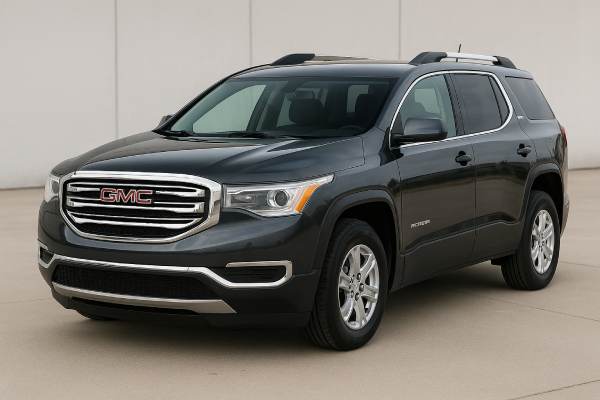
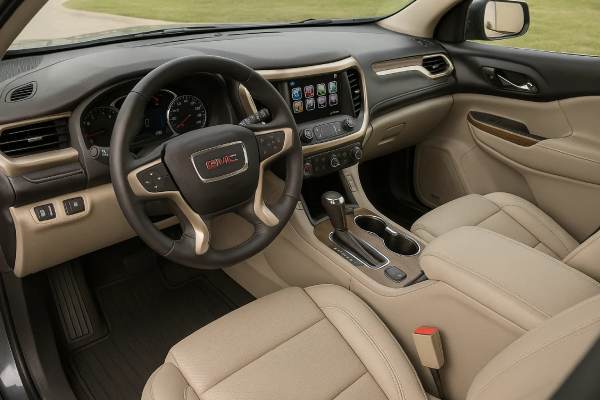
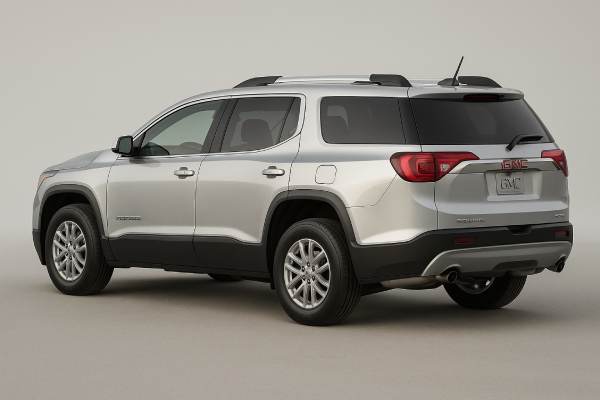
The second-generation GMC Acadia with the LGX 3.6 litre V6 is aimed at buyers who like the idea of a lighter, more efficient crossover but do not want to give up strong acceleration, towing confidence, or long-distance comfort. Compared with the previous, larger Acadia, the 2017–2019 C1UG platform is shorter, narrower and significantly lighter, which noticeably improves fuel economy and day-to-day manoeuvrability while keeping three rows of seating and a usable cargo area.
In front-wheel-drive form, the 3.6 V6 pairs with a six-speed automatic to deliver 310 hp and a relaxed, flexible character that works well for highway merging and overtaking. The chassis tuning leans more toward control than float, and the cabin technology (Apple CarPlay/Android Auto, active safety options) makes it easy to live with as a family vehicle. This guide walks through the key specs, reliability patterns, maintenance expectations and how the Acadia 3.6 FWD stacks up against rivals, so you can judge whether it fits your budget, your roads and your ownership style.
Owner Snapshot
- Strong 3.6 V6 gives confident acceleration and up to about 4,000 lb (1,814 kg) towing when properly equipped.
- Lighter C1UG body improves manoeuvrability and parking versus the previous Acadia while keeping three rows of seating.
- Available Driver Alert packages add useful safety tech such as blind-spot monitoring, rear cross-traffic alert and forward collision warning.
- Watch for “Shift to Park” switch faults, cooling-system leaks and occasional V6 oil leaks as mileage climbs.
- Plan engine oil and filter changes every 8,000–10,000 km or 6–12 months, shortening intervals for heavy towing or frequent short trips.
Section overview
- GMC Acadia 3.6 FWD focus
- Acadia 3.6 FWD specs sheet
- Model grades, options and safety
- Reliability patterns and common faults
- Maintenance strategy and buying guide
- Driving experience and performance
- GMC Acadia against its rivals
- References
GMC Acadia 3.6 FWD focus
For the 2017 model year, GMC downsized the Acadia onto the C1UG platform and repositioned it as a true midsize crossover rather than a near-full-size SUV. The LGX 3.6 litre V6 front-wheel-drive configuration sits at the heart of that shift. It is the step-up powertrain above the 2.5 litre four-cylinder, aimed at owners who regularly carry a full family, tow, or drive in hilly country and want effortless performance.
The LGX engine is a modern alloy-block V6 with direct fuel injection, dual overhead cams, four valves per cylinder and variable valve timing on both intake and exhaust cams. It is tuned for 310 hp and 271 lb-ft of torque, with a broad mid-range that makes the Acadia feel relaxed rather than strained. Cylinder deactivation allows it to run on four cylinders at light loads, improving highway fuel economy without needing a turbocharger.
Compared with the older, larger Lambda-platform Acadia, the 2017–2019 3.6 FWD model is several hundred pounds lighter. That gives it quicker responses, less body roll and shorter stopping distances while making it easier to park in typical garages. The trade-off is that the third row and cargo bay are not as cavernous as before, so it suits families who use the third row occasionally more than those who run seven adults most of the time.
Inside, the 3.6 FWD models usually appear from mid-range trims upward (SLE-2, SLT-1 and above), so you tend to get better seats, more sound insulation and a fuller equipment list than base four-cylinder versions. Intuitive infotainment, multiple USB ports and available tri-zone climate control help the Acadia feel like a long-distance family tool rather than just a commuter crossover.
For a used buyer, the 3.6 FWD strikes a balance: it avoids the added complexity and consumables of the all-wheel-drive system but retains enough power to handle passengers and cargo confidently. As long as you understand the common service needs – especially transmission fluid health, cooling system integrity and the occasional electronic glitch – it can be a solid, predictable ownership experience.
Acadia 3.6 FWD specs sheet
This section focuses on the 2017–2019 GMC Acadia with the LGX 3.6 litre V6 and front-wheel drive, using typical figures for North American models. Exact numbers can vary slightly by trim and market, so always confirm against the build sticker and owner’s manual.
Engine and performance
| Item | Value |
|---|---|
| Engine code | LGX 3.6L V6 |
| Layout and cylinders | 60° V6, aluminium block and heads |
| Valvetrain | DOHC, 4 valves per cylinder, dual VVT |
| Bore × stroke | ~95.0 × 85.8 mm (3.74 × 3.38 in) |
| Displacement | 3.6 L (3,649 cc) |
| Induction | Naturally aspirated |
| Fuel system | Direct fuel injection (DI) |
| Compression ratio | Approx. 11.5:1 |
| Max power | 310 hp (231 kW) @ 6,600 rpm |
| Max torque | 271 lb-ft (367 Nm) @ 5,000 rpm |
| Fuel requirement | Regular unleaded (87 AKI) recommended |
| Emissions standard | U.S. Tier 3 / LEV III equivalent |
| Rated economy (FWD 3.6) | ~12.4 L/100 km city / 9.4 L/100 km hwy (18/25 mpg US) |
| Combined EPA (2017 FWD 3.6) | 11.2 L/100 km (21 mpg US) |
Highway consumption at 120 km/h is typically in the 9.0–9.5 L/100 km range when driven gently in warm conditions.
Transmission and driveline
| Item | Value |
|---|---|
| Transmission | 6-speed automatic, torque-converter |
| Typical transmission code | 6T70/6T75 family (application-specific) |
| Manual mode | Yes, console-mounted +/- toggle |
| Final drive ratio | Approx. 3.16–3.49 depending on trim/tow package |
| Drive type | Front-wheel drive (FWD) |
| Differential | Open front differential |
| Tow rating (properly equipped) | Up to about 1,814 kg (4,000 lb) with V6 towing package |
Chassis and dimensions
| Item | Value |
|---|---|
| Platform | GM C1 (C1UG) |
| Front suspension | MacPherson strut with coil springs, stabilizer bar |
| Rear suspension | Independent multi-link with coil springs |
| Steering | Electric power rack-and-pinion |
| Turning circle | ~11.9 m (39 ft) kerb-to-kerb |
| Front brakes | Ventilated discs, ~321 mm (12.6 in) |
| Rear brakes | Solid discs, ~315 mm (12.4 in) |
| Typical wheel/tyre | 235/65 R18 or 235/55 R20, all-season |
| Length | ~4,915 mm (193.6 in) |
| Width (without mirrors) | ~1,915 mm (75.4 in) |
| Height | ~1,740 mm (68–69 in, by trim) |
| Wheelbase | 2,857 mm (112.5 in) |
| Ground clearance | ~182 mm (7.2 in), varies slightly by wheel package |
| Curb weight (3.6 FWD) | Roughly 1,870–1,900 kg (4,120–4,200 lb) |
| Fuel tank | ~72 L (19 US gal) |
| Cargo volume | Approx. 362 L (12.8 ft³) behind 3rd row; up to ~2,238 L (79 ft³) seats folded (SAE) |
Performance and capability
| Item | Value |
|---|---|
| 0–100 km/h (0–62 mph) | About 6.5–6.8 s, depending on trim and conditions |
| 0–60 mph (tested V6 FWD) | Around 6.2 s in instrumented testing |
| 100–0 km/h braking | Roughly 38–41 m (125–135 ft), tyre-dependent |
| Top speed (governed) | Around 210 km/h (130 mph) |
| Maximum towing (V6 FWD) | Up to ~1,814 kg (4,000 lb) with factory tow package |
| Payload | Typically 550–650 kg (1,200–1,430 lb), check door jamb label |
| Roof load | Often around 75–100 kg (165–220 lb) with factory rails and crossbars |
Fluids and service capacities (approximate)
Always verify exact specs and capacities with the manual and parts catalogue for your VIN.
| System | Specification and notes |
|---|---|
| Engine oil | Dexos1-approved full-synthetic 5W-30; roughly 5.7–6.0 L (6.0–6.3 US qt) with filter |
| Coolant | Organic acid technology (OAT), premix 50/50; on the order of 9–11 L (9.5–11.5 US qt) for full system |
| Automatic transmission | GM-spec low-viscosity ATF (Dexron-VI or superseding fluid); typical refill 5–6 L, more for full service |
| Power steering | Electric (no regular fluid service) |
| Brake fluid | DOT 3 or DOT 4 glycol-based, flush every ~3 years |
| A/C refrigerant | R-134a, charge quantity varies by model year; check under-bonnet label |
| A/C compressor oil | PAG-type oil, quantity and viscosity per service documentation |
Electrical and ignition
| Item | Value |
|---|---|
| Alternator | Typically 150–170 A, depending on equipment |
| 12 V battery | Group 48/49 or equivalent, often ~70–80 Ah with high cold-cranking rating |
| Spark plugs | Long-life iridium; service interval around 150,000 km (90,000–100,000 miles) under normal conditions |
| Plug gap | Approximately 0.8–0.9 mm (0.032–0.035 in); confirm for replacement parts |
Safety and driver assistance
| Item | Value |
|---|---|
| Airbags | Front, side, full-length curtain, plus driver/passenger knee coverage depending on trim/year |
| Electronic systems | ABS, stability control, traction control standard |
| Available ADAS | Forward collision alert, low-speed automatic braking, lane keep assist, lane departure warning, blind-spot monitoring, rear cross-traffic alert, front/rear park assist |
| NHTSA overall rating | Typically 5-star overall for 2017 Acadia (varies by exact configuration) |
| IIHS rating | “Top Safety Pick” for 2017 Acadia with optional front crash prevention and suitable headlights |
Model grades, options and safety
The LGX 3.6 FWD engine is not tied to one single trim; it is offered mainly on mid- and high-level Acadia grades. For 2017–2019, the general pattern in North America is:
- SLE-1: Usually four-cylinder only, cloth upholstery, 7-inch infotainment, manual liftgate.
- SLE-2: Adds features such as power driver seat, roof rails, and options like remote start; this is often the entry point where the 3.6 V6 becomes available as an option.
- SLT-1 and SLT-2: Leather seats, upgraded audio, more advanced Driver Alert packages; the V6 is common and can be standard on some configurations.
- Denali: Range-topper with distinctive styling, extra sound insulation, standard V6, and more comfort and tech equipment.
On V6 FWD models, you can usually identify the powertrain by the dual exhaust outlets and badge on the tailgate, as well as higher trim-level wheels and interior finishes. Inside, an analogue tachometer with a higher redline and a “V6” engine code on the emissions label under the bonnet are quick checks.
Option packages matter for both equipment and safety. The Driver Alert packages bring:
- Blind-spot monitoring with rear cross-traffic alert.
- Lane change alert and lane departure warning (with or without lane keep assist).
- Forward collision alert, sometimes paired with low-speed automatic emergency braking.
- Rear park assist and a multi-view rear camera in higher trims.
Some Denali and SLT variants add a surround-view camera, ventilated front seats, a power tilt/telescoping steering column and a head-up display depending on model year.
From a safety-rating perspective, the Acadia 3.6 FWD sits in a favourable position. NHTSA testing generally gives the 2017 Acadia strong marks in frontal and side impacts, leading to a high overall star rating for many configurations. IIHS testing for the 2017 redesign classifies it as a Top Safety Pick when equipped with the optional front crash prevention system and appropriate headlights. Headlight performance varies by trim; some halogen setups only score Marginal, while projector or HID units can do better.
Child-seat practicality is decent. The second row has ISOFIX/LATCH anchors that are accessible, though the third row is less comfortable for extended use. The design of the second-row “Smart Slide” seat allows access to the third row even with some child seats fitted, which can be helpful in day-to-day use.
From a service and repair perspective, the ADAS hardware (radar in the grille, camera near the rearview mirror) can require calibration after windscreen replacement, front-end alignment work or collision repairs. When buying used, ask whether any such work has been done and whether calibrations were completed with documentation.
In short, a 3.6 FWD Acadia with the right option packages combines good fundamental crash protection with a competitive list of active-safety aids, but you need to check each individual vehicle for the exact equipment level rather than assuming all are the same.
Reliability patterns and common faults
Overall, the 2017–2019 Acadia with the LGX V6 tends to sit in the middle of the midsize-SUV pack for reliability. Major engine failures are relatively uncommon when oil changes are done on time, but there are several recurring issues worth understanding, grouped by prevalence and cost.
Common and usually moderate-cost issues
- “Shift to Park” message and no shut-down
- Symptoms: Car reports “Shift to Park” even when in Park; vehicle may not shut off or allow key removal/push-button off.
- Likely cause: Faulty park-position switch in the shift lever or internal wear in the shifter assembly.
- Remedy: Replacement of the shifter assembly or switch, sometimes backed by TSBs or special coverage in some regions.
- Front brake wear and vibration
- Symptoms: Pulsation through brake pedal, steering wheel shake when braking from speed, or short pad life in city use.
- Cause: Heavy front-axle load, urban driving, and sometimes lower-cost replacement rotors.
- Remedy: Quality rotors and pads, proper hub cleaning, correct torque on wheel nuts; consider slightly more frequent brake inspections on heavy-use vehicles.
- Battery drain and electrical “gremlins”
- Symptoms: Intermittent no-start, random warning lights, or infotainment resets.
- Cause: Ageing 12 V battery, sensitive electronics, and sometimes poor ground connections.
- Remedy: Battery test and replacement around the 4–6 year mark, plus inspection of major ground points and charging voltage.
Occasional but higher-impact issues
- Cooling system leaks
- Symptoms: Gradual coolant loss, low-coolant warnings, sweet smell, or visible residue on hoses, water pump or thermostat housing.
- Cause: Age-related hose or clamp wear, water pump seal leaks, or plastic thermostat housings.
- Remedy: Pressure test, replace faulty components, refill with correct OAT coolant and bleed system. Catching this early prevents overheating and head-gasket damage.
- LGX timing components and oil-change neglect
- Symptoms: Rattles at cold start, timing correlation codes, or check-engine lights after extended oil-change intervals.
- Cause: While calmer than earlier GM V6 families, the LGX still relies on clean oil; long intervals can stress chain tensioners and guides.
- Remedy: Keep oil changes conservative (especially in city or towing use). If rattle and codes appear, inspection may reveal the need for timing-set replacement – a more expensive repair.
- Transmission shift quality issues
- Symptoms: Harsh upshifts, flare between gears, or delayed engagement when selecting Drive or Reverse.
- Cause: Degraded ATF, valve body wear or calibration issues.
- Remedy: Fluid and filter service using the correct specification, followed by software updates where applicable. Prompt attention can prevent more serious gearbox damage.
More rare but important items
- Vacuum-pump or brake-assist problems
Some Acadia models have had issues with reduced brake assist due to vacuum-pump concerns. Symptoms include a hard brake pedal and longer stopping distances, especially at low speeds. Certain vehicles have been covered by recall or service campaigns; always check for completion. - Airbag and seat-belt related recalls
As with many modern SUVs, a number of safety-related recalls have been issued over the years for components such as airbag inflators, seat-belt pretensioners or side-impact protection. The official recall lookup for your market is the best way to confirm that all required work has been completed.
When considering a used Acadia 3.6 FWD, ask for:
- Complete maintenance history, with evidence of regular oil changes using the correct spec.
- Records of any recall or service campaign work, especially involving the transmission, brake assist or airbag systems.
- Receipts for recent brake, cooling-system and battery work.
Finally, a professional pre-purchase inspection that includes a scan for stored diagnostic trouble codes, a hot-engine test drive, and underbody inspection for rust or fluid leaks is strongly recommended. The upfront cost is modest compared with the potential expense of catching a timing-set issue or gearbox problem after purchase.
Maintenance strategy and buying guide
A well-maintained Acadia 3.6 FWD can cover high mileage with relatively few surprises. The key is to treat the factory schedule as a baseline and adjust for how the vehicle is actually used.
Practical maintenance intervals (typical guidance)
Always cross-check with your own manual and local conditions, but as a working plan:
- Engine oil and filter: Every 8,000–10,000 km or 6–12 months, whichever comes first; shorten to 6,000–8,000 km for city, towing or very hot/cold climates.
- Engine air filter: Inspect at 20,000 km; replace around 30,000–40,000 km or sooner in dusty areas.
- Cabin filter: Replace every 20,000–25,000 km or every 1–2 years.
- Coolant: First replacement roughly at 5 years/150,000 km, then every 5 years; inspect level and condition annually.
- Spark plugs (iridium): Around 150,000 km or 90,000–100,000 miles, unless misfire or wear appears earlier.
- Automatic transmission fluid: Sensible to service around 60,000–80,000 km in mixed or hard use; consider a second service by 160,000 km.
- Brake fluid: Flush every 3 years regardless of mileage.
- Brake pads and rotors: Inspect at least annually; urban or heavy-load vehicles may need front pads well before 50,000 km.
- Serpentine/auxiliary belt and hoses: Inspect yearly after 80,000 km; typically replace belt around 100,000–130,000 km.
- Wheel alignment and tyre rotation: Rotate every 10,000–12,000 km; alignment check after tyre replacement or significant pothole hits.
- 12 V battery: Test yearly after year 3; replacement is often wise around years 4–6.
The LGX V6 uses a timing chain rather than a belt, so there is no fixed replacement interval. Instead, focus on good oil-change discipline and listening for abnormal cold-start noises, plus responding promptly to any timing-correlation codes.
Fluid choices and torque basics
- Use Dexos-approved synthetic oil in 5W-30 unless your manual specifies a different grade for your climate.
- Only fill with the correct long-life OAT coolant; mixing with other types can shorten life or damage components.
- For critical fasteners like wheel nuts and brake-caliper bolts, follow the torque values in the service manual; over- or under-tightening can cause vibration or compromised braking.
Buyer’s checklist for a used Acadia 3.6 FWD
When shopping, it helps to work methodically:
- Exterior and structure
- Check for uneven panel gaps or overspray that may indicate crash repairs.
- Inspect the underside of doors, tailgate and subframes for early rust, especially in road-salt regions.
- Engine bay
- Look for dried coolant traces around hose joints, the water pump and thermostat housing.
- Check oil level and condition; thick sludge under the fill cap hints at neglected changes.
- Road test
- From cold, listen for tapping or rattling at start-up that persists more than a second or two.
- Confirm smooth shifts without harsh thumps or flares between gears.
- Check for vibration at highway speed and under braking.
- Electrics and infotainment
- Verify all windows, locks, climate functions, cameras and parking sensors.
- Test all ADAS features on a safe road: lane alerts, blind-spot indicators, and collision warnings.
- Paperwork
- Ask for dealer or independent shop invoices for major maintenance.
- Obtain a recall printout showing “no open campaigns” for the VIN.
As for which years and trims to favour, early 2017 models represented the first year of the redesigned platform, so a 2018–2019 vehicle may have more running fixes and software updates. Mid-grade trims (well-equipped SLE-2 or SLT-1) often offer the best balance of safety equipment, comfort and cost without the extra cosmetic expense of the Denali.
In terms of long-term durability, an Acadia 3.6 FWD that sees regular highway use, sensible fluid care and no heavy accident damage can be a dependable 10- to 15-year vehicle. The major risks cluster around neglect: long oil-change intervals, skipped transmission service, and ignored early warning signs from cooling or brake systems.
Driving experience and performance
On the road, the LGX 3.6 transforms the Acadia from “adequate” to “confident.” Where the 2.5 litre engine can feel strained when loaded, the V6 keeps revs modest in normal driving and only needs to work hard when you ask for full acceleration.
Powertrain character
In city driving, the 3.6 V6 pulls away smoothly with only modest throttle, and the six-speed automatic usually shuffles into higher gears early to save fuel. Kick-down response is quick enough for merging or overtaking, and the engine’s willingness to rev gives a reassuring surge when you floor the pedal. Some drivers notice a subtle change in sound and feel when the engine switches to four-cylinder mode on light throttle, but it is generally well controlled.
At highway speeds, the Acadia settles into a quiet cruise. The V6 spins at relatively low rpm in top gear, with enough reserve torque to handle gentle hills without frequent downshifts. When climbing or towing, the gearbox will hold lower gears longer, and you may hear more induction and exhaust noise, but it remains composed rather than coarse.
Ride, handling and NVH
The downsized C1UG chassis is a key reason the Acadia feels more agile than its predecessor. Body motions are well controlled, and the steering, though not chatty, is accurate and suitably weighted. On typical 18-inch wheels, the ride is firm but acceptable over broken tarmac; models with 20-inch wheels can feel sharper over potholes and expansion joints.
Cabin noise is competitive for the class. Wind noise is well suppressed, and engine noise is low at a steady cruise. Tyre roar can increase on coarse surfaces, especially with larger wheel packages, but normal family conversation is easy at motorway speeds.
Real-world fuel economy
Most owners see:
- City: roughly 13–15 L/100 km (15–18 mpg US) depending on traffic and driving style.
- Highway (100–120 km/h): around 8.5–9.8 L/100 km (24–28 mpg US) in mild weather.
- Mixed: about 10.5–11.5 L/100 km (20–22 mpg US).
Cold weather, remote starts, short trips and roof boxes can all push consumption higher. Towing a moderate trailer or driving with a full load of passengers can add 20–40% to fuel use, which is typical for this segment.
Braking, stability and load behaviour
With healthy pads and discs, braking performance is strong and predictable. The Acadia tracks straight under hard stops, and the anti-lock system is well tuned for mixed surfaces. Stability control is tuned conservatively; it will intervene early if you attempt abrupt lane-change manoeuvres at speed, which is appropriate for a taller family crossover.
With passengers and luggage aboard, the suspension settles slightly but remains controlled. When towing within the rated limit with a properly set-up hitch and trailer brakes, the 3.6 FWD can pull steadily up motorway grades, though you will see the gearbox downshift more frequently and fuel economy can drop into the mid-teens (mpg US).
Overall, the 3.6 FWD Acadia drives like a confident, slightly firm family crossover. It rewards smooth inputs, feels stable on long journeys, and offers performance that many rivals only match with optional turbocharged engines.
GMC Acadia against its rivals
In the midsize-SUV class, the Acadia 3.6 FWD competes with vehicles like the Honda Pilot, Toyota Highlander, Mazda CX-9, Ford Explorer, Kia Sorento and its in-house cousin, the Chevrolet Traverse. Each has a slightly different balance of space, efficiency and character.
Space and packaging
The Acadia’s smaller footprint compared with some rivals is a double-edged sword. It is easier to park and thread through tight city streets than larger three-row SUVs, but the third row and cargo area are not as generous as, for example, the Honda Pilot or Chevrolet Traverse. If you regularly carry seven adults and lots of gear, those larger models have the edge. For families who mostly use the third row for kids or occasional guests, the Acadia’s size is a good compromise.
Performance and economy
With its 310 hp V6, the Acadia FWD accelerates more quickly than many four-cylinder turbo rivals, and it feels less stressed when fully loaded or towing. Its real-world fuel economy is broadly similar to other V6-powered midsize SUVs and somewhat thirstier than the most efficient turbo-four or hybrid options in the segment. If maximum efficiency is your top priority, a Highlander hybrid or similar vehicle will do better, but you will give up the linear V6 character.
Ride and refinement
The Acadia’s ride tends to be firmer than cushier competitors such as the Highlander or some versions of the Pilot. In return, it feels more tied down in corners and less wallowy in fast lane changes. Compared with the Mazda CX-9, which is often praised for its handling, the Acadia is close in composure but not quite as sharp in steering feel.
Inside, material quality is respectable but not class-leading. Denali trims bring more upscale finishes, but when priced head-to-head with similarly equipped rivals, the Acadia often wins on equipment and power rather than outright luxury feel.
Safety and tech
The Acadia lines up competitively on safety features when optioned correctly. Rival models may include some ADAS features as standard that are optional on certain Acadia trims, so equipment comparisons by VIN are important. Infotainment usability is a relative strength; GMC’s touchscreen layout is straightforward, and smartphone integration is simple.
Ownership and reliability
No mainstream three-row SUV is trouble-free, but reputations differ. Some competitors, especially from Toyota and Honda, tend to score slightly higher in long-term reliability surveys. The Acadia’s record is more mixed, mainly due to electronics and some transmission or cooling-system complaints rather than widespread catastrophic engine failures.
Where the Acadia 3.6 FWD stands out is in offering:
- Strong naturally aspirated V6 power.
- Manageable exterior size.
- Competitive safety scores and ADAS availability.
- Reasonable used-market pricing compared with some high-demand Japanese rivals.
If you value effortless performance and are comfortable following a slightly more proactive maintenance routine, the Acadia 3.6 FWD can be a smart, good-value alternative to more conservative choices in the segment.
References
- Manuals and Guides | Vehicle Support | GMC 2025 (Owner’s Manual)
- Gas Mileage of 2017 GMC Acadia 2017 (Fuel Economy Data)
- 2017 GMC Acadia 2017 (Safety Rating)
- Check for Recalls: Vehicle, Car Seat, Tire, Equipment | NHTSA 2025 (Recall Database)
- Tested: 2017 GMC Acadia V-6 FWD 2017 (Road Test and Performance Data)
Disclaimer
This article is intended for informational purposes only and does not replace professional diagnosis, repair advice or official service procedures. Specifications, fluid types and capacities, torque values, safety-equipment availability and maintenance intervals can vary by VIN, country, model year, trim level and installed options.
Always confirm details against your specific vehicle’s owner’s manual, official service information and local regulations before carrying out any work or making purchase decisions. If in doubt, consult a qualified technician or dealership.
If you found this guide helpful, consider sharing it with other owners or shoppers on your preferred social platforms to support the effort behind resources like this one.