
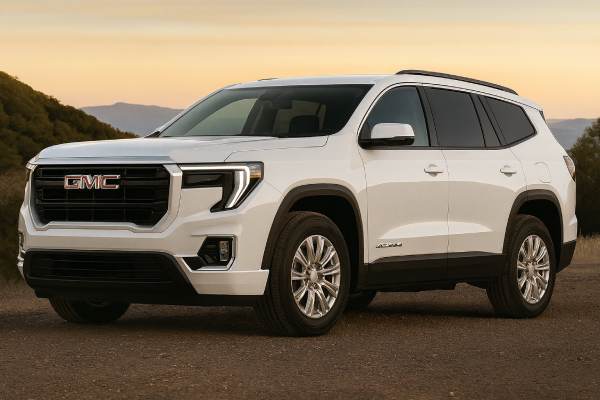
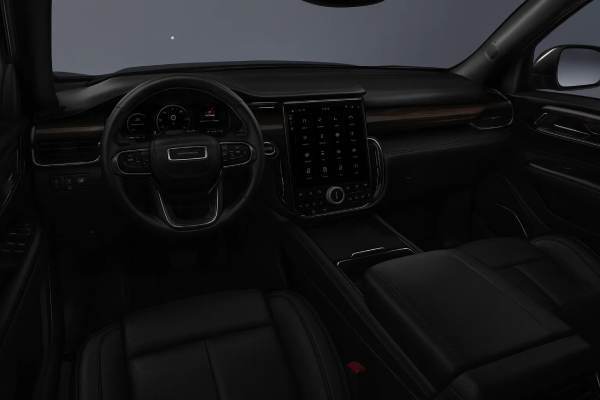
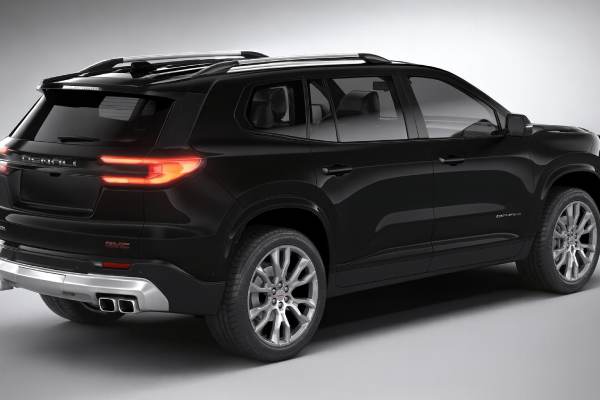
The latest GMC Acadia FWD with the LK0 2.5 litre turbo engine marks a big step forward from the previous generation. It grows into a true three-row family SUV again, with far more space, more power, and a modern electronics platform built around a 15-inch portrait touchscreen. Under the hood, the all-new 2.5 litre turbocharged four-cylinder delivers 328 hp and strong mid-range torque, backed by an eight-speed automatic and front-wheel drive.
For many buyers, this FWD configuration hits a sweet spot: maximum fuel economy and towing capability without the added weight and cost of all-wheel drive. It is also the most common drivetrain in fleets and family use. In this guide we focus on the front-drive C1UG-2 Acadia with the LK0 engine, explaining how it is built, how it performs, what to expect in running costs, and how it compares with rivals in the real world.
Core Points
- 2.5 litre LK0 turbo four-cylinder makes 328 hp and 326 lb-ft, giving the FWD Acadia brisk performance for a three-row SUV.
- Third-generation body is much larger, with up to about 2,760 L of cargo space and more legroom in all three rows.
- More than 15 standard safety and driver assistance systems, with later model years targeting top-tier crash-test scores.
- New engine and electronics platform mean software updates and correct fluids are important; early-build owners should keep up with dealer campaigns.
- Plan engine oil and filter changes roughly every 7,500–10,000 miles or 12 months (or as indicated by the oil-life monitor), using the specified Dexos-approved oil.
Section overview
- GMC Acadia 2.5 FWD context
- LK0 2.5 turbo technicals
- Grades, option packs and safety
- Reliability and common issues
- Maintenance roadmap and buyer tips
- On-road performance and efficiency
- How this Acadia stacks up
GMC Acadia 2.5 FWD context
The third-generation Acadia moves the nameplate back into the “full-size” end of the midsize SUV class. Overall length stretches to roughly 204 inches, with a long 120.9-inch wheelbase, which puts it close to some full-size SUVs in footprint. That extra space goes into a much roomier third row, wider second-row seats, and a very large cargo area, especially with the rear rows folded. It is still built on a unibody platform shared with the latest Chevrolet Traverse, focusing on comfort, refinement, and crash performance rather than body-on-frame toughness.
The FWD (front-wheel drive) configuration you are looking at is the standard layout for the Elevation and Elevation Premium trims in many markets. It uses the same LK0 2.5 litre turbo engine as the AWD versions, but without the extra rear drive module, prop shaft, and differential. That means less weight, slightly better fuel economy, and a simpler driveline. For drivers in warmer climates or mainly urban and highway conditions, FWD usually offers all the traction they need, especially on good all-season tyres.
This Acadia generation makes a big technology leap. A 15-inch portrait-style infotainment screen is standard on most trims, paired with an 11-inch digital driver display. The interior is heavily digital, from the climate controls integrated into the main display to the extensive customisation of instrument layouts and drive-mode settings. Super Cruise hands-free driving is available on higher trims, although most FWD buyers will see it mainly as an option on Elevation Premium and Denali rather than as a core feature.
From a usage standpoint, the FWD LK0 Acadia targets families who need:
- A genuine three-row SUV that can comfortably carry six to eight passengers.
- Strong towing capability for a camper, boat, or track car up to roughly 5,000 lb (with the proper trailering package).
- A comfortable highway cruiser with modern safety tech and a premium-leaning interior.
Compared with the previous second-generation Acadia, owners will notice a much larger footprint, a huge step up in cabin tech, and a switch from the old 2.0T/3.6 V6 engine mix to a single, powerful 2.5 turbo that already matches or beats the old V6 on output while promising better efficiency.
LK0 2.5 turbo technicals
Engine and performance (LK0)
| Item | Value |
|---|---|
| Engine code | LK0 2.5L Turbo I-4 |
| Layout and valvetrain | Inline-4, DOHC, 4 valves per cylinder, variable valve timing |
| Displacement | 2.5 L (approx. 2,500 cc) |
| Induction | Single twin-scroll turbocharger |
| Fuel system | Direct injection (SIDI) |
| Max power | 328 hp (244 kW) @ around 5,500 rpm |
| Max torque | 326 lb-ft (442 Nm) @ around 3,500 rpm |
| Timing drive | Chain-driven camshafts (no cambelt) |
| Emissions / standard | Meets current light-duty emissions standards for its class |
| Official fuel economy (FWD) | About 20/27/23 mpg US (city/hwy/combined) |
| Approx. fuel use (FWD) | ~11.8 / 8.7 / 10.2 L/100 km; ~24.0 / 32.4 / 27.6 mpg UK |
Real-world highway consumption at 120 km/h (75 mph) tends to sit close to the official highway figure when unladen, but can climb into the mid-20s mpg US (high-9 to low-10 L/100 km) when loaded, driving into a headwind, or crossing hilly terrain.
Transmission and driveline (FWD)
| Item | Value |
|---|---|
| Transmission | 8-speed automatic, electronically controlled |
| Gearbox type | Conventional torque-converter auto with manual mode |
| Drive type | Front-wheel drive |
| Final drive | Fixed ratio (varies slightly by trim and wheel/tire option) |
| Traction systems | StabiliTrak stability control, traction control; selectable drive modes |
| Tow rating (with package) | Up to about 5,000 lb (2,268 kg) max trailering |
| Unbraked trailer guideline | Typically 1,000–1,500 lb (check local regulations and owner’s manual) |
The Trailering Package is key if you plan to tow regularly. It typically adds a hitch receiver, wiring, cooling upgrades, and software calibration to manage gearshifts and engine braking when pulling a load.
Chassis and dimensions
| Item | Value (approximate) |
|---|---|
| Front suspension | MacPherson strut with coil springs, anti-roll bar |
| Rear suspension | Multi-link independent with coil springs |
| Steering | Electric power rack-and-pinion |
| Brakes | Four-wheel disc brakes (ventilated fronts, solid rears), ABS and brake assist |
| Wheels/tyres | 18–20 inch alloys; common sizes around 255/60 R18 or 255/55 R20 (market and trim dependent) |
| Length | ≈ 204.0 in (5,182 mm) |
| Width (without mirrors) | ≈ 79.6 in (2,022 mm) |
| Height | ≈ 71.0 in (1,803 mm) |
| Wheelbase | 120.9 in (3,071 mm) |
| Ground clearance | Around 7–8 in (exact value varies by trim; check manual) |
| Turning circle | Roughly 38–40 ft kerb-to-kerb (about 11.5–12.2 m) |
| Curb weight (FWD) | Approx. 2,065–2,130 kg (4,550–4,700 lb) depending on trim |
| GVWR | Around 2,800 kg (≈6,170 lb) |
Cargo and fuel:
| Item | Value |
|---|---|
| Fuel tank (FWD) | Approx. 19.4 US gal (73 L) |
| Cargo behind 3rd row | Roughly 23.0 ft³ (≈651 L) |
| Cargo behind 2nd row | Roughly 57.3 ft³ (≈1,623 L) |
| Max cargo (1st row only) | Roughly 97.5 ft³ (≈2,761 L) |
Fluids and service capacities (typical guidance)
Always confirm exact specifications and quantities in the owner’s or service manual.
| System | Specification and notes |
|---|---|
| Engine oil | Dexos-approved full-synthetic (commonly 0W-20); capacity roughly 5–6 L including filter |
| Engine coolant | Long-life OAT coolant, premix around 50:50; change interval typically 5 years/150,000 miles on first fill, then shorter |
| Automatic transmission | Specific GM-approved ATF for the 8-speed; drain and fill usually 4–6 L of fluid, full service higher |
| Brake fluid | DOT 3 or DOT 4 low-viscosity (check cap/manual); replace every 2–3 years |
| A/C refrigerant | R-1234yf with specified charge weight and compatible compressor oil |
Key torque specs, such as wheel nut torque or drain plug torque, should always be taken from current GM service documentation, as they can vary by wheel, brake package, and market.
Electrical and safety systems
| Item | Value / feature |
|---|---|
| 12 V battery | Maintenance-free AGM or flooded lead-acid, sized for high accessory load |
| Alternator | High-output alternator sized for heated seats, large screens, and towing demand |
| Spark plugs | Iridium long-life, typically 100,000-mile service interval (time-based limit also applies) |
| Safety structure | High-strength steel safety cage with multiple load paths and advanced crumple zones |
| Airbags | Front, side, curtain, and often driver’s knee airbag depending on market |
Grades, option packs and safety
GMC sells the third-generation Acadia in Elevation, Elevation Premium, AT4, and Denali trims, though availability and exact names can vary slightly by market. For FWD shoppers, Elevation and Elevation Premium are the main focus, as AT4 is typically AWD-only and Denali is most often bought with AWD as well.
Elevation is the entry point, but it is far from basic. Standard equipment usually includes the 2.5L turbo engine, 8-speed auto, three-row seating (up to eight seats), 15-inch infotainment screen, 11-inch digital cluster, LED lighting, power driver’s seat, and a comprehensive list of advanced safety systems. Elevation Premium layers in 7-seat captain’s chairs, larger wheels, more luxurious interior materials, and access to higher-end options such as Super Cruise and more sophisticated audio.
AT4 is the off-road-oriented grade. Even if you opt for FWD in some regions, it is worth understanding what AT4 adds: raised ride height, different tyres, unique styling, and more rugged underbody tuning. Denali, on the other hand, pushes the Acadia toward near-luxury territory, with distinctive exterior trim, more sound insulation, higher-grade leather, and more technology features as standard.
From a safety perspective, the new Acadia is heavily loaded even at the base level. Typical standard equipment includes forward collision alert, automatic emergency braking with pedestrian and bicyclist detection, lane keep assist with lane departure warning, blind-zone monitoring, rear cross-traffic alert, and automatic high beams. A surround-view camera system, Rear Camera Mirror, advanced parking assists, and Super Cruise hands-free highway driving are available depending on trim and package.
As the generation matures, independent crash-test bodies are beginning to publish results, and the Acadia is targeting high ratings under the latest protocols. That includes strong performance in small overlap front and updated side-impact tests, together with solid scores for front crash prevention and available headlights.
If you are cross-shopping trims, keep these points in mind:
- Elevation and Elevation Premium FWD are ideal if you want maximum space and features without AWD complexity.
- AT4 is for those who genuinely drive on rougher surfaces, where its extra ground clearance, tyre package, and off-road-tuned hardware help.
- Denali makes the most sense for long-distance drivers who value quieter cabins, higher-grade materials, and the broadest range of comfort and tech.
Whatever trim you choose, verify which ADAS features are standard on your specific VIN. Some features, such as Super Cruise or advanced automated parking, are optional packages and might require post-repair calibrations after windscreen, bumper, or radar work.
Reliability and common issues
Because the LK0-powered Acadia is a very new generation, there is not yet a deep track record of high-mileage failures. Most examples on the road are still in their original warranty period, and early feedback focuses more on software behaviour and minor fit-and-finish than on major mechanical problems. That said, we can outline likely patterns based on the engineering layout and on how similar GM turbo direct-injection engines and 8-speed transmissions have behaved in practice.
Common or expected, low-to-medium severity items in the first 3–5 years often include:
- Software quirks in the 15-inch infotainment system, such as lag, dropped Bluetooth connections, or occasional reboots. These are usually addressed through over-the-air or dealer-installed updates to the infotainment and body control modules.
- Sensor-related warnings for ADAS features (for example, blocked camera or radar) after windshield replacement, front-end repairs, or even heavy road grime. Proper recalibration and a clean sensor view typically resolve these.
- Occasional squeaks or rattles from interior trim in the third row or tailgate area, which are common on large crossovers with long bodies and big cargo openings.
Less common, but worth watching as the vehicle ages:
- Direct-injection intake valve deposits. Many DI turbo engines build carbon on the back of intake valves over 60,000–100,000 miles, which can gradually affect idle quality and performance. Using good-quality fuel and following oil-change intervals helps; some owners later choose professional intake cleaning.
- Turbocharger-related issues, such as wastegate actuator noise or charge-pipe leaks. These tend to show up as loss of power, underboost or overboost codes, or unusual whooshing or whistling sounds under load.
- Transmission calibration complaints rather than hard faults: slight hesitation on kick-down, or occasional shift flare during light throttle. In many cases, updated transmission control software improves behaviour.
So far there are no widely reported systemic failures specific to the LK0 Acadia, such as a known weak timing chain or recurring coolant leaks, but it is still early. It is wise to check for fresh technical service bulletins (TSBs) when the vehicle goes in for scheduled service. GM often addresses emerging issues through revised parts (for example, updated sensors or improved seals) and updated control software.
For now, the most effective reliability strategy is:
- Strict adherence to oil and coolant change intervals using the correct Dexos-approved oil and proper coolant type.
- Avoiding extended towing right up against the 5,000-lb limit in hot weather without proper rest periods and servicing.
- Ensuring all recalls, field actions, and software updates are completed by checking the VIN on official GM and government recall sites.
When buying used, ask for documentation confirming recall and TSB completion, especially for any campaigns relating to engine management, transmission programming, or advanced driver assistance functionality.
Maintenance roadmap and buyer tips
A good maintenance plan keeps the LK0 Acadia both reliable and pleasant to drive. Always default to the official service schedule for your region, but the following roadmap is a practical starting point for the FWD 2.5 turbo:
Routine service intervals (typical)
- Engine oil and filter: Every 7,500–10,000 miles (12,000–16,000 km) or 12 months, depending on the oil-life monitor, using Dexos-approved full-synthetic oil (commonly 0W-20).
- Engine air filter: Inspect at 15,000 miles (24,000 km), replace around 30,000–45,000 miles, sooner in dusty environments.
- Cabin air filter: Replace every 20,000–25,000 miles (32,000–40,000 km) or roughly every 2 years.
- Coolant: First change typically at 5 years/150,000 miles (240,000 km), then at shorter intervals; confirm in the manual for the LK0 engine.
- Spark plugs: Long-life iridium plugs usually specified around 100,000 miles (160,000 km) or the time-based limit listed in the schedule.
- Brake fluid: Replace around every 2–3 years regardless of mileage.
- Automatic transmission fluid: Many owners and independent technicians recommend a drain and fill between 45,000–60,000 miles (72,000–96,000 km), especially if towing.
- Tyre rotation and alignment: Rotate tyres every 6,000–7,500 miles (10,000–12,000 km), check alignment yearly or when you notice uneven wear or pulling.
- Aux belts and hoses: Visual inspection at every service after three years; replace as soon as cracking, glazing, or noise appears.
- 12 V battery: Load-test annually after year three; plan for replacement roughly in the 5–7 year window depending on climate and usage.
Because this is a turbo engine, warm-up and cool-down habits matter. Avoid hard acceleration immediately after a cold start, and try to give the engine a lighter last minute or two of driving before shutdown after towing or long climbs. This helps protect turbocharger bearings and oil life.
Fluid and torque considerations
- Use only GM-approved Dexos oil and the specified ATF, as the wrong fluids can cause driveability issues, transmission shudder, or premature wear.
- Critical torques, such as wheel nuts, engine drain plug, and suspension fasteners, should always be followed from the service documentation; over-tightening can damage threads or distort components.
Buyer’s guide
When inspecting a used FWD LK0 Acadia:
- Exterior and structure
- Check panel gaps and paint consistency; misalignment could indicate accident repairs.
- Inspect underbody, subframes, and suspension mounting points for corrosion, especially in road-salt regions.
- Engine bay
- Look for oil or coolant traces around the turbo area, front and rear main seal areas, and along coolant hose connections.
- Listen for whistle, rattle, or ticking sounds that change with boost and rpm.
- Driveline and brakes
- During a test drive, feel for shudder or slipping shifts, delayed engagement from Park into Drive or Reverse, or harsh clunks.
- Perform several medium and hard stops to evaluate brake feel, steering stability, and any pulsing from warped discs.
- Electronics
- Test all functions of the 15-inch screen, including CarPlay/Android Auto, camera views, and navigation.
- Verify operation of ADAS features where safe: lane keep assist, blind-spot alerts, parking sensors, and adaptive cruise (if fitted).
- Paperwork
- Ask for full service history, including oil changes and coolant flushes.
- Confirm that recall and TSB work is up to date by checking the VIN against official databases and GM’s own systems.
Overall, the new Acadia FWD LK0 looks promising for long-term durability if serviced correctly, but buyers should treat early-production vehicles with the usual extra care: check for software updates, and prefer examples with documented dealer maintenance.
On-road performance and efficiency
On the road, the 2.5 litre LK0 turbo is one of the Acadia’s main strengths. With 328 hp and 326 lb-ft on tap, the FWD version accelerates with ease even when loaded, feeling closer to a strong V6 than to the smaller turbos found in some rivals. Independent estimates suggest 0–60 mph times in the mid-6 to low-7 second range, depending on trim, tyres, and conditions, which is quick for a three-row family SUV.
Throttle response is generally good once the engine is warm, with only a brief pause as the turbo spools from very low rpm. The eight-speed automatic is tuned for smoothness and efficiency; in normal driving it upshifts early and keeps revs low. In Sport or towing-oriented modes, it holds gears longer and responds more eagerly to throttle inputs. Some owners may notice the occasional gentle hesitation on kick-down, especially when the gearbox is still learning a driver’s style, but this often improves after a few hundred miles and any calibration updates.
Ride quality is tuned for comfort, not aggression. The long wheelbase helps the Acadia float over expansion joints and broken pavement without the bobbing you sometimes feel in shorter crossovers. Body roll is present but well controlled, and steering weight feels natural rather than artificially heavy. The FWD layout makes the front end feel light and easy to place, and torque-steer is kept in check even with full power.
Noise levels are competitive: the cabin is generally quiet at 70–75 mph, with more wind noise around the door mirrors than from the tyres. Denali and some higher packages add more sound-deadening and laminated glass, making them noticeably more hushed on the highway.
In terms of efficiency, the official ratings for the FWD 2.5 turbo are about 20 mpg city and 27 mpg highway, with a 23 mpg combined figure. Real owners often report:
- Around 19–21 mpg US (11.2–12.4 L/100 km) in dense city use.
- 25–28 mpg US (8.4–9.4 L/100 km) on steady highway runs in mild conditions.
- 21–24 mpg US (9.8–11.2 L/100 km) in mixed driving, depending on load, terrain, and driving style.
Cold climates, short trips, and heavy HVAC use can push those numbers down, while patient, steady drivers can do better than the highway rating on longer, flatter journeys.
With a properly equipped FWD Acadia, towing a 3,500–5,000 lb trailer will typically increase fuel consumption by 30–50%, and you will feel more sensitivity to crosswinds and long grades than in a truck-based SUV. Still, the chassis and brakes are capable, and the engine has enough torque to pull confidently as long as you respect speed limits and cooling recommendations.
Overall, the FWD LK0 Acadia drives like a modern, refined family SUV: powerful, smooth enough, and easy to cover long distances in, while hitting fuel economy numbers that are respectable for its size and performance.
How this Acadia stacks up
The 2.5L FWD Acadia competes with a crowded field: Honda Pilot, Toyota Highlander and Grand Highlander, Hyundai Palisade, Kia Telluride, Volkswagen Atlas, and its platform cousin, the Chevrolet Traverse. Each of these models has its own strengths, but the Acadia has some clear talking points.
Where the Acadia stands out
- Power and towing: At 328 hp and 326 lb-ft, the Acadia’s turbo four outmuscles the base engines in many rivals and matches or beats several V6 offerings, while still towing up to about 5,000 lb when properly equipped.
- Interior tech: The 15-inch portrait infotainment display and 11-inch cluster are more tablet-like and configurable than what you will find in many alternatives, especially in mid-level trims.
- Safety and driver assistance: With a broad standard safety suite and the availability of Super Cruise on some trims for hands-free motorway driving, the Acadia is competitive with Japanese and Korean leaders in this space.
Where rivals may have the edge
- Fuel economy: Some hybrid competitors, such as the Toyota Highlander and Grand Highlander hybrids or certain plug-in rivals, can dramatically undercut the Acadia on fuel use in city driving. If you do mostly short urban trips, those hybrids may be cheaper to run.
- Third-row access and packaging: While the Acadia’s third row is much improved over the previous generation, some rivals offer slightly flatter floors or more open walk-throughs when fitted with captain’s chairs.
- Brand-specific strengths: Kia Telluride and Hyundai Palisade have built strong reputations for interior design and perceived value; Honda Pilot and Toyota’s SUVs carry a long reliability record that can translate into higher resale values.
The Acadia’s closest sibling, the new Traverse, shares much of its platform and powertrain, but the GMC version generally positions itself as more premium, with different styling, interior execution, and feature sets. Which one is better depends on whether you value GMC’s look and trim structure or Chevrolet’s pricing and branding.
For a buyer focused on strong performance, high safety content, and a tech-forward cabin in a FWD three-row configuration, the Acadia with the LK0 2.5 turbo sits very well in the segment. It is not the fuel-economy champion, but it offers an appealing blend of power, space, and equipment that will suit many families and business users.
References
- 2025 GMC Acadia | Mid-Size SUV 2025 (Model information and specifications)
- 2025 GMC Acadia 2025 (Safety Rating)
- 2025 TOP SAFETY PICKs 2025 (Safety Rating Criteria)
- 2025 GMC Acadia Owner’s Manual 2025 (Owner’s Manual)
- 2025 GMC Acadia Review, Pricing, and Specs 2024 (Independent Test and Specs)
Disclaimer
This article is for informational purposes only and is not a substitute for professional diagnosis, repair, or official service literature. Specifications, torque values, fluid types, and maintenance intervals can vary by VIN, model year, trim level, market, and equipment. Always confirm critical information against the latest GMC owner’s manual and official service documentation, and consult a qualified technician before performing work on your vehicle.
If you found this guide useful, you are welcome to share it with other owners or shoppers on social media platforms such as Facebook or X/Twitter. Thoughtful sharing helps support the effort that goes into creating detailed, independent technical guides like this one.