
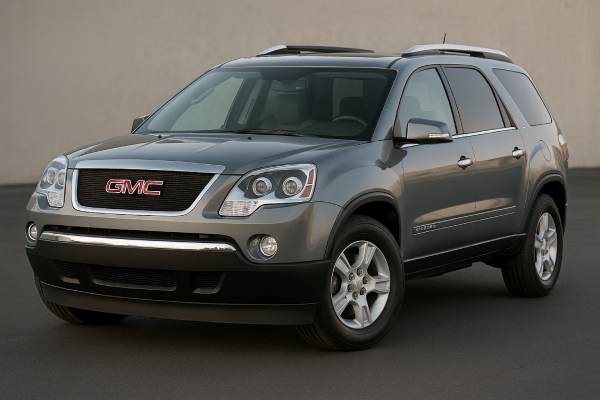
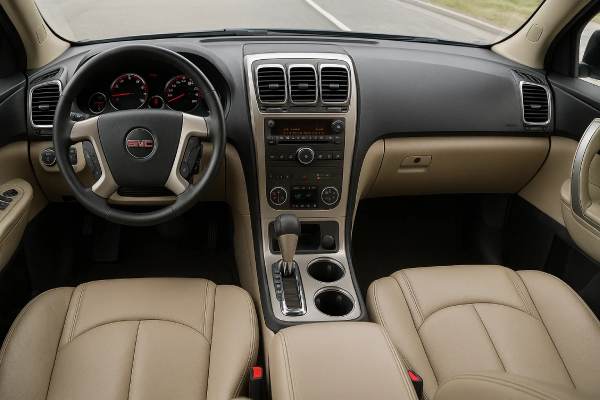
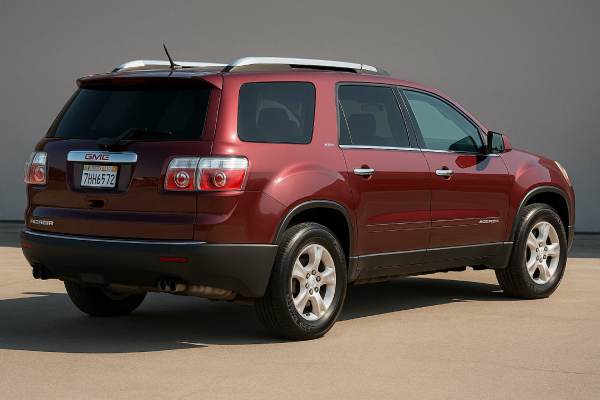
The first-generation GMC Acadia 2WD with the LY7 3.6 litre V6 marked a major shift for GMC. Built on the GMT968 Lambda unibody platform, it moved away from truck-based SUVs into a more car-like three-row crossover that could realistically replace both a minivan and a traditional SUV for many families. With 275 hp, a six-speed automatic, and seating for seven or eight, it was aimed squarely at buyers who needed space, comfort, and safety more than hardcore off-road ability.
In 2WD (front-wheel-drive) form, the Acadia offers a low step-in height, a stable long wheelbase, and a cabin that adults can use in all three rows. At the same time, owners have identified a few clear weak points over the years, especially around the 3.6 V6 timing chains and the 6T75 automatic transmission’s internal hardware if maintenance is stretched. This guide focuses on the 2006–2008 model years, helping you understand the specs, real-world behaviour, common issues, and what to look for if you’re buying one today.
Fast Facts
- Spacious three-row cabin seats 7–8, with roughly 19–20 ft³ of cargo behind the third row and over 110 ft³ with rear seats folded.
- LY7 3.6L DOHC V6 makes 275 hp and about 251 lb-ft through a 6-speed 6T75 automatic; performance is adequate, not sporty.
- Typical fuel economy for the 2WD model sits around 16 mpg city / 24 mpg highway / 19 mpg combined in US ratings (roughly 14.7 / 9.8 / 12.4 L/100 km).
- Major reliability watch items are timing-chain wear on the 3.6 V6 and wave-plate failures in the 6T75 automatic if fluid and oil changes are neglected.
- A sensible maintenance pattern is oil and filter every 5,000–7,500 miles (8,000–12,000 km) or as indicated by the oil life monitor, using quality synthetic 5W-30 that meets the correct GM specification.
Navigate this guide
- GMC Acadia 2WD ownership overview
- GMC Acadia 3.6 specifications
- Acadia 2WD trims and safety
- Reliability issues and service actions
- Maintenance schedule and buying guide
- Road manners and performance feel
- Acadia 2WD versus key rivals
GMC Acadia 2WD ownership overview
The 2006–2008 GMC Acadia 2WD was one of the first of GM’s large crossovers, sharing its Lambda platform with the Saturn Outlook and later the Buick Enclave and Chevrolet Traverse. Instead of the old body-on-frame layout, the unibody GMT968 structure allows a lower floor, more interior volume, and car-like refinement. For families stepping out of an Envoy or older Tahoe, the Acadia felt like a more modern, quieter alternative that still looked like an SUV.
In 2WD form, all power is sent to the front wheels through the 6-speed 6T75 automatic. The LY7 3.6-litre V6 produces 275 hp and around 251 lb-ft of torque, which is enough to move this heavy crossover at a relaxed pace. It is not a quick vehicle, but it merges confidently and cruises happily at motorway speeds when the engine and gearbox are healthy. A long wheelbase and wide track help stability, and the structure and restraint systems were strong enough to earn very good crash-test scores for the time.
The main reason many owners choose the Acadia is space. Depending on configuration, you get either a 2–3–3 or 2–2–3 seating layout, and adults can actually use the third row for shorter trips. Behind the third row is still a usable cargo area of roughly 19–20 cubic feet; fold the third row down and the space opens up into a near-minivan-level load floor that can take bikes, flat-pack furniture, or luggage for a full family holiday.
From an ownership standpoint, there are two sides to the Acadia 2WD. On the positive side, parts availability is excellent, many independent shops know the platform well, and the basic chassis is robust. On the negative side, early examples of the 3.6 V6 and 6T75 automatic are known for timing-chain wear, transmission wave-plate failures, and power-steering concerns if maintenance has been deferred. A good example with documentation can be a comfortable, capable family hauler; a neglected one can quickly become expensive. Understanding this split is key to making a smart decision.
GMC Acadia 3.6 specifications
This section covers the 2WD (front-wheel-drive) Acadia with the LY7 3.6-litre V6 and 6T75 automatic in the 2006–2008 model years. Always verify details by VIN and market, as minor differences exist.
Engine and performance (LY7 3.6 V6)
| Item | Specification |
|---|---|
| Engine code | LY7 High Feature V6 |
| Layout and cylinders | 60° V6, aluminium block and heads, DOHC, 24 valves, variable valve timing |
| Displacement | 3.6 L (3,564 cc) |
| Bore × stroke | 94.0 × 85.6 mm (3.70 × 3.37 in) |
| Compression ratio | Approx. 10.2:1 |
| Induction | Naturally aspirated |
| Fuel system | Sequential multi-port fuel injection |
| Max power | 275 hp (about 205 kW) at roughly 6,600 rpm |
| Max torque | Around 251 lb-ft (about 340 Nm) at roughly 3,200 rpm |
| Fuel type | Regular unleaded petrol (where available) |
| Official economy (2WD) | About 16 mpg city / 24 mpg highway / 19 mpg combined (≈14.7 / 9.8 / 12.4 L/100 km) |
| Timing drive | Chain-driven primary and secondary chains |
The LY7 is smooth and willing to rev, but the Acadia’s size means you often use the midrange rather than high rpm. Proper oil quality and change intervals are critical to timing-chain life.
Transmission and driveline
| Item | Specification |
|---|---|
| Transmission | 6-speed automatic, GM 6T75 |
| Drive type | Front-wheel drive (2WD) |
| Gear ratios (typical) | 1st 4.48, 2nd 2.87, 3rd 1.84, 4th 1.41, 5th 1.00, 6th 0.74 |
| Final drive ratio | Approx. 2.77–3.16 depending on calibration |
| Differential | Open front differential; traction and stability control use the brakes to control wheelspin |
There is no low-range transfer case. For light towing and rough tracks, the combination of gearing and torque is adequate, but this is not a rock-crawler.
Chassis and dimensions
| Item | Specification |
|---|---|
| Platform | GMT968 / Lambda unibody |
| Suspension (front) | Independent MacPherson strut with coil springs and stabiliser bar |
| Suspension (rear) | Independent multi-link with stabiliser bar |
| Steering | Power-assisted rack-and-pinion |
| Brakes | 4-wheel disc brakes with ABS and stability control |
| Wheelbase | 118.9 in (3,020 mm) |
| Length | Around 200.7 in (≈5,108 mm) |
| Width | Roughly 78–79 in (≈2,000 mm) excluding mirrors |
| Height | About 70–73 in depending on trim and roof rails |
| Ground clearance | Around 7.4 in (≈188 mm) |
| Turning circle | Around 40.4 ft (kerb-to-kerb) |
| Curb weight (2WD 3.6) | Around 4,600–4,700 lb (≈2,100–2,150 kg) |
| GVWR | Around 6,450–6,500 lb (≈2,925–2,950 kg) |
| Fuel tank | 22.0 US gal (≈83 L) |
| Cargo volume | Roughly 19–20 ft³ behind 3rd row; around 116 ft³ max with rear seats folded |
| Seating | 7 or 8 passengers (2–3–3 or 2–2–3 layout) |
Typical wheel and tyre packages:
- SLE/SLT1: 18-inch alloy wheels with 255/65R18 tyres
- SLT2: optional 19-inch alloys with 255/60R19 tyres
Performance and capability
| Metric | Value |
|---|---|
| 0–60 mph | Approximately 8.5–8.6 seconds in 2WD form |
| 0–100 km/h | Around 9.0–9.1 seconds |
| Top speed | Around 107 mph (≈172 km/h), typically limited electronically |
| Braking 100–0 km/h | Mid-40 m range in independent tests with good tyres and brakes |
| Towing capacity (with tow package) | Up to roughly 4,500–5,200 lb when properly equipped |
| Payload | Commonly in the 1,600–1,800 lb range (check door-jamb label) |
| Roof load | Typically about 200 lb including rack (verify in manual) |
Fluids and service capacities (approximate)
Always confirm by VIN and region, but the following figures are typical for a 3.6 LY7/6T75 2WD Acadia:
| System | Spec and capacity (approx.) |
|---|---|
| Engine oil | Synthetic 5W-30 to the correct GM spec; around 5.2–5.7 L (5.5–6.0 US qt) with filter |
| Coolant | Dex-Cool organic-acid coolant; about 11–12 L for a full system fill |
| Transmission | Dexron-VI ATF; around 4–6 L (4.2–6.3 qt) for a drain/fill, about 9–10 qt total capacity |
| Power steering | GM-approved power-steering fluid; change by volume when servicing |
| Brake fluid | DOT 3 or DOT 4 brake fluid |
| A/C refrigerant | R-134a system; typical charge around 0.8–1.0 kg (see under-hood label) |
Electrical and safety essentials
| Item | Specification |
|---|---|
| Alternator output | Typically around 170 A on many trims |
| 12 V battery | Group 48/H6 case; usually 70–80 Ah and 600–700 CCA depending on brand |
| Spark plugs | Long-life iridium plugs; gap around 1.10 mm (0.043 in) from factory |
Safety equipment includes six airbags (front, side, and curtain), stability control, traction control, ABS, tyre-pressure monitoring and, on most trims, OnStar with automatic crash notification. Rear parking sensors and a rear camera were available and become more common on higher trims and with navigation.
Acadia 2WD trims and safety
During the 2006–2008 period, the 2WD Acadia was mainly offered in SLE and SLT trims, with SLT further divided into levels like SLT1 and SLT2. Each step up adds comfort and convenience equipment, while the core mechanical package (3.6 V6, 6T75, 2WD) remains the same.
Trim and seating overview
- SLE
Typically the entry trim with cloth seating, manual front seats, 18-inch alloys, three-zone climate control, basic CD audio and usually 7-passenger seating (2–3–2). Equipment can vary with packages, but this is the more straightforward, utilitarian configuration. - SLT1
Adds leather upholstery, power-adjustable front seats, upgraded audio, and more comfort features. Buyers can choose between 7- and 8-passenger layouts, with second-row captain’s chairs being a popular choice for easier third-row access. - SLT2
Top trim with additional chrome and body-colour accents, optional 19-inch wheels, premium audio (often Bose-branded), power tailgate, and more technology options such as a navigation system and more extensive convenience features.
Regardless of trim, every 2WD Acadia in this period uses the same basic suspension, steering and braking layout. Mechanical differences mostly stem from options like:
- Factory tow package: Heavy-duty engine and transmission cooling, hitch receiver, trailer wiring and higher published tow ratings.
- Wheel and tyre packages: 19-inch wheels sharpen steering response but can make the ride slightly firmer and tyres more expensive.
Quick identifiers and codes
- SLE models usually wear simpler wheel designs, less chrome, and cloth interiors.
- SLT models carry “SLT” badges and have leather trim, more steering-wheel controls, and added features inside.
- The Service Parts Identification (SPID) label, often in the glovebox, lists three-letter RPO codes that identify the tow package, seat layout, audio upgrades and more; decoding these gives a precise picture of how a used vehicle was built.
Safety ratings and equipment
Safety is a strong point for the Acadia 2WD:
- Crash tests from major bodies rated the early Acadia very highly in frontal and side impacts, often with maximum scores in several categories.
- Rollover resistance scores are typical for a tall SUV, with electronic stability control helping reduce risk.
Standard safety equipment includes:
- Dual front airbags, front-seat side airbags and full-length curtain airbags covering all three rows.
- Electronic stability control, traction control, four-wheel ABS brakes.
- Tyre-pressure monitoring system (TPMS).
- LATCH child-seat anchors in the second row, with belt-based positions in the third row suitable for boosters and older children.
Higher trims and certain packages add:
- Rear parking assist sensors.
- A rearview camera, displayed either in the mirror or the navigation screen.
- More advanced audio and navigation systems, which indirectly improve safety by making hands-free features easier to use.
There is no factory automatic emergency braking, lane-keeping assist or adaptive cruise control in this era; the Acadia predates mainstream adoption of those systems. However, in terms of structural crash protection and restraint systems, it remains competitive among similar-age SUVs.
Reliability issues and service actions
The early GMC Acadia 2WD has a mixed long-term reliability record. Many owners enjoy years of service with only routine maintenance, while others encounter major engine or transmission repairs. The difference often comes down to maintenance quality and driving conditions.
Timing-chain wear and engine concerns
The LY7 3.6-litre V6 uses timing chains rather than belts, but early chains and tensioners have proven sensitive to oil quality and interval length. Common patterns include:
- Prevalence: Chain wear is common enough that GM released special coverage programs on certain model years and related vehicles, extending chain-related warranty coverage under specific conditions.
- Typical mileage: Problems often appear between 80,000 and 120,000 miles, but can occur earlier on vehicles that saw extended oil-change intervals or low oil levels.
- Symptoms: Rattle on cold start, check-engine light with cam/crank timing codes, rough idle and loss of power.
- Remedy: Replacing the full timing-chain set (primary and secondary chains, guides and tensioners) plus updated engine control software where applicable. This is a major job with significant labour cost.
Oil leaks, intake gunk and carbon build-up can also appear with age, especially if the engine has seen lots of short trips. Regular oil changes and occasional intake cleaning reduce the risk.
6T75 transmission wave-plate failures
The 6T75 automatic is generally smooth when healthy, but the original internal “wave plate” used in the 3rd/5th/reverse clutch pack is a known weak point.
- Prevalence: Not every transmission fails, but wave-plate issues are well documented across Lambda-platform vehicles.
- Typical mileage: Commonly 80,000–120,000 miles, sometimes sooner with heavy towing or repeated overheating.
- Symptoms:
- Harsh or slipping 3–5 shifts.
- Delayed or missing reverse engagement.
- Progression to loss of multiple gears or complete loss of drive.
- Remedy: Transmission rebuild or replacement with updated internal parts. Fluid condition and cooling are critical afterwards.
Regular fluid changes and avoiding overheating help, but they cannot guarantee that an original wave plate will never fail.
Steering, cooling and other mechanical issues
- Power steering: Leaking hoses, failing pumps and worn racks can cause heavy steering, whining noises or intermittent loss of assist, especially at parking speeds. Replacement of the faulty component and a proper bleed with the correct fluid usually solve the issue.
- Water pump and cooling system: Water-pump leaks and failures can occur, sometimes alongside overheating. A thorough cooling-system inspection (pump, hoses, radiator, thermostat) is important on higher-mileage vehicles.
- EVAP and intake issues: Faulty purge solenoids can cause rough starts, fuel odours and emissions codes. Replacement is usually straightforward.
Suspension and wheel bearings wear at a rate you would expect for a heavy family SUV: front struts, control-arm bushings and rear links may need attention by 100,000 miles, depending on road conditions.
Electrical, body and interior quirks
- Liftgate wiring: Repeated flexing of the tailgate harness can lead to intermittent power-liftgate or lighting issues.
- Sunroof drains: Blocked drains can let water into the cabin, soaking carpets and potentially affecting modules.
- Interior electronics: HVAC controls, seat motors and entertainment systems can develop isolated faults, usually resolved by component replacement.
Recalls, campaigns and how to verify work
Over the years, various recalls, technical service bulletins and special coverage programs have targeted issues such as:
- Timing-chain wear and associated diagnostic updates.
- Transmission control-module behaviour and shift quality.
- Steering-system components and potential leaks.
Because coverage and applicability vary by VIN, the safest approach is:
- Run a VIN check through the official recall database for your region (for example, NHTSA in the US).
- Ask a GM dealer to print a service history or at least confirm which campaigns and special coverages have been completed.
- Keep paperwork for any major engine or transmission work; this is valuable both for your own planning and for resale.
Maintenance schedule and buying guide
The early Acadia 2WD responds well to conservative, consistent maintenance. Following only the original long oil-life-monitor prompts is one of the main reasons timing-chain and engine problems show up later. A slightly more cautious schedule offers a good balance between cost and longevity.
Practical maintenance schedule (general guidance)
This is a practical, owner-friendly schedule rather than a replacement for the official maintenance plan. Always cross-check with your owner’s manual.
- Engine oil and filter
- Every 5,000–7,500 miles (8,000–12,000 km) or 12 months, whichever comes first.
- Shorter intervals for lots of city driving, short trips, or towing.
- Engine air filter
- Inspect at each service.
- Replace about every 30,000 miles (50,000 km), or sooner in dusty areas.
- Cabin air filter
- Replace every 20,000–25,000 miles (30,000–40,000 km) or around every 2 years.
- Coolant (Dex-Cool)
- GM often quotes up to 5 years/150,000 miles for the first change in ideal conditions.
- On a used vehicle with unknown history, a full flush soon after purchase is wise, then follow the time-based intervals.
- Transmission fluid (6T75)
- Drain and fill around every 40,000–60,000 miles (65,000–100,000 km).
- Shorter intervals if towing, hauling frequently or in hot climates.
- Brake fluid
- Flush every 2–3 years, regardless of mileage.
- Spark plugs
- Long-life iridium plugs are often rated for up to 100,000 miles (160,000 km), but replacement anywhere between 80,000 and 100,000 miles is prudent on an older vehicle.
- Serpentine/auxiliary belts and hoses
- Inspect annually and at each major service.
- Replace belts around 90,000–120,000 miles or at the first sign of cracking, noise or glazing.
- Power steering fluid
- Consider a fluid exchange every 60,000–90,000 miles, or whenever major steering work is done.
- Tyres, alignment and brakes
- Rotate tyres every 5,000–7,500 miles.
- Check alignment yearly or after any significant impact.
- Inspect brake pads, rotors and hoses at every service.
- 12 V battery
- Load-test yearly after year 4–5; most batteries last around 5–7 years depending on quality and climate.
Timing components and chain management
Although the LY7 uses chains, they are not guaranteed for the life of the vehicle. Good oil (correct grade and specification), sensible intervals and avoiding low oil levels are the best protection. If you hear timing-chain rattle on cold start, see cam/crank correlation codes, or are looking at a vehicle within the typical age/mileage window for chain issues, budgeting for a chain set replacement is sensible. When done correctly with quality parts, chain replacement can reset the clock and dramatically reduce future risk.
Buyer’s inspection checklist
If you are considering a used 2006–2008 Acadia 2WD, use this checklist as a starting point:
- Service history
- Look for frequent oil changes (ideally 5,000–7,500 miles, not 10,000+).
- Confirm at least one transmission fluid change by 80,000–100,000 miles.
- Ask specifically about timing-chain work and any transmission rebuild or replacement.
- Engine condition
- Cold start: listen for chain rattle and misfires.
- Warm idle: should be smooth, with no heavy ticking.
- Road test: ensure power delivery is consistent and check for warning lights.
- Transmission behaviour
- Shifts should be smooth without flare or harshness, especially 2–3 and 3–4.
- Engage reverse repeatedly; any delay, slip, or bang is a red flag.
- Steering and suspension
- Low-speed parking manoeuvres should not feel overly heavy or produce whining from the steering.
- Listen for clunks over bumps and inspect for leaks at the steering rack and struts.
- Body, frame and corrosion
- Inspect underbody, subframes and brake lines, especially in regions that use road salt.
- Check the tailgate area for rust around seams and wiring pass-throughs.
- Interior and electronics
- Test every power function: windows, seat adjustments, HVAC (front and rear), audio, navigation, and sunroof if fitted.
- Lift carpets to check for dampness that might indicate blocked sunroof drains.
Recommended years and trims
Within the 2006–2008 range:
- Later 2008 examples with complete service history are generally preferable.
- SLT1 or SLT2 trims often deliver the best balance of equipment and resale appeal.
- A slightly higher-mileage vehicle with proof of timing-chain or transmission work can be a better bet than a lower-mileage one with no history.
Above all, buy on condition, documentation and how the vehicle drives, not just mileage or asking price.
Road manners and performance feel
On the road, the Acadia 2WD feels more like a big, tall wagon than an old-school SUV. The long wheelbase, independent suspension and unibody construction work together to give a settled, comfortable ride that suits long trips and family use.
Ride, handling and comfort
- Ride quality: With 18-inch wheels, the Acadia soaks up most bumps well, only thudding over larger potholes. 19-inch wheels sharpen the feel but can make rough surfaces more noticeable.
- Handling: There is some body roll, as you would expect, but grip is reasonable and the vehicle remains predictable. It tends to understeer if pushed, with stability control stepping in smoothly.
- Noise levels: Wind and road noise are moderate; engine noise is mostly muted at cruise and becomes more noticeable only under heavy throttle.
Steering is fairly light and not especially communicative, which is typical for this class. As components wear, some vehicles develop heavier steering or noise from the pump or rack; that should be addressed as a maintenance issue rather than accepted as “normal”.
Powertrain character
The 3.6-litre V6 delivers enough power to move the Acadia confidently, though it never feels especially quick. In everyday use:
- Throttle response is linear, and the engine pulls best in the midrange.
- The 6-speed automatic shifts smoothly when healthy but can occasionally hunt between gears on rolling terrain.
- Early shift calibrations favour fuel economy, so downshifts can feel a little lazy unless you press the pedal firmly.
Any harsh shifts, flares on acceleration, or delayed reverse engagement should be treated as early warning signs and investigated before purchase.
Real-world efficiency and towing behaviour
Real-world consumption depends heavily on speed, load and driving style, but many owners see:
- City: 13–16 mpg (18–22 L/100 km).
- Highway at 65–70 mph: 20–23 mpg (10–12 L/100 km).
- Highway at 75 mph with a full load: 17–20 mpg (12–14 L/100 km).
With the factory tow package and within rated limits, the Acadia tows small boats, pop-up campers and lightweight trailers reasonably well. Expect:
- More time in lower gears and higher rpm on grades.
- Noticeable increases in fuel consumption, often 25–40% higher than unladen.
- The need to watch transmission temperatures and obey speed limits, particularly with high-sided trailers.
For regular heavy towing, a body-on-frame SUV or truck may be a better long-term tool, but for occasional recreational duty, a healthy Acadia 2WD is up to the task.
Acadia 2WD versus key rivals
When new, the GMC Acadia 2WD competed with early three-row crossovers and more traditional SUVs: Honda Pilot, Toyota Highlander, Mazda CX-9, Hyundai Veracruz, Ford Explorer and GM’s own Saturn Outlook and later Buick Enclave and Chevrolet Traverse.
Space and practicality
One of the Acadia’s biggest advantages is its interior:
- It offers more third-row space and overall cargo volume than many rivals of the same era. Adults can use the third row for shorter trips, and the cargo area is still usable with all seats up.
- Many competitors have tighter third rows or less luggage space, making them less flexible for large families.
- Within GM’s own lineup, the Saturn Outlook, Buick Enclave and later Chevrolet Traverse share similar packaging, differing mainly in styling, interior trim and branding.
If you routinely fill three rows of seats or need to haul bulky items, the Acadia remains a strong choice.
Ride, comfort and driving feel
Compared with truck-based SUVs of the time:
- The Acadia rides more smoothly and feels more planted on the highway than many body-on-frame rivals.
- It compares favourably to a Ford Explorer of similar age and feels more refined inside.
Against crossovers like the Pilot and Highlander:
- The Acadia often feels larger and more substantial, but also heavier and slightly less nimble in tight city streets.
- Noise levels and ride comfort are broadly competitive, with some reviewers placing the Acadia near the top of its class when new.
Performance, economy and safety
Performance sits squarely in the middle of the segment:
- The Acadia’s V6 is strong enough, but not dramatically faster than rival V6 models.
- Fuel economy is mid-pack: better than some heavier, truck-based SUVs, but generally not as frugal as lighter, smaller rivals.
In safety, the Acadia scores well, with strong crash-test results and standard stability control, multiple airbags and a solid structure. Japanese rivals like the Pilot and Highlander also offer excellent safety performance, so this is an area where the Acadia competes rather than dominates.
Reliability, ownership costs and value
This is where the picture becomes more nuanced:
- Honda and Toyota competitors of the same age generally record fewer catastrophic engine or transmission failures, though no vehicle is problem-free.
- The Acadia’s known timing-chain, transmission and steering issues increase the probability of large repair bills on neglected examples.
- Because of this reputation, used Acadias tend to be more affordable to buy than equally equipped Pilots or Highlanders. For a buyer who chooses carefully, this discount can offset some of the risk.
In simple terms:
- If you want maximum reliability with minimal maintenance involvement, one of the more conservative rivals may suit you better.
- If you prioritise interior space and comfort, are able to inspect carefully, and budget for diligent maintenance (and possibly some catch-up work), a well-chosen Acadia 2WD can still represent strong value.
References
- 2008 GMC Acadia Owner Manual M 2007 (Owner’s Manual)
- Gas Mileage of 2008 GMC Acadia 2008 (Fuel Economy Data)
- 2008 GMC Acadia 4-door SUV 2008 (Safety Rating)
- 2008 GMC Acadia Specs and Features 2008 (Specifications)
- 2008 GMC Acadia Review & Ratings 2008 (Road Test and Towing Data)
Disclaimer
This article is for informational purposes only and is not a substitute for professional diagnosis, repair or official service information. Specifications, torque values, service intervals and procedures can vary by VIN, market, production date and installed equipment. Always verify details against the official owner’s manual, workshop manual and current service bulletins for your specific vehicle, and consult a qualified technician before carrying out any work.
If you found this guide helpful, consider sharing it with other owners or shoppers on social platforms or enthusiast forums. It helps other drivers make better decisions and supports the effort that goes into creating detailed, independent technical content.