
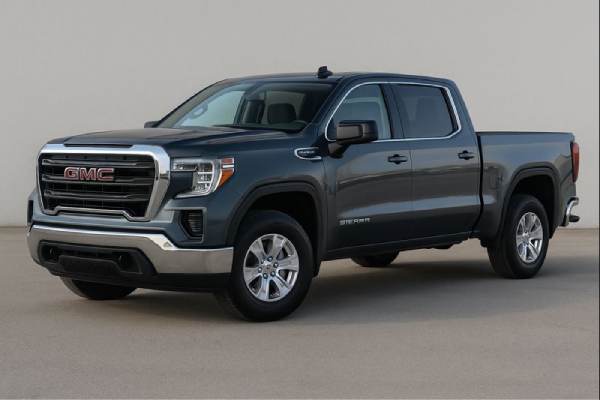
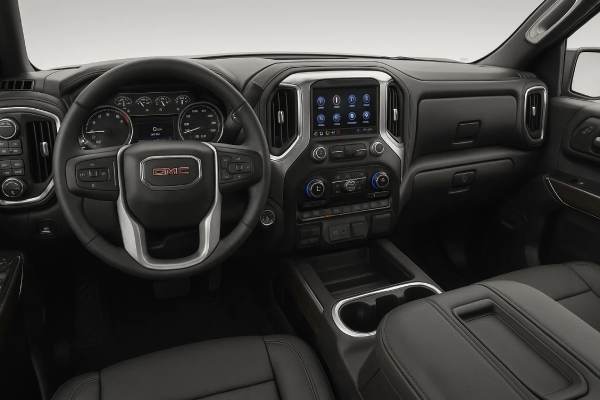
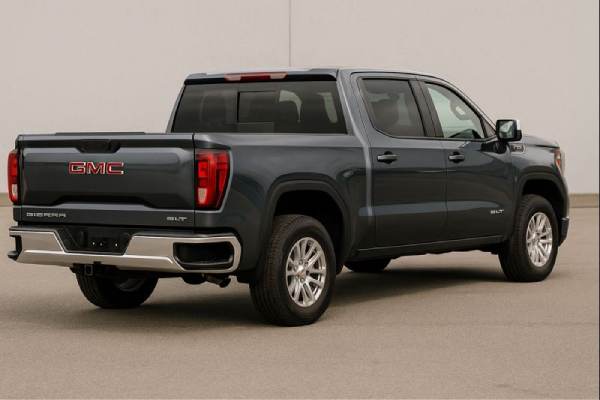
The 2020–2021 GMC Sierra 1500 4WD with the LM2 3.0 litre Duramax turbo-diesel is aimed at drivers who need real off-pavement traction and towing muscle but still care about fuel costs and refinement. This all-aluminium inline-six diesel makes 277 hp and 460 lb-ft of torque, paired with a 10-speed automatic and a part-time 4WD system with a two-speed transfer case on most trims. The result is a truck that feels calm and torquey at low rpm, with confident traction in bad weather and on job sites.
EPA ratings for 4WD diesel Sierras sit around 22 mpg city, 26 mpg highway and 24 mpg combined, only slightly below equivalent 2WD trucks, which makes this one of the most efficient full-size 4×4 pickups of its era. With the right axle ratio and trailering package, maximum tow ratings land near 9,000–9,300 lb for LM2 4WD configurations.
Whether you are choosing between gas and diesel, or between 2WD and 4WD, this guide walks through the engineering details, daily driving character, long-term reliability, safety tech, maintenance strategy and how the Sierra 1500 4WD Duramax compares with rival half-ton diesels.
Top Highlights
- Strong 277 hp / 460 lb-ft LM2 diesel with 10-speed automatic and 4WD delivers relaxed low-rpm torque and surefooted traction.
- EPA-rated around 22 mpg city / 26 mpg highway / 24 mpg combined for 4WD diesels, giving excellent range for a full-size 4×4 truck.
- Properly equipped LM2 4WD Sierras can tow roughly 9,000–9,300 lb, with payload typically in the mid-1,700 to low-2,000 lb range.
- Ownership caveat: modern diesel emissions and 4WD components (DEF system, DPF, front diff, transfer case) add complexity and require correct fluids and usage patterns.
- Typical oil change interval is about 7,500 miles / 12,000 km under normal use, or per the oil life monitor, using Dexos D 0W-20 diesel-rated oil.
Guide contents
- GMC Sierra 1500 4WD essentials
- Sierra 1500 4WD diesel data
- Sierra 4WD trims and safety suite
- 4WD Duramax LM2 reliability
- 4WD maintenance and buying guide
- On-road and off-road manners
- 4WD diesel rival comparison
GMC Sierra 1500 4WD essentials
In 2020, GMC introduced the LM2 3.0L Duramax turbo-diesel inline-six to the T1XX-generation Sierra 1500 as a refined, torque-rich option for buyers who wanted serious capability without the thirst of a big petrol V8. In 4WD form, the truck adds a transfer case and front differential, transforming it from a highway cruiser into a year-round workhorse for snow, dirt roads and light off-roading.
The LM2 diesel itself is shared with the Chevrolet Silverado 1500 and later GM SUVs. It uses an aluminium block and head, dual overhead camshafts with 4 valves per cylinder, and a variable-geometry turbocharger feeding a high-pressure common-rail injection system. Output is 277 hp at around 3,750 rpm and 460 lb-ft from as low as 1,500 rpm, giving a broad, flat torque curve. This engine is paired exclusively with the 10L80 10-speed automatic transmission.
The 4WD system on most 2020–2021 Sierra 1500 diesel models is a part-time setup with a 2-speed transfer case offering 2HI, 4HI, 4LO and an Auto 4WD mode on many trims. In Auto, an electronically controlled clutch engages the front axle as needed when slip is detected, which is especially useful on variable-grip roads (wet, packed snow, gravel). In 4HI and 4LO, the system locks the front and rear outputs together, which is best reserved for off-pavement or low-speed work to avoid driveline wind-up.
Compared with the equivalent RWD Sierra 1500 LM2, the 4WD version brings:
- More traction and confidence on wet, snowy or loose surfaces, and when launching with a trailer on ramps or hills.
- Slightly higher curb weight (typically around 200–300 lb heavier) due to the front differential and transfer case.
- Slightly lower fuel economy (about 24 mpg combined vs roughly 26 mpg for 2WD diesels in EPA testing).
- Minor differences in tow and payload ratings, often reducing maximum trailer capacity by a few hundred pounds versus the best 2WD configuration.
The 4WD LM2 trucks are offered across popular trims, including SLE, Elevation, SLT, AT4 and Denali in many markets. That means you can spec a bare-bones work truck, a mid-grade all-rounder, or a near-luxury off-road-ready Denali or AT4 and still get the same efficient diesel powertrain.
For many owners, the 4WD LM2 strikes a sweet spot: it delivers real full-size truck capability and off-pavement traction while still returning fuel consumption more often associated with smaller pickups and crossovers. If your driving involves winter weather, gravel roads, towing on unpaved surfaces, or accessing job sites, the 4WD diesel variant generally makes more sense than the RWD version.
Sierra 1500 4WD diesel data
This section focuses on the 2020–2021 GMC Sierra 1500 4WD equipped with the LM2 3.0L Duramax and 10-speed automatic, using typical crew-cab short-box values as a reference. Always confirm exact specs for your VIN and region.
Engine and performance – LM2 Duramax I6
| Item | Specification (LM2) |
|---|---|
| Engine code | LM2 Duramax 3.0L turbo-diesel |
| Configuration | Inline-6, aluminium block and head, DOHC, 4 valves/cyl |
| Displacement | 3.0 L (2,992 cc) |
| Bore × stroke | 84.0 × 90.0 mm (3.31 × 3.54 in) |
| Induction | Variable-geometry turbocharger, air-to-air intercooler |
| Fuel system | High-pressure common-rail direct injection |
| Compression ratio | Around 15:1 (market-dependent) |
| Max power | 277 hp ≈ 207 kW @ 3,750 rpm |
| Max torque | 460 lb-ft ≈ 623 Nm @ 1,500 rpm |
| Timing drive | Chain (no scheduled belt change) |
| Emissions hardware | EGR, DPF, SCR with DEF, oxidation catalyst |
Fuel economy and real-world efficiency
EPA fuel economy values for 2020 4WD diesel Sierras are approximately:
| Cycle | Official rating | Approx. L/100 km |
|---|---|---|
| City | 22 mpg US | ≈10.7 L/100 km |
| Highway | 26 mpg US | ≈9.0 L/100 km |
| Combined | 24 mpg US | ≈9.8 L/100 km |
Real-world testing and owner reports often show:
- 21–24 mpg combined in mixed driving.
- 25–30 mpg on steady highway runs at moderate speeds, especially in lighter trims and with low-rolling-resistance tyres.
Transmission and 4WD driveline
| Item | Specification |
|---|---|
| Transmission | Hydra-Matic 10L80 10-speed automatic |
| Drive type | 4WD with two-speed transfer case on most LM2 models (2HI, 4HI, 4LO, Auto) |
| Transfer case | Electronically controlled; single-speed case on some lower trims/markets |
| Typical axle ratio | Around 3.23 for many LM2 configurations; 3.42 or other ratios with certain packages |
| Rear differential | Open or automatic locking (G80) depending on option package |
Chassis, size and capacities (crew-cab 4WD, representative)
| Item | Approximate value |
|---|---|
| Platform | T1XX full-size body-on-frame |
| Front suspension | Independent coil-over front with aluminium lower control arms |
| Rear suspension | Solid axle, leaf springs |
| Steering | Electric power rack-and-pinion |
| Brakes | 4-wheel disc with ABS and stability control |
| Wheelbase (crew, short box) | ≈3,740 mm (147.4 in) |
| Overall length | ≈5,885 mm (231.7 in) |
| Width (without mirrors) | ≈2,030–2,060 mm (80–81 in) |
| Height | ≈1,890–1,930 mm (≈74–76 in; AT4 taller) |
| Ground clearance | Roughly 220–230 mm (8.7–9.1 in) on standard 4WD trims; AT4 adds ~50 mm (2 in) lift |
| Curb weight | Typically 5,000–5,300 lb depending on trim and bed length |
| GVWR | Commonly around 7,000–7,200 lb for LM2 4WD crew cabs |
| Fuel tank | About 24 US gal (≈91 L) on most 1500s |
Performance, payload and towing (LM2 4WD)
Exact numbers depend on cab, bed, axle ratio and trailering package. Use this as a guide, not a substitute for your door-jamb label and trailering chart.
| Metric | Typical figure |
|---|---|
| 0–60 mph | Around 7.5–8.0 seconds for LM2 4WD models |
| Quarter mile | About mid-16s at mid-80s mph for an AT4 Duramax |
| Max towing (LM2 4WD) | Roughly 9,000–9,300 lb when properly equipped |
| Payload | Roughly 1,700–2,000 lb depending on trim and options |
Key fluids and capacities (guide only)
Always confirm in the owner’s manual/service data for your VIN.
| System | Spec and indicative capacity |
|---|---|
| Engine oil | Dexos D 0W-20 diesel oil; ≈6.6 L (7.0 qt) with filter |
| Engine coolant | Dex-Cool OAT; total capacity varies by cab/engine cooling package |
| Automatic transmission | Dexron ULV; service refill considerably less than full dry capacity |
| Transfer case | GM-specified transfer-case fluid; capacity around 1–2 L |
| Front and rear axle | Synthetic gear oil to GM spec; capacities vary by axle code |
| DEF tank | Around 19–22 L; typical consumption 1–3% of fuel use |
Sierra 4WD trims and safety suite
The LM2 diesel is available across several 4WD trims, which is good news if you want both serious traction and a specific interior or styling package. Exact availability can vary by market and year, but for 2020–2021 in North America, you will commonly see LM2 4WD paired with SLE, Elevation, SLT, AT4 and Denali.
Trims and mechanical differences
- SLE 4WD LM2: A practical starting point, often with cloth interior, basic infotainment and available trailering packages. You typically get a two-speed transfer case and can option tow mirrors, integrated trailer brake controller and upgraded cooling.
- Elevation 4WD LM2: Adds blacked-out exterior trim, body-colour bumpers, dark wheels and sportier styling. Mechanically similar to SLE, but often specified with larger wheels/tyres that can slightly affect ride and fuel economy.
- SLT 4WD LM2: Moves into leather, power seats, more sound insulation, the MultiPro tailgate and more driver-assistance options. For many private owners who tow, a 4WD SLT LM2 with the appropriate trailering package is the “just right” configuration.
- AT4 4WD LM2: Off-road-oriented, with a 2-inch factory suspension lift, off-road-tuned shocks, skid plates and all-terrain tyres. The raised ride height improves approach/departure angles, but tow ratings are usually a bit lower than the most tow-focused SLT/Denali setups.
- Denali 4WD LM2: The luxury flagship, often with adaptive ride control (depending on model year), premium Bose audio, head-up display and enhanced camera systems. Denali trucks can carry substantial equipment weight, which slightly eats into payload, so check the door-jamb label if you plan to load heavily.
Quick ways to identify an LM2 4WD truck include the “Duramax” and “3.0L” badging on the hood/fenders, a diesel fuel filler neck, DEF filler under the fuel flap on many models, and VIN decoding through an official build sheet or dealer.
Safety ratings
Crash-test performance is shared across engines. The 2020 Sierra 1500 crew cab (the configuration many LM2 4WD trucks use) typically earns:
- Good ratings in moderate overlap front, original side, roof strength and head restraints.
- A weaker result in the passenger-side small overlap crash test (often Marginal).
- Overall NHTSA ratings around 4 stars, with strong side-impact performance and rollover ratings in line with other full-size pickups.
Headlight performance varies by trim and lighting package; some LED reflector setups score only Marginal or Poor in independent testing due to limited curve illumination and glare, so if you do a lot of night driving, consider this in your trim/option choice.
Safety systems and ADAS
Standard safety features include:
- Front, side and curtain airbags.
- Electronic stability control and traction control.
- Trailer sway control and hill-start assist.
- Rear-view camera and tyre-pressure monitoring.
Optional or package-based systems (often under Driver Alert or similar names) include:
- Forward collision alert and automatic emergency braking.
- Lane keep assist with lane departure warning.
- Blind-spot monitoring and rear cross-traffic alert.
- Front and rear park assist, surround-view camera systems.
- Rear camera mirror and head-up display on higher trims such as Denali.
When 4WD components or suspension are modified (lift kits, different tyre sizes), sensor aiming and calibration can be affected. Any collision repair, windshield replacement, bumper work or suspension height change should be followed by an ADAS calibration according to GM procedures so that braking and lane support systems continue to function correctly.
Child-seat installation in crew-cab 4WD Sierras is generally straightforward but can be made fiddly by tightly recessed ISOFIX/LATCH anchors and overlapping seatbelt hardware. Plan a test-fit if you regularly switch child seats between vehicles.
4WD Duramax LM2 reliability
Overall, the LM2 diesel in 4WD Sierra 1500s has shown a respectable reliability record so far, especially compared with some earlier light-duty diesels. Most reported issues relate to emissions hardware, sensors and 10-speed transmission behaviour rather than fundamental engine design flaws.
General reliability picture
Owner surveys and early long-term experiences suggest the Sierra 1500 LM2 is solidly “average to above average” in reliability for its class when maintained correctly and used regularly on the highway. As with any modern diesel, proper oil, correct fuel and appropriate duty cycles (not all short trips) are important.
The 4WD system itself—transfer case, front differential, CV axles—is conventional and well understood. Problems here are more likely to come from neglect (never changing fluids, running mismatched tyre sizes, or frequently using part-time 4HI on dry pavement) than from design defects.
Common and occasional issues
More common (low to medium cost):
- DEF and emissions sensors: Faulty DEF level sensors, NOx sensors or heaters can trigger “Service Emissions System” messages and limp-mode behaviour. The usual remedy is sensor replacement and a code clear; some campaigns or extended warranties may apply depending on market.
- EGR/DPF complaints: Trucks used mostly for short, cold trips may see frequent DPF regenerations, fuel dilution of engine oil, or EGR valve sticking. Regular highway runs and obeying regeneration prompts help keep soot loads under control.
- 10L80 shift refinement: A subset of owners report harsh shifts, shudder or flare, especially at light throttle. Updated transmission control software and, where appropriate, fluid services often improve behaviour.
Occasional (medium to high cost, monitor closely):
- Coolant or oil leaks: As with most modern engines, small leaks at hoses, seals or coolers can appear with age. Any recurring coolant top-off or oil misting should be investigated promptly to avoid overheating or contamination.
- Glow plug or control module faults: Faulty glow plugs can cause hard cold starts and stored codes. Correct removal procedures are important to avoid breaking plugs in the head.
4WD-specific points:
- Transfer case fluid neglect: If 4WD is used regularly (especially for towing off-road), old fluid can lead to noise or engagement issues over time. Following severe-service intervals is important.
- Front differential wear: Heavy loads, oversized tyres and extended 4HI highway use can stress the front diff. Listen for whining or grinding, especially on overrun.
Recalls, TSBs and software actions
Recall and TSB coverage is VIN-specific, but typical items that may touch LM2 4WD trucks include:
- Powertrain control module updates for drivability, emissions robustness and fault-detection logic.
- Transmission control updates for shift quality and torque-converter management.
- Campaigns addressing specific emissions components or wiring harnesses.
Always run the VIN through your national safety agency and GMC’s official recall lookup before purchase and periodically during ownership to ensure there are no outstanding safety or emissions actions.
Pre-purchase reliability checks
When evaluating a used 4WD LM2 Sierra 1500:
- Scan all modules (engine, transmission, 4WD, ABS, airbags, ADAS) for stored or pending codes.
- Inspect underbody for rust on frame rails, crossmembers and suspension mounts, especially in salt-treated regions.
- Check for fluid leaks around the engine front cover, oil pan, transmission pan, transfer case and differentials.
- Verify 4WD operation: switch through 2HI, Auto, 4HI and 4LO (if fitted) on a suitable surface and listen for abnormal noises or delayed engagement.
- Review maintenance records, focusing on oil type, fuel filter changes, differential/transfer case fluid services and any emissions-system repairs.
If a truck has repeated emissions problems, abnormal 4WD noises, evidence of tuning/deletes, or a patchy maintenance record, be cautious: repair costs can quickly erase any fuel-economy savings.
4WD maintenance and buying guide
A clear maintenance plan and a careful purchase inspection are the two biggest levers you have for long, trouble-free ownership of a 4WD Sierra 1500 LM2. Below is a practical schedule framework; always cross-check against your own manual.
Practical maintenance roadmap (approximate)
Engine and fuel system
- Oil and filter: Follow the oil life monitor; many owners see 7,500-mile / 12,000-km changes with mixed driving, shorter for heavy towing or lots of idling. Dexos D 0W-20 diesel oil is mandatory for the LM2.
- Fuel filter: Typically around every 22,500 miles / 36,000 km in severe service or as directed; sooner if you suspect contaminated fuel.
- Engine air filter: Inspect every 15,000 miles / 24,000 km; replace at 45,000 miles / 72,000 km or when dirty.
- Cabin air filter: Around every 22,500–30,000 miles (36,000–48,000 km), more often in dusty areas.
Cooling, driveline and brakes
- Coolant: Dex-Cool long-life coolant; initial change around 150,000 miles / 10 years is typical, then at shorter intervals.
- Automatic transmission fluid: For frequent towing or off-road use, a 45,000–60,000-mile (72,000–96,000-km) service interval is a sensible precaution even if not strictly required.
- Transfer case fluid: Treat this as severe service if you use 4WD often—around 45,000 miles is a good target, or per the manual.
- Front and rear differential fluid: 45,000–60,000 miles under towing/off-road use; otherwise longer intervals.
- Brake fluid: Replace every 5 years regardless of mileage.
- Tyre rotation and alignment: Rotate every 5,000–7,500 miles (8,000–12,000 km); check alignment annually and after any significant impact or off-road use.
Chassis and electrical
- Suspension and steering: Inspect ball joints, control-arm bushings, tie-rod ends and shocks at each major service; listen for clunks or wander.
- Battery: Test annually after year 4; many factory batteries last 4–6 years.
- 4WD system checks: Periodically engage 4HI and 4LO to circulate fluid and keep actuation mechanisms moving.
Buyer’s guide: what to inspect
Body and frame
- Look for corrosion on the frame, around rear spring mounts, bed crossmembers and bumper brackets.
- Check for uneven panel gaps or overspray that might indicate accident repairs.
Powertrain
- On a test drive, pay attention to cold starts (should be quick and smooth), turbo whistle (light is normal, loud or siren-like is not), and any hesitation under load.
- Under steady throttle, the 10-speed should shift smoothly without repeated hunting.
- In 4HI/Auto, listen for binding, clunks or vibration that might point to transfer-case or front-axle issues.
Electronics and safety tech
- Test all cameras, parking sensors, lane-keeping and collision-warning systems.
- Make sure the trailer brake controller (if fitted) powers up and adjusts correctly.
Which 4WD LM2 trucks make the most sense?
- Best all-rounder: SLT 4WD with LM2, tow package and key driver-assist features. It balances comfort, capability and price.
- Off-road-biased: AT4 4WD LM2 for owners who regularly drive off-pavement but still spend long hours on the highway.
- Luxury and tech-focused: Denali 4WD LM2 if you value the premium interior, HUD and extensive camera coverage.
Be cautious with heavily modified trucks (big lifts, oversized tyres, tuning, emissions deletes). These often compromise reliability, change driveline angles and may create legal/emissions issues depending on your region.
On-road and off-road manners
In 4WD form, the Sierra 1500 LM2 feels composed and confidence-inspiring on the road while adding a useful extra layer of security when the weather turns bad or the pavement ends.
Powertrain character
The inline-six diesel layout is inherently smooth, and GM’s noise insulation makes the LM2 one of the quieter light-duty diesels at idle and cruise. Under gentle driving, the engine operates mostly between 1,500 and 2,500 rpm, where the 460 lb-ft of torque makes the truck feel relaxed rather than busy.
Turbo lag is modest; there is a short pause from a standstill if you floor it, but for normal rolling starts and mid-throttle acceleration, the response is linear. The 10-speed automatic does a good job keeping the engine in its sweet spot. Kickdowns are decisive, and the spread of ratios is wide enough that the transmission can pick exactly the right gear for modest grades or overtakes without flaring.
Ride, handling and NVH
Compared with some rivals that use rear coil springs, the Sierra’s leaf-spring rear axle feels more traditional. Unladen, sharp bumps and expansion joints are noticeable, but body control is tidy and the truck is stable at speed. The extra weight and height of the 4WD hardware slightly raise the centre of gravity, but straight-line stability remains excellent and the steering feels consistent, if not particularly talkative.
Cabin noise at highway speeds is low. With standard all-season tyres, the biggest noise sources are wind around the mirrors and some road texture; the diesel is a subdued background hum. AT4 and other off-road-tyre-equipped trims add more tread noise but remain comfortable for long journeys.
Real-world efficiency and range
In mixed 4WD use, owners commonly report around 21–24 mpg combined, in line with or above the EPA combined rating of 24 mpg. Highway-only figures in the high-20s mpg are achievable with gentle driving, giving potential tank ranges around 600 miles (≈965 km) on the 24-gallon fuel tank.
Using 4HI on snow or loose dirt has only a modest impact on consumption at moderate speeds, though extended 4HI highway use on dry pavement (not recommended) can increase wear and reduce efficiency.
Towing a 5,000–7,000 lb trailer typically drops fuel economy into the mid-teens mpg, similar to other half-ton diesels but significantly better than equivalent gas V8s under the same load.
Off-road capability and traction
With 4HI, 4LO and an available locking rear differential, the LM2 4WD Sierra has enough hardware for most owners’ off-road needs: rutted tracks, work sites, snow-covered roads and mild trails. The AT4 variant strengthens the package with additional ground clearance, underbody protection and more aggressive tyres, at the cost of slightly higher fuel consumption and reduced tow ratings.
The Auto 4WD mode is particularly helpful for mixed-condition driving (e.g., patchy snow or wet backroads), where it can proactively send torque to the front axle when slip is detected, without locking the driveline full-time.
Braking performance is secure; instrumentation tests of similar 3.0L 4WD trucks show 60–0 mph stops in the low-130-foot range, comparable with other full-size pickups. Stability-control tuning is conservative but appropriate for a long-wheelbase, high-centre-of-gravity vehicle.
Overall, the 4WD LM2 Sierra prioritises calm, torque-rich progress and long-distance comfort rather than outright speed. For most owners, that balance makes daily commuting, winter driving and towing stress-free.
4WD diesel rival comparison
When you compare the 2020–2021 GMC Sierra 1500 4WD Duramax with its main competitors, a few patterns emerge around refinement, efficiency and available trims.
Versus Ford F-150 3.0 Power Stroke 4×4
Ford’s 3.0L Power Stroke V6 diesel offered similar output and competitive tow ratings but was produced for a shorter period and in fewer trims. In 4×4 form, fuel economy is close, though the LM2 inline-six often edges ahead in noise and vibration control. Independent tests of the GM 3.0L diesel in a related Silverado show combined results that meet or exceed already strong EPA ratings, which supports its efficiency reputation.
If you prioritise a very broad truck lineup and a long history of half-ton diesels, Ford is compelling. If you want an inline-six diesel with a reputation for smoothness and are comfortable with GM’s cabin and controls, the Sierra LM2 is attractive.
Versus Ram 1500 EcoDiesel 4×4
Ram’s 3.0L EcoDiesel V6 is known for strong torque and excellent fuel economy, and the Ram 1500’s coil-spring or air-suspension rear axle delivers a particularly plush ride. In 4×4 guise, the Ram may feel slightly more car-like.
The Sierra counters with:
- Simpler rear-suspension hardware, which some owners prefer for long-term durability and heavy loads.
- A very efficient inline-six diesel with excellent highway economy.
- Widely available 4WD diesel trims, from mid-spec SLE/Elevation to AT4 and Denali.
Your choice here often comes down to subjective preferences in ride quality, interior design and brand loyalty.
Versus gas 4WD Sierra 1500 engines
Within the Sierra lineup, the main alternatives to the 3.0L LM2 diesel in 4WD form are:
- 5.3L EcoTec3 V8 (various outputs and transmissions).
- 6.2L EcoTec3 V8 (performance-oriented).
- 2.7L turbo four-cylinder in certain trims.
Compared with these gasoline engines, the LM2 4WD:
- Uses significantly less fuel in mixed and towing conditions (around 24 mpg combined vs mid-teens to high-teens for gas V8 4WD trucks).
- Delivers stronger low-rpm torque feel for similar tow loads, though top-end acceleration may be softer than the 6.2L V8.
- Involves higher fuel and fluid costs per litre in some regions and adds the need for DEF and emissions hardware care.
If you rack up many highway miles, tow moderate loads regularly, or value long range between fill-ups, the 4WD diesel will likely repay its higher purchase and maintenance cost. If your driving is mostly short city trips or occasional light towing, a 5.3L or 2.7L gas 4WD may be simpler and more cost-effective.
Who should choose the 4WD LM2 Sierra?
The 2020–2021 GMC Sierra 1500 4WD LM2 makes the most sense if you:
- Drive year-round in mixed weather or on unpaved roads where 4WD traction matters.
- Tow or haul moderate loads on a frequent basis rather than only once or twice a year.
- Cover enough annual mileage that diesel efficiency and range are meaningful.
- Are comfortable following a diesel-specific maintenance schedule and keeping up with DEF and emissions-system care.
For buyers in that use case, the Sierra 1500 4WD Duramax offers an appealing combination of capability, comfort and long-legged efficiency that few rivals match.
References
<a href="https://www.gmc.com/support/vehicle/manuals-guides">Manuals and Guides | Vehicle Support</a> 2020 (Owner’s Manual Portal)<a href="https://www.fueleconomy.gov/feg/bymodel/2020_GMC_Sierra.shtml">Gas Mileage of 2020 GMC Sierra</a> 2020 (Fuel Economy Data)<a href="https://www.iihs.org/ratings/vehicle/gmc/sierra-1500-crew-cab-pickup/2020">2020 GMC Sierra 1500 crew cab pickup</a> 2020 (Safety Rating)<a href="https://www.gmc.com/content/dam/gmc/na/us/english/index/about/trailering-towing/02-pdfs/GMTB20CT300_2020_GMC_Trailering%20Guide.pdf">2020 GMC Sierra /Denali 1500 TRAILERING SPECS Canada</a> 2020 (Trailering Guide)<a href="https://contentdelivery.ext.gm.com/bypass/gma-content-api/resources/sites/GMA/content/staging/MANUALS/5000/MA5190/en_US/3.0/2020-gmc-sierra-quick-reference-guide.pdf">2020 SIERRA & SIERRA DENALI 1500/2500HD/3500HD – Getting to Know Your 2020 GMC Sierra</a> 2020 (Quick Reference Guide)
Disclaimer
This article is for informational purposes only and is not a substitute for professional diagnosis, repair procedures or safety advice. Specifications, torque values, fluid types, capacities, trailering limits and maintenance intervals can vary by VIN, model year, market, trim level and installed equipment. Always confirm details using the official owner’s manual, factory service information and current technical bulletins for your specific vehicle, and consult a qualified technician before performing any work or modifications.
If you found this guide helpful, please consider sharing it with other owners or shoppers on platforms such as Facebook or X/Twitter. Your support helps us continue producing detailed, independent technical content for enthusiasts and professionals.