
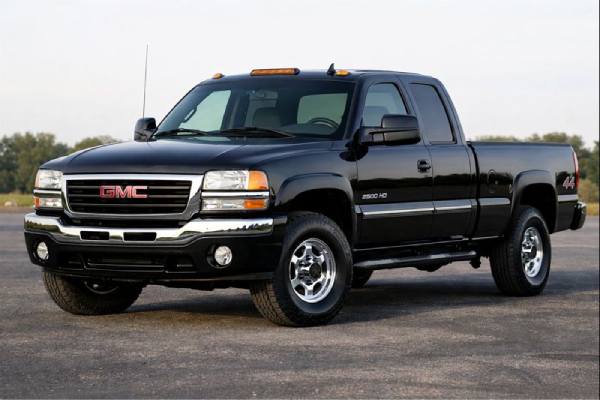
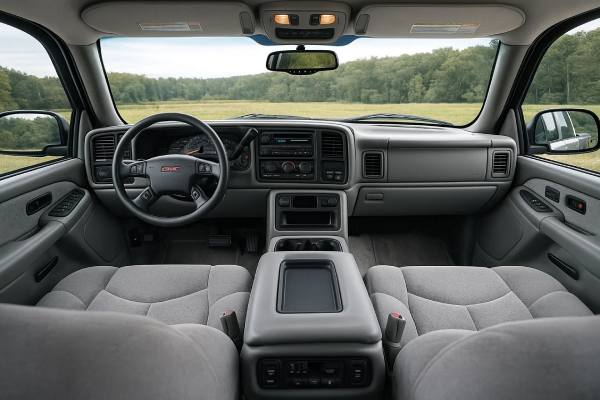
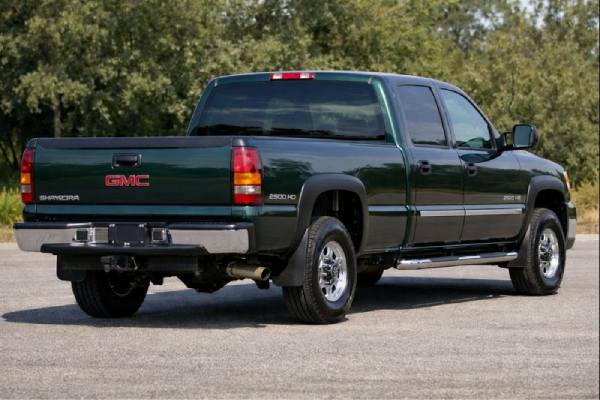
The 2001–2002 GMC Sierra HD RWD with the LB7 6.6L Duramax is one of the most influential heavy-duty pickups of its era. It paired a modern common-rail turbodiesel with a work-focused GMT800 chassis, giving owners strong low-rpm torque, confident towing manners, and a drivetrain that can rack up high mileage when maintained correctly. These early trucks also keep the driving experience simple: no complex modern driver aids, fewer emissions components than later diesels, and a cabin that prioritizes durability over polish.
That simplicity does not mean “set and forget.” The LB7’s reputation depends on fuel system health, clean filtration, and correct fluids—especially if the truck sees frequent towing or short-trip use. If you know what to inspect and you keep up with service intervals, the Sierra HD RWD can be a dependable long-term hauler with a very predictable ownership pattern.
Owner Snapshot
- Strong towing pull from low rpm, especially with the Allison automatic.
- Simple diesel era: fewer emissions add-ons than later Duramax generations.
- Heavy-duty chassis tolerates sustained load well when suspension and steering wear items are kept fresh.
- Budget for fuel-system attention on older LB7s (injectors and filtration are the big watch points).
- Change engine oil about every 8,000 km (5,000 mi) under severe use or frequent towing.
Quick navigation
- LB7 Sierra HD RWD fundamentals
- 2001–2002 LB7 specs tables
- Sierra HD trims, options, and safety
- Duramax LB7 problems and service actions
- Maintenance plan and buyer’s checklist
- Real-world driving and towing
- How the LB7 Sierra HD stacks up
LB7 Sierra HD RWD fundamentals
In 2001–2002 form, the Sierra HD RWD is best understood as a system: a stout ladder frame, heavy-duty axles and brakes, and a torque-first diesel meant to work. The LB7 Duramax (6.6L) was GM’s early leap into high-pressure common-rail direct injection, and it changed how these trucks deliver power. Instead of needing high rpm, the engine produces its best work in the low-to-mid range—exactly where towing and hauling live. In practice, that means the truck feels calm when pulling weight and less “busy” than many gas HDs of the same period.
The chassis is equally important to the ownership story. GMT800 HD trucks typically use a front torsion-bar suspension and a rear leaf-spring setup. It is not designed for sports-car response, but it is designed to stay stable under load. When everything is fresh, the truck tracks straight on the highway, and the rear-wheel-drive layout keeps the driveline simpler than 4×4 models (no transfer case, fewer u-joints and seals to service). That simplicity can lower long-term costs, especially for owners who tow on-road and do not need traction aids for mud or deep snow.
Where the “fundamentals” matter most is heat and filtration. Diesels do long, hot work—and that is where a healthy cooling system, clean air filtration, and disciplined fuel-filter changes pay off. Many LB7 trucks live easy lives, but the ones that get neglected often show the same pattern: fuel system complaints, smoky running, or diluted engine oil from injector issues. None of that is inevitable; it is usually the result of deferred service and poor fuel hygiene.
If you want a simple mental model: this Sierra HD RWD rewards owners who treat it like equipment. Keep fluids correct, fix small leaks early, and do not ignore subtle drivability changes. Do that, and the truck’s core design—low-stress torque delivery, heavy-duty running gear, and straightforward driveline—stays on your side for a long time.
2001–2002 LB7 specs tables
The exact numbers vary by cab style (regular/extended/crew), bed length, axle ratio, and transmission choice. The tables below focus on the 2001–2002 Sierra HD RWD Duramax LB7 and use ranges where configuration changes the result.
Engine and performance
| Item | Specification |
|---|---|
| Code | LB7 (Duramax) |
| Engine layout and cylinders | 90° V8, turbocharged, common-rail direct injection, 4 valves/cyl (32 valves) |
| Displacement | 6.6 L (6,599 cc) |
| Bore × stroke | ~103.0 × 99.0 mm (~4.06 × 3.90 in) |
| Induction | Turbocharged, air-to-air intercooler |
| Fuel system | High-pressure common-rail direct injection |
| Compression ratio | ~17.5:1 |
| Max power | 300 hp (224 kW) @ ~3,100 rpm |
| Max torque | ~705 Nm (520 lb-ft) @ ~1,800 rpm |
| Timing drive | Chain-driven cam-in-block valvetrain (diesel V8 architecture) |
| Rated efficiency | No official EPA label for many HD diesels; owners typically report wide variation by load and gearing |
Transmission and driveline (RWD)
| Item | Specification |
|---|---|
| Drive type | RWD |
| Automatic option | Allison 1000 (5-speed automatic, early years) |
| Manual option | ZF 6-speed manual (varies by trim and configuration) |
| Typical axle ratios (varies) | Commonly 3.73 or 4.10; verify on RPO/VIN label |
| Differential | Typically open; limited-slip/locker availability depends on axle and package |
Typical Allison 1000 (5-speed) ratios (early) (may vary slightly by calibration)
| Gear | Ratio |
|---|---|
| 1st | ~3.09 |
| 2nd | ~1.81 |
| 3rd | ~1.41 |
| 4th | 1.00 |
| 5th | ~0.71 |
| Reverse | ~5.35 |
Chassis and dimensions (configuration-dependent)
| Item | Typical value / range |
|---|---|
| Suspension (front/rear) | Independent torsion bar front / leaf spring rear |
| Steering | Power steering (recirculating ball); ratio varies |
| Brakes | 4-wheel disc on most HD trims; dimensions vary by GVWR |
| Wheelbase | ~3,378–3,886 mm (~133–153 in) |
| Length | ~5,650–6,250 mm (~222–246 in) |
| Width | ~2,000 mm (~79 in) excluding mirrors |
| Height | ~1,930–2,000 mm (~76–79 in) |
| Turning circle | ~13–15 m (~43–49 ft), depending on wheelbase |
| Curb weight | ~2,700–3,300 kg (~5,950–7,275 lb) depending on body and equipment |
| GVWR | Commonly ~3,900–4,500+ kg (~8,600–9,900+ lb), by model and axle |
Capability (typical ranges)
| Item | Typical value / range |
|---|---|
| Towing capacity | Often ~4,500–5,700 kg (~10,000–12,500 lb) depending on axle ratio and hitch setup |
| Payload | Often ~1,200–1,800+ kg (~2,650–3,970+ lb) depending on cab/bed and GVWR |
| Fuel tank | Commonly ~98–129 L (~26–34 US gal), by cab/bed |
Fluids and service capacities (verify by VIN and equipment)
| System | Specification (typical) |
|---|---|
| Engine oil | Diesel-rated oil meeting the required GM spec; common viscosity 5W-40 or 15W-40 by climate; capacity often ~9.5 L (~10 qt) with filter |
| Coolant | Extended-life coolant; capacity varies (often ~18–20 L / ~19–21 qt) |
| Transmission fluid | Allison-approved ATF (spec depends on service guidance); capacity varies widely by service method |
| Rear differential | Gear oil per axle spec; capacity varies by axle |
| A/C refrigerant | Type and charge vary by HVAC configuration |
Electrical
| Item | Typical value / range |
|---|---|
| Alternator output | Often 105–145 A; higher-output options exist |
| 12V batteries | Dual-battery setups common on diesels; size and CCA vary by package |
Safety and driver assistance (era-typical)
| Item | 2001–2002 typical equipment |
|---|---|
| Airbags | Front airbags standard; side airbags uncommon on HD pickups of this era |
| ABS | Standard on most trims |
| Stability control | Generally not present on early-2000s HD pickups |
| ADAS (AEB/ACC/LKA) | Not available in this generation |
Sierra HD trims, options, and safety
For 2001–2002, Sierra HD buyers typically encountered trim structures built around work needs rather than lifestyle branding. You will see trims such as SLE and SLT, with differences centered on comfort, interior materials, and convenience electronics—not on the core diesel capability. In most cases, the LB7 engine output stays the same, while towing confidence can change with axle ratio, cooling equipment, hitch class, and suspension package.
Trims and options that matter mechanically
The most meaningful “options” on these trucks are often hidden in build codes and hardware:
- Axle ratio (often 3.73 vs 4.10): A lower (numerically higher) ratio generally improves launch feel and grade performance with heavy trailers, while a taller ratio can reduce engine speed at cruise.
- Automatic vs manual: The Allison automatic is a major reason many owners love this generation. It tends to keep the engine in the meat of the torque curve and reduces driver workload when towing in traffic or on grades.
- Tow package content: Look beyond a receiver hitch. The best setups include the correct wiring provisions, cooling capacity, and (where equipped) trailer-brake wiring readiness.
- Seating and cab style: Crew cabs add comfort and passenger space but also add weight, which can reduce payload. Regular cabs often maximize payload for a given GVWR.
Quick identifiers to check in person (practical, not perfect):
- RPO code label (usually in the glovebox): confirms axle ratio, differential type, and major equipment packages.
- Hitch and wiring: factory-integrated wiring and clean routing is a positive sign; hacked wiring can be a reliability headache.
- Transmission behavior: a healthy Allison should shift firmly but not harshly, with predictable converter lockup at cruise.
Safety ratings and what they do (and do not) tell you
Heavy-duty pickups from this era were not tested as comprehensively as modern vehicles, and not every body style has like-for-like results. When crash data exists, it often relates to the light-duty Sierra 1500 structure of the same generation, which shares design DNA but is not identical in weight class or equipment.
What you can evaluate meaningfully today is real-world safety condition:
- Braking system health: HD trucks must stop heavy mass. A soft pedal, pulsing, or uneven braking under load deserves immediate attention.
- Tire condition and load rating: Tires are a safety system on towing rigs. Confirm proper load range for the truck’s real work.
- Lighting and mirrors: Proper headlight aim and towing mirrors matter for fatigue and reaction time.
Driver assistance and braking systems
Do not expect modern ADAS. There is no factory automatic emergency braking, adaptive cruise, or lane-keeping in this generation. The practical safety upgrades owners typically consider are:
- Fresh, correct-spec brake components and brake fluid service.
- High-quality tires matched to load and climate.
- Trailer brake controller (if towing) installed cleanly and set up correctly.
- Restored steering and suspension joints to reduce wander and improve emergency control.
For these trucks, “safety” is less about software and more about mechanical condition and towing setup discipline.
Duramax LB7 problems and service actions
A well-kept LB7 can be a long-distance workhorse, but it has a few known patterns. The key is to separate common nuisances from expensive failures, and to understand when mileage and operating conditions raise the odds.
Common (higher prevalence)
- Fuel injector wear or failure (medium to high cost):
Symptoms: haze or smoke at idle, rough running when warm, hard starting, rising oil level (fuel dilution), poor fuel economy, or persistent balance-rate concerns on a scan tool.
Likely root cause: internal injector leakage or degraded sealing surfaces over time; short trips and poor filtration can accelerate wear.
Recommended remedy: confirm with proper diagnostics (balance rates, return-rate testing where applicable), replace affected injectors, and address any contributing issues (fuel filter schedule, air leaks at the filter head, contaminated fuel). - Fuel filter head air intrusion (low to medium cost):
Symptoms: loss of prime after sitting, extended cranking, occasional stumble under load.
Root cause: small air leaks or seal degradation in the fuel filter head assembly.
Remedy: reseal or rebuild the filter head, ensure correct hose routing, and verify primer function. - Front-end wear in HD suspension/steering (medium cost, very common with age):
Symptoms: wander, steering play, uneven tire wear, clunks over bumps.
Root cause: wear in idler arm, pitman arm, tie rods, ball joints, and sometimes wheel bearings.
Remedy: replace worn parts as a system, then align. Piecemeal repairs often leave the truck still feeling loose.
Occasional (depends heavily on use)
- Transmission shift concerns or converter shudder (medium to high cost):
Symptoms: flare, harsh engagement, shudder at light throttle lockup, overheating when towing.
Root cause: fluid condition, calibration mismatch after repairs, or wear in high-mileage units.
Remedy: confirm fluid level and spec, check for stored codes, verify cooler condition, and service per Allison guidance. - Cooling system neglect and overheating (medium to high cost):
Symptoms: elevated temps under tow, coolant loss, heater performance changes.
Root cause: degraded coolant, restricted radiator/intercooler stack, failing fan clutch, old hoses.
Remedy: restore cooling capacity before towing season—clean the stack, pressure-test, and replace weak components.
Rare (but important to recognize)
- Severe engine damage from unchecked fuel dilution (high cost):
Symptoms: oil level rising between changes, thin-smelling oil, low oil pressure, bearing noise.
Root cause: prolonged operation with significant fuel in the oil.
Remedy: do not “wait and see.” Diagnose injector health immediately and change oil after repairs.
Recalls, TSBs, and service actions: how to approach them
Because these trucks are now older, the most reliable method is to verify by VIN:
- Check open recalls using an official VIN tool.
- Ask a dealer for a completion history if possible.
- During a pre-purchase inspection, look for evidence of corrected recall items (updated parts, documented repair orders).
Also keep expectations realistic: software updates exist for drivability and fault handling, but there is no modern ADAS calibration ecosystem here. The “software” you care about is primarily engine and transmission control behavior—especially if the truck has had drivetrain work or aftermarket tuning (which can complicate diagnostics and warranty coverage on any remaining service actions).
Maintenance plan and buyer’s checklist
A strong maintenance plan for an LB7 Sierra HD RWD focuses on oil health, fuel filtration, cooling capacity, and driveline fluids. Intervals should be adjusted for towing, idling, dusty work sites, and short-trip use.
Practical maintenance schedule (distance or time)
| Item | Normal use | Severe use (towing, short trips, dusty) |
|---|---|---|
| Engine oil and filter | ~12,000 km (7,500 mi) or 12 months (use oil life monitor if equipped) | ~8,000 km (5,000 mi) or 6 months |
| Fuel filter | ~20,000 km (12,500 mi) or 12 months | ~10,000–15,000 km (6,000–9,000 mi) |
| Engine air filter | Inspect every 10,000–15,000 km | Inspect more often; replace as needed |
| Cabin air filter (if equipped) | 12 months | 6–12 months |
| Coolant | Follow coolant type guidance; commonly 5 years | 3–5 years (more conservative) |
| Transmission fluid | Interval depends on towing and fluid spec | Service more often if towing hot/heavy |
| Rear differential oil | 50,000–80,000 km (30,000–50,000 mi) | 30,000–50,000 km (20,000–30,000 mi) |
| Brake fluid | Every 2 years | Every 2 years (do not skip) |
| Serpentine belt and hoses | Inspect annually | Inspect every service; replace at first cracking/swelling |
| Batteries and charging | Test annually | Test before winter and towing season |
Fluid choices: Use diesel-rated oils appropriate to climate and duty cycle. For towing in heat, many owners prefer a robust 5W-40 or 15W-40 with the correct approvals. For transmission and axle fluids, follow the exact axle and transmission requirements; these can vary by build and service history.
Essential “decision” torque values (common HD references)
| Fastener | Typical torque |
|---|---|
| Wheel lug nuts (8-lug HD) | ~190 Nm (~140 lb-ft) (verify wheel type) |
| Battery terminals | Snug plus proper clamp seating (avoid over-torque) |
(For engine, driveline, and suspension fasteners, use the correct service manual for your VIN—critical specs vary by axle and component revision.)
Buyer’s inspection checklist (LB7-specific and HD-specific)
Fuel system and engine
- Check for hard starting after sitting and watch for extended cranking.
- Look for oil level that seems too high or oil that smells strongly of fuel.
- At warm idle, watch for persistent haze and listen for uneven combustion.
- Inspect fuel filter area for wetness, cracked hoses, or evidence of repeated priming problems.
Cooling and towing readiness
- Look between the grille and radiator: a clogged stack (radiator/intercooler) is common on work trucks.
- Verify fan clutch engagement and that the coolant level is stable after a thorough warm-up.
- If you tow, confirm hitch rating, wiring condition, and brake controller quality.
Chassis and driveline
- Test for steering play and front-end clunks; plan on front-end refresh costs if it wanders.
- Check rear driveline joints (and carrier bearing on long wheelbases) for vibration under load.
- Inspect frame and brake line areas for corrosion if the truck lived in salted climates.
Durability outlook (realistic)
A cared-for LB7 Sierra HD RWD can be a long-term truck, but it is rarely “maintenance free.” Expect periodic front-end work, stay strict on fuel filter changes, and treat any injector-related symptoms as time-sensitive. Owners who do those three things usually experience a stable, predictable ownership curve instead of surprise repairs.
Real-world driving and towing
The defining trait of the LB7 Sierra HD is how relaxed it feels when asked to do real work. Around town, the truck is clearly heavy—steering response is slower than modern half-tons, and the turning circle reminds you that wheelbase matters. But once rolling, the diesel torque changes the whole character. Light throttle produces steady forward pull without needing high rpm, and that makes towing feel controlled rather than frantic.
Ride, handling, and NVH (noise, vibration, harshness)
- Ride: Unloaded, the rear leaf springs can feel firm and sometimes choppy over sharp bumps—typical HD behavior. With weight in the bed or a trailer on the hitch, the ride usually settles and feels more composed.
- Straight-line stability: When the steering and front-end joints are in good shape, the truck tracks well at highway speeds. If it wanders, it is often a wear issue, not “just how they are.”
- Cabin noise: Expect more diesel clatter at idle than later generations, plus wind noise consistent with early-2000s truck aerodynamics. At steady cruise, the engine typically fades into the background unless the exhaust or intake is modified.
Powertrain character
- Throttle response: Strong initial pull, especially once the turbo is making boost. It is not “snappy” like a modern gas turbo, but it is confident and predictable.
- Allison automatic behavior: The best setups feel like the transmission is always one step ahead when towing—holding gears on grades and using engine torque effectively. Harshness or hunting often points to fluid, calibration, sensor, or wear concerns.
- Manual behavior (when equipped): Capable and durable, but more demanding in traffic and less forgiving on steep launches with heavy trailers.
Efficiency and towing penalty (what owners notice)
With HD diesels of this era, fuel use swings widely with speed, axle ratio, tires, and load. A realistic way to think about it:
- Unloaded highway cruising: often “mid-teens to high-teens mpg” (US) depending on setup and speed.
- City or short trips: frequently drops into the low-to-mid teens.
- Moderate towing: a 20–40% fuel economy penalty is common; heavy or high-drag trailers can push the penalty higher.
Practical performance metrics (typical, configuration-dependent)
- 0–60 mph (0–97 km/h): often around 9.5–11.5 seconds for many stock setups.
- Highway passing (50–80 mph / 80–130 km/h): strong for the era because torque arrives early, especially with the Allison.
- Braking feel: strong when the system is fresh, but older trucks can suffer from neglected fluid, worn pads, or tired calipers—items that matter more when towing.
The takeaway: this truck is not about speed; it is about repeatable performance under load. Keep the cooling stack clean, use correct tires, and maintain brakes aggressively if you tow. That is how you preserve the “effortless” Duramax feel.
How the LB7 Sierra HD stacks up
Cross-shopping often comes down to three early-2000s heavy-duty diesel personalities: GM’s Duramax LB7, Ford’s 7.3L Power Stroke, and Dodge’s 5.9L Cummins. Each can be a great tool, but they reward different priorities.
Versus Ford Super Duty 7.3 Power Stroke (same era)
Where the Sierra HD RWD often wins
- Smoother, more car-like power delivery with modern common-rail behavior.
- The Allison automatic pairing (when equipped) is a major towing comfort advantage for many drivers.
- Often strong drivability at lower rpm and easy daily usability for an HD truck.
Where the Ford often wins
- Reputation for simple, robust long-life operation when stock and maintained.
- Huge parts and service ecosystem, especially in work-truck regions.
Decision tip: If you value a calmer towing experience and automatic behavior, the GM combo can feel more refined. If you value “old-school simple” and accept a different driving feel, the 7.3 remains attractive.
Versus Dodge Ram HD 5.9 Cummins
Where the Sierra HD RWD often wins
- More balanced engine feel in stock form and typically less vibration at idle.
- Automatic drivability can be excellent with the Allison-equipped GM trucks.
Where the Cummins often wins
- Inline-six packaging and service access can be simpler for some repairs.
- Strong enthusiast and towing community support, with plenty of proven upgrade paths.
Decision tip: If you want a truck that feels like a cohesive package from the factory, the Sierra HD Duramax/Allison combination is hard to ignore. If you prioritize the Cummins inline-six format and its long-standing reputation, the Dodge route may fit.
Versus gasoline HD trucks of the same period
This is where the LB7 still makes a strong case. The diesel’s low-rpm torque reduces downshifts and heat under load, and it generally feels less strained when towing heavy. The tradeoff is higher fuel-system complexity and stricter filtration discipline. If you tow frequently or run heavy, the diesel advantage is real. If you mostly drive empty and do short trips, a gas HD can be cheaper and simpler long-term.
Bottom line
The 2001–2002 Sierra HD RWD LB7 is best for owners who:
- Tow or haul enough to benefit from diesel torque.
- Prefer a simpler driveline (RWD) and are comfortable maintaining an older HD truck.
- Will treat fuel filtration and injector symptoms as non-negotiable priorities.
If that sounds like you, it is one of the more satisfying “work-first” trucks to own—because it delivers capability without needing modern complexity to do it.
References
- Manuals and Guides | Vehicle Support | GMC 2025 (Owner’s Manual Portal)
- Vehicle Detail Search – 2002 GMC SIERRA 2500 | NHTSA 2025 (Recall Database)
- Check for Recalls: Vehicle, Car Seat, Tire, Equipment | NHTSA 2025 (VIN Recall Lookup)
- 2001 GMC Sierra 1500 2025 (Safety Rating)
Disclaimer
This article is for informational purposes only and is not a substitute for professional inspection, diagnosis, or repair. Specifications, torque values, service intervals, and procedures vary by VIN, market, axle, transmission, and installed equipment. Always verify details using official owner and service documentation for your exact vehicle and consult qualified professionals when needed.
If this guide helped, please consider sharing it on Facebook, X (Twitter), or your favorite forum to support our work.