
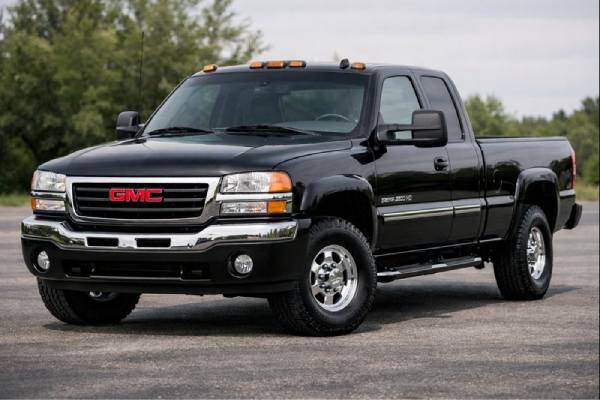
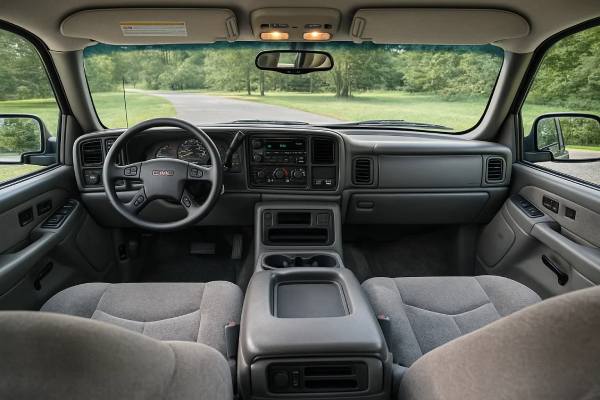
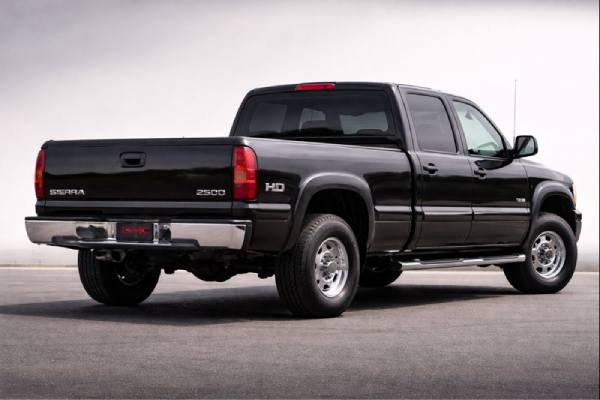
The 2001–2002 GMC Sierra HD 4WD with the LQ4 6.0L V8 sits in a sweet spot for owners who want heavy-duty structure without the complexity (and purchase price) of a diesel. The GMT800 platform brought a stiffer frame, modernized cab design, and a 4WD system that can be genuinely useful in winter or on job sites—while still driving more “normal” than older solid-axle trucks. The LQ4 is a simple, pushrod V8 with port fuel injection and a timing chain, paired most often with the 4L80-E automatic, one of GM’s most proven heavy-duty transmissions.
If you shop smart, this truck can deliver dependable towing, easy parts availability, and DIY-friendly service. The key is understanding configuration (cab, bed, axle ratio) and focusing your inspection on front-end wear, corrosion-prone brake/ABS areas, and 4WD driveline health.
Fast Facts
- Strong low- and mid-range pull for towing with fewer “diesel-only” maintenance costs.
- 4WD adds real traction and resale value for cold climates and work use.
- Expect more front suspension and steering wear than a solid-axle rival if driven hard on rough roads.
- Service the transfer case and both differentials every 80,000 km (50,000 mi) for long life.
- Plan on engine oil changes around 8,000 km (5,000 mi) or 6 months for mixed-use driving.
What’s inside
- What makes the 4WD LQ4 HD
- Tech data for LQ4 4WD
- Trim choices and safety layout
- Common faults, recalls, fixes
- Maintenance roadmap for used buyers
- How the LQ4 pulls and rides
- Comparing HD truck rivals
What makes the 4WD LQ4 HD
In 2001–2002, “Sierra HD” generally points you toward 2500HD and 3500 variants built on the GMT800 heavy-duty chassis. This article focuses on the common gasoline configuration: the LQ4 6.0L V8 rated at 300 hp, combined with a part-time 4WD system (2HI / 4HI / 4LO). Where owners sometimes get tripped up is assuming all HD trucks are the same. In reality, cab style, bed length, axle ratio, and even the transfer case type can change towing limits, ride height, service capacities, and how the truck behaves under load.
The LQ4’s advantage is straightforward engineering. It’s a pushrod (OHV) V8 with port fuel injection—no direct-injection carbon buildup, no turbo hardware, and fewer high-cost emissions parts than a diesel of the same era. It also tends to tolerate heavy use well when oil changes are kept consistent and the cooling system stays healthy. For many owners, the LQ4 is the “work V8” choice: it revs when asked, but it’s happiest pulling steady grades in the midrange.
The 4WD system is another defining feature. On these trucks, 4WD isn’t meant to be used on dry pavement in high range because the system locks front and rear driveshaft speeds together. Its job is traction, not cornering. The upside is durability and simplicity compared with many modern on-demand AWD systems. The trade-off is that tires must be closely matched in size and wear, and drivetrain fluids and joints matter more because you have more rotating parts: a front differential, CV axles, a transfer case, and additional u-joints.
From an ownership standpoint, the Sierra HD 4WD’s biggest strengths are its frame and parts ecosystem. The platform is widely supported, and most wear items are easy to source. Many repairs are also modular: hubs, CV shafts, steering idlers, and brake components can be replaced without exotic tools. The “HD tax” comes from weight and usage—these trucks often worked hard—so your inspection should assume towing, plowing, or commercial loads unless proven otherwise.
If you want a gas HD that can still be maintained like a traditional pickup, the 2001–2002 6.0L 4WD is one of the most practical entries—provided you shop by condition and configuration, not just badge and mileage.
Tech data for LQ4 4WD
Specs vary by cab/bed, axle ratio, and whether you’re looking at 2500HD vs 3500, so the tables below use typical ranges and the most common configurations for the 2001–2002 Sierra HD 4WD with the LQ4 6.0L gasoline engine. Always verify by RPO codes (glove box/door sticker), VIN build data, and the under-hood labels.
Engine and Performance (ICE)
| Item | Specification (typical for LQ4 6.0L) |
|---|---|
| Code | LQ4 |
| Engine layout and cylinders | V8, OHV (pushrod), 2 valves/cyl |
| Bore × stroke | 101.6 × 92.0 mm (4.00 × 3.62 in) |
| Displacement | 6.0 L (5,967 cc) |
| Induction | Naturally aspirated |
| Fuel system | Sequential MPFI (port injection) |
| Compression ratio | ~9.4:1 |
| Max power | 300 hp (224 kW) @ ~4,400 rpm |
| Max torque | ~488 Nm (360 lb-ft) @ ~4,000 rpm |
| Timing drive | Chain |
| Emissions and efficiency standard | EPA (U.S. certification) |
| Rated efficiency (closest published EPA listing) | 21.4 L/100 km (11 mpg US / 13.2 mpg UK) combined for 6.0L 2500 2WD; 4WD is typically slightly higher consumption |
| Real-world highway @ 120 km/h (75 mph) | Often ~18–24 L/100 km (13–10 mpg US / 15.6–12.0 mpg UK) depending on tires, gearing, load, and wind |
Transmission and Driveline
| Item | Specification (common) |
|---|---|
| Transmission | 4-speed automatic (4L80-E, typical with 6.0L HD) |
| Gear ratios | 1st 2.48 / 2nd 1.48 / 3rd 1.00 / 4th 0.75 (typical 4L80-E) |
| Final drive ratio | Commonly 3.73; 4.10 often paired with higher tow ratings (varies) |
| Drive type | Part-time 4WD |
| Transfer case | Commonly New Process heavy-duty units (manual-shift or electronic, varies by trim and year) |
| Differential | Typically open; limited-slip options exist; locking rear differentials are uncommon on early gas HDs (verify by RPO) |
Chassis and Dimensions (typical ranges)
| Item | Typical value (varies by cab and bed) |
|---|---|
| Suspension (front/rear) | Independent front (torsion bars) / rear leaf springs |
| Steering | Power steering; heavy-duty steering components (recirculating-ball style is typical) |
| Brakes | 4-wheel disc on most HD trims (verify by model and GVWR) |
| Wheels and tires | 16 in common (LT-rated tires); sizes vary by package |
| Ground clearance | Roughly 200–230 mm (7.9–9.1 in), varies with tires and suspension condition |
| Length | Roughly 5,740–6,250 mm (226–246 in) |
| Width | Roughly 2,020 mm (79.5 in) excluding mirrors |
| Height | Roughly 1,880–1,960 mm (74–77 in) |
| Wheelbase | Roughly 3,640–4,000 mm (143–157 in) |
| Turning circle | Approximately 14–16 m (46–52 ft), depends on wheelbase |
| Curb weight | Often ~2,630–3,000 kg (5,800–6,600 lb) |
| GVWR | Often ~4,173 kg (9,200 lb) for 2500HD; 3500 can be higher (verify) |
| Fuel tank | Commonly ~129–130 L (34 US gal / 28 UK gal), varies |
Performance and Capability (typical, configuration-dependent)
| Item | Typical value (varies) |
|---|---|
| 0–100 km/h (0–62 mph) | ~10–12 s (unladen, traction and gearing dependent) |
| Top speed | Often electronically limited; typically under ~160 km/h (100 mph) |
| Towing capacity | Broadly ~4,080–5,440 kg (9,000–12,000 lb) depending on axle ratio, cab, hitch, and cooling |
| Payload | Often ~1,130–1,590 kg (2,500–3,500 lb), varies with configuration |
| Roof load | Not commonly rated for these trucks; treat as low unless manufacturer guidance says otherwise |
Fluids and Service Capacities (decision-grade, verify for your exact truck)
| System | Typical fluid and capacity guidance |
|---|---|
| Engine oil | 5W-30 (common spec for the era); ~5.7 L (6.0 US qt) with filter (verify by pan and filter) |
| Coolant | GM-approved long-life coolant; 50/50 mix; capacity varies by radiator and heater setup |
| Transmission (4L80-E) | ATF meeting Dexron specification; pan service replaces only part of total volume |
| Transfer case | Fluid depends on transfer case type; use the correct labeled spec (critical) |
| Differentials | Gear oil typically 75W-90; consider heavier grade for frequent towing if approved |
| A/C refrigerant | R-134a (quantity varies by HVAC setup) |
Electrical (typical)
| Item | Typical value |
|---|---|
| Alternator output | Often 130–145 A (varies with option content) |
| 12V battery | Heavy-duty group sizes common; ~600–800 CCA typical |
| Spark plug | Correct heat range per under-hood label; gap commonly around 1.52 mm (0.060 in) for this era (verify) |
Safety and Driver Assistance
| Category | What to expect |
|---|---|
| Crash ratings | Ratings often available for related Silverado/Sierra 1500 body style tests; HD-specific ratings may not be published |
| ADAS | No modern AEB/ACC/LKA on this generation; focus is on ABS, airbags, and basic traction aids where equipped |
| Headlights | Performance varies by housing condition and bulb type; lens haze is common over time |
Trim choices and safety layout
For 2001–2002 Sierra HD 4WD trucks, trim is less about performance and more about comfort, appearance, and option packaging. The main mechanical variables you should prioritize are (1) axle ratio, (2) cooling and tow equipment, (3) cab/bed choice, and (4) transfer case type. If you treat trim names as the “main event,” it’s easy to buy the wrong truck for your job.
Common trims and how to spot them
Most buyers will run into work-focused trims (often labeled as base/SL), mid-level SLE, and more comfort-oriented SLT versions. Rather than relying only on badges, use quick identifiers:
- Interior tells: cloth vs leather, steering wheel controls, power seat switches, and higher-grade audio head units often track with SLE/SLT.
- External tells: chrome level, fog lamps, alloy wheels, and factory tow mirrors can signal a higher equipment level, but these are easy to retrofit.
- Build codes: the most reliable method is the RPO option list sticker; look for axle ratio, locking/limited-slip indicators, and tow package codes.
Options that change capability
For working use, these options matter most:
- Axle ratio (critical): A 4.10 truck usually tows more confidently and holds gears better on grades, but it typically uses more fuel at highway speed. A 3.73 truck can be a better everyday compromise.
- Tow package: Look for a factory receiver hitch, 7-pin wiring, transmission cooling provisions, and a trailering mirror package. Some trucks have the hitch but lack the full supporting cooling setup.
- Snow plow prep / heavy front suspension equipment: If you plan to plow, prioritize factory prep where available; the front-end wear penalty is real on IFS trucks when plowing heavy.
Safety ratings and what they mean here
Crash-test data is often published for related Silverado/Sierra 1500 extended cab models from the same body generation. Those tests provide a useful “structure clue,” but they are not a perfect proxy for an HD truck because weight, ride height, and some structural details can differ. Still, they help set expectations: early GMT800 pickups were designed before today’s roof-crush standards, side-curtain airbags, and advanced restraint tuning.
The more practical safety conversation for these trucks is condition-based:
- ABS function and brake feel matter more than almost any brochure claim, because corrosion and hub/sensor issues can create unpredictable low-speed ABS activation.
- Tire quality and matching matter because part-time 4WD trucks are sensitive to rolling circumference differences.
- Lighting and visibility should be treated as maintenance: cloudy lenses and tired reflectors can make night driving riskier than it needs to be.
Safety systems and “driver assistance”
Modern ADAS features (automatic emergency braking, lane-keeping assistance, adaptive cruise) are not part of the 2001–2002 package. What you will see instead:
- Front airbags are common; side airbags and curtains are not typical for this era.
- ABS is a core feature. Keep it healthy: it’s your main electronic safety net in panic stops.
- Traction aids may exist depending on drivetrain and option content, but they are basic compared with later stability-control systems.
If you want to make this truck safer in daily use, the best path is maintenance: brakes, tires, headlights, and steering tightness. A mechanically sharp GMT800 often feels far more secure than a worn example with the same trim badge.
Common faults, recalls, fixes
A well-kept LQ4 Sierra HD can age gracefully, but the “gotchas” are predictable—and that’s good news. You can inspect for most of them in a driveway and price them into the deal. Below are common issues mapped by prevalence and severity, plus what to do about them.
Common and usually medium cost
- Front-end wear (steering and suspension):
- Symptoms: wandering, uneven tire wear, clunks over bumps, steering wheel play.
- Likely causes: idler and pitman arm wear, tie-rod looseness, tired ball joints, worn hub bearings, and aged torsion-bar suspension components.
- Remedy: budget a full front-end refresh if there’s no proof it’s been done. After parts, insist on a proper alignment.
- 4WD driveline service neglect:
- Symptoms: vibration under load, clunks on takeoff, binding in 4WD, noisy front differential.
- Likely causes: dry u-joints, old transfer case fluid, mismatched tires, and worn CV axles/hubs.
- Remedy: verify correct transfer case fluid, replace suspect u-joints, and keep tire sizes matched within a tight tolerance.
- Exhaust manifold bolt leaks (age-related):
- Symptoms: ticking when cold, exhaust smell near the wheel well.
- Likely causes: broken manifold bolts from heat cycling.
- Remedy: repair sooner rather than later to avoid warped sealing surfaces.
Occasional but can be high cost if ignored
- Cooling system fatigue:
- Symptoms: temperature creep on grades, coolant smell, leaks at radiator or water pump.
- Likely causes: aged radiators, hoses, water pump seepage, and neglected coolant changes.
- Remedy: restore the cooling system before heavy towing season; overheating events shorten engine life fast.
- Transmission stress from towing without cooling support:
- Symptoms: delayed shifts, flare, burnt ATF smell, higher temps when towing.
- Likely causes: heavy loads with old fluid, weak cooling, or repeated hunting between gears.
- Remedy: service fluid on schedule, confirm auxiliary cooling, and make sure the truck is geared appropriately for your trailer.
Recalls and service actions to verify
One of the most important safety-related actions for 1999–2002 Sierra/Silverado trucks in corrosion-prone regions involves front wheel speed sensor corrosion. In affected areas, corrosion can occur between the hub/bearing assembly and the wheel speed sensor. That can trigger unwanted ABS activation at low speeds, increasing stopping distance when you need precision. The remedy typically involves inspection, cleaning, treatment, and sensor replacement when needed.
How to verify completion:
- Run the VIN through an official recall lookup (dealer service records and the national recall database).
- Ask for paperwork showing the recall work was performed.
- During the test drive, do several gentle stops from ~15 km/h (10 mph) to see if ABS triggers unexpectedly on dry pavement.
Pre-purchase checks to request
- A full service history with fluid change receipts (engine oil, transmission, transfer case, and both differentials).
- Proof of recall completion where relevant, especially if the truck lived in salted-road states.
- A front-end inspection printout (play measurements, alignment readings, tire wear notes).
- A tow-history conversation: what was towed, how often, and whether transmission temps were monitored.
These trucks are often honest about their condition. If the seller can’t demonstrate maintenance and the front end feels loose, assume you will do the work—then decide if the price still makes sense.
Maintenance roadmap for used buyers
A 2001–2002 Sierra HD 4WD can be a long-term keeper if you follow a “systems-first” maintenance approach: fluids, cooling, driveline joints, and steering tightness before cosmetic upgrades. The schedule below is practical for mixed driving and occasional towing; shorten intervals for heavy towing, short trips, or extreme temperatures.
Core maintenance schedule (distance or time, whichever comes first)
- Engine oil and filter: every 8,000 km (5,000 mi) or 6 months.
- If you tow frequently or idle a lot, consider 5,000 km (3,000 mi).
- Engine air filter: inspect every oil change; replace around 24,000–40,000 km (15,000–25,000 mi) depending on dust.
- Cabin air filter: not fitted on all trucks; replace annually if equipped.
- Fuel filter: replace every 48,000–64,000 km (30,000–40,000 mi) if your configuration uses a serviceable inline filter.
- Coolant: every 5 years or 160,000 km (100,000 mi), and sooner if the system has been opened or contamination is suspected.
- Spark plugs: often up to 160,000 km (100,000 mi) in light duty, but inspect earlier if you feel misfires under load.
- Serpentine belt and hoses: inspect at every oil change; replace proactively around 10 years/160,000 km (100,000 mi) if unknown.
- Transmission service: every 80,000 km (50,000 mi) for normal use; 50,000 km (30,000 mi) if towing regularly.
- Transfer case fluid: every 80,000 km (50,000 mi) and immediately after water intrusion (deep snow/water events).
- Front and rear differential fluid: every 80,000 km (50,000 mi) under mixed use; 50,000 km (30,000 mi) if towing or hauling heavy.
- Brake fluid: every 2–3 years regardless of mileage.
- Brake pads/rotors: inspect every 10,000–15,000 km (6,000–9,000 mi) if towing; otherwise at every tire rotation.
- Tires: rotate every 10,000–12,000 km (6,000–7,500 mi); keep all four closely matched in size and wear for 4WD health.
- Battery and charging system: load-test yearly; many batteries last 4–6 years in real use.
Fluids that require extra attention on 4WD
Transfer case fluid is not a “generic ATF situation.” These trucks can use different transfer case designs; some use ATF-type fluids while others require specific GM transfer case fluids. The safest habit is to read the service label, confirm the transfer case model, and buy the exact approved fluid.
Also, don’t forget greaseable driveline points if your truck is equipped with them. A u-joint that fails at highway speed can damage the driveshaft, yoke, or even the transmission tail housing.
Buyer’s inspection checklist (high value items)
- Frame and brake line corrosion: look along the inside of the frame rails, around crossmembers, and at brake line routing.
- Front hubs and ABS behavior: any grinding, play, or weird ABS pulses deserve attention.
- Transfer case operation: verify 2HI/4HI/4LO engagement and that it shifts smoothly (following correct procedure).
- Cooling system pressure and leaks: inspect radiator seams, water pump area, and hose ends.
- Transmission condition: fluid color and smell, shift quality under light and moderate throttle, and any delayed engagement into drive/reverse.
- Steering tightness: check for wander and for clunks while rocking the wheel at low speed.
Long-term durability outlook
If you keep fluids clean, prevent overheating, and stay ahead of front-end wear, the LQ4/4L80-E combination can be a durable, predictable ownership experience. Most “bad truck” stories on this platform trace back to neglected cooling systems, ignored steering play, or years of towing with overdue transmission and driveline service.
How the LQ4 pulls and rides
The LQ4 6.0L doesn’t deliver diesel-style low-rpm shove, but it makes honest power in the midrange, and it responds well when you let it rev. Unloaded around town, it feels like a big V8 pickup should: smooth, torquey, and calm at partial throttle. Under heavy load, the truck’s character depends heavily on axle ratio and whether the transmission is healthy and well-cooled.
Ride, handling, and NVH
Compared with solid-front-axle HD trucks of the same era, the Sierra HD’s independent front suspension can feel more composed on broken pavement when the front end is tight. Steering response is typically slower and heavier than modern trucks, and worn steering components can turn that into wander—so “tightness” is not optional if you plan long highway trips.
Cab noise is usually more wind and tire-driven than engine-driven. A healthy LQ4 doesn’t sound strained unless you’re climbing grades at higher RPM, where it will audibly work. That’s normal behavior for a gas HD pulling weight.
Powertrain character and shifting
With the 4L80-E, you can expect deliberate shifts rather than quick modern snap. Kickdown happens, but it’s not instantaneous, and the truck often prefers to hold a gear rather than constantly shuffle—again, assuming the transmission isn’t slipping or overheating. If you feel repeated hunting between gears on gentle hills, that can point to mismatched gearing for your use or a transmission that needs service.
A good rule: for frequent towing in hilly areas, a 4.10 axle ratio usually feels more relaxed because it reduces the need for big downshifts, even if it costs fuel at cruise.
Real-world efficiency and what changes it
These trucks are heavy, tall, and geared for work. Fuel use at highway speed can swing significantly based on:
- Tire type (aggressive LT tires can raise consumption notably)
- Axle ratio (4.10 often burns more at steady cruise)
- Speed (a jump from 105 km/h to 125 km/h can be a big penalty)
- Payload and trailer aerodynamics (a tall enclosed trailer can feel like a parachute)
If you want to reduce fuel consumption without losing capability, the best “mods” are maintenance: correct tire pressure, clean air filter, healthy oxygen sensors, and a cooling system that keeps temps stable.
Towing and load behavior
When properly equipped, the Sierra HD 4WD is a confident tow rig for moderate to heavy loads. Key real-world points:
- Stability: a weight-distributing hitch and correct tongue weight make a bigger difference than almost any power upgrade.
- Braking confidence: brakes must be in excellent condition, and your trailer brakes must be correctly adjusted. The truck is heavy, but so is the trailer.
- Heat management: watch transmission and coolant temperature behavior on long grades. Heat is the silent killer of older tow rigs.
In snow or muddy job sites, 4HI is genuinely useful for controlled traction. Just remember it’s not AWD—use it on low-traction surfaces, keep tires matched, and avoid binding the driveline on dry pavement.
Comparing HD truck rivals
In the early-2000s heavy-duty world, cross-shopping usually comes down to three families: GM Sierra/Silverado HD, Ford Super Duty, and Ram Heavy Duty. Your “best” choice depends on whether you value ride comfort, front-axle toughness, diesel availability, or ease of ownership.
Versus Ford Super Duty (gas HD)
Why the Sierra HD 6.0L can be the better pick:
- The LQ4 is a simple, proven gas V8 with wide parts availability and straightforward service.
- The independent front suspension can ride more comfortably on mixed pavement when it’s tight.
- The 4L80-E is widely understood and supported in the repair world.
Why the Super Duty might win for some owners:
- Solid front axles can be more tolerant for certain heavy front-end uses (like plowing) and can be simpler to lift or modify for off-road work.
- Some buyers prefer Ford’s steering feel or aftermarket ecosystem for specific work builds.
Versus Ram Heavy Duty (gas and diesel era)
Where the Sierra HD shines:
- Often lower purchase price than a comparable diesel Ram, and fewer diesel-era ownership costs.
- A well-kept GM gas HD can be a “get in and go” truck for occasional heavy work.
Where Ram can be compelling:
- Diesel options (depending on exact year and configuration) can deliver better fuel economy and lower-rpm towing feel, but usually at higher maintenance and repair cost.
The practical takeaway
If you want a heavy-duty pickup that is:
- Easy to keep running with normal tools,
- Friendly to parts availability,
- Capable for towing when correctly configured, and
- Not loaded with modern electronics,
…the 2001–2002 Sierra HD 4WD with the LQ4 is a strong value—especially if you buy the tightest, least-rusted example you can find. But if your daily reality is heavy snow plowing, constant maximum towing, or extreme corrosion exposure, a rival with a different front axle design (or a newer truck with better corrosion protection and stability control) may be the smarter long-term call.
References
- 2002 Chevrolet Silverado Owner’s Manual 2001 (Owner’s Manual)
- Microsoft Word – 05068C bulletin.doc 2008 (Recall Bulletin)
- 2001 GMC Sierra 1500 extended cab pickup 2025 (Safety Rating)
- Fuel Economy of the 2002 GMC Sierra 2500 2WD 2025 (Fuel Economy Database)
Disclaimer
This article is for informational purposes only and is not a substitute for professional diagnosis, inspection, or repair. Specifications, torque values, service intervals, procedures, and fluids can vary by VIN, market, production date, and installed equipment. Always verify details using your vehicle’s official service information, labels, and manufacturer documentation before performing maintenance or modifications.
If you found this guide useful, please consider sharing it on Facebook, X (Twitter), or your favorite forum—your support helps us keep publishing detailed, practical owner resources.