
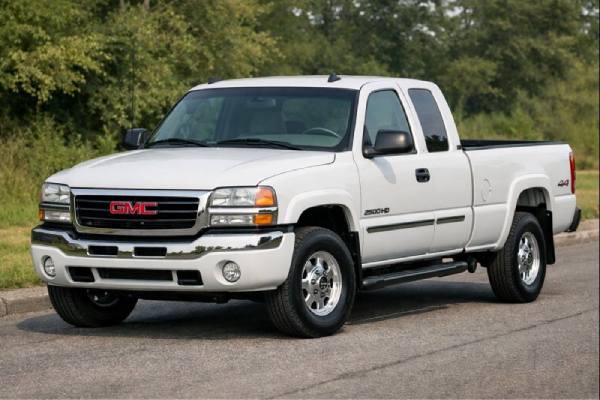
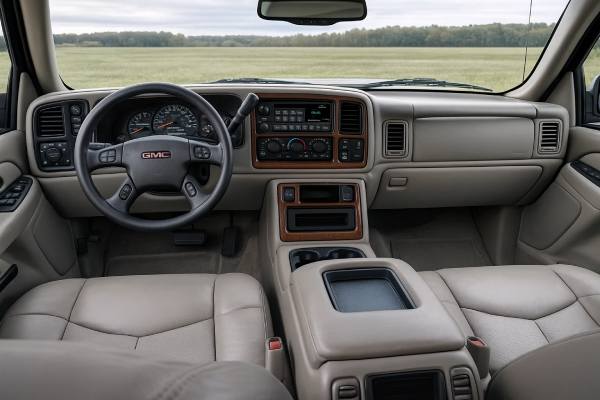
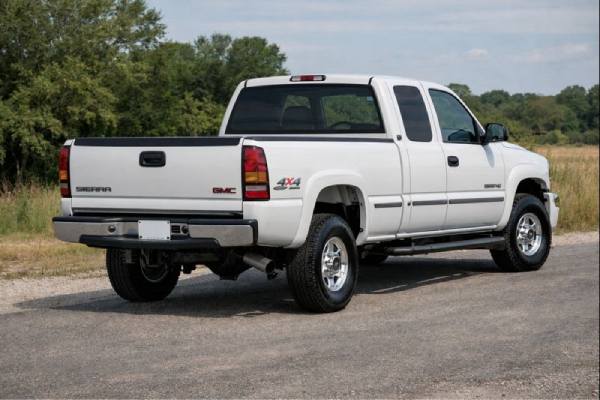
The 2001–2002 GMC Sierra HD 4WD with the LB7 6.6L Duramax is an early “modern diesel” heavy-duty pickup: common-rail injection, a strong torque curve, and a chassis that feels purpose-built for towing. In stock form it’s a straightforward work tool—power comes in low, the Allison automatic (when fitted) keeps the engine in its sweet spot, and the 4WD system adds real capability in snow, mud, and loose job-site surfaces.
Ownership is usually defined by two things: fuel-system care and drivetrain service discipline. The LB7 can run for a very long time, but it is less forgiving of neglected filtration and injector symptoms than a simpler gas HD. Add 4WD hardware—transfer case, front differential, CV axles, and hubs—and you have more wear points to inspect and maintain. Buy a clean example, keep fluids fresh, and this truck can be a dependable tow rig with a predictable cost pattern rather than surprise repairs.
Quick Specs and Notes
- Strong towing manners from low-rpm torque; relaxed cruising even with moderate trailer weights.
- Proven HD platform with broad parts support and good DIY access for many repairs.
- 4WD adds traction and resale value but increases maintenance points (transfer case, hubs, CVs).
- Budget for possible LB7 injector-related work on higher-mileage trucks.
- Replace the fuel filter about every 15,000 km (10,000 mi) or 12 months for consistent fuel-system life.
Contents and shortcuts
- Duramax LB7 4WD ownership picture
- LB7 4WD specifications and capacities
- Trims, tow packages, and safety
- Reliability hotspots and known remedies
- Maintenance schedule and buying advice
- Driving feel, mpg, and towing behavior
- LB7 Sierra HD 4WD versus competitors
Duramax LB7 4WD ownership picture
Think of the 2001–2002 Sierra HD 4WD LB7 as three systems working together: a torque-first diesel engine, an HD drivetrain, and a chassis designed to carry and control weight. When it’s healthy, the truck’s personality is calm and confident—especially with the Allison automatic—because the Duramax makes useful torque early and doesn’t need to scream to hold speed on grades. That matters for real-world towing: you get steady pull, fewer frantic downshifts, and less driver fatigue on long trips.
The LB7’s “modern diesel” design is a major reason these trucks are still sought after. Common-rail injection allows smoother combustion and strong low-end response, but it also raises the importance of fuel quality and filtration. A gas engine will often tolerate a sloppy maintenance rhythm; an LB7 is more likely to punish it with hard-start behavior, rough idle, or oil dilution if injector issues develop and go ignored. The upside is that the ownership pattern is usually readable: the truck gives warning signs long before it becomes catastrophic—if you know what to watch and you don’t normalize symptoms.
4WD adds another layer. In a part-time system, 4HI and 4LO are traction tools, not “always-on” modes. Used correctly, 4WD makes the truck far more capable for winter towing launches, muddy job sites, and pulling trailers on loose ramps. Used incorrectly—like running 4HI on dry pavement with mismatched tires—it can stress the transfer case and driveline. For owners, that means two habits matter: keep all four tires closely matched in size and wear, and treat drivetrain fluid service as scheduled maintenance, not an afterthought.
From a value standpoint, the Sierra HD 4WD LB7 often appeals to buyers who want diesel towing without later-era emissions complexity. You get a simpler emissions landscape than newer diesels, and you get a platform with wide parts support. The tradeoff is age: most examples have seen work. Your best results come from buying the cleanest truck you can—one with stable temperatures under load, consistent fuel-filter history, and a tight front end—then maintaining it like equipment.
LB7 4WD specifications and capacities
Configuration changes numbers on HD trucks more than people expect. Cab style, bed length, axle ratio, and 2500HD vs 3500 can all move towing, payload, curb weight, and even service capacities. The tables below focus on the 2001–2002 Sierra HD 4WD with LB7 Duramax (300 hp) and list typical values or ranges where equipment changes the result.
Engine and performance (ICE)
| Item | Specification |
|---|---|
| Code | LB7 (Duramax) |
| Engine layout and cylinders | 90° V8, OHV (pushrod), 4 valves/cyl (32 valves) |
| Bore × stroke | ~103.0 × 99.0 mm (~4.06 × 3.90 in) |
| Displacement | 6.6 L (6,599 cc) |
| Induction | Turbocharged, intercooled |
| Fuel system | High-pressure common-rail direct injection |
| Compression ratio | ~17.5:1 |
| Max power | 300 hp (224 kW) @ ~3,100 rpm |
| Max torque | ~705 Nm (520 lb-ft) @ ~1,800 rpm |
| Timing drive | Chain |
| Emissions / efficiency standard | U.S. EPA certification era; HD diesel economy labeling often varies by GVWR |
Transmission and 4WD driveline
| Item | Typical for this model |
|---|---|
| Transmission (common) | Allison 1000 5-speed automatic (early years) |
| Manual option | 6-speed manual offered in some configurations (verify by RPO/build) |
| Gear ratios (typical Allison 5) | 1st 3.09 / 2nd 1.81 / 3rd 1.41 / 4th 1.00 / 5th 0.71 |
| Drive type | Part-time 4WD (2HI / 4HI / 4LO) |
| Transfer case | Heavy-duty NP/New Process units vary by trim and year; verify model and required fluid |
| Differentials | Open or limited-slip depending on axle and options; verify by RPO codes |
| Typical axle ratios | Often 3.73 or 4.10 (configuration dependent) |
Chassis and dimensions (typical ranges)
| Item | Typical value / range |
|---|---|
| Suspension (front/rear) | Independent torsion bar front / leaf spring rear |
| Steering | Power steering (recirculating-ball architecture typical) |
| Brakes | 4-wheel disc on most HD trims (verify by GVWR) |
| Length | ~5,650–6,250 mm (~222–246 in) |
| Width | ~2,000 mm (~79 in) excluding mirrors |
| Wheelbase | ~3,378–3,886 mm (~133–153 in) |
| Turning circle | ~13.5–16 m (~44–52 ft) depending on wheelbase |
| Curb weight | ~2,900–3,400 kg (~6,400–7,500 lb) depending on cab/bed and equipment |
| GVWR | Often ~3,900–4,500+ kg (~8,600–9,900+ lb) by model |
Capability (configuration-dependent)
| Item | Typical value / range |
|---|---|
| Towing capacity | Often ~4,500–5,700 kg (~10,000–12,500 lb) depending on axle ratio and hitch class |
| Payload | Often ~1,100–1,800 kg (~2,400–4,000 lb), varies by cab/bed |
| Fuel tank | Commonly ~98–129 L (~26–34 US gal), varies |
Fluids and service capacities (verify for your exact truck)
| System | Typical guidance |
|---|---|
| Engine oil | Diesel-rated oil per GM guidance; capacity often ~9.5 L (~10 qt) with filter |
| Coolant | Long-life coolant, 50/50 mix; capacity varies by cooling package |
| Allison ATF | Allison-approved fluid; capacity depends on service method and pan depth |
| Transfer case | Fluid is transfer-case-specific; confirm the label before servicing |
| Differentials | Gear oil per axle specification; front and rear differ by capacity and fill procedure |
Safety and driver assistance (era-typical)
| Item | What to expect |
|---|---|
| Airbags | Front airbags standard; side curtains uncommon in this era |
| ABS | Commonly standard |
| Stability control / modern ADAS | Generally not present on 2001–2002 HD pickups |
Trims, tow packages, and safety
On 2001–2002 Sierra HD trucks, trim names matter far less than hardware. The same LB7 can feel like two different trucks depending on axle ratio, cooling equipment, hitch integration, and whether the truck has been maintained as a tow rig or merely “owned.” Start with configuration, then use trim as a comfort filter.
Trims and options that affect real capability
Most buyers will see work-oriented trims (often base/SL), mid-level SLE, and more comfort-focused SLT models. The mechanical and functional differences you should prioritize are:
- Axle ratio (often 3.73 vs 4.10): A 4.10-equipped truck generally holds speed better on grades and can feel more responsive with heavy trailers. A 3.73 can be a better everyday compromise and may reduce cruise rpm.
- Allison automatic vs manual: The Allison pairing is a major reason these trucks tow so smoothly. Manuals can be durable, but they put more workload on the driver and can reveal clutch wear faster under heavy towing.
- Tow package completeness: A receiver hitch alone is not enough. Look for clean factory-style wiring, proper 7-pin integration, and evidence that cooling capacity and transmission service were treated seriously.
- Cab and bed choice: Crew cabs add comfort but reduce payload for a given GVWR. Long beds can improve stability but increase turning circle and can amplify driveline wear if u-joints are neglected.
Quick identifiers to use on the truck:
- The RPO code label (commonly in the glove box) is your best truth source for axle ratio and major equipment.
- Look for factory wiring routing and tidy harnessing. Messy trailer wiring is a reliable predictor of electrical headaches.
- Check for matched tire brand/size and similar tread depth across all four corners—this matters more on part-time 4WD than many owners realize.
Safety ratings and what they really mean
Crash-test ratings for early-2000s pickups are often published for related Sierra/Silverado 1500 variants. They offer a useful snapshot of the generation’s structural performance, but they are not a perfect proxy for HD trucks because weight, ride height, and equipment can differ. Treat them as context, not a definitive “score” for your exact 2500HD/3500 configuration.
For these trucks, day-to-day safety is dominated by condition:
- Brake system health: HD trucks carry mass. Soft pedal feel, uneven braking, or low-speed ABS pulsing deserves immediate attention.
- Steering tightness: A loose front end increases fatigue and reduces emergency control, especially when towing.
- Tire load rating: Use the correct LT load range for the truck’s actual work. Under-rated tires are a safety risk, not a comfort choice.
- Lighting and mirrors: Headlight haze and poor aim are common; towing mirrors and clear rear visibility reduce stress on long trips.
Driver assistance and “modern” expectations
Do not expect automatic emergency braking, lane support, or adaptive cruise. This generation relies on fundamentals: airbags, ABS, and the driver. If you want the truck to feel safer, the best upgrades are maintenance-driven: fresh brake fluid, quality pads/rotors, properly rated tires, and restored steering components. On an LB7 tow rig, those basics often deliver more real-world safety than any comfort option package ever will.
Reliability hotspots and known remedies
The LB7 Sierra HD 4WD is capable of high mileage, but it has a few well-known pain points. The goal is to understand prevalence and cost tier, then recognize symptoms early so you repair proactively instead of paying for collateral damage.
Common (higher prevalence)
- Injector wear or leakage (medium to high cost):
- Symptoms: haze at idle, rough warm idle, hard starting, increased fuel consumption, oil level rising (fuel dilution), or persistent injector balance concerns on a scan tool.
- Likely cause: injector internal leakage over time, sometimes accelerated by poor fuel filtration practices.
- Remedy: confirm with proper diagnostics (not guesswork), replace affected injectors, and restore strict fuel-filter habits. If oil dilution is present, change oil promptly after repair.
- Fuel filter head air intrusion (low to medium cost):
- Symptoms: loss of prime, long crank after sitting, intermittent stumble.
- Cause: aging seals, cracks, or primer assembly issues allowing air into the fuel system.
- Remedy: reseal/rebuild the filter head, confirm hose integrity, and verify primer operation.
- Front-end wear (common on working HD trucks, medium cost):
- Symptoms: steering play, clunks, uneven tire wear, vague tracking at highway speed.
- Cause: idler/pitman wear, tie rods, ball joints, hub bearings—often worsened by heavy tires, plowing, or rough roads.
- Remedy: replace worn parts as a system, then align. Piecemeal repairs often leave the truck still wandering.
Occasional (depends on use and service history)
- Transfer case “pump rub” and leaks (medium cost, can become high if ignored):
- Symptoms: fluid seepage, dampness at case seams, new drivetrain noise, or low fluid discovered during service.
- Cause: internal wear pattern on certain transfer case designs that can abrade the case over time.
- Remedy: catch it early with regular fluid checks; repair before the case runs low and damages bearings.
- Allison towing heat and shift concerns (medium to high cost):
- Symptoms: shudder at lockup, harsh shifts, flare, or elevated temps when towing.
- Cause: old fluid, restricted cooler flow, or a life of heavy towing without scheduled service.
- Remedy: verify fluid spec/level, inspect cooler lines, scan for codes, and service on a towing-appropriate interval.
Rare but high-impact if ignored
- Severe engine wear from prolonged fuel dilution (high cost):
- Symptoms: rising oil level, thin fuel-smelling oil, low oil pressure, bearing noise.
- Cause: continuing to drive with leaking injectors that dilute oil.
- Remedy: stop the “wait and see.” Diagnose injectors immediately and protect the engine with prompt oil service after repairs.
Recalls, TSBs, and verification approach
Because these trucks are now older, rely on VIN-based verification rather than assumptions:
- Run the VIN through an official recall lookup.
- Ask for dealer documentation of completion.
- On a test drive, watch for safety-related warning signs—especially unusual ABS behavior at very low speeds on dry pavement, which can point to sensor/hub issues in corrosion-prone trucks.
The reliability story here is mostly about acting early. An LB7 that’s monitored and serviced tends to stay predictable; an LB7 that’s driven through symptoms becomes expensive.
Maintenance schedule and buying advice
A strong LB7 4WD maintenance plan is built around clean oil, clean fuel, controlled temperatures, and serviced driveline fluids. These trucks often work hard, so “severe duty” intervals are a smart default unless you have proof the truck lived an easy life.
Practical maintenance schedule (distance or time)
| Item | Normal use | Severe use (towing, short trips, dusty, frequent idle) |
|---|---|---|
| Engine oil and filter | ~12,000 km (7,500 mi) or 12 months | ~8,000 km (5,000 mi) or 6 months |
| Fuel filter | ~20,000 km (12,500 mi) or 12 months | ~15,000 km (10,000 mi) or 12 months |
| Air filter | Inspect every oil change | Inspect more often; replace as needed |
| Coolant | Typically up to 5 years (type-dependent) | 3–5 years (more conservative) |
| Allison ATF | Interval varies by use and fluid spec | Shorten interval if towing hot/heavy |
| Transfer case fluid | ~80,000 km (50,000 mi) | ~50,000 km (30,000 mi) |
| Front and rear diff fluid | ~80,000 km (50,000 mi) | ~50,000 km (30,000 mi) |
| Brake fluid | Every 2–3 years | Every 2 years |
| Tires | Rotate every 10,000–12,000 km (6,000–7,500 mi) | Same, plus more frequent pressure checks |
Fuel and filtration notes that pay off:
- Treat the fuel filter as routine, not optional. It’s cheap insurance for an expensive fuel system.
- If you notice hard starts or repeated priming, investigate immediately. Air leaks and weak filter heads create drivability issues and can complicate injector diagnosis.
Buyer’s checklist (LB7 4WD specific)
Engine and fuel system
- Check the oil level and smell: oil that is overfull or smells strongly of fuel is a red flag.
- Observe cold start and warm idle. Persistent haze or roughness deserves proper diagnostics.
- Look around the fuel filter head for wetness, cracked hoses, or evidence of frequent manual priming.
4WD and driveline
- Verify 2HI/4HI/4LO engagement (following the correct procedure) and listen for abnormal noises.
- Inspect CV boots, front differential seals, and driveshaft u-joints for play or rust dust.
- Confirm all four tires match closely in size and tread depth.
Cooling and towing readiness
- Check for a clogged radiator/intercooler stack, especially on work trucks.
- Ensure the truck holds stable temperatures on a longer test drive with a few sustained pulls.
- Inspect hitch wiring quality and trailer brake controller installation if present.
Long-term outlook (realistic)
A cared-for LB7 Sierra HD 4WD can be a long-term tow vehicle, but it is not “ignore it and it’ll be fine.” Owners who stay strict on fuel filtration, respond quickly to injector symptoms, and service the transfer case/differentials on schedule tend to have the best outcomes and the fewest expensive surprises.
Driving feel, mpg, and towing behavior
The LB7’s defining advantage is how it delivers work. Around town, the truck feels heavy and solid, but the engine’s low-rpm torque keeps it from feeling strained. The steering is slower than modern pickups, and the independent front suspension’s ride quality depends heavily on wear condition—tight front-end components make the truck feel composed; worn parts make it wander and feel tiring.
Ride, handling, and NVH
- Ride: unloaded, HD leaf springs can feel firm. Add bed weight or a trailer and the suspension often settles into a smoother, more controlled motion.
- Stability: with a healthy front end and correct tire pressure, the truck tracks confidently on the highway. If it feels loose, assume worn steering/suspension parts until proven otherwise.
- Noise: expect diesel clatter at idle and more wind/tire noise than newer trucks. At steady cruise, a stock truck usually sounds relaxed unless intake/exhaust modifications amplify it.
Powertrain behavior and towing character
- Throttle response: strong step-off and midrange pull once the turbo is working. The engine doesn’t need high rpm to do meaningful work, which is why it feels calm when towing.
- Allison shifting: generally predictable and towing-friendly in stock form, with firm but not harsh shifts. Persistent hunting or shudder can point to fluid condition, calibration mismatches after repairs, or wear.
- 4WD traction: 4HI is useful for low-traction launches and slippery grades; 4LO is for slow control and pulling power. Use 4WD on loose surfaces and avoid binding it on dry pavement.
Real-world efficiency ranges (what owners typically see)
Fuel economy varies widely with speed, tires, gearing, and load. A practical way to set expectations:
- Unloaded highway cruising: often around 12–16 L/100 km (20–15 mpg US / 24–18 mpg UK) depending on speed and setup.
- Mixed driving: commonly 13–18 L/100 km (18–13 mpg US / 22–16 mpg UK).
- Towing: moderate towing often adds a 20–40% fuel penalty; heavy or high-drag trailers can push the penalty higher.
The biggest controllable factors are speed, trailer aerodynamics, tire choice, and how well the engine and transmission maintain temperature under load.
Capability and confidence under load
A properly configured Sierra HD 4WD LB7 can tow with strong stability, but safe towing is a systems game:
- Use a weight-distributing hitch where appropriate.
- Set tongue weight correctly and keep trailer brakes properly adjusted.
- Service brakes aggressively—HD mass demands it.
- Monitor heat: long grades reveal cooling or transmission issues faster than any short test drive.
If your use includes winter towing, the 4WD system is a genuine advantage. It reduces wheelspin during launches and makes low-traction maneuvering much less stressful—assuming the tires are matched and the driveline fluids are maintained.
LB7 Sierra HD 4WD versus competitors
Cross-shopping a 2001–2002 Sierra HD 4WD LB7 usually means comparing it with two classic rivals: Ford Super Duty diesels from the same era and Ram HD trucks with the 5.9 Cummins. All can be excellent tools, but they tend to reward different ownership styles.
Versus Ford Super Duty (era-appropriate diesel)
Where the Sierra HD LB7 often shines
- Smooth, low-rpm torque delivery from common-rail fueling makes towing feel relaxed.
- The Duramax paired with the Allison automatic (when equipped) is a strong “factory combo” that many owners find easy to live with.
- Parts availability and community knowledge are deep, which helps with repairs and diagnostics.
Where the Ford can be compelling
- Some buyers prefer a simpler, older-school diesel character and a different chassis approach.
- Depending on exact engine and year, certain Ford diesels have their own reputation strengths and well-known service playbooks.
Decision tip: If you want refined towing feel and you value the Duramax/Allison pairing, the GM setup is hard to beat. If you prioritize a different axle/suspension layout or you already have Ford-focused service support, the Super Duty may fit better.
Versus Ram HD 5.9 Cummins
Where the Sierra HD can win
- The V8 Duramax is often smoother and quieter at idle than an inline-six diesel of the same era.
- The towing experience can feel more “integrated” with the Allison-equipped trucks.
Where the Cummins path can win
- Inline-six packaging can simplify certain service tasks.
- The Cummins ecosystem is huge, and many owners value its straightforward mechanical feel.
Decision tip: The best choice is the best example. A well-maintained LB7 with documented fuel filtration and injector attention will usually beat a neglected rival, regardless of brand reputation.
Versus gasoline HD trucks
A gas HD can be cheaper to maintain in some ways, but it usually works harder under heavy tow. If you tow often or tow heavy, the diesel advantage is real: lower-rpm pulling, less strain, and often better range from a tank. The tradeoff is diesel-specific costs—injectors, filtration discipline, and sometimes higher parts prices.
Bottom line
Choose the Sierra HD 4WD LB7 if you want:
- Strong, calm towing performance, especially with the Allison automatic.
- Real winter/job-site traction from part-time 4WD.
- A platform with broad parts support and a well-understood ownership playbook.
Just commit to the rules that keep it happy: clean fuel, prompt response to injector symptoms, and regular transfer case/differential service.
References
- 2002 GMC Sierra Owner’s manual 2001 (Owner’s Manual)
- Vehicle Detail Search – 2002 GMC SIERRA 2500 | NHTSA 2025 (Recall Database)
- Check for Recalls: Vehicle, Car Seat, Tire, Equipment | NHTSA 2025 (VIN Recall Lookup)
- Microsoft Word – 05068C bulletin.doc 2005 (Recall Bulletin)
- 2001 GMC Sierra 1500 2025 (Safety Rating)
Disclaimer
This article is for informational purposes only and is not a substitute for professional diagnosis, inspection, or repair. Specifications, torque values, fluid types, service intervals, and procedures vary by VIN, market, production date, and installed equipment. Always verify details against official service information and the labels on your exact vehicle before performing maintenance or modifications.
If this guide was helpful, please consider sharing it on Facebook, X (Twitter), or your preferred community to support our work.