
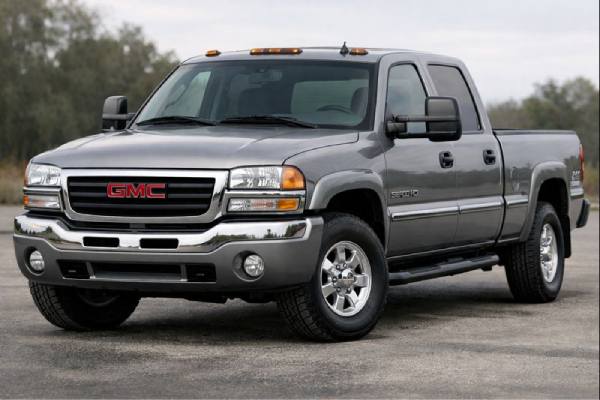
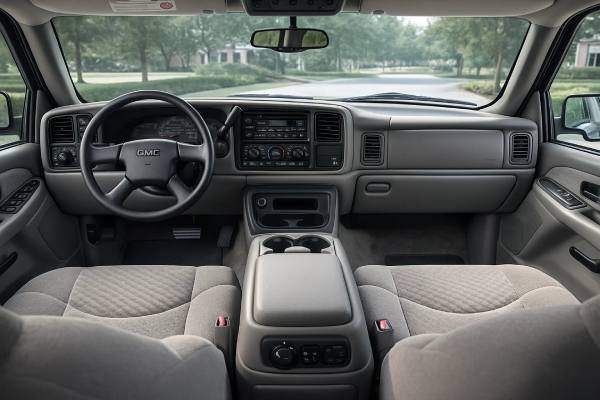
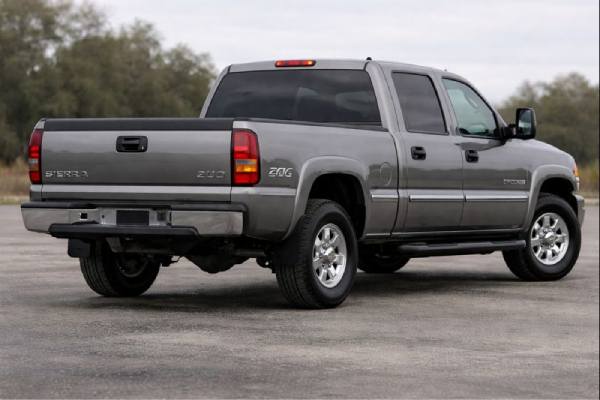
The 2003–2004 facelift-era GMC Sierra HD in RWD form is a very specific kind of work truck: a GMT800 chassis built around the early 6.6L Duramax LB7 and, most often, the Allison automatic. In stock 300 hp trim, it’s not about headline speed—it’s about low-rpm torque, predictable towing manners, and a drivetrain that can survive years of load when it’s maintained on time. RWD also changes the ownership math: fewer driveline parts than a 4×4, usually lower curb weight, and a cleaner front-end service life—balanced against traction limits on slick ramps or job sites.
These trucks are now old enough that condition matters more than mileage alone. The best examples feel tight, cool correctly under sustained pull, and shift consistently. The worst ones hide expensive diesel-specific issues, especially around fuel delivery and injectors. This guide focuses on what actually changes your ownership experience.
Owner Snapshot
- Strong low-end pulling power with simple, dependable RWD driveline hardware.
- Allison-equipped trucks are easy to live with under load and tend to hold value well.
- Wide parts availability and straightforward chassis service compared with newer emissions-era diesels.
- Budget for injector-related repairs if there’s no proof they’ve been addressed.
- Plan on fuel-filter service about every 15,000 miles (24,000 km) or sooner in dirty-fuel regions.
Guide contents
- 2003–2004 Sierra HD RWD basics
- LB7 6.6 specs and dimensions
- Trims, packages, and safety gear
- Reliability: common LB7 Sierra HD faults
- Maintenance plan and buying checks
- Driving feel and real-world performance
- Sierra HD RWD vs heavy-duty rivals
2003–2004 Sierra HD RWD basics
In this facelift window, the Sierra HD sits at a sweet spot in diesel-truck history: modern enough to have strong power density and comfortable highway gearing, but early enough to avoid the added complexity of later emissions hardware. The platform is GMT800, shared with the Silverado HD, and in RWD configuration it’s the simpler layout—front suspension, steering, and brakes up front; a heavy full-float rear axle and leaf springs out back; and no transfer case, front differential, or front driveshaft to maintain.
What “LB7” means in practice
The LB7 Duramax is a 6.6L V8 turbo-diesel that delivers a broad torque curve at low rpm. In the real world, that translates to relaxed towing with fewer downshifts and less throttle drama on grades. It also means the engine spends a lot of its life at high cylinder pressure, which is why fuel-system health matters so much on a used example. Unlike later variable-geometry setups, the LB7’s turbo behavior is generally predictable and linear—good for steady pulling, less “surge” from rapid vane changes.
Why RWD can be the better ownership choice
For owners who tow on pavement, haul on firm ground, or run mostly highway miles, RWD has concrete benefits:
- Lower maintenance burden: fewer fluids, fewer rotating parts, fewer seals to age out.
- Cleaner steering feel: less driveline drag and fewer front-end components to wear.
- Often better payload flexibility: depending on configuration, curb weight can be slightly lower than a comparable 4×4.
The trade-off is traction. If you launch boats, work on muddy sites, or live where winter is serious, the RWD truck needs proper tires, ballast management, and a realistic expectation of where it can and can’t go. Many owners run a dedicated winter tire set and add weight over the rear axle for seasonal use.
The ownership “make or break” factors
On these trucks, the difference between “great old diesel” and “never again” is usually one of three things:
- Cooling system and towing behavior: it must hold temperature under sustained pull, not just around town.
- Transmission consistency: the Allison (when fitted) should shift cleanly and hold gear without hunting.
- Fuel system condition and injector history: this is the big one—proof of correct repairs matters.
If you want the classic heavy-duty diesel experience—strong pulling power, long legs on the highway, and straightforward mechanical service—the 2003–2004 Sierra HD RWD can still deliver it. You just have to buy the right one.
LB7 6.6 specs and dimensions
Below are the core specifications for the 2003–2004 facelift-era Sierra HD RWD with the Duramax LB7 (300 hp). Because GMT800 HD trucks came in multiple cab/bed and axle configurations, some dimensions and ratings are best treated as typical ranges rather than one number that fits every VIN.
Engine and performance (LB7 6.6L)
| Item | Specification |
|---|---|
| Code | LB7 |
| Layout | V8 turbo-diesel, OHV |
| Displacement | 6.6 L (6,599 cc) |
| Induction | Turbocharged (single turbo) |
| Max power | 300 hp (224 kW) @ ~3,100 rpm |
| Max torque | ~705 Nm (520 lb-ft) @ ~1,800 rpm |
| Fuel system | High-pressure common-rail direct injection |
| Timing drive | Gear-driven cam (typical Duramax architecture) |
Transmission and driveline (RWD focus)
| Item | Specification (typical) |
|---|---|
| Transmission (common) | Allison 1000 5-speed automatic |
| Manual option (some trims) | ZF 6-speed manual |
| Drive type | RWD |
| Rear axle (common HD) | Full-float heavy-duty axle (AAM family) |
| Common axle ratios | 3.73 or 4.10 (varies by towing package and GVWR) |
| Differential | Open or limited-slip depending on build; some tow-focused packages vary |
Allison 1000 (5-speed) typical gear ratios
- 1st: 3.10
- 2nd: 1.81
- 3rd: 1.41
- 4th: 1.00
- 5th: 0.71
- Reverse: 4.49
Chassis and dimensions (ranges by configuration)
| Item | Typical range |
|---|---|
| Wheelbase | ~3,400–4,000 mm (134–158 in) |
| Overall length | ~5,300–6,250 mm (209–246 in) |
| Width (body) | ~2,000 mm (78–79 in) |
| Height | ~1,900–2,000 mm (75–79 in) |
| Curb weight (diesel HD) | ~2,800–3,200 kg (6,200–7,100 lb) |
Capability (configuration-dependent)
| Metric | Typical range (properly equipped) |
|---|---|
| Payload | ~1,300–2,100 kg (2,900–4,600 lb) |
| Conventional tow rating | ~5,400–7,700 kg (12,000–17,000 lb) |
| Fuel tank | 98–136 L (26–36 US gal) depending on bed/cab |
Fluids and service capacities (practical owner numbers)
Because diesel-specific details often live in separate supplements and service manuals, treat these as common service figures and verify by VIN and build:
- Engine oil: typically about 9.5 L (10 US qt) with filter (diesel-rated oil required).
- Allison ATF: service depends on pan/filter strategy; many owners do fluid + filters on a schedule rather than full capacity every time.
- Coolant: use the correct GM-approved coolant type and mix ratio; verify total capacity by radiator and heater configuration.
- Wheel lug torque (HD 8-lug): 190 lb-ft (258 Nm) is a commonly published spec for this platform—confirm for your exact wheels.
If you want, I can help you translate your glovebox RPO codes into the exact axle ratio, GVWR class, and towing configuration so your numbers match your truck, not the average.
Trims, packages, and safety gear
Trim names on GMT800 trucks matter less than the mechanical content hidden underneath. For a 2003–2004 Sierra HD RWD Duramax, you’re typically choosing between comfort and appearance levels (SLE/SLT-type equipment) while the real capability comes from the axle ratio, cooling package, hitch setup, and transmission choice.
Trims and options that change the truck mechanically
Look for these build differences because they directly affect towing behavior, service costs, and resale:
- Allison automatic vs manual: The Allison usually feels more composed when towing and is easier for mixed drivers. Manuals can be durable, but clutch condition and driver habits matter a lot.
- Axle ratio (often 3.73 vs 4.10):
- 3.73 tends to cruise a bit more relaxed and can be quieter.
- 4.10 generally improves launch and grade performance under heavy trailer loads.
- Cooling and trailering equipment: A true tow-focused build often includes extra cooling and more complete trailer wiring provisions. This matters on long grades and in hot climates.
- Rear differential type: Some trucks have a limited-slip unit; others are open. On RWD, this affects traction more than many buyers expect.
Quick identifiers that help in the driveway
- Glovebox RPO code sticker is the fastest way to confirm axle ratio, differential type, and factory trailering equipment.
- Hitch style, transmission shifter, and cluster indicators can hint at equipment, but RPOs are more reliable than visual cues alone.
Safety systems and what to realistically expect
These trucks predate modern driver assistance. Don’t shop expecting automatic emergency braking, lane keeping, or adaptive cruise. Instead, focus on fundamentals:
- ABS is common and important for control under load.
- Airbags: typically front airbags; side-curtain coverage was not yet the norm in this class/era.
- Child-seat provisions: expect LATCH/anchors depending on cab style and seat design, but verify in-cab.
Crash-test ratings: what applies and what doesn’t
Heavy-duty pickups are not always tested the same way as half-tons. IIHS crashworthiness results that reference the Sierra 1500/Silverado 1500 generation can still provide useful context about cab structure and restraint performance, but they are not a perfect match for an HD truck’s mass and suspension. Use ratings as a baseline indicator, not a guarantee.
A smart way to evaluate safety on a used HD truck is to combine:
- Published crash-test information for the platform family, and
- A hands-on inspection for airbag readiness, ABS warning lights, seatbelt function, frame corrosion near cab mounts, and evidence of past collision repair.
If safety is a top priority, the best upgrade you can make on this generation is often not electronic—it’s tires, brakes in top condition, and correct trailer brake control setup so the combination stops straight and predictably.
Reliability: common LB7 Sierra HD faults
The LB7 Duramax has a strong reputation for long engine life when cared for, but it also has a few repeat offenders that can turn ownership expensive. Below is a practical “what fails, when, and how you know” map, sorted by prevalence and cost tier.
Common (plan for it)
- Fuel injectors (high cost)
- Symptoms: hard starts, haze/white smoke at idle, rough running, fuel smell, rising oil level, poor economy.
- Likely cause: internal injector leakage or cracking; on LB7 this can be particularly painful because of how the injectors are packaged.
- Best remedy: replace with quality updated injectors and renew related seals/lines. After repair, confirm balance and check for fuel dilution in oil.
- Ownership tip: if a seller can’t document injector work, price the truck as if it will need it.
- Fuel filter head seal leaks / air intrusion (medium cost)
- Symptoms: intermittent stalling, loss of prime, extended cranking, bubbles in clear lines (if visible), inconsistent idle.
- Cause: aging seals or housing issues allowing air in.
- Remedy: reseal or replace the filter head, then verify prime stability.
Occasional (depends on use)
- Front-end wear (low to medium cost)
- Symptoms: wander, clunks over bumps, uneven tire wear, loose steering feel.
- Cause: HD trucks are hard on idler/pitman arms, ball joints, tie rods—especially with heavy front axle loads and big tires.
- Remedy: replace worn steering/suspension components and align correctly.
- Cooling system age-out (medium cost)
- Symptoms: runs hot when towing, coolant smell, slow coolant loss, fan clutch behavior changes.
- Cause: radiator efficiency loss, hoses, water pump seepage, or neglected coolant.
- Remedy: pressure-test, restore heat rejection, and don’t ignore small leaks.
- Allison shift quality changes (medium cost)
- Symptoms: flare, harsh shifts, converter shudder, towing downshift hunting.
- Cause: old fluid/filters, calibration mismatch after repairs, or wear from heavy use.
- Remedy: correct service with proper fluid strategy, then evaluate for deeper issues.
Rare (but worth screening)
- Severe corrosion / brake and line issues (high cost in rust regions)
- Symptoms: crusty brake lines, soft pedal, seized hardware, frame scaling near critical mounts.
- Remedy: walk away from structural corrosion unless you’re buying it as a project.
Recalls and service actions to verify
Even if the truck runs well, you should confirm recall completion through official VIN records and dealer history. Two examples relevant to the wider Sierra/Silverado family in this era include:
- Hydro-Boost accumulator over-pressurization (brake assist system-related recall family).
- Parking brake shoe and drum contact on certain HD configurations (notably involving manual-transmission applications).
The key point is not memorizing bulletin numbers—it’s making sure the truck’s safety actions are closed out before you put it to work.
Maintenance plan and buying checks
A 2003–2004 LB7 Sierra HD can be a “buy once, maintain forever” truck if you treat it like equipment, not a disposable appliance. The goal is simple: keep clean oil in it, keep fuel clean and air-free, keep cooling capacity high, and service the transmission on a schedule that matches how you tow.
Practical maintenance schedule (diesel HD use)
Use this as a real-world baseline, then tighten intervals if the truck tows heavy, idles a lot, or does short trips:
| Item | Interval (distance/time) | Notes |
|---|---|---|
| Engine oil and filter | 5,000–7,500 miles (8,000–12,000 km) or 12 months | Short-trip/tow use: stay closer to 5,000 |
| Fuel filter | ~15,000 miles (24,000 km) | Sooner with questionable fuel quality |
| Air filter | Inspect every oil change; replace as needed | Restriction matters on turbo-diesels |
| Cooling system | Inspect each oil change; refresh per coolant type | Pressure-test if towing temps creep up |
| Allison fluid and filters | 25,000–50,000 miles (40,000–80,000 km) depending on duty | Tow/heat = shorter intervals |
| Rear diff fluid | 50,000 miles (80,000 km) or 4 years | More often if towing in heat |
| Brake fluid | Every 2–3 years | Especially important for heavy towing |
| Serpentine belt and hoses | Inspect every oil change; replace on age/cracks | Don’t wait for failure under load |
| Batteries and charging test | Test annually; expect replacement ~4–6 years | Diesel cranking is demanding |
Fluid specifications (what matters most)
- Engine oil: use a diesel-rated oil with the correct viscosity for climate (many owners run 15W-40 in warm seasons and a winter-friendly grade in cold climates).
- Coolant: use the correct GM-approved coolant chemistry and proper mix ratio—mixing types is a common long-term mistake.
- ATF: don’t guess; Allison service outcomes depend heavily on using the right fluid and filters for your build and use.
A buyer’s inspection checklist that actually finds problems
Bring a flashlight, scan tool if possible, and don’t skip a real test drive.
Engine and fuel system
- Cold start behavior: long crank is a red flag.
- Idle quality and smoke: a light haze can happen, but persistent white smoke or raw-fuel smell isn’t “normal.”
- Check oil level and smell: oil that smells strongly of fuel or is overfull is a serious warning.
Cooling and towing readiness
- Inspect for dried coolant trails and wet hose ends.
- Confirm the fan clutch engages appropriately under heat load.
- If possible, drive a long grade and watch for temperature stability.
Transmission
- Smooth upshifts and consistent converter feel.
- No slipping, no harsh banging into gear, and no delayed engagement after sitting.
Chassis and rust
- Frame near cab mounts, brake line condition, and rear spring hangers.
- Steering play and front-end clunks over uneven roads.
Which builds tend to be the “best buys”?
- Documented injector work is worth paying for.
- Allison-equipped trucks with consistent service history are usually the least stressful to own.
- Avoid heavily modified tunes on unknown maintenance—extra power is fine only when the supporting systems are clearly upgraded and monitored.
If you shop with these priorities, you’ll spend less time chasing ghosts and more time using the truck the way it was meant to be used.
Driving feel and real-world performance
A stock LB7 Sierra HD RWD feels “honest” in the way older heavy-duty trucks often do: substantial steering weight, a long wheelbase that rewards smooth inputs, and power that builds with torque instead of drama. The facelift-era interior and controls also make long stints easier than earlier trucks, especially when you’re towing and constantly scanning gauges.
Ride, handling, and NVH
Unloaded, the rear leaf springs can feel firm—this is a truck designed around payload. Add weight in the bed or hook up a trailer and the ride often settles into its intended range, with better composure over larger bumps. Steering response is slower than modern half-tons, but stability is a strong point: the truck tracks well at highway speed and doesn’t feel twitchy when a trailer pushes air around it.
Noise levels depend heavily on tires and exhaust condition. A healthy stock truck typically has a steady diesel clatter at idle that fades into the background at speed, while aggressive all-terrains and worn door seals can make the cabin louder than the powertrain.
Powertrain character: why it tows well
The LB7’s defining feature is usable torque at low rpm. In real towing, that means you can hold speed with small throttle changes instead of constant downshifts. With the Allison, shift logic under load is usually predictable: it will drop a gear when it needs to, then hold it instead of hunting—assuming the truck is not overheating and the transmission is healthy.
Turbo response is generally linear for this era. You won’t get instant modern variable-geometry shove, but you also avoid some of the surge and sensitivity that later systems can introduce. For steady grades and long pulls, that consistency is a plus.
Real-world efficiency (what owners typically see)
Fuel economy swings widely with speed, gearing, tires, and towing:
- Unloaded highway cruising can be respectable for a heavy truck, especially at moderate speeds.
- City driving drops quickly due to mass and stop-start work.
- Towing adds a predictable penalty; headwinds and higher speeds multiply it.
A practical ownership approach is to treat efficiency as a “system check.” If economy suddenly worsens, it often points to something actionable—dragging brakes, boost leaks, fuel restriction, or injector issues—rather than “diesels just do that.”
RWD traction and control
RWD is perfectly workable for many owners, but it rewards planning:
- Use the right tires for your climate and load.
- Add ballast over the rear axle when conditions are slick.
- Don’t overestimate what an empty bed can do on wet grass, snow, or gravel ramps.
Driven within those limits, the truck’s performance is less about 0–60 times and more about how calmly it carries speed, heat, and load. That’s where a healthy LB7 Sierra HD still shines.
Sierra HD RWD vs heavy-duty rivals
Cross-shopping a 2003–2004 Sierra HD RWD usually means comparing it to two era-defining competitors: Ford Super Duty diesels of the same period and Dodge Ram Heavy Duty with the 5.9 Cummins. Each has its own “gotchas,” and the right pick depends on what you value most—power delivery, transmission behavior, service access, or long-term repair risk.
Versus Ford Super Duty (early-2000s diesel era)
Where the Sierra HD tends to win
- Automatic transmission manners (Allison): under load, it often feels more controlled and less stressed than many period automatics.
- Everyday drivability: smooth torque and predictable shifts make it easy to use as a daily tow rig.
Where Ford can be appealing
- Chassis options and aftermarket support are strong, and some owners prefer the steering and cab packaging.
The deciding factor
Buy based on engine condition and service history, not brand loyalty. In this era, a “good one” from either camp is far better than a neglected one with unknown repairs.
Versus Dodge Ram HD with 5.9 Cummins (24-valve era)
Where the Sierra HD tends to win
- Refinement: quieter operation and a more integrated, modern feeling powertrain in stock form.
- Automatic pairing: the Allison is a major selling point if you tow frequently.
Where the Cummins truck can win
- Engine bay service culture: many shops and owners know the 5.9 deeply, and it has a reputation for strong long-block durability when maintained.
The deciding factor
If you want a truck that feels composed and “factory matched” as a towing system, the Duramax/Allison pairing is the Sierra’s signature advantage. If you prioritize a simpler engine architecture culture and don’t mind a different automatic/manual experience, the Cummins option can be compelling.
Why the Sierra HD RWD still makes sense today
For buyers who:
- tow mainly on-road,
- want HD durability without 4×4 complexity, and
- can verify injector and fuel-system health,
…the 2003–2004 LB7 Sierra HD RWD remains one of the more satisfying older diesel trucks to own. Its biggest advantage is not one headline spec—it’s the way the drivetrain, cooling strategy, and chassis come together when everything is right.
If you’re choosing between two trucks in similar condition, the best “tie-breakers” are usually documentation (injectors, transmission service), rust level, and towing temperature stability, in that order.
References
- 2004 GMC Sierra Owners Manual 2004 (Owner’s Manual)
- 2003 GMC Sierra 1500 extended cab pickup 2003 (Safety Rating)
- RCRIT-05V043-5429 2005 (Recall Bulletin)
- RCRIT-05V161-3847 2006 (Recall Bulletin)
Disclaimer
This article is for informational purposes only and is not a substitute for professional inspection, diagnosis, or repair. Specifications, torque values, service intervals, and procedures can vary by VIN, market, and installed equipment, so always verify details using your official owner literature and the correct service information for your specific truck.
If this guide helped, please consider sharing it on Facebook, X (Twitter), or your favorite forum to support our work.