


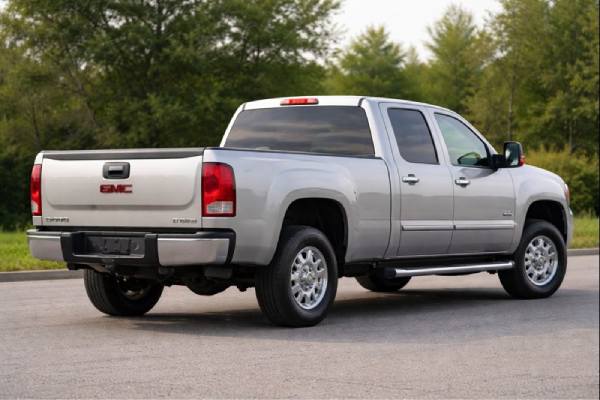
The 2011–2014 GMC Sierra HD RWD on the GMT900 platform is a straightforward heavy-duty pickup with a very specific twist: the 6.0-liter V8 coded LC8, engineered to run on compressed natural gas (CNG) in a factory-approved configuration. For fleets, high-mileage operators, and anyone with dependable access to public or private CNG, it offers predictable operating costs and a familiar GM truck service ecosystem. The RWD layout keeps driveline complexity down compared with 4WD models, which can help long-term maintenance and payload packaging.
What makes this truck worth understanding is the “whole system” approach: hardened valvetrain hardware for gaseous fuel, high-pressure storage equipment, and calibration strategies that prioritize reliability under load. If you buy one used, condition matters more than cosmetics—especially CNG tank age, fuel system integrity, and evidence of correct service intervals.
Owner Snapshot
- Strong low-end torque and stable towing manners for a gas V8 HD truck.
- CNG capability can reduce fuel cost volatility if you have reliable filling access.
- RWD layout is simpler to maintain than comparable 4WD configurations.
- CNG components and tanks add inspection requirements and age-based replacement planning.
- Change engine oil about every 8,000–12,000 km (5,000–7,500 mi) or 6–12 months, depending on duty cycle.
What’s inside
- Sierra HD RWD LC8 explained
- LC8 CNG specs and capacities
- Trims, packages, and safety tech
- Reliability patterns and bulletins
- Maintenance plan and buyer checks
- On-road feel and real use
- Rivals and best alternatives
Sierra HD RWD LC8 explained
Think of this Sierra HD as a conventional GMT900 heavy-duty truck first, and a CNG truck second. The foundation is the familiar HD frame, heavy-duty suspension and brakes, and a drivetrain designed for work. The LC8 6.0-liter V8 is the key differentiator: it’s built to tolerate the different combustion characteristics of gaseous fuel (higher octane, different flame speed, and reduced fuel wash on intake components). In factory-style setups, the truck typically operates as a bi-fuel system (gasoline plus CNG), letting you start, warm up, and run normally even when CNG is not available. This flexibility is a major ownership advantage over aftermarket conversions that may be “dedicated CNG” only.
Why does RWD matter here? For many fleets and highway-based users, RWD provides enough traction while reducing parts count: no transfer case, no front differential, fewer U-joints and seals to monitor, and fewer driveline vibration sources. That simplicity can also help diagnostic clarity: if you have a driveline clunk or vibration, you are chasing fewer possible components than in a 4WD truck. The tradeoff is obvious—less capability in deep snow, mud, and soft ground—so the suitability comes down to your routes and climate.
CNG ownership is less about horsepower and more about infrastructure and inspection discipline. CNG tanks store fuel at very high pressure, and the system includes regulators, solenoids, high-pressure lines, and safety valves. All of these can be reliable for years, but they demand clean, dry fuel and periodic checks for leaks, damage, and corrosion. It also changes day-to-day habits: you plan routes around stations, and you learn the “feel” of a good fill versus a weak, slow, or prematurely stopped fill.
The best way to approach this truck is as a work tool: match the configuration (cab, bed, axle ratio, hitch, payload rating) to what you actually do, then treat the CNG system as a critical sub-system with its own maintenance logic. When the truck is set up correctly, the payoff is steady, predictable service with lower fuel-price surprises.
LC8 CNG specs and capacities
Specifications on GMT900 Sierra HD trucks vary heavily by configuration (2500HD vs 3500HD, cab style, bed length, axle ratio, and emissions certification). The tables below focus on the common technical expectations for a 2011–2014 Sierra HD RWD with the LC8 6.0-liter CNG-capable V8 and 6-speed automatic, but you should confirm your exact build using the glovebox RPO codes (or build sheet) and the emissions label under the hood.
Engine and performance (ICE-only)
| Item | Specification (typical) |
|---|---|
| Code | LC8 |
| Engine layout and cylinders | V8, iron block, aluminum heads; OHV pushrod; 2 valves/cyl |
| Displacement | 6.0 L (5,967 cc) |
| Bore × stroke | ~101.6 × 92.0 mm (4.00 × 3.62 in) |
| Induction | Naturally aspirated |
| Fuel system | Electronic fuel injection; CNG-capable/bi-fuel equipment (application dependent) |
| Compression ratio | ~9.6:1 (varies by calibration) |
| Max power | 360 hp (268 kW) @ ~5,400 rpm (application dependent) |
| Max torque | ~520 Nm (380 lb-ft) @ ~4,200 rpm (application dependent) |
| Timing drive | Chain |
| Emissions and efficiency standard | EPA certification by year and GVWR class |
Transmission and driveline
| Item | Specification (typical) |
|---|---|
| Transmission | 6-speed automatic (commonly 6L90 family in HD gasoline trucks) |
| Gear ratios | 1st 4.03 / 2nd 2.36 / 3rd 1.53 / 4th 1.15 / 5th 0.85 / 6th 0.67 / Rev 3.06 |
| Final drive ratio | Often 3.73 or 4.10 (varies by tow package and GVWR) |
| Drive type | RWD |
| Differential | Open standard; mechanical locker optional on many HD builds (RPO-dependent) |
Chassis and dimensions (range by body style)
| Item | Typical range (varies by cab and bed) |
|---|---|
| Suspension (front/rear) | Independent front (torsion bars); rear multi-leaf solid axle |
| Steering | Hydraulic power steering (ratio varies by year/config) |
| Brakes | 4-wheel disc; rotor sizes vary by GVWR |
| Wheels/tyres | 17–18 in wheel options; LT-rated tyres (load range varies) |
| Length | ~5,600–6,300 mm (220–248 in) |
| Width | ~2,030 mm (80 in) excluding mirrors |
| Height | ~1,950–2,000 mm (77–79 in) |
| Wheelbase | ~3,530–4,030 mm (139–159 in) |
| Turning circle | Typically ~14–16 m (46–52 ft), configuration dependent |
| Kerb weight | Often ~2,700–3,300 kg (6,000–7,300 lb), configuration dependent |
| GVWR | Commonly ~4,200–5,400 kg (9,200–12,000 lb), by model |
Performance and capability (configuration dependent)
| Item | Typical expectation |
|---|---|
| 0–100 km/h (0–62 mph) | ~8.5–11.0 s unloaded (varies by axle ratio and weight) |
| Top speed | Electronically limited (often ~155–170 km/h / 96–106 mph) |
| Towing capacity | Often ~5,000–6,400 kg (11,000–14,000 lb) with proper hitch and gearing |
| Payload | Often ~1,000–1,800 kg (2,200–4,000 lb), varies widely |
| Roof load | Not typically rated for heavy loads; treat as accessory-only unless specified |
Fluids and service capacities (verify for your VIN)
| System | Specification (typical guidance) |
|---|---|
| Engine oil | dexos-approved 5W-30 (many applications); capacity often ~5.7 L (6.0 US qt) with filter |
| Coolant | GM-approved long-life coolant; capacity varies by radiator and cab |
| Transmission/ATF | Dexron VI family (confirm for transmission model); service fill varies |
| Differential | 75W-90 gear oil typical; capacity varies by axle (AAM sizes differ) |
| A/C refrigerant | R-134a; charge varies by cab and rear HVAC |
| Key torque specs | Lug nuts, drain plugs, and suspension fasteners vary by wheel and axle—confirm in service documentation |
Electrical and ignition
| Item | Typical |
|---|---|
| Alternator output | Often 145–160 A in HD applications (varies by upfit and options) |
| 12V battery | One or two batteries depending on package; CCA varies widely |
| Spark plug | Long-life plug type varies by year; gap specification varies by calibration |
Safety and driver assistance
| Item | What to expect |
|---|---|
| Crash ratings | Heavy-duty pickups are not consistently covered by the same public crash-test programs as lighter vehicles; confirm per year and body style |
| Airbags | Front airbags standard; side/curtain coverage depends on cab and options |
| Stability control | ESC and traction control commonly present; tuning differs for towing |
| ADAS | Modern AEB and lane-keeping features are generally not part of this generation’s HD feature set; expect basic stability and brake assist systems instead |
The practical takeaway: the LC8 Sierra HD RWD is mostly about durable mechanicals plus correct configuration. Once you confirm axle ratio, GVWR, hitch class, and CNG system type, you can predict how it will behave and what it will cost to keep healthy.
Trims, packages, and safety tech
For the 2011–2014 facelift years, Sierra HD trims usually follow a clear ladder: Work Truck (WT) for fleets, SLE for value and convenience, SLT for comfort and content, and Denali for high-trim appointments. Where it gets tricky is that CNG-capable builds were commonly ordered as fleet units or special packages, which means “trim level” may not tell the whole story. A plain-looking WT may have a serious alternator/battery setup, a tow-focused axle ratio, upgraded cooling, and a factory-style CNG system—while a nicely trimmed SLT might be configured for lighter towing and more highway comfort.
Trims and options that actually change the truck
- Axle ratio choices (3.73 vs 4.10 are common): This is one of the biggest drivers of towing feel. 4.10 gearing tends to hold gears better on grades and feels more responsive under load, while 3.73 is often calmer at highway speeds and may help fuel use slightly.
- Tow equipment: Look for factory hitch rating, wiring, integrated trailer brake controller (where equipped), and external transmission cooling. These matter more than badge names.
- Locking differential availability: Many HD trucks can be optioned with a mechanical locking rear differential. It helps low-speed traction on gravel, wet grass, and job sites—especially valuable on an RWD truck.
- Cab and seating configuration: Regular cab long bed setups maximize payload practicality; extended and crew cabs trade payload for people capacity and day-to-day comfort.
- Wheels and tyres: LT tyre load range and tread design change ride and traction. A stiff E-rated tyre can make an empty truck feel harsh but improve stability under load.
Quick identifiers to check
- RPO codes: The glovebox label is the fastest “truth source” for axle ratio, differential type, suspension package, and tow equipment.
- CNG hardware clues: Factory-style CNG upfits typically have shielded high-pressure lines, dedicated mounting brackets, and OEM-like routing. Aftermarket conversions can be excellent, but you want documented parts and certified installation.
- Underhood emissions label: It often signals fuel type, emissions family, and whether the vehicle is certified for alternative fuel.
Safety ratings and systems: what’s realistic
This generation of Sierra HD is built around traditional truck safety fundamentals: strong structure, large brakes, and stability control that is tuned for towing. You should expect:
- ABS and electronic stability control to be present on most models.
- Trailer sway mitigation logic to be part of the stability/tow strategy on many builds.
- Airbag coverage that varies by cab style and option packages—do not assume curtains are present on every truck.
Advanced driver assistance systems (automatic emergency braking, adaptive cruise with braking, lane centering) are generally not what this era is known for. Treat it as a truck you drive attentively, not one that actively manages risk for you. If safety tech is a priority, the best strategy is to buy the cleanest, best-maintained example, keep tyres and brakes fresh, and ensure stability and brake systems are functioning exactly as designed.
Reliability patterns and bulletins
The GMT900 Sierra HD is often described as “simple and tough,” and in many ways that’s fair—especially compared with newer trucks loaded with sensors and complex emissions hardware. But reliability on a CNG-capable HD truck is best understood by splitting the story into two layers: the base truck (engine, transmission, suspension, steering, brakes) and the CNG system layer (tanks, regulators, lines, valves, and calibration).
Common, lower-cost issues (annoying, usually manageable)
- Exhaust manifold bolt leaks (common)
Symptoms: ticking noise on cold start; soot marks near the manifold.
Root cause: heat cycles and fastener fatigue.
Remedy: replace broken bolts, inspect manifold flatness, use correct torque sequence. - EVAP and fuel vapor codes (common on gasoline side, occasional on bi-fuel trucks)
Symptoms: check-engine light, difficulty refueling gasoline, intermittent rough start.
Root cause: purge solenoid issues, vent valve problems, aged hoses.
Remedy: smoke test, replace failed valves/hoses, verify correct routing. - Accessory drive wear (common as mileage climbs)
Symptoms: belt squeal, alternator charging warnings, bearing noise.
Root cause: idler/tensioner wear, belt aging, heavy electrical load on work trucks.
Remedy: replace belt and tensioner components proactively; verify alternator output.
Occasional, medium-cost issues (plan for them)
- Transmission shift quality changes under load
Symptoms: shudder, flare, or harsh shifts, often more obvious when towing.
Root cause: fluid degradation, torque converter wear, calibration updates, or driveline angles.
Remedy: confirm correct fluid, check for updated calibrations, service fluid/filter as recommended for severe use. - Front-end wear (ball joints, tie rods, wheel bearings)
Symptoms: wandering steering, clunks over bumps, uneven tyre wear.
Root cause: HD loads and big tyres accelerate wear.
Remedy: inspect at every oil change; correct alignment after parts replacement.
CNG-specific reliability: the “must understand” layer
- High-pressure leaks (common risk, severity can be high)
Symptoms: fuel smell near tanks or fill port, hissing, hard switching to CNG, reduced CNG range.
Root cause: O-ring aging, fitting loosening, regulator seal wear, line abrasion.
Remedy: leak test with proper CNG-rated methods, repair using approved parts, protect lines from chafe points. - Regulator and solenoid performance (occasional)
Symptoms: stalls during fuel switching, rough running on CNG, fault codes for fuel pressure.
Root cause: contamination or moisture in fuel, internal wear, electrical connector corrosion.
Remedy: replace regulator/solenoids as assemblies where required; ensure station fuel quality and filters are correct. - Tank age and certification (severity high if ignored)
Symptoms: none—this is a calendar issue.
Root cause: tanks have service-life and inspection requirements.
Remedy: confirm manufacture date, inspection records, and replacement plan. Avoid “cheap” trucks with expired or undocumented tank status.
Recalls, TSBs, and how to verify
For any Sierra HD of this age, recalls and service bulletins matter more than most buyers assume—especially for work trucks that may have passed through multiple owners. The best practice is simple: run the VIN through an official recall lookup, then confirm completed work through dealer history or receipts. For CNG systems, demand documentation for the upfit and any tank inspections or replacements. A tidy paper trail often predicts a truck that behaves like a tool, not a project.
Maintenance plan and buyer checks
A Sierra HD RWD with the LC8 CNG-capable 6.0 is easy to own when you treat it like a commercial asset: frequent inspections, fluids on time, and a strict approach to anything that can become a safety issue. Below is a practical schedule that fits how these trucks are commonly used. If you tow often, idle for long periods, or run short trips, use the “severe service” side of the intervals.
Practical maintenance schedule (distance or time, whichever comes first)
- Engine oil and filter: every 8,000–12,000 km (5,000–7,500 mi) or 6–12 months.
- Use the correct oil specification for your year and calibration, and do not stretch intervals on a work truck.
- Tyre rotation and brake inspection: every 8,000–12,000 km (5,000–7,500 mi).
- Look for uneven wear that signals front-end looseness or alignment drift.
- Engine air filter: inspect every oil change; replace around 24,000–48,000 km (15,000–30,000 mi) depending on dust.
- CNG operation still needs clean intake air; a clogged filter hurts drivability and economy.
- Cabin air filter (if equipped): every 24,000 km (15,000 mi) or yearly.
- Transmission fluid and filter: around 80,000–160,000 km (50,000–100,000 mi) depending on towing and heat exposure.
- If it tows regularly, lean toward the shorter interval.
- Differential fluid: around 80,000–160,000 km (50,000–100,000 mi); sooner if the axle sees water intrusion or heavy hauling.
- Coolant: every 5 years (or per the coolant type and service documentation).
- Replace hoses and radiator cap if they show swelling, cracking, or pressure issues.
- Brake fluid: every 2–3 years.
- Heavy-duty brakes work hard; moisture in fluid reduces boiling margin.
- Spark plugs: often 160,000 km (100,000 mi) class intervals in many GM applications, but confirm for your exact LC8 calibration and duty cycle.
- 12V batteries: test yearly; expect replacement every 4–6 years depending on climate and electrical load.
CNG system maintenance and inspection essentials
- Leak checks: anytime you smell gas, notice reduced range, or after any underbody work near lines/tanks.
- Visual inspection: at every oil change—look for line chafe, bracket looseness, corrosion, and impact damage near tanks.
- Tank dates and records: verify manufacture date, inspection schedule, and any certification requirements. If records are missing, budget for professional inspection immediately.
Buyer’s guide: what to check before you commit
- Confirm the exact CNG configuration: factory-style bi-fuel vs aftermarket conversion. Ask for installation certificates and parts lists.
- Check for driveline slack: clunks on takeoff can point to U-joints, carrier bearing (if equipped), or differential wear.
- Look for cooling system integrity: towing trucks that ran hot may show stained coolant, soft hoses, or evidence of repeated top-ups.
- Scan for codes and readiness: a clean dash is not enough—use a scan tool to check history and monitor fuel switching behavior.
- Undercarriage corrosion and tank area: road salt plus CNG hardware demands careful inspection around mounts and shielding.
Long-term durability outlook is strong when the truck is not overheated, not overloaded, and the CNG system has documented care. The fastest way to turn one into a money pit is to ignore tank age, buy a “mystery conversion,” or treat it like a half-ton when it is built to work.
On-road feel and real use
Driving a GMT900 Sierra HD RWD is a very different experience from a modern half-ton. You sit higher, the steering feels heavier, and the truck communicates load changes clearly. The payoff is stability—especially when the bed has weight or a trailer is on the hitch.
Ride, handling, and NVH (noise, vibration, harshness)
Empty, the HD suspension can feel stiff, particularly with LT tyres that have high load ratings. Expansion joints and potholes come through the cab more sharply than in lighter trucks. Add a few hundred kilograms of payload and the ride settles down, tracking straighter and feeling more controlled. On the highway, these trucks are generally calm and confidence-inspiring, with a “big vehicle” feel that stays composed in crosswinds—again, especially when properly loaded.
Steering is typically hydraulic and direct enough for an HD truck, but it’s not sports-car precise. What matters is predictability: steady on-center feel, no wandering, and no vibration. If the truck shimmies, it usually points to tyres, wheel balance, worn steering links, or a tired wheel bearing—not a mystery.
Powertrain character on gasoline vs CNG
The 6.0-liter V8’s personality is simple: it likes revs when you ask for power. Unloaded, it feels smooth and linear. Under tow, it will downshift and hold higher rpm on grades, and that is normal. The 6-speed automatic’s Tow/Haul mode is your friend—it raises shift points, increases engine braking, and reduces “gear hunting.”
On CNG, many drivers notice two things:
- Slightly different throttle response (often a bit softer) depending on calibration and conversion type.
- Stable combustion under load, thanks to CNG’s high octane nature, which can feel “clean” and consistent once the system is working correctly.
If your truck is bi-fuel, pay attention to switching behavior. A good system transitions without drama. Hesitation, stalling, or repeated switching attempts are not “normal quirks”—they are diagnosis cues.
Real-world efficiency and operating cost logic
It’s best to think in energy terms. CNG is often priced and measured in gasoline-gallon equivalents (GGE). In practice:
- City use: HD trucks burn energy moving mass, so stop-and-go driving is costly regardless of fuel.
- Highway cruising: the truck can be surprisingly steady when lightly loaded, but gearing and tyre choice matter.
- Towing: expect a noticeable consumption penalty. A moderate trailer can push energy use up dramatically, and headwinds can matter as much as weight.
The ownership advantage is not “great mpg.” It’s cost stability and predictability if CNG pricing and access work for your situation.
Towing and load behavior
For moderate towing, the RWD Sierra HD is stable and reassuring. The key is setup: correct hitch height, good trailer brake control, proper tyre pressures, and conservative speeds. The truck’s braking feel is generally strong for its era, but the confidence you feel depends heavily on brake condition and fluid health. When everything is sorted, it tows like a tool—simple, honest, and consistent.
Rivals and best alternatives
This Sierra HD occupies a niche: a traditional heavy-duty gasoline truck with CNG capability. Rivals can be compared in two ways—by HD gas truck fundamentals and by alternative-fuel practicality.
If you want the same “simple HD” feel
- Chevrolet Silverado HD (same generation)
Mechanically very similar and often easier to shop because there are more of them. If you’re flexible on badges, it can be the best way to find the cleanest truck for the money. - Ford Super Duty gasoline trucks (same era)
Often excellent work platforms with strong aftermarket support. The shopping advantage is wide availability, but CNG integration varies more because many examples rely on aftermarket conversions. Documentation becomes the deciding factor. - Ram HD gasoline trucks (same era)
Competitive in towing and payload, but the ownership experience depends strongly on engine/transmission pairing and maintenance history. Again, alternative-fuel quality hinges on the conversion, not the badge.
If you care most about fuel strategy
- CNG vs diesel
A diesel HD truck can tow more efficiently and often feels stronger at low rpm. But it brings higher parts costs, more complex emissions hardware, and potentially expensive repairs as the truck ages. For owners who tow heavy daily, diesel can win. For mixed use with reliable CNG access, the LC8 truck can be the simpler long-term proposition—especially if you value predictable service and fewer high-dollar emissions failures. - CNG vs propane (LPG)
In some markets, propane infrastructure is easier than CNG. Propane conversions can be robust, but range and refueling experience differ. If your local station coverage favors propane, a well-documented propane HD truck may fit better than a CNG truck you can’t conveniently fuel.
What to choose based on your use case
- Choose the Sierra HD RWD LC8 CNG if you have dependable CNG access, do a lot of highway miles, and want a straightforward work truck with a simpler RWD driveline.
- Choose a diesel rival if you tow heavy frequently, live in mountainous terrain, and accept the risk of higher repair complexity.
- Choose a non-CNG gasoline HD if you cannot confidently fuel CNG week after week; the best fuel system is the one you can use without detours.
In the used market, the cleanest purchase is rarely the “perfect spec.” It’s the truck with verified maintenance, correct towing equipment, honest wear, and—especially for CNG—clear documentation of the fuel system, tank status, and inspection history.
References
- Recalls 2025 (Recall Database)
- Vehicle Detail Search 2025 (Official Database)
- Natural Gas Vehicle Basics – Alternative Fuels Data Center 2020 (Technical Guide)
Disclaimer
This article is for informational purposes only and is not a substitute for professional diagnosis, inspection, or repair. Specifications, torque values, service intervals, and procedures vary by VIN, market, emissions certification, and equipment. Always verify details using official owner information and service documentation for your exact truck.
If this guide helped, please consider sharing it on Facebook, X (Twitter), or your favorite forum to support our work.