
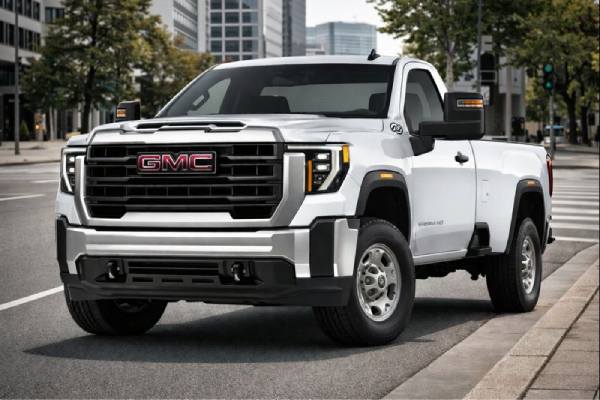
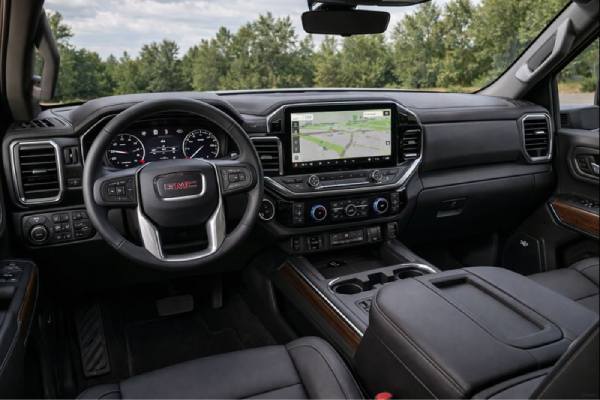
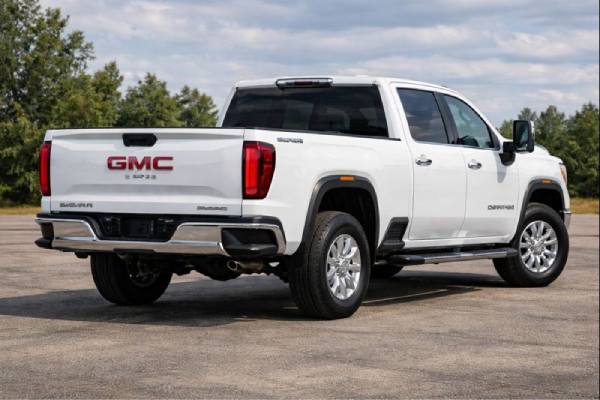
The 2024–present GMC Sierra HD RWD (2WD) with the L8T 6.6L gas V8 is the “work-first” side of the refreshed T1XX heavy-duty lineup. You get modernized trailering hardware, a far more usable cabin tech layout than earlier trucks, and a naturally aspirated engine that stays simple under heat and load compared with turbo-diesel systems. The headline change for facelift trucks is how the powertrain and towing tools work together: the big V8 makes its torque higher in the rev range, so gearing and cooling matter more than ever when you’re hauling. If you maintain fluids on time and spec the right axle and tow package, this configuration can be a durable fleet or owner-operator choice—especially when you value predictable operating costs and straightforward service access.
What to Know
- Strong low-stress towing feel from a large-displacement V8, especially with the right axle ratio and tow package.
- Refresh-era cabin and trailering cameras make hitching, backing, and long trips noticeably easier.
- Lower complexity than diesel ownership (no DEF system), but fuel use rises quickly under load.
- Plan on more frequent brake and tire inspections if you tow weekly or run heavy payloads.
- Change engine oil when the oil-life monitor calls for it or at 12 months, whichever comes first.
Section overview
- Facelift Sierra HD RWD overview
- L8T specs and capacities
- Trim lines and driver assistance
- Reliability watchlist and service actions
- Maintenance plan and buying checks
- Gas V8 driving and towing
- Comparison with HD competitors
Facelift Sierra HD RWD overview
Think of the 2024–present Sierra HD refresh as two upgrades in one: an interior and electronics overhaul you interact with daily, and a towing ecosystem that’s meant to reduce mistakes and fatigue when you’re working alone. In RWD form, these trucks typically serve fleets, contractors, and RV owners who tow on pavement and want maximum payload or a lower curb weight than a 4WD setup. The RWD chassis also removes transfer-case service and reduces front driveline complexity, which can help long-term operating costs if your use case does not demand four-wheel traction.
The L8T 6.6L gasoline V8 is the cornerstone here. It’s a pushrod (OHV) V8 tuned for heavy-duty duty cycles, not peak efficiency. You get a broad, predictable throttle and linear power build—useful when you’re modulating traction with a trailer or carrying a bed full of material. The trade-off is that the engine makes its best pull higher in the rpm band than a diesel, so the transmission will downshift more often on grades, and cooling airflow becomes more important when you’re at sustained high load in hot weather.
“Facelift” matters for ownership because it changes how you live with the truck. Camera coverage and trailer views reduce the stress of hitching and backing, and updated infotainment generally improves stability and usability compared with earlier systems. These improvements don’t show up in a spec sheet, but they can reduce accidental oversteer while backing, trailer jackknifing, and minor hitch damage—small things that add up.
Where RWD buyers should be deliberate is configuration. HD towing numbers vary sharply by cab, bed, axle ratio, tire rating, hitch type (conventional vs gooseneck/5th-wheel), and whether you have single rear wheels (SRW) or dual rear wheels (DRW) on 3500 models. The best “value” setup is usually the one that keeps you comfortably under limits—rather than chasing the maximum rating. If your trailer is near the upper range, prioritize the correct hitch, factory trailering package, integrated brake controller, and a payload margin that accounts for passengers and cargo.
L8T specs and capacities
Below are focused specifications for the facelift-era Sierra HD with the L8T 6.6L gas V8 in RWD form. Exact figures can vary by GVWR, cab/bed, axle, and package content, so treat these as the baseline technical profile and verify against your door-jamb labels and build data.
Engine and performance (L8T)
| Item | Specification |
|---|---|
| Code | L8T |
| Engine layout and cylinders | V8, OHV (pushrod), 2 valves/cyl |
| Bore × stroke | 103.0 × 98.0 mm (4.06 × 3.86 in) |
| Displacement | 6.6 L (6,616 cc) |
| Induction | Naturally aspirated |
| Fuel system | Direct injection |
| Compression ratio | 10.8:1 |
| Max power | 401 hp (298 kW) @ 5,200 rpm |
| Max torque | 629 Nm (464 lb-ft) @ 4,000 rpm |
| Timing drive | Chain (typical for this architecture; confirm by service documentation for your VIN) |
| Emissions and efficiency standard | EPA (market dependent; HD reporting differs by GVWR class) |
Transmission and driveline (RWD)
Most facelift-era L8T trucks are paired with an Allison-branded 10-speed automatic. This matters for towing because it tightens ratio spacing, helping the gas engine stay in its power band without dramatic rpm swings.
| Item | Specification |
|---|---|
| Transmission | Automatic, 10-speed (Allison-branded) |
| Drive type | RWD / 2WD |
| Final drive ratio (common) | 3.73 (varies by configuration) |
Gear ratios (10-speed):
| Gear | Ratio |
|---|---|
| 1st | 4.54 |
| 2nd | 2.87 |
| 3rd | 2.06 |
| 4th | 1.72 |
| 5th | 1.48 |
| 6th | 1.26 |
| 7th | 1.00 |
| 8th | 0.85 |
| 9th | 0.69 |
| 10th | 0.63 |
| Reverse | 4.86 |
Dimensions and chassis (typical ranges)
Because Sierra HD comes in multiple cab/bed combinations, it’s more useful to think in ranges. These are typical for HD pickups in this class and align with common Sierra HD configurations; verify exact measurements for your body style.
| Item | Typical range (approx.) |
|---|---|
| Length | ~5,980–6,760 mm (~236–266 in) depending on cab/bed |
| Width (excl. mirrors) | ~2,060–2,080 mm (~81–82 in) |
| Height | ~1,990–2,050 mm (~78–81 in) |
| Wheelbase | ~3,594–4,370 mm (~141.5–172.0 in) |
| Ground clearance | ~200 mm (~8 in), tire and suspension dependent |
Capability (why the numbers swing)
For L8T-equipped HD trucks, maximum conventional towing typically lands in the mid-to-high 10,000-lb range on many builds, with gooseneck/5th-wheel ratings higher on appropriately equipped 3500 models. Payload and trailer ratings can change by thousands of pounds based on options (diesel vs gas, 2WD vs 4WD, luxury equipment, bed length, DRW, and tire load rating). If you tow often, treat the payload sticker as the governing limit, not the brochure maximum.
Fluids and service capacities (ownership-useful view)
Exact capacities vary by cooling package, oil cooler routing, and service procedure (drain and refill vs overhaul). Use this as a “shopping and planning” table, then confirm the numbers in your owner’s manual and service information.
| System | Specification to use (typical) | Notes |
|---|---|---|
| Engine oil | GM dexos 0W-20 (common for late-model GM gas V8s) | Follow oil-life monitor; towing can shorten intervals |
| Coolant | GM-approved long-life coolant | Verify mix ratio and capacity by VIN |
| Automatic transmission fluid | Low-viscosity ATF specified by GM for the 10-speed | Fluid choice is not interchangeable—confirm exact spec |
| Rear differential | Synthetic gear oil (viscosity varies by axle) | Limited-slip units may require additive or specific fluid |
| Brake fluid | DOT 3/4 as specified by GM | Flush intervals depend on duty cycle and climate |
Trim lines and driver assistance
For the facelift era, Sierra HD trims are best understood as three layers: work-focused (where you pay for capability), comfort-focused (where you pay for time in the seat), and appearance/terrain-focused (where you pay for styling and hardware packages). In RWD form, most buyers land in the work and comfort layers.
Common trims and what changes mechanically
- Pro and SLE (fleet and value builds): These are often the easiest to spec for payload because they avoid heavy luxury equipment. Look here if you need a simple interior, durable seats, and straightforward replacement parts. Many towing and trailer camera features are package-driven rather than trim-locked.
- SLT: A comfort step-up with more standard convenience features. Mechanically, the important part is how frequently SLT trucks are ordered with popular tow and tech packages, which can be beneficial on the used market.
- AT4 (HD): More off-road oriented, but many AT4 HD trucks are 4WD. If you find a rare RWD AT4-type build, focus on tire rating and axle setup—aggressive tires can reduce stability and increase stopping distances under trailer load.
- Denali and Denali Ultimate: These trims are about noise control, seats, and technology. The hidden cost is mass: options can reduce payload, which matters if you load tools and tongue weight on top of passengers.
Options and packages that matter most for RWD owners
- Trailering package and integrated brake controller: If you tow more than occasionally, this should be non-negotiable. It improves braking consistency and reduces aftermarket wiring variability.
- Gooseneck or 5th-wheel prep (if applicable): Factory prep generally improves hitch fitment and bed reinforcement, and it can make resale easier if your region has many RV and livestock buyers.
- Upgraded cooling and charging hardware: Heavy towing is an electrical and thermal stress test. Extra cooling capacity and higher-output charging systems can reduce limp-mode risk when you’re running trailer brakes, auxiliary lighting, and camera systems.
- Camera and trailer-view system: The facelift-era camera suite can be a real safety upgrade for solo operators. It’s also a maintenance item: keep connectors clean and protect camera lenses from road film.
Safety ratings and what to expect
Heavy-duty pickups are not always tested or scored the same way as lighter vehicles in mainstream consumer crash programs. When ratings exist, they can be configuration-specific (cab type, GVWR class, restraint system revision). Practically:
- Use official databases to check whether a star rating exists for your exact configuration.
- If no consumer rating is published, lean on equipment choices: modern seat belts with pretensioners, side-curtain coverage where equipped, and collision-avoidance features that reduce the likelihood of a crash in the first place.
Driver assistance and calibration realities
Depending on trim and packages, you may see features such as forward collision alert, automatic emergency braking, front pedestrian braking, lane departure warning, following distance indicator, blind-spot monitoring (often with trailer-length support), rear cross-traffic alert, and high-beam assist. Two practical ownership notes:
- Windshield and bumper repairs can require recalibration. If your truck has camera- or radar-based features, insist on proper calibration after glass replacement or front-end work.
- Trailer settings matter. Features tied to trailering (blind-spot extensions, camera views, trailer profiles) work best when the trailer profile is set up correctly and the connectors are clean and secured.
Reliability watchlist and service actions
The L8T Sierra HD is generally valued for mechanical simplicity, but “reliability” on a modern HD truck is as much about electronics, sensors, and usage patterns as it is about the engine block. Below is a practical watchlist organized by prevalence and cost tier, with symptoms and likely remedies.
Common (low to medium cost, high annoyance)
- Infotainment glitches or camera dropouts
Symptoms: frozen screen, intermittent rear view, trailer camera not available.
Likely causes: software bugs, loose connectors at trailer camera harness, moisture at plug interfaces.
Remedy: update software where applicable; clean and reseat connectors; inspect harness routing for chafe. - Battery drain or weak-start complaints (work-truck duty)
Symptoms: slow crank after short trips, repeated low-voltage warnings, random module behavior.
Likely causes: heavy accessory use, short-trip charging deficit, aging battery, poor ground connections.
Remedy: battery test with a proper load test; clean grounds; consider a fresh AGM battery if your truck supports it; reduce idle accessory load. - Brake wear accelerated by towing
Symptoms: steering shake under braking, longer pedal travel, pad taper.
Likely causes: heat cycling, trailer brake imbalance, infrequent caliper slide service.
Remedy: inspect pads and rotors more often; service slide pins; confirm trailer brake controller gain is set correctly.
Occasional (medium to high cost, mileage dependent)
- Transmission shift quality issues
Symptoms: harsh 2–3 or 3–4 shifts, hunting on grades, delayed engagement when cold.
Likely causes: adaptive learning out of range, calibration updates needed, fluid condition degraded by heat.
Remedy: check for software updates; verify fluid level and correct specification; address overheating causes (blocked coolers, heavy sustained load). - Direct-injection intake deposit behavior (usage dependent)
Symptoms: rough idle, cold start stumble, gradual power loss.
Likely causes: intake valve deposits typical of some direct-injection engines, worsened by lots of idling and short trips.
Remedy: driving patterns that fully warm the engine help; if severe, professional intake cleaning may be required.
Rare (high cost, verify quickly)
- Cooling system leaks under heavy heat cycles
Symptoms: coolant smell, low reservoir, temperature creep on long grades.
Likely causes: hose clamp seepage, radiator tank seam stress, water pump seep, cap failure.
Remedy: pressure test; repair early to prevent overheating events that shorten engine life.
Recalls, TSBs, and service actions (how to handle them)
Rather than relying on hearsay, treat recall and bulletin work as part of your purchase checklist and annual routine.
- Verify by VIN in an official database. Don’t assume a recall applies just because it’s the same model year.
- Ask for dealer documentation. “Completed” should mean the repair action is recorded, not merely “inspected.”
- Software updates count. Powertrain and infotainment updates can fix drivability, trailer camera stability, and module communication faults. If your truck behaves oddly but no parts are failing, a reflash may be the official remedy.
Pre-purchase checks to request
- Full service history (oil-life monitor records help)
- Proof of recall completion by VIN
- Evidence of recent transmission and differential service if used for towing
- Underbody inspection for impacts, leaks, and harness damage
- Trailer connector function test and a scan for stored module codes
Maintenance plan and buying checks
A Sierra HD that tows often should not be maintained like a commuter half-ton. The best maintenance plan is built around heat, load, and time—not just miles. Use the schedule below as a practical baseline and adjust toward the “severe duty” side if you tow weekly, idle heavily, run short trips, or operate in dust or extreme temperatures.
Practical maintenance schedule (distance or time)
| Item | Normal use | Heavy towing / severe use |
|---|---|---|
| Engine oil and filter | Oil-life monitor or 12 months | Shorten interval; don’t ignore time limit |
| Tire rotation | Every 10,000–12,000 mi (16,000–19,000 km) | Every 6,000–8,000 mi (10,000–13,000 km) |
| Engine air filter | Inspect every oil change; replace as needed | Inspect frequently in dust |
| Cabin air filter | 12 months | 6–12 months depending on environment |
| Brake inspection | At every tire rotation | More often if towing in hills |
| Brake fluid | Every 2–3 years (typical) | Every 2 years is a safer target |
| Transmission fluid | Follow GM schedule; earlier if towing hot | Earlier service can be wise if used hard |
| Rear differential fluid | Follow GM schedule | Earlier service if towing and hot-running |
| Coolant | Follow GM long-life interval | Inspect annually; replace sooner if contamination suspected |
| 12V battery test | Annually after year 3 | Annually after year 2 if accessories are heavy |
Fluid choice discipline (what owners get wrong)
- Use the exact transmission fluid spec. The wrong low-viscosity ATF can change shift behavior and durability.
- Don’t “universal fluid” the axles. Some differentials require specific friction characteristics.
- Control heat. If you tow near limits, keep the radiator and coolers free of debris and bugs.
Essential torque and service notes (decision-useful)
Because torque specs vary by axle and hardware, don’t rely on a single number for every truck. Instead, focus on what you can control:
- Use a torque wrench on wheel lugs after tire rotations and brake work.
- After any driveline service, check for seepage after the first heat cycle and again after a week.
- If you add aftermarket towing gear, confirm mounting torque and recheck after the first towing trip.
Buyer’s guide: what to inspect on a used facelift Sierra HD RWD
Walk-around and underbody
- Uneven tire wear (alignment, ball joints, or overloaded front axle)
- Hitch wear or elongated pin holes (hard use indicator)
- Frame and bed crossmember condition (especially near hitch mounts)
- Fluid seepage at engine, transmission pan, and axle seals
Operational checks
- Cold start quality and idle stability
- Smooth, consistent shifts under light throttle and moderate throttle
- Parking brake function (important if you hitch on grades)
- Trailer plug fit and brake controller operation (test with a trailer if possible)
Which builds to seek
- Trucks with factory trailering equipment, documented service, and payload margin
- Simpler trim builds if payload is critical and you carry tools daily
Which builds to be cautious with
- Maxed-out luxury builds with low payload stickers if you tow a heavy tongue-weight trailer
- Trucks with mismatched tires (load rating matters on HD trucks)
Long-term, the L8T gas setup often rewards owners who keep fluids clean, manage heat, and avoid operating at the ragged edge of payload limits every day.
Gas V8 driving and towing
The facelift Sierra HD with the L8T feels like a modern HD truck should: heavy, stable, and unbothered by rough pavement—especially with a load in the bed. RWD models tend to feel a touch lighter on the nose than 4WD equivalents, and the steering can feel slightly more consistent because you’re not pushing extra front driveline mass around. That said, traction is still tire-dependent; a good set of LT tires with the correct load rating matters more than many owners expect.
Powertrain character
The 6.6L gas V8 delivers power in a calm, progressive way. Around town, it’s easy to meter throttle without the surge you can get from turbocharged engines. Under load, you’ll notice the engine prefers revs: it makes peak torque higher than a diesel, so the transmission works harder to keep you in the sweet spot on grades.
With a 10-speed, the truck can “stair-step” gears to hold speed without dramatic flares. The benefit is steadier engine temperature control and less speed loss on hills. The cost is more frequent shifting and a more active engine note when towing.
Ride, handling, and NVH
- Ride: Unloaded HD ride is firm, especially over sharp joints. With 800–1,500 lb of payload, the suspension often settles into a smoother, more controlled rhythm.
- Stability: Straight-line stability is a strong point. Crosswinds still affect tall trailers, but the chassis feels planted.
- Braking feel: Braking confidence is good when the trailer brakes are set correctly. If the trailer brake gain is too low, you’ll feel the truck doing too much work and heat building in the brakes.
Real-world efficiency (what owners typically see)
Fuel economy depends heavily on speed and load. As a general expectation:
- Empty mixed driving: often lands in the low-to-mid teens (mpg US).
- Highway cruising: can improve with conservative speeds, but aerodynamics and weight limit big gains.
- Towing: expect a noticeable drop; heavy trailers and headwinds can push economy into single digits.
Rather than chasing a specific mpg number, focus on habits that preserve range and temperatures: moderate cruising speeds, correct tire pressures, and letting the transmission do its work instead of forcing tall gears on grades.
Load and towing behavior (practical guidance)
- Plan your gearing strategy. When towing, let the transmission downshift early rather than lugging the engine. Lugging increases heat and can feel “lazy,” but it’s harder on components over time.
- Use tow/haul mode. It typically changes shift scheduling and engine braking behavior to reduce brake heat on descents.
- Watch temperatures, not just speed. If you’re pulling long grades in heat, a small speed reduction can dramatically reduce thermal load.
For frequent towing, the L8T’s best advantage is predictability. It won’t deliver diesel-like torque at low rpm, but it can run hard all day when cooled properly and maintained on schedule.
Comparison with HD competitors
In the heavy-duty gas space, the Sierra HD RWD L8T competes most directly with Ford Super Duty gasoline V8 offerings and Ram HD gasoline powertrains. The “right” choice is usually about how you tow, what you value in the cab, and how long you plan to keep the truck.
Versus Ford Super Duty gas (6.8L / 7.3L, configuration dependent)
Where the Sierra HD L8T often wins
- A refined refresh-era cabin experience and strong trailering camera ecosystem on properly equipped trucks
- A straightforward naturally aspirated character with strong high-load durability when maintained well
- Competitive towing tools that reduce hitching and backing stress
Where Ford may appeal more
- Certain fleet-focused configurations and upfit ecosystem
- Engine and gearing combinations that can feel especially strong in specific towing setups
- Availability patterns and dealer support in some regions
Versus Ram HD 6.4L gas (Hemi)
Where the Sierra HD can stand out
- The L8T’s heavy-duty tuning and cooling focus
- Transmission behavior that can feel more “gear-ready” for grades in some setups
- Strong trailering tech integration when optioned correctly
Where Ram can appeal
- Cab comfort and seating feel (highly subjective)
- Availability of certain packages and ride characteristics depending on axle and suspension choices
- A different power delivery style that some drivers prefer
The diesel alternative (within the same lineup)
Even if you’re shopping gas, it’s worth sanity-checking the diesel option in the same truck family. Diesel can reduce fuel consumption under heavy tow and provide stronger low-rpm pulling. But it adds cost, emissions-system complexity, and potentially higher out-of-warranty repair exposure. The gas L8T is often the better match if:
- You tow moderately, not constantly at maximum ratings
- You do lots of short trips or mixed use where diesel aftertreatment can be less happy
- You want simpler long-term ownership and predictable maintenance
Bottom line
Choose the Sierra HD RWD L8T if you want a refreshed, highly usable HD platform with strong towing support tech and you value simpler gas ownership over diesel complexity. Choose a rival if your best configuration match—payload sticker, axle ratio, hitch type, and tire rating—lands more cleanly in their ordering guide for your exact trailer and cargo reality.
References
- 2024 Sierra HD Catalog 2024 (Brochure)
- Recalls 2025 (Recall Database)
- Vehicle Safety Ratings 2025 (Safety Rating)
- 2024 GMC Sierra HD Owner Manual 2024 (Owner’s Manual)
Disclaimer
This article is for informational purposes only and is not a substitute for professional diagnosis, inspection, or repair. Specifications, torque values, service intervals, and procedures can vary by VIN, market, model year, and equipment. Always verify details using your official owner’s manual, factory service information, and the labels on your specific vehicle.
If you found this guide useful, please consider sharing it on Facebook, X (Twitter), or your favorite forum to help others find it.