
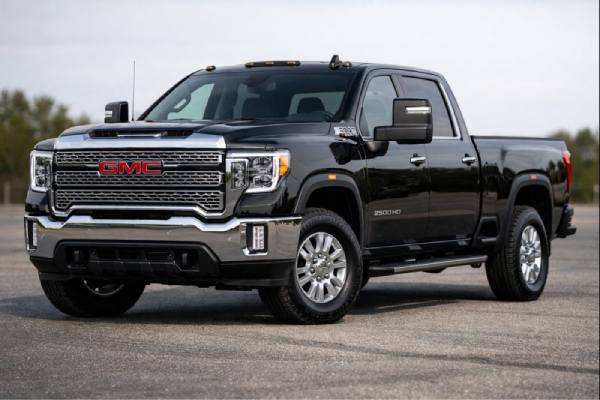
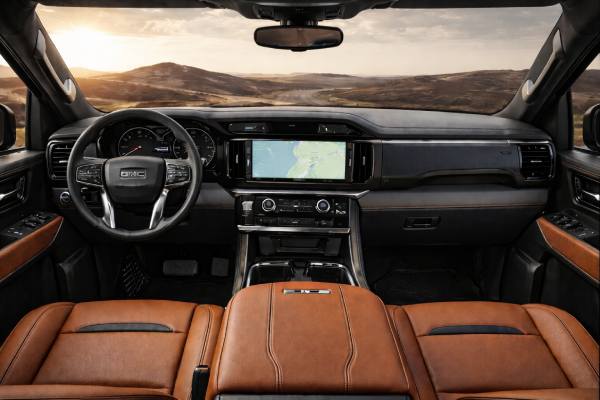

The 2020–2023 GMC Sierra HD RWD on the T1XX platform with the 6.6L L8T gasoline V8 is the “work-first” version of GM’s modern heavy-duty pickup: simpler than 4WD, easier to live with for fleets, and surprisingly refined when unladen. The L8T’s design leans on proven pushrod V8 fundamentals, but adds direct injection and variable valve timing to keep torque broad and response predictable under load. Pair that with the 6L90 6-speed automatic and a stout rear axle, and you get a truck that’s happiest towing, carrying, or idling all day without drama.
RWD matters here. It cuts front driveline complexity and typically reduces maintenance and wear points, but it also places more responsibility on tire choice and ballast when traction is limited. If you’re shopping used, the right axle ratio, cooling, and trailering equipment matter as much as trim.
What to Know
- Strong, predictable low- and mid-range torque makes it well-suited to frequent towing and heavy payloads.
- RWD reduces 4WD-system maintenance and can improve steering feel and turning ease for daily work.
- Expect higher fuel use under load; there is no EPA window-sticker fuel economy for most Sierra HD builds due to weight class.
- If you tow often, plan on earlier transmission and axle fluid service than “light-duty” intervals.
- Typical oil service cadence: follow the Oil Life Monitor, but many owners use 8,000–12,000 km (5,000–7,500 mi) or 12 months as a practical ceiling.
Navigate this guide
- T1XX Sierra HD RWD explained
- L8T 6.6 gas specifications
- Equipment, trims, and driver aids
- Common L8T and chassis problems
- Service schedule and ownership costs
- Real-world driving and towing
- Comparison with heavy-duty rivals
T1XX Sierra HD RWD explained
In Sierra HD form, the T1XX platform (2020–2023 pre-refresh) is built around capacity and stability more than outright agility. The frame, suspension, and braking system are engineered for sustained load: long highway grades, repeated stop-and-go in jobsite traffic, and the kind of trailer tongue weights that make half-tons feel nervous. In RWD configuration, you get the same heavy-duty core—front suspension and steering sized for HD duty, a strong rear axle, and the cooling and electrical capacity intended for commercial use—without the added weight and complexity of a front differential, transfer case, and front driveshafts.
The L8T 6.6L gas V8 is an especially good match for owners who prioritize predictable operating costs, simpler emissions equipment than a modern diesel, and easier cold-weather starting. It makes its torque higher in the rev range than the Duramax diesel, so the driving feel is different: you’ll hear it work when you ask for power, and it will downshift more often on grades. The upside is less diesel-specific upkeep (DEF, DPF regeneration behavior, and diesel fuel-system sensitivity), and often a lower initial buy-in on the used market.
RWD is also a decision about traction and duty cycle. If you operate mostly on pavement, in moderate climates, and tow on maintained roads, RWD can be a net positive: fewer rotating parts up front, fewer fluid services, and fewer driveline seals and joints to age out. But if your work involves mud, steep gravel, snowpack, or frequent launching on wet ramps, 4WD can pay for itself in one stressful day. With RWD, tire selection (load range and compound), proper tongue weight, and sometimes ballast over the rear axle are the real tools that replace a transfer case.
Finally, remember what “Sierra HD” includes: 2500HD and 3500HD vary widely in rear-suspension tuning (especially single-rear-wheel vs dual-rear-wheel), axle ratings, and how they carry load. The L8T exists across that range, so always shop the truck as a system: cab/bed, axle ratio, tires, cooling, and trailering package—not just the engine badge.
L8T 6.6 gas specifications
The tables below focus on the 2020–2023 Sierra HD with the L8T 6.6L gasoline V8 and RWD drivetrain. Some measurements and ratings vary by 2500HD vs 3500HD, cab/bed, axle ratio, and whether the truck is SRW or DRW—so treat ranges as guidance and confirm your VIN-specific placards and build codes.
Engine and Performance
| Item | Spec |
|---|---|
| Code | L8T |
| Layout and cylinders | V8, OHV (pushrod), 2 valves/cyl, hydraulic roller lifters |
| Displacement | 6.6 L (6,564 cc) |
| Bore × stroke | 103.25 × 98.0 mm (4.06 × 3.86 in) |
| Compression ratio | ~10.75–10.8:1 (source-dependent) |
| Induction | Naturally aspirated |
| Fuel system | Direct injection |
| Max power | 401 hp (299 kW) @ 5200 rpm |
| Max torque | 629 Nm (464 lb-ft) @ 4000 rpm |
| Valvetrain highlights | Variable valve timing (cam phasing) |
| Timing drive | Chain (cam-in-block architecture) |
| Fuel | Regular unleaded (87 AKI typically specified) |
Transmission and Driveline
| Item | Spec |
|---|---|
| Transmission | 6L90 6-speed automatic |
| Gear ratios | 1st 4.03 / 2nd 2.36 / 3rd 1.53 / 4th 1.15 / 5th 0.85 / 6th 0.67 / Rev 3.06 |
| Drive type | RWD (2WD) |
| Common axle ratios (varies by build) | 3.73 is common; other ratios may appear by GVWR/tow package |
Chassis and Dimensions
Because HD pickups are sold in many body styles, the most useful way to shop dimensions is by ranges:
| Item | Typical range (varies by cab/bed) |
|---|---|
| Overall length | ~5.9–6.8 m (~232–266 in) |
| Width (without mirrors) | ~2.06–2.09 m (~81–82 in) |
| Height | ~2.0–2.05 m (~79–81 in) |
| Wheelbase | ~3.6–4.4 m (~142–172 in) |
| Ground clearance | Often ~200–260 mm (~8–10 in), trim/tire dependent |
| Bed volume | ~2.0 m³ (≈69.6 ft³) standard bed; ~2.36 m³ (≈83.5 ft³) long bed |
Performance and Capability
Heavy-duty capability is configuration-specific. These are practical, shopping-oriented benchmarks for the L8T:
| Item | What to expect |
|---|---|
| 0–60 mph | Often mid- to high-7s unloaded (driver, fuel, no cargo); slower with tall tires/gearing |
| Braking feel | Strong initial bite, but thermal management matters when towing downhill |
| Max conventional towing | Up to ~7,900 kg (~17,300 lb) in some 2500HD RWD configs when properly equipped |
| Payload | Commonly ~1,400–1,800 kg (~3,000–4,000 lb) depending on 2500/3500 and options |
| GCWR | Varies with axle ratio and equipment; confirm with door label and trailering chart |
Fluids and Service Capacities
Exact capacities depend on oil cooler, auxiliary coolers, axle type, and GVWR package. Use this as a planning checklist and verify for your build:
| System | Typical spec to verify |
|---|---|
| Engine oil | GM dexos1-approved oil (often 0W-20); capacity varies with filter and cooler |
| Coolant | GM-approved extended-life coolant; verify mix ratio and total capacity |
| Transmission | 6L90 ATF spec per GM service info; consider severe-duty intervals if towing |
| Rear differential | Gear oil spec varies by axle/locker; verify friction modifier needs if equipped |
| Brake fluid | DOT 3/4 as specified; change by time due to moisture absorption |
Safety and Driver Assistance
| Category | What’s typical on 2020–2023 Sierra HD |
|---|---|
| Core safety | Multiple airbags, ABS, stability control, trailer sway control |
| Trailering visibility | Rear camera standard; multi-camera trailering views available on higher trims/packages |
| Driver assistance | Forward-collision alerts and lane-departure warnings can be trim/package dependent; confirm by build sheet |
| Crash ratings | HD pickups may have limited published crash-test results compared to light-duty models; verify by exact VIN and model year in official databases |
Equipment, trims, and driver aids
For 2020–2023 Sierra HD, trims matter less for the engine itself—your L8T is the same basic power unit—but they matter a lot for cooling, trailering confidence, and the parts you’ll pay to repair later. The most common trims you’ll encounter are Work Truck (often called Pro), SLE, SLT, AT4, and Denali. RWD examples skew toward Pro/SLE/SLT in fleet and commercial use, but you’ll also find well-optioned private-owner trucks built for long-distance towing.
Start by separating “comfort packages” from “mechanical packages.” Infotainment and leather do not raise tow ratings. Axle ratio, hitch hardware, cooling, and tire load rating do. When shopping, look for signs the truck was ordered to work: integrated trailer brake controller, the correct hitch receiver rating, trailering mirrors, and a factory 7-pin connector. In many builds, those are bundled into trailering packages that also include a higher-capacity cooling setup and more robust alternator/battery provisioning.
Trailering tech is a major differentiator in these years. Higher trims often bring extra camera angles that reduce stress when aligning to a hitch or monitoring a long trailer. If you tow frequently, a camera suite can be worth more than a chrome package because it lowers the odds of low-speed damage and helps you drive straighter in crosswinds and traffic. Also look for the in-vehicle trailering app functions (where equipped), which can store trailer profiles and help with checklists—useful for owners who swap trailers and want consistency.
For safety and driver assistance, be careful with assumptions. Heavy-duty pickups in this era often offered warning-based systems (alerts) more commonly than full hands-on intervention (automatic braking or lane-centering), and availability varies by trim and package. Treat any ADAS feature as “verify by VIN” rather than a guaranteed trim feature. The easiest way to confirm on a used truck is to check the steering wheel and dash controls, then confirm in the infotainment driver-assist menus.
Finally, note year-to-year changes that affect ownership: mid-cycle package shuffles can change which cameras, lighting, or infotainment modules are installed. If you’re comparing two trucks that look similar, the option content can still be different enough to affect both resale value and repair costs. When possible, request the build sheet or RPO (Regular Production Option) list, usually found in the glovebox area, door jamb, or dealer-provided printout.
Common L8T and chassis problems
The L8T’s reputation is generally “commercial-grade simple,” but no heavy-duty truck is immune to age, towing stress, or neglected service. The most helpful way to think about issues is by prevalence and cost tier—because a common annoyance is not the same as a rare, expensive failure.
Common (usually low to medium cost):
- Exhaust manifold leaks or fastener noise: Ticking on cold start that improves warm can point to minor leaks at the manifold or hardware. Remedy is typically hardware replacement, gasket work, and checking for warpage.
- Accessory drive wear: High idle hours and dusty environments shorten belt and tensioner life. Symptoms include squeal, chirp, or visible belt cracking. Remedy is standard belt/tensioner service.
- Cooling system housekeeping: Trucks used for towing or idling can accumulate debris in the radiator/AC stack. Symptoms include rising temps on grades or weak AC in traffic. Remedy is cleaning the stack and verifying fan operation.
Occasional (medium cost):
- Direct-injection fuel system sensitivity: Rough running, misfires, or long cranks can come from injector issues or high-pressure fuel system faults. Use high-quality fuel, keep filters and maintenance current, and diagnose with proper scan data before replacing parts.
- Transmission shift quality under heat: The 6L90 is robust, but towing in hot climates or with neglected fluid can lead to shudder, delayed shifts, or harsh engagement. Remedy may be fluid service, cooler verification, and in some cases torque-converter or valve-body work.
- Steering and front-end wear: Heavy front-axle loads and rough roads can accelerate wear in steering linkages and ball joints. Symptoms include wander, clunks over bumps, or uneven tire wear. Remedy is inspection-based replacement and alignment.
Rare (high cost):
- Internal engine mechanical issues: Any modern V8 can suffer from lifter/cam-related wear if oil quality and change cadence are poor, especially with severe-duty use. The good news is that symptoms often appear early as persistent misfires, noise, or scan-tool faults—so a thorough pre-purchase drive and scan matter.
Service actions, updates, and paperwork:
On 2020–2023 trucks, the smartest reliability move is not guessing which recall applies—it’s verifying completion. Ask for dealer records and run the VIN through official databases. Also ask whether the truck has received any drivability software updates, especially if you feel odd shift behavior or throttle mapping. Updates can improve transmission logic, warning system behavior, and infotainment stability.
Pre-purchase checks that actually save money:
- Review maintenance history and idle hours (if shown). High idle time is real engine time.
- Inspect for leaks at the rear main area, transmission pan, and differential seals.
- Test tow-related electronics: brake controller output, trailer lighting, and camera functions (if equipped).
- Drive at highway speed and brake firmly: vibration can signal rotor issues, and wander can signal worn steering components or alignment problems.
Service schedule and ownership costs
A Sierra HD that tows regularly should be maintained like equipment, not like a commuter car. The best schedule is the manufacturer’s baseline plus a “severe-duty overlay” for towing, heavy payload, short trips, dusty sites, and long idle periods. Below is a practical plan that fits most L8T RWD owners—then you tailor it to your real use.
Practical maintenance schedule
- Engine oil and filter: Follow the Oil Life Monitor, but many owners cap changes at 8,000–12,000 km (5,000–7,500 mi) or 12 months, especially with towing and idling. Use the correct dexos-approved oil grade for your year.
- Engine air filter: Inspect at every oil service; replace every 24,000–48,000 km (15,000–30,000 mi) depending on dust exposure.
- Cabin air filter: Replace every 24,000–48,000 km (15,000–30,000 mi) or annually in dusty/pollen-heavy regions.
- Spark plugs: Many modern GM V8s run long intervals, but for work use, plan inspection or replacement around 160,000 km (100,000 mi) unless the service guide specifies otherwise.
- Coolant: Extended-life coolants often target 5 years / 240,000 km (150,000 mi), but towing and heat cycles justify earlier testing and hoses inspection.
- Transmission fluid (6L90): For towing/severe duty, a conservative interval is 72,000–96,000 km (45,000–60,000 mi); lighter use may go longer. If you tow heavy, this is one of the best “preventive spend” items.
- Rear differential fluid: Inspect for seepage; service around 80,000–120,000 km (50,000–75,000 mi) under towing or frequent load.
- Brake fluid: Time matters more than miles; flush every 2–3 years to reduce moisture-related corrosion and maintain pedal feel.
- Tires: Rotate every 10,000–12,000 km (6,000–7,500 mi); align annually or when wear suggests it.
Fluids, specs, and “decision-grade” torque values
Because exact capacities and torque values vary with axle, wheel, and cooling equipment, use this as a checklist: confirm the exact spec in your official documentation before you buy fluids or torque critical fasteners. Common decision points include whether the truck uses a specific ATF for the 6L90, what gear oil is specified for the rear axle (and whether a locker requires a modifier), and the wheel lug torque for your wheel type. If a seller cannot provide the correct specs or has mixed fluids without documentation, budget for baseline fluid services after purchase.
Buyer’s guide: what to seek and what to avoid
Seek L8T RWD trucks with:
- Documented transmission and axle services (or a price that reflects doing them immediately).
- Factory trailering equipment (brake controller, hitch hardware, tow mirrors) if you tow.
- Tires with correct load rating and even wear—this is a window into alignment and suspension health.
Be cautious with:
- Trucks that show heavy trailer wear (hitch deformation, wiring splices) but no service records.
- Long idle-hour trucks with infrequent oil changes.
- Evidence of repeated overheating (coolant staining, replaced radiators with no explanation).
Long-term durability outlook: when maintained for severe duty, the L8T/6L90 pairing is one of the more straightforward HD ownership propositions—especially for buyers who want HD chassis strength without diesel emissions complexity.
Real-world driving and towing
Unloaded, the Sierra HD RWD can feel surprisingly calm for a truck designed around heavy work. The steering is sized for HD loads, so it’s not “sports quick,” but on-center stability is usually solid, and the truck tracks confidently at highway speeds. Ride quality depends heavily on rear-suspension rating: a 3500HD and any truck equipped for very high payload will feel stiffer when empty, while a 2500HD in a non-max configuration can feel more manageable in daily driving.
The L8T’s personality is honest: it makes good torque, but it delivers that torque in a way that’s more “rev and pull” than “idle and surge.” That means you’ll notice downshifts on grades and during passing, especially with taller tires or a conservative axle ratio. The upside is predictable throttle response and fewer surprises when merging or climbing. With Tow/Haul engaged, the shift logic typically holds gears longer and uses engine braking more assertively, which helps keep service brakes cooler.
Noise, vibration, and harshness (NVH) are generally work-truck appropriate. Expect more engine sound under load than a diesel at the same trailer weight, but also expect simpler cold starts and less sensitivity to fuel quality in day-to-day use. On the highway, wind and tire noise dominate more than engine noise—especially if the truck wears aggressive all-terrains.
Fuel economy is the trade: a large-displacement gas HD will consume noticeably more under load than the diesel, and even unloaded it will not behave like a half-ton. Because many Sierra HD builds fall outside typical EPA labeling categories, owners often rely on real-world tracking. In practice, plan your range conservatively when towing, especially in headwinds or at higher speeds where aero drag grows quickly.
For towing stability, the chassis is the star. Properly equipped, the truck’s longer wheelbase options, strong brakes, and integrated trailer brake controller (when fitted) make it feel planted. RWD is fully capable for towing on dry pavement, but traction becomes the limiter on wet ramps, steep gravel, or snow. If your use includes those conditions, tire choice and weight distribution become as important as horsepower.
Comparison with heavy-duty rivals
In the heavy-duty gasoline space, the Sierra HD RWD L8T competes less on luxury and more on total ownership logic: purchase price, service simplicity, and how confidently it works when the trailer is attached. The closest comparisons are typically Ford Super Duty gas models (7.3L “Godzilla” era trucks) and Ram HD gas models (6.4L HEMI), plus diesel variants of all three for buyers willing to pay diesel complexity for efficiency and low-rpm torque.
Where the Sierra HD L8T tends to stand out is its balance of modern fueling (direct injection) with traditional pushrod simplicity, plus a drivetrain pairing that’s widely understood in the service world. The 6L90 6-speed does not offer the same ratio spread as newer multi-speed automatics, but that simplicity can be a benefit for commercial owners who want predictable behavior and straightforward servicing. The tradeoff is that competitors with more gears may feel smoother or keep the engine in a narrower rpm band on long grades.
Against other gas HDs, the decision often comes down to how you tow:
- If you tow heavy but not constantly, gas HD ownership can be a smart “middle path,” especially when diesel emissions systems or DEF logistics don’t fit your use.
- If you tow very heavy, very often, at highway speeds, diesel still tends to win on relaxed grade-climbing and fuel consumption—at the cost of more complex aftertreatment and higher parts prices.
RWD versus 4WD is another comparison layer. Many rivals are purchased as 4WD by default, which can make RWD Sierra HDs comparatively affordable on the used market. If your routes are paved and your job sites are stable, that can be a genuine advantage. But if your work includes winter traction demands, muddy access roads, or frequent ramp launches, 4WD rivals can reduce stress and risk.
Bottom line: the 2020–2023 Sierra HD RWD with the L8T makes the most sense for owners who want HD chassis strength, gasoline simplicity, and a truck that can tow confidently without the added maintenance and wear points of a front driveline. If your environment regularly challenges traction, the same platform in 4WD may be the better “all-weather tool,” even if it costs more upfront.
References
- 2020 GMC Sierra HD Catalog 2020 (Specifications)
- 6.6L V-8 L8T Gasoline Engine | GM Powered Solutions 2025 (Engine Specs)
- Car Safety Ratings | Vehicles, Car Seats, Tires | NHTSA 2025 (Safety Rating Portal)
- Fuel Economy and Environment Label 2025 (Fuel Economy Label Guidance)
Disclaimer
This article is for informational purposes only and is not a substitute for professional diagnosis, inspection, or repair. Specifications, torque values, service intervals, capacities, and procedures vary by VIN, market, model year, and equipment. Always verify details using your official owner’s manual and service documentation for the exact vehicle you are working on.
If this guide helped, please consider sharing it on Facebook, X/Twitter, or your favorite forum to support our work.