

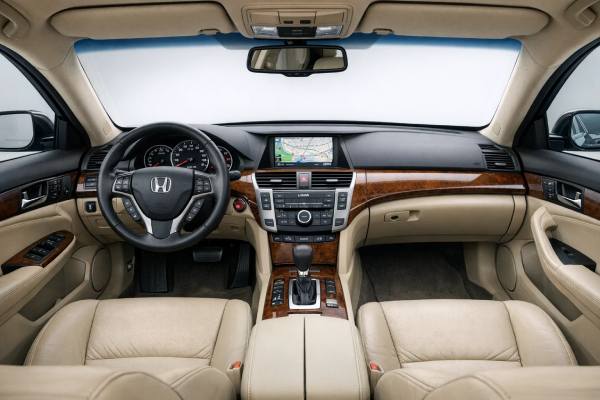

The 2008–2012 Honda Legend (KB1 facelift) is one of those rare “engineer’s sedans” that prioritizes traction, stability, and refinement over badge bragging. The headline change is the larger J37A 3.7-liter V6 paired with SH-AWD (Super Handling All-Wheel Drive), a torque-vectoring system that can actively bias torque side-to-side at the rear. In normal driving, that translates into confident wet-road grip and a calm, planted feel at highway speeds. In spirited driving, it helps the Legend rotate more like a lighter car than its size suggests.
Ownership is mostly about staying ahead of fluids, rubber, and electronics age. If you treat SH-AWD and the automatic transmission as service items—not “lifetime fill” components—the Legend rewards with smooth power delivery, strong long-distance comfort, and a level of real-world usability that still holds up.
What to Know
- SH-AWD traction and stability are standout strengths, especially on wet roads and in winter tyres.
- The J37A V6 is smooth and durable when serviced on schedule, with strong mid-range pull for overtakes.
- Cabin refinement is a core advantage: low NVH, supportive seats, and high-speed composure.
- Budget for drivetrain fluids (ATF and rear diff) more often than many owners expect—neglect is the main reliability trigger.
- Typical timing belt service is due around 170,000 km (105,000 mi) or 7 years (whichever comes first).
Quick navigation
- Facelift KB1 Legend explained
- J37A 3.7 spec tables
- Equipment, packages, and safety tech
- Reliability patterns and known fixes
- Maintenance plan and buying tips
- Road feel and real economy
- Rival sedans worth cross-shopping
Facelift KB1 Legend explained
Honda’s 2008-on facelift for the fourth-generation Legend looks like a styling refresh at first glance—new lighting, bumpers, bonnet/hood, and typically 18-inch wheels—but the meaningful upgrades are mechanical and calibration-focused. The big change is the move to the 3.7-liter J37A V6. Power is commonly quoted as 295 hp (217 kW) in many markets, while some regions list roughly 300 hp under different test standards. Either way, the character is the same: a silky, naturally aspirated V6 with strong mid-range torque, tuned for quiet thrust rather than drama.
The Legend’s defining feature is SH-AWD. Unlike simple “on-demand” AWD systems that mainly wait for slip, SH-AWD can actively distribute torque front-to-rear and side-to-side at the rear axle. In practice, it makes the car feel more stable and predictable in fast lane changes, and more neutral when you accelerate through a bend. For owners in mixed climates, this is a genuine advantage: the Legend is the sort of sedan that feels unbothered by heavy rain, rough surfaces, or cold-weather traction demands—assuming you fit appropriate tyres.
The facelift also brought a more responsive automatic gearbox behavior (and in some markets, later model years moved to a 6-speed unit). Even when the hardware remains similar, the shift logic changes matter: smoother kickdown, better use of torque, and fewer “busy” shifts around town. These cars were engineered to be effortless in real traffic and long motorway runs.
On the ownership side, the Legend is best approached like a premium machine: it rewards preventative maintenance. The drivetrain is robust, but it is not tolerant of fluid neglect—especially the rear differential unit that enables torque vectoring. Suspension bushings, mounts, and braking consumables also age like any heavy, powerful sedan. The good news is that the car’s fundamentals—body structure, cabin build, and powertrain design—tend to age gracefully when you keep the service baseline strong.
J37A 3.7 spec tables
Specs on the KB1 facelift vary slightly by market and model year (especially gearbox details and exact output rating). The tables below reflect the J37A 3.7 V6 / SH-AWD configuration commonly associated with the 2008–2012 facelift Legend.
Powertrain and efficiency
| Item | Specification |
|---|---|
| Code | J37A (market-specific suffixes exist) |
| Engine layout and cylinders | V6, 6 cylinders; SOHC; 4 valves/cyl |
| Displacement | 3.7 L (3664 cc) |
| Bore × stroke | 90.0 × 96.0 mm (3.54 × 3.78 in) |
| Induction | Naturally aspirated |
| Fuel system | PGM-FI multi-point injection (PFI/MPFI) |
| Compression ratio | ~11.2:1 (market-dependent) |
| Max power | ~295 hp (217 kW) @ ~6300 rpm (rating standard varies) |
| Max torque | ~371 Nm (274 lb-ft) @ ~5000 rpm (typical listing) |
| Timing drive | Belt |
| Rated efficiency | Commonly ~11–12 L/100 km combined (region and test-cycle dependent) |
| Real-world highway @ 120 km/h (75 mph) | Often ~9.5–10.8 L/100 km (driving style, tyres, temperature matter) |
| Aerodynamics | Cd and frontal area vary by documentation; expect “executive sedan” typicals rather than class-leading |
Transmission and driveline
| Item | Specification |
|---|---|
| Transmission | 5-speed automatic on many early facelift cars; some later markets/models use a 6-speed automatic |
| Drive type | AWD (SH-AWD with rear torque vectoring) |
| Differential | Active rear torque-vectoring unit; front differential integrated with transaxle (design varies by spec) |
Chassis, brakes, and tyres
| Item | Specification |
|---|---|
| Suspension (front/rear) | Independent double wishbone / independent multi-link |
| Steering | Rack-and-pinion with assist (equipment varies by market) |
| Brakes | 4-wheel disc; ABS, EBD, brake assist (diameters vary by year/market) |
| Wheels/tyres | Commonly 18-inch wheels; tyre sizes vary (often around 245-width fitments) |
Dimensions and capacities
| Item | Specification |
|---|---|
| Length | ~4957 mm (195.2 in) |
| Width | ~1845 mm (72.6 in) |
| Height | ~1450 mm (57.1 in) |
| Wheelbase | ~2800 mm (110.2 in) |
| Turning circle (kerb-to-kerb) | Typically ~11.6–12.0 m (38–39 ft), equipment dependent |
| Kerb weight | Typically ~1860 kg (4101 lb), equipment dependent |
| Fuel tank | Commonly ~73 L (19.3 US gal / 16.1 UK gal) |
| Cargo volume | Typically ~450 L (about 16 ft³), measurement method varies |
Performance and capability
| Item | Typical value |
|---|---|
| 0–100 km/h (0–62 mph) | ~7.0–7.5 s (market and transmission dependent) |
| Top speed | Often limited to ~250 km/h (155 mph) in some markets |
| Braking 100–0 km/h | Commonly in the high-30 m range on good tyres (test dependent) |
| Towing | Market-dependent; some regions do not rate towing for this model |
Fluids and service capacities (use as decision guides; verify by VIN)
| System | Spec | Typical capacity (approx.) |
|---|---|---|
| Engine oil | 0W-20 or 5W-20 meeting current API/ILSAC equivalent; quality filter | ~4.3 L (4.5 US qt) with filter |
| Coolant | Honda Type 2 long-life (premix) or equivalent; typical 50/50 | ~8–9 L (8.5–9.5 US qt) |
| Automatic transmission | Honda/Acura ATF (DW-1 commonly used as service fill) | Drain/fill often ~3.0–3.5 L; total varies by gearbox |
| SH-AWD rear diff | Acura/Honda DPSF (dual-pump fluid type) | Often ~1.1–1.3 L |
| A/C refrigerant | R-134a (most markets/years) | Charge varies by system label |
Electrical (typical)
| Item | Typical |
|---|---|
| Alternator output | Often around 130 A class (market dependent) |
| 12V battery | Size/spec varies; use OE-equivalent with correct venting and CCA |
| Spark plugs | Long-life iridium type; gap per service literature |
Safety and driver assistance (typical availability)
| Area | Notes |
|---|---|
| Airbags | Front, side, and curtain airbags common; exact count and knee airbag availability vary |
| Stability and braking | ABS, stability control, traction control are standard in most markets |
| Driver assistance | Depending on package/market: adaptive cruise, collision mitigation braking, parking sensors, reversing camera, blind-spot monitoring |
Equipment, packages, and safety tech
The KB1 facelift Legend was usually sold as a high-spec flagship rather than a wide trim ladder. That means your “trim selection” often comes down to market naming (Executive/Advance/Technology equivalents), plus a smaller set of option bundles: audio/navigation, driver-assist features, and comfort items like ventilated seating.
Trims and options: what changes in real life
In many regions, you’ll see a single well-equipped grade with leather, navigation, premium audio, xenon/HID or later lighting variants, and memory seating. Where packages do exist, focus on differences that affect ownership:
- Driver-assistance pack: adaptive cruise control and collision-mitigation braking can add expensive sensors and calibration requirements. They are useful on long commutes, but repairs can be pricier after minor bumper damage.
- Parking tech: front/rear sensors and a camera reduce bumper scuffs. If they fail, it’s often wiring, sensors, or a control module rather than “the whole system.”
- Audio and infotainment: premium systems age well when kept dry and electrically healthy. Navigation-era hardware can be slow by modern standards, but it’s usually reliable unless a unit has suffered voltage events.
Quick identifiers when shopping:
- Look for SH-AWD badging and confirm tyre matching (brand/model and wear depth should be close across all four corners).
- Check the steering wheel for paddle shifters (common on facelift cars).
- Confirm the presence of ACC/CMBS controls if you specifically want those features; retrofits are not realistic.
Safety ratings and what they mean here
Safety ratings can be confusing because the Legend/RL was tested under different programs, and test protocols evolved during the car’s life. The key point: the structure and restraint systems were engineered to a high standard for its era, and the car generally performs strongly in the mainstream crash modes that were emphasized at the time.
When reading any rating:
- Confirm the exact test year and protocol (older “moderate overlap” tests are not the same as later “small overlap” tests).
- Note that roof strength and head restraint performance are separate sub-scores and can differ from front/side performance.
- Understand that ADAS features are not part of many older crash ratings, even though they can reduce real-world crash risk when functioning correctly.
ADAS and calibration implications
If your Legend has radar-based cruise or collision mitigation:
- Windshield replacement, bumper repairs, alignment changes, and sensor removal can require calibration procedures.
- After purchase, it’s smart to run a full diagnostic scan so you know whether warning lights were “cleared” rather than actually fixed.
- In winter climates, keep sensor areas clean; many “faults” are simply blocked sensors.
Bottom line: a well-optioned Legend is a comfortable, modern-feeling long-distance sedan even today, but higher driver-assist content raises the importance of good repair history and careful bodywork checks.
Reliability patterns and known fixes
The KB1 facelift Legend’s reliability story is less about catastrophic design flaws and more about how the car reacts to deferred maintenance. Treat it like a premium AWD sedan with a torque-vectoring rear unit, and it generally behaves like one—excellent when serviced correctly, frustrating when it isn’t.
Below is a practical “prevalence × cost” map to keep expectations realistic.
Common (most owners will encounter)
- SH-AWD rear differential fluid degradation (medium cost, high annoyance)
Symptoms: low-speed shudder, binding sensation on tight turns, chatter when parking, or a “dragging” feel.
Likely cause: old or incorrect rear diff fluid; heat cycling and shear degrade it.
Remedy: correct-spec fluid exchange (often multiple drain/fills), then keep a shorter interval going forward. If ignored too long, internal wear can become expensive. - Automatic transmission shift quality issues from aged ATF (medium cost)
Symptoms: flare, harsh 2–3/3–4 shifts, torque-converter shudder at light throttle, delayed engagement when cold.
Likely cause: neglected ATF, especially if the car did short trips.
Remedy: staged drain/fills with the correct fluid; software updates where applicable; address mounts if vibration persists. - Suspension wear in bushings and links (medium cost)
Symptoms: clunks over sharp bumps, vague steering on-center, inner tyre wear, instability under braking.
Likely cause: normal aging of rubber components on a heavy AWD sedan.
Remedy: replace worn control arm bushings/ball joints, stabilizer links, and align properly.
Occasional (depends on climate, mileage, and past repairs)
- Electrical “gremlins” from low voltage (low-to-medium cost)
Symptoms: intermittent warning lights, infotainment resets, keyless quirks, slow cranking.
Cause: aging battery, weak charging performance, corroded grounds.
Remedy: battery test, alternator output verification, clean grounds, ensure correct battery spec. - A/C performance decline (medium cost)
Symptoms: weak cooling, noisy compressor, inconsistent vent temps.
Cause: age-related leaks, condenser damage, compressor wear.
Remedy: leak test, repair, correct recharge by weight. - Brake vibration (low-to-medium cost)
Symptoms: steering shake under braking.
Cause: uneven pad transfer or warped-feeling rotors from heat.
Remedy: quality pads/rotors, correct bedding, check caliper slide pins.
Rare (but expensive when it happens)
- Rear differential mechanical damage (high cost)
Usually a “neglect outcome” rather than random failure. If you feel consistent binding or hear persistent whining, take it seriously. - Timing belt-related damage (very high cost if the belt fails)
The J37A uses a timing belt. Failure risk rises sharply with age, not just mileage. A complete belt service is non-negotiable for long-term peace of mind.
Recalls, service bulletins, and verification
Because these cars were sold across multiple markets, recall campaigns can vary by region and VIN range. Your best practice:
- Run the car’s VIN through the official recall database in your country.
- Ask a dealer to confirm completion history.
- Treat missing documentation as “not done” until proven otherwise.
A well-maintained Legend is usually dependable. A neglected one can be deceptively expensive because SH-AWD and premium electronics raise the cost of catching up. Your goal as an owner is to keep the car in the “fluid-fresh, rubber-healthy, voltage-stable” zone.
Maintenance plan and buying tips
A sensible maintenance approach for the KB1 facelift Legend is built around two truths: it’s a timing-belt V6, and SH-AWD depends on clean, correct fluid. If you follow that logic, the rest of the schedule looks familiar.
Practical maintenance schedule (baseline)
Use this as a conservative plan if you don’t trust the service history. If the car has a factory maintenance minder system, treat it as guidance—not permission to ignore time-based items.
| Item | Interval (distance/time) | Notes |
|---|---|---|
| Engine oil and filter | 8,000–10,000 km (5,000–6,000 mi) or 6–12 months | Shorter if mostly city, cold starts, or high-speed runs |
| Cabin air filter | 20,000–30,000 km (12,000–18,000 mi) or yearly | Keeps HVAC clean; easy win |
| Engine air filter | 30,000–45,000 km (18,000–28,000 mi) | Inspect more often in dusty areas |
| Brake fluid | Every 2–3 years | Moisture control matters for pedal feel and ABS health |
| Coolant | ~5 years initially, then ~3 years (region dependent) | Use correct long-life type; avoid mixing |
| Spark plugs | ~160,000 km (100,000 mi) | Replace coils only if needed |
| Timing belt + tensioner + water pump | ~170,000 km (105,000 mi) or 7 years | Do it early if history is unknown |
| Automatic transmission fluid | 40,000–60,000 km (25,000–37,000 mi) | Drain/fill cycles are common; avoid “flush” without a plan |
| SH-AWD rear diff fluid | 25,000–40,000 km (15,000–25,000 mi) | Shorter if you do lots of tight urban driving |
| Tyre rotation and alignment check | 10,000–15,000 km (6,000–9,000 mi) | Critical on AWD to prevent driveline stress |
| 12V battery test | Annually after year 4 | Voltage stability prevents many false faults |
Key service choices that protect the drivetrain
- Match tyres closely: SH-AWD systems dislike large rolling-radius differences. Keep the same brand/model, and replace in pairs or sets depending on wear.
- Staged ATF changes beat neglect: if fluid is dark and history is unknown, multiple drain/fills over a short period is often safer than a single aggressive exchange.
- Do the belt service as a package: belt, tensioner, idlers, and water pump together is the value move.
Essential torque values (verify by service literature)
Use these as general decision aids only:
- Wheel lug nuts: typically around 108 Nm (80 lb-ft)
- Engine oil drain plug: typically around 39 Nm (29 lb-ft)
- Spark plugs: often ~18 Nm (13 lb-ft) for long-reach plugs (confirm exact spec)
Buyer’s guide: what to check before purchase
Service history questions
- Timing belt date and mileage (invoice proof)
- ATF and rear diff fluid change records (what fluid was used?)
- Any SH-AWD shudder complaints and how they were fixed
- Battery age and charging system checks
Physical inspection checklist
- Tight-turn parking lot test: listen/feel for binding or shudder
- Highway cruise at steady throttle: note vibration or converter shudder
- Suspension: clunks, uneven tyre wear, steering wander
- Brakes: vibration, pulling, or inconsistent pedal
- Electronics: climate control function, infotainment stability, all cameras/sensors
Which years to seek?
- If your market offered later transmission updates, those can be worth targeting for efficiency and shift quality.
- If you want driver-assist features, prioritize clean bodywork history—sensor cars punish sloppy repairs.
Durability outlook: with documented belt service and consistent drivetrain fluid care, many Legends run long and remain tight-feeling well past “typical executive sedan” mileage. The car is not cheap to reset from neglect, but it is very satisfying to maintain correctly.
Road feel and real economy
The Legend’s driving experience is defined by composure. It feels heavier than sport sedans in quick transitions, but it also feels more stable and settled at speed—especially in poor weather. For many owners, that’s the point: you buy a Legend to arrive calm.
Ride, handling, and NVH
- Ride: generally supple over long-wave bumps, with firm control on undulations. On worn 18-inch tyres or with tired dampers, harshness can creep in—so suspension condition matters more than people expect.
- Handling balance: SH-AWD gives the car a secure front end and helps it rotate under power rather than simply pushing wide. It’s not a drift tool; it’s a confidence tool.
- Steering feel: typically accurate and predictable, with more isolation than a sports sedan. Worn bushings can make it feel vague; fresh front-end rubber restores precision.
- Braking feel: strong and consistent when the system is healthy. Brake vibration is usually a maintenance/setup issue (pads, rotor condition, caliper slides) rather than a fundamental flaw.
- Cabin noise: one of the Legend’s real strengths. Wind and road noise are well suppressed for the era, and the V6 is quiet at cruise.
Powertrain character
The J37A delivers smooth torque without turbo lag. You don’t need to chase redline for progress; it pulls confidently from the mid-range. The automatic gearbox is tuned for unobtrusive shifts, and many cars respond well to a gentle “reset” of fluid condition and adaptation if they feel lazy or rough.
If you test-drive:
- Do a rolling acceleration from 60–100 km/h (37–62 mph). The car should pull cleanly without hesitation.
- Try manual mode or paddles. Delayed response can indicate software behavior, but harshness can indicate fluid or mount issues.
Real-world efficiency
Expect fuel use typical of a 3.7 V6 AWD executive sedan:
- City: often 13–15 L/100 km (18–16 mpg US) depending on traffic and temperature
- Highway (100–120 km/h): often 9.5–10.8 L/100 km (25–22 mpg US) if tyres and alignment are right
- Mixed: commonly 11–12.5 L/100 km (21–19 mpg US)
Cold weather and short trips can push consumption up noticeably. Premium fuel is commonly recommended for full performance, and many owners report smoother running and better consistency when they follow that guidance.
The payoff is the way the car behaves when conditions are bad: SH-AWD traction and the Legend’s stability make it feel like a quiet, fast train that doesn’t get rattled by real roads.
Rival sedans worth cross-shopping
The KB1 facelift Legend sits in a niche: flagship comfort with a distinctly “Honda” engineering mindset. It competes best against other mid-to-late 2000s executive sedans that offer AWD or strong chassis control, but it brings a different flavor than the usual German choices.
Lexus GS 350 AWD
Why consider it: excellent long-term reliability reputation, strong resale in many markets, refined drivetrain.
Where the Legend wins: SH-AWD’s cornering confidence and the “planted” all-weather feel can be more engaging.
Ownership note: Lexus parts availability can be strong; the Honda may be rarer depending on region.
Infiniti M37x / M35x
Why consider it: lively performance feel and often more responsive steering.
Where the Legend wins: calmer NVH, more “set-and-forget” stability, and often better winter confidence when tyres are comparable.
Ownership note: check transmission behavior and electronics history on both.
Audi A6 (AWD variants)
Why consider it: cabin design, technology, and strong highway manners; some engines are very capable.
Where the Legend wins: simpler naturally aspirated power delivery and generally fewer “premium European” maintenance surprises when kept to schedule.
Ownership note: Audis can be wonderful, but you must buy based on documented service and correct engine/transmission pairing.
BMW 5 Series xDrive / Mercedes E-Class 4MATIC
Why consider them: classic executive benchmark feel, strong chassis tuning, broad specialist support.
Where the Legend wins: SH-AWD’s torque-vectoring character in poor grip and a more understated, durable interior vibe.
Ownership note: German rivals often offer sharper dynamics, but can be less forgiving of deferred maintenance in different ways.
The Legend’s core advantage in this field
If you value predictable all-weather behavior and long-distance serenity, the Legend’s engineering makes sense. It’s not the fastest, lightest, or most fashionable choice—but it is a deeply competent one. The best examples feel “expensive” in the way they go down the road, and they keep that feeling if you maintain the fluids, belt service, and suspension baseline.
References
- Extensive Updates for the Honda Legend 2008 (Press Release)
- 2012 Acura RL 2012 (Safety Rating)
- Vehicle Detail Search – 2012 Acura RL | NHTSA 2012 (Recall Database)
- Fuel Economy of 2012 Acura RL 2012 (Official Fuel Economy Data)
Disclaimer
This article is for informational purposes only and is not a substitute for professional diagnosis, inspection, or repair. Specifications, torque values, service intervals, and procedures can vary by VIN, market, model year, and equipment. Always verify details using the official owner’s manual and service documentation for your specific vehicle.
If you found this guide useful, please consider sharing it on Facebook or X (Twitter) to support our work.