
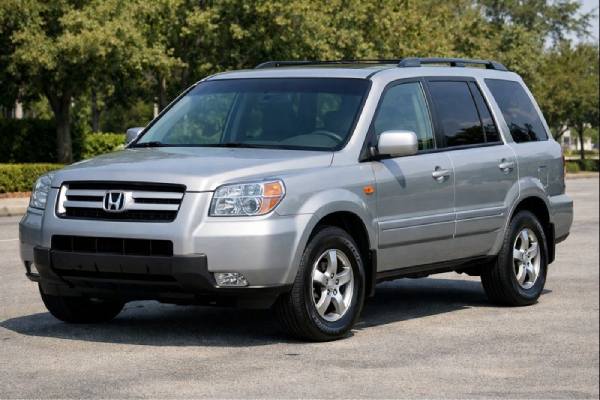
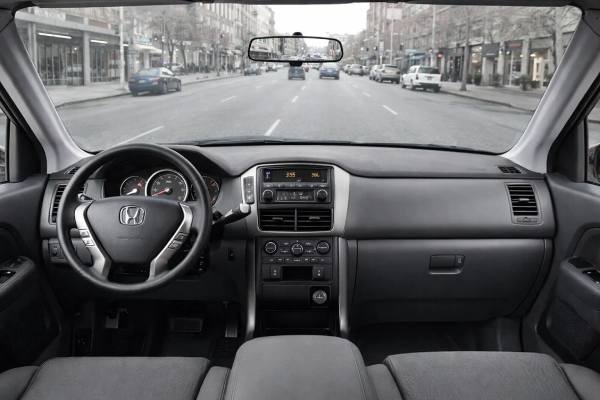
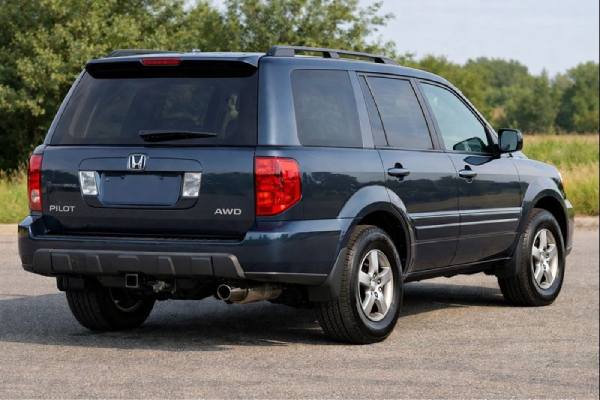
The facelifted 2006–2008 Honda Pilot AWD (YF1) is the “mature” version of the first-generation Pilot: quieter, better equipped for family duty, and meaningfully improved in crash protection compared with earlier years. In AWD form (VTM-4 system), it keeps the simple, durable formula—3.5-liter V6, 5-speed automatic, and a unibody chassis tuned more for stability and comfort than sharp handling. The upside is easy everyday driving, predictable winter traction, and strong towing ability for the class when correctly equipped. The trade-off is that upkeep matters: timing-belt service is non-negotiable, fluid condition directly affects driveline behavior, and age-related rubber and electrical items can add up. If you want a three-row SUV that feels “honest” and maintainable, this Pilot is still a smart used buy—when you choose carefully.
At a Glance
- Solid AWD traction with a simple, predictable system that works well on snow, wet grass, and gravel.
- Comfortable ride and stable highway manners; a good long-distance family SUV.
- Strong towing capability for a midsize SUV when equipped and loaded within limits.
- Timing-belt interval and drivetrain fluids are critical—skipping them is where “reliable Hondas” get expensive.
- Plan engine oil service about every 8,000–12,000 km (5,000–7,500 mi) or 6–12 months, depending on use.
Section overview
- Honda Pilot AWD facelift deep dive
- Honda Pilot AWD numbers and capacities
- Honda Pilot AWD trims and driver aids
- Failure trends and recall checks
- Care schedule and purchase screening
- Road manners and fuel use
- Cross-shopping midsize SUVs
Honda Pilot AWD facelift deep dive
Think of the 2006–2008 Pilot AWD as a three-row crossover built before crossovers became “car-soft.” It’s a unibody SUV with real ground clearance, a boxy cabin that prioritizes space, and a drivetrain engineered for predictable traction rather than rock-crawling. The facelift years matter because Honda did more than tweak styling: crash structure improvements and broader airbag coverage made these years the safest first-gen Pilots to target.
The J35A9 3.5-liter V6 is a smooth, naturally aspirated V6 with strong midrange torque—ideal for a vehicle that often runs loaded with people, luggage, or a trailer. It’s paired to a 5-speed automatic that’s generally durable when fluid condition stays clean and the cooler circuit is healthy. The main driving character is “effortless.” It pulls cleanly from low rpm, doesn’t demand constant downshifts, and stays relaxed at highway speeds.
AWD is handled by Honda’s VTM-4 system. In normal driving it behaves like a front-drive crossover until slip is detected, then it sends torque rearward through an electronically controlled rear clutch pack. The key owner benefit is confidence in low-grip situations—slippery hills, wet launches, light off-pavement work. It’s not a full-time locking center differential system, but it’s effective when you use the right tires and don’t overload it with heat (long wheelspin, heavy sand, repeated hard launches).
As an ownership proposition, this Pilot rewards “baseline discipline.” If you treat it like a heavy family vehicle and service it on time, it tends to age gracefully. If you treat it like a low-maintenance appliance and ignore fluids and rubber parts, the same vehicle can start to feel sloppy—clunks in the front end, driveline shudder, and small leaks that turn into larger jobs. The biggest advantage is that most common issues are known, diagnosable, and fixable without exotic tools. The biggest risk is buying one with unknown history and hoping it will “Honda” its way out of neglect.
Honda Pilot AWD numbers and capacities
Below are practical, ownership-focused specs for the facelift 2006–2008 Pilot AWD. Some dimensions vary slightly by trim (LX vs EX) and equipment; where that’s common, ranges are shown.
Powertrain and efficiency (AWD focus)
| Item | Specification |
|---|---|
| Engine code | J35A9 |
| Layout | V6, SOHC i-VTEC, 24 valves (4 valves/cyl) |
| Displacement | 3.5 L (3,471 cc) |
| Bore × stroke | 89.0 × 93.0 mm (3.50 × 3.66 in) |
| Induction | Naturally aspirated |
| Fuel system | PFI (port fuel injection) |
| Timing drive | Belt |
| Max power | 244 hp (182 kW) @ rpm (varies by market test standard) |
| Max torque | ~325 Nm (240 lb-ft) class output (varies by market test standard) |
| Rated efficiency (EPA, 2006 example) | 15/20 mpg US city/highway (15.7/11.8 L/100 km) |
| Real-world highway @ 120 km/h | Commonly ~12.5–14.5 L/100 km (16–19 mpg US), tires and load dependent |
Transmission and driveline
| Item | Specification |
|---|---|
| Transmission | 5-speed automatic |
| Drive type | AWD (VTM-4) |
| Rear drive unit | Electronically controlled clutch pack; not a full-time locked center diff |
| Differentials | Open front; rear clutch-based torque transfer |
Chassis, dimensions, and weights
| Item | Specification |
|---|---|
| Front suspension | Independent (strut-type layout) |
| Rear suspension | Independent multi-link style |
| Steering | Power-assisted rack-and-pinion |
| Brakes | 4-wheel disc (ABS standard) |
| Most common tire sizes | 245/65 R17 common on EX; 235/70 R16 common on LX (market-dependent) |
| Wheelbase | 2,700 mm (106.3 in) |
| Length | 4,779 mm (188.0 in) |
| Width | 1,943 mm (76.5 in) LX; 1,969 mm (77.5 in) EX (typical) |
| Height (AWD) | ~1,791 mm (70.5 in) LX; ~1,821 mm (71.7 in) EX (typical) |
| Ground clearance | ~200 mm class (varies by tires and load) |
| GVWR (AWD) | 2,700 kg (5,950 lb) |
| Fuel tank | 73.6 L (19.4 US gal / 16.2 UK gal) |
Capability (towing and load) — when properly equipped and within limits
| Item | Typical value |
|---|---|
| Max trailer weight (boat trailers, with coolers) | Up to 2,045 kg (4,500 lb), then reduced with higher occupant/cargo load |
| Max trailer weight (other trailers, with coolers) | Typically lower than boat trailer rating; load-dependent |
| Combined weight guidance | Must respect GCWR and reduce allowance at altitude (per manual guidance) |
Fluids and service capacities (common service-relevant items)
| System | Specification | Capacity |
|---|---|---|
| Engine oil | 5W-20 typical; verify for climate and market | 4.3 L (4.5 US qt) change w/ filter; 5.0 L (5.3 US qt) total |
| Engine coolant | Honda-type coolant; verify spec for your region | 7.6 L (8.0 US qt) 2WD; 8.3 L (8.8 US qt) AWD class |
| Automatic transmission fluid | Honda ATF spec for era (verify exact) | ~3.3 L (3.5 US qt) per drain/refill; ~7.8 L (8.3 US qt) total AWD class |
| Rear differential (VTM-4) | Honda rear diff fluid (verify exact) | ~2.6 L (2.79 US qt) |
| Windshield washer | Washer fluid | 4.5 L (4.8 US qt) |
| A/C refrigerant | R-134a (most markets) | Verify under-hood label; varies |
Safety and driver assistance (baseline)
This generation predates modern camera/radar ADAS. Safety is primarily structural design, airbags, ABS, and stability/traction control where equipped.
- Crashworthiness highlights for 2006–2008 include improved structure for offset frontal performance and standard side curtain airbags across all three rows on 2006+ models (per IIHS notes for the 2006–08 rating applicability).
- Expect ABS and front airbags throughout; stability control availability can vary by trim and year, so confirm by VIN build and interior switchgear.
Honda Pilot AWD trims and driver aids
For most markets, the facelift Pilot range is anchored by LX and EX, with higher trims adding comfort and convenience rather than major mechanical changes. The AWD hardware is fundamentally the same concept across trims, but tow equipment, wheels/tires, and interior features can shift how the vehicle feels and what it’s worth to you.
Trims and options: what usually changes
- LX vs EX (typical): EX commonly adds upgraded wheels/tires, more convenience features, and may bundle stability/traction features more consistently depending on market. LX often has simpler interior materials and fewer electronic features—sometimes a plus for long-term aging.
- Seating and cabin: Most are 8-passenger configurations with a second-row bench. Some markets/options emphasize comfort (heated seats, premium audio), but these don’t change the mechanical fundamentals.
- Towing equipment: The key functional “option set” is towing readiness—hitch hardware and, more importantly, cooling provisions and wiring. The owner’s manual guidance ties tow ratings to proper equipment, so treat “comes with a hitch” as only the starting point. A clean factory-style install with correct wiring and evidence of maintenance is what you want.
Quick identifiers in the driveway
- VTM-4 controls: AWD models typically have VTM-4 labeling and a lock function control (confirm in your market). If the interior has the related switchgear and the rear differential service history exists, you’re looking at a better-cared-for example.
- Tire size and wheels: Wheel size differences can hint at trim level and also affect ride comfort. The Pilot is heavy; a softer sidewall can improve ride quality, while larger wheels can sharpen steering feel slightly but raise tire cost.
- Third-row airbag coverage: Facelift years generally improved safety equipment consistency. If you’re shopping within 2006–2008, confirm curtain airbags and seatbelt condition in all rows.
Safety ratings: how to interpret them
- IIHS (U.S.): For the 2006 Pilot, IIHS lists Good ratings for moderate overlap front (original test) and side (original test), and notes that the rating applies to 2006–08 models. It also calls out structural changes beginning with 2006 models and that side curtain airbags became standard for all three rows.
- Euro NCAP: Not all U.S.-market vehicles have directly comparable Euro NCAP star ratings for these exact configurations, so don’t force a comparison if you can’t match the test protocol and model spec.
Driver assistance reality check (no modern ADAS)
This Pilot is from the pre-AEB era. If you’re expecting automatic emergency braking, adaptive cruise, or lane centering, you won’t find it here. What you do get is simpler: stable braking with ABS, traction control where equipped, and an AWD system that reduces “surprise” in slick conditions. That simplicity can be an advantage long-term: fewer sensors to calibrate, fewer cameras to fail, and fewer modules that can turn a minor impact into a costly repair.
Failure trends and recall checks
Reliability on the 2006–2008 Pilot AWD is best understood as “strong core hardware, sensitive to maintenance quality.” Below are common patterns, grouped by prevalence and cost severity. Mileage and age bands are approximate because condition matters as much as odometer reading.
Common (low to medium cost)
- Front suspension wear (bushings, links, ball joints):
Symptoms: clunks over bumps, vague steering, uneven tire wear.
Root cause: heavy front-end load plus age-hardening rubber.
Remedy: inspect control arm bushings, stabilizer links, and ball joints; align after replacement. - Engine mounts and drivetrain “thump”:
Symptoms: clunk on shifts, vibration at idle in gear.
Root cause: mount rubber fatigues with heat cycles and torque loads.
Remedy: replace the failed mount(s); verify idle speed and misfire status so mounts aren’t blamed for an engine issue. - Brake judder and caliper slide issues:
Symptoms: steering wheel shake under braking, uneven pad wear.
Root cause: rotor hot spots, sticky slide pins, or neglected brake service.
Remedy: service slide pins, replace rotors/pads as a set if needed, and flush brake fluid periodically.
Common (medium to high cost if ignored)
- Timing belt overdue:
Symptoms: often none until it’s too late.
Risk: belt-driven cam timing means a belt failure can cause major engine damage on many designs.
Remedy: treat timing-belt service as a purchase requirement unless documented recently, including tensioner and water pump best practice. - Automatic transmission shift quality sensitivity:
Symptoms: harsh 2–3 shift, flare, delayed engagement, or shudder.
Root cause: old ATF, heat stress, or internal wear.
Remedy: correct fluid type, staged drain-and-fill servicing when appropriate, and check for cooler health—especially on tow-used vehicles.
Occasional (medium cost)
- Rear differential/VTM-4 fluid neglect:
Symptoms: groan or chatter on tight turns, shudder in low-speed maneuvers.
Root cause: degraded rear diff fluid and clutch pack behavior.
Remedy: drain and refill with the correct fluid; confirm tire sizes match across axles (mismatched tires can mimic diff problems). - Cooling system aging:
Symptoms: slow coolant loss, fluctuating temps, heater performance changes.
Root cause: hoses, radiator end tanks, or clamps aging.
Remedy: pressure test, replace weak hoses and radiator if needed, and keep coolant fresh.
Rare but worth screening (high cost)
- Rust and corrosion hotspots (region dependent):
Symptoms: seized fasteners, brake line concerns, subframe rust.
Root cause: road salt exposure and long-term moisture.
Remedy: underbody inspection before purchase; prioritize clean-body examples in harsh climates. - Electrical gremlins from water intrusion:
Symptoms: intermittent warning lights, odd power accessory behavior.
Root cause: clogged sunroof drains (if equipped), door seals, or prior repairs.
Remedy: verify drains, check for wet carpets, and scan for stored codes.
Recalls, TSBs, and verification
Even well-maintained vehicles can have open recalls. The practical approach is simple:
- Run the VIN through the official recall database and print results.
- Ask the seller for dealer invoices showing completion.
- If uncertain, a Honda dealer can confirm campaign completion history.
If you’re buying blind, assume at least one “paperwork gap” and budget time to confirm recall status rather than trusting verbal assurances.
Care schedule and purchase screening
A well-kept 2006–2008 Pilot AWD usually feels tight, quiet, and predictable. A neglected one often feels “busy”: driveline shudder, suspension noise, and small leaks. The schedule below is a practical baseline; always cross-check your VIN, market, and driving conditions.
Core maintenance schedule (practical baseline)
- Engine oil and filter: every 8,000–12,000 km (5,000–7,500 mi) or 6–12 months. Short-trip driving and cold climates push you toward the shorter end.
- Air filters:
- Engine air filter: inspect every 15,000 km (10,000 mi); replace as needed.
- Cabin air filter: every 15,000–25,000 km (10,000–15,000 mi), depending on dust/pollen.
- Coolant: replace on schedule for your coolant type; many owners treat 5 years / 100,000 km (60,000 mi) as a conservative maximum on older vehicles if history is unknown.
- Spark plugs: typically 160,000 km class intervals on many Honda V6 applications, but confirm the plug type and service history.
- Timing belt service: treat as mandatory at the manufacturer interval or sooner if there’s no proof. Best practice is belt + tensioner + water pump together, because labor overlaps.
- Automatic transmission fluid: drain-and-fill intervals matter more on tow-used vehicles. If history is unknown, a careful, staged service plan is safer than a “panic flush.”
- Rear differential (VTM-4): service more frequently than a 2WD axle because the clutch pack relies on fluid condition for smooth engagement.
- Brake fluid: every 2–3 years is a sensible baseline; moisture-laden fluid harms ABS components and braking feel.
- Tires and alignment: rotate every 8,000–10,000 km (5,000–6,000 mi). Keep all four tires matched in size and wear to protect AWD behavior.
- 12 V battery and charging system: test annually; older Pilots can mask a weak battery until cold weather hits.
Fluid specifications and capacities (buyer-friendly summary)
- Confirm exact fluid specs for your market, but the bigger point is consistency: use the correct Honda-era ATF and correct rear diff fluid, and don’t mix unknown coolants.
- If receipts show “generic ATF” or “universal gear oil” without clarity, treat that as a negotiating point and plan corrective service.
Used-buyer inspection checklist (high yield)
- Cold start: listen for rattles, belt noise, or rough idle. A healthy J35 should settle quickly.
- Transmission behavior: check for delayed engagement from Park to Drive, flare, or harsh shifts when warm.
- Low-speed tight turns: in a parking lot, do slow figure-eights. Shudder/groan can suggest rear diff fluid issues or mismatched tires.
- Suspension: drive over small bumps with the windows cracked—clunks reveal worn links or bushings.
- Cooling system: look for dried coolant residue, oil contamination, or a sweet smell after the drive.
- Underbody: inspect brake lines, subframe areas, and exhaust corrosion if you live in salt regions.
- Towing evidence: hitch wear, wiring quality, and transmission temperature history matter. A tow-used Pilot can be great—if maintained correctly.
Durability outlook
If you buy one with proof of timing-belt service, clean ATF history, and regular rear diff fluid changes, the facelift Pilot is one of the more dependable “old-school” family SUVs to keep running. The key is that it’s not tolerant of skipped intervals—especially the belt and fluids that keep the drivetrain happy.
Road manners and fuel use
The facelift Pilot AWD drives like a well-weighted family vehicle: stable, calm, and easy to place on the road. The steering is light to moderate in effort and prioritizes predictability over sharp feedback. On-center stability is a strong point—especially compared with some truck-based SUVs of the era—so it’s comfortable for long highway days.
Ride, handling, and NVH (noise, vibration, harshness)
- Ride quality: tuned for comfort. It absorbs broken pavement well, though worn suspension bushings can make it feel busy or clunky. Fresh dampers and good tires noticeably restore the “one-piece” feel.
- Cornering: safe and progressive. You’ll feel body roll, but it doesn’t feel unstable when the chassis is healthy. Good tires matter more than people expect because the vehicle’s weight leans heavily on tire sidewalls.
- Cabin noise: generally reasonable for the era. Wind noise is acceptable, and the V6 stays smooth at cruise. Tire choice can be the biggest variable—some all-terrain patterns add a lot of hum.
Powertrain character
The J35A9 V6 is strong where you use it most: merging and passing. Throttle response is clean and linear, and the 5-speed automatic typically shifts smoothly when fluid condition is good. Under heavy load, it will downshift decisively rather than lug the engine. If you notice frequent gear hunting on gentle hills, look first at tire size changes, transmission fluid condition, and whether the engine is running clean (no misfires, no clogged air filter).
Real-world efficiency
For AWD examples, official EPA ratings for the era commonly land around 15 mpg city / 20 mpg highway / 17 mpg combined (about 15.7 / 11.8 / 13.8 L/100 km). In real use:
- City-heavy, short trips: expect higher consumption, often 16–18 L/100 km depending on traffic and temperature.
- Highway at 100–120 km/h: many owners see roughly 12.5–14.5 L/100 km with normal loads and correct tire pressures.
- Winter penalty: cold starts and winter fuel blends can add a meaningful increase, especially with short commutes.
Traction and control in AWD form
VTM-4 works best when you treat traction as a system: matched tires, correct pressures, and no excessive wheelspin. On snow, a good winter tire transforms the Pilot more than any drivetrain option. If you tow or regularly climb steep, low-grip surfaces, prioritize transmission cooling health and rear differential fluid condition—heat management is what separates “confident AWD” from “why does it shudder?”
Towing and load behavior
When properly equipped and loaded within limits, the Pilot can tow confidently for a midsize unibody SUV. The key is not the maximum number—it’s how you achieve stable towing:
- Keep tongue load appropriate (too little causes sway; too much lightens steering).
- Use a good hitch setup and verify cooling provisions.
- Expect a notable fuel-consumption increase when towing; a 20–40% penalty is common depending on trailer shape and speed.
Cross-shopping midsize SUVs
If you’re shopping a 2006–2008 Pilot AWD, you’re likely choosing between other three-row crossovers and a few older body-on-frame SUVs. The best choice depends on what you value: towing confidence, interior packaging, long-term repair simplicity, or modern safety tech (which this era won’t match).
Pilot AWD vs Toyota Highlander (same era)
- Why choose the Pilot: typically feels more “SUV-like” in stance and cargo packaging, with a straightforward drivetrain and strong towing reputation when correctly equipped.
- Why choose the Highlander: often smoother around town, sometimes slightly better fuel economy depending on configuration, and a reputation for refinement.
- Decision tip: if you prioritize third-row practicality and towing use, the Pilot tends to fit. If you prioritize daily comfort and a softer driving feel, Highlander can win.
Pilot AWD vs Ford Explorer (mid-2000s)
- Why choose the Pilot: generally more car-like on pavement and often easier to keep consistent in terms of handling and braking feel as it ages.
- Why choose the Explorer: some trims can tow strongly and have a more “truck-ish” feel some buyers prefer.
- Decision tip: choose based on maintenance history and rust condition. A clean, documented vehicle matters more than badge comparisons at this age.
Pilot AWD vs Honda’s own alternatives (MDX of the era)
- Why choose the Pilot: simpler ownership cost profile, and often cheaper tires and parts.
- Why choose the MDX: more premium feel and often more consistent feature content.
- Decision tip: buy condition, not marketing. A well-kept Pilot can be the smarter long-term value if you don’t need luxury features.
Where the facelift Pilot shines
- Family logistics: boxy packaging, comfortable ride, and stable highway manners.
- Winter capability: AWD + proper tires equals confident daily traction.
- Serviceability: common jobs are familiar to independent shops; no exotic systems.
Where rivals can beat it
- Modern safety and ADAS: newer vehicles (even newer used ones) offer AEB and better lighting.
- Fuel economy: some competitors—especially later-generation crossovers—can be noticeably cheaper to run.
- Cabin tech: infotainment and connectivity are dated; upgrades are possible but not “native.”
Bottom line
Pick the Pilot AWD if you want a durable, straightforward three-row SUV and you’re willing to maintain it like a machine—not a disposable appliance. Pick a rival if you need newer safety tech, better fuel economy, or a more modern cabin experience.
References
- 2006 Pilot Online Reference Owner’s Manual 2006 (Owner’s Manual)
- 2006 Honda Pilot 4-door SUV 2006 (Safety Rating)
- Gas Mileage of 2006 Honda Pilot 2006 (Fuel Economy Data)
- Vehicle Detail Search – 2006 HONDA PILOT 4 DR AWD | NHTSA 2006 (Recall Database)
Disclaimer
This article is for informational purposes only and is not a substitute for professional inspection, diagnosis, or repair. Specifications, torque values, service intervals, and procedures can vary by VIN, market, model year, and installed equipment. Always verify details using your official owner’s manual and service documentation for your exact vehicle.
If this guide helped you, please consider sharing it on Facebook, X/Twitter, or your favorite forum to support our work.