
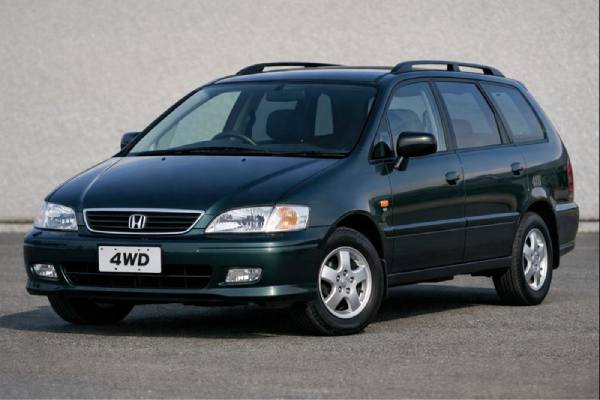
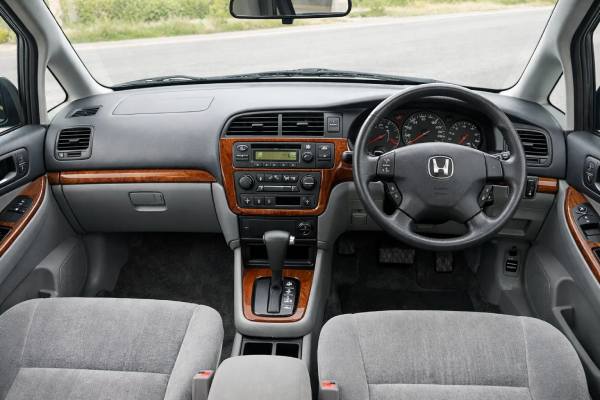
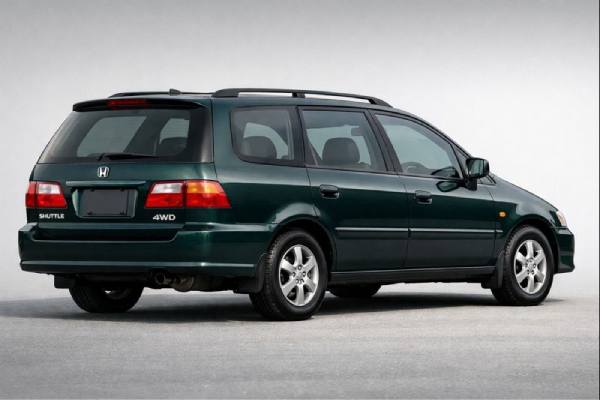
Honda’s first-generation Shuttle/Odyssey has a rare mix of traits: it sits low like a passenger car, carries people like a minivan, and in RA2 form adds 4WD hardware for better traction when the weather turns. The packaging is the secret. A transverse 2.2-liter four-cylinder keeps the nose compact, while the long wheelbase and flat floor make three-row seating genuinely usable. For owners today, the appeal is not just space—it is the way the RA2 drives with calm, predictable responses, helped by double-wishbone suspension at both ends.
The trade-off is age and complexity. A 4WD driveline adds extra seals, bearings, and fluid service points, and any neglected cooling or timing-belt history can turn a good vehicle into a project. If you approach the RA2 as a “maintained machine” rather than a cheap people carrier, it rewards you with stable road manners, winter confidence, and long-term practicality.
Quick Specs and Notes
- Car-like stability from a low center of gravity and double-wishbone suspension front and rear.
- 4WD improves traction on wet and snowy climbs without the bulk of an SUV.
- Plan on more upkeep than FWD: rear driveline fluids, extra CV joints, and more seals to monitor.
- Replace the timing belt on schedule (commonly every 90,000–100,000 km or 6–7 years, market-dependent).
- Consider rear driveline fluid service every 30,000–40,000 km as preventive maintenance on older 4WD systems.
Jump to sections
- How the RA2 4WD is built
- RA2 F22B8 technical specifications
- Equipment, trim clues, and safety
- Known problems and service actions
- Maintenance plan and buyer’s checklist
- Real-world driving and efficiency
- RA2 4WD versus rivals
How the RA2 4WD is built
The RA2 is best understood as a family vehicle engineered with passenger-car priorities. Instead of building height into the body like a traditional van, Honda kept the floor low and stretched the wheelbase. That single choice improves three things owners notice immediately: step-in height, high-speed stability, and how “natural” the vehicle feels on a winding road. A long wheelbase also spreads cabin space across all rows, which matters more than overall length when you are trying to fit adults behind adults.
Chassis layout is another key part of the RA2 identity. Double-wishbone suspension front and rear is not just a brochure highlight—it is a geometry choice that helps keep the tires upright through suspension travel. Practically, that means the vehicle can stay composed over rough pavement and mid-corner bumps, with less of the “lean and float” sensation many tall MPVs develop as they age. Steering feel is also more car-like, and it responds well to fresh bushings and a proper alignment.
The 4WD system is the RA2’s ownership divider. Compared with a FWD Shuttle/Odyssey, you add a propshaft, rear differential, rear axles, and additional mounts and seals. In slippery conditions, that hardware can transform the vehicle’s usefulness: pulling away on wet paint lines, climbing icy side streets, and maintaining traction when the front tires are overwhelmed by a steep grade. The downside is predictable: more parts that can leak, more joints that wear, and more fluids that must be kept clean.
Because the RA2 is now decades old, condition matters as much as design. A maintained RA2 feels tight and stable; a neglected one often shows the same pattern: sagging dampers, tired bushings, and driveline shudder from worn mounts or mismatched tires. The best examples are not necessarily the lowest-mileage ones—they are the ones with documented timing-belt work, cooling-system refreshes, and regular fluid services across both the transmission and rear driveline.
If your goal is a winter-capable family hauler that still drives like a Honda, the RA2 formula holds up. The trick is buying and maintaining it with the assumption that every rubber part and every fluid is on a clock.
RA2 F22B8 technical specifications
Below are owner-relevant specifications for the Honda Shuttle 4WD (RA2) with the 2.2-liter F-series engine commonly listed as F22B8. Specs can vary by market, build date, and equipment, so treat these as a baseline and confirm against the chassis plate and your exact driveline configuration.
Powertrain and efficiency
| Item | Specification |
|---|---|
| Code | F22B family (often cataloged as F22B8) |
| Engine layout and cylinders | Inline-4; transverse mount |
| Valvetrain | SOHC; 4 valves per cylinder |
| Bore × stroke | 85.0 × 95.0 mm (3.35 × 3.74 in) |
| Displacement | 2.2 L (2,156 cc) |
| Induction | Naturally aspirated |
| Fuel system | PGM-FI (electronic fuel injection) |
| Compression ratio | 8.8:1 |
| Max power | 145 PS (107 kW) @ 5,600 rpm (often listed around 143–150 hp depending on rating) |
| Max torque | 196 Nm (145 lb-ft) @ 4,600 rpm |
| Timing drive | Belt |
| Rated efficiency | Period cycle data varies by market; expect higher consumption in modern city traffic |
| Real-world highway @ 120 km/h (75 mph) | Commonly 8.5–10.0 L/100 km (28–24 mpg US / 33–28 mpg UK) in good condition |
| Aerodynamics | Cd and frontal area are not commonly published for this variant |
Transmission and driveline
| Item | Specification |
|---|---|
| Transmission | 4-speed automatic (electronic control, lock-up function) |
| Drive type | 4WD |
| Differential | Typically open (traction depends on tires and system engagement strategy) |
Chassis and dimensions
| Item | Specification |
|---|---|
| Suspension (front/rear) | Double wishbone / double wishbone |
| Steering | Rack and pinion |
| Brakes | Disc front and rear (equipment may vary by trim/market) |
| Wheels and tyres | Commonly 205/65 R15 (rim 15 in) |
| Ground clearance | 155 mm (6.1 in) |
| Length / width / height | 4,750 / 1,770 / ~1,660–1,690 mm (187.0 / 69.7 / ~65.4–66.5 in) |
| Wheelbase | 2,830 mm (111.4 in) |
| Turning circle (kerb-to-kerb) | ~5.7 m (18.7 ft) |
| Kerb weight | Commonly ~1,530–1,600 kg (3,373–3,527 lb), trim-dependent |
| Fuel tank | Often 65 L (17.2 US gal / 14.3 UK gal), sometimes listed as 60 L |
Performance and capability (typical real-world expectations)
| Item | Typical range |
|---|---|
| Acceleration 0–100 km/h (0–62 mph) | ~11–13 s (condition and load sensitive) |
| Top speed | Often ~170–180 km/h (106–112 mph), market-dependent |
| Braking distance 100–0 km/h | Strongly dependent on tires and brake condition; prioritize fresh fluid and healthy calipers |
| Towing, payload, roof load | Verify on your market’s data plate or manual; equipment differences matter |
Fluids and service capacities (owner decision values)
| System | What to use and why it matters |
|---|---|
| Engine oil | Use a quality oil suited to climate; typical viscosity is 5W-30 or 10W-30 depending on temperature range. Fill to dipstick, not just a number. |
| Coolant | Use a compatible long-life coolant and correct mix ratio; keep the system clean and sealed to avoid overheating. |
| Transmission and ATF | Use the correct Honda-spec ATF for the era; avoid “universal” fluid guesses. Drain-and-fill is often safer than an aggressive flush on unknown-history units. |
| Rear driveline | Use the correct fluid type for the rear differential/4WD hardware; wrong fluid can cause noise, wear, or chatter. |
Electrical and ignition
| Item | Practical note |
|---|---|
| Alternator output | Varies by market and accessory load; verify by part number if replacing |
| 12 V battery | Choose the correct physical size and cold-cranking rating for winter use |
| Spark plugs | Use the correct heat range; set gap to specification for your ignition system |
Safety and driver assistance
| Item | What to expect |
|---|---|
| Crash ratings | Public, directly comparable Euro NCAP or IIHS ratings are often unavailable for this Japan-market-era MPV variant |
| ADAS | This generation predates modern ADAS suites; safety depends heavily on ABS presence, tires, and maintenance |
Equipment, trim clues, and safety
On paper, the RA2 family was offered in multiple “types” and option groupings, but in today’s used market the practical differences come down to safety equipment, seating layout, and comfort features. Many vehicles have also crossed borders as imports, which means trim labels in listings can be inconsistent. The best approach is to identify your exact equipment by physical inspection and chassis plate information, then shop parts by chassis code and build date rather than by a seller’s trim description.
Trims and options that change how the RA2 feels
- Seating configuration (6 vs 7): A 6-seat layout often uses second-row captain’s chairs, which improves long-trip comfort and makes third-row access easier. A 7-seat layout increases flexibility for kids and carpool duty. If you frequently carry adults, the 6-seat arrangement usually “feels” like a better vehicle even if the headline capacity is lower.
- ABS availability: In a 1990s family vehicle, ABS can be the biggest real-world safety upgrade. Some examples have it, others do not. Confirm the ABS lamp does a normal bulb-check at key-on and goes out after start, and confirm braking behavior on a safe surface if possible.
- Airbags (SRS): Driver and passenger airbags vary by market and year. Check that the SRS light follows correct self-check behavior (on briefly at key-on, then off). A permanently off light can be as suspicious as a permanently on one.
- Wheels and tires: Factory-style 15-inch tire packages typically suit the suspension and steering best. Oversized wheels may look modern, but they can worsen ride quality and accelerate wear in ball joints and bushings, especially on rough roads.
Quick identifiers for accurate parts ordering
- Chassis plate: Confirm “E-RA2” and the chassis number range. This is the anchor for correct driveline and electrical parts.
- 4WD hardware check: Visually confirm the presence of a rear differential and rear axles. If the vehicle has been modified or repaired with mixed parts, the chassis plate alone may not tell the full story.
- Brake hardware: Confirm front and rear brake types and rotor dimensions when ordering parts; decades of repairs can lead to mixed calipers or aftermarket substitutions.
Safety: how to evaluate it without modern ratings
Even if you cannot find a clean modern crash rating that maps directly to the RA2, you can meaningfully improve real safety by focusing on fundamentals:
- Tires first: Use fresh tires with correct load rating and matched sizes across axles. For 4WD drivetrains, keep tread depth consistent to reduce drivetrain stress.
- Brakes as a system: Replace brake fluid every two years, inspect rubber hoses, and ensure caliper slides move freely. Old fluid and sticking calipers are common on older disc setups.
- Belts and seats: Confirm seatbelts retract strongly and lock properly. If you carry children, use modern child seats that fit the belt geometry correctly.
- Lighting and visibility: Restore headlight clarity and aim; upgrade bulbs responsibly. Being seen and seeing well is a large part of safety in older vehicles.
The RA2’s safety story is less about technology and more about condition. A well-maintained RA2 with good tires, healthy brakes, and working ABS and SRS can be a trustworthy family tool, even without modern driver assistance.
Known problems and service actions
The RA2’s reliability is fundamentally strong when maintained, but its age means most issues are no longer “design flaws” so much as predictable wear patterns. The goal is to separate low-cost annoyances from the faults that can strand you or cause expensive secondary damage. Below is a practical map by prevalence and severity, followed by what to do about recalls and service actions.
Common and usually manageable
- Oil leaks and seepage (low to medium cost)
Symptoms: oil smell after driving, wet lower engine, drips after parking, oil residue near timing covers.
Typical causes: valve cover gasket, cam and crank seals, distributor-area seals, and aged oil pan sealing surfaces.
Best fix: reseal the “highest leak first” so oil does not migrate onto the timing belt area. Leaks left alone often become timing-belt contamination problems rather than just driveway stains. - Cooling system fatigue (medium cost, high consequence)
Symptoms: temperature creep in traffic, heater output changes, unexplained coolant loss, sweet smell after shutdown.
Typical causes: aging radiator tanks, tired radiator cap, old hoses, stuck thermostat, weak fan switches or relays.
Best fix: treat cooling as a system. A 25-year-old radiator that “still works” can still fail under pressure on a hot day. - Suspension wear and alignment drift (medium cost)
Symptoms: clunks over bumps, inner tire wear, vague on-center tracking, steering wheel not centered.
Typical causes: worn bushings, ball joints, tired dampers, and degraded top mounts.
Best fix: restore geometry parts first (bushings, joints), then align. A perfect alignment cannot compensate for loose hardware.
Occasional but can be expensive
- 4-speed automatic shift quality issues (medium to high cost)
Symptoms: flare between gears when warm, harsh engagement, delayed movement into Drive or Reverse, shudder on light throttle lock-up.
Typical causes: old ATF, clogged internal screens, worn solenoids, and general wear from heat and neglect.
Best fix: start with correct-fluid drain-and-fill cycles and a careful diagnosis. Avoid random additives. If symptoms persist, test solenoids and line pressure before assuming the transmission is “done.” - 4WD driveline noises and leaks (medium cost)
Symptoms: rear humming at speed, clunk on takeoff, visible wet seals at the rear differential, vibration under load.
Typical causes: low or degraded rear fluid, worn mounts, bearing wear, and CV joint fatigue.
Best fix: address leaks early and keep tires matched. A small leak that lowers fluid level can accelerate bearing damage quickly.
Rare but high severity
- Structural corrosion (high cost)
Symptoms: soft jacking points, bubbling seams, rust around subframe mounts, uneven door gaps.
Best fix: avoid severely rusted examples unless you have a realistic body repair plan. Rust is the one “problem” that maintenance cannot easily reverse.
Recalls, service actions, and verification
For older imports, recall history is often incomplete. Treat recall verification as part of the purchase process, not an afterthought:
- Run an official Honda recall search by chassis number in the original market when possible.
- Request documentation: dealer invoices, recall completion stickers, or a service history printout.
- Inspect common campaign areas if paperwork is missing (ignition switch behavior, oil leak mitigation, and any campaign-specific stickers or markings).
Even if an RA2 has been reliable for years, recalls exist to prevent low-frequency, high-impact failures. If you want the vehicle to be dependable family transport, verifying and completing outstanding campaigns is one of the highest-value steps you can take.
Maintenance plan and buyer’s checklist
A good RA2 is not “set and forget.” It is a vehicle that stays dependable when you follow a predictable schedule and keep fluids clean. The most effective strategy is to treat maintenance as three layers: frequent basics, periodic driveline work, and age-based rubber and cooling refreshes.
Practical maintenance schedule (distance or time, whichever comes first)
- Engine oil and filter: every 7,500–10,000 km or 12 months. If you do short trips in winter, shorten the interval.
- Timing belt service: commonly every 90,000–100,000 km or 6–7 years (market-dependent). Replace belt, tensioner, and inspect or replace the water pump at the same time. If history is unknown, do it immediately.
- Coolant service: every 3–5 years depending on coolant type. Replace questionable hoses and the radiator cap if age is unknown.
- Spark plugs: every 40,000–80,000 km depending on plug type. Inspect ignition components and address misfires promptly.
- Automatic transmission fluid: drain-and-fill every 40,000–60,000 km. If shifting quality is poor, do multiple drain-and-fills with the correct fluid and diagnose rather than guessing.
- Rear driveline fluid: every 30,000–40,000 km as preventive maintenance unless your official documentation states otherwise.
- Brake fluid: every 2 years. Inspect calipers for sticking and sliders for corrosion.
- Air filters: engine air filter every 15,000–30,000 km; cabin filter (if equipped) at similar intervals based on dust and pollen conditions.
- Tires: rotate every 10,000–12,000 km and check alignment yearly or after suspension work.
Fluids, specs, and “safe decision” guidance
For an older vehicle with uncertain history, the safest method is to refill to verified levels and use correct-spec fluids rather than chasing perfect capacities:
- Engine oil: choose viscosity suitable for your climate; fill to the dipstick mark and recheck after a short drive and settle time.
- ATF: measure what drains out and replace the same amount, then confirm level using the correct procedure (temperature and gear cycling matter).
- Rear driveline: identify the correct fluid type for your specific rear unit and follow a conservative interval.
Buyer’s checklist: what to inspect before purchase
Structure and rust
- Rocker panels, rear arches, floor seams, and subframe mounting points.
- Evidence of poor lifting (crushed pinch welds) which can hint at weakened structure.
Engine health and cooling
- Cold start: stable idle after initial settle, no persistent hunting.
- Temperature control: steady gauge behavior in traffic, fans cycling correctly.
- Leak check: look around valve cover, distributor area, and timing cover edges.
Transmission and 4WD
- Warm drive: no shift flare, no harsh engagement, no delayed movement into Drive or Reverse.
- Rear driveline: listen for humming at speed and clunks on takeoff; inspect for wet seals.
- Tires: confirm matching sizes and similar tread depth across axles.
Brakes and suspension
- Straight-line braking with no pull or vibration.
- No clunks over bumps; no uneven tire wear.
Which examples make the best long-term owners
Seek:
- Clear timing-belt and cooling-system service history.
- Working ABS and correctly behaving SRS self-check lights.
- Evidence of regular ATF and rear driveline fluid services.
Avoid:
- Overheating history with vague explanations.
- Mismatched tires on a 4WD vehicle.
- Advanced structural rust unless you are buying a project on purpose.
A well-chosen RA2 can stay dependable for years, but it rewards buyers who treat condition and documentation as part of the value, not as optional extras.
Real-world driving and efficiency
The RA2’s standout trait is composure. It does not feel tall or top-heavy, and it stays steady at highway speeds thanks to its long wheelbase and low seating position relative to typical vans. When suspension components are fresh, it rides with a controlled, “Honda car” firmness rather than a floaty bounce. When components are worn, the same vehicle can feel vague and noisy, which is why a test drive should include rough pavement and braking checks, not just a smooth road loop.
Ride, handling, and NVH
- Ride: With healthy dampers and bushings, bumps are absorbed without excess body motion. Worn rear bushings often show up as a loose or “stepping” rear feel over mid-corner bumps.
- Handling: Steering response is predictable and the chassis resists excessive roll for a three-row vehicle. Tires strongly influence the feel; comfort-oriented touring tires usually match the suspension best.
- Noise: Expect more road and wind noise than a modern MPV. Most avoidable noise comes from old door seals, worn engine mounts, and uneven tire wear.
Powertrain character and transmission behavior
The 2.2-liter engine is tuned for smooth, usable torque rather than sharp top-end performance. In daily driving, it feels cooperative: it pulls cleanly from low rpm and does not require aggressive throttle to keep up with traffic. The 4-speed automatic is the limiting factor by modern standards. It is competent, but it has fewer ratios to keep the engine in its sweet spot, so you will notice downshifts on hills and when merging with a full load.
What “healthy” feels like:
- Smooth, consistent shifts without flare.
- Lock-up engagement that is steady rather than shuddery.
- Stable idle and clean throttle response after warm-up.
Real-world efficiency and what changes it most
Fuel use depends heavily on condition and how the vehicle is used. As a practical expectation for well-maintained examples:
- City and short trips: commonly 11–14 L/100 km (21–17 mpg US / 26–20 mpg UK)
- Mixed driving: commonly 10–12 L/100 km (24–20 mpg US / 28–24 mpg UK)
- Highway at 110–120 km/h: commonly 8.5–10.0 L/100 km (28–24 mpg US / 33–28 mpg UK)
The biggest controllable factors are:
- Tires and alignment: underinflation and toe misalignment can add surprising fuel use.
- Cooling system health: engines that run too cool or too hot often run less efficiently.
- ATF condition: poor lock-up behavior can raise cruising consumption.
- Load and roof boxes: three rows plus cargo and a roof carrier can add a visible penalty.
Load carrying and winter use
The RA2 handles load better than many expect because the chassis stays stable and the wheelbase is long. The 4WD system improves confidence when traction is limited, but it does not replace tires. If you want winter security, prioritize quality winter tires first, then rely on 4WD as the backup that helps you start and climb when conditions are marginal.
RA2 4WD versus rivals
Shopping an RA2 today is usually a values decision: you want three-row practicality with a car-like feel, and you are willing to maintain an older machine properly. Here is how the RA2 4WD stacks up against common alternatives and what type of owner each option suits.
RA2 4WD versus RA1 FWD (2WD)
If you do not need extra traction, the FWD RA1 can be the smarter ownership choice. It removes rear driveline complexity, reduces potential leak points, and often costs less to keep quiet as it ages. In terms of drive layout, the 2WD Shuttle/Odyssey is FWD, not RWD. The RA2 wins when your environment includes snow, steep grades, muddy access roads, or frequent wet traction limits. The RA1 wins when simplicity and running costs matter more than winter performance.
RA2 4WD versus later Honda MPVs
Later Odyssey variants can offer improved drivability and, depending on market, easier parts sourcing. However, “newer” does not automatically mean “better deal” because later vehicles may bring different transmission behaviors, more electronics, and higher purchase prices. If your priority is low purchase cost with a known mechanical identity, the RA2 remains attractive. If your priority is long-distance refinement and easier dealership support, a later generation may be a better fit.
RA2 4WD versus Toyota and Nissan contemporaries
- Toyota MPVs with AWD options often lean toward durability and predictable ownership costs, with a ride feel that can be softer and less driver-focused than Honda’s setup.
- Nissan compact MPVs of the era can be practical and affordable, but condition varies widely today, and parts availability can become the deciding factor.
Where the RA2 still holds an advantage
- Driving confidence: low stance and stable geometry make it feel more like a large wagon than a tall van.
- Space efficiency: three-row practicality without SUV bulk, especially useful in tight urban parking.
- Simple, serviceable fundamentals: when maintained, the engine and chassis are approachable for specialists and experienced owners.
The honest ownership trade-offs
Choose the RA2 4WD if:
- You regularly face slippery hills or winter roads.
- You value car-like stability and a low step-in height.
- You are comfortable following a maintenance schedule for both the transmission and rear driveline.
Choose an alternative if:
- You want the simplest, lowest-effort ownership path.
- You do not need 4WD traction benefits.
- You prefer modern safety tech and quieter cabins.
In the right environment and with the right maintenance mindset, the RA2 4WD is still a uniquely useful vehicle: practical, steady on the road, and capable in weather that can make older FWD vans feel limited.
References
- ODYSSEY 1994.10|プレスインフォメーション|Honda公式サイト 1994 (Specifications)
- Honda’s Odyssey Goes Through a Minor Model Change | Honda Global Corporate Website 1997 (News Release)
- 四輪車の情報 / リコール・改善対策一覧 | リコール等情報 | Honda 2026 (Recall Database)
- オデッセイ、CR-V、ステップワゴンのリコール | Honda 2006 (Recall Notice)
Disclaimer
This article is for informational purposes only and is not a substitute for professional inspection, diagnosis, or repair. Specifications, torque values, service intervals, and procedures vary by VIN, chassis number, market, and equipment level. Always verify details using official Honda service documentation for your exact vehicle.
If this guide helped you, please consider sharing it on Facebook, X (Twitter), or your preferred platform to support our work.