

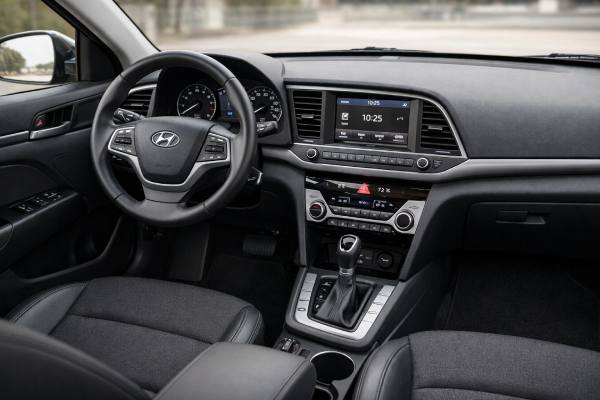

The Hyundai Elantra AD 1.6 MPI is one of those compact sedans that looks conservative on paper but turns out to be more appealing in real ownership. Its main strengths are easy to understand: a roomy cabin, a large trunk, tidy ride comfort, and a naturally aspirated 1.6-liter engine that avoids the extra complexity of turbocharging and direct injection. For the 2016 to 2018 car, Hyundai also delivered a more mature platform than older Elantras, with better crash performance, cleaner cabin design, and a calmer feel on longer drives. This 128 hp variant is not a performance model, but it is strong enough for normal daily use and usually cheaper to maintain than more ambitious engine choices. That is why it still makes sense as a used buy. The catch is simple: condition matters far more than price. A well-kept AD can feel refined and dependable. A neglected one can hide suspension wear, overdue fluid changes, and timing-chain complaints behind decent cosmetics.
Quick Overview
- The 1.6 MPI engine is simpler and usually cheaper to own than later small turbo units.
- Rear-seat room and trunk space are strong for the class, which makes the AD easy to live with.
- Ride comfort and motorway stability are better than many buyers expect from a basic compact sedan.
- Poor oil service can shorten timing-chain life and lead to cold-start rattle or timing faults.
- A sensible oil and filter interval is every 10,000 to 12,000 km or 12 months.
Jump to sections
- Hyundai Elantra AD essentials
- Hyundai Elantra AD spec tables
- Hyundai Elantra AD trims and protection
- Failure points and recall work
- Service plan and buyer checks
- Road feel and fuel use
- Position against key rivals
Hyundai Elantra AD essentials
The AD-generation Elantra was Hyundai’s effort to make its compact sedan feel more complete, more refined, and more globally competitive. It succeeded in several important ways. Compared with older Elantras, the AD looks cleaner, feels more mature on the road, and offers better crash performance. That matters because the 1.6 MPI version is not meant to win buyers over with straight-line speed. Its case is built on balance. It gives you enough power for normal use, enough cabin room for family duty, and enough mechanical simplicity to stay manageable as a used car.
The core engine is Hyundai’s 1.6-liter Gamma MPI four-cylinder. In this trim it produces about 128 hp, with output usually quoted at 127.5 PS or 126 bhp depending on market convention. That is enough to make the Elantra feel acceptable rather than slow, especially with the manual gearbox. More important than the number is the layout. This is a naturally aspirated, chain-driven, port-injected engine. That means fewer expensive fuel-system surprises than a direct-injection turbo alternative. It also means throttle response is clean and predictable, which suits the Elantra’s everyday character well.
The rest of the package follows the same logic. The platform uses front MacPherson struts and a torsion-beam rear axle. That does not sound exotic, but Hyundai tuned it with comfort first in mind. The result is a sedan that rides broken surfaces well, feels settled at motorway speed, and stays easy to place in traffic. Interior packaging is another strong point. Rear-seat room is generous for the class, and the trunk is large enough to make the AD feel more useful than some hatchback rivals with fold-down seats but less real cargo depth.
This generation also arrived with a stronger safety story than many older Hyundais. Its structure was revised for better small-overlap performance, and depending on trim and market, it could be equipped with features like blind-spot detection, lane departure warning, and autonomous emergency braking. That gives it a more modern ownership feel than earlier Elantras, even though the 1.6 MPI version stays mechanically simple.
The weakness is not the base design. It is age and maintenance discipline. These cars are now old enough for suspension wear, brake drag, weak batteries, mixed tyres, and overdue fluid changes to matter. The best way to understand the AD 1.6 MPI is as a well-rounded compact sedan that rewards buying by condition, not by brochure promise.
Hyundai Elantra AD spec tables
The figures below focus on the 2016 to 2018 Elantra sedan with the 1.6 MPI engine in 128 hp form. Some values vary slightly by market, trim, or transmission, but the overall mechanical picture remains consistent.
| Powertrain and efficiency | Data |
|---|---|
| Code | Gamma 1.6 MPI |
| Engine layout and cylinders | Inline-4, DOHC, 4 valves per cylinder, 77.0 × 85.4 mm (3.03 × 3.36 in) |
| Displacement | 1.6 L (1,591 cc) |
| Motor | Not applicable |
| Induction | Naturally aspirated |
| Fuel system | MPI |
| Compression ratio | About 10.5:1 |
| Max power | 128 hp (94 kW) @ 6,300 rpm |
| Max torque | About 157 Nm (116 lb-ft) @ 4,850 rpm |
| Timing drive | Chain |
| Rated efficiency | Roughly 6.4–6.8 L/100 km combined depending on transmission and market cycle |
| Real-world highway @ 120 km/h | About 5.8–6.8 L/100 km in a healthy car |
| Transmission and driveline | Data |
|---|---|
| Transmission | 6-speed manual or 6-speed automatic |
| Drive type | FWD |
| Differential | Open |
| Chassis and dimensions | Data |
|---|---|
| Suspension (front/rear) | MacPherson strut front / coupled torsion-beam rear |
| Steering | Rack-and-pinion electric power steering |
| Brakes | Front ventilated discs; rear disc or drum depending on trim and market |
| Wheels and tyres | 195/65 R15 and 205/55 R16 are the most common sizes |
| Ground clearance | About 150 mm (5.9 in), market dependent |
| Length / Width / Height | About 4,570 mm / 1,800 mm / 1,440–1,450 mm |
| Wheelbase | 2,700 mm (106.3 in) |
| Turning circle (kerb-to-kerb) | About 10.6 m (34.8 ft) |
| Kerb weight | Roughly 1,220–1,290 kg (2,690–2,844 lb) depending on trim and gearbox |
| GVWR | Around 1,750–1,820 kg (3,858–4,012 lb), depending on specification |
| Fuel tank | About 50 L (13.2 US gal / 11.0 UK gal) |
| Cargo volume | About 458 L (16.2 ft³) for the sedan |
| Performance and capability | Data |
|---|---|
| Acceleration | 0–100 km/h in about 10.1–11.6 s depending on gearbox |
| Top speed | About 195–200 km/h (121–124 mph) |
| Braking distance | No single validated figure confirmed for the exact 1.6 MPI trim |
| Towing capacity | Around 1,200 kg (2,646 lb) braked in some market specs; verify locally |
| Payload | Roughly 450–550 kg (992–1,213 lb), depending on trim |
| Fluids and service capacities | Data |
|---|---|
| Engine oil | 5W-30 is generally the safe all-round choice, with 5W-20 or 5W-40 depending on climate and market guidance; about 3.6–3.8 L with filter |
| Coolant | Ethylene glycol-based coolant; about 5.7–6.0 L (6.0–6.3 US qt) |
| Transmission / ATF | Manual: GL-4 class gear oil, about 1.9–2.0 L; automatic: Hyundai SP-IV-family fluid, verify exact service-fill method |
| Differential / transfer case | Not applicable |
| A/C refrigerant | R-134a; verify exact charge on the under-bonnet label |
| A/C compressor oil | Verify by label or workshop literature |
| Key torque specs | Wheel nuts about 107–127 Nm (79–94 lb-ft), depending on market guidance |
| Safety and driver assistance | Data |
|---|---|
| Crash ratings | IIHS Good in driver-side small overlap, moderate overlap, side, roof strength, and head restraints for 2017–2018 applicability; later award criteria depended on specific headlights and optional front crash prevention |
| Headlight rating | Varies by trim and option |
| ADAS suite | Depending on market and trim: AEB, lane departure warning, lane departure prevention, blind-spot detection, rear cross-traffic alert |
The main takeaway is that the AD 1.6 MPI is not a spec-sheet hero. It is a straightforward, efficient compact sedan with enough performance to feel usable and enough mechanical simplicity to stay attractive as a used car.
Hyundai Elantra AD trims and protection
Trim structure on the AD varies significantly by market, so the smartest way to evaluate one is by equipment rather than by badge alone. In some regions the 1.6 MPI sat in value-oriented trims, while in others it could be paired with surprisingly complete equipment. That means the used market can include very different cars wearing the same basic engine badge.
Mechanically, the biggest trim differences are usually in wheels, rear-brake setup, safety equipment, and cabin convenience features. Better-equipped versions are more likely to have rear disc brakes, larger infotainment screens, alloy wheels, automatic climate control, and the driver-assistance systems that help separate later AD cars from older compact sedans. Lower trims can still be good buys if the condition is excellent, but they are harder to justify when better-equipped examples are available with similar history and price.
Quick identifiers help. Mid- and upper-trim cars usually have alloy wheels, steering-wheel controls, better seat fabric or leatherette, more complete center-stack buttons, and in some cases a larger touchscreen. Cars with blind-spot mirrors or visible bumper sensors may also point to a better safety-equipment package, though market differences make exact assumptions risky. Because these cars have now passed through multiple owners, consistency matters more than trim labels. A supposedly high-spec car with missing sensors, mismatched panels, or a stripped cabin deserves closer inspection.
Safety is one of the AD’s stronger arguments. This generation improved significantly over the earlier Elantra in small-overlap and overall crash performance. In IIHS testing, the 2018 Elantra sedan recorded Good ratings in driver-side small overlap, moderate overlap, side impact, roof strength, and head restraints. Passenger-side small overlap was rated Acceptable for certain builds, and crash-avoidance awards depended on optional front crash prevention and specific headlights. That is a solid result for a mainstream compact sedan of the period.
In everyday ownership terms, the AD also offered more available safety tech than older Elantras. Depending on trim and market, buyers could get autonomous emergency braking, lane departure warning, lane-keeping support, blind-spot detection, rear cross-traffic alert, and LATCH or ISOFIX child-seat anchors. Those features do not turn it into a modern semi-autonomous car, but they do make it feel more current than many similarly priced used compact rivals.
The important caveat is simple: safety equipment only matters if it still works properly. On a used AD, badly repaired crash damage, cheap aftermarket windscreens, alignment issues, or unresolved recalls can undermine what was a strong factory safety story. When shopping, the right questions are not only “what trim is it?” but also “does every warning light behave correctly?” and “is the structure straight?” On this generation, trim matters, but condition matters more.
Failure points and recall work
The Elantra AD 1.6 MPI is generally a low-drama car, but like most modern compact sedans, it has a few patterns worth understanding before you buy. The good news is that it does not suffer from one famous catastrophic flaw that defines every example. The more realistic picture is a series of medium-level issues that appear when servicing is delayed or when owners treat the car as appliance transport rather than something that still needs care.
The first point to watch is timing-chain health. The 1.6 MPI uses a chain, not a belt, which is an advantage. But the chain system still depends on clean oil and correct oil level. Long intervals, cheap oil, or repeated short-trip use can accelerate tensioner and guide wear. The common symptoms are cold-start rattle, rough idle on startup, and timing-correlation faults rather than immediate engine failure. In many cases, the root cause is simply poor oil-service history. That makes paperwork especially important on this engine.
Beyond that, the usual engine issues are conventional. Ignition coils, spark plugs, oxygen sensors, EVAP leaks, thermostat wear, and rocker-cover seepage can all appear with age. The advantage of the MPI setup is that it avoids the heavier intake carbon problems common on some direct-injection engines. The cooling system is also generally straightforward, but radiators, hoses, and caps still age. A small coolant leak is worth fixing quickly before it becomes an overheated aluminum engine.
Chassis wear follows a predictable compact-car pattern. Front drop links, lower control-arm bushes, dampers, wheel bearings, and rear brake hardware are all common wear areas once mileage climbs or roads get rough. None of these are unusual or alarming. They just matter because the AD feels noticeably better when sorted. A good one is quiet, tidy, and composed. A worn one feels cheaper than it really is.
Steering complaints are also worth noting. Some owners report clicking or knocking through the column or intermediate steering components, especially at low speed. That does not always mean a dangerous fault, but it is a sign that the car needs inspection rather than reassurance. Electric steering systems can hide wear in a way older hydraulic racks often did not.
Recall and campaign history is a major part of the AD ownership story. Two headline items are especially relevant:
- Side-curtain airbag module and headliner bracket recall: certain 2017–2018 Elantras were recalled because a displaced headliner support bracket could interfere during side-curtain airbag deployment.
- ABS module / fire-risk recall: certain later campaign actions affecting Elantra ranges of this era addressed internal brake-fluid leakage in the ABS module, which could create an electrical short and increase fire risk.
These issues do not mean the model is a bad buy. They do mean a buyer should always run the VIN through the official recall system and ask for dealer records where possible. On this generation, recall completion is not optional housekeeping. It is part of buying the car responsibly.
Service plan and buyer checks
The Elantra AD 1.6 MPI responds well to regular, sensible maintenance. This is not a car that needs exotic servicing, but it does reward owners who stay ahead of wear items rather than waiting for faults to become obvious. Because the engine uses a timing chain, the most important preventive step is not a belt interval. It is oil quality and consistency.
| Item | Practical interval | Notes |
|---|---|---|
| Engine oil and filter | Every 10,000–12,000 km or 12 months | Shorter intervals help chain life |
| Engine air filter | Inspect every service, replace around 20,000–30,000 km | Earlier in dusty use |
| Cabin air filter | Every 15,000–20,000 km or 12 months | Helps HVAC performance |
| Spark plugs | Around 45,000–60,000 km for standard plugs, longer for iridium types | Use the correct specification |
| Coolant | Every 2–3 years | Keep coolant type consistent |
| Brake fluid | Every 2 years | Helps ABS and caliper health |
| Manual gearbox oil | About 60,000–80,000 km if use is heavy or shift feel worsens | Fresh oil helps synchronizer life |
| Automatic fluid | Conservative servicing if history is known and fluid condition is good | Use correct Hyundai fluid only |
| Timing chain | No fixed replacement interval; inspect if noise, rattle, or timing faults appear | Oil quality is the main protection |
| Auxiliary belt and hoses | Inspect every service | Replace on cracking or glazing |
| Tyre rotation and alignment | Every 10,000–12,000 km | Check for inner-edge wear |
| Battery testing | Yearly from age 4 onward | Weak batteries can cause misleading faults |
A few practical notes matter with this car. First, engine oil is not an area to save pennies. A good-quality oil that suits the climate and factory guidance is one of the cheapest ways to protect the chain system. Second, brake fluid should not be ignored, because later ABS-related issues make clean fluid and proper inspections even more important. Third, cooling-system condition matters more than many owners think. A clean coolant reservoir, sound hoses, and a dry radiator area tell you a lot about how carefully the car has been kept.
As a used buy, the AD 1.6 MPI makes the most sense in manual or conventional automatic form, with the decision depending on condition rather than theory. The manual is the simpler long-term choice and usually the best value if you do not mind shifting. The automatic is easy to live with, but only if its fluid history and shift quality are convincing. I would rather buy a clean manual with full records than a nicer-trim automatic with vague service history.
The inspection order should be simple:
- Body shell and underbody.
- Recall completion and service records.
- Cold-start engine sound.
- Cooling-system condition.
- Steering and suspension feel.
- Brake performance and tyre quality.
- Electronics, locks, and warning lights.
Cars to seek are the honest ones: matching tyres, straight structure, quiet cold start, smooth idle, and documented servicing. Cars to avoid are the familiar ones: chain rattle, mixed tyres, vague steering, unresolved recalls, coolant smell, or evidence of cheap crash repair. The AD is durable enough to reward a careful buyer, but not forgiving enough to excuse neglect.
Road feel and fuel use
The Elantra AD 1.6 MPI is an easy car to underestimate. It does not feel flashy or overtly sporty, but on the road it comes across as calm and well resolved. The steering is light, the controls are intuitive, and the cabin is quiet enough to make longer trips feel relaxed rather than tiring. In town, the Elantra is easy to place. On the motorway, it feels stable and more mature than its compact-sedan label suggests.
The 1.6 MPI engine suits that personality well. It is not strong in the way a turbo engine is strong, but it is predictable and clean in its responses. Around town it pulls willingly enough, and on open roads it will hold speed comfortably when not overloaded. The manual gearbox helps the car feel more alert, because it makes better use of the modest power and torque. The automatic is smoother in traffic, but it softens the car’s responses and makes overtaking feel a little more deliberate.
Ride comfort is one of the AD’s best qualities. Hyundai clearly tuned the car for normal daily use rather than sharp-edged sportiness. Broken surfaces are handled well, body control is acceptable, and the suspension generally feels composed rather than cheap. The torsion-beam rear setup is simple, but in this application it works well enough that most owners will care more about bushing and tyre condition than about suspension architecture. A worn AD feels significantly worse than a sorted one, so a good test drive tells you a lot.
Brake feel is straightforward when the system is healthy. Cars with rear discs and good tyres tend to feel more confidence inspiring, but even the simpler versions behave well if serviced properly. Tyres matter a lot here. Cheap tyres make the Elantra noisier, less precise, and less stable under braking. A decent set of quality tyres transforms the car more than many buyers expect.
Fuel economy remains one of the 1.6 MPI’s biggest arguments. In realistic mixed use, a healthy manual car can usually stay around the mid-6s to low-7s L/100 km, with motorway runs often falling into the high-5s or low-6s. City driving will usually move that closer to the high-7s or low-8s depending on traffic and climate. Those are respectable numbers for a roomy naturally aspirated sedan that avoids turbo complexity. The real strength is the overall balance between fuel use and maintenance cost. The AD 1.6 MPI is not exciting, but it is efficient enough and comfortable enough to make daily driving easy.
Position against key rivals
The Elantra AD 1.6 MPI lived in one of the toughest compact-car classes in the market. It had to face the Toyota Corolla, Honda Civic, Mazda 3, Ford Focus, and various regional contenders that were all strong in different ways. The Hyundai’s advantage was not that it dominated the class in one obvious category. It was that it offered a very usable mix of comfort, space, fuel economy, and mechanical simplicity.
Against a Toyota Corolla, the Elantra usually loses on long-standing reputation and sometimes on resale confidence, but it often wins on equipment value and used purchase price. Against a Honda Civic, the Hyundai can feel less polished dynamically, yet it is often easier to buy without paying a badge premium. Against a Mazda 3, the Elantra gives up steering feel and driver engagement, but counters with a calmer ride and a less demanding ownership character. Against a Ford Focus, the Hyundai loses outright on steering sharpness, but many buyers will prefer its simpler drivetrain choices and lower long-term risk.
That last point matters a lot. The AD 1.6 MPI is not the enthusiast’s Elantra. It is the sensible Elantra. It offers a naturally aspirated engine, conventional transmissions, a roomy body, and generally modest running costs when maintained correctly. That makes it especially appealing to buyers who want fewer surprises as the car ages. A Focus or Mazda 3 may be more enjoyable in quick back-road driving, but the Elantra’s easier day-to-day character is exactly what many compact-sedan owners actually value.
The car’s biggest weakness versus the strongest rivals is that it can feel more ordinary than special. It does not have the Corolla’s reputation, the Civic’s image, or the Mazda’s driver appeal. But that same lack of hype can help buyers. Clean Elantras are often priced more realistically, and that means you can sometimes afford a better-condition example for the same budget.
So the verdict is straightforward. The 2016–2018 Hyundai Elantra AD 1.6 MPI is not the class icon of its generation. It is one of the more rational used buys from that generation. It offers real practicality, respectable safety, easy drivability, and a mechanical layout that stays refreshingly straightforward. For buyers who value condition, history, and running costs over badge mythology, that is a very convincing package.
References
- ELANTRA : Specification | Sedan | Hyundai Asia & Pacific 2026
- Elantra 2017
- 2018 Hyundai Elantra 2018 (Safety Rating)
- Part 573 Safety Recall Report 17V-769 2017 (Recall Database)
- Part 573 Safety Recall Report 23V-651 2023 (Recall Database)
Disclaimer
This article is for informational purposes only and is not a substitute for professional diagnosis or repair. Specifications, torque values, service intervals, procedures, and equipment can vary by VIN, market, trim, transmission, and production date, so always verify the exact vehicle against official service documentation before buying parts or carrying out repairs.
If this guide helped you, please consider sharing it on Facebook, X, or another platform to support our work.