
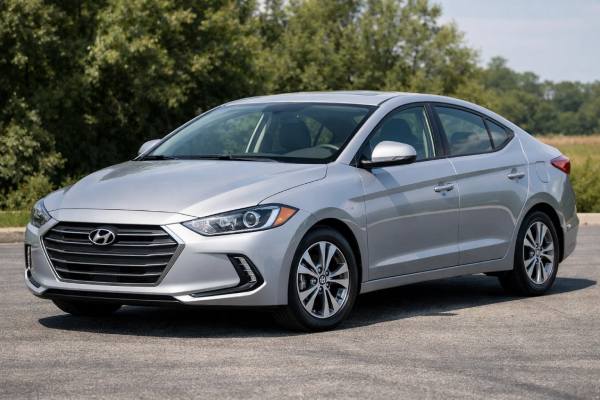

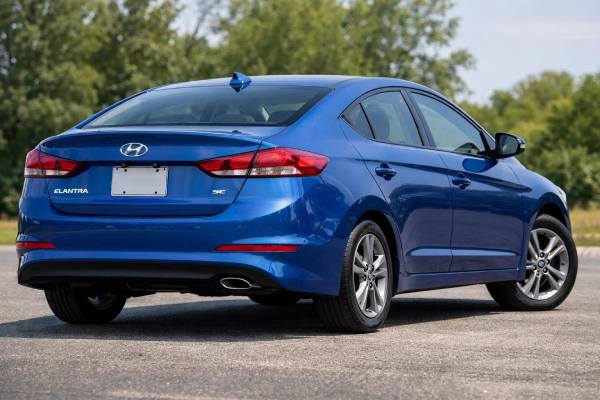
The Hyundai Elantra AD 1.6 CRDi 136 hp is one of the more interesting compact diesel sedans from the late-2010s. It was built for markets where buyers still wanted long-range fuel economy, strong motorway torque, and a proper four-door body rather than another crossover. In this version, the Elantra combines a 1.6-litre common-rail diesel with either a 6-speed manual or a 7-speed dual-clutch automatic, plus a roomy cabin, a useful trunk, and a platform that feels more refined than older Elantras. Its real strengths are not badge prestige or outright excitement. They are low fuel use, easy long-distance cruising, and a practical ownership package with enough comfort to make daily commuting feel relaxed. The main caution is that this is a modern diesel, not an old-school simple one. DPF health, EGR cleanliness, chain noise, emissions hardware condition, and a strong service record matter far more than they did on earlier Hyundai diesels.
Essential Insights
- The 1.6 CRDi gives the Elantra strong mid-range torque and low fuel use, especially on longer trips.
- Cabin space, trunk volume, and motorway comfort are real strengths for a compact four-door sedan.
- The 7DCT version is the most efficient on paper, while the manual is usually the simpler long-term ownership choice.
- Short-trip use can create DPF and EGR headaches, so city-only examples deserve extra care.
- Use annual servicing and realistic oil changes around every 8,000–10,000 km or 12 months if the car is driven hard or mostly in town.
Guide contents
- Hyundai Elantra AD diesel profile
- Hyundai Elantra AD data guide
- Hyundai Elantra AD trim and safety
- Weak points and recall checks
- Ownership routine and buyer tips
- Diesel manners and real economy
- Against the key alternatives
Hyundai Elantra AD diesel profile
The AD-generation Elantra marked a meaningful step forward for Hyundai’s compact sedan. It was not designed to be flashy in the way a coupe or hot hatch might be. Instead, Hyundai focused on the areas that matter over years of ownership: structural stiffness, reduced cabin noise, improved seat comfort, cleaner controls, and better long-distance refinement. That approach suits the 1.6 CRDi particularly well, because this version is at its best when used as a quiet, efficient road car rather than a city-only commuter.
One of the biggest engineering changes was body structure. Hyundai significantly increased the share of advanced high-strength steel in the AD platform, and that paid off in both stiffness and noise reduction. The car feels more solid than older Elantras, and that helps it on rough roads and at motorway speeds. The aerodynamic work matters too. Hyundai quoted a low drag figure, tighter underbody treatment, and reduced wind noise, which fits the diesel model’s role as a distance-friendly sedan.
The 1.6 CRDi also arrived at the right time for Europe. Hyundai’s own launch material made clear that the diesel mattered because the four-door compact segment was still diesel-heavy in many European markets. That explains why this Elantra got a proper 136 hp diesel with either a 6-speed manual or a 7-speed dual-clutch option. It was meant to compete as a real fleet and private-buyer choice, not just as a niche trim.
In daily use, the drivetrain has a split personality in the best sense. The manual version is the more traditional option and gives a broader torque band, while the BlueD 7DCT version is the economy-focused choice with lower official fuel use and higher peak torque. That is an interesting distinction. The automatic makes more torque on paper, but the manual is actually the quicker car to 100 km/h in Hyundai’s public technical sheet. That suggests the DCT was tuned more for economy and relaxed drivability than for brisk acceleration.
Another important trait is practicality. This is a sedan, but it is not cramped. The wheelbase is generous, rear-seat room is respectable, and the trunk is large enough to make the car genuinely useful for family or work travel. In a market increasingly dominated by crossovers, that matters. The Elantra still delivers the low seating position and slippery shape that help fuel economy, without giving up normal everyday usability.
The downside is simple: this is a modern emissions-era diesel. That means DPF condition, EGR cleanliness, fuel quality, sensor health, and correct oil specification matter much more than on an older, simpler diesel Hyundai. The Elantra AD 1.6 CRDi can be a very satisfying used buy, but only if it has been used and maintained in a way that suits diesel hardware. The right car will feel refined and cheap to run. The wrong one will reveal every missed service and every short-trip compromise.
Hyundai Elantra AD data guide
For the Europe-market diesel Elantra AD, Hyundai’s own 2016 technical data sheet provides unusually helpful public figures. It covers both the 1.6 CRDi 136 hp manual and the 1.6 CRDi 136 hp BlueD 7DCT. Where open official material does not publish a value, the table says so instead of guessing.
Powertrain and efficiency
| Item | Hyundai Elantra AD 1.6 CRDi 136 |
|---|---|
| Code | Commonly associated with Hyundai’s U2 1.6 CRDi / D4FB family; verify exact code by VIN |
| Engine layout and cylinders | Inline-4, 4 cylinders |
| Valvetrain | DOHC, 16 valves, 4 valves per cylinder |
| Bore × stroke | 77.2 × 84.5 mm (3.04 × 3.33 in) |
| Displacement | 1.6 L (1,582 cc) |
| Induction | Turbocharged |
| Fuel system | Common-rail direct injection |
| Compression ratio | 16.0:1 |
| Max power | 136 hp (100 kW) @ 4,000 rpm |
| Max torque | 260 Nm (192 lb-ft) @ 1,500–3,500 rpm for 6MT; 300 Nm (221 lb-ft) @ 1,750–2,500 rpm for BlueD 7DCT |
| Timing drive | Commonly chain-driven on this engine family; verify by engine code and VIN |
| Rated efficiency | 4.5 L/100 km combined for 6MT and 4.1 L/100 km for 7DCT, about 52.3 / 57.4 mpg US or 62.8 / 68.9 mpg UK |
| Real-world highway @ 120 km/h (75 mph) | Usually around 4.8–5.7 L/100 km in good condition, depending on tyres, load, weather, and transmission |
Transmission and driveline
| Item | Data |
|---|---|
| Transmission | 6-speed manual or 7-speed dual-clutch automatic |
| Drive type | FWD |
| Differential | Open |
Chassis and dimensions
| Item | Data |
|---|---|
| Suspension front / rear | MacPherson strut front / semi-rigid CTBA torsion-beam rear with coil springs, stabilizer bar, and gas dampers |
| Steering | Motor-driven electric power steering |
| Brakes | Front ventilated discs / rear solid discs; Hyundai’s public sheet groups them with 15-inch front and 14-inch rear brake package sizing rather than exact rotor diameters |
| Wheels and tyres | 195/65 R15 on 15-inch steel or 225/45 R17 on 17-inch alloy, depending on trim |
| Ground clearance | Not clearly published in the open Hyundai technical sheet |
| Length / Width / Height | 4,570 / 1,800 / 1,450 mm (179.9 / 70.9 / 57.1 in) |
| Wheelbase | 2,700 mm (106.3 in) |
| Turning circle (kerb-to-kerb) | About 10.6 m (34.8 ft), derived from Hyundai’s 5.3 m turning radius |
| Kerb weight | Not clearly published in the open Hyundai technical sheet |
| GVWR | 1,870 kg (4,123 lb) for 6MT; 1,900 kg (4,189 lb) for 7DCT |
| Fuel tank | 50 L (13.2 US gal / 11.0 UK gal) |
| Cargo volume | 407 L VDA, with 458 L also listed in Hyundai’s public sheet |
Performance and capability
| Item | Data |
|---|---|
| 0–100 km/h (0–62 mph) | 10.5 s for 6MT; 11.0 s for 7DCT |
| Top speed | 190 km/h (118 mph) |
| Braking distance | No public Hyundai figure located in open-access technical material |
| Towing capacity | Hyundai Spain’s public sheet lists 300 kg braked and 300 kg unbraked, which effectively means the model is not intended for serious towing in that market |
| Payload | Depends on actual curb weight and equipment; verify by VIN plate |
Fluids and service capacities
| Item | Data |
|---|---|
| Engine oil | Use the low-ash ACEA-grade specified in the VIN-specific manual; exact capacity not clearly published in open-access Hyundai sources used here |
| Coolant | Hyundai-approved long-life ethylene-glycol coolant, typically 50:50 mix; exact capacity not clearly published in open-access Hyundai sources used here |
| Transmission / ATF | Verify by exact gearbox code and service manual |
| Differential / transfer case | Not separately serviced on this FWD layout |
| A/C refrigerant | Verify by under-bonnet label |
| A/C compressor oil | Verify by compressor type |
| Key torque specs | Use VIN-specific workshop data only |
Safety and driver assistance
| Item | Data |
|---|---|
| Crash ratings | ANCAP 2016: 5 stars, 35.01 out of 37 overall, applies to all petrol and diesel variants including turbo in that market |
| Headlight rating | No comparable public IIHS headlight score for this Europe-diesel version |
| ADAS suite | No modern full ADAS suite; key safety tech includes ESC, EBD, BAS, tyre-pressure monitoring, and blind-spot detection on upper trims |
The numbers reveal the Elantra’s character clearly. The 7DCT is the cleaner paper-economy choice and gives more torque, while the manual is the slightly quicker and mechanically simpler option. That difference shapes the ownership verdict more than the headline power figure does.
Hyundai Elantra AD trim and safety
Trim structure on the Europe-market diesel Elantra varied by country, but the broad pattern was consistent. Hyundai sold the car as a practical four-door sedan with a limited but sensible grade spread. The Spanish technical sheet shows trims such as Klass, Tecno, and Style, and those are useful because they illustrate how Hyundai approached the car: a base value trim, a stronger mid-level version, and a better-equipped upper grade with the diesel automatic reserved for richer specifications.
The mechanical split matters. The 1.6 CRDi manual could be paired with both lower and higher trims, while the BlueD 7DCT was aimed at better-equipped versions. That means a used manual diesel often makes the best sense for buyers who want lower complexity and lower purchase price, while the DCT cars usually add equipment and slightly better official economy. The decision is less about performance and more about ownership style.
Wheel and tyre packages are one of the clearer visual clues. Lower trims used 15-inch wheels with 195/65 tyres, while higher trims switched to 17-inch alloys with 225/45 tyres. That changes the look, but it also affects ride quality and tyre replacement cost. A 17-inch car looks better and turns in a little more crisply, but a 15-inch car usually rides more quietly and cheaply.
Equipment on the better trims could be surprisingly strong for a compact sedan of this class. Hyundai’s launch material highlighted HID or xenon headlamps, LED daytime running lights, LED rear lamps, keyless start, smart trunk access, dual-zone climate control, heated and ventilated front seats, and a driver-oriented dashboard. The car was clearly pitched as more than a bare fleet special. That matters today because a well-specified AD still feels modern enough inside for ordinary family or commuting use.
Safety is one of the model’s stronger selling points, though it needs a region-specific explanation. Open official safety coverage is clearest through ANCAP, which awarded the AD Elantra five stars in 2016 and stated that the rating applied to all variants, including petrol and diesel vehicles. ANCAP also noted strong offset and side-impact scores, advanced seat-belt reminders, standard curtain airbags, and standard ESC, EBD, and emergency brake assist. That is a solid result and one of the more useful public references for this generation.
In feature terms, the Elantra AD was not a full ADAS car in the modern sense. ANCAP noted that autonomous emergency braking and lane-support systems were not available on any variant in that rating. Hyundai’s own press material instead emphasized a strong passive-safety structure, seven airbags including a driver’s knee airbag in some markets, blind-spot detection, and a reversing camera with dynamic guide lines. That is a respectable package for the time, but it should not be confused with current driver-assistance expectations.
For used buyers, the practical lesson is simple. The best trim is not automatically the top one. A clean manual Tecno-style diesel with smaller wheels and full service history is often a better ownership proposition than a tired, poorly maintained DCT Style car loaded with features but missing campaign history.
Weak points and recall checks
The Elantra AD 1.6 CRDi is not a notorious problem car, but it is a modern diesel sedan with emissions equipment, electronics, and trim-specific complexity. That means reliability depends heavily on usage pattern. A car used for longer mixed or motorway miles usually ages much better than one used for repeated cold starts and very short urban journeys.
The most common weak point on cars like this is not the base engine itself. It is the emissions side of the ownership cycle. DPF loading, interrupted regeneration, EGR contamination, intake soot, and sensor-related warning lights are much more likely on short-trip cars than on long-distance examples. The typical symptom pattern is familiar: fans running after shutdown, higher fuel use, frequent regeneration attempts, limp-home behaviour, or engine-warning lights that keep coming back after simple resets. The cure is not to keep clearing the code. It is to fix the use pattern or the failed component, then confirm that the car can complete proper regeneration.
The second area to watch is the 7DCT. Hyundai’s 7-speed dual-clutch unit can work well when it has the right software state and a smooth driver profile behind it, but used examples deserve a long, warm test drive. The warning signs are not vague. Look for take-up shudder when creeping, delayed engagement, odd flare between gears, or jerky low-speed transitions after the car is fully hot. That does not mean every DCT is troublesome. It means you should judge the exact car, not the brochure.
Manual cars have their own wear points. The 1.6 CRDi makes decent torque, so clutch and dual-mass flywheel condition matters, especially on cars used in heavy traffic or with poor driving habits. A high bite point, rattly idle with the clutch released, or harsh take-up on pull-away all deserve investigation.
Diesel-specific mechanical faults tend to be ordinary rather than dramatic. Boost hoses can split, vacuum lines can age, thermostats can get lazy, glow plugs can seize with age, and injectors can become noisy or uneven long before they fail outright. None of these is unique to Hyundai. The difference is that they stack more quickly on cars that were serviced to the minimum rather than cared for properly.
Software and campaign history also matter. Open official sources show that the AD generation did have market-specific service actions and recalls. One example is the 2017 U.S.-market campaign for certain early 2017 Elantra AD cars where an EPS motor connector issue could illuminate the warning lamp and drop the steering into manual-assist mode. That is not proof of a Europe-wide diesel defect, but it is a reminder that market-specific campaign history must be checked by VIN, not guessed from general internet advice.
The most important recall rule for a used AD is simple: verify every open campaign through Hyundai’s recall and service campaign system and dealer history. If a seller cannot show recall completion and the car’s digital or paper service trail is patchy, price alone is not enough reason to proceed. A good AD diesel feels like a mature compact sedan. A neglected one feels like an emissions lesson on wheels.
Ownership routine and buyer tips
A 1.6 CRDi Elantra AD does not need exotic care, but it does need disciplined care. That is the difference between a diesel sedan that feels economical and one that slowly becomes expensive through small, avoidable faults. The best maintenance approach is to assume that short-trip use is hard use, even if the odometer number looks modest.
A practical service routine looks like this:
| Item | Practical interval |
|---|---|
| Engine oil and filter | Every 8,000–10,000 km or 12 months for real-world ownership, especially on town-driven cars |
| Engine air filter | Inspect every service; replace around 20,000–30,000 km |
| Cabin air filter | Every 12 months |
| Coolant | Inspect yearly; renew by official schedule or if history is unclear |
| Fuel filter | Inspect service history closely; many owners treat 30,000–60,000 km as a sensible diesel-service window depending on fuel quality |
| Glow plugs | Test on condition if cold-start quality worsens |
| Timing components | Chain-driven engine family; inspect for cold-start rattle, chain noise, or timing-correlation faults rather than replacing on a belt interval |
| Auxiliary belt and hoses | Inspect every service |
| Manual gearbox oil | Check for leaks and shift quality; refresh preventively at higher mileage |
| 7DCT service | Follow VIN-specific guidance and check software status; do not improvise fluid strategy if the gearbox service plan is unclear |
| Brake fluid | Every 2 years |
| Brake pads and discs | Inspect every service |
| Tyre rotation and alignment | Rotate every 10,000–12,000 km; check alignment if wear becomes uneven |
| 12 V battery | Test from about year 4 onward |
| DPF and EGR health | Watch regeneration frequency, smoke, warning lights, and use pattern; cars that never stretch their legs often become expensive |
For fluids, the safest rule is to use the exact Hyundai-approved spec rather than a close-enough substitute. That matters most for engine oil on a DPF-equipped diesel. Even when the viscosity looks right, the wrong ash content can shorten aftertreatment life. On this model, that is not a technical detail. It is a running-cost decision.
The buyer’s checklist should be strict:
- Start the car fully cold.
- Watch for excessive cranking, unstable idle, or diesel knock that does not settle.
- Check for warning lamps, especially engine, DPF, or steering-related lights.
- Drive the car long enough to test full operating temperature.
- On manual cars, listen for dual-mass flywheel noise.
- On DCT cars, check crawl behaviour, warm engagement, and low-speed smoothness.
- Inspect the tailpipe area and underbody for soot, leaks, and poor previous work.
- Confirm recall and campaign history by VIN.
- Ask directly how the car was used. A motorway car is usually better than a short-trip urban car here.
The versions to seek are the ones with full history, correct oil use, and obvious long-distance life. The ones to be cautious with are low-mileage city diesels, patchy-history DCT cars, and any example showing repeated emissions faults. Long-term durability is good enough to justify ownership, but only when the car’s service past matches the complexity of its diesel hardware.
Diesel manners and real economy
On the road, the Elantra AD 1.6 CRDi feels like a car designed to cover distance calmly. That is its sweet spot. The steering is light but tidy, the seats are comfortable enough for longer runs, and the body feels more solid than older Elantras. It is not a sports sedan, and it does not pretend to be one. What it offers instead is mature motorway behaviour and low-effort daily driving.
The diesel engine defines the experience. In both manual and DCT form, the car feels stronger in real traffic than the 136 hp number suggests because the torque arrives low in the rev range. The manual version has the broader torque plateau and feels the more natural fit for drivers who want control and slightly stronger response. The 7DCT version is smoother in congestion and more efficient on paper, but it trades some immediacy for cleaner calibration and economy-minded gearing.
One of the more interesting details in Hyundai’s public figures is that the manual reaches 100 km/h a little faster than the DCT, even though the automatic version makes more torque. In practice, that means the manual feels a touch more eager, while the DCT feels more relaxed and less busy. Neither version is fast in a genuinely sporting sense, but both are strong enough for ordinary overtakes and full-load motorway use.
Ride quality is better than some buyers expect from a torsion-beam rear suspension car on 17-inch wheels, though the smaller-wheel versions are the more comfortable choice on broken roads. The body control is neat, the cabin feels well insulated for the class, and Hyundai’s extra work on structure and NVH shows up at speed. Wind noise is controlled, diesel noise is subdued once warm, and the car settles into a long-leg stride naturally.
Real-world fuel use is where the Elantra makes its strongest case. Official combined numbers of 4.5 L/100 km for the 6MT and 4.1 L/100 km for the 7DCT are very good for a roomy four-door sedan. In actual ownership, a well-maintained manual often returns around 5.0–5.8 L/100 km mixed, while the DCT can do slightly better on steady routes. Highway work at 100–120 km/h is usually easy territory for this car, often staying under 6.0 L/100 km if traffic is flowing and the DPF is healthy. Heavy city use is the wrong environment and will not only raise fuel use, but also increase the chance of regeneration and EGR trouble.
Braking feel is conventional and predictable rather than sporty. Stability is good in a straight line, and the Elantra feels more like a compact tourer than a compact back-road toy. That is exactly why the diesel version works. It turns the AD into a quiet, steady commuter that can genuinely save fuel without making the driver work hard.
Against the key alternatives
The Elantra AD diesel occupied a smaller niche than many of its rivals because Hyundai never sold the Elantra in Europe with the same visibility as brands like Volkswagen, Skoda, Toyota, or Honda. That means buyers often overlook it, which is both a weakness and an advantage. The weak point is smaller community knowledge and thinner market presence. The advantage is that good cars can represent unusually strong value.
Against a Skoda Octavia 1.6 TDI, the Elantra loses on hatchback practicality and sheer fleet familiarity, but it can win on cabin atmosphere, equipment value, and used price. The Octavia is the more obvious choice. The Elantra is the quieter outsider that often costs less for similar age and mileage.
Against a Honda Civic 1.6 i-DTEC, the Hyundai usually feels less distinctive to sit in and less clever in packaging, but it still offers strong motorway manners and often a lower buy-in. The Honda tends to have the stronger diesel reputation. The Hyundai tends to have the less inflated used price.
Against a Toyota Corolla diesel of the same era, the Elantra makes a case on cabin width, feature content, and outright rarity. The Toyota badge still helps resale and buyer confidence, but the Elantra often feels like the better-equipped car. Against a Mazda3 diesel, the Hyundai is less engaging to drive but usually calmer and more comfort-focused.
The Elantra’s biggest advantage is balance. It gives you a proper sedan body, strong diesel economy, generous space, and straightforward controls without pushing too far into sportiness or premium pricing. Its biggest weakness is that it relies on good diesel ownership habits. Buyers who do only short urban trips are better off in a petrol model or another kind of car entirely. Buyers who do mixed or long-distance miles will understand the point of the 1.6 CRDi immediately.
There is also a brand-perception angle. Hyundai’s depreciation traditionally worked against it when new, but in used form that can favour the buyer. A clean Elantra AD diesel can cost noticeably less than a more obvious rival while delivering most of the same practical benefits. That is why it makes sense as a value-led alternative rather than a segment headline act.
Overall, the 2016–2018 Elantra AD 1.6 CRDi 136 hp is not the default compact diesel sedan choice, but it is one of the more rational ones. It is efficient, roomy, comfortable, and mature enough to feel like a proper long-distance car. Buy one with the right history, the right usage pattern, and the right maintenance, and it can be a smarter ownership decision than its resale image suggests.
References
- El nuevo modelo de Elantra 2016 (Manufacturer Press Material)
- Elantra características técnicas. 2016 (Technical Specifications)
- Hyundai Elantra | Safety Rating & Report 2016 (Safety Rating)
- Home | Hyundai Recalls & Service Campaigns 2026 (Recall Checker)
- 2017 ELANTRA (AD) MDPS MOTOR REPLACEMENT (RECALL CAMPAIGN 161) 2017 (Recall Notice)
Disclaimer
This article is for informational purposes only and is not a substitute for professional diagnosis or repair. Specifications, torque values, intervals, procedures, emissions hardware, and fitted equipment can vary by VIN, market, transmission, trim, and production date, so always verify critical details against the official service documentation for the exact vehicle.
If this guide helped you, please consider sharing it on Facebook, X/Twitter, or other social platforms to support our work.