
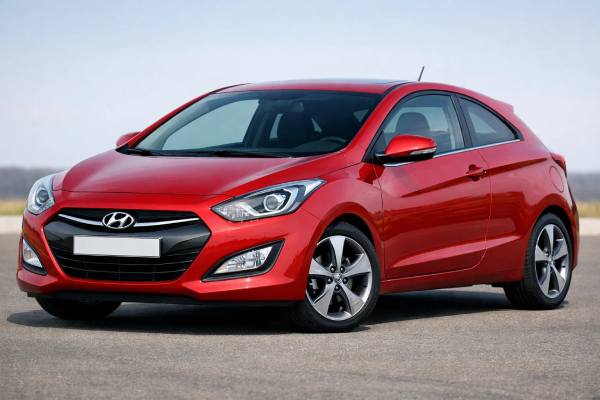
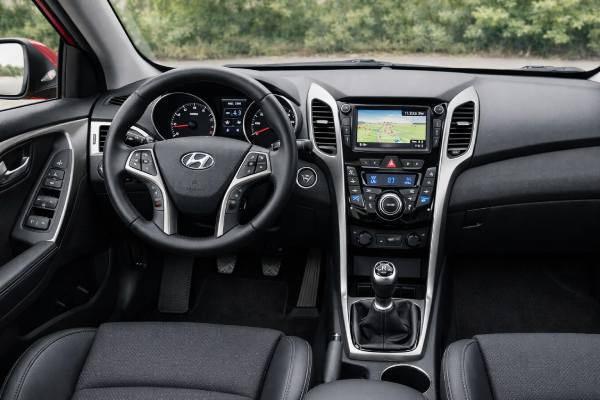
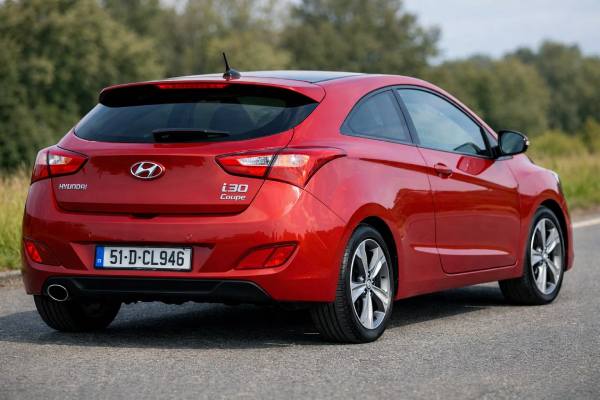
The facelifted Hyundai i30 Coupe GD 1.6 CRDi 110 hp is an unusual but appealing choice in the used market. It takes the solid second-generation i30 formula and wraps it in a lower, sleeker three-door body, while keeping the diesel torque and long-range efficiency that make the regular hatchback so easy to live with. That combination matters. You get a car that looks more distinctive than the five-door, but still offers sensible running costs, respectable space, and a mature chassis.
This version also sits in a smart part of the range. The 1.6 CRDi 110 hp engine gives the Coupe enough mid-range pull to feel relaxed in daily driving, yet it remains economical enough to justify diesel ownership for drivers who cover real distance. The key caution is familiar: this is still a modern diesel. The best examples are the ones with strong service records, proper motorway or mixed use, and no history of ignored warning lights or overdue maintenance.
Core Points
- The three-door body gives the i30 a more distinctive look without losing the useful hatchback boot and rear-seat practicality entirely.
- The 1.6 CRDi 110 hp engine offers strong everyday torque and very good motorway fuel economy.
- The GD platform rides with maturity, and smaller wheel packages suit the Coupe especially well.
- Short-trip cars can develop DPF, EGR, and soot-related diesel faults if they are used like city-only petrol cars.
- A sensible oil and filter interval is every 15,000 km or 12 months, with earlier service on severe use.
On this page
- Hyundai i30 Coupe Diesel Essentials
- Hyundai i30 Coupe Spec Charts
- Hyundai i30 Coupe Trim and Safety
- Reliability Patterns and Campaigns
- Upkeep Plan and Buying Guide
- Driving Manners and Real Economy
- Coupe Versus Compact Rivals
Hyundai i30 Coupe Diesel Essentials
The Hyundai i30 Coupe was never a pure sports coupe. That is exactly why it can make sense today. Hyundai took the GD-generation i30 hatchback, gave it a lower and more style-led three-door body, and kept the sensible engineering underneath. In facelifted 2015–2017 form, the result is a car that looks more interesting than the regular five-door without abandoning the values that made the i30 competitive in the first place.
The 1.6 CRDi 110 hp diesel is central to that appeal. In a car like this, power matters less than torque delivery, and the engine’s 280 Nm figure gives the Coupe a stronger everyday character than the 110 hp output suggests. It pulls cleanly from low rpm, works well with the six-speed manual gearbox, and makes the car feel more capable than a modest naturally aspirated petrol would in the same body. For commuting, rural driving, or regular motorway use, that matters a great deal more than a dramatic 0–100 claim.
The Coupe body changes the experience in subtler ways too. The longer front doors, lower roofline, and tighter rear side-glass treatment make the car feel more personal and less generic than the five-door hatch. At the same time, it still uses the same basic GD platform, so you do not lose the core benefits of the i30 line. The cabin remains roomy enough for the class, the boot is still practical, and the rear seats are usable rather than symbolic. That makes it one of the more rational three-door compacts of its era.
The chassis is another quiet strength. Hyundai kept a multi-link rear suspension on the GD i30 family, and that helps the Coupe feel calm, planted, and more mature than many cheaper compact rivals. It is not an especially sharp driver’s car, but it does not feel crude or underdeveloped either. The ride is composed, motorway stability is good, and the steering is easy and predictable.
The main ownership question is diesel suitability. This is not the right choice for constant cold short trips, repeated start-stop urban use, or buyers who ignore service intervals. The car works best when it is driven in a way that suits a DPF-equipped diesel. Drivers who cover meaningful distance often find the Coupe makes excellent sense. Drivers who only crawl around town often do not.
That is the big picture. The facelifted i30 Coupe 1.6 CRDi 110 is not a high-drama performance car. It is a stylish, efficient, usable compact three-door that gives you a little more personality than the ordinary hatchback while keeping most of the practical strengths intact.
Hyundai i30 Coupe Spec Charts
The figures below describe the common European Hyundai i30 Coupe GD facelift 1.6 CRDi 110 hp from 2015 to 2017. Market, trim, wheel size, and transmission choice can change some details, so this should be treated as a solid baseline rather than a universal answer for every VIN.
Powertrain and efficiency
| Item | Specification |
|---|---|
| Engine code | D4FB |
| Engine layout and cylinders | Inline-4, transverse, 4 cylinders |
| Valvetrain | DOHC, 4 valves per cylinder |
| Bore × stroke | 77.2 × 84.5 mm (3.04 × 3.33 in) |
| Displacement | 1.6 L (1,582 cc) |
| Induction | Turbocharged, intercooler |
| Fuel system | Common-rail direct injection |
| Compression ratio | 16.0:1 |
| Max power | 110 hp (81 kW) @ 4,000 rpm |
| Max torque | 280 Nm (207 lb-ft) @ 1,500–3,000 rpm |
| Timing drive | Chain |
| Rated efficiency | 3.6–3.9 L/100 km (65.3–60.3 mpg US / 78.5–72.4 mpg UK) |
| Real-world highway @ 120 km/h | about 4.8–5.5 L/100 km (42.8–49.0 mpg US / 51.4–58.9 mpg UK) |
Transmission and driveline
| Item | Specification |
|---|---|
| Transmission | 6-speed manual; some markets also listed a 7-speed DCT with the same output |
| Drive type | Front-wheel drive |
| Differential | Open |
Chassis and dimensions
| Item | Specification |
|---|---|
| Suspension front / rear | MacPherson strut / independent multi-link |
| Steering | Rack and pinion, electric power steering |
| Steering ratio / turns | about 2.85 turns lock-to-lock |
| Brakes | Front ventilated discs, rear discs |
| Most common tyre size | 195/65 R15, 205/55 R16, or 225/45 R17 depending on trim |
| Ground clearance | about 135 mm (5.3 in) |
| Length / width / height | 4,300 / 1,780 / 1,465–1,470 mm (169.3 / 70.1 / 57.7–57.9 in) |
| Wheelbase | 2,650 mm (104.3 in) |
| Turning circle | 10.6 m (34.8 ft) |
| Kerb weight | about 1,281–1,417 kg (2,824–3,124 lb) |
| GVWR | 1,920 kg (4,233 lb) |
| Fuel tank | 53 L (14.0 US gal / 11.7 UK gal) |
| Cargo volume | 378 L / 1,316 L (13.35 / 46.47 ft³) |
Performance and capability
| Item | Specification |
|---|---|
| 0–100 km/h | 10.6 s |
| Top speed | 189 km/h (117 mph) |
| Braking distance | tyre and surface dependent; no single factory figure confirmed for this exact trim |
| Towing capacity | 1,500 kg (3,307 lb) braked / 650 kg (1,433 lb) unbraked |
| Payload | about 503–639 kg (1,109–1,409 lb), trim dependent |
Fluids and service capacities
| Item | Specification |
|---|---|
| Engine oil | correct low-ash diesel oil for DPF-equipped use; 5.3 L (5.6 US qt) with filter |
| Coolant | about 6.9 L (7.29 US qt) |
| Manual transmission fluid | exact specification varies by gearbox revision; verify by VIN |
| Differential / transfer case | not applicable |
| Brake fluid | DOT 4 |
| A/C refrigerant | R134a; charge varies by equipment and market |
| Key torque specs | wheel nuts 88–108 Nm (65–80 lb-ft) |
Safety and driver assistance
| Item | Specification |
|---|---|
| Crash ratings | no separate public Euro NCAP Coupe test was widely published; the GD i30 hatchback line carried a 5-star Euro NCAP result |
| IIHS | not applicable |
| Headlight rating | not applicable |
| ADAS suite | mainstream facelift Coupes generally lacked standard AEB, ACC, BSD, RCTA, and lane-centering |
| Core safety systems | ABS, ESC/ESP, VSM, Brake Assist, airbags, ISOFIX, Hill-start Assist on many versions |
The Coupe’s numbers explain its character well. It is not a tiny sports car and not a heavy GT either. It is a compact three-door hatch with sensible weight, good torque, useful cargo space, and strong economy.
Hyundai i30 Coupe Trim and Safety
The i30 Coupe always occupied a slightly different place in the range from the standard hatchback. It was bought more for shape and individuality, so in many markets it came in fewer configurations and with a somewhat more style-focused equipment mix. Exact trim names varied, but the broad pattern was familiar: lower-grade essentials, mid-range all-rounders, and better-equipped upper trims with larger wheels, more convenience gear, and a stronger visual presence.
The trim choice matters because the Coupe can look more premium than it really is. Bigger wheels, tinted glass, body-color details, sportier bumpers, nicer seat trim, and steering-wheel controls all make a difference to how the car presents. Yet the smartest used buy is rarely the highest trim by default. Smaller wheel packages often ride better, cost less to replace, and suit the diesel Coupe’s relaxed character more naturally.
Typical features on better-equipped facelift Coupes may include:
- alloy wheels
- cruise control with speed limiter
- Bluetooth and steering-wheel audio controls
- parking sensors
- climate-control or upgraded air-conditioning interfaces
- leather-trimmed wheel and gear knob
- automatic lights and rain-sensing wipers on upper grades
- upgraded audio or navigation in some markets
Mechanically, there is usually less separation between trims than buyers expect. The engine, gearbox, braking layout, and core suspension design remain the same. What changes more often are the tyre package, cabin spec, and convenience features. That means condition is still more important than badge.
Safety needs a careful explanation. The GD-generation i30 family made a real step forward over the FD car, and the widely published Euro NCAP result for the i30 hatchback platform was strong for its time. The Coupe shares the same underlying platform and general safety architecture, but buyers should remember that the Coupe body was not always listed as a separately published public test result. In practice, that means the five-star hatchback-family result is a useful benchmark, but it should not be confused with a unique Coupe-specific crash score.
On the hardware side, the Coupe still offers a decent passive-safety foundation:
- front, side, and curtain airbags on many versions
- ABS with electronic control logic
- ESC or ESP and Vehicle Stability Management
- Brake Assist Control
- ISOFIX outer rear mounting points
- Hill-start Assist on many cars
What it does not offer, in ordinary 2015–2017 110 hp trim, is a modern advanced driver-assistance package. You should not expect current-generation autonomous emergency braking, blind-spot monitoring, rear cross-traffic assistance, or lane-following support. The car depends much more on good tyres, effective brakes, sound visibility, and driver attention than on intervention technology.
When inspecting a used car, check the basics carefully:
- Airbag, ABS, ESC, and steering-system warning lights.
- Tyre age, brand consistency, and correct load rating.
- Brake feel, straight stopping, and rear caliper condition.
- Seatbelt retraction and buckle operation.
- Crash-repair quality around the front rails and door openings.
- Rear-seat latch condition and ISOFIX hardware.
The best Coupe trims are usually the ones that give you the right balance of looks and ownership simplicity. A tidy mid-spec example often makes more sense than a higher-spec car carrying expensive old electronics and oversized wheels.
Reliability Patterns and Campaigns
The facelifted i30 Coupe 1.6 CRDi is generally a solid used car when it has been maintained properly and driven in a way that suits a modern diesel. Its biggest weaknesses are not unique to Hyundai. They are the usual diesel-era risks: soot, regeneration problems, fuel-system neglect, and higher-mileage wear in clutch and brake components.
Common, medium-cost issues
- DPF trouble: This is the biggest risk on short-trip cars. Symptoms include frequent regeneration, warning lights, limp mode, rising oil level from fuel dilution, and worsening economy. The likely cause is a life spent on repeated cold urban journeys. Remedies range from forced regeneration and sensor diagnosis to cleaning or replacement if the fault has been left too long.
- EGR and intake soot build-up: Sluggish response, flat spots, rough idle, smoke under load, or related fault codes often point to soot build-up. Cars that rarely get fully warm are most vulnerable.
- Rear brake drag: The i30 family can develop sticking rear calipers with age. This is easy to miss on a casual viewing, but it can hurt both refinement and economy.
Occasional, higher-cost issues
- Injector and fuel-system wear: Hard starting, diesel knock, rough running, or fuel smell should never be ignored. Prompt diagnosis is cheaper than waiting.
- Turbo and boost-control faults: Split hoses, actuator problems, sticking vanes, or vacuum leaks can make the car feel slower than it should and may trigger limp mode.
- Clutch and dual-mass flywheel wear: Manual diesel Coupes with heavy traffic use, hard launches, or occasional towing can develop DMF chatter, vibration, or poor take-up.
Other age-related faults
- wheel-bearing noise
- suspension-link and bush wear
- battery and glow-plug complaints
- hatch-lock or central-locking glitches
- parking-sensor issues on equipped cars
- occasional cabin switchgear or blower resistor faults
Timing-chain problems are less common than DPF or EGR complaints, but chain-driven does not mean chain-free forever. Poor oil quality or long oil intervals can contribute to cold-start noise or timing-related faults later in the car’s life.
Software matters too, even if this is not a software-led vehicle. Persistent emissions faults, repeated regeneration complaints, or odd sensor behavior are reasons to ask whether dealer diagnostics and control-unit updates were performed. On many modern diesels, a calibration check is part of proper troubleshooting, not an afterthought.
Campaign history should always be checked by VIN through Hyundai’s official tools. Coverage can vary by region and production date, and it is a mistake to rely on forum posts or seller memory. For a used buyer, proof that recall or service-campaign work was completed is a real part of the car’s value.
Before purchase, request:
- full service history
- proof of recall or campaign completion
- a cold start
- a diagnostic scan for stored diesel faults
- recent invoices for brakes, tyres, or clutch work
- evidence of correct oil specification use
A healthy i30 Coupe diesel should feel easy, smooth, and quietly competent. If it feels hesitant, smoky, noisy, or electronically fussy, there is usually a reason.
Upkeep Plan and Buying Guide
This is a car that rewards routine maintenance more than dramatic repair work. The strongest i30 Coupe 1.6 CRDi examples are rarely the cheapest ones. They are the ones that had timely oil changes, proper filters, good tyres, and early diagnosis when small diesel faults first appeared.
A practical maintenance schedule looks like this:
| Item | Practical interval |
|---|---|
| Engine oil and filter | Every 15,000 km or 12 months |
| Engine air filter | Inspect every service, replace about every 30,000–45,000 km |
| Cabin air filter | Every 15,000 km or 12 months |
| Fuel filter | Replace by official schedule or earlier where fuel quality is questionable |
| Coolant | First replacement around 210,000 km or 10 years, then every 30,000 km or 24 months |
| Brake fluid | Every 24 months |
| Brake pads and discs | Inspect at every service |
| Serpentine belt and tensioners | Inspect regularly |
| Manual gearbox oil | Check for leaks and shift quality; proactive renewal around 90,000–120,000 km is sensible |
| Timing chain | No fixed replacement interval; inspect if noise or timing faults appear |
| Tyre rotation | Every 10,000–15,000 km |
| Alignment check | Yearly or after uneven wear appears |
| 12 V battery | Test from year 4 onward |
| DPF health | Monitor regeneration behavior, warning lights, and oil level |
For fluids and service data, a few numbers matter more than most owners realize. Engine oil fill is 5.3 L with filter, coolant is about 6.9 L, brake fluid is DOT 4, and wheel-nut torque is 88–108 Nm. More importantly, the engine needs the correct low-ash oil for DPF-equipped diesel use. This is not a place to save money with the wrong specification.
A strong buyer’s inspection checklist should focus on the expensive truth:
- genuine cold start
- no prolonged chain rattle
- stable idle and clean low-rpm pull
- no warning lights staying on
- no obvious smoke under load
- stable coolant temperature
- no clutch slip or DMF chatter
- no dragging rear brakes after a drive
- no serious underbody corrosion
- no sign of water intrusion in the hatch area
The best examples are usually mid-spec manual cars with clear mixed-use or motorway history, standard or near-standard wheels, and evidence of steady maintenance. The cars to approach carefully are low-mileage city diesels, heavily modified examples, or cars where the three-door style clearly mattered more to previous owners than service discipline.
Common reconditioning needs on older examples include tyres, rear brakes, battery, air-conditioning service, drop links, and sometimes clutch-related work. None of that is unusual. What matters is whether those jobs are normal upkeep or signs that the seller has deferred everything.
Long-term durability is good when the car is owned in a way that suits a diesel. That is the simplest buying rule of all. If your use case is mainly short urban journeys, the Coupe’s shape will not save you from diesel-system frustration.
Driving Manners and Real Economy
The facelifted i30 Coupe 1.6 CRDi feels more polished than its modest badge and numbers might suggest. It is not a hot hatch, but it is also not just a style exercise. Hyundai gave the GD platform a mature chassis, and the Coupe benefits from that every day.
Ride quality is one of its strongest traits. On sensible tyres, the Coupe deals with rough roads well and never feels overly stiff just because it has a sportier shape. The multi-link rear suspension helps it stay calm over broken surfaces, and the body settles nicely at speed. That gives the car a surprisingly grown-up feel on longer journeys.
Straight-line stability is strong too. The Coupe feels comfortable on faster roads, tracks cleanly on the motorway, and remains easy to drive in crosswinds or on poor surfaces. Steering is light and predictable rather than especially talkative, but it suits the car’s role. The Coupe asks little of the driver, which is part of its appeal.
The engine provides the best part of the driving experience. The 280 Nm torque figure gives the car useful flexibility, and the 1.6 CRDi pulls better than the 110 hp rating alone suggests. Around town, it does not need to be worked hard. On country roads or motorway slip roads, it feels stronger and more relaxed than a small petrol equivalent. Overtaking still needs planning, but much less planning than you might expect from a 110 hp family diesel.
Noise levels are reasonable for the class and period. There is the usual diesel clatter when cold, and you still know it is a diesel under load, but the overall noise, vibration, and harshness picture is well controlled. That matters because many buyers choose this Coupe for long-range economy, not just its looks.
Real-world fuel use usually looks like this:
- city: about 5.2–6.1 L/100 km, or 38.4–45.2 mpg US and 46.3–54.3 mpg UK
- highway at 100–120 km/h: about 4.8–5.5 L/100 km, or 42.8–49.0 mpg US and 51.4–58.9 mpg UK
- mixed use: about 4.9–5.7 L/100 km, or 41.3–48.0 mpg US and 49.6–57.6 mpg UK
Those figures assume a healthy DPF system, correct tyre pressures, good-quality tyres, and an owner who allows the car to complete regeneration cycles. Constant short trips, winter cold, blocked emissions hardware, or dragging brakes can push them noticeably higher.
With a 53-liter tank, the Coupe can cover useful distance between fills. That is one of the reasons it still makes sense as a commuter or motorway car. Even now, the combination of style, range, and low running costs is not easy to replace at the same budget.
Coupe Versus Compact Rivals
The i30 Coupe 1.6 CRDi sits in an interesting niche. It is not competing only with ordinary five-door hatchbacks. It also overlaps with style-led three-door compacts that tried to mix sharper looks with everyday usability.
Against the Kia pro_cee’d 1.6 CRDi, the Hyundai faces its closest relative. Shared engineering means the real decision usually comes down to condition, trim, and price. The Kia often feels a touch more overtly sporty in image, while the Hyundai can feel a little more understated. There is no major mechanical gap between them when maintenance history is equal.
Against the Volkswagen Golf 1.6 TDI 3-door, the Golf still carries stronger badge appeal and, for some buyers, a slightly more premium cabin impression. But the Hyundai often undercuts it on used price while delivering similar real-world usefulness and very comparable economy.
Against the Ford Focus 1.5 TDCi, the Ford remains the better steer and the more engaging car if driver feel matters most. The Hyundai answers with a calmer everyday nature, strong value, and a more distinctive three-door identity than the equivalent mainstream Focus.
Against the Vauxhall Astra GTC CDTi, the Hyundai often looks less dramatic, but it usually feels more rational. Visibility, control layout, and day-to-day ease of use all work in the Hyundai’s favor.
The i30 Coupe’s strongest points are clear:
- distinctive three-door styling
- good diesel torque and real-world economy
- mature, comfortable chassis
- usable cargo space for the shape
- sensible used values
Its weaker points are just as clear:
- not truly sporty to drive
- diesel after-treatment dislikes short-trip use
- heavier doors and tighter rear access than the five-door
- limited modern driver-assistance coverage
- less badge image than some German rivals
That leaves the Hyundai in a very specific but appealing position. It is best for buyers who want something more stylish than an ordinary hatchback, but who still care about fuel economy, space, and low-drama ownership. If you want the sharpest handling, there are better choices. If you want the smartest balance of style and practicality at a sensible price, the facelifted i30 Coupe 1.6 CRDi remains easy to understand.
References
- Hyundai i30 II Coupe (facelift 2015) 1.6 CRDi (110 Hp) blue | Technical specs, data, fuel consumption, Dimensions 2026 (Technical Data)
- Hyundai Owners Manuals 2026 (Owner’s Manual Portal)
- EuroNCAP | Hyundai i30 2012 (Safety Rating)
- Home | Hyundai Recalls & Service Campaigns 2026 (Recall Checker)
- Hyundai i30 2015 (Brochure)
Disclaimer
This article is for informational purposes only and is not a substitute for professional diagnosis, repair, or official workshop procedures. Specifications, torque values, service intervals, capacities, and repair methods can vary by VIN, market, production date, emissions equipment, and trim level, so always verify details against official service documentation for the exact vehicle.
If this guide helped you, please consider sharing it on Facebook, X, or another social platform to support our work.