
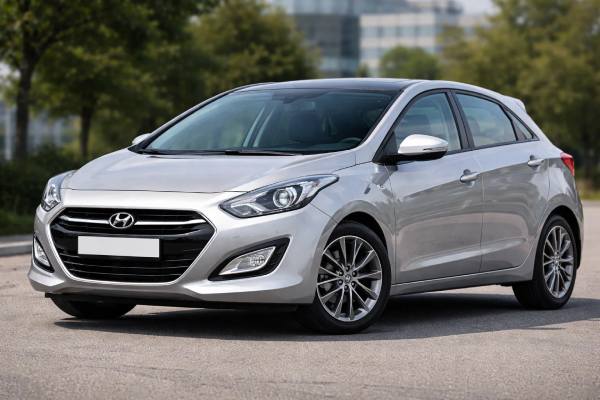
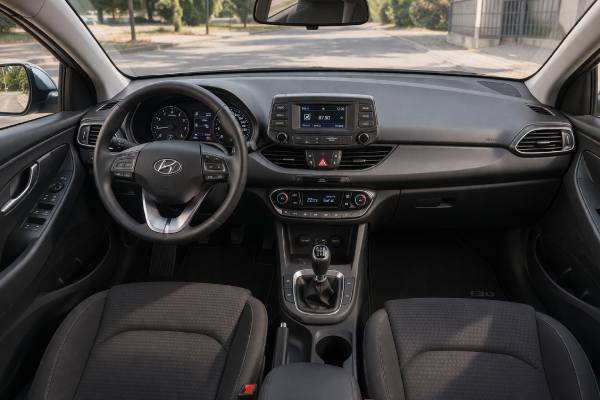
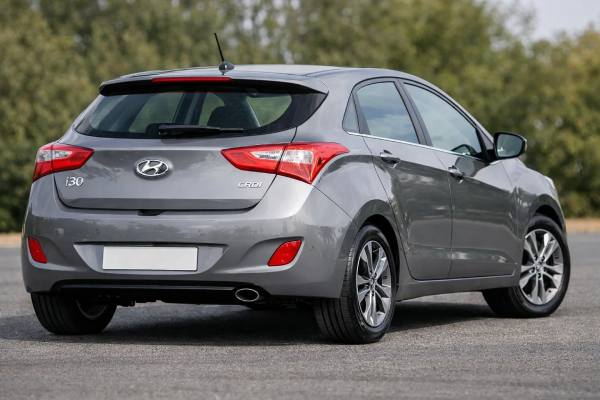
The facelifted Hyundai i30 GD 1.6 CRDi 136 hp is one of the most convincing versions of the second-generation i30. It keeps the practical five-door hatchback layout and tidy European road manners that made the GD a strong family car, but adds the stronger diesel tune, Euro 6-era efficiency, and, in many markets, the option of Hyundai’s 7-speed dual-clutch transmission. That matters because this version feels more complete than the lower-output diesels when the car is loaded, driven on the motorway, or used for longer distances. It is still not a performance hatch, but it has enough torque and flexibility to feel easy rather than strained. Today, the attraction is clear: low real-world fuel use, useful luggage space, a mature chassis, and a cabin that still feels solid. The main caution is equally clear. This is now an older diesel with DPF, EGR, and chain-driven timing hardware, so service history and usage pattern matter more than trim badge alone.
What to Know
- The 136 hp diesel is the most satisfying mainstream GD diesel for mixed driving and motorway work.
- Euro 6 tuning and the facelift update made the late GD feel cleaner, more refined, and more mature than early cars.
- Hatchback practicality stays strong, with a useful 378-liter boot and flat-folding rear seat versatility.
- Short-trip use is the main ownership caveat because DPF and EGR issues are more likely on lightly used diesel cars.
- A sensible oil-and-filter interval is every 15,000 km or 12 months, with shorter intervals for severe use.
Quick navigation
- Hyundai i30 facelift diesel profile
- Hyundai i30 facelift technical detail
- Hyundai i30 facelift equipment map
- Typical faults and campaign checks
- Service plan and used-buyer advice
- On-road feel and real economy
- Rivals and ownership value
Hyundai i30 facelift diesel profile
The facelifted i30 GD sits at an interesting point in Hyundai’s compact-car history. By this stage, the i30 no longer felt like a budget outsider trying to prove itself against the European class leaders. It felt like a proper mainstream contender. The GD already had the right fundamentals before the facelift: European-focused ride and handling, sensible dimensions, decent cabin quality, and a strong safety result. The 2015 update sharpened that formula rather than replacing it. Hyundai refined the design, improved efficiency, and broadened the powertrain range with newer diesel options and the 7-speed dual-clutch transmission in selected markets.
In 1.6 CRDi 136 hp form, the facelifted hatchback lands in the sweet spot of the range. The lower-output 110 hp diesel is a strong economy choice, but the 136 hp version better matches the car’s chassis and everyday role. It offers the same basic 1.6-liter U2-series diesel architecture, but with stronger performance and more flexibility. In manual form, it delivers about 280 Nm, while DCT versions are quoted at 300 Nm in official facelift material. That difference matters in real life because it helps the i30 carry speed more confidently, especially on faster roads or with passengers and luggage on board.
The hatchback body remains one of the model’s main strengths. At 4,300 mm long, it is easy to place in traffic and simple to park, yet it still offers a boot capacity of 378 liters with the rear seats up and 1,316 liters with them folded. That is enough to make the car genuinely useful as a family hatch rather than just an efficient commuter. It does not have the outright carrying ease of the Tourer estate, but it is much more practical than its neat shape might suggest.
The facelift also matters because it pushed the GD toward a more modern ownership experience. It remained mechanically conventional in the best possible way, but the updates brought tidier interior tech, improved trim logic in many markets, and a more mature impression overall. That is why this version still has a strong used-market case. It is efficient without being especially delicate, modern enough to feel current in daily use, and still free of the more complicated electrification layers that arrived later. The main caveat is that the diesel only really makes sense for drivers who cover enough distance to keep the emissions hardware healthy.
Seen that way, the facelifted i30 1.6 CRDi 136 hp is not just the “best diesel” on paper. It is the version that makes the GD feel most complete. It combines the strongest mainstream diesel tune, good economy, a mature body shell, and everyday practicality in a package that still feels rational years later. That is why the car remains appealing today, provided the specific example has the service history and usage pattern to match the drivetrain.
Hyundai i30 facelift technical detail
For this article, the baseline is the facelifted Hyundai i30 GD five-door hatchback sold from 2015 to 2017 with the 1.6 CRDi 136 hp diesel engine. In some markets, the 136 hp unit was offered with either a 6-speed manual or a 7-speed DCT. The headline figures below reflect that reality, because the gearbox meaningfully changes torque output, performance, and economy.
Powertrain and efficiency
| Item | Hyundai i30 (GD facelift) 1.6 CRDi 136 hp |
|---|---|
| Code | U2 1.6 CRDi / D4FB family |
| Engine layout and cylinders | Inline-4, 4 cylinders, DOHC, 4 valves/cyl |
| Bore × stroke | 77.2 × 84.5 mm (3.04 × 3.33 in) |
| Displacement | 1.6 L (1,582 cc) |
| Induction | Turbocharged, intercooler |
| Fuel system | Common-rail direct injection |
| Compression ratio | 16.0:1 |
| Max power | 136 hp (100 kW) @ 4,000 rpm |
| Max torque, manual | 280 Nm (207 lb-ft) |
| Max torque, DCT | 300 Nm (221 lb-ft) @ 1,750–2,500 rpm |
| Timing drive | Chain |
| Emissions standard | Euro 6 |
| Drive type | FWD |
| Differential | Open |
The facelift brochure clearly shows the diesel paired with the 7DCT and quotes 300 Nm, while manual-market technical listings commonly show the same 136 hp engine with 280 Nm. That is why buyers should always verify the transmission and exact powertrain code rather than assuming all 136 hp cars are identical.
Transmission, dimensions, and capacities
| Item | Hyundai i30 (GD facelift) 1.6 CRDi 136 hp |
|---|---|
| Transmission | 6-speed manual or 7-speed DCT |
| Suspension front / rear | Fully independent MacPherson strut / fully independent multi-link |
| Steering | Rack and pinion, motor-driven power steering |
| Steering wheel turns lock-to-lock | 2.85 |
| Turning circle | 10.6 m (34.8 ft) |
| Brakes | Front and rear discs |
| Wheels and tyres | 195/65 R15, 205/55 R16, or 225/45 R17 depending on trim |
| Length | 4,300 mm (169.3 in) |
| Width | 1,780 mm (70.1 in) |
| Height | 1,470 mm (57.9 in) |
| Wheelbase | 2,650 mm (104.3 in) |
| Ground clearance | about 140 mm (5.5 in) |
| Kerb weight | about 1,391–1,468 kg for brochure-listed DCT range; around 1,429 kg commonly listed for manual blue models |
| GVWR | about 1,920–1,940 kg depending on version |
| Fuel tank | 53 L (14.0 US gal / 11.7 UK gal) |
| Cargo volume | 378 L (13.35 ft³) seats up / 1,316 L (46.47 ft³) seats folded |
Performance, towing, fluids, and safety basics
| Item | Hyundai i30 (GD facelift) 1.6 CRDi 136 hp |
|---|---|
| 0–100 km/h, manual | about 10.2 s |
| Top speed, manual | about 196 km/h (122 mph) |
| 0–100 km/h, DCT | 10.6–11.8 s depending on market/source |
| Top speed, DCT | 185–200 km/h (115–124 mph) depending on market/source |
| Combined fuel use, manual | about 4.0 L/100 km |
| Combined fuel use, DCT | about 4.2–4.4 L/100 km |
| Braked towing capacity | about 1,500 kg (3,307 lb) where listed |
| Unbraked towing capacity | about 650 kg (1,433 lb) |
| Engine oil capacity | about 5.3 L (5.6 US qt) |
| Coolant capacity | about 6.9 L (7.3 US qt) |
| Crash rating | Euro NCAP 5 stars |
| Euro NCAP scores | Adult 90%, Child 90%, Pedestrian 67%, Safety Assist 86% |
| ADAS | No modern AEB, ACC, or lane-centering suite on this facelifted GD setup |
That table also explains the facelift’s character. The manual is usually the more efficient and enthusiast-friendly choice, while the DCT gives smoother traffic use and a little more torque. Both remain practical, but the ownership advice is not exactly the same because the DCT adds another system that deserves careful inspection.
Hyundai i30 facelift equipment map
Trim structure on the facelifted i30 varied by country, so used buyers should treat trim names as hints rather than facts. The broad pattern was simple enough: entry trims focused on value, mid-range cars added the features most people actually wanted, and upper trims brought larger alloys, panoramic roof options, parking aids, nicer upholstery, and more convenience equipment. The exact naming changed from market to market, but the underlying trim logic stayed familiar.
The strongest used-buying case is usually in the middle of the range. That is where the 136 hp diesel often makes the most sense. A mid-spec car typically combines the stronger diesel with sensible wheel sizes, cruise control, better seat adjustment, parking sensors, Bluetooth, and a cabin that feels modern enough without becoming expensive to maintain through big wheels or heavily optioned trim. Larger wheels and extra visual equipment can improve the look, but they also raise tyre costs and can harden the ride.
The facelift brochure also shows how Hyundai packaged equipment. Standard entry-level items commonly included front and side airbags, curtain airbags, ISOFIX, front fog lights, air conditioning, Bluetooth, steering-wheel audio controls, Flex Steer, LED daytime running lights, ABS, ESP, vehicle stability management, and brake assist. Mid-range trims then added 16-inch alloys, cruise control with speed limiter, rear parking sensors, power-lumbar support, auto lights, and further cabin trim upgrades. Higher trims built on that with panoramic sunroof, privacy glass, dual-zone climate control, rain-sensing wipers, and upgraded upholstery. That means even lower trims were not bare-bones in the way older budget compacts sometimes were.
Safety remained a key selling point. The i30 GD’s Euro NCAP result was strong for the period, with 90% scores for adult and child occupant protection and an 86% safety-assist score. That put it in the mainstream of the class rather than on the margins. It is also important that the facelift still carried the fundamental restraint and body-shell strengths of the original GD generation rather than trying to reinvent them.
Buyers should still keep period context in mind. This is a strong early-2010s safety package, not a modern ADAS showcase. The facelifted GD focuses on conventional safety equipment and stability systems, not autonomous emergency braking, adaptive cruise control, or blind-spot monitoring. In daily ownership, that shifts attention back to the basics: airbags, ESC, tyres, brakes, and recall completion. A lower trim with healthy tyres and documented maintenance is usually a smarter buy than a more expensive trim with deferred servicing and flashy wheels.
Typical faults and campaign checks
The facelifted i30 1.6 CRDi 136 hp is fundamentally a sensible used diesel, but it is not a car that forgives neglect. Its reliability picture is shaped less by one dramatic design flaw than by how closely the car’s service history and usage pattern match the needs of an older Euro 6 diesel. Regular longer journeys, timely oil changes, and proper attention to filters and brakes suit it well. Years of short urban trips do not.
The most common diesel-related issues are predictable. DPF loading becomes more likely on lightly used cars or those that spend most of their lives in traffic. Symptoms include frequent regeneration, rising fuel consumption, warning lights, limp mode, or a car that feels strangely flat. EGR fouling is another familiar issue, often showing up as hesitation, uneven response, smoke under load, or repeated engine-management faults. Fuel filter neglect or poor diesel quality can make cold starting and idle quality worse, while boost-pipe or intercooler-hose leaks can leave the car feeling much weaker than 136 hp should.
Manual cars bring the usual diesel clutch and dual-mass flywheel considerations. A shudder on take-up, idle rattle, slip under load, or an unusually heavy clutch pedal all deserve attention. DCT cars need a different mindset. The transmission is one of the facelift’s attractions, but it is also a system worth checking carefully. Slow engagement, abrupt take-up, warning lights, or evidence of unresolved drivability complaints should be treated seriously rather than dismissed as “normal for a DCT.” Software and calibration can also matter on modern diesels and automated transmissions, so invoice-backed evidence of dealer servicing is more valuable than a vague claim that “everything was updated.”
Chassis wear is usually ordinary rather than frightening. Expect to inspect front suspension bushes, drop links, brakes, wheel bearings, tyres, and engine mounts. These are normal used-car items, but they strongly affect how refined the car feels. A tired i30 can feel cheap and noisy even if the underlying design is sound. That is why a careful test drive matters so much. A good example should feel tight, stable, and quieter than many older compact diesels.
Recalls and service campaigns are not optional background checks. The correct process is a VIN check through Hyundai’s official recall portal plus dealer or invoice-backed confirmation of completed work. On a used facelifted GD, that should be basic due diligence. The same goes for software history where available. If a seller cannot explain warning-light history, repeated repairs, or recent emission-system work, assume the car needs deeper inspection before purchase.
Service plan and used-buyer advice
The i30 GD 1.6 CRDi 136 hp responds best to conservative maintenance. It does not need exotic care, but it also is not a car to maintain by guesswork. Fresh oil, correct low-SAPS lubricant, clean filters, good tyres, and prompt attention to brakes and warnings are what keep it feeling like a smart buy rather than an expensive one.
Practical maintenance schedule
- Engine oil and filter: every 15,000 km or 12 months for normal use; shorten the interval for severe use, short trips, or repeated cold starts.
- Engine air filter: inspect at each service and replace when dirty.
- Cabin air filter: replace regularly to protect HVAC performance.
- Fuel filter: keep on schedule and replace early if fuel quality or starting behavior is questionable.
- Coolant: follow the factory schedule for the exact VIN, but refresh early if the history is uncertain.
- Brake fluid: every 24 months is a practical preventive interval.
- Manual gearbox oil: inspect for leaks and refresh sensibly on higher-mileage cars.
- DCT fluid and service history: verify the exact gearbox requirements and past servicing before purchase.
- Brakes: inspect pads, discs, rear caliper movement, and parking-brake operation at every routine service.
- Tyre rotation and alignment: rotate tyres and investigate uneven wear quickly.
- Battery and glow plugs: test before winter on older cars.
- Timing components: chain-driven engine, so inspect for start-up rattle, timing-correlation faults, and tensioner symptoms rather than assuming lifetime service.
- Belts and hoses: inspect auxiliary belt, pulleys, and coolant hoses for age-related wear.
Fluids and useful service data
| Item | Practical guidance |
|---|---|
| Engine oil capacity | about 5.3 L (5.6 US qt) |
| Coolant capacity | about 6.9 L (7.3 US qt) |
| Fuel tank | 53 L (14.0 US gal / 11.7 UK gal) |
| Oil type | Low-SAPS diesel oil meeting the correct Hyundai and ACEA specification |
| Coolant type | Hyundai-approved ethylene-glycol coolant |
| Brake fluid | DOT 4-type fluid is the normal expectation |
| Common tyre sizes | 195/65 R15, 205/55 R16, 225/45 R17 |
| Critical torque values | Confirm from VIN-specific workshop data before tightening safety-critical fasteners |
Used buyer’s checklist
- Start the engine from cold and listen for chain noise, excessive injector harshness, or unstable idle.
- Check that there are no DPF, ABS, ESC, or airbag warnings left on after start-up.
- Confirm smooth boost delivery with no flat spots or smoke under load.
- On manuals, test the clutch carefully for slip, vibration, or rattling flywheel symptoms.
- On DCT cars, check take-up quality, low-speed smoothness, and fault-free operation.
- Inspect tyres for mismatched brands and uneven wear.
- Check the body, arches, underside, and exhaust for corrosion or accident repairs.
- Verify service history with invoices, not just stamps.
- Run the VIN through Hyundai’s official recall portal.
The best examples are usually cars that did regular mixed or motorway mileage, had timely oil service, and were not used almost exclusively for short urban trips. Cars to avoid are those with warning lights, unresolved drivability complaints, vague recall status, or evidence of repeated low-budget repairs. Long-term durability is good enough to recommend the model, but only if the specific car has been maintained in a way that suits an older diesel hatchback.
On-road feel and real economy
The facelifted i30 1.6 CRDi 136 hp drives like a mature compact hatchback rather than a budget alternative. That is one of its strongest qualities. Straight-line stability is solid, the steering is accurate enough without feeling nervous, and the chassis is settled in the way you want from a car that is likely to cover regular motorway miles. The GD was already a more polished car than the old FD, and the facelifted version keeps that broader impression of calm competence.
The stronger 1.6 CRDi suits the car well. Off the line, throttle response is still recognizably diesel and there is some lag if you demand everything at very low revs. Once the turbo is working, though, the car feels properly useful. The manual version is the purer fit for drivers who like to make the most of the engine’s flexibility, while the DCT gives smoother traffic use and a more relaxed feel in daily commuting. Neither turns the i30 into a warm hatch, but the 136 hp tune does give it enough shove to feel confident rather than merely economical.
Ride quality depends quite a lot on wheel size. Cars on 15- or 16-inch wheels usually suit the i30’s character best. They keep the suspension calmer over poor surfaces and reduce tyre costs. Seventeen-inch cars look sharper, but they bring more road noise and a firmer edge to the ride. That is not unusual in the class, but it does matter on a used family hatch where comfort and running costs are part of the appeal.
Noise levels are respectable for a diesel of this era. At idle and on cold start, the engine makes its presence known, but once warm and cruising it settles down well enough to feel more refined than many older diesel rivals. Tyre quality and engine-mount condition matter a lot here. A healthy i30 on decent rubber can feel quiet and composed. A neglected one on cheap tyres can feel much rougher and older than the model deserves.
Real-world economy is one of the strongest reasons to choose this version. Official combined fuel use sits around 4.0 L/100 km for manual blue versions and roughly 4.2 to 4.4 L/100 km for DCT variants, but real life is usually a little higher. In mixed driving, a healthy manual car often lands somewhere in the low-to-mid 5s L/100 km. Fast motorway use at 120 km/h usually means mid-5s to low-6s, depending on tyre size, weather, and load. For a 136 hp diesel hatch, that is still very respectable.
Performance is best described as confident rather than exciting. A manual car can reach 100 km/h in about 10.2 seconds and continue to around 196 km/h, while DCT variants are broadly in the same zone with slightly different character depending on market tune and gearing. That is enough to make the i30 feel easy on the motorway and useful when overtaking, which is exactly what most buyers of this version want.
Rivals and ownership value
In the used market, the facelifted Hyundai i30 GD 1.6 CRDi 136 hp competes with some very credible cars: Ford Focus 1.5 or 1.6 TDCi, Volkswagen Golf 1.6 TDI and 2.0 TDI variants, Kia cee’d 1.6 CRDi, Skoda Octavia diesel models, and Peugeot 308 HDi or BlueHDi versions. The Hyundai’s case is not that it beats all of them in one dramatic area. Its case is that it balances the important things very well.
Against the Focus, the Hyundai usually loses some steering sparkle and driver appeal. Against the Golf, it can give away a little cabin prestige and badge pull. Against the cee’d, the contest is extremely close because the cars share a similar Korean approach to the class. Against an Octavia, the Hyundai does not match the Skoda’s larger-car feel or liftback practicality. Yet the i30 often remains very attractive because it combines useful performance, strong efficiency, good safety fundamentals, and a straightforward hatchback body without feeling like a compromise.
Its strongest arguments are clear:
- efficient real-world diesel running costs,
- a stronger and more flexible powertrain than the 110 hp version,
- solid five-star-era safety credentials,
- practical hatchback packaging,
- and a mature, stable on-road feel.
Its main drawbacks are just as clear:
- it is still an older Euro 6 diesel with DPF and EGR ownership risks,
- bigger-wheel trims can dilute the comfort-and-value sweet spot,
- DCT cars need more careful inspection than manuals,
- and it does not offer the modern ADAS features buyers may know from newer cars.
That leads to a straightforward verdict. The facelifted i30 GD 1.6 CRDi 136 hp is one of the better rational used diesels in the class if you actually use a diesel in the way it was meant to be used. It makes sense for regular-mileage drivers who want a well-balanced hatchback, not for buyers doing nothing but cold urban errands. Choose the cleanest, best-documented car you can find, prefer condition over trim, and verify recall and service history by VIN and invoices. Done that way, this version of the i30 still offers a very convincing mix of performance, practicality, and ownership value.
References
- Hyundai i30 2015 (Brochure)
- Hyundai Owners manuals | Hyundai Motor UK 2026 (Owner’s Manual)
- Hyundai i30 – Crash Test 2012 2012 (Safety Rating)
- Home | Hyundai Recalls & Service Campaigns 2026 (Recall Database)
- Hyundai i30 II (facelift 2015) 1.6 CRDi (136 Hp) blue 2026 (Technical Data)
Disclaimer
This article is for informational purposes only and is not a substitute for professional diagnosis or repair. Specifications, torque values, service intervals, procedures, and fitted equipment can vary by VIN, market, model year, transmission, emissions package, and trim. Always verify critical service information against the official documentation for the exact vehicle before carrying out maintenance or repairs.
If this guide helped you, please consider sharing it on Facebook, X, or another social platform to support our work.