
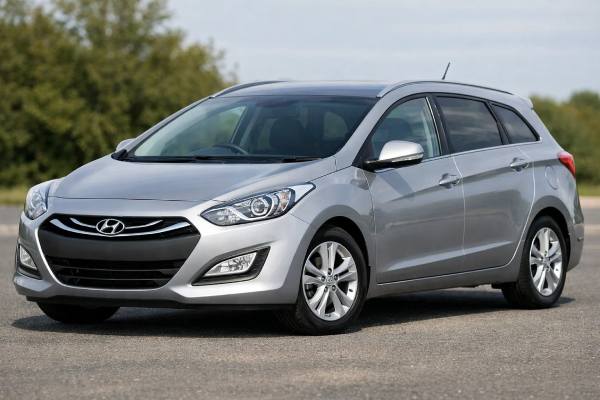
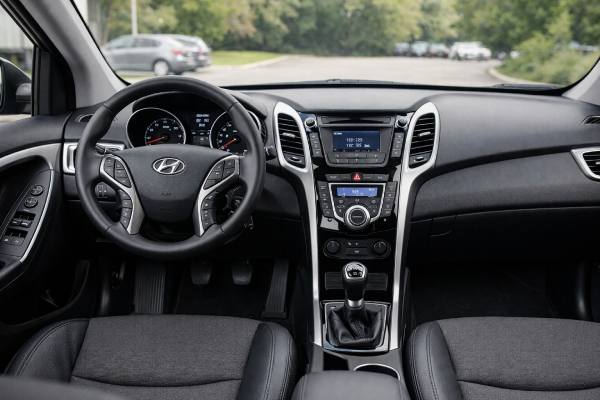
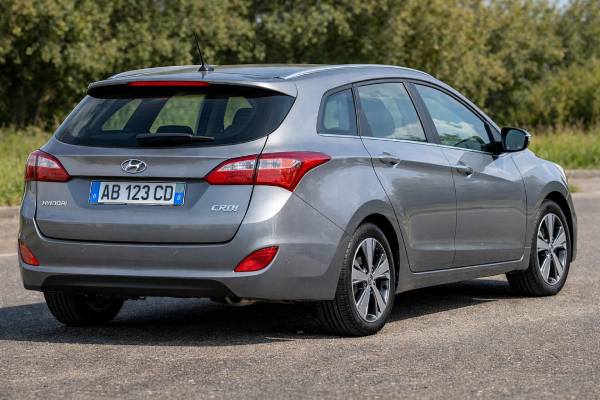
The 2012–2015 Hyundai i30 Tourer 1.4 MPI is a practical compact estate built for owners who value space, simplicity, and predictable running costs more than outright pace. It takes the second-generation GD i30 platform, stretches it into a longer wagon body, and pairs it with Hyundai’s naturally aspirated 1.4-liter petrol four-cylinder and a 6-speed manual gearbox. That combination tells you a lot about the car before you even drive it. This is not the fast i30, and it was never meant to be. Instead, it aims to be useful, easy to service, and comfortable enough for family work. The engineering recipe is fairly conservative: multi-port fuel injection, a timing chain, front-wheel drive, and a chassis that uses independent rear suspension rather than the cheaper rear-axle setups many rivals relied on. In used form, that makes it appealing to careful buyers who want a wagon without diesel complexity or turbo-related repair risk.
What to Know
- The Tourer body is genuinely practical, with 528 L of cargo space and a low, usable load floor.
- The 1.4 MPI engine is simple by modern standards, with port injection and no turbocharger.
- Independent rear suspension helps the car ride and handle with more composure than many budget estates.
- Performance is modest, so a full load or fast motorway work will require frequent downshifts.
- A sensible service baseline is engine oil and filter every 15,000 km or 12 months.
Contents and shortcuts
- Hyundai i30 Tourer GD Basics
- Hyundai i30 Tourer GD Technical Numbers
- Hyundai i30 Tourer GD Versions and Protection
- Usual Faults and Factory Actions
- Maintenance Rhythm and Buying Tips
- Road Feel and Running Costs
- Versus Other Compact Estates
Hyundai i30 Tourer GD Basics
The second-generation Hyundai i30 Tourer is one of those cars that becomes more convincing the more closely you look at how it was designed. Hyundai did not try to turn this version into a sporty lifestyle wagon or a premium estate imitation. Instead, it built a compact family car with real luggage space, easy cabin access, and straightforward mechanicals. In 1.4 MPI form, that idea is even clearer. This is the simple petrol option for owners who want fewer moving parts, fewer emissions-related complications, and a car that can be maintained without specialist drama.
At the heart of the model is Hyundai’s 1.4-liter G4FA petrol engine. It is a naturally aspirated inline-four with multi-port injection, a 10.5:1 compression ratio, dual continuously variable valve timing, and a timing chain instead of a belt. Output is 100 hp at 5,500 rpm and 137 Nm at 4,200 rpm. That means the engine is not especially torquey at low revs, and it needs to be worked harder than the diesel versions. But it also avoids turbochargers, direct-injection carbon build-up, high-pressure diesel components, and particulate-filter issues. For buyers who do short trips, mixed urban use, or relatively low annual mileage, that matters a lot.
The Tourer body is a big part of the appeal. Compared with the five-door hatch, it adds a more useful load bay and a better shape for everyday cargo. The official-style minimum boot figure is 528 liters, and with the rear seatbacks folded the space grows to 1,642 liters. Those numbers do not just look good in a brochure. They translate into easy stroller duty, airport trips, flat-pack furniture, and family holiday packing without the bulk of a larger D-segment estate. The wheelbase remains compact enough that the car is still easy to park and place in town.
The platform itself is also stronger than the car’s modest image suggests. Front suspension is MacPherson strut, while the rear uses an independent multi-link setup rather than the simpler torsion-beam layout used by many cheaper wagons. That gives the i30 Tourer a more settled ride and better body control than some rivals, especially when the cargo area is loaded. Steering is electrically assisted, and while it is not especially rich in feedback, it suits the car’s family-first brief.
There is, however, an honest trade-off. The 1.4 MPI is the calm, economical, mechanically simple choice, but it is not the effortless one. In the Tourer body, 100 hp is adequate rather than generous. Around town it feels fine, and on country roads it is pleasant enough if you use the gearbox properly. On fast roads with passengers and luggage, it can feel short of reserve. That does not make it a bad engine. It just makes it important to match the car to the way you drive.
In used form, this model works best for owners who prioritize space, simplicity, and long-term predictability. It is less convincing for drivers who want easy motorway overtaking or who regularly tow near the limit. That is the central character of the i30 Tourer 1.4 MPI: practical, rational, comfortable, and honest about its limits.
Hyundai i30 Tourer GD Technical Numbers
The 2012–2015 Hyundai i30 Tourer 1.4 MPI is a good example of a car whose specification sheet closely matches the ownership experience. The numbers show a simple naturally aspirated petrol estate with moderate performance, useful load space, and a sensible mechanical layout.
| Powertrain and efficiency | Specification |
|---|---|
| Code | G4FA |
| Engine layout and cylinders | Inline-4, DOHC, 4 valves per cylinder |
| Bore × stroke | 77 × 75 mm (3.03 × 2.95 in) |
| Displacement | 1.4 L (1,396 cc) |
| Induction | Naturally aspirated |
| Fuel system | Multi-port manifold injection |
| Compression ratio | 10.5:1 |
| Max power | 100 hp (74 kW) @ 5,500 rpm |
| Max torque | 137 Nm (101 lb-ft) @ 4,200 rpm |
| Timing drive | Chain |
| Rated efficiency | 7.9 / 4.9 / 6.0 L/100 km urban / extra-urban / combined |
| Rated efficiency in mpg | 29.8 / 48.0 / 39.2 mpg US and 35.8 / 57.6 / 47.1 mpg UK |
| Real-world highway @ 120 km/h | Usually around 7.0–7.8 L/100 km in a healthy, lightly loaded car |
| Emissions standard | Euro 5 |
These numbers explain the car very well. It is not a low-rpm torque engine, so the best performance comes when you keep it in the middle of the rev range. In return, the engine stays simple and avoids many of the expensive fuel-system and emissions problems that affect small diesels and later direct-injection petrol units.
| Transmission, driveline, and chassis | Specification |
|---|---|
| Transmission | 6-speed manual |
| Drive type | FWD |
| Differential | Open front differential |
| Suspension front / rear | Independent MacPherson / independent coil spring multi-link rear setup |
| Steering | Rack-and-pinion electric power steering |
| Brakes | Ventilated front discs / rear discs |
| Wheels and tyres | Common sizes include 195/65 R15, 205/55 R16, and 225/45 R17 depending on trim |
| Length / width / height | 4,485 / 1,780 / 1,500 mm (176.6 / 70.1 / 59.1 in) |
| Wheelbase | 2,650 mm (104.3 in) |
| Turning circle | 10.6 m (34.8 ft) |
| Kerb weight | About 1,185 kg (2,612 lb) in commonly published base data; heavier trims vary upward |
| GVWR | 1,820 kg (4,012 lb) |
| Fuel tank | 53 L (14.0 US gal / 11.7 UK gal) |
| Cargo volume | 528 L (18.7 ft³) seats up / 1,642 L (58.0 ft³) seats folded |
| Payload | About 635 kg (1,400 lb) in one widely published configuration |
It is worth noting that curb weight and exact tire fitment can vary with market and trim. Base cars are lighter and often ride on smaller wheels. Better-equipped versions may add enough equipment to make them feel slightly slower despite being mechanically identical.
| Performance and service capacities | Specification |
|---|---|
| 0–100 km/h | 13.2 s |
| Top speed | 182 km/h (113 mph) |
| Braking distance | Not consistently published for the exact Tourer 1.4 MPI |
| Towing capacity | Market-dependent; confirm from VIN plate and owner documentation before towing |
| Engine oil | About 3.3 L (3.5 US qt) service fill |
| Coolant | About 5.8 L (6.1 US qt) |
| Transmission oil | Manual transaxle quantity varies by service method and gearbox code; verify before filling |
| Differential / transfer case | Not applicable |
| A/C refrigerant | R-134a; exact charge varies by VIN and under-bonnet label |
| A/C compressor oil | PAG-type oil; verify exact grade by compressor label |
| Key torque specs | Wheel nuts commonly 100 Nm (73.8 lb-ft) |
| Safety ratings | 2012-era ANCAP 5-star rating applies to all hatch and wagon variants under the tested specification |
| Headlight rating | IIHS not applicable for this market and model |
| ADAS suite | No AEB, ACC, lane support, BSD, or traffic-sign assist on the relevant tested variants |
The spec sheet makes one thing clear: the i30 Tourer 1.4 MPI is best viewed as a practical and efficient family estate, not a performance wagon. Its value lies in space, simplicity, and low-stress ownership.
Hyundai i30 Tourer GD Versions and Protection
Trim naming on the Hyundai i30 Tourer GD varies by market, so it is better to think in layers of equipment than in one universal trim ladder. In many European markets, the 1.4 MPI Tourer appeared in entry or mid-range grades such as Classic, Comfort, Style, or similarly named versions. The mechanical package stayed broadly the same: naturally aspirated 1.4 MPI engine, 6-speed manual, front-wheel drive, and the same basic chassis. That means the big differences between trims are comfort, convenience, wheel size, and visual presentation rather than a fundamentally different driving experience.
Entry trims usually came with the essentials properly covered. Expect manual or basic automatic climate control depending on region, power windows, a simple audio unit, cloth seats, trip computer functions, and smaller wheel sizes. These are often the most sensible used buys because they keep the car simple and usually ride a little better on taller tires. Mid-level cars often add alloy wheels, better steering-wheel controls, improved interior trim, and sometimes cruise control or upgraded media functions. These touches matter more than you might expect in a family estate, because they make long journeys easier without changing the car’s repair profile.
One helpful point for buyers is that the 1.4 MPI Tourer does not usually hide major mechanical surprises in option packs. You are not choosing between radically different suspension packages, complex adaptive systems, or heavy performance add-ons. That makes condition much more important than trim badge. A well-kept lower-spec car is often the smarter purchase than a tired nicer-trim example.
Safety is one of the stronger parts of the GD i30 story. ANCAP’s 2012 rating for the second-generation i30 states that the tested model was introduced during 2012 and that the rating applies to all 5-door and 3-door hatch and wagon variants. The left-hand-drive European model tested used the 1.4-liter engine, and Hyundai provided evidence that the relevant variants offered comparable occupant protection. That is useful for this exact Tourer, because it means the safety result is not just borrowed loosely from another engine or body style.
The tested equipment package included dual front airbags, a driver knee airbag, side airbags, and head-protecting side curtains as standard, along with ABS, EBD, ESC, and intelligent seat-belt reminders for all seats. ANCAP’s published scores were strong for the period: 15.35 out of 16 in frontal offset, 15.33 out of 16 in side impact, 2 out of 2 in the pole test, and 35.69 out of 37 overall. That makes the GD i30 a respectable older family car in passive safety terms.
What it does not have is modern active safety. ANCAP lists autonomous emergency braking city, interurban, pedestrian, junction, backover, and lane support as not available on any variant in the rating period. So while the structure and restraint package were strong for their time, this remains a pre-ADAS car by modern standards.
For a buyer today, the smart approach is simple:
- check that the airbag and warning-light system behaves correctly,
- confirm ESC and ABS operation,
- verify child-seat anchors and rear-seat condition if family use matters,
- and do not assume every market version has identical convenience equipment.
The Tourer’s trim structure is simple enough that safety equipment and service history matter more than chasing the fanciest badge.
Usual Faults and Factory Actions
The i30 Tourer 1.4 MPI is one of the simpler GD-generation cars to own, but that does not mean it is fault-free. It means the common problems are usually more old-car and maintenance related than design-catastrophe related. In practical terms, that is good news. A well-kept car can age very well. A neglected one will usually show you exactly where corners were cut.
The engine itself is generally robust when oil changes are done on time. The most common concern is timing-chain and top-end noise on cars that have seen stretched oil intervals or repeated short-trip use. Symptoms are usually a metallic rattle on cold start, a rougher idle when oil quality is poor, or timing-related fault codes in worse cases. The usual root cause is wear in the chain, guides, or tensioner system rather than a sudden internal failure. Catching it early matters, because chain jobs are far cheaper than running the engine until timing becomes unstable.
Ignition and running-quality faults are another predictable area. Coils, spark plugs, and throttle-body contamination can produce hesitation, misfire, lazy throttle response, or uneven idle. On this engine, these issues are usually manageable and often cheaper to solve than on more complex direct-injection units. The same applies to minor oil leaks from age-hardened seals or the rocker-cover area. They are not unusual on older petrol cars and should be treated as maintenance rather than scandal, provided they are not ignored.
The steering system deserves special attention. The GD i30 is well known for steering-column and electric-assist complaints, especially clunks, knocks, or clicking sensations felt through the wheel at low speed or during parking maneuvers. In many cases, the issue traces to wear in the flexible coupling within the electric steering assembly. It is often more annoying than dangerous, but it can make the car feel much older than it is. A quiet steering column is a good sign. A noisy one should be priced as a repair item, not excused as normal.
Other age-related faults are more routine:
- worn drop links or suspension bushes causing light front-end knocks,
- wheel-bearing noise,
- sticking rear brake hardware on little-used cars,
- weak batteries confusing electronic systems,
- and air-conditioning performance decline as seals and refrigerant age.
Corrosion is not usually the first thing people mention with the GD i30, but it still matters on older wagons. Check the tailgate opening, lower door seams, rear arch edges, suspension hardware, and underbody fasteners. Estate cars often live harder lives than hatchbacks, and cargo-area wear can reveal how the vehicle was treated.
Factory actions and recall checking still matter. Official Hyundai recall portals are the right way to verify open or completed campaigns by VIN. Generic recall themes for this era of Hyundai include airbag-related actions, ABS module concerns on some models, and market-specific service campaigns. The key point is not to guess. Check the VIN and dealer history.
The pre-purchase lesson is straightforward: the 1.4 MPI Tourer is usually a good used-car idea when it starts cleanly from cold, idles evenly, steers quietly, and has paperwork that supports regular servicing. It becomes a bad used-car idea when the seller shrugs off steering knocks, chain noise, warning lights, or vague service history.
Maintenance Rhythm and Buying Tips
The i30 Tourer 1.4 MPI does best with boring, regular maintenance. That is actually one of its main strengths. You do not need an exotic service routine to keep it healthy. You just need to avoid the common used-car trap of assuming a simple naturally aspirated petrol engine can be ignored indefinitely.
A practical maintenance schedule looks like this:
| Item | Practical interval |
|---|---|
| Engine oil and filter | Every 15,000 km or 12 months |
| Engine air filter | Inspect every service, replace around 30,000–45,000 km |
| Cabin air filter | Usually yearly |
| Spark plugs | Around 45,000–60,000 km depending on plug type and use |
| Coolant | About every 90,000 km or 5 years |
| Fuel filter | Not generally a routine service item in the same way as a diesel; inspect by system design and market guidance |
| Manual transmission oil | Sensible preventive change around 90,000–120,000 km |
| Brake fluid | Every 2 years |
| Auxiliary belt | Inspect every service and replace if cracked, noisy, or contaminated |
| Timing chain | No fixed replacement interval; inspect for noise, stretch symptoms, and timing-correlation faults |
| Brake inspection | At every service |
| Tyre rotation | About every 10,000–15,000 km |
| Alignment check | When wear becomes uneven or after suspension work |
| Battery test | Yearly after about 4 years |
The key message is that the chain is not a magical lifetime component. If a cold-start rattle becomes more than brief and occasional, or if the engine develops timing-related codes, inspection comes first. Fresh oil of the right grade is one of the cheapest ways to protect the top end and chain system.
Useful workshop numbers are fairly simple. Engine oil capacity is about 3.3 liters for a normal service fill, coolant is about 5.8 liters, and wheel nuts are commonly tightened to 100 Nm. Gearbox oil quantity depends on the exact service method and transmission details, so that is one area where VIN-specific documentation is worth checking before filling. Air-conditioning refrigerant and compressor-oil quantities should always be taken from the under-bonnet label or workshop data, not guessed from another i30 variant.
For buyers, the best checklist is practical rather than overly technical:
- insist on a fully cold start,
- listen for timing-chain noise and rough idle,
- check for steering-column knocks when turning at low speed,
- confirm smooth clutch take-up and quiet gearbox operation,
- inspect all four brakes for drag or uneven wear,
- scan for stored engine, ABS, steering, and airbag codes,
- and verify recall status by VIN.
Also inspect the body carefully. Wagons often carry bikes, pets, tools, and luggage, so the rear cargo area tells a useful story. Look for heavy scratches, dampness under the boot floor, damaged trim panels, or signs of poor rear-end repair. Outside, check lower door edges, arch lips, tailgate shut lines, and the underbody.
The best examples are usually the most ordinary ones: regular servicing, matching tires, no steering noises, and no owner trying to hide a cold start. The ones to avoid are cheap cars with vague maintenance claims, warning lights explained away as sensor issues, or obvious catch-up work everywhere you look.
Long-term durability is good when the car is treated like a well-engineered family wagon. It is mediocre only when owners mistake simplicity for invincibility.
Road Feel and Running Costs
On the road, the i30 Tourer 1.4 MPI feels much like its specification suggests: calm, honest, and more polished than powerful. It does not try to be sporty, yet it is also not a clumsy budget estate. Hyundai gave the GD-generation i30 a good base chassis, and the Tourer benefits from that. Straight-line stability is solid, the steering is light and predictable, and the independent rear suspension helps the car stay composed over poor surfaces and when the boot is full.
Around town, the 1.4 MPI suits the car reasonably well. The clutch is easy to manage, the gearbox is light enough for daily traffic, and visibility is good by wagon standards. The engine’s weakness is low-end torque. It is not lazy, but it does need revs more than a diesel or a larger naturally aspirated petrol would. That means urban driving is fine, while faster A-road and motorway use asks more of the driver. When the car is lightly loaded, that is manageable. With four people and luggage, you will find yourself downshifting more often.
Ride quality is a real strength. The Tourer tends to feel more settled than many compact estates that used a simpler rear axle. Small bumps are absorbed well, and the car remains reasonably composed when it is carrying family gear in the back. It never feels sporty, but it also does not feel under-developed. That mature, easy nature is one of the reasons the i30 Tourer ages well as a family car.
Noise levels are acceptable rather than impressive. The engine is not especially loud, but under load it sounds like a small naturally aspirated four-cylinder doing honest work. At motorway speed, wind and tire noise tend to matter more. Cars on smaller wheels usually ride better and sound calmer, which is one reason entry and mid-trim examples can make especially good used buys.
Real-world economy is decent, but expectations need to stay realistic. Official combined consumption is 6.0 L/100 km. In real life, most healthy cars fall somewhere like this:
- City: around 8.0–8.8 L/100 km
- Highway at 100–120 km/h: around 7.0–7.8 L/100 km
- Mixed driving: around 7.3–8.0 L/100 km
That is not remarkable by modern hybrid standards, but it is perfectly acceptable for a naturally aspirated petrol estate of this size and age. It is also more predictable than a small diesel used in the wrong pattern. Because there is no turbocharger or particulate filter to manage, the Tourer 1.4 MPI often makes more financial sense for low-mileage or mostly urban owners even if its fuel figure is higher on paper.
Performance itself is modest. A 0–100 km/h time of 13.2 seconds and a top speed of 182 km/h tell the story honestly. The car is perfectly usable, but not especially quick. Passing maneuvers need planning, especially uphill or when loaded. In return, the drivetrain is simple, easy to understand, and usually inexpensive to keep healthy.
Overall, the i30 Tourer 1.4 MPI feels best when driven with mechanical sympathy rather than urgency. Used that way, it is an easy, comfortable, practical daily wagon with predictable costs and few nasty surprises.
Versus Other Compact Estates
The Hyundai i30 Tourer 1.4 MPI competed in one of the busiest parts of the market, and its natural rivals still look familiar on the used scene: the Kia Cee’d Sportswagon 1.4, Ford Focus Estate 1.6 petrol, Volkswagen Golf Variant 1.2 or 1.4 petrol, Opel Astra Sports Tourer 1.4, and in some markets the Peugeot 308 SW petrol. That is a strong field, so the Hyundai’s place is best understood through balance rather than badge appeal.
Against the Kia Cee’d Sportswagon, the story is largely about shared engineering. The Hyundai and Kia are so closely related that condition and service history matter more than branding. Against the Ford Focus Estate, the Hyundai usually gives away some steering feel and dynamic sharpness, but it often feels more straightforward to own in basic petrol form and still offers a composed ride. Against the Golf Variant, the Hyundai often loses on interior sophistication and image, but it can be the more rational buy if you want a simpler naturally aspirated petrol engine and a lower purchase price.
The i30 Tourer’s main strengths are easy to define:
- real wagon practicality without excessive size,
- a simple petrol engine with fewer high-cost systems,
- a comfortable ride and good body control,
- and solid passive safety credentials for the era.
Its weaknesses are just as clear:
- the 1.4 MPI is slow when loaded,
- motorway overtaking needs patience,
- some rivals offered richer cabins,
- and steering-column knocks are common enough to deserve real attention.
That last point matters because the Hyundai is often bought by practical owners who want low-stress motoring. In that role, it succeeds well when it has been maintained correctly. It is not the estate for buyers who want strong performance from a small engine. It is the estate for buyers who want usable space, a good ride, and uncomplicated petrol ownership.
Compared with compact crossovers of the same budget today, the i30 Tourer still makes a strong value case. It gives you better luggage shape, usually better fuel economy than older non-hybrid SUVs, and less bulk on the road. It also avoids some of the suspension and tire costs that come with larger, heavier vehicles.
The best summary is simple. The Hyundai i30 Tourer 1.4 MPI is not the most exciting compact estate of its period, and it is not the premium choice. But it is one of the more sensible ones. For buyers who understand its power limits and value mechanical simplicity, it remains an appealing used family wagon. Buy the cleanest, quietest, best-documented one you can find, and it is easy to recommend. Buy only on price, and its small faults will quickly eat away the bargain.
References
- Hyundai Owners manuals 2026 (Owner’s Manual)
- Hyundai i30 | Safety Rating & Report | ANCAP 2012 (Safety Rating)
- Stellar safety for new Colorado, i30 and BRZ 2012 (Safety Rating)
- Car Recalls | Owning | Hyundai Australia 2025 (Recall Checker)
- Safety Recall Campaigns 2026 (Recall Database)
Disclaimer
This article is for informational purposes only and is not a substitute for professional diagnosis, repair, or official workshop guidance. Specifications, torque values, service intervals, procedures, and equipment can vary by VIN, market, production date, and trim, so always verify critical details against the correct official service documentation for the exact vehicle.
If this guide helped you, please consider sharing it on Facebook, X, or another social platform to support our work.