
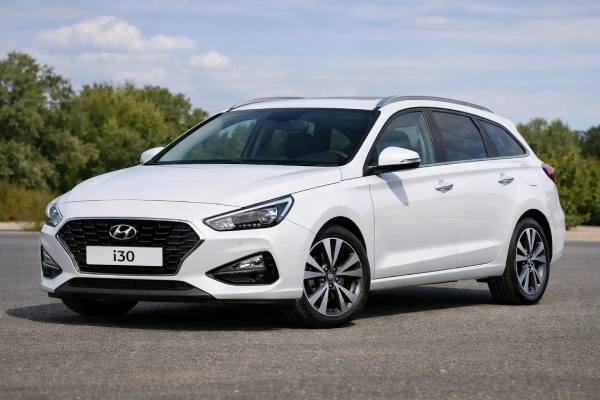
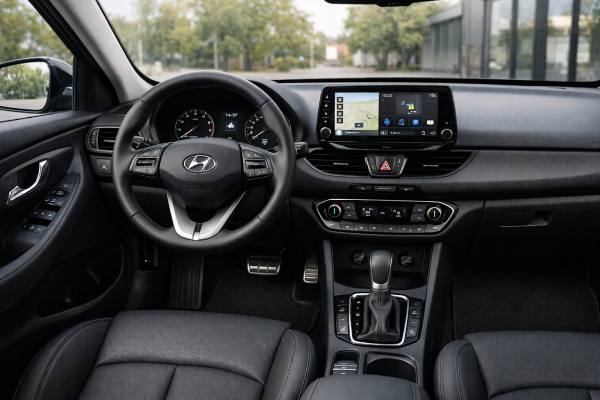
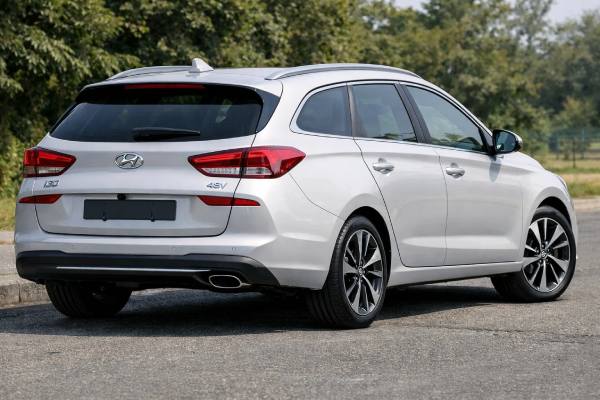
The facelifted Hyundai i30 Wagon PD with the 1.6 CRDi 48V drivetrain is one of the more rational long-distance family cars in the compact class. It combines the space advantage of the estate body with a strong mid-range diesel engine, mild-hybrid assistance, and useful towing ability. That matters because this version was aimed at drivers who cover real mileage, not just short urban hops. The 48-volt system adds a belt-driven starter-generator, a small lithium-polymer battery, smoother stop-start behavior, and more efficient coasting strategies, while the 1.6 CRDi keeps the low-rev torque that makes a loaded wagon easy to use. The result is not sporty, but it is capable, efficient, and mature. For used buyers, the big questions are less about headline performance and more about diesel-system health, gearbox choice, software history, and whether the car’s service record proves it was maintained as a long-run tool rather than treated like a disposable fleet estate.
Essential Insights
- The wagon body gives this i30 a genuinely useful 602 L boot and strong family-trip practicality.
- The 1.6 CRDi 48V delivers the torque and motorway economy many petrol rivals cannot match.
- Towing capacity is strong for the class, at up to 1,500 kg braked.
- Short-trip use is the main ownership caveat because it is harder on the DPF, EGR, and AdBlue system.
- Official diesel service intervals are 30,000 km or 24 months, though hard-use cars benefit from more frequent oil changes.
Section overview
- Hyundai i30 Wagon diesel snapshot
- Hyundai i30 Wagon spec tables
- Hyundai i30 Wagon trims and safety
- Known weak spots and campaigns
- Service plan and buying advice
- On-road character and economy
- Wagon rivals and ownership value
Hyundai i30 Wagon diesel snapshot
The facelift-era i30 Wagon 1.6 CRDi 48V is best understood as the practical end of Hyundai’s C-segment range. Where the hatchback is a balanced all-rounder, the wagon pushes harder on luggage room, long-distance comfort, and working-family usability. In diesel mild-hybrid form, it also becomes one of the most sensible motorway cars in the line-up. Hyundai paired the 1.6-litre common-rail diesel with 48-volt assistance, an intelligent manual transmission in some markets, and a 7-speed dual-clutch option in others. That meant buyers could choose between maximum simplicity and easier urban convenience without giving up the same basic engine character.
This powertrain matters because it suits the wagon body better than the smaller petrol engines if you regularly carry passengers, luggage, or a trailer. Official output is 100 kW, or 136 PS, with 280 Nm in manual form and up to 320 Nm in DCT versions. Those are healthy figures in a compact estate, especially when the torque arrives low in the rev range. In real ownership terms, that means fewer downshifts, more relaxed climbing ability, and a calmer feel when the car is fully loaded.
The estate body is a major part of the appeal. Hyundai gave the wagon a 4,585 mm overall length, a 2,650 mm wheelbase, and a large VDA-rated cargo bay of 602 litres with the rear seats up and 1,650 litres with them folded. That is enough space for family travel, work samples, flat-pack loads, or a dog crate without the car becoming bulky or awkward in town. It is still smaller and easier to place than many midsize estates, which is part of its quiet charm.
The 2020 facelift also improved the i30 range in more than cosmetic ways. Hyundai added stronger SmartSense safety content, better infotainment, and broader mild-hybrid availability. In 2024, the i30 family received another update with standard LED lighting, USB-C charging, over-the-air map updates, and more standard driver assistance. Buyers should note, though, that late-year engine availability varied by country, so the 1.6 CRDi 48V is best treated as a 2020 to 2024 facelift-era powertrain rather than a guarantee in every final-year market.
The ownership logic is clear. This is a car for people who drive enough to justify diesel, want useful cargo space, and prefer a normal, low-stress estate over a heavier SUV. Its weak point is not design balance. It is usage mismatch. If you mainly do short cold trips, the diesel aftertreatment system becomes the biggest reason to think twice. If you cover regular longer distances, it becomes one of the i30 range’s smartest choices.
Hyundai i30 Wagon spec tables
The tables below focus on the facelifted European i30 Wagon with the 1.6 CRDi 48V 136 hp drivetrain. Some figures vary slightly by market, trim, and whether the car uses the 6-speed intelligent manual or 7-speed DCT, so the ranges shown are the practical ones to use when buying, servicing, or comparing cars. Hyundai’s official 2020 to 2021 wagon technical sheets supply the core mechanical data, while the broader facelift press material and Euro NCAP record fill in the family-level safety and equipment picture.
| Powertrain and efficiency | Hyundai i30 Wagon 1.6 CRDi 48V |
|---|---|
| Code | 1.6 CRDi 100 kW 48V mild hybrid |
| Engine layout and cylinders | Inline-4 diesel, 4 cylinders, DOHC, 4 valves per cylinder |
| Bore × stroke | 77.0 × 85.8 mm (3.03 × 3.38 in) |
| Displacement | 1.6 L (1,598 cc) |
| Motor | Belt-driven starter-generator, single unit, front-engine accessory drive |
| System voltage | 48 V |
| Battery chemistry | Lithium-polymer |
| Battery capacity | 0.44 kWh |
| Induction | Turbocharged, variable-geometry turbo |
| Fuel system | Common-rail direct injection, piezo injectors |
| Compression ratio | 15.9:1 |
| Max power | 136 PS (100 kW) @ 4,000 rpm |
| Max torque | 280 Nm (207 lb-ft) @ 1,500–3,000 rpm manual, 320 Nm (236 lb-ft) @ 2,000–2,250 rpm DCT |
| Timing drive | Belt |
| Emissions hardware | SCR with AdBlue, oxidation catalyst, NOx storage catalyst, EGR, DPF |
| Rated efficiency | About 4.5–5.2 L/100 km WLTP depending on trim and transmission |
| Real-world highway at 120 km/h | Roughly 5.2–5.8 L/100 km in normal conditions |
| Transmission and driveline | Data |
|---|---|
| Transmission | 6-speed intelligent manual or 7-speed dual-clutch automatic |
| Drive type | Front-wheel drive |
| Differential | Open |
| Chassis and dimensions | Data |
|---|---|
| Front suspension | MacPherson strut |
| Rear suspension | Multi-link rear axle |
| Steering | Electric rack-and-pinion, 13.4:1 ratio |
| Steering turns lock-to-lock | 2.57 |
| Front brakes | Ventilated discs, 280 mm, 288 mm, or 305 mm depending on trim |
| Rear brakes | Solid discs, 272 mm or 284 mm depending on trim |
| Popular tyre sizes | 205/55 R16, 225/45 R17, and 225/40 R18 on N Line |
| Ground clearance | 140 mm (5.5 in) |
| Length | 4,585 mm (180.5 in) |
| Width | 1,795 mm (70.7 in) |
| Width incl. mirrors | 2,039 mm (80.3 in) |
| Height | 1,465 mm without rails, 1,475 mm with roof rails (57.7 / 58.1 in) |
| Wheelbase | 2,650 mm (104.3 in) |
| Turning circle | 10.6 m kerb-to-kerb (34.8 ft) |
| Kerb weight | 1,415–1,573 kg manual, 1,445–1,603 kg DCT (3,120–3,468 lb / 3,186–3,534 lb) |
| GVWR | 1,920 kg manual, 1,950 kg DCT (4,233 / 4,299 lb) |
| Fuel tank | 50 L (13.2 US gal / 11.0 UK gal) |
| AdBlue tank | 12 L (3.2 US gal) |
| Cargo volume | 602 L / 1,650 L, VDA (21.3 / 58.3 ft³) |
| Performance and capability | Data |
|---|---|
| 0–100 km/h | 10.4 s manual, 10.1 s DCT |
| Top speed | 200 km/h (124 mph) |
| Braking distance | Trim and tyre dependent; no single public factory figure published |
| Towing capacity, braked | 1,500 kg (3,307 lb) |
| Towing capacity, unbraked | 650 kg (1,433 lb) |
| Payload | 347–505 kg (765–1,113 lb) |
| Fluids and service capacities | Data |
|---|---|
| Engine oil capacity | 4.4 L incl. filter (4.6 US qt) |
| Gear oil capacity | 1.6 L manual, 2.0 L DCT (1.7 / 2.1 US qt) |
| Coolant capacity | 7.3 L (7.7 US qt) |
| A/C refrigerant | R-1234yf |
| A/C charge | Verify by VIN and body-year combination before service |
| Key torque specs | Wheel and brake fastener values vary by wheel and brake package; verify by VIN before repair |
| Safety and driver assistance | Data |
|---|---|
| Euro NCAP | 5 stars |
| Adult occupant | 88% |
| Child occupant | 84% |
| Vulnerable road users | 64% |
| Safety assist | 68% |
| IIHS | Not rated as a North American-market model |
| ADAS | AEB, lane keep assist, speed-limit support, and later lane following and broader collision features depending on trim and year |
The data tells a very clear story. This is not a fast estate, but it is a strong one. The wagon body, 1.6 diesel torque, and 1,500 kg tow rating make it more useful than the headline 136 hp might suggest. More importantly, Hyundai gave it real long-trip credentials without making it large, thirsty, or awkward to maintain.
Hyundai i30 Wagon trims and safety
Trim naming changed across Europe, but the facelift wagon followed a familiar Hyundai pattern. Lower trims focused on value and basic practicality, mid-level trims added the features most owners actually want, and N Line versions added a sharper look with larger wheels and a slightly more aggressive cabin atmosphere. German-market material shows the 1.6 CRDi 136 48V spread mainly through Trend, Prime, and N Line-style grades, while Spanish-market material grouped it into straightforward value and tech-oriented trims. In practical used-car terms, the exact badge matters less than the equipment sheet. You want to know the wheel size, headlight type, parking-sensor coverage, seat trim, and which driver-assist systems were included from the factory.
The most important equipment split is not cosmetic. It is mechanical and functional. Manual and DCT versions share the same basic drivetrain but behave differently in traffic, and higher trims often brought larger wheel and brake packages. On the wagon, 16-inch wheels are usually the comfort sweet spot, while 17-inch wheels still look right and preserve the car’s long-distance balance. N Line versions with 18-inch wheels look sharper but ride more firmly and cost more to re-tyre.
Safety is a real strength of the facelift i30 family. Euro NCAP awarded the i30 five stars, with 88 percent adult-occupant protection, 84 percent child-occupant protection, 64 percent vulnerable-road-user protection, and 68 percent safety assist. The structure, restraint performance, and standard AEB base were all solid. The weaker areas were not unusual for the class at the time, including mixed protection around the windscreen pillars for pedestrian impacts and only moderate safety-assist scoring by newer standards.
For facelift buyers, equipment evolution matters as much as crash scores. Hyundai’s 2020 update broadened SmartSense coverage with features such as lane following assist, rear collision-avoidance support, improved blind-spot support, bicycle recognition in forward-collision assist, and eCall. The 2024 update added more standard LED lighting, a standard 4.2-inch color cluster, USB-C charging, over-the-air map updates, and more standard safety features such as forward collision-avoidance assist, lane following assist, and intelligent speed-limit assist. Later cars can therefore feel materially more modern than early facelift examples, even when the underlying body shell is the same.
For used buyers, one detail is easy to miss: ADAS calibration. A wagon that has had a windshield replacement, front-end repair, or sensor replacement can still look immaculate and yet have a poorly calibrated camera or radar-related function. That is not a reason to avoid the car. It is a reason to ask better questions. On a modern i30, proof of proper repair and calibration is more valuable than a shiny valet finish.
Known weak spots and campaigns
The i30 Wagon 1.6 CRDi 48V is better approached as a modern diesel with familiar risk points than as a car defined by one notorious flaw. In other words, its reliability is usually good when the usage pattern fits the drivetrain. The biggest problems tend to come from short-trip running, neglected servicing, or incomplete diagnosis when warning lights first appear.
The most common low-to-medium-cost issues are aftertreatment related. If the car spends too much of its life on cold urban trips, the DPF can load up more often, regens get interrupted, and the engine may start showing symptoms such as raised idle speed, cooling fans running unexpectedly, poor economy, or a warning light. The likely root cause is incomplete regeneration rather than a broken engine. The remedy is to diagnose soot load properly, correct the underlying use pattern, and perform a forced regen only when needed. The same logic applies to EGR contamination. Hesitation, rougher low-speed response, or fault codes can come from soot-heavy operation, and the cure is usually cleaning, software checks, or component replacement rather than panic.
AdBlue and NOx-system complaints are also worth watching. Symptoms include restart countdowns, emissions warnings, or repeated top-up messages. Likely causes include crystallisation in the dosing path, sensor faults, or a lazy injector. On a wagon used for long runs, these systems are usually less troublesome than on a city-only diesel, but they still need proper fluid quality and prompt attention when warnings appear.
The 48V system is usually not dramatic in service, but it adds another electrical layer. Weak 12V battery performance can mimic more serious hybrid faults by upsetting stop-start, charging logic, and warning systems. The small 48V battery itself is not known in public official sources for widespread failure on this model, but it is sensible to check for fault-free operation, smooth stop-start behaviour, and any history of charging-system or hybrid warnings. No broad public battery-warranty extension for this version is clearly identified in Hyundai’s open European sources, so buyers should verify any remaining coverage by VIN and market.
On DCT cars, low-speed hesitation, shudder, or awkward parking maneuvers deserve a careful test drive. Symptoms point first to software behaviour, clutch adaptation, or wear, rather than a guaranteed gearbox failure. Manual and intelligent-manual cars avoid that concern, though clutch take-up and flywheel condition still matter on high-mileage examples.
Hyundai’s public recall and service-campaign process is VIN-based, which is the right way to treat this car. Do not rely on generic forum lists. Run the VIN through Hyundai’s official recalls and service-campaign checker and ask for dealer proof of completion. That is especially important for any car with patchy service history or signs of accident repair.
Service plan and buying advice
Officially, Hyundai’s public wagon technical sheet lists the 1.6 CRDi service pattern at 30,000 km or two years, including oil change. That is acceptable for light, mostly motorway use, but it is not the schedule I would choose for a used high-mileage diesel you plan to keep. For this powertrain, cleaner oil and earlier inspections are cheap insurance.
A practical real-world schedule looks like this:
| Item | Practical interval |
|---|---|
| Engine oil and filter | Every 15,000 km or 12 months on mixed use; official public interval is 30,000 km or 24 months |
| Engine air filter | Inspect yearly, replace around 30,000 km sooner in dusty use |
| Cabin filter | Every 12 months or about 15,000 to 20,000 km |
| Fuel filter | Follow VIN-specific service documentation; inspect water contamination and replace on schedule |
| Brake fluid | Every 2 years |
| Coolant | Inspect annually and replace to official Hyundai schedule |
| AdBlue | Top up as needed; 12 L tank |
| Gearbox fluid | Inspect for leaks and shift quality each service; follow VIN-specific interval |
| Brake pads and rotors | Inspect every service |
| Tyre rotation | About every 10,000 to 12,000 km |
| Wheel alignment | Yearly, and after pothole strikes or uneven wear |
| Timing belt and auxiliary-belt path | Inspect each service; replace at the official interval or sooner if contaminated, cracked, noisy, or undocumented |
| 12V battery test | Annually after year 4 |
| 48V system check | At service if any charging, start-stop, or hybrid warnings appear |
For fluids, the safe rule is simple. Use only the VIN-correct Hyundai-approved low-ash diesel engine oil, the correct Hyundai coolant, the correct transmission fluid for manual or DCT cars, and clean AdBlue from a reputable source. Public technical sheets confirm capacities, but detailed approvals can vary by market and production date, so workshop documents should win over general online parts-catalog guesses.
Used-buyer inspection priorities should be disciplined:
- Ask for invoices, not just stamped service pages.
- Confirm recall and campaign status by VIN.
- Cold-start the engine and listen for belt-path noise, rough idle, or excessive smoke.
- Road-test until fully warm and check for smooth boost delivery.
- On DCT cars, repeat low-speed starts, reverse maneuvers, and creeping traffic behaviour.
- Check for DPF or AdBlue warnings, even if only stored in the history.
- Inspect underbody and rear suspension for impact damage, corrosion, and overloaded-estate wear.
- Check that all parking sensors, camera functions, and driver-assist systems work normally.
- Look for uneven tyre wear that suggests poor alignment or cheap maintenance.
The best version for many buyers is a well-kept mid or upper trim on 16-inch or 17-inch wheels, ideally with a documented long-run usage pattern. The manual is the safer choice for long-term simplicity. The DCT can still be good, but only if it behaves properly when warm. Long term, the 1.6 CRDi 48V wagon looks durable when used as intended: regular mileage, timely servicing, and no ignored warning lights.
On-road character and economy
On the road, the i30 Wagon 1.6 CRDi 48V feels like a car designed by people who understood commuting, family travel, and European motorway work. It is not especially playful, but it is composed, settled, and easy to trust. The estate body does not make it feel cumbersome. Straight-line stability is good, the steering is light but accurate enough, and the longer rear body helps the car feel planted rather than busy at speed.
The diesel engine suits the wagon well. You notice its value less in the first second off the line than in the next ten seconds, when the torque carries the car without fuss. With 280 Nm in manual form and more in the DCT version, it pulls cleanly from low revs and feels notably less strained than smaller petrol alternatives when passengers and luggage are on board. Turbo lag is modest. Most of the time, what you feel is not delay but just a calm, progressive diesel shove.
The 48V system does not transform the car, but it improves the edges. Stop-start is smoother, coasting strategies are smarter, and the engine feels slightly tidier in urban transitions than an older non-hybrid diesel. The intelligent manual transmission also suits the car’s efficient character. The DCT is easier in traffic when behaving well, though it still deserves the same low-speed caution as other dry-clutch systems.
Ride quality is one of the wagon’s nicer surprises. On 16-inch and many 17-inch setups, it absorbs poor surfaces well and remains quiet enough for long drives. N Line and 18-inch combinations look sharper but inevitably add some firmness and tyre noise. Braking is stable and confidence-inspiring, especially on cars with the larger brake package.
Real-world economy is where this version earns its keep. Official mixed WLTP figures sit roughly in the mid-4s to low-5s L/100 km depending on trim and transmission. In practice, many owners should see about 4.8 to 5.8 L/100 km in mixed use, with 120 km/h motorway running commonly landing in the low-to-mid 5s if the car is healthy and not heavily loaded. Short trips, winter use, frequent DPF regens, and roof-box driving will move that upward. The official figures are believable, which is not always true in this class.
Wagon rivals and ownership value
The i30 Wagon 1.6 CRDi 48V competes in a shrinking but still relevant corner of the market: the compact estate for buyers who drive enough to appreciate diesel efficiency and cargo space. Its main rivals include the Kia Ceed Sportswagon diesel, Ford Focus Estate diesel, Volkswagen Golf Variant 2.0 TDI, Skoda Octavia Combi 2.0 TDI, Peugeot 308 SW BlueHDi, and Opel Astra Sports Tourer diesel.
Against the Ford Focus Estate, the Hyundai is usually less entertaining but easier to buy as a rational long-term tool. Against the Golf Variant and Octavia Combi, it may lose some cabin polish or brand pull, but it often wins on value and straightforward equipment. Against the Peugeot 308 SW, the Hyundai feels less design-led but more conservative in the best sense: easier ergonomics, fewer surprises, and a more traditional driving position.
The Kia Ceed Sportswagon is the closest conceptual rival because it targets almost the same buyer mindset. Choice between the two often comes down to condition, trim, price, and service history more than any deep mechanical difference. The Hyundai’s advantage is that it feels understated and mature. The Skoda’s advantage is rear-seat and load-space packaging brilliance. The Ford’s is steering feel. The Hyundai’s is balance.
That is why this i30 Wagon still makes sense. It does not dominate the class in glamour, but it covers the fundamentals very well. It has the right body style, a genuinely useful diesel mild-hybrid powertrain, strong towing ability, real family luggage space, and a calm ownership personality. For the right driver, that combination matters more than style points.
References
- New Hyundai i30: sleeker, safer, and more efficient 2020 (Press Kit)
- Hyundai i30 Kombi | Technische Daten | Stand: 4.2019 2021 (Technical Data)
- Bolder and more high-tech: i30 gets update 2024 (Press Release)
- EuroNCAP | Hyundai i30 2020 (Safety Rating)
- Home | Hyundai Recalls & Service Campaigns 2026 (Recall Database)
Disclaimer
This article is for informational purposes only and is not a substitute for professional diagnosis, repair, or VIN-specific workshop guidance. Specifications, torque values, service intervals, fluid approvals, software actions, and repair procedures can vary by VIN, market, trim, transmission, and production date, so always verify the exact details against official Hyundai service documentation for the vehicle in front of you.
If this guide helped you, please consider sharing it on Facebook, X, or another social platform to support our work.