
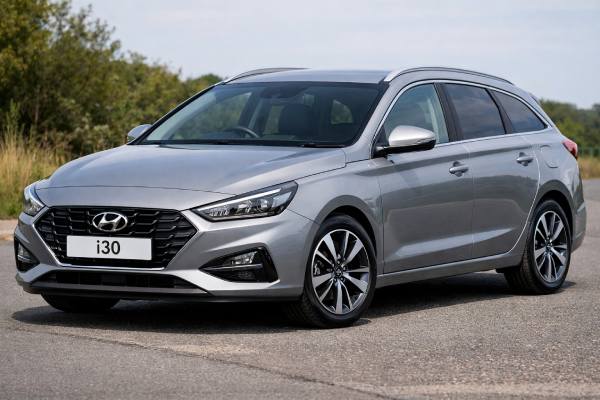
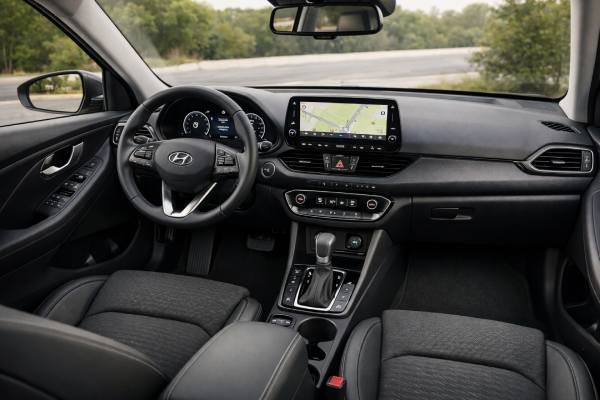
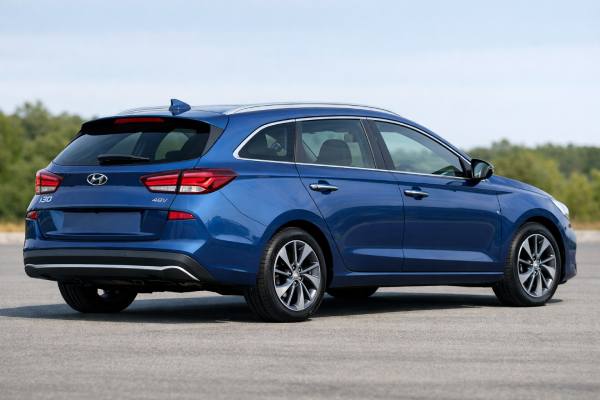
The facelift Hyundai i30 Wagon 1.0 T-GDi 100 is the quietly sensible choice in the current i30 estate range. It pairs the practical long-roof body with Hyundai’s smallest turbo petrol engine, giving buyers a car that feels modern, useful, and easier to own than the stronger diesel or performance-focused versions. That combination matters. The wagon still offers one of the better cargo areas in the compact class, while the 2024 update adds better lighting, improved safety systems, cleaner infotainment, and a more polished cabin. The 1.0-litre engine will not make the i30 Wagon feel fast, but it brings enough torque for everyday driving and keeps fuel use and ownership costs in check. This version makes the most sense for drivers who want real family-car practicality without stepping up to a heavier, more expensive powertrain. If your priorities are smart packaging, moderate running costs, and long-term usability, the facelift i30 Wagon 1.0 T-GDi deserves serious attention.
Quick Overview
- The wagon body gives you real family practicality, with a large boot and a useful square load area.
- The 1.0 T-GDi is modest but efficient, and its turbo torque makes it more flexible than a basic naturally aspirated small petrol.
- The 2024 update improves safety, connectivity, and standard lighting equipment.
- As a small direct-injected turbo engine, it benefits from timely oil changes and careful warm-up habits.
- A 12-month or 15,000 km oil-service routine is the safest real-world ownership pattern.
On this page
- Hyundai i30 Wagon turbo-petrol role
- Hyundai i30 Wagon official figures
- Hyundai i30 Wagon grades and safeguards
- Wear patterns and known weak spots
- Service routine and buyer screening
- Road manners and real consumption
- Compact estate rivals reviewed
Hyundai i30 Wagon turbo-petrol role
The facelift i30 Wagon 1.0 T-GDi occupies a very clear place in Hyundai’s line-up. It is the affordable, everyday petrol estate for buyers who want the usefulness of the wagon body without the extra weight, complexity, or fuel-system demands of the diesel models. In a market where many family cars have moved toward crossovers, this matters more than it first seems. The i30 Wagon is still shaped like a real estate car, and that gives it honest advantages in cargo room, loading ease, and outward visibility.
The 2024 refresh sharpened that package rather than reinventing it. Hyundai kept the PD wagon’s basic proportions, but updated the lighting, cabin technology, and safety equipment. The result is a car that still feels compact enough for ordinary urban use, yet more useful than many hatchbacks and more rational than many SUVs of similar price. This 1.0 T-GDi version also keeps the model focused on sensible ownership rather than on performance claims.
That powertrain defines the car’s personality. With 100 hp and a modest curb-weight advantage over stronger variants, the 1.0 T-GDi is built for ordinary commuting, school runs, weekend trips, and regular mixed driving. It is not intended to feel muscular. Instead, it relies on light turbocharging and a broad enough torque band to feel flexible at everyday speeds. In manual form, that makes it a straightforward, efficient companion. In DCT form, where available, it adds convenience but also changes towing ability and long-term maintenance considerations.
The wagon body is one of the strongest reasons to choose it. Hyundai gives this version 602 litres of luggage space with the rear seats up and up to 1,650 litres with the rear seats folded. That is proper estate-car capacity, not a token improvement over the hatchback. For young families, dog owners, cyclists, or buyers who simply want one car to do more things well, that is still a major strength in this class.
The other ownership advantage is balance. The 1.0 T-GDi avoids the emissions-system complexity of the modern diesels and the higher cost profile of the 1.5 T-GDi and N Line-related versions. Yet it still benefits from the same cabin, same facelift safety package, and same wagon practicality. For many buyers, that means it is the most rational version of the current i30 Wagon range.
Its limitations are just as easy to understand. If you drive with a full load often, tow regularly, or spend much of your life overtaking on fast motorways, the 1.0-litre engine may feel strained. It is best suited to drivers who value practicality, design, and controlled ownership costs more than strong straight-line pace. In that role, it makes a very good case for itself.
Hyundai i30 Wagon official figures
The facelift 2024–present i30 Wagon 1.0 T-GDi 100 is now clearly listed in current Hyundai market material, including model-year 2025 pricing and specification documents. Those current documents are useful because they confirm that the smaller turbo petrol remains available in 100 hp form and show the key differences between the 6-speed manual and 7-speed DCT versions.
| Powertrain and efficiency | 1.0 T-GDi 6MT | 1.0 T-GDi 7DCT |
|---|---|---|
| Engine family | 1.0 T-GDi petrol | 1.0 T-GDi petrol |
| Engine layout | Inline-3, front-transverse | Inline-3, front-transverse |
| Valvetrain | DOHC D-CVVT, 4 valves per cylinder | DOHC D-CVVT, 4 valves per cylinder |
| Bore × stroke | 71.0 × 84.0 mm (2.80 × 3.31 in) | 71.0 × 84.0 mm (2.80 × 3.31 in) |
| Displacement | 1.0 L (998 cc) | 1.0 L (998 cc) |
| Induction | Turbocharged | Turbocharged |
| Fuel system | Direct injection petrol | Direct injection petrol |
| Compression ratio | 10.5:1 | 10.5:1 |
| Max power | 100 hp @ 6,000 rpm | 100 hp @ 6,000 rpm |
| Max torque | 172 Nm (127 lb-ft) @ 1,500–3,500 rpm | 200 Nm (148 lb-ft) @ 2,000–2,500 rpm |
| Timing drive | Chain | Chain |
| Rated efficiency | 5.6–6.3 L/100 km | 5.9–6.6 L/100 km |
| Rated economy | about 42.0–37.3 mpg US / 50.4–44.7 mpg UK | about 39.9–35.6 mpg US / 47.9–42.8 mpg UK |
| Real-world highway at 120 km/h | about 5.7–6.5 L/100 km | about 6.0–6.8 L/100 km |
| Transmission and driveline | Hyundai i30 Wagon 1.0 T-GDi |
|---|---|
| Transmission | 6-speed manual or 7-speed DCT |
| Drive type | FWD |
| Differential | Open |
| Chassis and dimensions | Hyundai i30 Wagon 1.0 T-GDi |
|---|---|
| Front suspension | MacPherson strut |
| Rear suspension | Multi-link |
| Steering | Electric rack and pinion |
| Steering ratio | about 13.4:1 |
| Turning circle | 10.6 m (34.8 ft) |
| Front brakes | Ventilated discs |
| Rear brakes | Disc brakes |
| Most common tyre sizes | 195/65 R15, 205/55 R16, 225/45 R17 |
| Ground clearance | 140 mm (5.5 in) |
| Length | 4,585 mm (180.5 in) |
| Width | 1,795 mm (70.7 in) |
| Height | 1,465 mm without rails / 1,475 mm with roof rails |
| Wheelbase | 2,650 mm (104.3 in) |
| Kerb weight | 1,241 kg (2,736 lb) manual / 1,271 kg (2,802 lb) DCT minimum |
| GVWR | 1,840 kg (4,057 lb) manual / 1,870 kg (4,123 lb) DCT |
| Fuel tank | 50 L (13.2 US gal / 11.0 UK gal) |
| Cargo volume | 602 / 1,650 L (21.3 / 58.3 ft³), VDA |
| Performance and capability | 1.0 T-GDi 6MT | 1.0 T-GDi 7DCT |
|---|---|---|
| 0–100 km/h | 13.3 s | 13.3 s |
| 80–120 km/h | 14.0 s | 10.2 s |
| Top speed | 178 km/h (111 mph) | 178 km/h (111 mph) |
| Towing, braked | 1,010 kg (2,227 lb) | 710 kg (1,565 lb) |
| Towing, unbraked | 510 kg (1,124 lb) | 510 kg (1,124 lb) |
| Fluids and service capacities | Hyundai i30 Wagon 1.0 T-GDi |
|---|---|
| Engine oil | about 3.6 L (3.8 US qt) including filter |
| Coolant | about 6.0 L (6.3 US qt) |
| Manual transmission oil | about 1.6 L (1.7 US qt) |
| DCT fluid | verify by VIN and transmission code |
| A/C refrigerant | verify under-bonnet label |
| A/C compressor oil | verify under-bonnet label |
| Key torque spec | wheel nuts 107–127 Nm (79–94 lb-ft) |
| Safety and driver assistance | Hyundai i30 Wagon facelift |
|---|---|
| Euro NCAP | 5 stars |
| Adult occupant protection | 88% |
| Child occupant protection | 84% |
| Vulnerable road user | 64% |
| Safety assist | 68% |
| IIHS | not applicable |
| ADAS availability | FCA, LFA, DAW, MCB, ISLA, HDA 1.5, ROA, rear camera, and parking sensors depending on trim and market |
Those figures show the car’s character very clearly. The manual remains the better towing and simplicity choice, while the DCT improves rolling acceleration but cuts braked towing capacity substantially. The wagon’s real strength is not speed. It is that it brings honest estate-car dimensions and load space to a small, efficient turbo petrol package.
Hyundai i30 Wagon grades and safeguards
The 2024 update improved the i30 Wagon’s trim logic because it pushed more useful equipment into the standard package. That matters a lot on the 1.0 T-GDi, which is often the value-driven engine in the line-up. Buyers choosing the smallest engine do not want a stripped car. Hyundai seems to understand that, and the facelift makes the wagon feel better equipped even before you climb the trim ladder.
Current market material shows grades such as Modern, Smart, and Smart Plus in some regions, while other markets use names more like Advance, N Line, Premium, or local equivalents. The names vary, but the pattern is familiar:
- entry and mid-level cars focus on value, comfort, and lower running costs;
- upper trims add larger screens, extra safety hardware, and cosmetic upgrades;
- N Line packages mainly change appearance, wheel size, and cabin finish rather than turning the 1.0 into a performance model.
The mechanical differences that matter most are modest but still worth checking. Wheel size is one of them. Fifteen- and sixteen-inch setups suit the 1.0 T-GDi especially well because they keep ride comfort strong and tyre replacement cheaper. Seventeen-inch cars look sharper, but they add cost and take away some compliance on poor roads. For most owners, the mid-spec smaller-wheel car is the better fit.
Lighting and convenience are stronger across the board after the update. Hyundai now makes LED headlamps and LED rear lamps standard in the wagon line in several current-market configurations, and the facelift added a standard 4.2-inch colour driver display, USB-C ports, OTA map support, and better connectivity integration. Upper trims can still move the interior closer to premium compact territory with larger displays and more polished trim materials.
Safety is one of the facelift’s clearest wins. Hyundai openly states that the enhanced SmartSense package is more deeply integrated into the refreshed i30 family. Depending on market and trim, the wagon can include:
- Forward Collision-Avoidance Assist,
- Junction Turning support,
- Lane Following Assist,
- Intelligent Speed Limit Assist,
- Highway Driving Assist 1.5,
- Multi-Collision Braking,
- Rear Occupant Alert,
- front and rear parking sensors,
- and a rear-view camera.
Some regional FAQ and features pages also indicate that features such as blind-spot support and rear cross-traffic alert may remain optional or trim-dependent. That makes exact specification checking important. On a used car, do not assume every facelift wagon carries the same ADAS package simply because the dashboard looks similar.
The Euro NCAP five-star result for the i30 family remains relevant here. This is still a compact family car with a strong safety baseline, ISOFIX mounting points, ESC, multiple airbags, and a useful set of modern assistance systems. The facelift simply makes more of those systems easier to get in ordinary trim levels.
From a buying perspective, the best trims are usually not the flashiest ones. A well-specced mid-grade wagon with the 6-speed manual, sixteen-inch wheels, and the right safety pack often makes more sense than a larger-wheel DCT car bought only for appearance. On this engine, balance matters. The trims that preserve that balance tend to be the smartest choices.
Wear patterns and known weak spots
The 1.0 T-GDi wagon is not known for one catastrophic defining weakness, which is encouraging. Its reliability story is closer to that of many modern small turbo petrols: generally sound when maintained properly, but less forgiving than an older naturally aspirated engine if service quality slips. The good news is that most ownership risks are understandable and usually manageable when caught early.
A realistic issue map looks like this:
- Common and low cost: spark plugs, ignition coils, battery wear, filters, tyres, brake wear, and occasional sensor warnings.
- Occasional and medium cost: coolant seepage, thermostat issues, boost leaks, rough DCT low-speed behavior on neglected automatic cars, and wheel bearing wear.
- Rare but higher cost: chain-noise symptoms from poor oil care, turbo wear after delayed servicing, overheating damage, or repeated misfire problems ignored for too long.
The most important ownership theme is oil quality and oil interval. This is a direct-injected, turbocharged three-cylinder engine. It relies on clean oil more than an old low-stress naturally aspirated unit does. Cars that miss oil changes, run incorrect oil, or spend long intervals on cheap service parts can develop timing-chain noise, turbo distress, and rougher running over time.
Typical symptoms and likely causes look like this:
- hesitation under load or a soft misfire often starts with tired spark plugs or ignition coils;
- uneven idle or patchy cold running can point to ignition issues, software calibration, or intake-side problems;
- reduced pull and a whooshing or hissing sound can indicate a boost leak;
- unexplained coolant loss needs quick attention because small turbo engines do not like overheating;
- jerky crawling on DCT cars often reflects clutch adaptation, wear, or old fluid and software history rather than a catastrophic gearbox failure.
Because the 1.0 T-GDi uses direct injection, long-term intake-valve deposits can become part of the picture on higher-mileage cars, especially those driven mostly on short trips. That does not mean every engine suffers badly from it. It means buyers should understand the normal trade-off of a modern DI turbo petrol and not expect the total simplicity of an older multi-point-injection engine.
The timing drive is chain-based, which many owners prefer, but that does not remove maintenance responsibility. A chain can last very well when lubrication is right. It can also become noisy or unhappy when oil service has been careless. In other words, “chain” does not mean “ignore forever.”
There is no single public recall headline that defines this engine in the facelift wagon. Still, buyers should always check the VIN in Hyundai’s official campaign system and compare the result with dealer records. Market-specific service actions are possible even when no one big issue dominates internet discussion.
The best reliability signal on this model is not low mileage alone. It is evidence of disciplined routine care. A well-serviced higher-mile car can be a much safer buy than a cheaper low-mile example that skipped intervals, wore poor tyres, or shows signs of hasty cosmetic repair. With this engine, ownership quality matters more than marketing language.
Service routine and buyer screening
The 1.0 T-GDi wagon rewards straightforward preventive maintenance. That is part of its appeal. It does not need exotic care, but it does need consistency. Owners who stay ahead of service tend to keep these cars easy to live with. Owners who rely on minimum-cost maintenance can turn a simple family wagon into an avoidable expense.
A practical maintenance routine looks like this:
| Item | Sensible real-world interval |
|---|---|
| Engine oil and filter | every 12 months or 15,000 km |
| Engine air filter | inspect yearly, replace around 30,000 km |
| Cabin filter | every 12 months or 15,000–20,000 km |
| Spark plugs | inspect by schedule; plan replacement around 30,000–45,000 km |
| Coolant | inspect yearly; replace by VIN-specific schedule or when history is unclear |
| Brake fluid | every 2 years |
| Manual transmission oil | inspect for leaks; refresh around 100,000–120,000 km |
| 7DCT fluid and operating check | follow exact Hyundai guidance and inspect regularly |
| Auxiliary belt and hoses | inspect every service |
| Brake pads and discs | inspect every service |
| Tyres and alignment | inspect around every 10,000–15,000 km |
| 12 V battery | test yearly after year four |
| Timing chain | inspect only if symptoms appear |
Useful service data for planning:
- engine oil capacity is about 3.6 L with filter,
- coolant capacity is about 6.0 L,
- manual gearbox oil is about 1.6 L,
- and wheel nut torque sits in the 107–127 Nm range.
The factory-style maintenance interval shown in facelift-era technical material can look fairly generous, but the smartest long-term ownership approach is still annual oil service. That one habit does more to protect the chain, turbocharger, and general drivability than any other simple decision.
For buyers, the inspection checklist should focus on the kind of neglect that is easy to miss:
- cold-start quality and idle stability,
- clean pull through the mid-range without hesitation,
- proof of regular oil changes,
- coolant level and cooling-system behavior,
- smooth clutch take-up on manuals,
- calm low-speed operation on DCT cars,
- even tyre wear and straight tracking,
- correct operation of every warning-free ADAS and parking aid feature,
- and no evidence of poor front-end or windscreen repair.
Common reconditioning items are ordinary enough: tyres, battery, plugs, front brakes, filters, maybe a suspension link, and sometimes an alignment correction. None of that should scare a buyer. What matters is whether the seller priced the car as if those items were already done when they are obviously not.
The strongest used examples are usually mid-spec manual cars with a full service record and sensible wheel size. The versions to be more careful with are poorly documented DCT cars, heavily city-driven examples that feel rough when cold, or any car showing cheap tyres and vague invoice history. This engine can age well, but it wants ownership that is methodical rather than careless.
Road manners and real consumption
On the road, the facelift i30 Wagon 1.0 T-GDi feels more substantial than its modest power figure suggests, but only if you judge it in the right context. It is not quick. It is, however, easy to drive, light in response, and well matched to the wagon’s everyday mission. The small turbo petrol suits city and suburban use very well, and the estate body gives the car a stable, mature feel on open roads.
The engine’s character is typical of a modern three-cylinder turbo. At low speeds it feels willing, and the turbo torque helps it avoid the lifelessness that used to define weak small-displacement petrol engines. The manual transmission is the natural fit here because it lets the driver use the engine’s mid-range cleanly and keeps the ownership profile simple. The DCT version adds convenience and better 80–120 km/h response, but it also brings a lower towing allowance and a little more long-term complexity.
Ride and handling are well judged for a compact family wagon. The multi-link rear suspension helps the i30 Wagon feel more settled than some simpler rear-axle competitors, and that shows most clearly on uneven faster roads. Steering is light rather than detailed, but accurate enough for easy daily driving. The car does not feel sporty, yet it also avoids feeling clumsy or dull.
The 1.0’s limits show most on fast highways with a full load. With passengers, luggage, and a steep incline, you need planning and downshifts. That is especially true if you are coming from a diesel or a bigger turbo petrol. This is the kind of engine that works best when driven smoothly and kept in its useful band rather than asked to recover lazily from very low revs.
Real-world fuel use is one of the car’s better strengths:
- city driving: about 6.7–7.8 L/100 km,
- highway at 100–120 km/h: about 5.7–6.8 L/100 km,
- mixed driving: about 6.0–7.0 L/100 km.
That is not class-leading in every situation, but it is solid and consistent. The manual usually gives the best ownership balance, while the DCT often trades a little extra fuel use for convenience. Cold weather, short repeated trips, and heavy traffic all raise consumption, as they do in most small turbo petrol cars.
Towing performance also deserves a practical note. The manual’s braked towing allowance of 1,010 kg makes it the more versatile choice for light trailer work. The DCT’s 710 kg braked limit is much lower, which may matter to buyers with bikes, small campers, or garden trailers.
Overall, the i30 Wagon 1.0 T-GDi drives like a competent, polished compact estate. Its strengths are stability, usability, and moderate fuel cost, not acceleration. If you buy it with that expectation, it makes good sense.
Compact estate rivals reviewed
The i30 Wagon 1.0 T-GDi competes in a smaller field than compact hatchbacks do, because there are fewer true wagon alternatives left in this size class. That actually helps the Hyundai. Buyers looking for a compact estate are usually already prioritizing practicality and value, and the i30 Wagon plays directly to those priorities.
The Skoda Octavia Combi remains the obvious benchmark for sheer space. It is roomier and often feels like a larger car. If maximum cabin and cargo volume matter above all else, the Octavia is very hard to ignore. The Hyundai counters by feeling slightly easier to size up, often cheaper to buy, and simpler in some ownership scenarios.
The Kia Ceed Sportswagon is the closest family rival. It shares much of Hyundai-Kia’s general approach to packaging and value, and many buyers will find the decision comes down to price, equipment, and local-market availability. The Hyundai’s advantage is its familiar i30 driving position, strong safety presentation, and, in some markets, a more straightforward trim structure.
The Ford Focus Estate is arguably the better driver’s car. Steering feel and body control are sharper, especially for drivers who care about chassis response. The Hyundai answers with a calmer, more polished family-car feel and a lower-stress ownership character when equipped sensibly.
The Peugeot 308 SW brings stronger design flair and can feel more modern in some cabin details, but it is also more taste-dependent and often leans into a different ergonomic layout that not every buyer enjoys. The Hyundai is more conventional, which many family buyers still prefer in daily use.
The Toyota Corolla Touring Sports is the clearest alternative for buyers whose lives are dominated by urban and suburban running. Its hybrid drivetrain will usually beat the Hyundai on city fuel economy and low-speed smoothness. But it is also more complex, usually automatic-only, and serves a different kind of owner. The Hyundai is the simpler turbo-petrol estate for drivers who still want a manual and a more traditional driving feel.
So where does the i30 Wagon 1.0 T-GDi land? It makes the most sense for:
- buyers who want a real estate body rather than an SUV,
- drivers who prioritize moderate running costs over strong performance,
- families needing space without stepping into a larger class,
- and owners who prefer a simple, well-understood petrol powertrain.
It makes less sense for:
- drivers doing constant high-speed motorway work with heavy loads,
- buyers wanting effortless overtaking,
- or those whose daily routine would clearly benefit more from a hybrid.
The Hyundai’s biggest strength is that it stays honest. It does not pretend to be fast, premium, or adventurous. It is a practical compact wagon with current safety tech, a useful boot, and manageable ownership demands. For the right buyer, that is not a compromise. It is exactly the point.
References
- Nowy Hyundai i30 Wagon 2025 (Price List and Technical Data)
- Bolder and more high-tech: i30 gets update – Hyundai Europe 2024 (Press Release)
- Hyundai i30 Wagon | Zalety 2026 (Model Overview)
- Euro NCAP | Hyundai i30 2017 (Safety Rating)
- Hyundai Owners manuals 2026 (Owner’s Manual)
Disclaimer
This article is for informational purposes only and is not a substitute for professional diagnosis, repair, or official workshop guidance. Specifications, torque values, service intervals, fluids, procedures, and equipment can vary by VIN, market, trim, transmission, and production date. Always verify critical details against the correct official service documentation for the exact vehicle.
If this guide was useful, please consider sharing it on Facebook, X, or another social platform to support our work.