
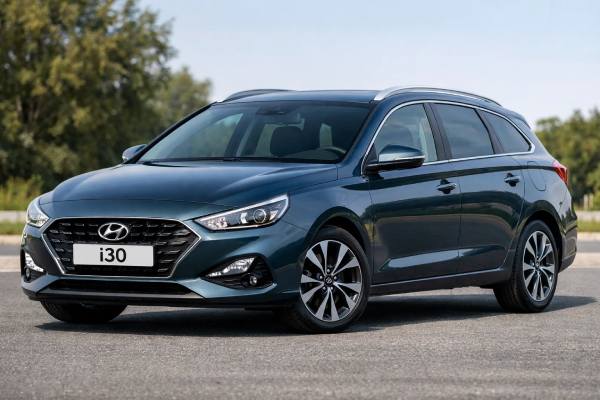
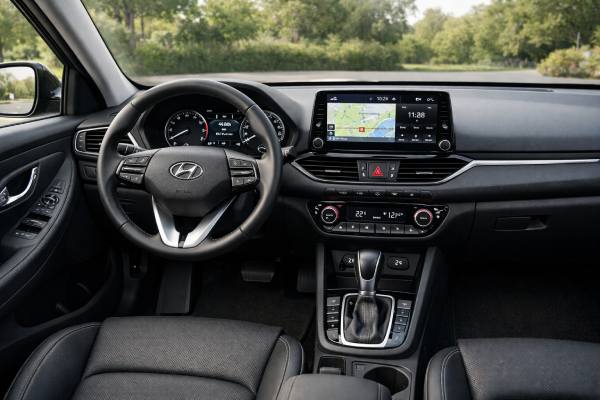
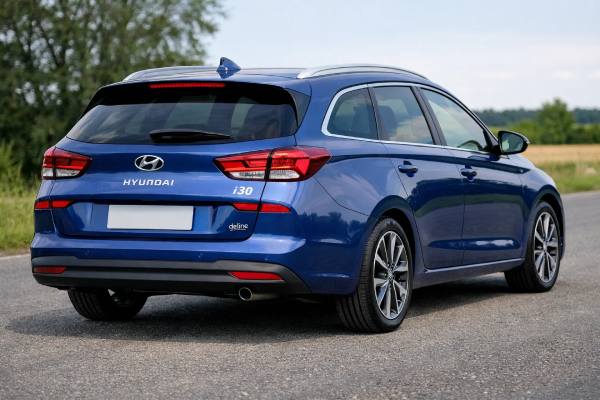
The facelifted Hyundai i30 Wagon PD with the 1.0 T-GDi 48V mild-hybrid powertrain is one of the most rational compact estates of its era. It gives buyers the space and long-roof usefulness of the wagon body, but pairs it with a small turbo petrol engine, a 48-volt mild-hybrid system, and lower running costs than the stronger 1.5-litre options. That combination matters because it changes the i30’s character. This is not the fastest wagon in the class, but it is often one of the easiest to justify for daily use.
The 2020 facelift also brought meaningful upgrades. Hyundai added sharper styling, newer connectivity, more safety technology, and, depending on market, broader trim choice. For many owners, the attraction is clear: a 602-litre boot, sensible road manners, good safety credentials, and a drivetrain that feels modern without becoming a full hybrid. The main caveat is that this version still depends on careful servicing, especially if it has the 6iMT or 7DCT and has spent years on short urban trips.
What to Know
- The wagon body is genuinely practical, with 602 L of boot space and useful towing ability for a small petrol estate.
- The 48V system improves stop-start smoothness and efficiency without changing the car into a complicated full hybrid.
- The 1.0 T-GDi feels stronger in daily driving than its size suggests, especially with light loads.
- Poor battery health, skipped oil changes, and neglected clutch or DCT servicing are the main ownership cautions.
- A sensible baseline is an oil and filter service every 10,000 to 15,000 km or 12 months.
Section overview
- Hyundai i30 Wagon 48V in context
- Hyundai i30 Wagon 48V numbers
- Hyundai i30 Wagon grade breakdown
- Reliability patterns and fixes
- Maintenance schedule and buying advice
- Real-world driving and economy
- Where it stands among rivals
Hyundai i30 Wagon 48V in context
The facelifted i30 Wagon sits in the heart of the compact estate market, and the 1.0 T-GDi 48V mild-hybrid version is the efficiency-minded petrol choice. Hyundai took the existing PD-generation wagon and gave it a meaningful 2020 update rather than a token refresh. The body stayed practical, but the nose, lighting details, cabin tech, and safety equipment all moved forward. More importantly for this exact version, the facelift introduced the electrified 48-volt mild-hybrid setup to the small turbo petrol engine. That changed the ownership case more than the styling did.
This mild-hybrid system is not a full hybrid in the Toyota sense. It does not turn the i30 Wagon into an EV around town. Instead, it uses a belt-driven mild-hybrid starter-generator and a 48-volt lithium-ion polymer battery to support smoother stop-start operation, energy recuperation, and lower fuel use. In simple terms, it adds some efficiency and refinement without dramatically changing how the car drives. For many buyers, that is exactly the right balance. You get a modern powertrain feel, but you keep the straightforward packaging and familiar servicing pattern of a turbo petrol family car.
The 1.0-litre three-cylinder engine remains the centre of the experience. Output is 120 PS, commonly listed as 120 hp, and official facelift technical data shows 172 Nm of torque. That is enough to give the car decent response in normal use, though it is still a wagon with modest power. When lightly loaded, it feels capable and smooth enough. When packed with passengers, luggage, or a trailer, it needs more planning. That is part of the deal. This is the efficient family version, not the quick one.
The wagon body is a major reason to choose it over the hatchback. Hyundai’s public technical data lists 602 litres of luggage space with the rear seats up and 1,650 litres with them folded. That is a strong number in this class and gives the i30 Wagon a clear advantage over many crossovers that take up more road space without delivering as much flat load space. For family use, dog transport, hobby gear, or airport work, that matters more than a few extra tenths in a 0–100 km/h time.
From 2020 to 2024, this model also became easier to recommend on equipment. Hyundai added a larger digital display environment, more connected features, and broader SmartSense safety content. In the facelift years, the i30 line also received a 2024 design and technology refresh, which kept the model looking current longer than many rivals. As a result, a late 2023 or 2024 wagon can feel noticeably more modern than an early facelift 2020 car even when the basic platform is unchanged. That is important in the used market, where buyers often compare a late i30 Wagon with newer-looking rivals rather than with cars from its original 2017 generation launch.
Hyundai i30 Wagon 48V numbers
For this section, the most useful baseline comes from Hyundai’s public facelift technical data and UK-market Tourer specifications, because Hyundai published complete 1.0 T-GDi 48V wagon figures there. In the UK, the wagon is called the i30 Tourer, but it is the same body style covered here.
| Powertrain and efficiency | Specification |
|---|---|
| Engine family | 1.0 T-GDi 48V mild hybrid |
| Engine layout and cylinders | Inline-3, DOHC, 12 valves |
| Displacement | 1.0 L (998 cc) |
| Bore × stroke | 71 × 84 mm (2.80 × 3.31 in) |
| Induction | Turbocharged |
| Fuel system | Direct injection |
| Compression ratio | 10.5:1 |
| Electric motor type | 48V mild-hybrid starter-generator |
| Battery type | LiPD lithium-ion polymer |
| Battery power | 12 kW |
| System voltage | 48 V |
| Max power | 120 PS (88.3 kW) @ 6,000 rpm |
| Max torque | 172 Nm (127 lb-ft) @ 1,500–4,000 rpm |
| Timing drive | Chain |
| Transmission | 6iMT intelligent manual or 7-speed DCT |
| Drive type | FWD |
| Differential | Open |
| Performance and fuel use | Specification |
|---|---|
| 0–100 km/h | 11.2 s |
| 0–62 mph | about 11.2–11.4 s depending on market data |
| Top speed | 196 km/h (122 mph) |
| Official combined economy | about 5.2–5.4 L/100 km (45.2–43.6 mpg US / 54.3–52.3 mpg UK), trim and transmission dependent |
| Real-world highway at 120 km/h | typically around 6.2–6.9 L/100 km in normal use |
| Chassis and dimensions | Specification |
|---|---|
| Front suspension | MacPherson strut |
| Rear suspension | CTBA on published UK 1.0 Tourer data |
| Steering | MDPS electric power steering |
| Lock-to-lock turns | 2.57 |
| Turning circle | 10.6 m (34.8 ft) |
| Brakes | Front and rear discs |
| Most common tyre sizes | 205/55 R16 or 225/45 R17 |
| Length | 4,585 mm (180.5 in) |
| Width | 1,795 mm (70.7 in) |
| Height | about 1,455 mm to 1,475 mm depending on market and roof rail specification |
| Wheelbase | 2,650 mm (104.3 in) |
| Kerb weight | about 1,241–1,429 kg (2,736–3,150 lb), depending on trim and transmission |
| GVWR | 1,840–1,870 kg (4,057–4,123 lb) |
| Fuel tank | 50 L (13.2 US gal / 11.0 UK gal) |
| Cargo volume | 602 L seats up / 1,650 L seats down, VDA |
| Capability | Specification |
|---|---|
| Braked towing | 1,200 kg manual / 700 kg DCT |
| Unbraked towing | 600 kg manual / 300 kg DCT |
| Roof load | 80 kg |
| Payload | roughly 440–600 kg depending on exact trim and kerb weight |
| Service and fluid basics | Practical note |
|---|---|
| Engine oil | Use the exact Hyundai-approved petrol turbo grade for the VIN and climate |
| Engine oil capacity | Commonly around 3.6 L with filter for the 1.0 T-GDi family; verify before service |
| Coolant | Hyundai-approved long-life coolant, exact fill by VIN |
| Gearbox fluid | VIN-specific specification for 6iMT or 7DCT |
| 48V system | Not a routine consumer-service item, but battery health and belt-driven starter-generator condition matter |
The numbers show what this car is about. It is not underpowered for gentle use, but it is not a fast estate either. The best figures are the ones that shape ownership: 602 litres of boot space, 50 litres of fuel, modest official fuel use, and useful towing for a small petrol wagon. The mild-hybrid system’s value is also clearer here. It adds efficiency support without making the car heavy or overly complex.
Hyundai i30 Wagon grade breakdown
Trim structure varies by country, so the safest way to discuss this car is to use the UK facelift Tourer lineup as the baseline and then note broader European differences. In the UK, the 1.0 T-GDi 48V mild-hybrid car was typically positioned in practical trims such as SE Connect and Premium, with the stronger 1.5-litre engine more closely tied to N Line. In continental Europe, buyers also saw Comfort, Style, Trend, Prime, and market-specific equivalents, plus the wagon finally gained N Line appearance availability from summer 2020.
That matters because the 1.0 48V wagon is usually not a stripped-out base model. Even the lower trims in the facelift years tend to offer a decent safety and convenience package. In UK-market form, SE Connect versions commonly brought 16-inch alloys, rear camera, rear parking sensors, smartphone integration, trailer wiring preparation, and the core active-safety hardware most buyers care about. Premium versions added larger 17-inch wheels, more cabin tech, keyless entry, heated seats, front parking sensors, and a stronger convenience focus. That makes Premium the more desirable used buy if the price gap is reasonable, but SE Connect is often the smarter value choice.
The facelift also improved cabin technology in a way that still feels relevant. Hyundai introduced a 10.25-inch navigation system in higher trims, a seven-inch digital cluster in the wider facelift family, wireless charging in better-equipped versions, and connected features through Bluelink in navigation cars. Those upgrades help late facelift wagons feel newer than many used rivals from the same period. A 2020 or 2021 example with the smaller screen is still fine, but the later cars do feel more polished in daily use.
Safety is one of the i30 family’s real strengths. Euro NCAP awarded the i30 a five-star result, and Euro NCAP’s model-page validity record shows that facelift and mild-hybrid variants were added to the rating history. The published scores were 88% for adult occupant protection, 84% for child occupant protection, 64% for vulnerable road users, and 68% for safety assist. The key detail for today’s buyer is that the rating expired in 2024 under Euro NCAP’s time-based validity rules, but the underlying crash and equipment result remains solid for the period.
ADAS availability improved over the facelift run. Core systems in the facelift i30 family included eCall, Forward Collision-Avoidance Assist for car and pedestrian detection, Lane Keep Assist, Manual Speed Limit Assist, and TPMS. Higher trims added or widened the availability of Intelligent Speed Limit Warning, Lane Follow Assist, Blind Spot Collision Warning, Rear Cross Traffic Collision Warning, and Safe Exit Warning. That means trim choice affects more than comfort features. A Premium car is meaningfully richer in driver assistance than a lower-spec example. Buyers should therefore shop by equipment list, not just by engine and mileage, especially if daily motorway use and family safety features matter.
Reliability patterns and fixes
The facelift i30 Wagon 1.0 T-GDi 48V is best described as maintenance-sensitive rather than inherently troublesome. There is no single official public defect pattern that defines every car, and that is good news. But it is still a small turbo direct-injection petrol engine with a mild-hybrid support system, so condition matters. Cars with annual servicing, healthy batteries, and no warning-light history tend to be fine. Cars used only for short trips, delayed oil changes, or low-budget ownership can become fussy.
The most common issues are the usual modern small-petrol problems. Rough idle, occasional misfire, or weak pull under load are usually caused by spark plugs, ignition coils, or air leaks rather than by a major engine failure. Symptoms often show up first as a slightly uneven cold idle, a momentary stumble on boost, or a check-engine light during acceleration. The sensible fix path is simple: scan the car properly, inspect plugs and coils, then check intake and boost plumbing before assuming the worst. These are usually low-to-medium cost items.
Battery health is another common theme. Because this is a 48V mild-hybrid car, weak electrical support can create more symptoms than on a simpler petrol wagon. Owners may notice lazy stop-start behaviour, mild-hybrid warnings, or intermittent electrical complaints that turn out to be caused by a weak 12V battery or poor charging support rather than a catastrophic 48V failure. That makes battery testing important on any pre-purchase inspection. It is not enough to say the car “starts fine.” It should be checked properly.
Occasional mid-cost issues tend to centre on the transmission choice and the electrified hardware around it. On 6iMT cars, an inconsistent clutch take-up, odd low-speed response, or jerky restart behaviour can point to a calibration issue, clutch wear, or actuator-related adjustment needs. On 7DCT cars, hesitation, shunt at parking speeds, and warning lights deserve closer inspection, especially if the car has been used heavily in urban traffic. Neither transmission is automatically a bad choice, but both deserve a cleaner service history than a basic old-school manual hatch would.
The 48V system itself should be treated as an inspection area rather than a fear point. Watch for stored fault codes, belt-driven starter-generator noise, repeated stop-start inactivity, or evidence of previous battery-area water ingress or poor repairs after rear-end damage. Public owner-facing Hyundai literature does not point to one universal 48V system defect here, so the right approach is careful inspection rather than alarm.
Rare but more expensive risks are the ones owners can often prevent. Long oil-change delays can contribute to timing-chain wear, turbo stress, and sludge-related headaches. Repeated short-trip use can make a direct-injection turbo engine less happy over time, especially if it never gets fully hot. As the cars age, also inspect suspension bushes, rear brakes, wheel bearings, and underbody corrosion in salted-road markets.
For recalls, campaigns, and software actions, always use a VIN-based Hyundai check and dealer records. Hyundai’s own service guidance notes that recommended updates are checked during routine servicing, which matters on a car that blends engine, transmission, braking, and mild-hybrid controls. If a seller cannot show a sensible service trail, assume you are buying deferred work.
Maintenance schedule and buying advice
The easiest way to keep this car reliable is to treat it like a slightly more sophisticated petrol estate, not like an appliance that can be ignored. Hyundai’s i30 family uses sensible service logic, and a practical ownership plan is straightforward. Even if your market manual allows longer intervals under ideal conditions, the 1.0 T-GDi 48V responds well to shorter oil changes in real life.
| Maintenance item | Practical interval |
|---|---|
| Engine oil and filter | Every 10,000–15,000 km or 12 months |
| Engine air filter | Inspect every service, replace around 30,000 km |
| Cabin filter | Every 15,000–30,000 km or 12–24 months |
| Spark plugs | About 60,000–75,000 km, earlier if misfire symptoms appear |
| Coolant | Check yearly, replace by official schedule or sooner if history is unclear |
| Brake fluid | Every 24 months |
| 6iMT or DCT inspection | Check for calibration, clutch behaviour, and leaks every service |
| Gearbox fluid strategy | Refresh by specialist advice if history is unknown or the car feels rough |
| Tyres and alignment | Inspect often, align whenever wear pattern changes |
| Brake pads and discs | Inspect every service |
| Auxiliary belt and starter-generator drive area | Inspect every service |
| Timing chain | No fixed public replacement interval, but inspect if noisy or mistimed |
| 12V battery | Test yearly after year 4 |
| 48V system health | Scan for faults during major service or pre-purchase inspection |
A few maintenance principles matter more than the table. First, always use the correct Hyundai-approved oil specification for the VIN and climate. Second, do not ignore small drivability changes. A mild misfire, lazy stop-start operation, or jerky transmission response is cheaper to investigate early than late. Third, do not assume low mileage means low wear. This engine often wears more gracefully on regular longer trips than on very short urban use.
For the used market, the best buys are normally 2021–2024 cars with full history, ordinary wheel sizes, and no dashboard warnings. The 2020 launch-year facelift cars are not automatically bad, but later examples tend to benefit from a little more maturity in software, trim, and owner experience. If you want the simplest long-term version, the 6iMT manual is attractive. If you want easier daily traffic use, the DCT can still be worthwhile, but only if the service file is convincing and the low-speed behaviour is clean.
During inspection, ask for proof of:
- annual servicing,
- correct oil and filter work,
- battery checks,
- recall and campaign status,
- recent brake work,
- tyre brand consistency,
- and any clutch or gearbox diagnosis.
Then drive the car cold and warm. Listen for chain noise at startup, feel for smooth take-up in first gear, check that the turbo pulls cleanly from low revs, and make sure no mild-hybrid or charging warnings appear. Also inspect the boot floor and rear structure carefully, because the wagon body and electrified hardware make rear-impact repair quality more important than on a very basic hatch.
Long-term durability looks good when maintenance is steady. This is not a fragile wagon, but it is also not a car that likes neglect. Buy the best history you can find and it should repay you with predictable family-car service.
Real-world driving and economy
The i30 Wagon 1.0 T-GDi 48V drives exactly the way many family buyers want a compact estate to drive. It is calm, secure, and easy to use. The steering is light enough for urban work, motorway stability is strong, and the wagon body does not feel ungainly or overlong from the driver’s seat. On sensible tyre sizes, the car rides well and avoids the fidgety feel that affects some rivals with larger wheels or firmer sports trims.
The engine is better than the badge suggests, but only if expectations are realistic. In everyday driving, the 1.0 T-GDi feels flexible thanks to its early torque delivery. The mild-hybrid support helps with smoother restarts and a slightly cleaner low-speed feel. Around town, the car feels responsive enough. On open roads with one or two occupants, it is perfectly capable. But when the car is loaded with luggage or climbing on faster roads, the limits show. Overtaking needs planning, and the wagon is happier with clean, measured inputs than with constant hard acceleration.
The 6iMT manual suits the engine well. It lets the driver work around the car’s modest output and usually feels like the more natural pairing for the 1.0. The 7DCT brings convenience and can make urban use easier, but it also removes some control over how the little engine is used under load. That is why some owners prefer the manual even when they are not traditional manual enthusiasts. It simply matches the engine’s character better.
Official fuel economy is one of the main reasons to buy this version. Depending on trim and transmission, facelift wagon figures sit around the low-to-mid 5 L/100 km range in combined testing. In real use, expect more. A healthy manual car driven gently can still return mid-5s on lighter mixed use in warm weather, but a true 120 km/h motorway run usually lands closer to the mid-6s. Short winter trips, roof loads, and city congestion can easily push the number beyond 7.0 L/100 km. That is not bad for a petrol wagon of this size, but it is a reminder that brochure figures are easiest to match in ideal conditions.
Noise and refinement are decent rather than exceptional. The three-cylinder engine is smoother than many older small triples, but you still hear it under load. At steady speed, wind and road noise are well controlled enough for family travel. The car is not luxurious, but it feels mature. That maturity is one of its biggest strengths. It does not try to be sporty. It tries to make ordinary family driving feel straightforward and settled.
Towing and load-carrying also deserve a mention. A manual car rated for 1,200 kg braked is useful in real life, but owners should remember that performance drops noticeably when towing or carrying a full load. The chassis remains stable, but acceleration becomes measured. That is fine, because the wagon’s real skill is dependable all-round use, not effortless heavy-load pace.
Where it stands among rivals
The facelift i30 Wagon 1.0 T-GDi 48V competes best against other practical estates bought for daily life rather than image. Against the Kia Ceed Sportswagon with a comparable small petrol engine, the Hyundai feels very close in mission. Both make sense, both are easy to live with, and both rely more on condition and trim than on badge prestige. The Hyundai’s advantage is often its slightly calmer road feel and strong safety reputation. The Kia can sometimes win on value or warranty perception in specific markets.
Against the Ford Focus Estate 1.0 EcoBoost, the Hyundai usually loses on steering feel and back-road involvement. The Focus remains the more playful car. But the i30 Wagon often feels more conservative in a good way. It is stable, predictable, and comfortable, and its cabin and control layout usually feel simpler to live with for family use. Buyers who care most about everyday ease may well prefer the Hyundai.
The Skoda Octavia Combi is the more obvious benchmark if maximum practicality is the goal. It often feels roomier inside and offers a broader range of powertrains. But it is also commonly more expensive, and the used-market spread is wider and more complicated. The i30 Wagon makes a strong case if you want most of the usefulness with a simpler buying decision and lower acquisition cost.
The Opel or Vauxhall Astra Sports Tourer is another close rival. It can look attractive on price, but engine and gearbox combinations vary more widely in how desirable they are. The Hyundai’s 1.0 T-GDi 48V is not exciting, yet it is a very coherent package when paired with the wagon body. It gives buyers a modern but understandable drivetrain, strong boot space, and a stable driving experience without pushing them into a larger or thirstier engine.
So where does the i30 Wagon land overall? It is not the quickest compact estate, not the most luxurious, and not the most technically adventurous. But it is one of the most balanced. The 48V system adds just enough modernity to improve efficiency and stop-start smoothness without changing the car’s basic identity. The wagon body gives it real family usefulness. The facelift years keep it looking and feeling up to date. For buyers who want a compact estate that does many things well and very little badly, this Hyundai remains one of the smarter choices in the class.
References
- Hyundai i30 Technical Specifications 2020 (Technical Data)
- New i30 – pricing spec and tech (final) 2020 (Technical Data)
- New Hyundai i30: sleeker, safer, and more efficient 2020 (Press Information)
- Hyundai Owners Manuals 2026 (Owner’s Manual)
- EuroNCAP | Hyundai i30 2017 (Safety Rating)
Disclaimer
This article is for informational purposes only and is not a substitute for professional diagnosis, repair, or factory service information. Specifications, torque values, intervals, procedures, software content, and equipment can vary by VIN, market, model year, and trim, so always verify the exact vehicle against official Hyundai service documentation before servicing, repairing, or purchasing a car.
If this guide helped you, please consider sharing it on Facebook, X, or another platform to support our work.