


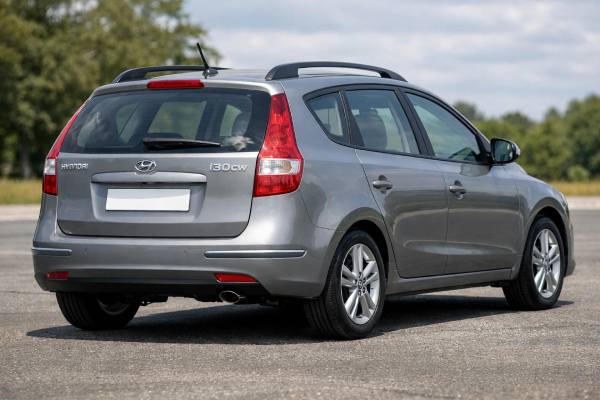
The facelifted Hyundai i30cw FD 1.6 MPI is one of the more sensible compact wagons from its era. It does not rely on turbocharged punch or premium-brand image. Instead, it offers a simple naturally aspirated petrol engine, a roomy estate body, and a chassis that was tuned with European family use in mind. For many used-car buyers, that formula still works well. The 1.6-liter MPI engine is straightforward, chain-driven, and generally easier to live with than an aging diesel if your driving pattern involves short trips, urban traffic, or low annual mileage. The facelifted 2010–2012 cars also benefit from cleaner styling, updated equipment in some markets, and a cabin that remains practical rather than flashy. The main trade-off is performance. With 126 hp and modest torque, this wagon needs revs and sensible expectations. Buy a well-kept example, though, and the i30cw can still be a dependable, affordable family estate with low drama and honest everyday usability.
At a Glance
- Simple 1.6 MPI petrol engine suits short trips better than many used diesels of the same age.
- Large cargo area, useful rear-seat space, and compact outside dimensions make it easy to live with.
- Facelift models keep the i30’s stable chassis and practical wagon body without adding much complexity.
- Neglected oil service can accelerate timing-chain noise and top-end wear on high-mileage cars.
- A sensible oil-and-filter interval is every 10,000 to 15,000 km or 12 months.
Section overview
- Hyundai i30cw Facelift Essentials
- Hyundai i30cw Facelift Technical Sheet
- Hyundai i30cw Facelift Trims and Safety
- Weak Points and Service Actions
- Service Schedule and Buying Checklist
- Driving Feel and Real Economy
- Rival Wagons in Perspective
Hyundai i30cw Facelift Essentials
The facelifted i30cw is best understood as a practical compact wagon built around clarity rather than complexity. Hyundai took the original FD-generation i30 estate and gave it a visual refresh for 2010, while keeping the core strengths intact: a roomy load bay, a long 2,700 mm wheelbase, an independent rear suspension setup, and an ownership brief centered on value. In 1.6 MPI form, the facelift wagon also became one of the simpler versions in the range. There is no turbocharger, no diesel particulate filter, and no dual-clutch gearbox complication in the baseline manual version. That alone makes it attractive to buyers who want lower mechanical risk from a used family car.
The G4FC 1.6-liter petrol engine is a familiar Hyundai/Kia unit from the Gamma family. It uses multi-point injection, a naturally aspirated layout, and a timing chain rather than a scheduled timing belt. On paper, 126 hp and 154 Nm do not sound exciting. On the road, the engine feels honest but clearly tuned for smoothness and predictable daily use rather than effortless mid-range thrust. In an empty car, it is perfectly adequate. In a loaded wagon with passengers, roof gear, or luggage, you notice that this is not the engine for lazy low-rpm overtakes. That does not make it a poor fit. It simply means the i30cw 1.6 MPI rewards drivers who are happy to use the gearbox and let the engine spin.
That powertrain character also shapes where the car makes the most sense. This version is a strong choice for buyers who do shorter trips, suburban errands, school runs, or moderate annual mileage and want to avoid the complications that come with old diesel hardware. It is less compelling for drivers who routinely carry heavy loads across mountain routes or who want the relaxed low-end pull of a turbo-diesel. Hyundai offered stronger diesels in the same body for that reason. The 1.6 MPI exists for drivers who value simplicity first.
The estate body is another large part of the appeal. The i30cw is longer than the hatch but still compact enough to park easily, and it offers noticeably better boot flexibility. The cargo area is wide, useful, and genuinely family-friendly. Rear-seat space is also good for the class, especially when you consider the car’s overall footprint. This is not a giant wagon, but it is cleverly sized.
The facelift itself did not transform the car mechanically, but it helped keep the package fresh. Depending on market, buyers also got revised trim combinations, updated front and rear styling, and cleaner Euro 5 petrol calibration. In today’s used market, that matters because facelift examples often feel just a little more sorted and a little newer than the pre-facelift cars, while still staying within the same basic ownership logic: practical, uncomplicated, and most appealing when condition is better than the asking price suggests.
Hyundai i30cw Facelift Technical Sheet
The table below focuses on the facelifted 2010–2012 Hyundai i30cw FD with the 1.6 MPI 126 hp petrol engine in its common 6-speed manual form. Some market-specific details, trim-based tyre sizes, towing values, and transmission offerings vary by VIN and region. A 4-speed automatic was available in some markets, but the manual is the cleaner baseline for specs and ownership analysis.
Powertrain and efficiency
| Item | Value | Notes |
|---|---|---|
| Code | G4FC | Hyundai Gamma petrol engine |
| Engine layout and cylinders | Inline-4, DOHC, 16-valve | 4 cylinders, 4 valves per cylinder |
| Bore × stroke | 77.0 × 85.4 mm | 3.03 × 3.36 in |
| Displacement | 1.6 L (1,591 cc) | Naturally aspirated petrol |
| Induction | Naturally aspirated | No turbo or supercharger |
| Fuel system | MPI / multi-point manifold injection | Simpler than later GDI layouts |
| Compression ratio | 10.5:1 | Common published figure |
| Max power | 126 hp (93 kW) @ 6,200 rpm | Manual and automatic share output |
| Max torque | 154 Nm (114 lb-ft) @ 4,200 rpm | Needs revs more than a diesel |
| Timing drive | Chain | No fixed belt replacement interval |
| Rated efficiency | 6.5 L/100 km (36.2 mpg US / 43.5 mpg UK) | Combined, manual |
| Real-world highway @ 120 km/h | about 6.2–6.8 L/100 km | Wind, load, and tyres matter |
Transmission, chassis, and dimensions
| Item | Value | Notes |
|---|---|---|
| Transmission | 6-speed manual | 4-speed automatic optional in some markets |
| Drive type | FWD | Front-wheel drive |
| Differential | Open | Standard road-car setup |
| Suspension front/rear | MacPherson strut / independent multi-link | A strong FD-generation feature |
| Steering | Rack and pinion, electric assist | Light and easy rather than sporty |
| Brakes | Front ventilated discs / rear discs | ABS standard |
| Wheels and tyres | 185/65 R15 | Popular baseline size |
| Ground clearance | 135 mm (5.31 in) | Market and tyre dependent |
| Length / Width / Height | 4,500 / 1,775 / 1,565 mm | 177.2 / 69.9 / 61.6 in |
| Wheelbase | 2,700 mm | 106.3 in |
| Turning circle | 10.4 m | 34.1 ft |
| Kerb weight | 1,236 kg | 2,725 lb |
| GVWR | 1,820 kg | 4,012 lb |
| Fuel tank | 53 L | 14.0 US gal / 11.7 UK gal |
| Cargo volume | 415–1,395 L | 14.7–49.3 ft³ |
Performance, capacities, and safety
| Item | Value | Notes |
|---|---|---|
| 0–100 km/h | 11.5 s | Manual |
| Top speed | 192 km/h | 119 mph |
| Towing capacity | 1,200 kg braked / 550 kg unbraked | Market dependent |
| Payload | about 584 kg | Based on common published weights |
| Engine oil | 5W-30 or 5W-40 meeting the correct Hyundai petrol spec | Climate and market matter |
| Engine oil capacity | 3.3 L | 3.5 US qt |
| Coolant capacity | 6.0 L | 6.3 US qt |
| Manual transmission fluid | about 1.9–2.0 L | Verify by gearbox code |
| A/C refrigerant | R134a | Charge varies by system |
| Key torque spec | Wheel nuts commonly around 90–110 Nm | Verify exact value by market manual |
| Euro NCAP | 4-star adult, 3-star child, 2-star pedestrian | Original FD i30 range result |
| Headlight rating (IIHS) | Not applicable | No IIHS program relevance for this model |
| ADAS suite | none | No AEB, ACC, LKA, BSD, or TSR |
The specs tell the story clearly. This is a practical petrol wagon with decent space efficiency, moderate weight, and enough performance for normal family use. The large gap between power peak and torque peak is important. This engine feels smoother and happier when worked rather than short-shifted like a diesel. That characteristic shapes both the driving experience and the ownership verdict.
Hyundai i30cw Facelift Trims and Safety
Trim structures varied by country, but the facelifted i30cw generally followed a familiar Hyundai pattern: lower trims covered the essentials, mid-grade cars added the equipment most owners actually use, and higher trims added cosmetic and convenience upgrades rather than major mechanical differences. That makes the used-car search easier. On this model, the right trim is usually the one with the best condition, service history, and cleanest equipment balance, not the one with the highest original list price.
Entry and mid-level cars commonly offered air conditioning, power windows, remote locking, a height-adjustable driver’s seat, audio controls, and straightforward cloth interiors. Better-equipped versions often added climate control, alloy wheels, parking sensors, cruise control, rain-sensing wipers, automatic headlights, and nicer steering wheel trim. Some markets also bundled roof rails, upgraded audio, or heated front seats higher up the range. The facelift helped the cabin feel slightly fresher, but this remained a simple interior focused on visibility and function rather than dramatic design.
Mechanical differences between trims were modest. The biggest real-world changes usually came from wheel and tyre size. Cars on 15-inch wheels tend to ride more softly, cost less to re-tyre, and suit the 1.6 MPI’s comfort-first character well. Better-equipped trims with larger wheels can look sharper, but they may ride a little more firmly and expose tired bushes or dampers more clearly. The 1.6 MPI itself stays the same basic engine across trims, and in most markets the biggest powertrain split was manual versus automatic rather than trim-specific tuning.
Quick identifiers matter if you are looking at several used cars in one day. Base cars usually have simpler dash trim, fewer steering wheel buttons, and basic climate controls. Mid-spec examples often hit the sweet spot because they add the genuinely useful items without layering on complexity. Higher trims are easy to spot through parking sensors, alloy designs, automatic lighting equipment, and better cabin trim. None of these turn the i30cw into a luxury wagon, but they can make a visible difference in how pleasant it feels in daily use.
Safety was competitive for its era. The original i30 range earned a Euro NCAP result of 4 stars for adult occupant protection, 3 stars for child occupant protection, and 2 stars for pedestrian protection under the 2007 test regime. That is an old test standard and should not be compared directly with modern ratings, but it still matters because it confirms the FD i30 was engineered with a credible safety baseline. The published test notes stated the rating applied to all i30 models. Standard and widely available safety features included front airbags, front side airbags, curtain airbags, ABS, electronic brakeforce distribution, brake assist, traction control, and stability control.
There were no modern driver-assistance systems in the way buyers now expect. No autonomous emergency braking, lane-keeping assist, blind-spot monitoring, or adaptive cruise control. That absence can be a drawback for some buyers, but it also reduces calibration and sensor complexity on an older used car. For many owners, the safety story here is about solid passive protection, a stable chassis, and predictable braking rather than advanced driver assistance.
Weak Points and Service Actions
The facelifted i30cw 1.6 MPI is generally one of the lower-risk FD variants, but that should not be confused with fault-free. Age, maintenance habits, and use patterns now matter much more than original reliability rankings. The good news is that most common issues on this engine and body are understandable and usually cheaper to manage than equivalent diesel failures. The bad news is that neglected examples can still need a stack of medium-cost work.
Common, low to medium cost: ignition-related issues. Coil packs, spark plugs, and sometimes crank or cam signal problems are among the most believable causes of rough idle, misfire under load, hesitant cold starts, and a flashing engine light. Symptoms often begin as a slight stumble and get worse over time. The root cause may be a weak coil, worn plugs, or poor maintenance history. The remedy is usually straightforward diagnosis, then replacing the failed coil, fitting the correct plugs, and checking for stored fault codes instead of guessing.
Common, medium cost: timing-chain noise or timing-correlation faults on cars with poor oil-change history. The G4FC uses a chain, which avoids scheduled belt replacement, but it is not immune to wear. Rattle on cold start, fault codes linked to cam timing, or a rough metallic top-end sound can point to stretched chain components, tired guides, or tensioner wear. The risk is higher on cars that lived on extended service intervals or poor oil. The fix is proper chain-set diagnosis and replacement when out of spec, not simply hoping the noise will fade.
Occasional, low to medium cost: oil seepage and cooling-system age issues. Expect to inspect rocker-cover areas, hose junctions, thermostat housings, and the radiator for early sweating or crusty dried residue. These are not dramatic failures at first, but they can turn a simple petrol wagon into an unreliable one if ignored. Rough idle can also come from intake leaks or a dirty throttle body, especially on cars that have seen mostly urban use.
Driveline and transmission: the 6-speed manual is usually the safer long-term bet, but clutch wear, release bearing noise, and occasional synchro complaints can appear on higher-mileage cars. The 4-speed automatic is simpler than many later units and can last well, but only if fluid condition has not been ignored forever. Harsh shifts, delayed engagement, or flare between gears justify a careful road test and a budget for service rather than blind optimism.
Chassis and body wear: front drop links, lower-arm bushes, top mounts, wheel bearings, and tired dampers are all normal age-related issues. Rear brake calipers can seize or corrode, especially on lightly used cars. Estates also deserve extra scrutiny around the tailgate, rear arches, sill edges, underbody seams, rear subframe areas, and brake lines. Cosmetic paint can look fine while the underside tells a harder story.
Electrical annoyances: window regulators, door lock actuators, audio-unit age faults, and tired battery or charging-system behavior are occasional rather than defining problems. They matter because they are easy to dismiss during a quick viewing, yet they add up fast after purchase.
Formal recall and campaign history depends on market, so the correct method is always the same: run an official VIN recall check, ask for dealer records, and treat missing documentation as uncertainty, not as proof the car is clear. Pre-purchase, ask specifically for service history, evidence of regular oil changes, spark-plug replacement, recent brake work, and any paperwork covering chain, clutch, or cooling-system repairs.
Service Schedule and Buying Checklist
A practical service plan for the i30cw 1.6 MPI should be stricter than the broadest possible factory marketing intervals. This engine responds well to fresh oil, correct plugs, clean filters, and simple preventive work. If you are buying one for long-term use, conservative maintenance is cheaper than waiting for symptoms.
A sensible schedule is:
- Engine oil and filter: every 10,000 to 15,000 km or 12 months.
- Engine air filter: inspect every service, replace roughly every 20,000 to 30,000 km.
- Cabin filter: every 15,000 to 20,000 km or yearly.
- Spark plugs: usually every 45,000 to 60,000 km depending on plug type and market guidance.
- Coolant: every 5 years or around 90,000 to 100,000 km.
- Brake fluid: every 2 years.
- Manual gearbox oil: every 60,000 to 90,000 km if you want better long-term shift quality and bearing life.
- Automatic transmission fluid: service periodically even if a seller says it is sealed for life.
- Timing chain: no fixed replacement interval, but inspect immediately if there is start-up rattle, metal in oil, or timing-related fault codes.
- Accessory belt and hoses: inspect every service, replace on condition or at major age milestones.
- Brake pads, discs, sliders, and handbrake operation: inspect every service.
- Tyres and alignment: inspect regularly, rotate when wear pattern supports it, and align after suspension work.
- 12 V battery: test annually once the battery is four years old.
- Fuel filter: not normally a routine external service item on most MPI versions, but fuel delivery faults still need proper diagnosis if symptoms appear.
Fluid decisions should stay boring and correct. A quality 5W-30 or 5W-40 that matches the correct Hyundai petrol specification is the safe default for most climates. Oil capacity is about 3.3 L. Coolant capacity is about 6.0 L. Manual transmission fluid is roughly 1.9 to 2.0 L, depending on exact gearbox details. Wheel-nut torque is commonly cited around 90 to 110 Nm, but anything more critical than that should be checked against the exact service literature for the car’s VIN and market.
When buying, start with the simplest checks. Look for a cold start with a stable idle, no prolonged chain rattle, and no obvious blue smoke. Then test drive the car long enough to feel clutch take-up, gearbox smoothness, throttle response, and brake balance. Listen for front suspension knocking over small bumps and rear brake drag after a run. Open the tailgate and inspect the load floor, spare-wheel well, and inner seams for water entry or corrosion. Underneath, focus on the sills, rear arches, brake lines, and subframes.
The best examples are usually facelift manual cars with complete records, clean oil history, and evidence of recent routine maintenance. Mid-level trims are often the sweet spot. Cars to avoid are the ones with missing service history, chain noise dismissed as “normal,” worn rear brakes, obvious rust underneath, or multiple small electrical faults that suggest generally poor care. Long term, the i30cw 1.6 MPI can be a durable used wagon. It simply needs honest upkeep and a buyer willing to choose condition over shiny trim.
Driving Feel and Real Economy
On the road, the i30cw 1.6 MPI feels balanced, transparent, and almost old-fashioned in a good way. There is no big torque spike, no sudden turbo surge, and no complicated drive-mode trickery. The engine gives you exactly what the numbers suggest. Around town, response is smooth and predictable. In normal commuting, that makes the car easy to place and easy to drive cleanly. But once you add passengers, luggage, or an incline, the naturally aspirated nature becomes obvious. This engine likes revs. It is calmer and more willing above the mid-range than below it.
That shapes the whole driving experience. Throttle response is crisp enough off idle, but genuine progress comes from using the gearbox. In the 6-speed manual, that is not a problem. The car feels most natural when the driver shifts with purpose and lets the engine breathe. The automatic version is easier in traffic, but the 4-speed layout makes the powertrain feel flatter and less efficient. For most buyers who enjoy driving even a little, the manual suits the 1.6 MPI much better.
The chassis remains one of the better parts of the package. Straight-line stability is good, and the independent rear suspension helps the wagon ride with more control than some rivals that feel cheaper from the rear axle. Steering is light and not especially talkative, but it is accurate enough for everyday use. This is not a sporty estate, yet it is composed and easy to trust. Cornering balance is neutral at normal road speeds, and the longer wagon body does not make the car feel clumsy.
Noise levels are acceptable for the period. At city pace, the engine is smooth and mostly subdued. At motorway speed, cabin noise depends a lot on tyre choice and road surface. Cars on smaller wheels generally feel quieter and more relaxed, which suits the 1.6 MPI’s character. Under hard acceleration, the engine becomes audible, but the sound is cleaner and less harsh than the old diesels many buyers cross-shop against.
Braking feel is straightforward. A healthy car stops cleanly with a predictable pedal, though rear brake condition makes a noticeable difference. Older examples with sticking calipers or rusty rear discs can feel less settled than the chassis deserves.
Real-world economy is respectable rather than outstanding. Expect roughly 7.8–9.0 L/100 km in short-trip urban use, 6.2–6.8 L/100 km on steady highway runs at 100–120 km/h, and 6.7–7.5 L/100 km in mixed use for a healthy manual car. Cold weather, roof bars, full family loads, and neglected alignment or tyre pressures can push those numbers higher. The automatic usually uses a little more fuel, especially in city traffic. Under moderate towing or full-load holiday use, consumption can climb by around 10 to 15 percent.
The verdict from behind the wheel is simple: the i30cw 1.6 MPI is pleasant, predictable, and honest. It is not quick, but it is easy to live with, and for many owners that matters more than pace.
Rival Wagons in Perspective
The i30cw 1.6 MPI sits in a crowded part of the used market, where buyers often choose between badge image, driving feel, and mechanical simplicity. Its place among rivals becomes clearer once you focus on the full ownership picture rather than showroom appeal.
Against the Kia cee’d SW 1.6 petrol: this is the closest relative in both thinking and engineering. The Kia shares much of the same logic: sensible size, usable cargo room, and straightforward petrol running costs. The deciding factors are usually condition, maintenance record, and local parts pricing rather than any major difference in core capability.
Against the Ford Focus Estate 1.6 petrol: the Ford is usually the more engaging driver’s car. Steering feel, front-end bite, and chassis polish are stronger. But the Hyundai often answers with a simpler ownership impression, a practical cabin, and a less demanding used-car price. If you care most about road feel, the Focus still has an edge. If you care about value and general ease of use, the i30cw is very competitive.
Against the Skoda Octavia Combi 1.6 MPI: the Skoda usually wins on outright boot usefulness and mature road manners, and it has a strong reputation for rational family ownership. But it can also carry a stronger price premium in some markets. The Hyundai’s advantage is that it often gives you much of the same day-to-day usefulness for less money up front.
Against the Volkswagen Golf Variant petrol models: the Volkswagen often feels more polished inside and carries the stronger badge. It may also cost more to buy and to recondition properly. The i30cw does not have the same interior prestige, but it can be the smarter buy when you measure total value instead of perceived status.
Against the Peugeot 308 SW 1.6 VTi: the Peugeot can offer clever packaging and a more distinctive interior feel, but long-term ownership usually depends heavily on the exact car and service history. The Hyundai’s appeal is its straightforward cabin layout, simple powertrain concept, and predictable mechanical priorities.
That comparison leads to a clear conclusion. The facelifted i30cw 1.6 MPI is not the most charismatic compact wagon of its period, but it is one of the easier ones to justify as a used purchase. It offers a practical body, a simple petrol engine, decent safety equipment for its age, and stable road manners. Its biggest weakness is not design. It is that weak examples can feel slow, neglected, and unimpressive very quickly. Its biggest strength is that a good example still makes everyday family transport feel refreshingly uncomplicated. In the used market, that is a real advantage.
References
- Hyundai Owners manuals | Hyundai Motor UK 2026 (Owner’s Manual)
- Owner manuals | Hyundai Australia 2025 (Owner’s Manual)
- Check if a vehicle, part or accessory has been recalled – GOV.UK 2026 (Recall Database)
- Car Recalls | Owning | Hyundai Australia 2026 (Recall Checker)
- Frontal impact driver Frontal impact passenger Side impact … 2007 (Safety Rating)
Disclaimer
This article is for informational purposes only and is not a substitute for professional diagnosis or repair. Specifications, torque values, intervals, procedures, and equipment can vary by VIN, market, model year, transmission, and trim. Always verify critical information against the correct official service documentation, owner’s manual, parts catalog, and recall records for the exact vehicle.
If this guide was useful, please consider sharing it on Facebook, X, or another social platform to support our work.