
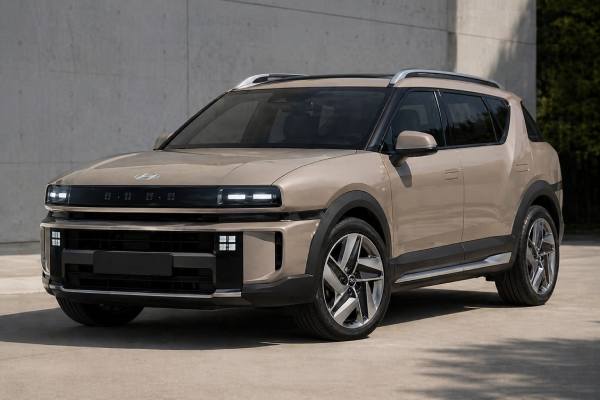

The 2026–present Hyundai NEXO is a fuel cell electric SUV, which means it drives like an electric vehicle but stores energy as compressed hydrogen instead of relying on a large plug-in battery. Its front electric motor delivers 150 kW, or about 204 hp, while the fuel cell stack and small high-voltage battery work together to supply the motor with power.
That makes the second-generation NEXO a very specific ownership proposition. It offers long rated range, very quick hydrogen refuelling, quiet electric drive, and zero tailpipe emissions apart from water vapour. At the same time, it depends heavily on hydrogen station access, specialist servicing, and market-specific support. For the right driver and region, it is one of the most advanced hydrogen passenger vehicles available. For everyone else, infrastructure is the deciding factor.
Fast Facts
- The 150-kW front motor gives the new NEXO stronger acceleration than the earlier model, with 0–100 km/h quoted at 7.8 seconds.
- Official European data lists up to 826 km WLTP range on 18-inch wheels, supported by a larger usable hydrogen capacity of up to 6.69 kg.
- The cabin, cargo space, and safety technology are much closer to a modern midsize electric SUV than to an experimental alternative-fuel vehicle.
- Maintenance is lighter than an ICE vehicle in some areas, but fuel-cell coolant, ion filter, hydrogen-system checks, and dealer-level diagnostics matter.
- Typical routine checks should be treated as at least annual or mileage-based, with brake fluid, cabin filter, tyres, 12 V battery, coolant loops, and hydrogen components inspected on schedule.
Table of Contents
- Hyundai NEXO FCEV Identity
- Hyundai NEXO Technical Specs
- Hyundai NEXO Trims and Safety
- Reliability, Issues and Service Actions
- Maintenance and Buying Advice
- Driving, Range and Performance
- NEXO Versus Hydrogen and EV Rivals
Hyundai NEXO FCEV Identity
The 2026–present Hyundai NEXO is the second-generation version of Hyundai’s dedicated hydrogen fuel cell SUV. It replaces the earlier NEXO sold from 2018/2019 in selected markets and brings a larger body, stronger electric drive system, upgraded hydrogen storage, a more modern interior, and much broader driver-assistance technology.
Although the title describes it as “Electric,” the important detail is that this is not a conventional battery electric vehicle. It is a fuel cell electric vehicle, or FCEV. Hydrogen is stored in high-pressure tanks. The fuel cell stack combines hydrogen with oxygen from the air to generate electricity. That electricity powers the front-mounted traction motor and also works with a compact high-voltage battery that buffers energy during acceleration and regenerative braking.
The covered version uses a single front electric motor rated at 150 kW and 350 Nm. In horsepower terms, that is about 204 hp from the motor. Hyundai also quotes total system output of 190 kW because the fuel cell stack and battery together can support stronger combined electrical output than before. This distinction matters: the motor rating tells you what turns the wheels, while the total system output describes the power available from the fuel-cell and battery power electronics.
The NEXO is front-wheel drive only. There is no multi-speed automatic transmission, no combustion engine, no exhaust aftertreatment system, no engine oil, no spark plugs, and no fuel pump in the petrol or diesel sense. Instead, the major systems are the fuel cell stack, hydrogen tanks, high-voltage battery, power electronics, DC–DC converter, electric motor, reduction gear, coolant loops, air compressor, hydrogen lines, valves, sensors, and safety control systems.
The main advantage is refuelling time. A hydrogen fill can take around five minutes when the station is operating correctly and temperature/pressure conditions are suitable. This is much closer to a petrol or diesel stop than a high-speed EV charging session. The trade-off is that hydrogen stations are rare in many regions, sometimes concentrated around California, Korea, Japan, Germany, selected fleet corridors, or demonstration zones.
In practical terms, the NEXO suits drivers who live or work near reliable hydrogen stations and want long electric range without long charging stops. It is less suitable for rural use, unplanned long-distance travel, or regions where hydrogen supply is inconsistent. The vehicle itself is highly developed, but ownership convenience depends more on infrastructure than on the SUV’s mechanical ability.
Hyundai NEXO Technical Specs
The all-new NEXO’s headline figures are a 150-kW front motor, 350 Nm of torque, a 2.64-kWh high-voltage battery, and hydrogen storage of up to 6.69 kg. The strongest official range figure is the European WLTP estimate of up to 826 km on 18-inch wheels. Market figures can differ because homologation cycles, trims, tyres, equipment, and hydrogen station standards vary.
| Item | Hyundai NEXO 2026–present |
|---|---|
| Vehicle type | Hydrogen fuel cell electric SUV |
| Generation | Second-generation NEXO, global launch from early 2026 |
| Combustion engine | Not fitted |
| Motor type and layout | Single front electric traction motor |
| Motor output | 150 kW / approx. 204 hp |
| Motor torque | 350 Nm / 258 lb-ft |
| Total system output | 190 kW, market data dependent |
| Fuel cell stack power | 110 kW gross / 94 kW net fuel-cell system output |
| High-voltage battery | 2.64 kWh energy capacity; 80 kW power capability |
| Hydrogen tank volume | 162.6 L total, three tanks of 54.2 L |
| Usable hydrogen | Up to 6.69 kg |
| Rated consumption | 0.81 kg/100 km on 18-inch wheels; 0.89 kg/100 km on 19-inch wheels, WLTP |
| Rated range | Up to 826 km WLTP with 18-inch wheels, European model |
| Real-world highway at 120 km/h | Not yet broadly standardized; expect tyre, wind, temperature, load, and station fill quality to matter significantly |
| Item | Specification |
|---|---|
| Transmission | Single-speed reduction gear |
| Drive type | Front-wheel drive |
| Differential | Open front differential with electronic traction and stability control |
| Suspension | Independent front and rear suspension; final regional specification varies |
| Steering | Electric power steering; exact ratio market dependent |
| Tyres | 225/55 R18 or 245/45 R19, depending on trim |
| Length | 4,750 mm / 187.0 in |
| Width | 1,865 mm / 73.4 in |
| Height | 1,640 mm / 64.6 in; 1,675 mm / 65.9 in with roof rack |
| Wheelbase | 2,790 mm / 109.8 in |
| Kerb weight | Market dependent; Euro NCAP test vehicle listed at 1,910 kg |
| Cargo volume | 993 L behind second row / 1,719 L behind first row, SAE method |
| Item | Specification |
|---|---|
| 0–100 km/h | 7.8 seconds |
| Top speed | 179 km/h / 111 mph |
| Towing capacity | Up to 1,000 kg in European specification where approved |
| Payload | Market and trim dependent; verify by VIN plate |
| Braking distance | Official global value not yet consistently published; tyre package will affect independent test results |
| Area | Known guidance |
|---|---|
| Engine oil | Not applicable |
| Transmission fluid | Reduction-gear fluid specification and capacity must be checked in the official service manual by VIN |
| Coolant | Fuel-cell, battery, inverter, and power-electronics coolant requirements are specialist items; use Hyundai-approved coolant only |
| A/C refrigerant | Market-specific; verify underhood label and service manual |
| Critical torque values | Wheel nuts, brake hardware, suspension fasteners, hydrogen-system mounts, and tank fasteners must be confirmed from official service data |
| Euro NCAP | 5 stars; 90% adult occupant, 85% child occupant, 76% vulnerable road users, 80% safety assist |
| IIHS and NHTSA | Check current U.S. databases by model year and VIN, as ratings and campaigns can change after launch |
Hyundai NEXO Trims and Safety
The new NEXO is expected to remain a limited-distribution model, and trim names differ by region. Korea, Europe, Japan, Canada, and the United States may not receive identical grades, option packages, or retail availability. Some markets may treat it as a fleet or demonstration vehicle, while others may offer private sales in regions with hydrogen infrastructure.
The main mechanical specification is broadly consistent: front-wheel drive, one front electric motor, a fuel cell stack, a small high-voltage battery, and three hydrogen tanks. The most important trim differences are likely to be equipment, wheel size, digital mirrors where legal, seating materials, audio, driver assistance, exterior trim, and towing approval. Wheel choice matters more than it may first appear because the 18-inch tyre package is associated with the longest WLTP range, while 19-inch wheels carry a higher official hydrogen consumption figure.
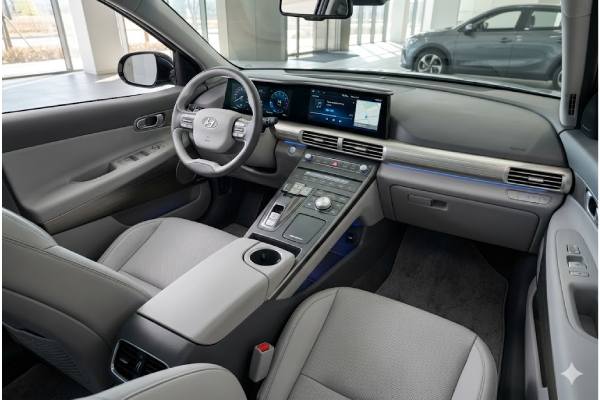
The easiest identifiers are the body shape and lighting. The second-generation model has a squarer, more upright design than the earlier NEXO, with Hyundai’s HTWO-inspired lighting signature, a more rugged SUV stance, and a modern interior with curved displays. Interior tells may include the dual-screen layout, updated console, available premium audio, sustainable trim materials, and market-specific digital side mirrors.
Safety is one of the strongest areas of the new vehicle. Euro NCAP tested the all-new NEXO as a 2025 model in base trim and awarded it five stars. Its adult and child occupant scores are strong, and the assessment notes good protection in many major crash areas. The vulnerable-road-user score is helped by autonomous emergency braking capability and pedestrian/cyclist detection, although, as with many SUVs, physical impact protection varies by body area.
Expected driver-assistance features include forward collision-avoidance assistance, lane keeping or lane following support, adaptive cruise control, blind-spot monitoring, rear cross-traffic assistance, driver attention warning, high-beam assist, traffic sign support, parking assistance, and highway driving assistance depending on market and trim. Availability should be checked carefully because the same feature name may not mean the same sensor set, operating speed range, or regulatory behavior in every country.
After windscreen replacement, bumper repair, suspension alignment work, steering-angle sensor replacement, front camera work, radar replacement, or collision repair, ADAS calibration is important. A NEXO with poorly calibrated radar or camera systems may still drive normally but deliver late warnings, false alerts, reduced lane support, or unavailable safety functions. For a hydrogen vehicle, body repair also needs attention to hydrogen tank location, high-voltage isolation, and approved repair procedures.
For families, check ISOFIX/LATCH access, rear-seat belt geometry, airbag status information, and child-seat compatibility in the actual vehicle. Euro NCAP noted that all child restraint types for which the car was designed could be properly installed and accommodated, but the safest setup still depends on the specific child seat, seating position, and local manual guidance.
Reliability, Issues and Service Actions
The 2026–present NEXO is too new for a mature long-term reliability record. The best way to judge it is to combine Hyundai’s previous NEXO experience with the specific upgrades in the new generation. The earlier vehicle proved that fuel-cell SUVs can work in daily service, but it also showed why hydrogen vehicles need specialist inspection, software updates, and recall awareness.
The most common ownership problems are not always component failures. They are often infrastructure-related. A driver may experience reduced practical range because a station underfills the tanks, operates at lower pressure, is temporarily offline, or has temperature-related limits. That can feel like a vehicle problem even when the car is functioning normally. Owners should learn the difference between a vehicle warning, a station fill limitation, and normal hydrogen temperature/pressure behavior.
Potential issue areas can be grouped by system:
| System | Prevalence | Symptoms | Likely action |
|---|---|---|---|
| Hydrogen refuelling system | Occasional | Slow fills, incomplete fills, range lower than expected after refuelling | Compare stations, check tank temperature/pressure data, inspect receptacle and sensors |
| Fuel-cell cooling and ion filter | Maintenance-sensitive | Warnings, reduced output, coolant service messages, poor cold operation | Use Hyundai-approved coolant and replace service items on schedule |
| 12 V battery | Common on many electrified vehicles | No-start condition, warning lights, communication errors | Test battery health and charging logic; replace weak battery before deeper diagnosis |
| Regenerative braking and friction brakes | Occasional in wet/cold use | Rotor corrosion, uneven braking feel, noise after parking | Regular brake inspection, occasional firm friction-brake use, pad/rotor service if needed |
| ADAS sensors | Occasional after repair | Disabled lane/ACC/AEB functions, false warnings | Perform proper calibration after glass, bumper, radar, camera, or alignment work |
Fuel-cell stack degradation should be monitored differently from battery degradation in a BEV. The NEXO’s small high-voltage battery is a buffer, not the main range source. Range depends on hydrogen capacity, fuel-cell efficiency, driving style, tyre choice, weather, and station fill quality. A proper diagnostic report should check stack performance, insulation resistance, coolant condition, hydrogen system data, compressor behavior, valve function, and stored fault codes.
Software updates are especially important. In a vehicle like this, calibration can affect cold-start behavior, hydrogen system monitoring, power-limiting logic, warning thresholds, infotainment stability, route planning, ADAS behavior, and diagnostic routines. When an official reflash is the remedy, replacing parts before updating software can waste money.
For used examples or ex-demonstrator vehicles, ask for written proof of all recalls, service campaigns, and technical service actions. Earlier NEXO models had hydrogen-related recalls in some markets, including pressure relief device and leak-detection items on affected 2019–2024 vehicles. That does not automatically apply to the 2026–present generation, but it shows why an official VIN check matters. Never assume a hydrogen vehicle is clear because it has low mileage.
Corrosion checks should focus on suspension arms, brake hardware, subframes, fasteners, underbody shields, coolant pipe brackets, and areas around aerodynamic covers. The hydrogen tanks themselves require approved inspection procedures and should not be treated like ordinary underbody components.
Maintenance and Buying Advice
The NEXO has fewer traditional service items than a petrol or diesel SUV, but it is not maintenance-free. It does not need engine oil, spark plugs, timing belts, exhaust repairs, diesel particulate filter regeneration, or conventional fuel-system cleaning. Its expensive systems are different: fuel-cell stack, hydrogen tanks, hydrogen valves and sensors, coolant loops, high-voltage electronics, 12 V battery, brake system, tyres, suspension, and ADAS hardware.
A practical maintenance plan should be built around official Hyundai service data for the exact VIN and market. Until local 2026 manuals are fully available, owners should treat the following as a conservative checklist rather than a replacement for the service book.
| Interval | Work to prioritize |
|---|---|
| Every month or before long trips | Check tyre pressure, tyre wear, washer fluid, exterior lights, warning messages, refuelling receptacle condition, and visible underbody damage |
| Every 10,000–15,000 km or annually | Multi-point inspection, tyre rotation, brake inspection, suspension check, 12 V battery test, diagnostic scan, coolant-level inspection, cabin filter check |
| Every 2 years | Brake fluid replacement where specified, A/C function check, ADAS operation check, underbody corrosion inspection |
| Every 3 years or around 60,000 km where specified | Fuel-cell coolant and ion-filter related service may apply; confirm exact market interval and coolant type |
| At higher mileage | Reduction-gear oil inspection or replacement if specified, motor mounts, wheel bearings, brake rotors, coolant hoses, and high-voltage component checks |
| After impact or underbody contact | Dealer-level hydrogen tank, high-voltage, underbody, and ADAS inspection before further use |
The 12 V battery deserves more attention than many owners expect. Electrified vehicles still rely on a conventional low-voltage system to wake control modules, unlock systems, close contactors, and manage communication. A weak 12 V battery can cause confusing fault messages that look more serious than they are. Testing it annually after the first few years is sensible.
Tyres affect range, comfort, braking, and steering. The 18-inch setup is the efficiency choice, while 19-inch tyres may sharpen response and appearance at the cost of higher consumption. Always use tyres with the correct load rating and low-rolling-resistance characteristics where specified. Poor replacements can reduce range more than expected.
A buyer should inspect more than mileage and cosmetic condition. Ask for:
- Complete Hyundai dealer service records.
- Proof of hydrogen-system checks and coolant-related services.
- Recall and service campaign completion by VIN.
- A diagnostic scan with no unresolved fuel-cell, high-voltage, ADAS, or hydrogen-storage faults.
- Evidence that accident repairs used approved procedures.
- A current battery and fuel-cell health report where available.
- Confirmation that nearby hydrogen stations are reliable, accessible, and compatible with the vehicle.
The best NEXO to buy is usually the newest, cleanest, fully documented example from a region where Hyundai supports the fuel-cell system and where hydrogen supply is stable. Avoid vehicles with incomplete service history, unexplained warning lights, prior underbody damage, uncertain import status, or no practical refuelling access.
Driving, Range and Performance
The second-generation NEXO drives much like a refined electric SUV. Step-off is smooth, there is no gear shifting, and the front motor delivers immediate torque without turbo lag or engine noise. The 150-kW motor is not meant to turn the NEXO into a performance EV, but it gives the vehicle a useful improvement over the earlier 120-kW model.
The quoted 7.8-second 0–100 km/h time is quick enough for confident urban driving, motorway merging, and passing. The top speed of 179 km/h is more than adequate for most markets. More important than the peak numbers is the way the power arrives. The motor responds cleanly at low speed, and the small high-voltage battery helps cover short power demands while the fuel cell supplies steady electricity.
Ride and refinement are expected to be among the NEXO’s strengths. The absence of combustion vibration helps, and the new model’s more mature cabin design should make it feel closer to a premium electric SUV than a niche prototype. At city speeds, tyre noise and suspension impacts will be more noticeable than the powertrain. At highway speeds, wind noise, tyre choice, and road surface become the main sources of cabin noise.
Regenerative braking should feel familiar to EV drivers, but hydrogen fuel-cell vehicles are not identical to large-battery BEVs. The compact battery limits how much energy can be stored compared with a full EV battery pack. That means regeneration is useful for smoothness and efficiency, but it is not the same as recovering large amounts of energy on long descents in a big BEV. Brake blending quality and pedal feel should be checked during a test drive.
Range is the main attraction. The official WLTP figure of up to 826 km on 18-inch wheels is impressive, but real-world range will vary. Highway speed, cold weather, winter tyres, roof accessories, payload, headwinds, mountainous routes, and incomplete hydrogen fills can all reduce the distance between stops. Drivers who regularly travel at 120 km/h or more should expect a lower figure than the best WLTP number.
Cold weather affects FCEVs differently from BEVs. The NEXO does not carry a huge traction battery whose usable capacity falls sharply in winter, but the fuel-cell system still has temperature management needs. Hyundai highlights improved low-temperature operability for the new model, which should help startability and winter drivability. Cabin heating, short trips, and cold hydrogen station conditions can still affect practical range.
Refuelling is fast when everything works correctly. A typical hydrogen stop can be close to five minutes, but that assumes the station is online, chilled, pressure-ready, compatible, and not limited by back-to-back fills. In some regions, station downtime is the single biggest ownership frustration. A buyer should test the local hydrogen network before committing to the vehicle, not after.
European models add a useful capability: towing up to 1,000 kg where approved. Towing will reduce range, as it does in any EV or FCEV, and it places more demand on brakes, tyres, cooling systems, and route planning. The advantage is that quick refuelling can make light towing less time-consuming than it would be in some battery EVs, provided hydrogen stations are available along the route.
NEXO Versus Hydrogen and EV Rivals
The NEXO has very few direct hydrogen rivals. The Toyota Mirai is the obvious comparison, but it is a sedan rather than an SUV. The Mirai is smooth, efficient, and refined, but the NEXO offers a more practical body style, easier cargo loading, and a higher seating position. For families or fleet users who need SUV packaging, the Hyundai has a clear advantage.
Against battery electric SUVs, the comparison is more complicated. A Hyundai IONIQ 5, Kia EV6, Tesla Model Y, Volkswagen ID.4, Skoda Enyaq, Nissan Ariya, or Toyota bZ4X will usually be easier to live with in places where public charging and home charging are available. BEVs can be charged at home, have broader service familiarity, and are not tied to scarce hydrogen stations. They also tend to offer stronger acceleration for the money.
The NEXO’s counterargument is refuelling speed and long rated range. For drivers who cannot charge at home but have reliable hydrogen access, a fuel-cell SUV can make sense. It can also suit fleet routes where refuelling is centralized and downtime matters. Taxi, government, corporate, airport, or municipal users may find it easier to justify than private drivers in areas with limited hydrogen coverage.
| Alternative | NEXO advantage | NEXO disadvantage |
|---|---|---|
| Toyota Mirai | SUV body, larger cargo opening, more upright seating | Mirai may be more sedan-like and efficient in some driving |
| Hyundai IONIQ 5 | Faster refuelling where hydrogen is available | IONIQ 5 has easier home/public charging access and stronger EV market support |
| Tesla Model Y | Hydrogen stop can be faster than charging on a long route | Model Y has far broader charging infrastructure and quicker acceleration |
| Diesel or hybrid SUV | Zero tailpipe emissions apart from water vapour, smooth electric drive | Diesel and hybrid fuelling infrastructure is vastly easier in most regions |
The NEXO is therefore not a universal replacement for a regular SUV. It is a strong specialist vehicle. Its advantages are real: long official range, quiet electric drive, fast hydrogen refuelling, strong safety performance, usable cargo space, and advanced technology. Its limitations are also real: limited markets, station dependency, specialist servicing, and uncertain residual values in places where hydrogen policy changes.
For a private buyer, the decision should start with infrastructure. Can you refuel within your normal routine? Are there backup stations? Are they reliable? Is Hyundai fuel-cell service available nearby? Is the warranty valid in your country? If the answer to any of those questions is weak, a battery EV or hybrid will probably be easier to own.
For a driver with reliable hydrogen access, the 2026–present Hyundai NEXO is one of the most complete FCEV passenger vehicles yet. It moves the technology closer to mainstream SUV usability while keeping the key hydrogen promise: electric driving with very short refuelling stops.
References
- Hyundai Motor’s All-New NEXO Sets New Standards in Hydrogen Technology and Electrified Mobility 2025 (Specifications)
- NEXO | Highlights | Hyundai Motor Europe 2026 (Manufacturer Model Page)
- Euro NCAP | Hyundai NEXO 2025 (Safety Rating)
- Vehicle Detail Search – 2026 Hyundai NEXO | NHTSA 2026 (Recall Database)
- The First Things You Want To Know About Your NEXO | MyHyundai 2026 (Owner Resource)
Disclaimer
This article is for informational purposes only and is not a substitute for professional diagnosis, repair, or inspection. Specifications, torque values, fluid requirements, service intervals, safety equipment, recall status, and procedures can vary by VIN, market, trim, software version, and equipment. Always verify critical information against the official owner’s manual, service documentation, VIN plate, recall database, and an authorized Hyundai fuel-cell service provider.
If this article was useful, please consider sharing it on Facebook, X/Twitter, or another platform to help other readers find reliable vehicle information.