
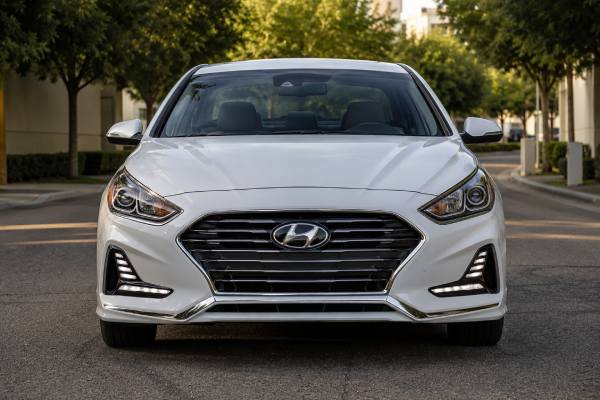
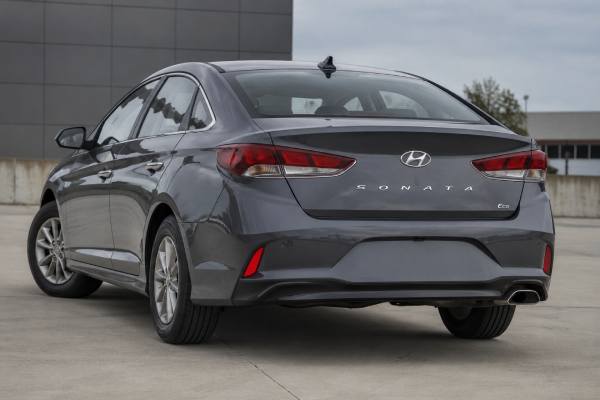
The facelifted 2018–2019 Hyundai Sonata Eco is the efficiency-focused 1.6-liter turbo version of the LF-generation Sonata. It pairs a Gamma 1.6 T-GDi gasoline engine with a 7-speed EcoShift dual-clutch transmission, front-wheel drive, and a large sedan body that gives it more space than its “Eco” badge might suggest.
Its appeal is practical rather than flashy: strong low-rpm torque, good EPA fuel economy, a roomy cabin, a large trunk, and generous safety equipment for the class. The main thing to understand before buying one is that the Sonata Eco is not simply a base Sonata with a smaller engine. Its dual-clutch transmission gives it a different driving feel, different maintenance priorities, and different inspection points than the 2.4-liter automatic versions.
Final Verdict
The 2018–2019 Hyundai Sonata Eco is a good used midsize sedan for commuters and family drivers who want generous interior space, strong highway efficiency, and easier passing power than a naturally aspirated base engine provides. Its best trait is the combination of 195 lb-ft of torque with 31 mpg combined EPA economy, but the ownership tradeoff is the dry dual-clutch transmission, which needs smooth driving habits and careful inspection for low-speed shudder or clutch wear. Buy one only with clean service history, completed recalls, no transmission hesitation, and regular oil changes on the turbocharged 1.6 T-GDi engine.
| Pros | Cons |
|---|---|
| Turbo 1.6 delivers strong low-rpm torque for commuting | Dry DCT can feel jerky in slow traffic |
| EPA-rated 31 mpg combined with full-size cabin space | Not as smooth as the 2.4-liter automatic Sonata |
| Roomy 106.1 cu ft passenger volume and 16.3 cu ft trunk | Eco trim limits wheel, audio, and luxury options |
| Standard blind-spot monitoring and smartphone integration | Best ADAS features depend on trim and packages |
| Gamma 1.6T avoids many Theta II engine concerns | Turbo GDI maintenance is sensitive to oil quality |
Table of Contents
- Sonata Eco LF Overview
- Specifications and Technical Data
- Trims, Safety and Driver Assistance
- Reliability, Common Issues and Service Actions
- Maintenance and Used Buying Guide
- Driving, Performance and Efficiency
- How the Sonata Eco Compares to Rivals
Sonata Eco LF Overview
The Sonata Eco is the fuel-saving turbo gasoline version of the facelifted LF Sonata, sold in the U.S. market for 2018 and 2019. It is best understood as a comfortable midsize sedan with an efficient downsized engine, not as a sporty 1.6T performance model.
The LF Sonata arrived for 2015, and the 2018 facelift brought sharper exterior styling, revised interior details, updated infotainment, and broader safety-feature availability. The Eco version kept the 1.6-liter turbocharged Gamma engine and 7-speed dual-clutch transmission that Hyundai had used earlier in the generation. For 2018–2019, that combination produced 178 hp and 195 lb-ft of torque.
The engine is the key reason this version exists. A small turbocharged engine can make useful torque at lower rpm, so the car does not need to be revved hard in normal driving. The Sonata Eco feels stronger in the midrange than its engine size suggests, especially during light highway passing or rolling acceleration from city speeds.
The transmission is equally important. Instead of the conventional 6-speed automatic used by many 2.4-liter Sonata models, the Eco uses Hyundai’s 7-speed EcoShift dry dual-clutch transmission. It is efficient and quick once moving, but it behaves differently from a torque-converter automatic. At parking-lot speeds, in stop-and-go traffic, and during hill starts, it may feel more mechanical. A healthy DCT should engage cleanly and shift predictably, but it will not creep as smoothly as a traditional automatic.
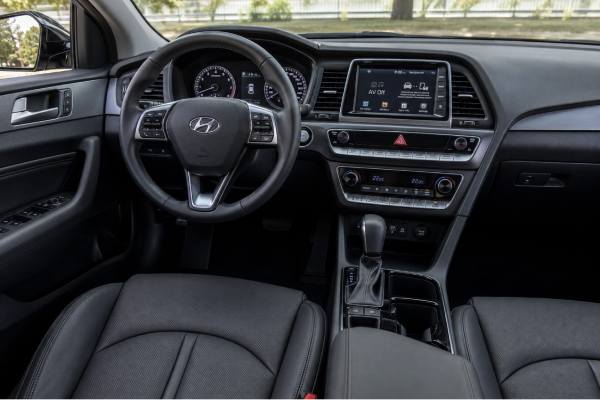
The Sonata Eco also has the same basic sedan strengths as other LF Sonatas. Passenger space is generous, the driving position is easy to adjust, the rear seat is adult-friendly, and the trunk is large for the class. The cabin layout is simple and practical, with physical controls for common functions and a standard 7-inch touchscreen with Apple CarPlay and Android Auto on 2018 models.
The best buyer is someone who drives enough highway or mixed miles to benefit from the fuel economy, wants more space than a compact sedan, and understands the need to inspect the DCT carefully. The Eco makes less sense for someone who spends most of the day creeping in heavy traffic, routinely drives on steep urban hills, or wants the smoothest possible automatic behavior.
Specifications and Technical Data
The 2018–2019 Sonata Eco uses a front-wheel-drive layout, a turbocharged direct-injected 1.6-liter four-cylinder engine, and a 7-speed dry dual-clutch automatic transmission. Its most important numbers are 178 hp, 195 lb-ft of torque, 31 mpg combined EPA fuel economy, and a large sedan body with 106.1 cu ft of passenger volume.
| Item | Hyundai Sonata Eco 1.6 T-GDi |
|---|---|
| Engine family | Gamma 1.6 T-GDi gasoline four-cylinder |
| Displacement | 1.6 L / 1,591 cc |
| Induction | Twin-scroll turbocharger |
| Fuel system | Gasoline direct injection |
| Valvetrain | DOHC, D-CVVT, 4 valves per cylinder |
| Power | 178 hp at 5,500 rpm / about 133 kW |
| Torque | 195 lb-ft at 1,500–4,500 rpm / about 264 Nm |
| Bore × stroke | 77.0 × 85.0 mm |
| Compression ratio | 10.0:1 |
| Fuel | Regular unleaded gasoline |
| Item | Specification |
|---|---|
| Transmission | 7-speed EcoShift dual-clutch transmission |
| Clutch type | Dry dual clutch |
| Manual mode | SHIFTRONIC manual gear selection |
| Drive type | Front-wheel drive |
| Final drive | 4.294:1 / 3.174:1 |
| Item | Specification |
|---|---|
| Body style | Four-door midsize sedan, five seats |
| Length | 4,854 mm / 191.1 in |
| Width | 1,864 mm / 73.4 in |
| Height | 1,476 mm / 58.1 in |
| Wheelbase | 2,804 mm / 110.4 in |
| Ground clearance | 135 mm / 5.3 in |
| Curb weight | 1,473 kg / 3,247 lb |
| Passenger volume | 106.1 cu ft |
| Cargo volume | 16.3 cu ft |
| Fuel tank | 18.5 gal / about 70 L |
| Item | Specification |
|---|---|
| Front suspension | MacPherson strut with stabilizer bar |
| Rear suspension | Independent multi-link with coil springs |
| Steering | Column-mounted motor-driven power steering |
| Turning circle | 35.8 ft curb-to-curb |
| Front brakes | 12.0-in ventilated discs |
| Rear brakes | 11.2-in solid discs |
| Standard tires | P205/65R16 |
| Standard wheels | 16 × 6.5-in aluminum alloy |
| Item | Figure |
|---|---|
| EPA city | 28 mpg US / 8.4 L/100 km / 33.6 mpg UK |
| EPA highway | 37 mpg US / 6.4 L/100 km / 44.4 mpg UK |
| EPA combined | 31 mpg US / 7.6 L/100 km / 37.2 mpg UK |
| 0–60 mph | Typically in the high-7 to mid-8-second range |
| Towing | Not recommended |
Trims, Safety and Driver Assistance
The Eco trim sits near the efficiency end of the LF Sonata lineup, but it was not stripped of useful equipment. Its main trim distinction is mechanical: the 1.6-liter turbo and 7-speed DCT replace the 2.4-liter engine and 6-speed automatic used by many mainstream trims.
For the 2018 facelift, the U.S. Sonata lineup included versions such as SE, Eco, SEL, Sport, Limited, and turbo/hybrid variants depending on configuration. The Eco is easy to identify by the Eco badge, 16-inch alloy wheels, 205/65R16 tires, and the 1.6T/DCT powertrain shown on the window sticker or VIN build data.
Equipment and trim identifiers
The Eco commonly includes:
- 7-inch touchscreen infotainment
- Apple CarPlay and Android Auto
- Bluetooth and USB input
- Rearview camera
- Blind Spot Detection with Rear Cross-Traffic Alert
- Lane Change Assist
- Heated front seats on many Eco configurations
- Proximity key with push-button start on Eco models
- 16-inch alloy wheels and efficiency-oriented tire sizing
Compared with Sport or Limited trims, the Eco is less likely to have premium audio, larger wheels, ventilated seats, LED headlights, navigation, rear parking sensors, and the fullest driver-assistance package. This is important when shopping because two 2018–2019 Sonatas can look similar but differ a lot in ADAS and comfort equipment.
Safety ratings
The LF Sonata performs well in independent crash testing. IIHS rated the 2018 Sonata a Top Safety Pick+ when equipped with optional front crash prevention and specific headlights, with the award applying to vehicles built after September 2017. The 2019 Sonata also earned Top Safety Pick+ status with optional front crash prevention and specific headlights.
NHTSA ratings for the 2018 and 2019 Sonata are commonly listed as 5-star overall, with 5-star frontal and side ratings and a 4-star rollover rating. A used buyer should still verify the exact vehicle by model year and body configuration, because safety databases can distinguish between gasoline, hybrid, plug-in hybrid, build dates, and equipment groups.
Airbags, braking and child-seat provisions
The facelift LF Sonata includes a broad passive-safety package for its age. Standard equipment includes advanced dual front airbags, front side-impact airbags, side-curtain airbags for front and rear occupants, and a driver’s knee airbag. It also includes ABS, Electronic Brake-force Distribution, Brake Assist, Electronic Stability Control, Traction Control, Vehicle Stability Management, and tire-pressure monitoring with individual tire pressure display.
Rear LATCH anchors are provided for child seats. As with many sedans, the outboard rear positions are usually the most practical for child-seat installation, while the center position should be checked carefully for seat width, belt geometry, and the child-seat maker’s instructions.
ADAS availability and calibration
Blind-spot monitoring and rear cross-traffic alert are among the most valuable standard features on the Eco because the Sonata is a long sedan with wide rear pillars. More advanced systems, such as Automatic Emergency Braking, Lane Keep Assist, Smart Cruise Control with stop/start, Automatic High Beam Assist, and some headlight upgrades, depend on trim or package.
Any car with camera- or radar-based ADAS should be checked after windshield replacement, front-end collision repair, bumper replacement, suspension work, or alignment correction. Poor calibration can cause false warnings, weak lane tracking, or disabled front-crash-prevention functions.
Reliability, Common Issues and Service Actions
A well-maintained Sonata Eco can be durable, but the 1.6T/DCT combination needs more careful evaluation than the simpler 2.4-liter automatic version. The engine is generally not the same risk profile as the larger Theta II engines, but turbo GDI oil care and DCT behavior matter a lot.
| Issue | Prevalence | Cost tier | Typical signs |
|---|---|---|---|
| DCT clutch judder or hesitation | Occasional | Medium to high | Shudder, delayed takeoff, harsh low-speed engagement |
| Turbo GDI carbon buildup | Occasional | Medium | Rough idle, misfires, weaker response at higher mileage |
| Ignition coil or spark plug misfire | Occasional | Low to medium | Check-engine light, stumble under boost |
| Oil seepage or consumption | Occasional | Low to high | Low oil level, burning smell, oil around covers or turbo lines |
| Suspension and steering wear | Common with age | Low to medium | Clunks, wandering, uneven tire wear |
| Brake corrosion or rotor pulsation | Common in rust-belt use | Low to medium | Vibration, scraping, weak parking brake feel |
DCT symptoms to take seriously
The 7-speed EcoShift DCT is efficient, but it is not ideal for every use pattern. It dislikes repeated creeping, throttle-on/throttle-off parking maneuvers, and drivers who hold the car on a hill using light throttle. These conditions create clutch heat.
During a test drive, check for:
- Smooth initial engagement from a stop
- No strong shudder during gentle launch
- No long delay when shifting from Reverse to Drive
- No harsh 1–2 or 2–1 shift in traffic
- No warning lights or transmission-temperature messages
- No burning smell after slow maneuvering
A mild mechanical feel is normal. A repeated shudder, flare, bang, or delayed takeoff is not something to ignore. Remedies can range from software adaptation or relearn procedures to clutch or actuator work.
Engine and turbo concerns
The Gamma 1.6 T-GDi uses direct injection and turbocharging, so it needs clean oil, proper warm-up behavior, and timely spark plugs. At higher mileage, carbon buildup on the intake valves may contribute to rough idle, misfire codes, or reduced response. This is a common ownership consideration for many GDI engines, not a Sonata-only defect.
Oil level matters. A turbocharged engine can punish long oil-change intervals more than a simple naturally aspirated engine. Low oil, sludge, or poor-quality oil can affect the turbocharger, timing chain system, cam phasers, and internal wear. A pre-purchase inspection should include a cold start, oil-level check, scan for stored misfire or fuel-trim codes, and inspection around the valve cover, timing cover, oil pan, turbo oil lines, and coolant hoses.
Recalls, TSBs and service actions
Recall and campaign status is VIN-specific. Certain 2017–2018 Sonata LFa vehicles were included in a trunk-latch-base recall where thermal contraction could damage the latch pawl and prevent the emergency trunk release from opening the trunk. The remedy is replacement of the trunk latch base.
Do not assume a car is clear just because it drives well. Ask for dealer records and run the VIN through the official Hyundai and NHTSA recall tools. Also ask a Hyundai dealer to check for open campaigns, ECM/TCM updates, infotainment updates, and ADAS-related calibrations. For the Eco specifically, TCM updates or adaptation procedures may matter if the owner reports low-speed DCT complaints.
Pre-purchase checks to request
Before buying, ask for:
- Full oil-change history, ideally with correct oil and short intervals
- Proof of recall completion by VIN
- DCT service or diagnostic records, if any
- Evidence of spark plug replacement at the proper interval
- Brake fluid and coolant history
- Tire wear pattern and alignment history
- Scan report showing no pending misfire, boost, fuel-trim, or transmission codes
- Cold-start and hot-restart test
- Longer test drive including traffic, hill starts, reverse maneuvers, and highway passing
Maintenance and Used Buying Guide
The Sonata Eco rewards preventive maintenance. The two priorities are simple: keep the turbocharged 1.6T engine on clean oil and confirm the DCT operates smoothly before committing to the car.
| Item | Practical interval | Why it matters |
|---|---|---|
| Engine oil and filter | Every 5,000–6,000 miles or 6–12 months | Protects turbo, chain, cam timing and GDI engine internals |
| Engine air filter | Inspect yearly; replace about 15,000–30,000 miles | Dirty filters affect turbo response and fuel trims |
| Cabin air filter | Every 12 months or as needed | Maintains HVAC airflow and windshield defogging |
| Spark plugs | About 45,000–60,000 miles; sooner if misfiring | Turbo engines stress plugs under boost |
| DCT fluid | Inspect per schedule; severe use around 75,000 miles | Supports shift quality and transmission longevity |
| Coolant | First major service around 60,000 miles, then periodically | Protects turbo and aluminum engine cooling passages |
| Brake fluid | Every 2–3 years | Prevents moisture-related corrosion and soft pedal feel |
| Brake pads and rotors | Inspect every service | Rust and uneven wear are common on aging sedans |
| Drive belt and hoses | Inspect yearly after 60,000 miles | Age cracking can cause cooling or charging failures |
| 12 V battery | Test yearly after 3 years | Weak voltage can cause electronic and starting complaints |
| Tires and alignment | Rotate every 5,000–7,500 miles | Protects ride quality, fuel economy and steering feel |
For oil, the owner’s literature for this engine commonly points to 5W-30 meeting the specified API/ILSAC or ACEA requirements, with climate and market variations. A typical 1.6 T-GDi oil refill is about 4.5 L / 4.75 US qt, but always verify by dipstick and VIN-specific documentation. Do not overfill.
The timing drive is a chain, not a scheduled belt. That does not mean it should be ignored forever. Listen for cold-start rattle, check for cam/crank correlation faults, and investigate rough running that suggests chain stretch, guide wear, or tensioner issues. Replace chain components only when symptoms, diagnostic data, or inspection justify it.
Used buyer inspection checklist
A good Sonata Eco should start cleanly from cold, settle into a steady idle, pull smoothly under boost, and shift without harsh flare or repeated shudder. Walk away from a car that has unexplained transmission warnings, heavy oil leaks, coolant loss, persistent misfire codes, or a seller who cannot show maintenance records.
Check these areas carefully:
- Front bumper and grille area for hidden crash repairs affecting ADAS sensors
- Windshield replacement history if lane camera systems are fitted
- Lower doors, rocker seams, rear subframe and brake lines for corrosion
- Turbo hoses and intercooler pipes for oil mist or loose clamps
- Engine mounts for vibration at idle
- Suspension bushings, ball joints and struts for clunks
- Rear brakes for corrosion, especially in snowy climates
- Trunk latch operation and recall completion
- Infotainment, Bluetooth, backup camera and steering-wheel controls
Best versions to seek
The best Eco is a clean, stock, adult-owned car with documented oil changes, smooth DCT behavior, matching tires, and no accident history. A 2019 model may have slightly better used-market age and fewer early-facelift build concerns, but condition matters more than model year. A 2018 built after the relevant safety-equipment dates and with all recalls completed can also be a strong buy.
Avoid heavily modified cars, cars with bargain tires and uneven wear, cars used mostly for dense city driving without DCT service history, and any example showing unresolved transmission hesitation. The Eco is appealing because it is efficient and roomy; once it needs major transmission work, its value advantage can disappear quickly.
Driving, Performance and Efficiency
The Sonata Eco drives like a relaxed, efficient sedan with useful turbo torque. It is not a sports sedan, but it has enough midrange pull to feel confident in normal commuting and highway traffic.
The 1.6T engine’s best quality is its torque band. With 195 lb-ft available from 1,500 to 4,500 rpm, the car does not need high revs for ordinary acceleration. Around town, light throttle is enough to keep pace. On the highway, the car can pass without the strained feel that some naturally aspirated four-cylinder sedans develop when loaded with passengers.
The DCT is quick and efficient once rolling. It upshifts early in relaxed driving, which helps fuel economy and keeps engine noise low. Under stronger throttle, it drops gears decisively enough, though not with the creamy smoothness of a conventional automatic. In Sport-oriented driving, the car’s limits come more from its comfort suspension, economy tires, and front-wheel-drive layout than from engine output.
Ride comfort is one of the Sonata’s strengths. The 16-inch wheels and tall-sidewall 205/65R16 tires help absorb broken pavement better than larger wheel packages. Steering is light and predictable, with enough accuracy for daily driving but limited feedback. Body control is safe and composed rather than sharp. The car is happiest cruising, commuting, and covering distance.
Noise levels are generally low for the class. Wind and tire noise are modest at highway speeds, although coarse pavement can bring some tire roar into the cabin. The engine is quiet under light load but becomes more noticeable when the turbo engine is asked for full acceleration.
Real-world fuel economy depends heavily on use. Drivers who spend most of their time on highways at 60–75 mph can often see mid-30s mpg US. Mixed driving is commonly close to the high-20s to low-30s if the car is healthy and tires are properly inflated. Dense urban driving, short winter trips, aggressive boost use, and constant stop-and-go traffic can pull economy into the mid-20s.
Cold weather affects both efficiency and DCT behavior. The engine runs richer during warm-up, the transmission may feel less refined until fully warm, and winter tires reduce mpg. In freezing climates, expect a meaningful drop from EPA numbers on short trips.
The Sonata Eco is not rated for meaningful towing use, and towing is not recommended. If you regularly carry heavy loads, the car remains stable with passengers and luggage, but braking distance, tire wear, and rear suspension wear should be watched more closely.
How the Sonata Eco Compares to Rivals
The Sonata Eco competes best against midsize sedans bought for space, value, fuel economy and comfort. Its strongest case is cabin room and features per dollar; its weakest point is DCT smoothness compared with conventional automatics and CVTs.
| Rival | Where it beats Sonata Eco | Where Sonata Eco can win |
|---|---|---|
| Honda Accord 1.5T | Sharper handling, newer cabin feel, strong efficiency | Often lower used price and simpler controls |
| Toyota Camry 2.5 | Excellent long-term reputation and smooth automatic | More features for money in many used examples |
| Kia Optima 1.6T | Similar platform with different styling and packaging | Sonata may be easier to find in conservative trims |
| Mazda6 2.5 | Better steering feel and more engaging chassis | Roomier-feeling rear seat and softer ride |
| Nissan Altima 2.5 | Smooth everyday power delivery and available AWD later | No CVT concerns and stronger turbo midrange feel |
| Ford Fusion 1.5 EcoBoost | Composed chassis and broad used availability | Larger trunk, strong warranty history when newer |
Against the Accord 1.5T, the Sonata Eco feels more relaxed and less athletic. The Accord is the better driver’s car and often more efficient in real-world use, but used prices can be higher. Against the Camry, the Sonata usually offers more equipment for the money, while the Camry counters with a stronger reputation for long-term simplicity and resale value.
The Kia Optima is the closest mechanical rival because it shares a related platform and many engineering decisions. The choice often comes down to condition, price, equipment and styling. Mazda6 buyers may prefer the Mazda’s steering and chassis feel, but the Sonata is easier to recommend for someone who values a calmer ride and rear-seat space.
The Sonata Eco is most attractive when priced below the best Accord and Camry examples while still showing better maintenance history. Do not buy one simply because it is cheap. Buy it because the DCT is healthy, the engine has been serviced properly, the safety equipment works, and the car’s strengths match how you drive.
References
- 2018 HYUNDAI SONATA ECO SPECIFICATIONS 2018 (Manufacturer Specifications) ([Hyundai News][1])
- 2018 HYUNDAI SONATA FEATURES & OPTIONS 2018 (Manufacturer Features) ([Hyundai News][2])
- 2019 Hyundai Sonata 2019 (Safety Rating) ([IIHS Crash Testing][3])
- LFa CAN-e 7.qxp 2019 (Owner’s Manual Maintenance Section) ([Hyundai Canada][4])
- HMA TSB 2021 (Recall 208 TSB) ([NHTSA][5])
Disclaimer
This article is for informational purposes only and is not a substitute for professional diagnosis, inspection, repair, or official service guidance. Specifications, torque values, service intervals, fluid requirements, recall eligibility, software updates, and procedures can vary by VIN, market, production date, equipment, and service history. Always verify details against the official owner’s manual, factory service information, Hyundai dealer records, and a qualified technician’s inspection.
If this guide helped you, please consider sharing it on Facebook, X/Twitter, or another platform to support our work.