
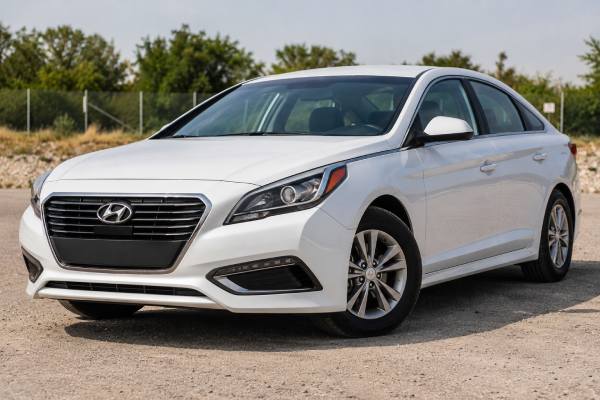
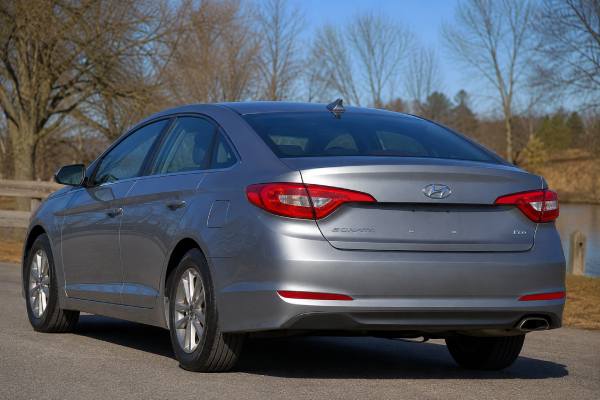
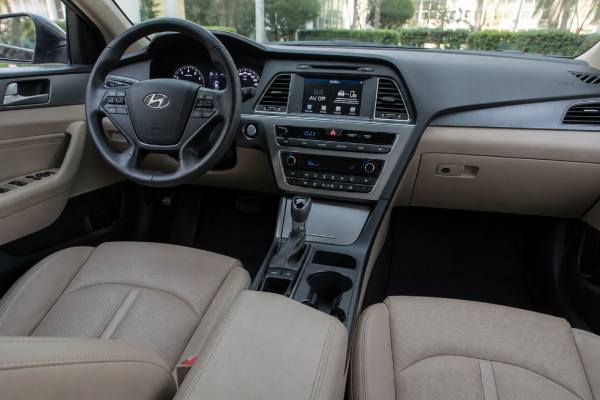
The Hyundai Sonata Eco from the LF generation is a midsize sedan built around one clear idea: give Sonata buyers better fuel economy without moving to the hybrid model. Sold for the 2015, 2016, and 2017 model years, the Eco pairs Hyundai’s 1.6-liter Gamma turbocharged direct-injection engine with a 7-speed dual-clutch automatic transmission and front-wheel drive.
It is not the fastest LF Sonata and it is not the simplest version mechanically, but it is one of the most efficient gasoline-only Sonatas of its period. For the right buyer, it offers a roomy cabin, large trunk, quiet highway manners, and strong mid-range torque in a package that can be less expensive to buy than comparable Toyota Camry, Honda Accord, or Sonata Hybrid models. The important trade-off is the 7-speed dual-clutch transmission, which needs a careful test drive and proper service history because it does not behave like a traditional torque-converter automatic in slow traffic.
Quick Overview
- Spacious midsize sedan with excellent gasoline-only fuel economy for its size.
- The 1.6 turbo delivers useful low-rpm torque, especially for highway merging and passing.
- Strong safety structure, though advanced driver assistance was mostly optional and headlights were a weak point.
- Main ownership caveat is 7-speed DCT behavior in stop-and-go driving, especially judder or harsh takeoff.
- Use correct 5W-30 oil and service it about every 5,000–7,500 miles, or 8,000–12,000 km, depending on use.
Table of Contents
- Sonata Eco LF Model Snapshot
- Sonata Eco LF Specs and Data
- Sonata Eco LF Trims and Safety
- Reliability Issues and Service Actions
- Maintenance Schedule and Buying Advice
- Driving Performance and Real Economy
- How Sonata Eco Compares
Sonata Eco LF Model Snapshot
The Hyundai Sonata Eco sits in a specific place in the LF Sonata range. It is a front-wheel-drive midsize sedan with a smaller turbocharged engine than the base 2.4-liter Sonata and a different transmission from most other LF trims. The purpose was not to create a sport model. The Eco was designed to reduce fuel use while keeping the cabin space, trunk capacity, and comfort expected from a conventional Sonata.
The engine is Hyundai’s Gamma 1.6 T-GDi, an inline-four with gasoline direct injection and turbocharging. Output is 177 hp and 195 lb-ft of torque, which gives it less peak horsepower than the naturally aspirated 2.4-liter engine but more low-end torque. That difference matters in normal driving. The Eco can feel stronger than its horsepower number suggests once the turbo is awake, especially from urban speeds to highway speeds.
The transmission is the key feature and the key caution. Instead of a conventional automatic, the Eco uses a 7-speed dual-clutch transmission. In steady driving, it helps the car feel efficient and responsive. It shifts quickly, keeps revs low on the highway, and contributes to the strong EPA fuel-economy rating. In creeping traffic, parking maneuvers, hill starts, and repeated low-speed stop-and-go use, it can feel less smooth than a normal automatic because it uses clutches rather than a fluid torque converter.
For most used buyers, the Sonata Eco makes the most sense as a commuter car. It is comfortable, quiet, efficient, and large enough for family use. The rear seat is generous, the trunk is large, and the standard 16-inch tire package keeps ride comfort and replacement tire costs reasonable. It is less suitable for drivers who spend most of their time in dense city traffic, expect luxury-car smoothness at walking speed, or want a car for regular towing.
The 2015 model year introduced the Eco to the redesigned LF Sonata lineup. The 2016 model year brought useful equipment updates across the Sonata range, including improved infotainment availability and updated suspension components. The 2017 model year is attractive because later LF cars benefited from safety-structure refinements and wider availability of advanced safety options, although equipment still varies sharply by build, package, and market.
In ownership terms, the Eco’s appeal depends heavily on condition. A well-maintained example with clean oil-change records, smooth DCT engagement, no outstanding recalls, good tires, and no warning lights can be a very smart used midsize sedan. A neglected example with jerky clutch engagement, old spark plugs, repeated check-engine lights, or incomplete recall history can quickly lose the fuel-savings advantage through repair costs.
The most important buying rule is simple: do not judge this car only by mileage. Judge it by service history, DCT behavior, recall completion, oil-change discipline, and how it drives when cold and fully warm. The engine itself is capable when maintained correctly, but turbocharged direct-injection engines are less tolerant of neglected oil, cheap spark plugs, ignored misfires, and long periods of short-trip use than older naturally aspirated engines.
Sonata Eco LF Specs and Data
The figures below focus on the 2015–2017 Hyundai Sonata Eco with the 1.6-liter Gamma T-GDi engine, 7-speed dual-clutch automatic transmission, and front-wheel drive. Some details vary by market, production date, tire package, and official VIN label, so the vehicle’s own placards and service documentation should always take priority.
| Item | Hyundai Sonata Eco LF 1.6 T-GDi |
|---|---|
| Model years | 2015, 2016, 2017 |
| Engine code/family | Gamma 1.6 T-GDi |
| Engine layout | Inline-4, DOHC, 4 valves per cylinder |
| Bore × stroke | 77.0 × 85.4 mm; 3.03 × 3.36 in |
| Displacement | 1.6 L; 1,591 cc |
| Induction | Single turbocharger |
| Fuel system | Gasoline direct injection |
| Compression ratio | Approximately 10.0:1 |
| Maximum power | 177 hp; 132 kW, about 5,500 rpm |
| Maximum torque | 264 Nm; 195 lb-ft, about 1,500–4,500 rpm |
| Timing drive | Timing chain |
| Rated fuel economy | 8.4 city / 6.5 highway / 7.6 combined L/100 km; 28 city / 36 highway / 31 combined mpg US; about 34 city / 43 highway / 37 combined mpg UK |
| Real-world highway at 120 km/h | Typically about 6.7–7.6 L/100 km; 31–35 mpg US; 37–42 mpg UK, depending on tires, wind, load, and terrain |
| Item | Specification |
|---|---|
| Transmission | 7-speed dual-clutch automatic |
| Drive type | Front-wheel drive |
| Differential | Open front differential |
| Front suspension | MacPherson strut |
| Rear suspension | Independent multi-link |
| Steering | Motor-driven rack-and-pinion; ratio approximately 14.3:1 |
| Brakes | Four-wheel disc brakes; front about 305 mm, 12.0 in; rear about 284 mm, 11.2 in |
| Common tire size | 205/65R16 on 16-inch wheels; other Sonata trims used 17- and 18-inch packages |
| Ground clearance | About 135 mm; 5.3 in |
| Length / width / height | About 4,855 / 1,865 / 1,475 mm; 191.1 / 73.4 / 58.1 in |
| Wheelbase | About 2,805 mm; 110.4 in |
| Turning circle | About 10.9 m; 35.8 ft, kerb-to-kerb |
| Curb weight | Typically about 1,475–1,490 kg; 3,250–3,285 lb |
| GVWR | About 1,960 kg; 4,321 lb |
| Fuel tank | 70 L; 18.5 US gal; 15.4 UK gal |
| Cargo volume | 462 L; 16.3 ft³ trunk volume |
| Acceleration | 0–100 km/h in about 8.3–8.8 seconds; 0–60 mph in about 8.0–8.4 seconds |
| Top speed | Approximately 210 km/h; 130 mph, market-dependent |
| Braking distance | 100–0 km/h typically about 38–41 m; 62–0 mph about 125–135 ft, tire-dependent |
| Towing capacity | Not generally rated or recommended for towing in the main U.S. Sonata Eco application |
| Payload | Approximately 470 kg; 1,035 lb calculated from typical curb weight and GVWR; verify door placard |
| System | Specification or capacity |
|---|---|
| Engine oil | API SM or newer, ILSAC GF-4 or newer, or ACEA A5 or newer; 5W-30 commonly recommended for economy; 5W-40 permitted in some conditions; capacity about 4.5 L, 4.75 US qt |
| Coolant | Ethylene-glycol coolant for aluminum engines/radiators; about 7.1 L, 7.50 US qt; use correct mix, commonly 50/50 with deionized water |
| DCT fluid | Use Hyundai/Kia-approved dual-clutch transmission lubricant by VIN; do not substitute ordinary ATF unless the official service document for that VIN specifically requires it |
| Brake fluid | DOT 3 or DOT 4; about 0.7–0.8 L, 0.7–0.8 US qt for system service |
| A/C refrigerant | R-134a; 525 ± 20 g, 18.5 ± 0.7 oz |
| A/C compressor oil | PAG ND-OIL8; 80 ± 10 mL, 2.82 ± 0.35 fl oz |
| Wheel lug nut torque | 88–107 Nm; 65–79 lb-ft |
| Tire pressure | Typically 235 kPa, 34 psi cold for common factory tire fitments; verify tire placard |
| Area | Sonata Eco LF notes |
|---|---|
| Crash-test performance | Strong overall LF Sonata structure; later 2016 and 2017 examples performed especially well in IIHS small-overlap testing when built after structural updates |
| IIHS highlights | 2017 Sonata earned Top Safety Pick when equipped with optional front crash prevention; Eco halogen headlights were rated Poor |
| NHTSA | LF Sonata received strong federal crash-test results, commonly listed with a 5-star overall rating in U.S. testing; verify exact model-year record by VIN and market |
| Airbags | Seven-airbag layout, including front, side, curtain, and driver knee airbag |
| Standard stability systems | ABS, electronic brake-force distribution, brake assist, stability control, traction control, vehicle stability management, and tire-pressure monitoring |
| ADAS availability | Blind-spot monitoring, rear cross-traffic alert, lane departure warning, adaptive cruise, forward collision warning, and automatic emergency braking were equipment- and year-dependent rather than universal |
Sonata Eco LF Trims and Safety
The Sonata Eco was not simply a Sonata SE with a different badge. Its defining mechanical package is the 1.6-liter turbo engine and 7-speed dual-clutch transmission. In the LF lineup, buyers could also find the 2.4-liter SE, Sport, and Limited, the 2.0T Sport and Limited in some years, and the separate Hybrid and Plug-In Hybrid models. The Eco’s role was to offer the lowest fuel use among regular gasoline Sonatas while avoiding hybrid hardware.
Trim identifiers and equipment
Quick identifiers include the Eco badge, 1.6T engine label under the hood, 7-speed DCT behavior, and usually 16-inch alloy wheels with 205/65R16 tires. The VIN, emissions label, and build sheet are the most reliable identifiers because used cars may have replacement wheels, missing badges, or mixed trim parts after accident repair.
Common Eco equipment included air conditioning, power accessories, cruise control, Bluetooth, a rearview camera on many examples, and a practical cloth interior. Infotainment and safety equipment changed by year and package. For 2016, Hyundai expanded availability of its 7-inch Display Audio system with Android Auto on several Sonata trims, including the Eco. Buyers should check the actual car rather than assuming all Eco models have the same screen, smartphone support, audio system, or advanced safety content.
Mechanically, the Eco’s main differences are engine and transmission. It did not use the larger brakes, sport-tuned character, or higher-output engine of the 2.0T models. It also did not have all-wheel drive, a limited-slip differential, or a special tow package. Suspension layout is the same general LF Sonata design, but wheel and tire choice has a noticeable effect on ride quality. The Eco’s 16-inch tire package is usually the most comfortable and economical, while larger wheels from other trims can add steering response at the cost of impact harshness and tire price.
Safety ratings and equipment changes
Safety is one of the LF Sonata’s stronger areas, but there are important year and build-date details. The 2015 Sonata performed well in most major IIHS tests, but early LF cars did not perform as strongly in the small-overlap driver-side test as later updated examples. Hyundai made structural and front suspension changes, and later 2016 and 2017 cars built after the relevant update performed better in that test area.
For 2017, the Sonata was recognized as an IIHS Top Safety Pick when fitted with optional front crash prevention. The front crash prevention system could earn a Superior rating in IIHS testing when properly equipped, but it was not standard on every Eco. Headlights were a weaker point. Eco models with halogen headlights were rated Poor by IIHS, mainly because of visibility and glare performance. This does not mean the lights are unusable, but buyers who drive frequently on dark rural roads should test the headlights at night and consider condition, aim, lens clarity, and legal bulb quality.
Standard passive and active safety equipment was solid for the class. The Sonata used a seven-airbag layout, including a driver knee airbag, plus stability control, traction control, anti-lock brakes, brake assist, electronic brake-force distribution, vehicle stability management, and tire-pressure monitoring. Rear child-seat provisions include lower anchors in the outboard positions and a center tether anchor. As with many sedans, the rear-center child-seat installation may require more attention than the outboard positions.
ADAS service implications
Advanced safety systems matter during ownership because they can require calibration after body, glass, or suspension work. Cars equipped with forward collision warning, automatic emergency braking, adaptive cruise control, or lane-related systems may need radar, camera, or steering-angle calibration after windshield replacement, front bumper repair, alignment work, or collision repair. A car that has no warning lights can still have poorly calibrated sensors if repair work was done incorrectly.
For used buyers, the best approach is to confirm the exact equipment by operating it. Check for blind-spot warning indicators in the mirrors, lane warning controls, adaptive cruise buttons, forward-collision settings, and warning messages in the instrument cluster. Then verify that no ADAS, ABS, airbag, or steering-related codes are stored in the relevant control modules.
Reliability Issues and Service Actions
The Sonata Eco can be reliable, but its risk profile is different from the simpler 2.4-liter Sonata. The 1.6 turbo engine, gasoline direct injection, and 7-speed dual-clutch transmission all reward correct maintenance and careful driving habits. The most expensive used-car mistakes usually come from ignoring DCT symptoms, buying without service records, or assuming all recall and software work has already been completed.
| Issue | Prevalence | Severity | Typical signs | Best response |
|---|---|---|---|---|
| Low-speed DCT judder or harsh engagement | Common enough to check carefully | Medium to high | Shudder from a stop, jerky reverse, hesitation, burning clutch smell, harsh hill starts | Scan TCU, check for updates and adaptations, inspect mounts and clutch condition, avoid cars with severe repeat symptoms |
| Misfires from plugs, coils, or GDI deposits | Occasional | Low to medium | Rough idle, flashing check-engine light, hesitation under boost | Use correct spark plugs, diagnose coils and injectors, inspect intake valves if mileage is high |
| Turbo or boost-control issues | Occasional | Medium | Low power, whistle, oil seepage, boost codes, limp mode | Check boost hoses, wastegate control, PCV system, oil supply, and service records |
| Oil leaks or neglected oil service | Occasional | Medium | Oil smell, wet valve cover area, low dipstick level, turbo noise | Repair leaks promptly and shorten oil intervals on short-trip or severe-use cars |
| Suspension and steering wear | Occasional with age | Low to medium | Clunks, uneven tire wear, wandering, vibration | Inspect struts, bushings, ball joints, wheel bearings, alignment, and tire condition |
| Corrosion in salt climates | Market-dependent | Medium | Rust on subframes, brake lines, suspension arms, lower seams, trunk well | Inspect underneath before purchase; avoid heavily corroded examples unless priced for repair |
DCT behavior and software
The 7-speed DCT is the system that deserves the longest test drive. A healthy unit should engage smoothly enough from a stop, shift cleanly once moving, and reverse without strong shudder. It may feel different from a conventional automatic, especially during parking-lot creeping, but it should not bang into gear, flare repeatedly, smell burned, or hesitate dangerously when pulling into traffic.
Some drivability complaints can improve with transmission control software updates, clutch adaptation procedures, or repair of related engine issues. Other problems indicate clutch wear or internal transmission concerns. During a pre-purchase inspection, ask the shop to scan the engine and transmission modules, check for pending codes, review adaptation values if available, and test the car cold and hot in stop-and-go driving.
Engine-specific concerns
The Gamma 1.6 T-GDi is a turbocharged direct-injection engine, so oil quality matters. Long oil intervals, low oil level, poor-quality filters, and repeated hot shutdowns after hard use can shorten turbo and timing-chain life. The timing chain does not have a routine replacement interval like a belt, but it should be investigated if there is cold-start rattle, cam/crank correlation faults, rough running, or evidence of poor oil history.
Direct injection can also lead to intake valve deposits over time because fuel does not wash the back of the intake valves. This is not always a problem, but higher-mileage cars with rough idle, cold-start misfires, or uneven compression behavior may need intake cleaning after proper diagnosis. Spark plugs are another important service item. Turbo GDI engines need the correct plug type and gap, and they can become sensitive to worn plugs earlier than older non-turbo engines.
Recalls and service actions
Several official actions are important for this generation. Certain 2015–2016 Sonata models with a panoramic sunroof were recalled because the sunroof glass panel could detach. Some 2015–2016 Sonata models were recalled for a parking brake warning-lamp issue caused by switch corrosion. Certain 2015–2017 Sonata vehicles were also recalled for Smart Junction Box logic that could cause turn-signal behavior opposite to the driver’s intended direction.
The key point is not to assume completion. Ask for dealer records, check the VIN through an official recall lookup, and confirm the work on the repair order. A recall that sounds minor can still matter if it affects lighting, warning lamps, glass retention, or electronic body-control behavior. For cars with advanced driver assistance, also look for proof of proper calibration after collision, windshield, bumper, or alignment work.
Maintenance Schedule and Buying Advice
Good maintenance is the difference between a Sonata Eco that remains an economical commuter and one that becomes frustrating. The Eco’s engine is not unusually exotic, but it is a turbocharged GDI engine connected to a dual-clutch transmission. That combination is less forgiving of deferred service than a simple naturally aspirated engine with a conventional automatic.
| Interval | Service item | Practical note |
|---|---|---|
| Every 5,000–7,500 miles; 8,000–12,000 km; or 6–12 months | Engine oil and filter | Use correct 5W-30 oil meeting specification; choose the shorter interval for short trips, heat, traffic, or turbo-heavy use |
| Every oil service | Fluid levels, leaks, tires, brakes, lights, wipers | Pay attention to oil level, coolant level, turbo oil seepage, and uneven tire wear |
| Every 5,000–7,500 miles; 8,000–12,000 km | Tire rotation | Helps prevent front-tire wear on the FWD chassis; check alignment if wear is uneven |
| Every 15,000–30,000 miles; 24,000–48,000 km | Engine air filter and cabin air filter | Dusty climates may need shorter intervals; a restricted air filter can affect drivability and economy |
| About every 45,000 miles; 72,000 km | Spark plugs | Use correct turbo GDI plugs; worn plugs can trigger misfires under boost |
| Every 2 years or about 30,000 miles; 48,000 km | Brake fluid | Use DOT 3 or DOT 4; moisture-contaminated fluid affects braking and ABS components |
| Inspect from 30,000 miles; 48,000 km onward | Drive belt, hoses, mounts | Replace if cracked, noisy, oil-soaked, swollen, or loose |
| About 60,000 miles; 96,000 km in severe use, or per VIN documentation | DCT inspection and fluid service where specified | Use only approved DCT lubricant and correct procedure; never treat it casually as a normal automatic |
| About 100,000–120,000 miles; 160,000–193,000 km, then shorter after first change | Coolant | Use correct ethylene-glycol coolant for aluminum engines; follow official interval for the exact market |
| No fixed replacement interval | Timing chain | Inspect if there is rattle, timing fault codes, poor oil history, or cam/crank correlation issues |
| Annually after year 3 | 12 V battery and charging system | Typical replacement window is about 4–6 years depending on climate and usage |
Pre-purchase inspection checklist
A used Sonata Eco should be inspected more like a compact turbo-DCT car than a basic family sedan. During the test drive, start with the car cold. Listen for timing-chain rattle, uneven idle, exhaust smoke, turbo whine, or belt noise. Let it warm fully, then drive in city traffic, stop on a hill, reverse slowly, creep through a parking lot, and accelerate firmly onto a faster road. The DCT should not shudder heavily, slam into gear, or hesitate so much that the car feels unsafe.
Ask for complete maintenance records. The best cars have regular oil changes with correct oil, documented spark plug replacement, brake fluid service, coolant service when due, tire rotations, and recall completion. A car with vague “dealer serviced” claims but no paperwork deserves a deeper inspection.
Check the engine bay for oil seepage around the valve cover, turbo oil lines, PCV plumbing, intercooler connections, and intake ducting. Look for coolant crust near hoses and the radiator area. Scan for stored and pending diagnostic trouble codes, not just dashboard warning lights. Misfire history, boost codes, transmission codes, ABS codes, airbag codes, or ADAS calibration faults should be investigated before purchase.
Under the car, inspect front and rear subframes, suspension arms, brake lines, exhaust hangers, and lower body seams, especially in snow-belt areas. Check the trunk floor and spare-tire well for water entry. If the car has a panoramic sunroof, operate it fully, inspect the glass and wind deflector, check for water stains, and confirm recall completion where applicable.
Best years and versions to seek
For many buyers, a clean 2016 or 2017 Eco is the best target because of equipment updates and later safety refinements. A later-build 2016 or 2017 with optional safety technology, complete records, smooth DCT behavior, and no accident history is more desirable than a lower-mileage car with poor records.
Avoid examples with severe DCT shudder, repeated misfires, neglected oil changes, incomplete recalls, heavy rust, flood signs, or mismatched body panels around ADAS sensors. A low price can still make sense if the issue is minor and documented, but DCT or turbo-related uncertainty should be priced very carefully.
Long term, the Sonata Eco can be a durable and efficient sedan when maintained correctly. Its strongest ownership case is value: it often costs less than a comparable Camry or Accord while offering a large cabin, strong safety structure, and excellent highway economy. Its weakest case is complexity: the dual-clutch transmission and turbo GDI engine require more thoughtful maintenance than the simplest midsize sedans.
Driving Performance and Real Economy
The Sonata Eco drives like a comfort-focused midsize sedan with a torque-rich small turbo engine. It is not a sport sedan, and it does not try to be one. The chassis favors straight-line stability, low noise, and easy highway cruising over sharp steering feedback. On the standard 16-inch wheel and tire package, ride quality is one of its better traits. Impacts are generally well controlled, and tire noise is modest when the tires are in good condition.
Steering is light and predictable. It does not give the road feel of a Mazda6 or a sport-oriented Accord, but it is easy to place in traffic and relaxed on long trips. Body roll is present if the car is pushed hard, though the independent rear suspension keeps the car composed enough for normal driving. Braking feel is steady for commuting, but tire quality has a large effect on emergency stopping distance and wet-road confidence.
Powertrain character
The 1.6 turbo’s best attribute is mid-range torque. Once moving, it pulls cleanly without needing high rpm, and the DCT helps keep the engine in its efficient torque band. The car feels stronger from 30–70 mph than its 177 hp rating might suggest. Passing power is adequate for a midsize sedan, especially with one or two occupants, though it is not as quick as a V6 competitor or Sonata 2.0T.
The DCT is smoothest when driven decisively. Gentle creep, repeated half-throttle starts, and long uphill crawling are the situations where it can feel least natural. Some drivers adapt quickly by leaving a little more space and using the brake positively rather than inching forward constantly. Others may prefer the smoother feel of a conventional automatic or CVT, especially in heavy city use.
Drive modes change the feel more than the actual output. Eco mode softens throttle response and encourages earlier shifts. Normal mode is the best everyday balance. Sport mode makes the car more alert, holds gears longer, and can make passing feel easier, but it also works against the main reason to buy the Eco: fuel efficiency.
Real-world fuel economy
The official rating is the headline: 28 mpg city, 36 mpg highway, and 31 mpg combined in U.S. EPA terms. In metric terms, that is about 8.4 L/100 km city, 6.5 L/100 km highway, and 7.6 L/100 km combined. For a roomy gasoline midsize sedan from this period, those are strong numbers.
Real-world results depend heavily on traffic. In relaxed suburban and highway use, many drivers can see mixed economy around 7.1–8.4 L/100 km, or 28–33 mpg US. At steady highway speeds around 100–110 km/h, economy can be very good. At 120 km/h, expect something closer to 6.7–7.6 L/100 km, or about 31–35 mpg US, depending on wind, grade, tire pressure, and cargo. In cold weather, dense traffic, short trips, or hilly urban use, fuel use can rise into the 8.8–10.0 L/100 km range, or about 24–27 mpg US.
The Eco rewards smooth driving. Early braking, steady throttle, correct tire pressure, fresh spark plugs, clean filters, and proper wheel alignment all help. A dragging brake caliper, worn plugs, old tires, or misbehaving DCT can erase much of the advantage over a regular 2.4-liter Sonata.
Load, traction, and daily use
With front-wheel drive and an open differential, the Sonata Eco is straightforward in dry and wet conditions. Stability control is tuned for safe, predictable behavior rather than playful handling. In snowy climates, winter tires make a bigger difference than any trim feature. The standard tire size is also helpful because winter tires are usually less expensive than 18-inch fitments.
The car is not a towing-focused vehicle. Owners should treat it as a passenger sedan, not a light tow vehicle, unless the official manual for their exact market gives a specific rating and procedure. Fully loaded with passengers and luggage, the Eco remains stable, but passing performance and braking distance naturally suffer. The turbo engine also works harder on long grades, so oil and coolant condition matter.
How Sonata Eco Compares
The Sonata Eco competes with mainstream midsize sedans rather than sport sedans or luxury cars. Its closest rivals are the Toyota Camry 2.5, Honda Accord 2.4, Mazda6 2.5, Ford Fusion EcoBoost, Nissan Altima 2.5, Kia Optima 1.6T, and Sonata Hybrid. The right choice depends on whether the buyer values simplicity, fuel economy, driving feel, resale value, or purchase price most.
| Model | Main advantage | Main trade-off | Best for |
|---|---|---|---|
| Hyundai Sonata Eco 1.6T | Excellent gasoline fuel economy, roomy cabin, strong value, good torque | DCT smoothness and turbo GDI maintenance need attention | Commuters wanting space and economy without buying a hybrid |
| Toyota Camry 2.5 | Smooth powertrain, strong reputation, easy ownership, high resale | Often more expensive used; less distinctive driving feel | Buyers prioritizing low-risk long-term ownership |
| Honda Accord 2.4 | Efficient, roomy, sharper handling than most rivals | CVT feel and road noise may not suit everyone | Drivers wanting a practical sedan with better steering response |
| Mazda6 2.5 | Best steering feel and driver engagement in this group | Less rear-seat space and not as torque-rich at low rpm | Drivers who care more about handling than maximum cabin room |
| Ford Fusion 1.5 EcoBoost | Comfortable ride, attractive styling, available features | Heavier feel and more mixed reliability reputation | Buyers who like the Fusion’s design and can verify service history |
| Kia Optima 1.6T | Similar engine/transmission concept with different styling and equipment | Shares many of the same DCT inspection concerns | Shoppers cross-shopping Hyundai and Kia value trims |
| Hyundai Sonata Hybrid | Better city economy and smoother low-speed driving | Hybrid battery and electric-drive checks add inspection needs | Urban drivers who want maximum efficiency and smoother traffic behavior |
The Sonata Eco’s strongest case is against other gasoline midsize sedans when purchase price matters. Compared with a Camry or Accord, it may offer more equipment for the money and better highway economy than many naturally aspirated competitors. Compared with a Mazda6, it is roomier and more relaxed, though less engaging. Compared with a Sonata Hybrid, it is mechanically simpler in some areas but less efficient in city traffic and less smooth at very low speeds.
The Camry remains the safer default for buyers who want the least complicated ownership experience. The Accord is a strong all-rounder with better handling balance. The Mazda6 is the driver’s choice. The Sonata Eco is the value-and-efficiency choice, provided the DCT is healthy and the service history is strong.
For most used buyers, the decision should come down to the individual car rather than the badge. A carefully maintained Sonata Eco with smooth DCT operation is a better buy than a neglected Camry or Accord at the same price. But a Sonata Eco with clutch judder, old oil records, unresolved recalls, and cheap tires is not a bargain. Condition, documentation, and test-drive behavior are the deciding factors.
References
- Specifications & Consumer information 2016 (Owner’s Manual)
- NEW FEATURES, UPGRADED SUSPENSION COMPONENTS AND STYLING REVISIONS HIGHLIGHT 2016 SONATA 2015 (Manufacturer Publication)
- Gas Mileage of 2017 Hyundai Sonata 2017 (EPA Fuel Economy)
- 2017 Hyundai Sonata 2017 (Safety Rating)
- Check for Recalls: Vehicle, Car Seat, Tire, Equipment 2026 (Recall Database)
Disclaimer
This article is for informational purposes only and is not a substitute for professional diagnosis, repair, or inspection. Specifications, torque values, service intervals, fluids, calibration procedures, and equipment details can vary by VIN, production date, market, and option package. Always verify critical information against the vehicle’s official service documentation, owner’s manual, emissions label, tire placard, and dealer records before servicing or buying.
If this guide helped you, please consider sharing it on Facebook, X/Twitter, or your preferred automotive community to support our work.