
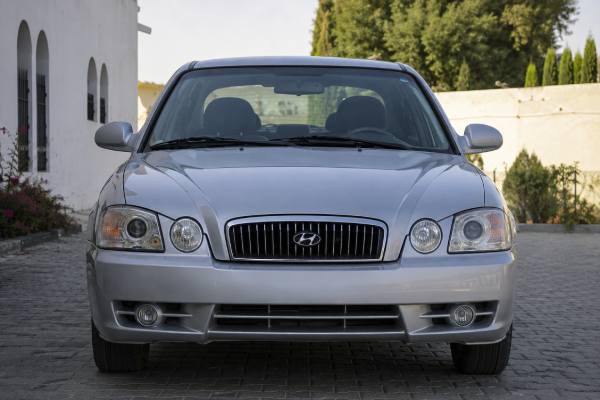
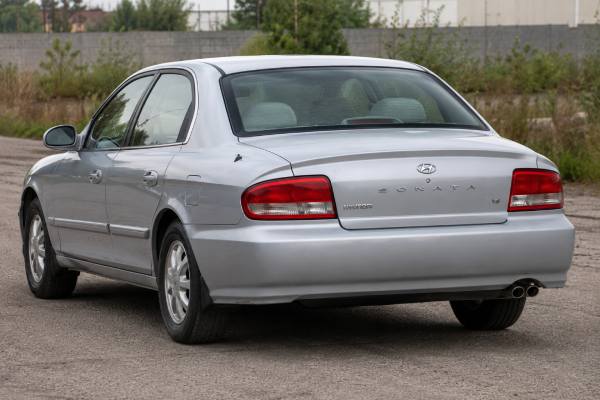
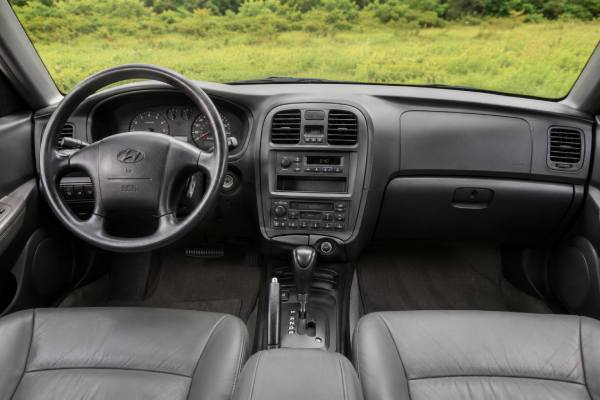
The Hyundai Sonata EF with the Sirius II 2.4-liter four-cylinder engine sits in an interesting place among early-2000s midsize sedans. It was not the sportiest car in its class, but it offered a roomy cabin, simple mechanical layout, strong equipment value, and a proven naturally aspirated engine that is still understandable and serviceable today.
For 2000–2001 examples, the key appeal is practicality. The 2.4-liter DOHC inline-four makes 149 hp, drives the front wheels, and was offered with either a 5-speed manual or a 4-speed automatic depending on market and trim. This article focuses on the EF-generation Sonata equipped with the 2.4 Sirius II engine, with North American specifications used as the main baseline where figures differ by region.
Owner Snapshot
- Spacious midsize sedan packaging with a 2700 mm wheelbase, a large trunk, and comfortable highway manners.
- The 2.4 Sirius II is simple, naturally aspirated, and easier to diagnose than many newer direct-injection or turbo engines.
- The main ownership caveat is age-related corrosion, especially the front subframe and suspension mounting areas in salt-belt climates.
- Timing belt service is critical; use a practical replacement interval of about 60,000 miles / 96,000 km unless your official market schedule differs.
- Severe-use oil service can be as short as 3,000 miles / 4,800 km or 3 months; normal use is commonly listed at 7,500 miles / 12,000 km or 6 months.
Table of Contents
- Hyundai Sonata EF Explained
- Hyundai Sonata EF Technical Specs
- Hyundai Sonata EF Trims and Safety
- Reliability, Faults and Recalls
- Maintenance Plan and Buying Checks
- Driving Feel and Real-World Performance
- Sonata EF Versus Period Rivals
Hyundai Sonata EF Explained
The EF-generation Hyundai Sonata was Hyundai’s midsize sedan offering around the turn of the millennium. In many markets, it represented a major step forward from earlier Sonatas because it used a more modern platform, independent suspension at both ends, a roomier cabin, and a stronger value proposition against established rivals such as the Toyota Camry, Honda Accord, Nissan Altima, Ford Taurus, Mazda 626, and Mitsubishi Galant.
The version covered here is the 2000–2001 Sonata EF with the Sirius II 2.4-liter inline-four, commonly identified by the G4JS engine family. It is a naturally aspirated, DOHC, 16-valve four-cylinder with multipoint fuel injection. In North American trim, output is listed at 149 hp at 5,500 rpm and 156 lb-ft of torque at 3,000 rpm. That torque peak is fairly low for a four-cylinder of the era, which helps the car feel usable in normal city driving even if it is not especially quick.
This Sonata is front-wheel drive. The automatic version uses an electronically controlled 4-speed automatic, while some markets and configurations offered a 5-speed manual. The automatic is more common in many used markets, especially in North America. It suits the car’s relaxed character, but it also makes maintenance history important because old ATF, heat, and delayed service can cause shift quality problems as these cars age.
The 2.4-liter Sonata should be understood as a comfort-focused, value-oriented midsize sedan rather than a performance model. Its strengths are cabin space, simple controls, good outward visibility, affordable parts, and mechanical familiarity. It is easier to work on than many modern cars because it lacks turbocharging, direct injection, high-voltage hybrid systems, electric parking brakes, and complex driver-assistance hardware.
Its weaknesses are also typical for the period. Crash protection is not comparable to a modern midsize sedan. Electronic stability control and advanced driver assistance systems were not part of this generation’s normal feature set. Interior materials can age poorly, paint and clearcoat may deteriorate, and neglected examples can suffer from oil leaks, cooling system issues, worn suspension parts, airbag warning lights, and corrosion.
For a buyer today, the EF Sonata 2.4 makes the most sense as a low-cost local-use car, a simple commuter, or an inexpensive second vehicle. It is less ideal if you need modern safety technology, quiet long-distance refinement, or guaranteed rust resistance. The difference between a good one and a bad one is almost entirely maintenance and corrosion history. A well-kept, rust-free car with timing belt records can still be useful; a neglected salt-belt car with subframe corrosion should be treated with caution no matter how cheap it looks.
Hyundai Sonata EF Technical Specs
The following tables focus on the 2.4-liter Sirius II / G4JS Sonata EF. Some values vary by market, transmission, trim, wheel package, and measurement standard, so use them as a model-specific guide rather than a substitute for a VIN-specific service manual.
Powertrain and Efficiency
| Item | Hyundai Sonata EF Sirius II 2.4 |
|---|---|
| Engine code / family | Sirius II / G4JS family |
| Engine layout | Front transverse inline-four |
| Cylinders / valvetrain | 4 cylinders, DOHC, 4 valves per cylinder |
| Bore × stroke | 86.5 × 100.0 mm (3.41 × 3.94 in) |
| Displacement | 2.4 L / 2,351 cc (143.5 cu in) |
| Induction | Naturally aspirated |
| Fuel system | Multipoint fuel injection |
| Compression ratio | 10.0:1 commonly listed for this 2.4 variant |
| Max power | 149 hp (111 kW) @ 5,500 rpm |
| Max torque | 211 Nm (156 lb-ft) @ 3,000 rpm |
| Timing drive | Timing belt |
| Fuel requirement | Regular unleaded, 87 AKI / 91 RON or higher where specified |
| EPA rating, 4-speed automatic | 18 city / 26 highway / 21 combined mpg US |
| EPA rating, 5-speed manual | 19 city / 27 highway / 22 combined mpg US |
| Approximate metric equivalent, automatic | 13.1 city / 9.0 highway / 11.2 combined L/100 km |
| Real-world highway at 120 km/h / 75 mph | Typically around 8.5–10.0 L/100 km, depending on tires, load, terrain, and engine condition |
Transmission and Driveline
| Item | Specification |
|---|---|
| Standard driveline | Front-wheel drive |
| Automatic transmission | Electronically controlled 4-speed automatic with overdrive; F4A42-family units are commonly associated with this generation |
| Manual transmission | 5-speed manual where fitted |
| Differential | Open front differential |
| AWD / 4×4 | Not applicable for this covered variant |
Chassis and Dimensions
| Item | Specification |
|---|---|
| Front suspension | Independent double-wishbone |
| Rear suspension | Independent multi-link |
| Steering | Power-assisted rack and pinion |
| Steering ratio | About 14.1:1 where listed |
| Turning circle, kerb-to-kerb | 10.5 m (34.4 ft) |
| Front brakes | Ventilated discs, about 277 mm (10.9 in) |
| Rear brakes | Drums without ABS; discs where ABS-equipped in some trims/markets |
| Common tire sizes | P195/70R14 on GL-type trims; P205/60R15 on GLS or optional wheel packages |
| Ground clearance | About 160 mm (6.3 in), market dependent |
| Length | 4,710 mm (185.4 in) |
| Width | 1,815–1,818 mm (71.4–71.6 in), depending on source/market |
| Height | 1,410 mm (55.5 in) |
| Wheelbase | 2,700 mm (106.3 in) |
| Curb weight | About 1,393–1,409 kg (3,070–3,107 lb), depending on transmission and equipment |
| GVWR | About 1,890 kg (4,166 lb) in commonly listed North American data |
| Fuel tank | 65 L (17.2 US gal / 14.3 UK gal) |
| Cargo volume | About 374–377 L (13.2–13.3 ft³), trunk; market/source dependent |
Performance and Capability
| Item | Typical figure |
|---|---|
| 0–100 km/h / 0–62 mph | About 9.8–10.5 seconds, depending on transmission and test method |
| 0–60 mph | About 9.5–10.0 seconds in typical listed estimates |
| Top speed | About 200–203 km/h (124–126 mph) where listed |
| 100–0 km/h braking distance | Not consistently published for the exact 2.4 trim; condition and tires matter more today |
| Towing capacity | Often listed around 907 kg (2,000 lb) braked/dead-weight in North American data, but verify local manual guidance |
| Payload | Market dependent; calculate from door-jamb GVWR minus actual curb weight |
Fluids and Service Capacities
| Item | Specification / capacity |
|---|---|
| Engine oil grade | API SH, SG, SG/CD or later as originally specified; modern equivalent quality oil may be used if compatible |
| Engine oil viscosity | 10W-30 / 10W-40 for normal climates; 5W-30 / 5W-40 for colder climates; 20W-40 / 20W-50 for hot climates where appropriate |
| Engine oil capacity with filter | 4.3 L (4.5 US qt) |
| Engine oil capacity without filter | 4.0 L (4.2 US qt) |
| Manual transaxle oil | Hyundai Genuine Parts MTF 75W-90, API GL-4; about 2.1 L (2.2 US qt) |
| Automatic transaxle fluid | Diamond ATF SP-III or SK ATF SP-III; total capacity commonly listed around 7.8 L (8.2 US qt) |
| Engine coolant | Ethylene glycol coolant suitable for aluminum radiators; about 8.6 L (9.0 US qt) for the 2.4 |
| Power steering fluid | PSF-3 type fluid; about 0.9 L (0.95 US qt) |
| Brake / clutch fluid | DOT 3 or DOT 4 equivalent |
| A/C refrigerant | R-134a; charge varies by market and label, so verify under-hood decal |
| Critical torque examples | Wheel nuts should be tightened to the official service value for the fitted wheels; engine and suspension torque values require service-manual confirmation |
Safety and Driver Assistance Data
| Item | Result / availability |
|---|---|
| IIHS moderate overlap front | Acceptable overall for 1999–2005 Sonata ratings group |
| IIHS side impact, original test | Poor overall for the rated 1999–2005 group |
| IIHS head restraints and seats | Poor for the rated 2001 model listing |
| Euro NCAP | No directly comparable Euro NCAP star rating commonly available for this exact 2000–2001 2.4 variant |
| Frontal airbags | Driver and front passenger airbags |
| Side airbags | Front seat-mounted side airbags on many North American 2001 examples; verify trim and market |
| ABS | Optional or trim-dependent in many markets |
| Stability control | Not fitted on this generation in normal 2.4 form |
| ADAS | No AEB, adaptive cruise control, lane keeping, blind-spot monitoring, or traffic-sign assist |
Hyundai Sonata EF Trims and Safety
In North America, the 2001 Sonata lineup was simple compared with modern midsize sedans. The 2.4-liter four-cylinder was mainly tied to the base Sonata sedan, while the GLS was usually associated with the 2.5-liter V6. In other markets, trim names and equipment mixes differed, and the 2.4 could appear in more than one grade.
The practical way to identify a 2.4 Sonata EF is to check the emissions label, VIN/build plate, engine stamping, and under-hood layout rather than relying only on badges. A 2.4 Sirius II car has the transverse inline-four layout with a timing-belt-driven DOHC head. The V6 models have a visibly different engine bay, different service parts, and different maintenance access.
Trim and Option Differences
Typical equipment on the base 2.4 included cloth seating, power steering, power-assisted brakes, air conditioning, and basic audio. Depending on market and option package, buyers could get power windows, power locks, cruise control, alloy wheels, a CD player, moonroof, ABS, traction control on some versions, and upgraded trim.
Mechanical differences that matter most today are not luxury features but brakes, wheels, and transmission. ABS-equipped cars may have rear disc brakes rather than rear drums, and 15-inch wheel packages can change tire cost, ride feel, and braking response. Manual cars are rarer in some markets and may be more engaging, but clutch hydraulics, mounts, and shift linkage condition become important after two decades.
Year-to-year changes around 2000–2001 were modest for this specific pre-facelift EF shape. The larger visual and structural update arrived for the later facelifted EF-B generation, which is outside the exact 2000–2001 focus here. That matters because some later 2.4 Sonatas were rated differently in certain markets, and facelift equipment should not automatically be applied to the early EF.
Crash Ratings and Safety Limits
The EF Sonata’s safety story is mixed. The IIHS moderate-overlap frontal result was acceptable for the 1999–2005 ratings group, which was respectable but not class-leading. The original IIHS side-impact result was poor, and head restraints/seats were also rated poor on the 2001 listing. These results need context: the tests and vehicle designs are from an earlier safety era, long before modern small-overlap testing, widespread side-curtain airbags, electronic stability control, and advanced crash-avoidance systems.
For family use, the main safety advantage is that the car is a midsize sedan with decent mass and basic airbag protection for its period. The main disadvantage is the absence of modern active safety features. There is no automatic emergency braking, adaptive cruise control, lane support, blind-spot monitoring, rear cross-traffic alert, backup camera, or tire-pressure monitoring system as factory equipment.
Child-seat provisions also vary by year and market. Later early-2000s cars may have child-seat anchors, but buyers should physically confirm anchor points, seat-belt locking behavior, rear-seat belt condition, and owner’s manual instructions. Rear-seat belts, buckles, and child locks should be tested carefully because age, interior wear, and previous repairs can create practical safety issues even when the original design was compliant.
Reliability, Faults and Recalls
The 2.4-liter Sonata EF can be durable, but age has now overtaken mileage as the biggest issue. A low-mileage car that sat outside for years may need more work than a higher-mileage car that was driven regularly and serviced properly. The most important reliability areas are timing belt history, cooling system condition, oil leaks, automatic transmission behavior, suspension wear, SRS warning lights, and corrosion.
| Issue | Prevalence | Severity / cost | Symptoms | Likely remedy |
|---|---|---|---|---|
| Timing belt neglect | Common on poorly documented cars | High | No proof of replacement, belt noise, old covers/seals | Replace timing belt, balance/related belts where applicable, tensioners, water pump, cam/crank seals if leaking |
| Front subframe corrosion | Common in salt-belt climates, rare in dry climates | High | Clunks, steering pull, visible rust, alignment changes | Inspect subframe and control-arm mounts; verify recall/campaign work; replace unsafe parts |
| Oil leaks | Common with age | Low to medium | Burning smell, oil on timing cover, valve cover seepage | Replace valve cover gasket, cam/crank seals, oil pan gasket as needed |
| Cooling system aging | Common | Medium | Overheating, coolant smell, brittle hoses, radiator seepage | Replace radiator, thermostat, hoses, cap, coolant |
| Automatic shift issues | Occasional | Medium to high | Harsh 2–3 shifts, flare, delayed engagement | Check ATF condition, service with correct SP-III fluid, diagnose solenoids/sensors before overhaul |
| Suspension bushings and ball joints | Common | Medium | Clunks, wandering, uneven tire wear | Replace worn arms, bushings, ball joints, struts, mounts |
| SRS / airbag warning light | Known issue | Medium | Airbag light on, seat movement changes warning status | Scan SRS, inspect under-seat side-airbag harness/connectors, confirm recall remedy |
| Power accessories | Occasional | Low to medium | Window regulator noise, weak locks, radio issues | Replace regulator, switches, relays, or worn wiring |
Engine-Specific Reliability Notes
The Sirius II 2.4 is not a complicated engine, but it is unforgiving of skipped belt service. A timing belt failure can cause serious engine damage, so proof of replacement is more valuable than mileage claims. A proper belt job should include tensioner components and should be combined with water pump and front seal inspection when labor overlap makes sense.
Oil leaks are usually not catastrophic if caught early, but they can contaminate belts and mounts. Valve cover gaskets, cam seals, crank seals, oil pan seepage, and distributor or sensor-area leaks should be checked with the engine clean and warm. A burning-oil smell after highway driving often points to oil reaching hot exhaust components.
Cooling system health is another priority. Original or old radiators, hoses, thermostats, heater hoses, and caps are living on borrowed time. Any 2.4 EF that runs hot, loses coolant, pushes coolant into the overflow, or has rusty coolant should be inspected before regular use.
Recalls and Service Actions
The most important recall concern for this generation is front subframe corrosion in salt-belt regions. The recall involved inspection of the front subframe, rust-proofing and drainage-hole work if acceptable, or replacement if corrosion was beyond limits. Because these cars are now old, a buyer should not assume the recall was completed correctly or that a treated subframe remains safe decades later. Look for dealer documentation and inspect the structure physically.
There were also airbag-related recalls involving the side-impact airbag wiring harness and connectors under the front seats. The symptom is often an illuminated SRS light. The official remedy involved securing the harness/connectors to reduce movement and maintain the side-airbag connection. Any airbag light should be treated as a safety fault, not a cosmetic warning.
For a pre-purchase inspection, request:
- VIN-based recall check from Hyundai or NHTSA.
- Dealer records showing recall completion.
- Timing belt and water pump documentation.
- ATF service history using correct SP-III specification fluid.
- Undercar photos or lift inspection, especially of the front subframe, control-arm mounts, brake/fuel lines, rocker panels, rear wheel arches, and suspension mounting points.
Maintenance Plan and Buying Checks
A 2000–2001 Sonata 2.4 is easiest to own when maintenance is preventive rather than reactive. The newest examples are now more than two decades old, so many parts should be judged by condition as well as mileage. Rubber, seals, fluids, electrical connectors, and suspension bushings age even when the odometer is low.
Practical Maintenance Schedule
| Item | Practical interval | Notes |
|---|---|---|
| Engine oil and filter | 7,500 miles / 12,000 km or 6 months normal use; 3,000 miles / 4,800 km or 3 months severe use | Use correct viscosity for climate; check level often on older engines |
| Engine air filter | Inspect every 12,000 miles / 20,000 km; replace as needed | Replace sooner in dust or pollen-heavy areas |
| Cabin / evaporator-blower filter | Inspect yearly if fitted | Not all markets/configurations are identical |
| Timing belt | About 60,000 miles / 96,000 km, or by age if unknown | Replace immediately if history is missing |
| Drive belts | Inspect at oil services; replace when cracked/noisy | Includes alternator, power steering, A/C belt routing |
| Coolant | Inspect yearly; replace about every 2–3 years on an older car | Use aluminum-compatible ethylene glycol coolant at correct mix |
| Spark plugs | About 60,000 miles / 96,000 km for platinum-type plugs | Use correct heat range and gap |
| Fuel filter | Follow market schedule; often around 60,000 miles / 96,000 km where serviceable | Confirm location and serviceability |
| Automatic transmission fluid | 30,000–60,000 miles / 48,000–96,000 km depending on use | Use SP-III compatible fluid; avoid universal fluid unless explicitly compatible |
| Manual transaxle oil | Inspect for leaks; replace around 60,000 miles / 96,000 km or sooner if shifting poorly | API GL-4 75W-90 specification |
| Brake fluid | Every 2 years | Flush if dark or moisture-contaminated |
| Brake pads, rotors, drums | Inspect every 6–12 months | Check rear drums on non-ABS cars and rear discs on ABS-equipped cars |
| Tires | Rotate every 7,500 miles / 12,000 km | Align if wear is uneven |
| Suspension and steering | Inspect annually | Pay attention to ball joints, tie rods, struts, bushings, and boots |
| 12 V battery | Test yearly after 3 years; replace typically at 4–6 years | Weak voltage can create false electrical symptoms |
| A/C system | Check cooling yearly | Repair leaks before recharging |
Fluids and Torque Items to Verify
For decision-making, the most useful service capacities are engine oil with filter at 4.3 L, automatic transaxle total capacity around 7.8 L, manual transaxle around 2.1 L, coolant around 8.6 L, and fuel tank at 65 L. These figures are useful for planning parts and fluid purchases, but actual refill amounts can differ after partial drains.
Do not guess critical torque values on suspension, steering, engine mounts, head bolts, cam sprockets, crank bolts, or brake components. A modern searchable workshop manual or official Hyundai service information is worth the cost if you plan to do more than basic maintenance. Wheel nuts should be tightened with a torque wrench to the official wheel specification for the fitted wheel type.
Buyer’s Checklist
A good Sonata EF 2.4 should start cleanly cold, settle into a steady idle, pull smoothly without misfire, shift without flare or harsh engagement, track straight, and stop without vibration. The temperature gauge should remain stable, the cooling fan should cycle properly, and no warning lights should remain on after startup.
Avoid cars with:
- No timing belt proof.
- Active SRS warning light.
- Visible front subframe perforation or control-arm mount rust.
- Milky oil, coolant loss, or repeated overheating.
- Burnt-smelling ATF, delayed reverse, or slipping shifts.
- Severe rocker-panel or rear suspension corrosion.
- Multiple electrical faults from water intrusion or poor repairs.
The best example is not necessarily the lowest-mileage one. It is the car with clean structure, complete service records, recent belt service, correct fluids, working safety systems, and tires/brakes/suspension that do not need immediate catch-up spending.
Driving Feel and Real-World Performance
The Sonata EF 2.4 drives like a traditional comfort-biased midsize sedan. The long wheelbase, soft suspension tuning, and relatively tall sidewall tires give it a relaxed ride over rough urban roads. It is happiest at moderate speeds, on commuting routes, and on steady highway drives rather than on tight back roads.
The engine’s character is straightforward. The 2.4 has enough low- and mid-range torque for normal traffic, and the 3,000 rpm torque peak helps it move away from lights without constant high-rev work. It becomes louder when pushed, and it does not have the smoothness of the V6, but it is easier to service and usually cheaper to repair.
With the automatic transmission, acceleration is adequate rather than quick. Expect around ten seconds to 100 km/h in real-world conditions, slower if the car is heavily loaded, running old tires, or shifting poorly. Kickdown response is acceptable for the period, but the 4-speed gearbox has wider ratios than modern 6-, 8-, or 10-speed automatics, so highway passing requires planning.
The manual transmission, where fitted, makes the 2.4 feel more responsive and gives the driver better control over the engine’s useful mid-range. However, manual cars are now old enough that clutch condition, hydraulic leaks, worn mounts, and linkage feel matter more than the original specification.
Ride comfort is one of the car’s better qualities. It absorbs bumps well when the struts and bushings are fresh. Worn examples can feel floaty, loose, or noisy, especially over broken pavement. A healthy suspension should not clunk over small bumps, wander on the highway, or chew through front tires. If it does, inspect lower control arms, ball joints, tie rods, strut mounts, and alignment.
Steering is light and easy, with more emphasis on low-effort use than sharp feedback. Braking performance depends heavily on equipment and condition. Non-ABS rear-drum cars need properly adjusted rear brakes to feel balanced. ABS-equipped cars with rear discs may feel more confident, but caliper slides, old hoses, warped rotors, and contaminated fluid can erase that advantage.
Real-world fuel use is reasonable but not modern. Expect roughly 10–12 L/100 km in mixed use for an automatic, better on steady highways and worse in short-trip winter driving. At 120 km/h / 75 mph, aerodynamic drag, tire choice, and engine tune make a noticeable difference. A well-maintained 2.4 can be economical for its size and age, but it will not match later direct-injection, hybrid, or downsized turbo rivals.
Sonata EF Versus Period Rivals
Against its early-2000s rivals, the Sonata EF 2.4’s main advantage was value. It usually cost less than a comparable Camry or Accord while offering good cabin space, a long warranty when new in some markets, and generous equipment for the money. On the used market today, that value remains if the car is rust-free and mechanically documented.
| Rival | Where the rival is stronger | Where the Sonata EF 2.4 can still appeal |
|---|---|---|
| Toyota Camry 2.2 / 2.4 | Refinement, resale value, long-term reputation | Lower purchase cost, roomy cabin, simpler value proposition |
| Honda Accord 2.3 | Handling, manual gearbox feel, build quality | Softer ride, often cheaper to buy, straightforward 2.4 torque |
| Nissan Altima 2.4 | Lighter feel, decent engine response | More conservative comfort, often better value when maintained |
| Mazda 626 2.0 / 2.5 | Steering feel, lighter chassis | More rear-seat/trunk practicality in many comparisons |
| Mitsubishi Galant 2.4 | Similar Japanese/Korean-era simplicity, styling | Sonata may offer better value and parts availability in some regions |
| Kia Optima / Magentis | Mechanically related in many areas | Sonata may have broader used-parts support depending on market |
The Toyota Camry remains the safer default choice for buyers who want the least risk, especially if budget allows a clean example. The Honda Accord is more rewarding to drive and has a stronger enthusiast and parts ecosystem. The Sonata’s case is different: it makes sense when condition is excellent and price is sensible.
The EF Sonata is not a car to buy blindly because it is cheap. Its value disappears quickly if it needs a subframe, timing belt, transmission work, four tires, suspension arms, brakes, and an SRS diagnosis at the same time. But if those items are already handled, the 2.4 Sonata can be a comfortable, low-stress sedan with enough space for daily use and enough mechanical simplicity to remain serviceable.
The best verdict is practical: choose the Sonata EF 2.4 for condition, not prestige. A clean, rust-free, documented Sonata is better than a neglected Camry or Accord at the same price. A rusty Sonata with no belt history is not a bargain; it is a repair backlog.
References
- HYUNDAI 2001 SONATA OWNER’S MANUAL Pdf Download | ManualsLib 2001 (Owner’s Manual)
- Gas Mileage of 2001 Hyundai Sonata 2026 (Official Fuel Economy Data)
- 2001 Hyundai Sonata 2026 (Safety Rating)
- Hyundai – Recalls 2026 (Recall / Service Campaign VIN Check)
- HYUNDAI SONATA 2001 SUSPENSION Recall NHTSA Campaign ID Number: 09V124000 | Justia 2009 (Recall Database)
Disclaimer
This article is for informational purposes only and is not a substitute for professional diagnosis, repair, or safety inspection. Specifications, torque values, service intervals, fluids, capacities, procedures, recalls, and equipment can vary by VIN, market, production date, and trim. Always verify details against official Hyundai service documentation, the owner’s manual for your market, the under-hood labels, and a qualified technician’s inspection.
If this guide helped you, please consider sharing it on Facebook, X/Twitter, or your preferred social platform to support our work.