
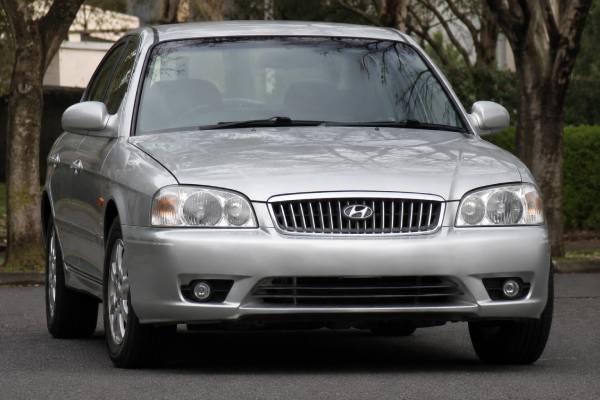
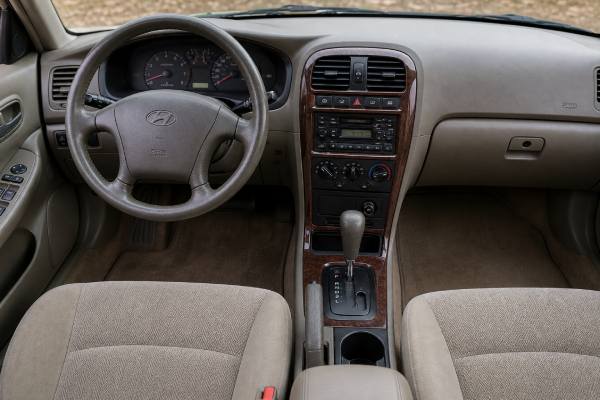
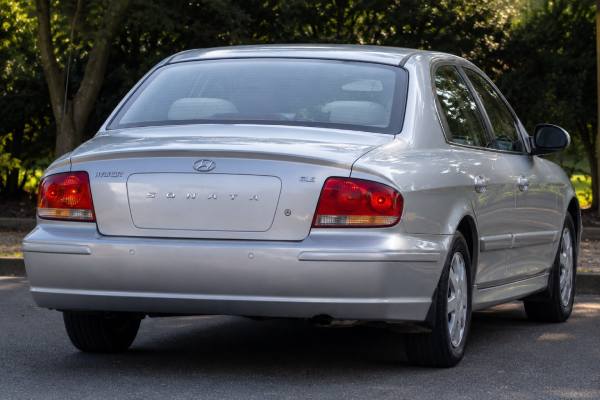
The 2000–2001 Hyundai Sonata EF with the Delta 2.5 V6 is a straightforward midsize sedan from the period when Hyundai was moving from budget-brand simplicity toward better refinement, longer warranties, and more complete safety equipment. In GLS V6 form, the Sonata offered a smooth 170 hp engine, front-wheel drive, independent suspension, generous cabin space, and comfort features that made it good value when new.
Today, the appeal is different. A clean Sonata EF V6 can still be a comfortable and inexpensive daily driver, but age matters more than mileage alone. Timing belt history, automatic transmission condition, front subframe corrosion, cooling-system health, and airbag or recall completion are the key items that separate a usable older Sonata from one that becomes uneconomical to repair.
Quick Specs and Notes
- The 2.5L Delta V6 makes 170 hp and gives the Sonata smoother, quieter power than the base four-cylinder.
- GLS V6 models typically include useful equipment such as alloy wheels, side airbags, power features, and available ABS/traction control.
- Rust, especially front subframe corrosion in salt-belt cars, is the most serious buying concern.
- Treat any undocumented timing belt as overdue; plan replacement around 60,000 miles or 96,000 km.
- Healthy V6 automatic cars are usually around 20 mpg US combined, with slightly better results from the manual.
Table of Contents
- Sonata EF V6 Core Details
- Sonata EF V6 Specs
- Sonata EF V6 Trims and Safety
- Reliability, Issues and Recalls
- Maintenance and Buying Advice
- Road Feel and Performance
- How It Compares With Rivals
Sonata EF V6 Core Details
The EF-generation Hyundai Sonata arrived as a larger, more rounded replacement for the earlier Sonata, with a stronger focus on midsize comfort. The 2000–2001 2.5 V6 version sits near the top of the range for these years, especially in GLS specification. It is not a sports sedan, but it is the version to consider if you want the smoother powertrain, better equipment, and more relaxed highway character.
The engine is Hyundai’s Delta-family 2.5-liter V6, an all-aluminum, naturally aspirated DOHC unit with 24 valves. Output is 170 hp at 6,000 rpm and 166 lb-ft of torque at 4,000 rpm, which was competitive for value-oriented midsize sedans at the time. The V6 does not have the low-rpm shove of a larger American six-cylinder, but it is smooth, willing to rev, and better suited to highway merging and loaded driving than the base four-cylinder.
Most cars in this specification are front-wheel drive. A 5-speed manual was available, while many surviving examples use the optional 4-speed automatic. The automatic is simple by modern standards, but it needs the correct SP-III type fluid and should not be judged only by whether it still moves the car. Delayed engagement, flare between shifts, dark fluid, or harsh downshifts are warning signs on a car of this age.
The Sonata EF V6 is also useful because it is conventional. There is no turbocharger, no direct injection, no dual-clutch transmission, no complex all-wheel-drive system, and no modern ADAS sensor network. For a buyer who wants an older sedan that can still be maintained by a good independent workshop, that simplicity is an advantage. Parts availability is generally reasonable, and many repairs are familiar mechanical work rather than software-heavy diagnosis.
The trade-off is age-related risk. These cars are now old enough that original rubber parts, cooling components, suspension bushings, electrical connectors, seals, brake lines, fuel lines, and interior electronics may all need attention. A low purchase price does not automatically make the car cheap to own if it needs a timing belt service, tires, brakes, struts, subframe work, and air conditioning repair at the same time.
The strongest Sonata EF V6 candidates are cars with a documented timing belt replacement, clean underside, smooth cold start, stable idle, good automatic shift quality, functioning air conditioning, no SRS warning light, and clear evidence that recalls were completed. The weakest candidates are neglected examples with unknown belt history, salt corrosion around the front cradle, overheated engines, leaking valve covers, slipping transmissions, or warning lights that the seller explains away as “just a sensor.”
As a used car, the 2000–2001 Sonata V6 makes the most sense as a low-cost commuter or second vehicle when bought on condition rather than mileage. It is comfortable, reasonably roomy, simple enough to service, and smoother than many cheap older sedans. It is not the right choice for someone who wants modern crash protection, advanced driver assistance, strong resale value, or guaranteed low repair risk.
Sonata EF V6 Specs
The figures below apply to the 2000–2001 Hyundai Sonata EF with the Delta 2.5 V6, primarily U.S.-market GLS V6 specification where applicable. Some dimensions, equipment, fluids, and service details vary by country, transmission, emissions package, wheel size, and production date, so VIN-specific verification is important before ordering parts or performing repairs.
| Item | Hyundai Sonata EF Delta 2.5 V6 |
|---|---|
| Engine family / code | Hyundai Delta 2.5 V6, commonly identified as G6BW family |
| Engine layout | 60-degree V6, 6 cylinders, DOHC, 4 valves per cylinder, 24 valves total |
| Bore × stroke | 84.0 × 75.0 mm (3.31 × 2.95 in) |
| Displacement | 2.5 L, 2,493 cc |
| Induction | Naturally aspirated |
| Fuel system | Multi-point fuel injection |
| Compression ratio | 10.0:1 |
| Max power | 170 hp (127 kW) @ 6,000 rpm |
| Max torque | 225 Nm (166 lb-ft) @ 4,000 rpm |
| Timing drive | Timing belt |
| Official fuel economy, automatic | 18 city / 25 highway / 20 combined mpg US; about 13.1 / 9.4 / 11.8 L/100 km |
| Official fuel economy, manual | 18 city / 26 highway / 21 combined mpg US; about 13.1 / 9.0 / 11.2 L/100 km |
| Real-world highway at 120 km/h | About 9.0–10.0 L/100 km (24–26 mpg US / 29–31 mpg UK) when healthy |
| Item | Specification |
|---|---|
| Manual transmission | 5-speed manual, market and trim dependent |
| Automatic transmission | 4-speed electronically controlled automatic with overdrive |
| Drive type | Front-wheel drive |
| Differential | Open front differential |
| Item | Specification |
|---|---|
| Front suspension | Independent double-wishbone layout |
| Rear suspension | Independent multi-link layout |
| Steering | Power-assisted rack and pinion |
| Brakes | Ventilated front discs; rear discs on many GLS/ABS cars, drums on some non-ABS versions |
| Popular tyre size | P205/60R15 on GLS V6; some lower trims used P195/70R14 |
| Ground clearance | Approx. 150–160 mm (5.9–6.3 in), market and tyre dependent |
| Length / width / height | 4,710 / 1,815–1,818 / 1,410 mm (185.4 / 71.4–71.6 / 55.5 in) |
| Wheelbase | 2,700 mm (106.3 in) |
| Turning circle | About 10.5 m (34.4 ft) |
| Curb weight | About 1,409 kg (3,107 lb), depending on transmission and equipment |
| GVWR | About 1,975 kg (4,354 lb), market dependent |
| Fuel tank | 65 L (17.2 US gal / 14.3 UK gal) |
| Cargo volume | About 374 L (13.2 ft³) in U.S. listings; sedan body, no practical seats-down cargo rating |
| Item | Typical figure |
|---|---|
| 0–100 km/h | About 8.8–9.8 seconds, depending on transmission, test method, and condition |
| Top speed | About 200–205 km/h (124–127 mph), market dependent |
| 100–0 km/h braking | Not consistently published; brake condition and tyre age matter more than original figures today |
| Towing capacity | Market dependent; verify the local owner’s manual and tow-equipment rating before towing |
| Payload | About 560–590 kg (1,235–1,300 lb), depending on market and equipment |
| System | Specification / capacity |
|---|---|
| Engine oil | API SH/SG-era specification or better; common grades include 5W-30, 10W-30, 10W-40 by climate; about 4.5 L (4.77 US qt) with filter |
| Coolant | Ethylene-glycol coolant suitable for aluminum engines; about 8.6 L (9.0 US qt), mixed to climate requirements |
| Automatic transmission fluid | SP-III type ATF; total capacity about 7.8 L (8.2 US qt), drain-and-fill amount lower |
| Manual transmission oil | 75W-90 API GL-4; about 2.1 L (2.2 US qt) |
| Brake fluid | DOT 3 or DOT 4 |
| Power steering fluid | PSF-3 type; about 0.95 L (1.0 US qt) |
| A/C refrigerant | R-134a system; charge amount should be verified from the under-hood label or service manual |
| A/C compressor oil | Use the compressor and service-label specification; do not fill by guesswork |
| Critical torque specs | Use factory service data by VIN; wheel, suspension, subframe, brake, and timing fasteners should not be tightened from generic charts |
| Item | 2000–2001 Sonata EF V6 notes |
|---|---|
| IIHS moderate overlap front | Acceptable for the 1999–2005 Sonata test group |
| IIHS side impact | Poor for the tested group by later IIHS side-impact standards |
| IIHS head restraints/seats | Poor |
| Airbags | Dual front airbags and front side airbags were available/standard depending on market and trim |
| ABS / traction control | Available on GLS V6 in some markets and packages |
| Modern ADAS | No AEB, adaptive cruise control, lane keeping, blind-spot monitoring, or traffic-sign assist |
Sonata EF V6 Trims and Safety
In North America, the 2.5 V6 is most closely associated with the GLS trim. The simpler Sonata trims were usually four-cylinder models, while the GLS V6 positioned the car as a value-rich midsize sedan with stronger performance and more standard comfort equipment.
Trim and equipment identifiers
A GLS V6 car should generally be identifiable by its GLS badging, 15-inch wheel package, V6 engine bay layout, and higher equipment level. The under-hood emissions label, VIN, service records, and original window sticker are better evidence than badges alone because older cars may have replacement trunk lids, swapped wheels, or missing trim pieces.
Typical GLS V6 equipment included power windows, power locks, power mirrors, air conditioning, cruise control, alloy wheels, split-folding rear seat, and upgraded interior trim. Depending on year, market, and package, options could include a power sunroof, leather seating, power driver’s seat, upgraded audio, anti-lock brakes, and traction control.
Mechanically, the most important differences are not exotic. The V6 brings the Delta engine and different front-end service access compared with the four-cylinder. GLS cars also commonly came with larger wheel and tyre packages and rear disc brakes, especially when ABS was fitted. That matters when ordering brake parts because rotor, caliper, drum, and parking-brake hardware can vary by build.
The 2000 and 2001 cars are broadly similar. Year-to-year differences are mostly equipment packaging, availability, and safety-related campaigns rather than a major mechanical redesign. The later facelifted EF Sonata would bring styling and detail changes, but the 2000–2001 cars covered here are the earlier EF shape.
Safety structure and restraints
For its era and price class, the Sonata EF offered useful safety content, including front airbags, available front side airbags, seat-belt pretensioners, child safety locks, and three-point rear seating belts. However, it should be judged as a late-1990s design, not a modern family sedan.
The IIHS moderate-overlap front result was acceptable for the tested generation, but side-impact and head-restraint results were poor by IIHS standards. This does not mean every crash outcome is poor, but it does mean the body structure, seat design, head restraints, and side-impact protection are not comparable with later midsize sedans that were engineered for tougher crash tests.
Child-seat provisions also need careful checking. Many 2000–2001 cars rely primarily on seat-belt installation and tether-anchor arrangements rather than the full later LATCH/ISOFIX setup found on newer vehicles. Anyone planning regular child-seat use should inspect the exact car, check the owner’s manual, and confirm that the seat can be installed tightly and correctly in the intended seating position.
Driver assistance and service implications
There is no modern ADAS suite on this Sonata. You will not find automatic emergency braking, adaptive cruise control, lane keeping assist, blind-spot monitoring, rear cross-traffic alert, camera calibration, radar alignment, or traffic-sign recognition. From a maintenance perspective, that keeps repairs simple. From a safety perspective, it means the driver carries the full burden of speed control, following distance, lane discipline, and hazard recognition.
ABS and traction control, when equipped, are the main active-safety systems. A functioning ABS light at key-on and then light-off after start is important. A permanently lit ABS, traction, or SRS warning light should be treated as a repair item, not a cosmetic defect. On a low-value older sedan, sellers may ignore these lights because the car still drives, but an illuminated warning light can mean the system is disabled.
After collision repair, seat removal, carpet work, or dashboard work, the SRS harness and connectors deserve special attention. Side-airbag wiring was a known campaign area on early-2000s Sonatas, so a car with an SRS light, mismatched seats, or signs of water intrusion needs proper diagnosis before purchase.
Reliability, Issues and Recalls
The Sonata EF V6 can be dependable when maintained, but its weaknesses are well-defined. The most important pattern is that many problems are age-related rather than design disasters. A well-kept car with a clean underside and documented belt service can be far better than a lower-mileage example that has sat outside, leaked coolant, missed transmission services, or lived on salted roads.
| Issue | Prevalence | Severity / cost | What to check |
|---|---|---|---|
| Timing belt age or unknown history | Common | High if it fails | Records for belt, tensioner, idlers, water pump, seals, and accessory belts |
| Front subframe corrosion | Common in salt areas | High | Lower-control-arm mounting area, front cradle seams, perforation, steering pull |
| Automatic transmission shift issues | Occasional | Medium to high | Delayed engagement, flare, harsh shifts, dark ATF, wrong fluid history |
| Valve-cover and cam/crank seal leaks | Common with age | Low to medium | Oil smell, smoke from engine bay, wet timing cover, oil on belts |
| Cooling-system deterioration | Common with age | Medium to high | Radiator tanks, hoses, thermostat, fans, water pump, overheating history |
| SRS warning light / seat airbag harness | Occasional | Medium | Airbag light behavior, seat wiring, recall completion |
| MAF wiring-related stalling | Specific recall area | Medium | Low-speed stall, harness routing, recall record |
Engine and timing belt concerns
The Delta 2.5 V6 uses a timing belt, and this is the first service item to verify. A broken belt can lead to serious internal engine damage, so an undocumented belt should be treated as overdue. On a newly purchased car, the best practice is to replace the belt, tensioner, idlers, water pump, camshaft seals, crankshaft seal, and accessory belts as a package unless there is clear recent documentation.
Oil leaks are common on older V6 cars. Valve-cover gaskets, cam seals, crank seals, and oil-pan sealing can all seep. A light misting is not unusual, but active dripping, oil on the timing belt, burning oil smell, or smoke from the exhaust area should be fixed. Leaks around the timing cover are especially important because they can shorten timing-belt life.
Misfires can come from old plugs, ignition wires, coils, vacuum leaks, or intake-related issues. The V6 uses platinum-style plugs in many applications, but age and heat cycles matter. If the intake has to come off for rear-bank access, it is wise to inspect hoses, gaskets, wiring, and coolant pipes at the same time.
Transmission and driveline issues
The automatic transmission is not especially sophisticated, but it is sensitive to fluid condition and correct fluid specification. SP-III type fluid is the key detail. Universal ATF may create shift quality problems, and a car with a long history of neglected or incorrect fluid is risky.
During a test drive, check cold engagement into Drive and Reverse, smooth light-throttle upshifts, kickdown response, and highway lockup behavior. A small amount of old-car firmness is different from flare, slip, banging shifts, or delayed movement after selection. Manual cars should be checked for clutch take-up, synchro wear, gear noise, and leaks at the axle seals.
Front-wheel-drive axle boots, wheel bearings, and engine mounts also deserve inspection. Torn CV boots can become clicking axles, weak mounts can cause clunks or vibration, and worn bearings can sound like tyre roar that changes with steering load.
Corrosion and chassis weak points
Corrosion is the most serious structural concern. The front subframe recall for salt-belt corrosion is central to any buying inspection. Road salt can attack the front cradle from the inside, especially around the forward lower-control-arm mounting area. Symptoms can include clunks, alignment changes, steering pull, unusual tyre wear, or visible perforation.
Even outside formal salt-belt regions, inspect the front cradle, rear suspension mounting points, rocker panels, brake and fuel lines, strut towers, floor seams, and jacking points. A car can look acceptable from above and still be uneconomical underneath.
Suspension wear is normal by this age. Struts, control-arm bushings, ball joints, sway-bar links, rear links, and tie-rod ends may all need renewal. These parts are not unusual repairs, but the combined cost can exceed the value of a rough car.
Recalls and service actions
Important campaigns for this era include side-airbag wiring harness concerns, a mass-airflow sensor wiring reroute on certain V6 cars, and front subframe corrosion inspection or repair in affected salt-belt vehicles. Completion should be verified by VIN, not assumed from model year alone.
Ask the seller for dealer records, recall paperwork, and repair invoices. If records are missing, use an official Hyundai or government VIN check and then confirm with a dealer if needed. A completed recall is not always the end of the inspection; for rust campaigns, the quality of the repair and the current condition of the metal still matter.
Maintenance and Buying Advice
A Sonata EF V6 is best maintained on a conservative schedule because age, heat cycles, and past neglect are bigger concerns than the original new-car service plan. The goal is not to overspend blindly; it is to prevent the small number of failures that can destroy the value of the car.
| Item | Practical interval | Notes |
|---|---|---|
| Engine oil and filter | Every 3,000–5,000 miles or 4,800–8,000 km on older cars | Use climate-appropriate viscosity; severe-use factory guidance supports shorter intervals |
| Timing belt system | Around 60,000 miles or 96,000 km; also by age | Replace belt, idlers, tensioner, water pump, seals, and accessory belts when history is unknown |
| Engine air filter | Inspect yearly; replace about every 15,000–30,000 miles | Shorten interval in dusty areas |
| Cabin / evaporator filter | Inspect yearly | Poor airflow, odor, or noisy blower may indicate restriction |
| Spark plugs | About 60,000–100,000 miles depending on plug type and condition | Use correct heat range; inspect wires and coils during service |
| Coolant | Every 2–3 years on an older vehicle | Use aluminum-compatible ethylene-glycol coolant and correct mix |
| Automatic transmission fluid | Every 30,000 miles or 48,000 km in severe use | Use SP-III type fluid; avoid unknown universal-fluid substitutions |
| Manual transmission oil | Inspect for leaks; service around 60,000–100,000 km depending on use | Use 75W-90 API GL-4 |
| Brake fluid | Every 2 years | Use DOT 3 or DOT 4; inspect calipers, hoses, lines, and rear hardware |
| Tyre rotation and alignment | Rotate every 6,000–8,000 miles; align when wear or pull appears | Uneven wear can reveal worn suspension or subframe problems |
| 12 V battery | Test yearly after 3 years; replace commonly around 4–5 years | Factory-style capacity is around 68 Ah |
Pre-purchase inspection checklist
A good inspection should start cold. Listen for rattles, misfires, belt noise, lifter noise, or exhaust leaks. Watch the temperature gauge during a long idle and road test. Check for coolant smell, oil smoke, radiator fan operation, and heater performance. A car that overheats during inspection is usually a poor candidate unless the price allows for major repairs.
Under the car, focus on rust and leaks. The front subframe, control-arm mounts, brake lines, fuel lines, rocker seams, rear suspension mounts, and jacking points are more important than small body dents. Surface rust is common; perforation, swelling seams, flaking structural metal, or fresh undercoating over crusty areas are warning signs.
Inside, confirm that every warning light illuminates at key-on and then goes out after starting. Missing warning-light bulbs or taped-over indicators are still seen on old cars. Test the air conditioning, heater blend doors, blower speeds, power windows, mirrors, locks, sunroof if fitted, radio, interior lights, and trunk release. Electrical repairs can be annoying even when the parts are cheap.
On the road, the engine should pull smoothly to higher rpm without hesitation. The automatic should shift cleanly and consistently. The steering should track straight, the brakes should stop without pulsation, and the suspension should not clunk over small bumps. A car that needs brakes, struts, tyres, a timing belt, and transmission work is rarely a bargain.
Best versions to seek
The best 2000–2001 Sonata EF V6 is a clean GLS with complete maintenance records, no structural rust, functioning ABS if equipped, cold air conditioning, no SRS light, and a documented timing belt service. A manual-transmission V6 can be appealing for simplicity and slightly better economy, but manuals are less common. An automatic is acceptable if the shift quality and fluid history are good.
Avoid cars with unknown timing belt history unless you budget for immediate service. Avoid salt-belt cars with questionable subframe condition, cars with repeated overheating, and cars with slipping automatic transmissions. Cosmetic wear is tolerable on a low-cost older sedan; structural corrosion, transmission failure, and major deferred maintenance are not.
Long-term durability is fair when the car is maintained and protected from corrosion. The engine itself can cover high mileage, but the car around it must be kept alive. At this age, buying the best-condition example is far wiser than buying the cheapest one.
Road Feel and Performance
The Sonata EF V6 drives like a comfort-biased midsize sedan, not a sharp sport model. Its best qualities are smoothness, relaxed cruising, and enough power to feel composed in normal traffic. The V6 gives the car a more mature character than the four-cylinder, especially when merging, climbing grades, or carrying passengers.
Around town, throttle response is gentle rather than aggressive. The engine is smooth at low and moderate rpm, and the automatic usually shifts early for quietness and fuel economy. Kickdown is adequate but not instant by modern standards. A healthy car should not stumble, flare, or bang into gear. If it does, the issue is more likely maintenance or wear than normal behavior.
The manual version feels livelier because it lets the driver keep the V6 in the stronger part of the rev range. The engine’s peak torque arrives at 4,000 rpm, so it is happiest when allowed to rev. Below that, it is smooth but not muscular. This is one reason the Sonata V6 feels better on open roads than in hard stop-and-go driving.
Ride comfort is generally good. The independent suspension absorbs broken pavement reasonably well, and the wheelbase gives the car decent straight-line stability. On tired original-style struts, however, the body can float, pitch, or feel loose over repeated bumps. Fresh dampers, good tyres, and tight suspension links can transform the way an old EF feels.
Handling is predictable and front-wheel-drive safe. Push hard and the car tends toward understeer, with moderate body roll and steering that is more light than communicative. It is easy to place in traffic and stable on the highway, but it does not have the precision of a contemporary Accord or the firmer European feel of a Passat. Tyres matter a great deal. Old budget tyres can make the car noisy, vague, and poor in wet braking.
Braking performance depends heavily on hardware condition. Front ventilated discs and rear discs on many GLS cars are adequate for normal use, but soft brake hoses, old fluid, worn pads, rusty rear hardware, or seized caliper slides can make the pedal feel long or uneven. A firm pedal, straight stops, and clean ABS operation are more important than any period test number today.
Real-world economy is acceptable, not exceptional. Expect roughly 13–15 L/100 km in heavy city use, about 9–10 L/100 km at steady highway speeds, and around 10.5–12.5 L/100 km mixed. In U.S. terms, that is often about 16–18 mpg city, 24–26 mpg highway, and 19–22 mpg mixed. Cold weather, short trips, old oxygen sensors, dragging brakes, underinflated tyres, and rich running can make economy noticeably worse.
Noise, vibration, and harshness are good for the price class when the car is healthy. The V6 is the highlight, with less coarse sound than the base engine. Wind and road noise are present at highway speeds, and old door seals or worn tyres can make the cabin louder. Engine mounts, exhaust flex sections, and suspension bushings also influence perceived refinement.
Towing is not the Sonata’s natural role. Even if a local manual lists a tow rating, this is an old front-wheel-drive sedan with modest cooling and braking reserves by modern standards. Light utility use may be possible with the correct equipment and local rating, but heavy towing, mountain grades, and repeated high-load use are not good matches for the car.
How It Compares With Rivals
The 2000–2001 Sonata EF V6 competed with the Toyota Camry, Honda Accord, Nissan Altima, Ford Taurus, Mazda 626, Chevrolet Malibu, and Volkswagen Passat. When new, Hyundai’s main argument was value: more equipment and warranty coverage for less money. As a used car today, that value case only works if the individual car is clean and mechanically sound.
| Rival | Where the Sonata does well | Where the rival may be stronger |
|---|---|---|
| Toyota Camry V6 | Often cheaper to buy; good equipment for the money | Better reputation, stronger resale, broader parts knowledge |
| Honda Accord V6 | Softer ride, lower entry price, simpler value appeal | Sharper handling, stronger brand support, better cabin execution |
| Nissan Altima | Smoother V6 than many four-cylinder Altimas of the era | Altima can feel lighter and more responsive |
| Ford Taurus V6 | More compact feel, simpler import-sedan layout | Taurus may be roomier and easier to source in some regions |
| Volkswagen Passat | Lower complexity, usually cheaper parts and purchase price | Passat has a more premium cabin and stronger road feel |
Against a Camry V6, the Sonata usually loses on reputation and long-term resale. The Toyota is the safer default for buyers who want the least risk, but it often costs more in similar condition. A neglected Camry is still a bad buy, though, and a well-kept Sonata can be more sensible than an overpriced Toyota with hidden rust or overdue maintenance.
Against an Accord V6, the Sonata feels softer and less athletic. The Honda has better steering response and a more polished chassis, but some Accord V6 automatics from the era have their own transmission concerns. The Sonata’s advantage is price and simplicity, provided the timing belt, rust, and transmission checks are clean.
Compared with a Passat, the Sonata is less refined inside and less composed at speed, but it is also less complex. A Passat can be more satisfying to drive, yet an older Volkswagen may bring more expensive electrical, turbo, or suspension repairs depending on engine and version. Buyers who prioritize simple ownership may prefer the Hyundai even if it is less premium.
The Ford Taurus and Chevrolet Malibu can be inexpensive alternatives with roomy cabins and widely available parts in North America. The Hyundai feels more like an import midsize sedan, with a smoother V6 than many four-cylinder competitors and a more compact driving feel than the Taurus. Rust and maintenance history still dominate the decision.
The right way to compare these old cars is not by original brochure ranking. At this age, condition beats brand hierarchy. A rust-free Sonata EF V6 with records, good tyres, fresh fluids, and a completed timing belt is a better car than a famous rival with structural rust, warning lights, and deferred maintenance. But if two cars are equally clean, the Camry and Accord generally remain safer long-term choices for parts support, resale, and crash-safety development.
The Sonata EF V6 is best for a buyer who wants a low-cost, comfortable, conventional sedan and is willing to inspect carefully. It is not the strongest car in the class, but it can still be a practical value when purchased with discipline.
References
- HYUNDAI 2001 SONATA OWNER’S MANUAL Pdf Download | ManualsLib 2001 (Owner’s Manual)
- HYUNDAI SONATA IS MIDSIZED VALUE LEADER FOR 2000 MODEL YEAR 1999 (Manufacturer Publication)
- Gas Mileage of 2001 Hyundai Sonata 2001 (Fuel Economy)
- 2001 Hyundai Sonata 2001 (Safety Rating)
- Defect Information Report 2009 (Recall Database)
Disclaimer
This article is for informational purposes only and is not a substitute for professional diagnosis, repair advice, or factory service procedures. Specifications, torque values, fluid capacities, service intervals, recall applicability, and repair steps can vary by VIN, market, production date, transmission, and equipment. Always verify details against the official service documentation and a qualified technician before buying parts or performing work.
If this guide was useful, please consider sharing it on Facebook, X/Twitter, or your preferred platform to support our work.